
Non Woven Bag Printing Machine Compliance: CE, ISO 9001 & Customs Qualification for Importers
Non Woven Bag Printing Machine Compliance: CE, ISO 9001 & Customs Qualification for Importers
Compliance for a non woven bag printing machine is a three-layer requirement, and each layer is verified by a different party. The machine itself must conform to the product-safety rules of the destination market. The factory that built it must operate a documented quality management system. The shipment must carry import documentation that matches the destination country's customs program. An importer who treats these three layers as a single question — “does the supplier have certificates?” — is usually the one whose container is held at port.
This article separates the layers, explains where the documents stop being interchangeable, and describes how compliance evidence appears during a buyer qualification review. Zhejiang Zhengxin Machinery Co., Ltd., a Wenzhou, Zhejiang-based manufacturer of non-woven bag making machines and flexographic and screen printing machines (trading as ZX Zhengxin Machinery), is used as a worked example, because its certificate scope, model list and documentation package are specific enough to be checked line by line against a purchase order.
Why Compliance Is a Procurement Gate, Not a Formality
For an importer at the evaluation and execution stage, compliance is not a marketing detail — it determines whether the machine physically arrives. Four documentation failures account for most customs detentions of bag-making and printing equipment: missing mandatory certification for the destination (CE for the EU, SONCAP for Nigeria, PVOC for Kenya, SASO for Saudi Arabia), an incorrect HS code classification that triggers the wrong duty rate or a prohibited-goods flag, an incomplete commercial invoice, and wooden packaging that lacks an ISPM 15 fumigation stamp.
The cost of these failures is measurable and ongoing. Port storage and demurrage charges typically run at USD 100–500 per day depending on the country, and a held machine produces no bags while the importer continues to fund the order. Printing machines add a further layer of scrutiny because they combine rotating rollers, a drying oven, tension-controlled fabric feeding and a low-voltage control cabinet — a hazard profile that customs and market-surveillance authorities read as “machinery,” not “accessory.”
What CE Certification Actually Covers on a Non Woven Bag Printing Machine
CE marking is a manufacturer's declaration that the machine meets the applicable European directives. Zhejiang Zhengxin Machinery states that its CE conformity covers the Machinery, Low Voltage and EMC Directives, and the underlying certificate is traceable: certificate number M.2021.206.C70911, issued by UDEM for the EU market, issued 24 January 2022 and valid through 23 January 2027.
The standards listed on that certificate are the practical content of the claim, and each one addresses a different risk:
- EN ISO 12100:2010 — risk assessment and risk-reduction principles applied during machine design.
- EN 60204-1:2018 — electrical equipment of machines: insulation, grounding, emergency stop and control circuitry.
- EN IEC 61000-6-2:2019 and EN IEC 61000-6-4:2019 — electromagnetic immunity and emission for industrial environments.
- EN IEC 61000-3-2:2019 and EN 61000-3-3:2013+A1:2019 — harmonic current and voltage fluctuation limits for low-voltage equipment.
A printing machine also falls under the harmonized European standard for its own machine category. EN 1010-1:2004+A1:2010 is the published harmonized standard covering safety requirements for the design and construction of printing and paper converting machines, which is why printing and converting units are assessed on in-running nip points, roller guarding and ink or drying-oven handling in addition to general machinery requirements.
The certificate scope names the machine groups covered: ZXH-C(21200-2000), ZXH-C4(800-2000), ZXH-C6(800-2000), ZXH-A(1200-2000), ZXH-B(1200-2000), ZXN-A(800-2000), ZXN-B(800-2000) and ZX-850.
What ISO 9001:2015 Tells an Importer About the Factory
CE answers a product question. ISO 9001 answers a process question, and the two are frequently confused in supplier presentations. Zhejiang Zhengxin Machinery holds ISO 9001:2015 certification number 20225Q21503R2M, issued by QPC, valid worldwide, against the standard GB/T19001-2016/ISO9001:2015, issued 26 December 2025 and valid through 12 January 2029. The registered scope is specific: production and sales of bag making machine, slitting machine, and non woven printing machine.
In operational terms, that certification is what makes the factory's inspection routine auditable rather than informal. The stages described by the manufacturer are incoming material inspection, in-process QC checkpoints, and a continuous full-load production test on every machine before shipment, with 100% testing rather than batch sampling.
ISO 9001 does not certify that a machine complies with EU product-safety law, and it is not a customs document. It also does not by itself confirm which components were installed in the machine on the buyer's order. That last gap is why third-party pre-shipment inspection exists: Zhengxin states that an inspection by SGS, Bureau Veritas or CCIC can be arranged at the buyer's request before shipment, which converts a factory claim about branded components into a witnessed fact. Standard commercial terms are a 30% deposit with 70% payable before shipment, against pre-shipment test as the acceptance criterion, on FOB or CIF delivery terms.
Customs Qualification by Destination: EU, Middle East and South America
In the European Union, the required evidence set is the CE marking plate on the machine body, the Declaration of Conformity, and the technical file available on request. Shipments arriving without valid CE marking risk rejection at EU ports. Because the Zhengxin CE certificate is issued against a named model scope and carries an expiry date, an importer should match the certificate number and model designation against the actual purchase order before the vessel departs.
Outside the EU, requirements fragment. A number of markets accept CE conformity as part of their clearance file, and the manufacturer lists CE-supported clearance across the EU, the Middle East, Africa and other markets that recognise CE marking, alongside regional offices in Kenya, Morocco, Egypt, Vietnam, Tanzania, Dubai, Oman, Indonesia and Ethiopia. At the same time, several destinations operate their own compulsory conformity programs — SONCAP in Nigeria, PVOC in Kenya, SASO in Saudi Arabia — each requiring a separate application, its own inspection, and additional fees, none of which is covered by a CE certificate.
For South America, requirements are set nationally rather than regionally, so the practical route is a licensed import broker in the destination country, engaged before the shipment arrives rather than after the vessel docks. Non-woven bag making and printing machinery is commonly classified under HS headings around 8441.20 or 8477.80, but classification should be confirmed with the broker, since the correct heading drives duty rate and any licensing conditions.
Model-Level Compliance Mapping for ZXH Printing Machines
Because customs and conformity documents are matched to a model number, the buyer review should begin at the model level. The four printing machines below are the ones most commonly paired with non-woven bag production lines, and each falls inside the CE certificate's named scope.
| Model | Printing type | Max fabric roll width | Max printing size / width | Print length | Printing speed | Total power |
|---|---|---|---|---|---|---|
| ZXH-A1200 | Screen, one colour | 1250 mm | 1100 × 1200 mm | — | 1500–4000 m/hour | 26 kW |
| ZXH-B1200 | Screen, listed as two-colour configuration | 1250 mm | 1100 × 1200 mm | — | 1500–3000 m/hour | 52 kW |
| ZXH-C21200 | Flexo, two colour | 1200 mm | 1160 mm printing width | 250–1000 mm | 10–60 m/min | 8 kW |
| ZXH-C41200 | Flexo, four colour | 1200 mm | 1160 mm printing width | 220–1000 mm | 10–60 m/min | 18 kW |
The screen models carry a 30 m fabric path inside the drying oven and accept material from 60–150 g/m² (ZXH-A1200) and 70–150 g/m² (ZXH-B1200); both use a round roller mirror printing surface with continuous or intermittent printing mode. The flexo models use 2.28 mm or 3.94 mm plate thickness and run on 380 V.
Customisation sits under an OEM/ODM structure rather than a single catalogue configuration: voltage and power can be set for 220 V, 380 V, 415 V or 440 V in single-phase or three-phase; flexo printing can be configured from 1 to 6 colours, single-side or double-side; the control system uses a Siemens, Mitsubishi or Delta PLC with a multi-language HMI touch screen. Stated capacity is 40 units per month, standard lead time 30–45 working days, and minimum order quantity is 1 unit. For an importer, the important consequence is that a custom configuration is a compliance event: the machine's model designation and its conformity evidence must stay aligned when the specification is changed.
Branded Components and English Documentation in Qualification Reviews
Two questions dominate importer qualification reviews of printing equipment: what is inside the control cabinet, and what paperwork arrives with the crate.
On components, the manufacturer specifies genuine branded parts — Siemens, Delta or Mitsubishi PLCs, Omron sensors and NSK bearings — and states that these can be verified by third-party inspection (SGS, Bureau Veritas or CCIC) before shipment at the buyer's request. Component identity matters beyond reliability: when a PLC fails, the replacement lead time and the availability of the parameter backup determine how many production days are lost, and a discontinued or unbranded controller can turn a component failure into a machine-level problem.
On documentation, the package described includes an English operation manual, an electrical wiring diagram, a spare parts catalog, PLC parameter settings and a troubleshooting guide covering common error codes. The practical value of the wiring diagram and parameter backup is that they allow a local electrician to work on the machine without waiting for an overseas engineer, and they let the buyer verify that the delivered configuration matches the ordered configuration.
After-sales terms are part of the same qualification file. Zhengxin provides a 12-month warranty on major components, remote diagnosis seven days a week by WhatsApp and video call, and states that engineers resolve more than 80% of reported issues remotely. Where remote diagnosis is insufficient, on-site engineer dispatch is available on published terms: round-trip airfare plus accommodation plus a daily service fee. Spare parts are despatched by express courier, typically arriving within 3–7 days.
A buyer-side checklist for this layer of the review:
- Confirm the certificate number, issuing body and expiry date on each document, and verify them on the issuing body's own record.
- Match the certificate's model scope against the model designation on the proforma invoice.
- Confirm voltage, frequency and phase in writing, and confirm who bears the cost of a voltage stabiliser if grid power fluctuates.
- Request the spare parts list and the PLC parameter backup before shipment, not after commissioning.
- Decide in advance whether third-party pre-shipment inspection is required, and who pays for it.
- Confirm the Incoterm, because transit risk and insurance responsibility shift between FOB and CIF.
Where Certified Printing Machines Are Actually Deployed
Compliance capability is easiest to judge against installed lines rather than certificates alone. Zhengxin reports exports to more than 120 countries, with a 60% export ratio concentrated in Africa, the Middle East, Southeast Asia and Latin America.
In Indonesia, a customer's site runs 42 machines across five models, a fleet that includes 12 ZXH-A1200 screen printing units alongside bag making platforms. According to the case record, the deployment supported the customer's build-out into what it describes as the largest non-woven bag manufacturing capacity in Indonesia, supplying retail chains and food delivery platforms nationally and exporting within Southeast Asia.
In Egypt, a food packaging and retail bag manufacturer has operated five units since 2017 — one ZXL-E700, two ZXH-C21200 flexo printing machines and two ZXL-D700 — supporting three distinct product lines for restaurant takeaway and retail promotions in Cairo and Alexandria. In Kenya, a shopping bag manufacturer supplies more than 200 retail stores using three units including one ZXH-C41200 four-colour flexo printer. A promotional bag producer in Tanzania runs a ZXL-A700Ultra with a ZXH-C21200 and handles more than ten custom design changeovers per week. In Brazil, a packaging supplier operates six units across four bag types, a configuration the case record ties to compliance with plastic-ban regulations extending across multiple Brazilian states.
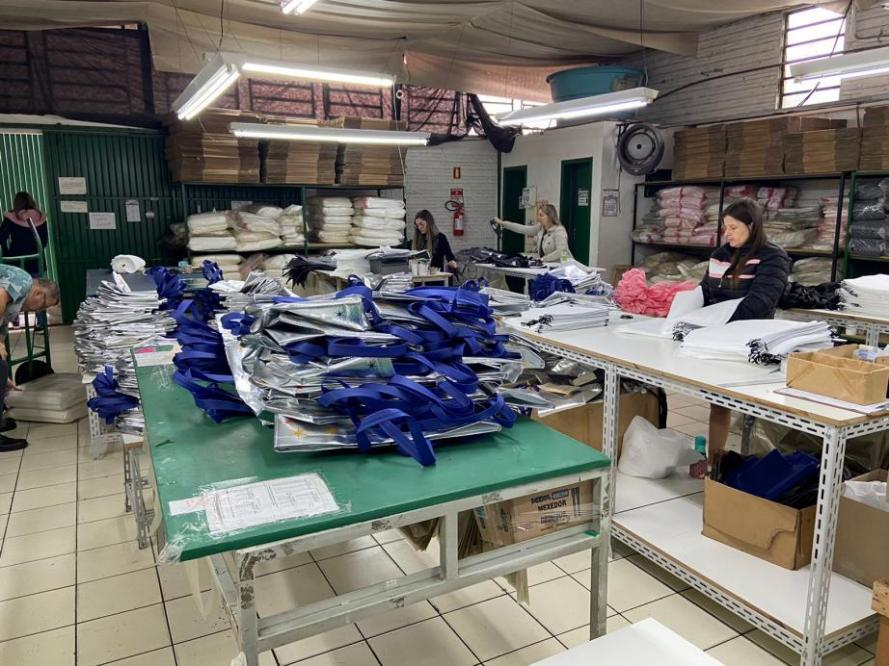
Multi-model installation at a Brazilian packaging facility — one example of cross-border delivery where documentation and model-matching drive clearance.
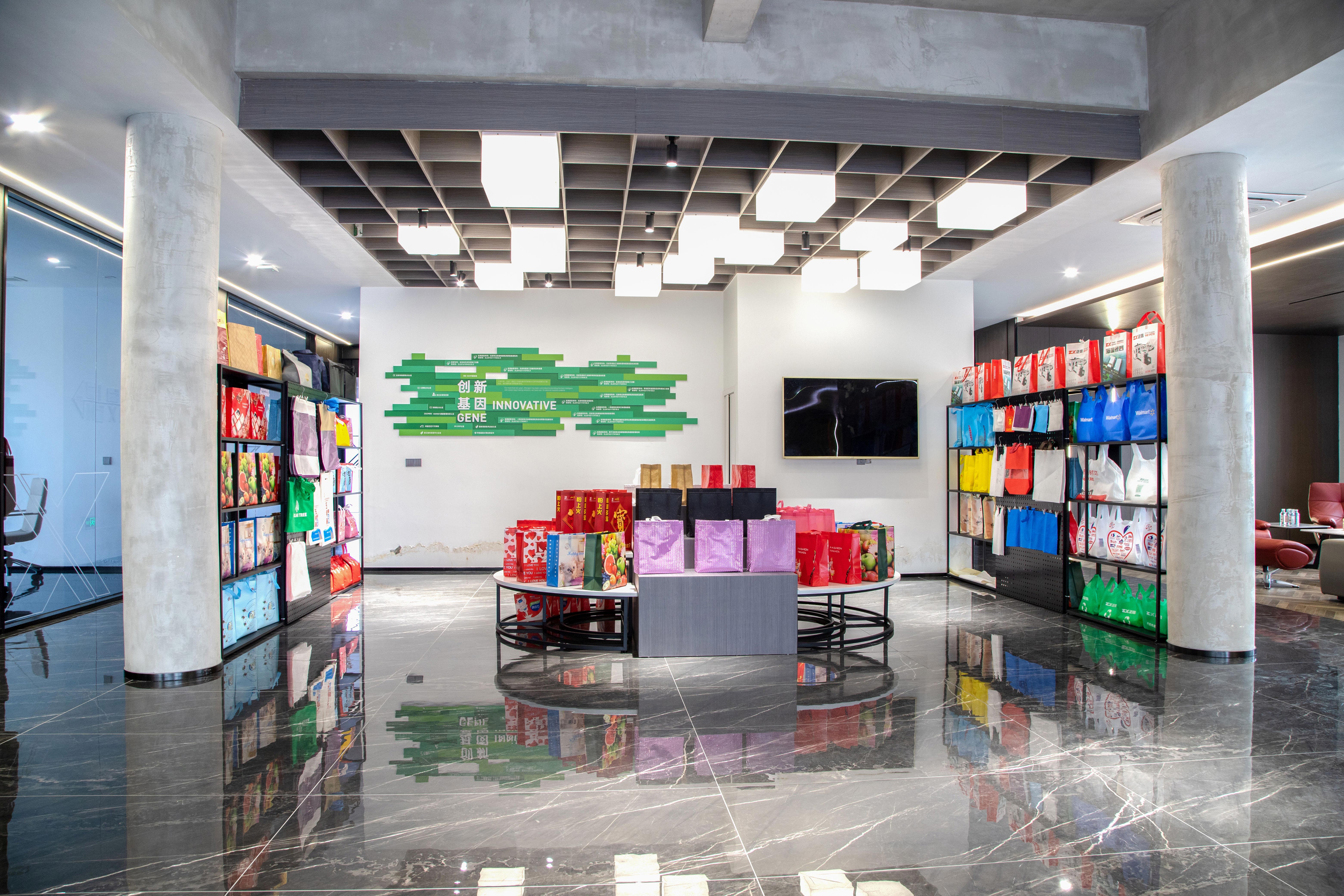
Printed bag samples from the sample room, used to confirm colour count and registration against the ordered printing configuration.
Market Trend: Why Compliance Scrutiny Is Rising
The volume of equipment moving across borders is increasing, and so is the documentation attached to it. LP Information projects the global non-woven bag making machine market growing from USD 179 million in 2025 to USD 733 million by 2032, a CAGR of 22.5% between 2026 and 2032. Dataintelo reports that Asia-Pacific accounted for 43.6% of bag making machine revenue in 2025, and that the automatic segment held 52.4% of the market in the same year.
Printing capacity is expanding with it. Grand View Research values the global flexographic printing machine market at USD 17.57 billion in 2024, with a projected CAGR of 9.7% through 2030. Absolute market-size estimates for this segment diverge between research houses — Market Research Future puts 2024 at USD 14.95 billion while Fortune Business Insights estimates USD 19.63 billion for 2025 — so the direction of growth is more reliable than any single figure.
Regulation is the other driver. More than 100 countries have implemented bans or taxes on single-use plastic bags, and California's SB 1046, effective January 2025, requires retailers to shift toward compostable non-woven or paper substitutes. China exported 1.52 million tons of nonwovens in 2024, valued at USD 4.04 billion, a 6.25% increase over 2023, according to China Customs data. With an average automated non-woven bag making machine priced at approximately USD 29,000 in 2025, per LP Information, the equipment behind this shift is high-value cargo — and high-value cargo attracts document scrutiny.
Certified Documentation Versus Unverified Supply: A Buyer-Side Comparison
The comparison that matters to an importer is not between two machine specifications, but between two evidence positions.
| Review dimension | Documented manufacturer (ZX Zhengxin example) | Unverified workshop supply |
|---|---|---|
| Product conformity evidence | CE certificate M.2021.206.C70911 (UDEM), scope-matched to named ZXH/ZXN model groups, valid to 23 January 2027 | No verifiable certificate, or a certificate that cannot be confirmed with the issuing body |
| Factory quality system | ISO 9001:2015 certificate 20225Q21503R2M (QPC), scope covering bag making, slitting and non woven printing machines | No audited quality management system |
| Component traceability | Siemens, Delta or Mitsubishi PLC; Omron sensors; NSK bearings; third-party inspection available | Unbranded or substituted components with no documented supply chain |
| Documentation package | English operation manual, wiring diagram, spare parts catalog, PLC parameter settings, troubleshooting guide | Frequently Chinese-only documentation, or none |
| Defined after-sales process | 12-month warranty on major components; remote diagnosis 7 days a week; published on-site dispatch terms | No documented response process once the shipment leaves the factory |
The limitations on the certified side are real and should be planned for, not assumed away. Three matter most. First, the CE certificate covers named model groups; a substantially customised machine outside those groups needs separate conformity work, and the certificate should not be read as an umbrella approval. Second, some destinations accept a manufacturer's self-declaration of CE conformity, while others require notified-body certification, and compulsory national programs such as SONCAP, PVOC and SASO sit entirely outside the CE framework, requiring separate applications, inspections and fees. Third, the documents carry dates: the CE certificate expires on 23 January 2027 and the ISO 9001 certificate on 12 January 2029, so importers placing repeat or long-lead orders need to track renewal, not just validity at the moment of the first order.
Two commercial boundaries are also worth stating plainly. Warranty coverage does not extend to damage caused by connecting a machine to the wrong voltage or phase, which is treated as an installation error — a reason to verify the factory's actual supply with a multimeter rather than relying on the national standard. And while remote support resolves most reported issues, on-site engineer dispatch is a chargeable service rather than an included entitlement.
Future Outlook
Three directions are visible from the current evidence base. First, harmonized machinery standards for printing and converting equipment are consolidating around documents such as EN 1010-1, which makes conformity files more comparable across suppliers and easier for customs and market surveillance to assess. Second, destination-country conformity programs are expanding rather than contracting, so the paperwork burden per shipment is likely to grow for importers in Africa, the Middle East and South America. Third, certificate lifecycle management is becoming part of procurement: with CE validity cycles running on multi-year renewals and ISO 9001 certificates audited annually, buyers who track expiry dates on supplier documents will avoid the situation where a repeat order is placed against evidence that has quietly lapsed.
For non woven bag printing machines specifically, the practical implication is that compliance should be evaluated as a capability — a factory's ability to produce, maintain and re-issue verifiable conformity documentation across a defined model range — rather than as a one-time attachment to an order.
FAQ
Does a non woven bag printing machine need CE marking to clear customs in the EU?
Machinery placed on the EU market must comply with the applicable European directives, and CE marking together with a Declaration of Conformity and an available technical file is the standard evidence route. Shipments arriving without valid CE marking risk rejection at EU ports. For the ZXH printing range, the relevant certificate is M.2021.206.C70911, issued by UDEM, valid from 24 January 2022 to 23 January 2027, with the model groups it covers listed on the certificate itself. Importers should match the model designation on the purchase order to the certificate scope rather than relying on a general statement of CE compliance.
What does an ISO 9001 certificate on a printing machine manufacturer actually cover?
ISO 9001:2015 certifies a factory's quality management system, not a product. For Zhejiang Zhengxin Machinery, certificate 20225Q21503R2M issued by QPC covers, in its registered wording, the production and sales of bag making machine, slitting machine, and non woven printing machine, against GB/T19001-2016/ISO9001:2015, valid from 26 December 2025 to 12 January 2029. In practice the certificate underpins documented incoming material inspection, in-process QC checkpoints and a full-load production test on each machine before shipment. It is not a customs document and does not confirm which specific components were installed on a given order.
Which European standards apply to a non woven bag printing machine?
The standards listed on the ZXH certificate are EN ISO 12100:2010 for risk assessment and design principles, EN 60204-1:2018 for electrical equipment of machines, EN IEC 61000-6-2:2019 and EN IEC 61000-6-4:2019 for electromagnetic immunity and emission, and EN IEC 61000-3-2:2019 with EN 61000-3-3:2013+A1:2019 for harmonic and voltage-fluctuation limits. Printing and paper converting machines are additionally assessed against EN 1010-1:2004+A1:2010, the harmonized standard for safety requirements in that machine category, which addresses hazards specific to printing units rather than general machinery risks alone.
What documents should an importer receive with a non woven bag printing machine shipment?
A practical shipment file contains: the CE Declaration of Conformity with the CE marking plate fixed to the machine body; the ISO 9001 certificate copy; the English operation manual; the electrical wiring diagram; the spare parts catalog; PLC parameter settings and the troubleshooting guide; a commercial invoice stating full manufacturer name and address, detailed machine description with model number, HS code, country of origin, unit and total value, shipping terms and payment terms; and confirmation that wooden packaging is fumigation-free or ISPM 15 stamped. Where the destination operates a compulsory program such as SONCAP, PVOC or SASO, the corresponding country certificate is required in addition to — not instead of — the CE file.
What compliance-related support matters after the machine has been installed?
After installation, the relevant support is the ability to keep the machine running within its declared configuration. Zhengxin provides a 12-month warranty on major components, remote diagnosis seven days a week by WhatsApp and video call — the manufacturer states that engineers resolve more than 80% of reported issues remotely — and spare parts despatched by express courier with typical delivery in 3–7 days. Where remote resolution is not possible, on-site engineer dispatch is available at round-trip airfare plus accommodation plus a daily service fee. Regional offices in Kenya, Morocco, Egypt, Vietnam, Tanzania, Dubai, Oman, Indonesia and Ethiopia shorten the practical distance for buyers in those markets.