
Non Woven Bag Making Machine Suppliers: A Long-Term Evaluation Framework
More than 140 countries had enacted legislation restricting or banning single-use plastic bags as of 2026 — a policy wave that has moved the non woven bag making machine from a niche converting asset into mainstream packaging infrastructure. LP Information projects the specialized global market for these machines to grow from USD 179 million in 2025 to USD 733 million by 2032, while Dataintelo valued the broader bag making machine market at USD 4.8 billion in 2025, with Asia Pacific holding a 43.6% revenue share and automatic machines accounting for 52.4% of the product-type market.
Rising volume explains why more buyers are entering the category. It does not explain why so many of them evaluate a supplier as though the decision ends on delivery day. This article sets out a structured framework for judging whether a non woven bag machine supplier will still be a usable partner in year six — using specification transparency, material and mass data, automation architecture, scenario fit, and post-sale continuity as the five checkable dimensions.
Why the First Purchase Is the Wrong Evaluation Unit
A non woven bag making machine is quoted, produced, and shipped inside a compressed window. Zhejiang Zhengxin Machinery Co., Ltd. — a non woven bag making machine manufacturer based in Wenzhou, Zhejiang, China, founded in 2014, operating a 60,000 m² facility with around 200 employees and an annual output of 500 units — publishes a standard production lead time of 30–45 days and a one-year warranty on major components. The buyer, meanwhile, is making a five-to-ten-year commitment to a steel frame, a control system, a spare parts supply chain, and a technical support relationship.
That asymmetry produces three failure modes that almost never appear in the first twelve months:
- Untested build assumptions. Frame stiffness, steel grade, and component sizing are accepted on the strength of a photograph rather than a documented mass and material specification.
- Incomplete documentation. Power draw, voltage, air demand, footprint, and weight are discovered after the machine lands, during foundation work, container planning, or electrical connection.
- Unverified automation components. A control system built on components that are no longer in production becomes a repair problem four years earlier than expected.
Each of these is checkable before the purchase order. None of them requires hindsight.
A Five-Dimension Supplier Evaluation Framework
The framework below converts a vague question — "is this supplier reliable?" — into five questions with evidence requirements attached.
| Dimension | Evaluation question | Evidence to request |
|---|---|---|
| 1. Structural build and material options | Which steel grades are offered, and what is the documented machine mass? | Parameter sheet listing net weight, overall dimensions, and material of construction |
| 2. Specification transparency | Are power, voltage, air demand, and footprint stated in writing? | Complete parameter list: total power (kW), voltage and frequency, dimensions, weight, GSM range |
| 3. Automation architecture | Which PLC, sensor, and drive brands are used, and are those models still in production? | Named component brands, HMI language options, third-party inspection report (SGS, Bureau Veritas, or CCIC) |
| 4. Application fit | Does the configuration match the actual bag style, material, and production rhythm? | Scenario documentation with working conditions, matched equipment list, and reference configurations |
| 5. Post-sale continuity | What happens in year three when a sensor fails? | Warranty scope, recommended spare parts kit, parts shipping terms, remote support terms, on-site dispatch terms |
Dimension 1 — Steel Options and Structural Mass as Build Evidence
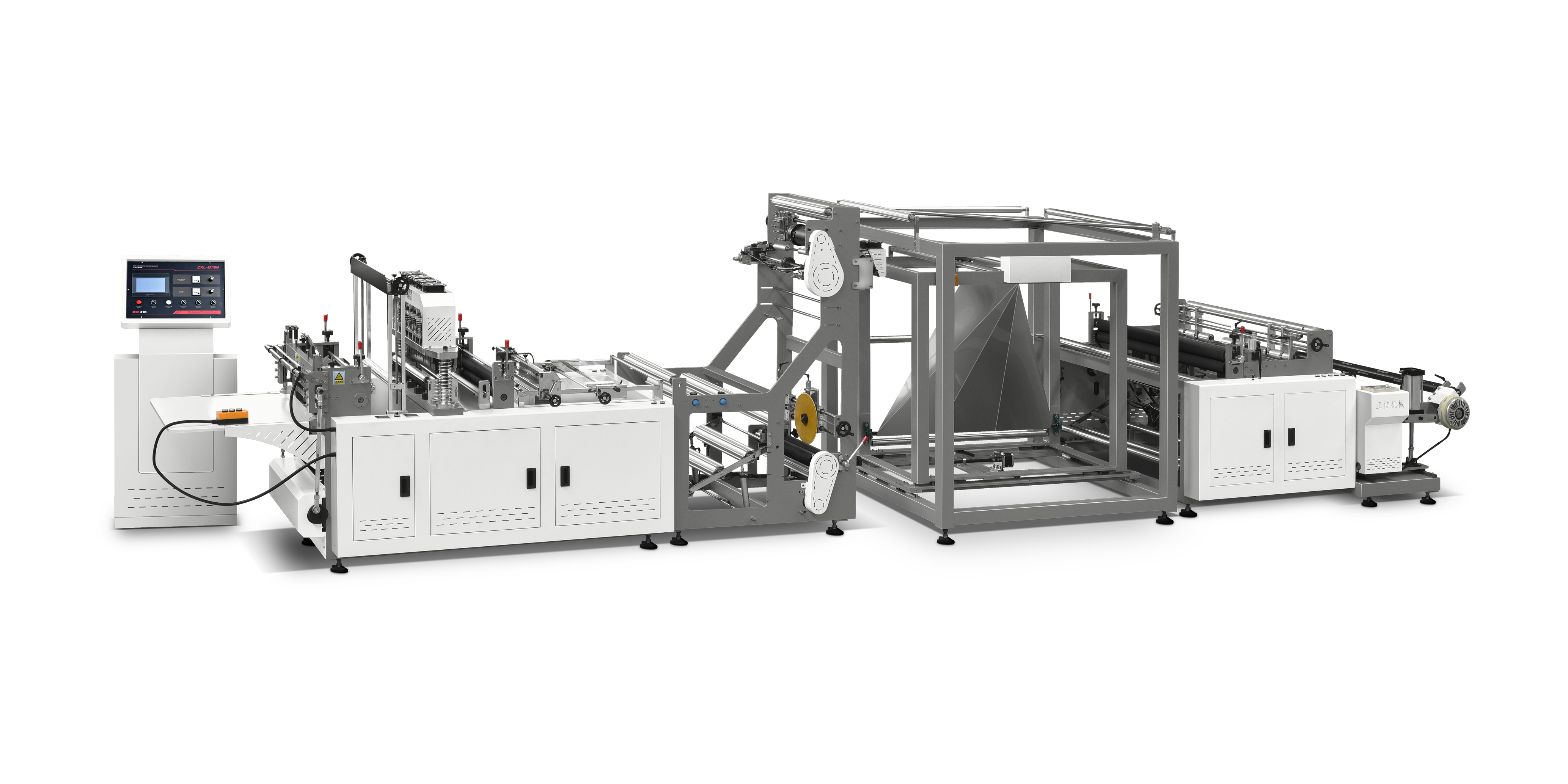
Zhengxin's machine range is documented as being constructed from carbon steel, stainless steel, or alloy steel, and the lineup publishes net weights that vary far more than the bag styles suggest. Within the same manufacturer, the ZXL-B700 is listed at 2,200 kg with 12 kW total power, the ZXL-A700 at 2,900 kg with 15 kW, the ZXL-D700 at 3,200 kg, the ZXL-E700 at 4,000 kg with 18 kW, and the ZXL-G700 at 4,200 kg. The 3D box bag platform sits in a different class entirely: the ZX-LT500 is listed at 9,500 kg with 50 kW, the ZX-LT500Pro at 10,000 kg with 60 kW, and the ZX-LT500V at 12,000 kg with 50 kW.
Within a given class, a documented mass figure is one of the few build-quality signals a buyer can compare across suppliers without disassembling anything. A machine rated at 12 kW and 40–120 pcs/min that weighs 2,200 kg on a footprint of 8,000 × 2,050 × 1,900 mm has more steel in it than a machine of the same output class whose weight is left off the datasheet. Mass resists vibration; vibration is what gradually degrades seal consistency, cut accuracy, and photoelectric tracking alignment over thousands of operating hours.
Dimension 2 — Documentation Transparency on Power and Weight
The single most common cause of avoidable cost in this category is a specification conversation that happened verbally. Total power across the Zhengxin lineup alone spans 12 kW to 60 kW — from the ZXL-B700 at 12 kW to the ZX-LT500Pro at 60 kW — which changes transformer sizing, voltage stabilizer capacity, generator requirements, and per-shift energy cost. Weight across the same lineup spans 2,200 kg to 12,000 kg, which changes container planning, crane capacity, and floor preparation.
Voltage is the higher-stakes item. Zhengxin machines are commonly configured at 380V/220V, with the 3D box bag platform listed at 380V/50Hz. The company's OEM and ODM capability covers voltage and power configuration across 220V, 380V, 415V, and 440V, in single-phase or three-phase form. All industrial bag machines in this class require a three-phase supply. A machine connected to the wrong voltage or phase can destroy the PLC, servo drives, and motors, and that damage is treated as user error rather than warranty coverage.
A buyer evaluating a supplier over a long horizon should therefore require, in writing and before order confirmation:
- Fabric roll width range, production speed, bag height and width range, and material GSM range.
- Voltage, frequency, and phase, matched to the actual factory supply rather than the national standard on paper.
- Total power in kW, plus air pressure and air flow requirement where the model uses pneumatics.
- Overall dimensions and net weight, for freight, foundation, and floor layout planning.
- Material of construction and the declared component brands.
- Certification documents: CE Declaration of Conformity and the ISO 9001:2015 factory certificate.
Zhengxin's facility holds ISO 9001:2015 certification and its machines carry CE marking covering the Machinery Directive, the Low Voltage Directive, and the EMC Directive. Third-party pre-shipment inspection by SGS, Bureau Veritas, or CCIC can be arranged at the buyer's request, which converts a claim about the machine into a documented observation about that specific unit.
Dimension 3 — Automation Reliability: PLC, Photoelectric Tracking, and Ultrasonic Sealing
Automation architecture determines how the machine behaves in year four, not how it performs on the demonstration day. Three elements carry most of that weight.
Control platform and component traceability
Zhengxin machines are documented as using Siemens, Delta, or Mitsubishi PLCs, Omron sensors, and NSK bearings, with a PLC and touchscreen HMI as the operating interface. HMI language options are configurable. The long-term implication is straightforward: the more widely used the component, the more likely a replacement exists quickly when it fails. A PLC brand that has been discontinued turns a two-day repair into a multi-week sourcing problem.
Photoelectric tracking and registration
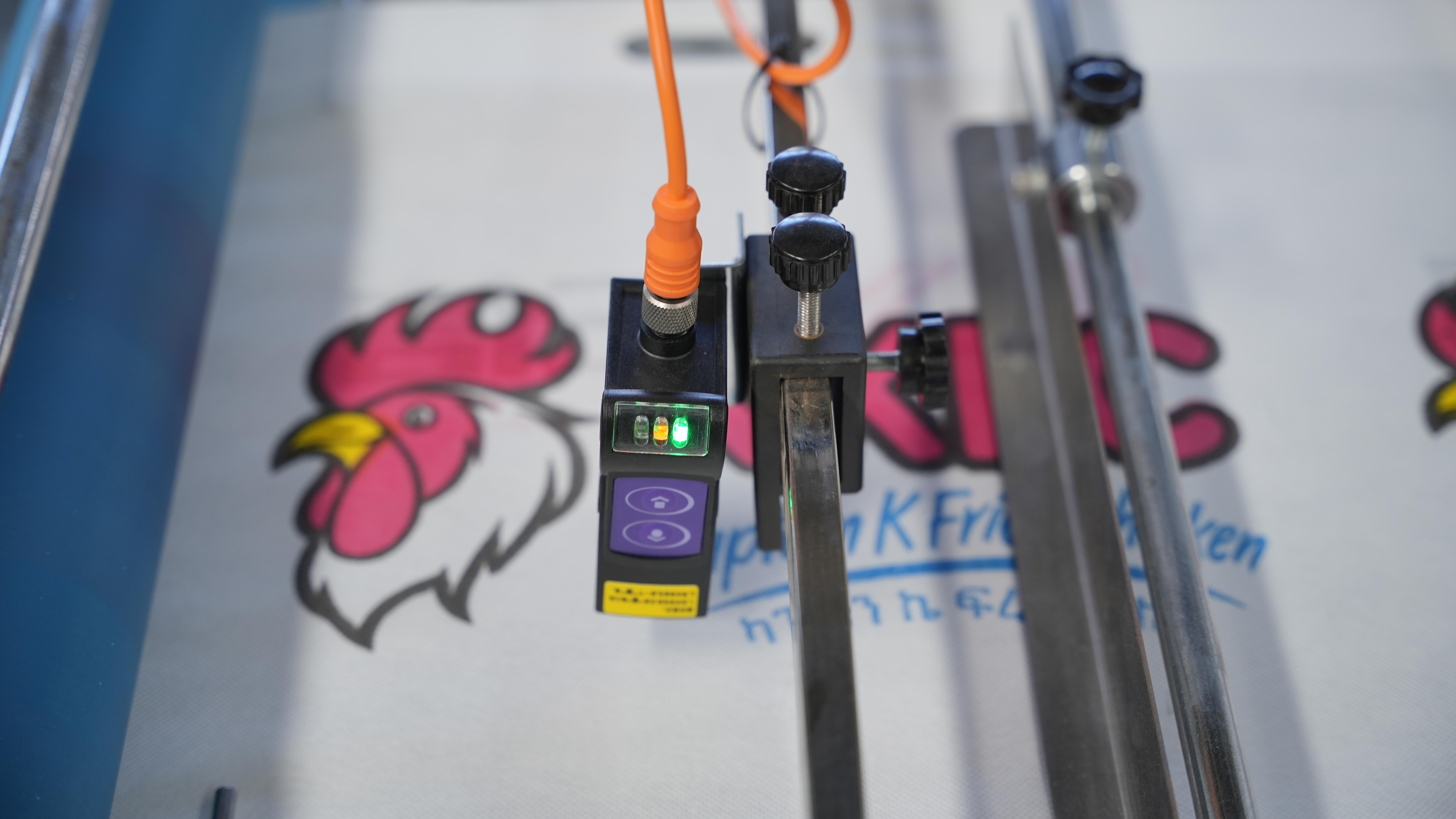
The ZXL-B700 uses a stepping motor and PLC system with a colour tracking sensor rated for 4,000–5,000 non woven bags per hour, an automatic stop when material runs out, a magnetic powder tension controller for stable fabric tension, and a buffer swing arm that synchronises discharge with the embossing mould and cold blades. The ZXL-G700 adds photoelectric tracking with an automatic computer-controlled edge-guiding system. The ZXL-D700 uses an optical sensor positioning system for precise cutting of printed bags.
These are not marketing features; they are the mechanisms that decide how much printed fabric is wasted when a sensor drifts. A registration error on a printed roll consumes material at production speed, and calibration drift is one of the most common maintenance tasks in daily operation.
Sealing method and consumable load
Ultrasonic welding removes needle and thread entirely from the process. The documented benefits are lower maintenance frequency, sealed seams that resist fraying and curling, and a consistent weld line — and on material-thrift models such as the ZXL-A700Ultra and ZXL-E700Ultra, a no-waste-edge design that the manufacturer states saves approximately 5% on raw material procurement cost. Fewer mechanical consumables means fewer scheduled interventions per thousand bags, which is precisely the variable that determines whether a machine is still economical in year five.
Dimension 4 — Application Fit: Matching Configuration to Scenario
Long-term viability also depends on whether the configuration still fits the business in year three. The published scenario data for this machine category is specific enough to be used as a specification reference rather than a sales narrative.
| Production scenario | Documented requirements | Matched configuration |
|---|---|---|
| Retail, supermarket and grocery chain | Indoor factory, 380V three-phase, 15–35 °C, moderate humidity; fully automatic 24/7 operation from feeding to stacking; at least 100 pcs/min; defect rate below 0.5% | ZXL-A700 class machine; supporting equipment: air compressor, flexo printing unit, automatic counting and bundling machine, voltage stabilizer |
| Garment, fashion retail and apparel manufacturing | Indoor clean workshop, 20–30 °C, 220V/380V; 16-hour double shift with 1–2 operators per machine; anti-static material compatibility and wrinkle-free bag surface | ZXL-A700 or ZXL-A700Ultra; supporting equipment: flexo printing unit, folding conveyor belt, automatic handle punching and attaching unit |
| Food delivery and takeaway service | Dust-free workshop with positive air pressure, 20–28 °C; 24/7 operation with automated stacking and batch coding; odorless, non-toxic water-based ink printing | ZX-LT500 family box bag platform; supporting equipment: automatic counting and bundling machine, inkjet date coder |
| Advertising, promotional products and corporate gifts | Standard factory, 380V power, flexible workstation layout; small-to-medium batches with quick job changeover; print registration accuracy of ±0.3 mm | Multi-colour flexo printing station (4+ colours), die-cutting unit, handle attaching machine, grommet punching unit |
Two points matter for evaluation. First, scenario fit is not the same as model tier — a mid-range platform correctly configured for a supermarket line outperforms a higher-specification machine aimed at the wrong bag style. Second, the machine is only one line item: the retail scenario above explicitly requires an air compressor, a printing unit, a counting and bundling machine, and a voltage stabilizer alongside the bag machine. Auxiliary equipment that is under-specified relative to the scenario is one of the more expensive long-term mistakes, because it degrades bag consistency in ways the main machine cannot compensate for.
Where a manufacturer offers over twenty bag types across a single platform — including vest bags, drawstring bags, 3D and box bags, D-cut and flat bags — the configuration conversation should be anchored to the specific bag the buyer intends to sell, not to the total count of possible outputs.
Dimension 5 — Post-Sale Continuity: The Part That Is Hard to Retrofit
Every other dimension on this list can be fixed before shipment. Support infrastructure cannot be retrofitted into a relationship that was never built.
Documented support components for Zhengxin include a one-year warranty on major components, installation and commissioning services, on-site service by a professional technical team, and remote support available seven days a week via WhatsApp and video call — through which the manufacturer states its engineers diagnose and resolve more than 80% of issues. The company maintains offices in Kenya, Morocco, Egypt, Vietnam, Tanzania, Dubai, Oman, Indonesia, and Ethiopia, and its machines have been exported to over 120 countries across Southeast Asia, Africa, the Middle East, South America, and Eastern Europe.
Multi-year reference deployments published by the manufacturer illustrate how this plays out operationally:
- Egypt: five units (ZXL-E700 ×1, ZXH-C21200 ×2, ZXL-D700 ×2) running since 2017 — nine years — supporting three distinct product lines from a single supplier, which the client describes as reducing procurement and maintenance complexity.
- Indonesia: 42 units across five models (ZX-LT500 ×8, ZXL-E700 ×13, ZXL-A700 ×7, ZXH-A1200 ×12, ZXL-G700 ×2) installed since 2018, spanning box bag, five-type bag, mid-volume and heavy-format production.
- Brazil: six units across four models since 2018, where interchangeable spare parts across models and a single training session covering all machine types reduced the burden of running a diversified line.
- Kenya: three units in service since 2023, supplying over 200 retail stores.
- Tanzania: a two-machine installation expanded from one to two production lines within 18 months.
These figures are supplier-reported reference deployments. Their value in an evaluation is not as proof of performance but as a verification checklist: a long-tenured reference customer in a comparable market is contactable, and their answer about parts availability and response time is more informative than any datasheet.
What the Market Data Says About the Next Five Years
Forecast divergence in this category is itself a signal. General bag making machinery forecasts cluster near 6% annual growth, while non-woven-specific machine forecasts exceed 20% — LP Information places the CAGR for non woven bag making machines at 22.5% between 2026 and 2032, driven substantially by plastic ban policies. Dataintelo recorded automatic machines at 52.4% of the product-type market in 2025, and Asia Pacific at 43.6% of revenue.
On the material side, spunbonded nonwovens accounted for 37% of China's nonwoven export value in 2024, which indicates a mature and competitive upstream supply chain for the fabric these machines convert. LP Information also estimates an average unit price of approximately USD 29,000 for a non woven bag making machine in 2025 — a figure published with medium confidence and best treated as a planning reference rather than a quotation.
The practical implication for buyers is that a machine purchased in 2026 is likely to be expanded, redeployed, or resold well inside the forecast window. That raises the value of two things that have nothing to do with purchase price: complete documentation, and a component architecture that can still be serviced.
Limitations and Where This Framework Does Not Apply
- Mass is a proxy, not a verdict. A documented weight tells you something about structural steel; it says nothing about bearing quality, weld inspection, or control tuning. It must be paired with material grade, named components, and factory test evidence.
- Material-saving technology has a volume threshold. The no-waste-edge design carries a price premium, and its payback depends on daily fabric consumption. At low startup volumes, the payback period extends well beyond three years, and the same capital may be better deployed on a printing unit that generates revenue immediately.
- Semi-automatic machines are not obsolete. For daily output below roughly 10,000 bags with frequent style changeovers, a semi-automatic machine can still be the rational choice; the framework above is written for buyers operating at higher, more continuous volumes.
- 3D box bag platforms are niche equipment. A 9,500–12,000 kg, 50–60 kW vertical-folding machine is not a general-purpose substitute for a flat or vest bag line.
- Voltage misconfiguration is not a warranty event. If the machine is built for a voltage the factory cannot supply, the resulting damage sits with the buyer.
- On-site engineer dispatch carries defined costs beyond warranty coverage, and reference deployments cited by any manufacturer should be independently verified.
Future Outlook
Three shifts are likely to define supplier selection through 2032. First, compliance is becoming a procurement filter rather than a formality: with more than 140 countries legislating against single-use plastic bags, destination-market certification documentation is increasingly what determines whether a machine clears customs at all. Second, automation share keeps rising — already above half the market by product type — which means the evaluation conversation will migrate further toward control architecture, component traceability, and remote diagnostics. Third, as the non-woven machinery segment outgrows general bag machinery by a wide margin, the supplier landscape will consolidate around manufacturers that can document their machines, service them across borders, and keep spare parts available for a decade rather than a warranty period.
For buyers, the discipline is the same in all three cases: evaluate the supplier against the ownership horizon, not the delivery date.
Frequently Asked Questions
What does a five-to-ten-year supplier evaluation actually assess?
It assesses five things, each verifiable before the order: the structural build and material options offered; the completeness of written specifications covering power, voltage, weight, and footprint; the automation architecture and whether its component brands remain in production; whether the configuration genuinely fits the intended bag style, material, and production rhythm; and post-sale continuity — warranty scope, spare parts availability, remote diagnostic support, and on-site service terms. Purchase price and delivery lead time are relevant, but they are the shortest-lived inputs in the decision.
Which specifications should be confirmed in writing before ordering a non woven bag making machine?
Fabric roll width range, production speed, bag height and width range, material GSM range, voltage and frequency, total power in kW, overall dimensions, net weight, and material of construction. As a concrete reference, the ZXL-B700 is documented at a 500–1,300 mm fabric roll width, 40–120 pcs/min, 200–580 mm bag height, 100–800 mm bag width, 30–120 g/m² material thickness, 380V/220V, 12 kW total power, 8,000 × 2,050 × 1,900 mm dimensions, 2,200 kg net weight, and carbon steel, stainless steel, or alloy steel construction. Certification documents — CE Declaration of Conformity and the ISO 9001:2015 factory certificate — should be supplied alongside the parameter sheet.
Is a heavier machine always a better machine?
No. Within one machine class, a documented net weight is a reasonable indicator of structural steel content and vibration resistance, which affects long-term seal consistency and cut accuracy. Across classes, weight reflects a different machine rather than a better one: a 2,200 kg ZXL-B700 and a 12,000 kg ZX-LT500V are built for different bag types, material thickness ranges, and power loads. Heavier machines also increase freight, rigging, and floor-loading requirements, so mass should be read together with material grade, component brands, and factory test documentation.
Which configuration suits a supermarket shopping bag production scenario?
The published scenario requirement for retail, supermarket and grocery chain production is an indoor factory with 380V three-phase power, ambient temperature between 15 °C and 35 °C, moderate humidity, fully automated 24/7 operation from raw material feeding to finished bag stacking, a production speed of at least 100 pieces per minute, and a defect rate below 0.5%. A complete line at that specification includes an air compressor, a flexo printing unit, an automatic counting and bundling machine, and a voltage stabilizer. The ZXL-A700 class of machine is documented as being used in this scenario for high-volume production of shopping bags with single- or multi-colour printed logos.
What support should exist after the first year?
Warranty coverage on major components typically spans one year, so continuity beyond that depends on parts and diagnostics. Buyers should confirm whether the PLC, sensor, and drive brands used are still in active production; whether a recommended spare parts kit is offered with the machine; how quickly a replacement component can be shipped; whether remote video diagnosis is available and within what response window; and what the terms are for on-site engineer dispatch, including the service fee, airfare, and accommodation arrangements. Documentation matters here too — an English operation manual, wiring diagram, and parameter backup are what allow a local technician to resolve routine faults without waiting for a dispatched engineer.
How does voltage documentation reduce ownership risk?
Machines in this category must be configured for the destination market's voltage, frequency, and phase before production. Documented configuration options include 220V, 380V, 415V, and 440V, and all industrial bag machines of this type require a three-phase supply. Connecting a machine to a voltage or phase it was not built for can destroy the PLC, servo drives, and motors instantly, and that damage is normally classified as user error rather than a warranty claim. Where grid quality fluctuates, a voltage stabilizer is recommended between the supply and the machine. The voltage clause therefore belongs in the contract, not in the installation week.
For readers who want the full model and parameter listing referenced in this framework, the Zhengxin Machinery product brochure is available here: Non Woven Bag Making Machine Brochure (PDF).
¿Tiene preguntas o necesita más detalles?
Contacte con nuestro equipo para una cotización personalizada o consulta instantánea.
Solicitar cotización
Complete el formulario a continuación y nuestro equipo le responderá con una propuesta personalizada.
Chat directo de WhatsApp
¿Prefiere chatear en tiempo real? Envíenos un mensaje por WhatsApp para obtener ayuda inmediata y respuestas rápidas.
- Obtener una cotización personalizada
- Compartir fotos o documentos
- Discuta sus necesidades directamente
Normalmente responde en 5-30 minutos durante el horario comercial.