
Non-Dairy Creamer Capability: Evidence from Cograin's Plant
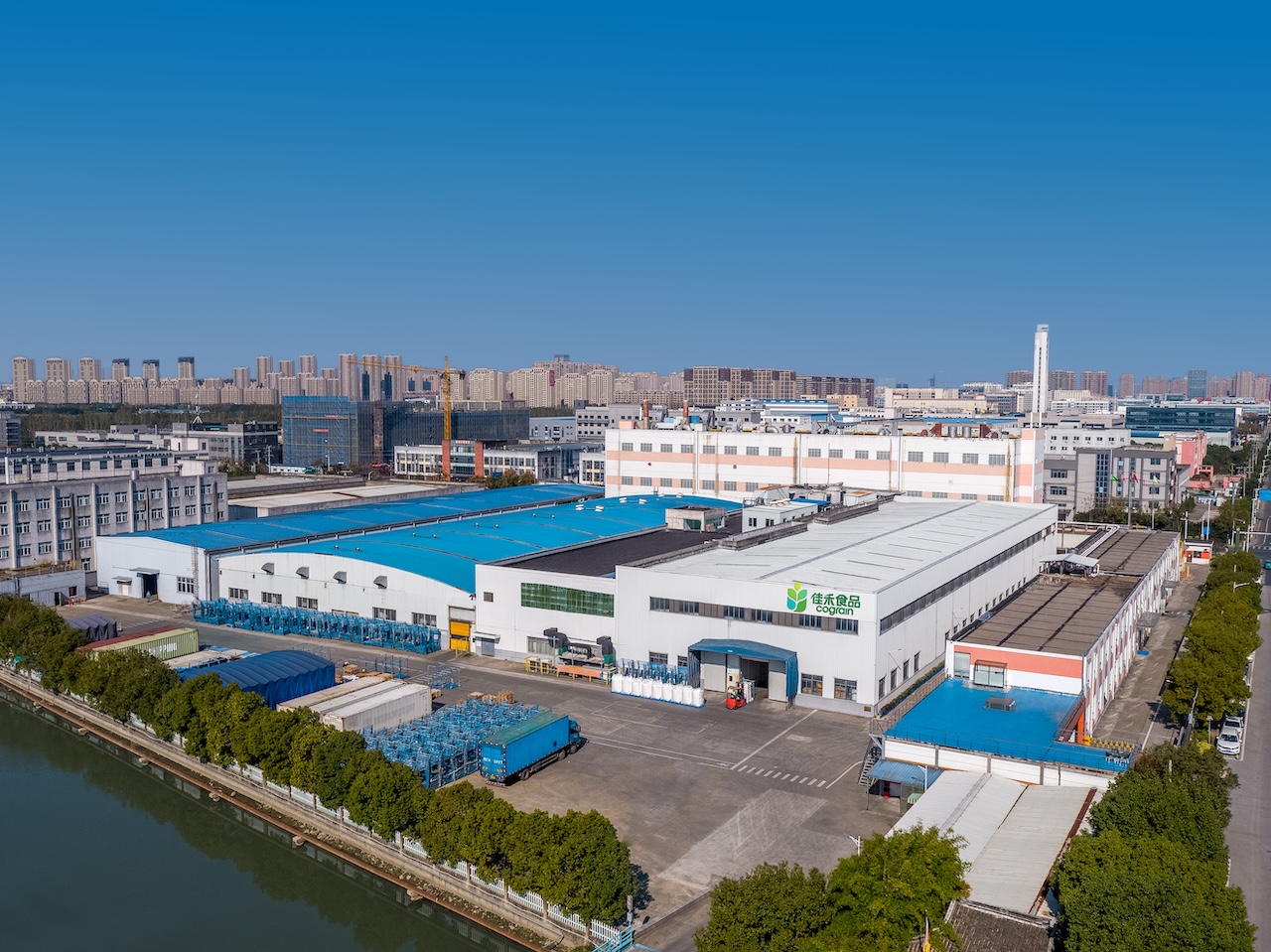
Jiahe Foods Industry operates three production bases and five factories across Suzhou, Nantong and Singapore. Image: Jiahe Foods Industry Co., Ltd.
Non-dairy creamer is no longer a substitute category. The global non-dairy creamer market was valued at USD 2.4 billion in 2024 and is projected to reach USD 4.4 billion by 2034, according to Future Market Insights, and powdered formats account for 68.4% of that market because they store and ship well. Coffee remains the largest single demand segment at roughly 41% of global utilization, while medium-fat variants containing between 21% and 50% fat hold an estimated 43.6% to 46% share of the category.
For a buyer in the research and evaluation stage, that market-level picture is useful but not decisive. The decisive question is narrower: can the supplier document what is actually inside the bag? Fat content, protein content, moisture ceiling, ingredient architecture, certificate numbers, certificate scope and commercial terms all determine whether a creamer model fits a specific coffee blend, milk tea base, bakery system or feed formulation. The review below examines that documentary layer for Cograin, the non-dairy creamer brand supplied by Jiahe Foods Industry Co., Ltd., a Chinese food ingredient manufacturer headquartered in Suzhou, Jiangsu Province. It is based on the manufacturer's published product specifications, certification records and capacity data, and it deliberately separates what is evidenced from what still has to be verified by the buyer.
Why constraint evidence decides supplier screening
Sourcing non-dairy creamer in 2026 is less about finding a supplier and more about filtering one out. Procurement teams generally screen three constraint layers, and each one has a different failure mode.
Nutritional and functional parameters. Fat content drives mouthfeel and body; protein content determines whether a creamer can foam or build structure; moisture ceilings affect flowability and shelf stability. A model that reads well in a marketing summary can still fail a formulation trial because its fat-to-protein ratio was designed for a different application.
Certification scope and validity. The most common documentation gap is a supplier that answers "we are certified" without naming the model, the certificate number, the issuing body or the validity window. Certificate scope matters: a certificate issued to one legal entity or one production site does not automatically extend to every product that leaves a group's other factories. Validity windows matter just as much, because certificates expire on fixed dates regardless of how the product performs.
Regulatory labeling nuances. Two rules frequently surprise buyers. Under U.S. FDA rules, a product containing milk derivatives such as sodium caseinate may still carry the term non-dairy, provided the derivative is declared as a milk derivative on the label. Separately, kosher authorities treat a non-dairy creamer containing sodium caseinate as dairy for certification purposes, which is why such products are certified as kosher dairy rather than pareve. Neither rule is a defect. Both mean that a dairy-free positioning claim must be verified against the formulation, not against the phrase on the front of the pack.
This is the practical value of a specification-led capability review: it converts plant-scale claims into the constraint-level evidence that a technical buyer can actually act on.
The production platform behind the specifications
Jiahe Foods Industry Co., Ltd. was founded in 2001 and is headquartered in Suzhou, Jiangsu Province. The company has been listed on the main board of the Shanghai Stock Exchange since 2021 under stock code 605300. It operates three production bases and five factories, located in Suzhou, Nantong and Singapore, with an annual production capacity of more than 300,000 tons across the group. The company's declared annual output includes 200,000 tons of non-dairy creamer alongside 200,000 tons of starch sugar, 100,000 tons of solid beverage packaging, 100,000 tons of liquid milk packaging and 50,000 tons of flavored syrup packaging. The site footprint is recorded at 77,333.33 square meters, with 310 employees and a research and development team of 22 engineers. Approximately 50% of output is exported, with Southeast Asia identified as the principal market.
The legal entity named on the group's quality and food safety certificates for creamer production is Nantong Jiazhiwei Food Co., Ltd. That detail is not administrative trivia. When a buyer validates a supplier, the entity on the certificate must match the entity that will appear on the commercial documents, otherwise the certificate is not evidence for the transaction at hand.
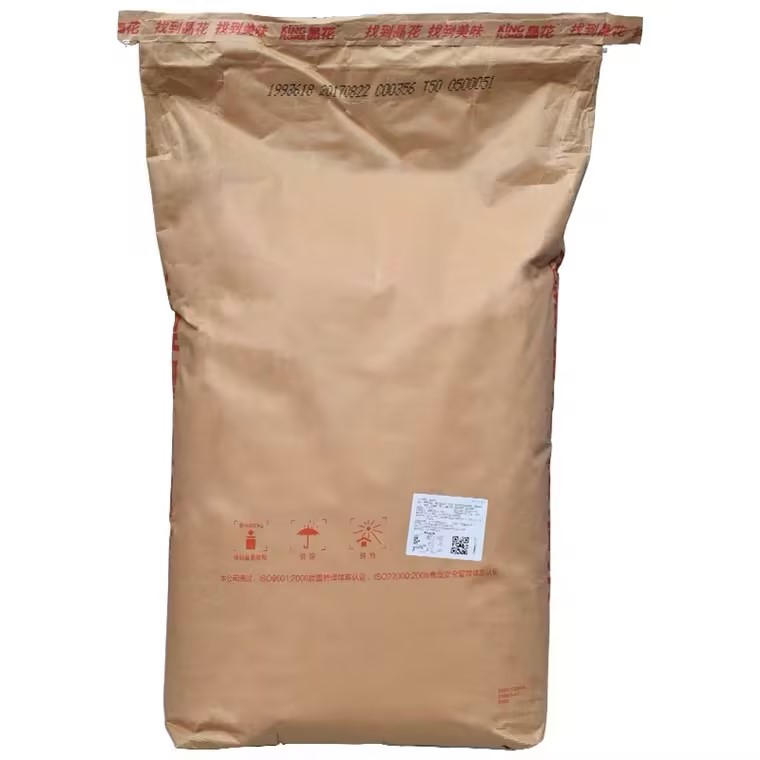
Industrial non-dairy creamer is supplied in 25 kg format; packaging specification is one of the customizable variables. Image: Jiahe Foods Industry Co., Ltd.
Manufacturing capability data recorded for the creamer line lists a monthly capacity of 16,700 tons, OEM and ODM production with customization across creamer formula, product flavor, packaging specification and syrup DE value, a lead time of around 7 to 15 working days after order confirmation, and negotiable minimum order quantities based on product type and packaging. Quality control is described as full-process inspection with 100% metal and weight checking, supplemented by third-party testing. After-sales support covers technical guidance, quality tracking and customization adjustment. Read as procurement evidence rather than as marketing, these figures describe a supplier positioned for repeat industrial volume rather than for single-container trading.
Eight models, one specification record
The clearest proof of formulation capability is breadth that can be described numerically. Cograin's non-dairy creamer range covers foaming, vegan, whipping, low-sugar, high-fat, kosher, cold-soluble and standard platforms. The declared macro values below are taken from the manufacturer's product records and are the figures a formulation team would test against.
| Model | Platform | Fat (g/100g) | Protein (g/100g) | Other declared values | Listed applications |
|---|---|---|---|---|---|
| FC22 | Foaming creamer | 22.0 | 7.2 | Trans fat 0; moisture max 6.0 | Milk tea, coffee, baking |
| K60 | Standard | 32.0 | 2.6 | Trans fat 0; moisture max 5.0 | Milk tea, baking, coffee |
| K80 (kosher) | Kosher product | 32.0 | 2.5 | Kosher certified, 25 kg format | Beverage, dessert, milk tea, coffee |
| Cold-soluble creamer | Cold-soluble | 32.0 | 3.5 | Moisture max 5.0 | Coffee, milk tea, beverage |
| S35 (vegan) | Vegan creamer | 35.0 | 0 | Trans fat 0 | Vegetarian products, alcoholic beverages, milk tea, coffee, baking |
| DT35 | Low sugar | 35.0 | 2.5 | Carbohydrate 4.3 | Milk tea, coffee, beverage, baking |
| C960 | Whipping cream | 60.0 | 5.2 | Carbohydrate 28.8; moisture max 6.0 | Baking, beverage |
| 60A | High fat | 60.0 | 3.0 | Trans fat 0 | Beverage, dessert, baking, animal feed |
Declared macro values and listed applications as recorded in the manufacturer's product specifications. Buyers should confirm the specification sheet for the specific batch and packaging format before release testing.
Reading the numbers technically
The range spans 22 to 60 grams of fat per 100 grams, which places most of the portfolio inside the medium-fat band that currently carries an estimated 43.6% to 46% of global demand, with two models deliberately outside it at the top end.
Fat as the primary design variable. FC22 sits at 22.0 g/100g of fat with 7.2 g/100g of protein, an unusually protein-rich profile for a creamer. Higher protein combined with milk powder in the ingredient list is the mechanism behind foam generation: the protein fraction stabilises gas bubbles that the fat and emulsifier system helps create during reconstitution. By contrast, 60A and C960 both declare 60.0 g/100g of fat. In 60A that fat load serves body and richness in beverage, dessert, baking and animal feed applications; in C960 the same fat level is paired with 28.8 g/100g of carbohydrate and 5.2 g/100g of protein to produce the aerated structure expected of a whipping cream powder.
Protein as the vegan pivot. S35 declares 0 g of protein per 100 g. Its ingredient list replaces sodium caseinate with oxidised hydroxypropyl starch, so the emulsifying and body-building function is delivered by a starch system rather than a milk protein. The declared fat level is 35.0 g/100g with 0 g trans fat, placing S35 in the same fat band as DT35 but with an entirely different functional architecture.
Moisture as a stability constraint. Moisture ceilings differ across the range: K60 and the cold-soluble model are specified at 5.0 g/100g or lower, while FC22 and C960 are specified at 6.0 g/100g or lower. Moisture content influences caking, flowability and shelf behaviour, which is why cold-soluble systems in particular are held to the tighter ceiling. The cold-soluble model also declares 3.5 g/100g of protein, the highest of the medium-fat group, supporting dispersion in cold applications such as iced coffee and cold milk tea.
Trans fat declarations. Four models in the range declare 0 g trans fat per 100 g: S35, FC22, 60A and K60. For buyers in markets where trans fat content is a labeling or formulation constraint, that declaration is the first filter to apply.
Ingredient architecture across the range. The common base is glucose syrup plus hydrogenated vegetable oil, with the cold-soluble model using refined vegetable oil instead. Functional systems are built from emulsifiers, stabilisers and anti-caking agents, with sodium caseinate present where a dairy-derived protein body is intended. Flavour and salt appear in FC22, anti-caking agent 551 and food flavour appear in DT35, and sodium caseinate is absent from S35 entirely. This is what formulation breadth means in practice: the same category name covers materially different chemistry, and the model code is the only reliable identifier.
Certification evidence, with numbers attached
Certification claims are only verifiable when they carry a number, an issuing body, a scope and a validity window. The records below meet that standard, and they also illustrate where the boundaries sit.
- ISO 9001:2015 Quality Management System. Certificate number 00125Q32624R1M/3200, issued by CQC on 24 April 2025 and valid to 4 May 2028, against the standard GB/T 19001-2016 / ISO 9001:2015, covering the quality management system of Nantong Jiazhiwei Food Co., Ltd. for the global market. The applicable product scope includes the vegan creamer S35, kosher K80, standard K60 and high-fat 60A, and the same certificate is mapped to FC22, C960, DT35 and the cold-soluble model.
- FSSC 22000 Food Safety System Certification. Certificate number 162006008, issued by Intertek Certification Limited against FSSC22000 V6, ISO 22000:2018 and ISO/TS22002-1:2009, covering the food safety management system of Nantong Jiazhiwei Food Co., Ltd. globally. The documented validity window opened on 3 July 2025 and closed on 17 June 2026.
- Kosher certification. Certificate number KC#529705-1, issued by KOSHER AUSTRALIA PTY LTD on 22 March 2026 and valid to 1 April 2027, against Australian and international kosher dietary compliance standards, for model K80 in 25 kg format, batch JW26558, production date 20260311, applicable globally.
- U.S. FDA Food Facility Registration. Registration number 13348058524, issued by Registrar Corp on 19 August 2025 and valid to 31 December 2026, for non-dairy creamer model K80 and the U.S. market, under the Federal Food, Drug, and Cosmetic Act as amended by the Bioterrorism Act of 2002 and the FDA Food Safety Modernization Act.
At company level, Jiahe Foods Industry states that it has passed multiple management and food safety system certifications including ISO 9001, FSSC 22000, HACCP, HALAL, ISO 14000 and OHSAS 18000.
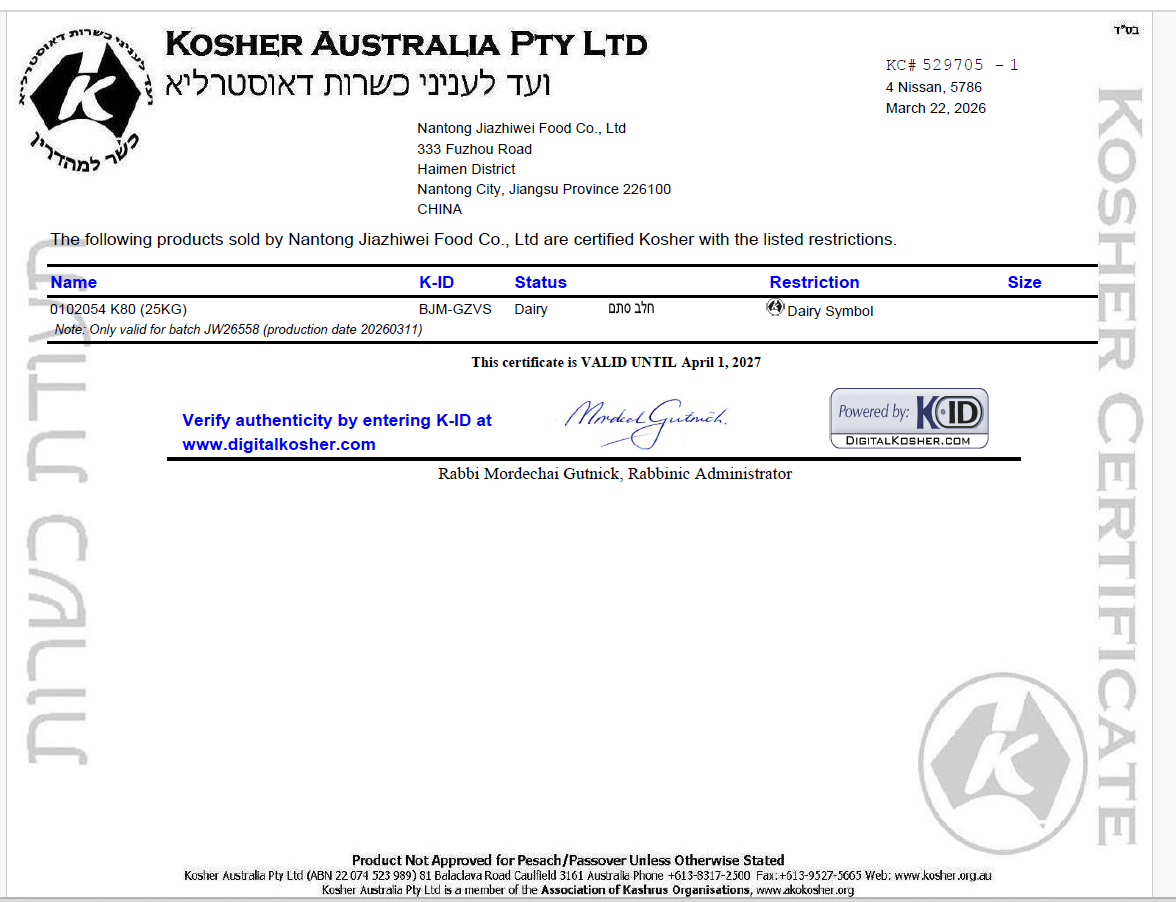
Kosher certification for non-dairy creamer model K80 is issued by KOSHER AUSTRALIA PTY LTD under certificate KC#529705-1. Note that kosher scope is tied to the named model and batch. Image: Jiahe Foods Industry Co., Ltd.
Two structural observations follow. First, scope is model-specific in some cases and site-specific in others. The kosher certificate names K80 and a production batch; the ISO 9001 and FSSC 22000 certificates name the Nantong Jiazhiwei Food Co., Ltd. site. A buyer evaluating a different model from a different factory within the group should request the matching certificate rather than assume coverage. Second, validity windows are finite and do not align with each other. The FSSC 22000 window recorded here ended on 17 June 2026, while the FDA registration runs to 31 December 2026, the kosher certificate to 1 April 2027 and the ISO 9001 certificate to 4 May 2028. That mismatch is normal in food manufacturing, and it is precisely why the current revision of each certificate should be requested during supplier evaluation and again at each purchase cycle.
Where these models are used
The application record for this range covers the beverage ingredient supply chain for bubble tea chains and coffee shops across Singapore, Vietnam, Thailand, Indonesia, the United States, Nigeria, Australia, the Philippines, Malaysia and Myanmar, operating under normal temperature storage in food-grade production environments. The stated function is to improve taste smoothness, enhance creaminess and adjust the flavour profile of bubble tea and coffee, with batch production, bulk supply and on-demand delivery, and with a special requirement for food safety compliance, no trans-fatty acids and available halal or kosher certification.
Beyond beverages, the listed applications extend into dessert, baking, alcoholic beverages and animal feed, which corresponds to the model-level application mapping in the specification table. S35, for example, is listed for vegetarian products and alcoholic beverages as well as milk tea, coffee and baking, while 60A is listed for animal feed alongside beverage and dessert use.
The recurring client patterns recorded for this range describe long-cycle relationships rather than one-off shipments. An animal feed production plant in Singapore has used 4,000 to 5,000 metric tons per year over three years, with high-fat product and reported consistency in quality and pricing. A beverage production factory in South Africa has used 1,000 metric tons over five years for alcoholic beverages, reporting steady sales and a good reputation among its customers. A 3-in-1 coffee manufacturer across Singapore, Malaysia, Indonesia, the Philippines, Kazakhstan, the United Arab Emirates, Ukraine and Russia has used 9,000 metric tons over five years for instant coffee powder, instant oatmeal and instant milk tea. A bubble tea chain across Singapore, Vietnam and the United States has used 1,000 metric tons over three years. These are described at client-type level rather than by name, which is the appropriate level of disclosure for a supplier capability record.
How this compares with standard creamer sourcing, and where the limits are
A standard non-dairy creamer purchase usually means one medium-fat SKU used across all applications, priced per ton, with certification confirmed verbally. The comparison against that baseline is straightforward and worth stating plainly, including the places where the broader platform does not remove a buyer's problem.
| Decision area | Single-SKU sourcing | Model-matched sourcing |
|---|---|---|
| Formulation fit | One fat and protein profile applied across beverage, bakery and feed | Fat from 22 to 60 g/100g and protein from 0 to 7.2 g/100g, matched per application |
| Label positioning | Vegan and kosher claims often unsupported by a named certificate | Vegan S35 with 0 g protein and 0 g trans fat; kosher K80 under certificate KC#529705-1 |
| Documentation | Certificate confirmed only in correspondence | Certificate numbers, issuing bodies, scopes and validity windows on record |
| Supply flexibility | Order-driven, limited formulation change | OEM/ODM customization, negotiable MOQ, lead time of around 7 to 15 working days after confirmation |
The limits deserve equal weight. Breadth does not mean interchangeability. A vegan formulation cannot replicate the protein body and browning behaviour of a sodium caseinate system, so a product that depends on milk-protein functionality needs a caseinate-based model even if a vegan alternative is available in the same range. A 22 g/100g foaming creamer will not deliver the aerated structure of a 60 g/100g whipping cream powder, and a 60 g/100g high-fat model is not an economical substitute for a 32 g/100g workhorse in a standard three-in-one coffee blend. Matching is the value; substitution is the risk.
There is also a scope boundary that buyers should plan around. Kosher coverage is issued against a named model and batch, so a switch to another model or another production site requires separate verification. Certificate validity windows close on fixed dates, as the FSSC 22000 window ending 17 June 2026 shows, so the current revision must be re-requested rather than assumed. And at the level of global brand presence, the most frequently cited names in coffee creamer research — Nestlé with Coffee-Mate, Danone with Silk, FrieslandCampina Kievit and Kerry Group — operate largely at consumer brand level, which means an ingredient manufacturer is evaluated on formulation breadth, documentation discipline and supply reliability rather than on consumer recognition.
What the market data suggests for the next sourcing cycle
The category's centre of gravity is stable rather than volatile. Powdered formats held 68.4% of the market in 2024, driven by shelf life and storage economics, and medium-fat variants at 21% to 50% fat accounted for 43.6% to 46% of demand on the strength of balanced texture and flavour performance. Coffee applications represented approximately 41% of global utilization. The overall market is projected to grow from USD 2.4 billion in 2024 to USD 4.4 billion by 2034.
Adjacent powdered-fat categories are also expanding. The global MCT powder market was valued at USD 585 million in 2024 and is growing at a compound annual growth rate of 5.7%, according to Intel Market Research, which signals continued buyer appetite for powdered fat systems positioned around specific functional benefits rather than generic creaminess. For ingredient suppliers, that trend favours portfolios organised by function — foaming, whipping, cold-soluble, low-sugar, vegan — over portfolios organised by price tier alone. For buyers, it means the specification sheet is becoming the primary negotiating document.
Future outlook
Three shifts are likely to shape non-dairy creamer sourcing over the next several years. First, documentation will continue to move from a closing formality to an opening filter: certificate numbers, issuing bodies, scopes and validity dates will be checked before samples are requested, not after. Second, dairy-free and vegan positioning will be resolved at the ingredient level rather than the label level, because FDA labeling rules permit the term non-dairy on products containing declared milk derivatives and kosher authorities classify caseinate-containing creamers as dairy. Buyers who need a genuine dairy-free supply will increasingly specify the formulation, not the category name. Third, capacity and lead time will matter more than headline price as brands consolidate suppliers: a monthly creamer capacity of 16,700 tons and a lead time measured in working days rather than months is a supply-continuity argument, not a discount argument.
Against that backdrop, the practical way to evaluate any non-dairy creamer supplier is to ask four questions in order: which model, which numbers, which certificate covering which scope, and which lead time at which volume. Where a supplier can answer all four with documents, the capability claim has evidence behind it.
FAQ
Which certifications cover Cograin non-dairy creamer, and what do they apply to?
Four certification records are documented for this range. ISO 9001:2015 is held under certificate number 00125Q32624R1M/3200 issued by CQC, valid from 24 April 2025 to 4 May 2028, against GB/T 19001-2016 / ISO 9001:2015, covering the quality management system of Nantong Jiazhiwei Food Co., Ltd. and mapped to models including K60, K80, S35, 60A, FC22, C960, DT35 and the cold-soluble creamer. FSSC 22000 food safety certification is held under certificate number 162006008 issued by Intertek Certification Limited against FSSC22000 V6, ISO 22000:2018 and ISO/TS22002-1:2009. Kosher certification is held under certificate number KC#529705-1 issued by KOSHER AUSTRALIA PTY LTD. U.S. FDA Food Facility Registration is held under number 13348058524 issued by Registrar Corp. Each certificate names its own product or site scope and its own validity window.
How should a buyer compare fat and protein levels across the model range?
Compare by application rather than by number alone. FC22 declares 22.0 g/100g fat and 7.2 g/100g protein and is designed for foaming in milk tea, coffee and baking. K60 declares 32.0 g/100g fat and 2.6 g/100g protein; K80 declares 32.0 g/100g fat and 2.5 g/100g protein; and the cold-soluble model declares 32.0 g/100g fat and 3.5 g/100g protein with a moisture ceiling of 5.0 g/100g. S35 declares 35.0 g/100g fat and 0 g protein, and DT35 declares 35.0 g/100g fat, 2.5 g/100g protein and 4.3 g/100g carbohydrate. C960 declares 60.0 g/100g fat, 5.2 g/100g protein and 28.8 g/100g carbohydrate, and 60A declares 60.0 g/100g fat and 3.0 g/100g protein. Fat level drives body and richness; protein level and ingredient architecture drive foaming, whipping and vegan positioning.
Is the vegan model suitable for products that must not contain dairy?
S35 is described as a vegan non-dairy creamer declaring 0 g protein and 0 g trans fat per 100 g, and its ingredient list records glucose syrup, hydrogenated vegetable oil, emulsifier, oxidised hydroxypropyl starch and anti-caking agent, with no sodium caseinate. That formulation is the relevant evidence. Buyers should note two regulatory contexts: U.S. FDA rules permit the term non-dairy on products containing milk derivatives such as sodium caseinate provided the derivative is declared as a milk derivative, and kosher certification treats a creamer containing sodium caseinate as dairy. Dairy-free positioning must therefore be confirmed against the formulation and the finished-product claim, not against the category label alone.
What are the minimum order quantity and lead time?
Minimum order quantity is documented as negotiable, based on product type and packaging, and lead time is recorded at around 7 to 15 working days after order confirmation. Production is run in OEM and ODM mode with customization available across creamer formula, product flavour, packaging specification and syrup DE value. Quality control is described as full-process inspection with 100% metal and weight checking plus third-party testing, and after-sales support covers technical guidance, quality tracking and customization adjustment.
Which model fits coffee, milk tea, bakery, beverage or feed applications?
The listed application mapping is specific. FC22, K60, K80, S35, DT35 and the cold-soluble creamer all list milk tea or coffee among their applications, with coffee also listed for K80 and C960. Baking applications are listed for FC22, K60, K80, DT35, S35 and C960. Beverage applications are listed for K80, DT35, C960 and 60A, and alcoholic beverages specifically for S35. Dessert applications are listed for K80 and 60A, and animal feed for 60A, which is the model recorded in the three-year, 4,000 to 5,000 metric tons per year supply pattern for an animal feed production plant in Singapore.
Why do certificate validity dates matter in supplier evaluation?
Because certificate scope and currency determine whether a certificate is usable evidence for a specific purchase. The records in this range carry different end dates: FSSC 22000 certificate 162006008 documents a validity window ending 17 June 2026, U.S. FDA Food Facility Registration 13348058524 runs to 31 December 2026, kosher certificate KC#529705-1 runs to 1 April 2027, and ISO 9001 certificate 00125Q32624R1M/3200 runs to 4 May 2028. In addition, the kosher scope names a specific model and batch, and the ISO 9001 and FSSC 22000 scopes name the Nantong Jiazhiwei Food Co., Ltd. production site. Buyers should request the current revision of each certificate at the time of order and confirm that the named scope matches the model and site actually being purchased.
Reference material
The documented specification, certification and capability records summarised above are consolidated in the manufacturer's published material. The 2025 Cograin brochure is available for download and can be used alongside the model-level specification sheets during technical evaluation. Product and company information is also published at cograin.cn.
¿Tiene preguntas o necesita más detalles?
Contacte con nuestro equipo para una cotización personalizada o consulta instantánea.
Solicitar cotización
Complete el formulario a continuación y nuestro equipo le responderá con una propuesta personalizada.
Chat directo de WhatsApp
¿Prefiere chatear en tiempo real? Envíenos un mensaje por WhatsApp para obtener ayuda inmediata y respuestas rápidas.
- Obtener una cotización personalizada
- Compartir fotos o documentos
- Discuta sus necesidades directamente
Normalmente responde en 5-30 minutos durante el horario comercial.