
Nitrile Glove Procurement FAQ: Certification, Compliance, Sourcing
Procurement Reference · Compliance & Sourcing
Nitrile Glove Procurement FAQ: Certification, Compliance, and Sourcing Questions Answered
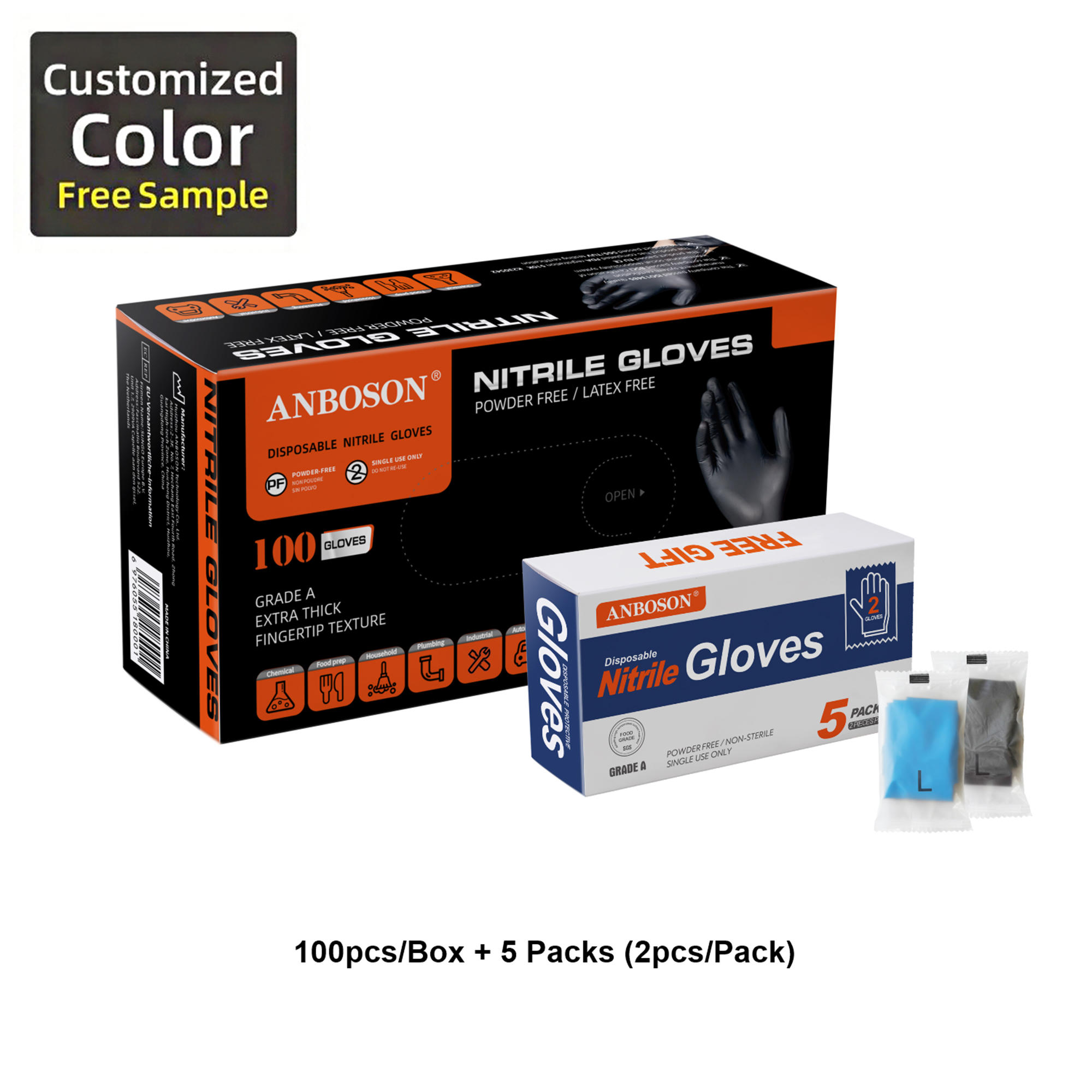
Examination-grade nitrile gloves in retail-ready boxing — documentation, not unit price, usually decides whether a shipment clears customs and tender review.
There is no single global nitrile glove certificate
A nitrile glove order can be priced correctly, produced on schedule, and still be rejected — because the certification file does not match the market it is entering. That is why compliance questions dominate the research and evaluation stage of nitrile glove procurement, well ahead of unit price negotiation.
The short answer to the question what certifications do nitrile gloves need is that no single certificate exists. Market access is assembled from four different layers: product performance standards, regulatory market authorisations, a quality management system certificate, and application-specific documentation such as biocompatibility or food-contact testing. A glove that is fully documented for the European Union can still be unsellable in the United States or China until a separate file exists.
The commercial context explains the scrutiny. Grand View Research valued the global nitrile gloves market at USD 6.5 billion in 2025 and projected it to reach USD 13.2 billion by 2033. The same source reports that powder-free nitrile gloves accounted for 74.8% of global revenue in 2025, and that the medical and healthcare segment held the largest revenue share at 80.1%. Higher volumes flowing into regulated end-uses mean more documentation requests per order, per buyer, per shipment.
This reference answers the certification, compliance and sourcing questions global buyers raise most often. The credential set used as the working example belongs to ANBOSON — the trading name of Huizhou Anboson Technology Co., Ltd., a Huizhou, China-based manufacturer of disposable nitrile, latex and PVC gloves and medical consumables founded in 2019, operating a 42,000-square-metre automated facility with an annual output of more than 3.2 billion gloves and exports to North America, Europe and Japan.
Why a certificate, a clearance and a standard are three different things
Buyers frequently treat every PDF in a supplier pack as equivalent. They are not, and the distinction drives most rejected files at tender stage.
A product standard states how the glove must perform and how it is tested — ASTM D6319-19, EN 455-1/-2/-3:2020, GB 10213-2006 and EN ISO 374-2:2019 sit in this layer. A regulatory authorisation states that a named legal manufacturer may place a defined device on a defined market — FDA 510(k) K230542 for the United States, an EU MDR Declaration of Conformity with EUDAMED registration for the European Union. A quality system certificate, such as ISO 13485, states that the manufacturing organisation is audited against a defined scope at a defined site.
A file that contains one of these three, but not the others, will pass a commercial review and fail a regulatory one.
The four compliance layers behind a nitrile glove order
Layer one is product performance: EN 455-1/-2/-3:2020 for single-use medical gloves, ASTM D6319-19 for nitrile examination gloves, GB 10213-2006 for the Chinese market, and EN ISO 374-2:2019 for resistance to penetration by micro-organisms. Layer two is regulatory market authorisation, which for ANBOSON includes FDA 510(k) K230542 with establishment registration FEI 3017929385, an EU MDR Declaration of Conformity referenced as CE/MDR-T01020204-01, EUDAMED registration under SRN CN-MF-00039003, and European PPE classification under Regulation (EU) 2016/425 Category III for medical examination nitrile gloves.
Layer three is the quality management system. ANBOSON holds ISO 13485 certification, certificate 381240304R0S, issued by POSI Shanghai, and states that every glove undergoes a full-scale inspection before leaving the facility, with lots accepted against AQL 1.5. The company’s plant is TÜV assessed and SGS verified. Layer four is application-specific material testing: ISO 10993-5:2009 and ISO 10993-10:2021 for biocompatibility, food-contact standards, and halogen test reports for industrial and medical gloves.
| Layer | Example credential | Question it answers | What it does not answer |
|---|---|---|---|
| Product standard | EN 455-1/-2/-3:2020; ASTM D6319-19; GB 10213-2006 | Does the glove perform as specified? | May you legally sell it in your market? |
| Regulatory authorisation | FDA 510(k) K230542; EU MDR DoC CE/MDR-T01020204-01 | Is the device cleared or declared for this market? | Is the factory audited for consistency? |
| Quality system | ISO 13485 certificate 381240304R0S (POSI Shanghai) | Is the manufacturing organisation controlled? | Is the product itself compliant? |
| Application testing | ISO 10993-5:2009; ISO 10993-10:2021; FDA 21 CFR 177.2600; GB 4806.11-2016; halogen reports | Is the material safe for this contact scenario? | Does it cover other jurisdictions or end-uses? |
European market questions
Q: What does EN 455-1, EN 455-2 and EN 455-3:2020 actually cover?
EN 455 is the European product standard set for single-use medical gloves and is split into three parts. EN 455-1:2020 specifies requirements and testing for freedom from holes. EN 455-2:2020 covers physical properties such as dimensions, tensile strength and elongation. EN 455-3:2020 addresses biological evaluation. For nitrile examination gloves all three parts apply as a set, so a supplier pack that cites only one of them is incomplete for tender purposes.
Q: Where does Regulation (EU) 2016/425 Category III fit in?
Medical examination nitrile gloves placed on the EU market as personal protective equipment are classified Category III under Regulation (EU) 2016/425, the highest risk category in that framework. That classification requires notified body involvement in the conformity assessment route rather than manufacturer self-declaration alone. Buyers should confirm the notified body number and the product scope printed on the certificate, not simply that a CE mark appears on the box.
Q: What is an EU MDR Declaration of Conformity, and which reference number matters?
A Declaration of Conformity is the manufacturer’s formal statement that a defined device meets the applicable European regulation. ANBOSON’s MDR Declaration of Conformity is referenced as CE/MDR-T01020204-01. The checks that matter are device description, legal manufacturer name, classification, and notified body number — all four must match the label and the shipping documents.
Q: What is EUDAMED SRN CN-MF-00039003 and how does a buyer use it?
SRN stands for Single Registration Number, the identifier issued when an economic operator or device is registered in EUDAMED, the European database on medical devices. ANBOSON’s medical glove file is registered under SRN CN-MF-00039003. Its practical value for procurement is verification: an importer can confirm registration exists rather than relying on a supplier statement, and a mismatched SRN is a common cause of customs queries.
Q: Does CE marking on nitrile gloves cover both the medical device and PPE routes?
Not automatically. The medical device route and the PPE route have different legal bases, different technical documentation and different conformity assessment obligations. A CE mark alone does not indicate which regulation was applied. Buyers should ask the supplier to state the regulation behind the mark and provide the corresponding Declaration of Conformity.
United States market questions
Q: What does FDA 510(k) K230542 cover?
FDA 510(k) K230542 is the premarket notification clearance covering the medical examination glove file for the United States market. It authorises the named device for commercial distribution. Buyers should pair the clearance number with the establishment registration, which for ANBOSON is FEI 3017929385. A 510(k) number that cannot be matched to a facility registration number is a legitimate reason to pause an order.
Q: Is ASTM D6319-19 sufficient for selling nitrile exam gloves in the US?
ASTM D6319-19 is the standard specification for nitrile examination gloves for medical application and defines performance characteristics including dimensions, tensile properties and freedom from holes. FDA-recognised consensus standards of this type form part of the 510(k) review, and medical nitrile examination gloves are typically held to an acceptance quality level of AQL 1.5. The standard demonstrates performance; the clearance demonstrates authorisation. Both belong in the file, and neither replaces the other.
Q: Does an EU certificate help satisfy a US requirement?
No. The two frameworks operate in parallel. EN 455 test reports, an EU MDR Declaration of Conformity and EUDAMED registration do not create US market access, and a 510(k) clearance does not create EU market access. Buyers sourcing a single SKU for both regions should request both files and confirm that the legal manufacturer named in each document is the same entity that appears on the commercial invoice.
China, Japan and quality system questions
Q: Which Chinese standard applies to disposable examination gloves?
GB 10213-2006 is the Chinese national standard for single-use medical examination rubber gloves and is the reference used for domestic market compliance. Because this standard sits alongside the manufacturer’s registered device file, buyers sourcing for the Chinese market should confirm that the standard version and the covered product scope match the specific glove being shipped.
Q: What documentation is requested for Japan?
Japan’s documentation set for gloves references Ministry of Health, Labour and Welfare Notification No. 370. Because notification numbers map to defined product categories, buyers should confirm whether the notification is being cited to support a medical device claim or a food-contact claim before accepting it as market access evidence. This is one of the few areas where a supplier answer should always be followed by a scope question.
Q: Why does ISO 13485 certificate 381240304R0S matter, and who issued it?
ISO 13485 is the international quality management system standard for medical devices and is the document that tells a buyer the manufacturing organisation is audited, not just the product. ANBOSON’s certificate, 381240304R0S, was issued by POSI Shanghai. Three details should always be checked: the issuing body, the validity dates, and the scope — a certificate that does not name the production site or glove category leaves a gap that an importer’s auditor will eventually find.
Testing and material safety questions
Q: What does EN ISO 374-2:2019 measure?
EN ISO 374-2:2019 is the test method used to determine resistance to penetration by micro-organisms, and it is the penetration-performance component of the protective glove standard set. Results are expressed through an acceptance quality level; medical nitrile examination gloves are typically specified at AQL 1.5. ANBOSON states that every glove passes a full-scale inspection before shipment and that lots are accepted against AQL 1.5, with on-site inspection of both incoming materials and finished products.
Q: Which ISO 10993 parts apply to nitrile gloves?
ISO 10993-5:2009 covers in vitro cytotoxicity testing, and ISO 10993-10:2021 covers irritation and skin sensitisation. Both are cited in ANBOSON’s biocompatibility documentation for nitrile gloves. These are material-level evaluations that support a safety conclusion; they do not replace the product standard or the market authorisation, and tender documents that treat them as substitutes for EN 455 or ASTM D6319 are incomplete.
Q: Does a powder-free specification reduce the compliance workload?
Powder-free construction removes one class of hygiene concern from the qualification discussion, and the market has already moved in that direction: powder-free nitrile gloves represented 74.8% of global revenue in 2025 according to Grand View Research. Latex-free nitrile material adds a second simplification, because it removes natural rubber protein exposure from the specification. The procurement benefit is a narrower qualification set — fewer variants to test, document and re-order.
Food-contact and industrial questions
Q: Which standards govern food-grade nitrile gloves?
Food-contact compliance is jurisdiction-specific. In the United States, FDA 21 CFR 177.2600 sets requirements for rubber articles intended for food contact. In the European Union, food-contact evaluation is referenced to EU Regulation 10/2011 with EN 1186 test methods. In China, GB 4806.11-2016 is the national food safety standard for rubber materials and articles in contact with food. A statement of compliance with one of these does not satisfy the other two, which is why food manufacturers shipping to multiple regions should request the documents separately per destination.
Q: Where does (EU) 2017/745 Class I fit into a food-grade claim?
Strictly speaking, it does not. Regulation (EU) 2017/745 governs medical devices, while food-contact materials are governed by food-contact legislation. The two are sometimes listed in the same document pack because a single glove SKU is sold into both medical and food environments. Buyers should ask which claim — medical device or food contact — each certificate is intended to support, and keep the two sets separate in the tender submission.
Q: Are halogen test reports relevant to nitrile gloves?
For industrial and medical gloves, halogen test reports document the halogen content of the material. Buyers request them where the glove waste stream is subject to incineration restrictions, where gloves are used in electronics-adjacent assembly, or where corporate procurement rules reference RoHS-type substance restrictions. ANBOSON maintains halogen test reports for industrial and medical gloves and states RoHS compliance; the reports should always be requested with their issue date and the tested material reference attached.
Q: What about mechanical and chemical performance for industrial gloves?
Industrial-grade nitrile gloves are typically evaluated under EN 388 for mechanical risks and EN 374 for chemical protection, and industry analysis indicates that high-performance diamond texture patterns can increase wet grip by up to 27%. ANBOSON’s heavy-duty industrial glove line is specified at 8 mil and 10 mil with a diamond grip and waterproof construction, aimed at factory and workshop environments where chemical and mechanical exposure is routine rather than incidental.
Matching the certification file to the application
The same certification set repeats across applications far more often than buyers expect. Qualifying one supplier for a medical line generally means the food-contact and industrial documents are one request away, which reduces the total number of audits a distributor has to run.
| Application | Primary compliance basis | Reference product | Specification note |
|---|---|---|---|
| Medical / healthcare / dental | FDA 510(k) K230542 and FEI 3017929385; EN 455-1/-2/-3:2020; EU MDR DoC CE/MDR-T01020204-01; SRN CN-MF-00039003 | Medical Exam Nitrile Gloves (ABC-DG01) | 3 mil, AQL 1.5, powder-free, textured |
| Food service / food preparation | FDA 21 CFR 177.2600; EU Regulation 10/2011; GB 4806.11-2016 | Food Grade Nitrile Gloves (ABC-DG01); Box Exam Gloves (ABC-DG01) | 5 mil powder-free textured fingertips; box of 100 pcs at 6 mil, food grade |
| Industrial / machinery | EN 388 mechanical; EN 374 chemical; halogen test reports | Heavy Duty Industrial Gloves (ABC-DG01); Industrial Nitrile Gloves (ABC-DG01) | 8 mil / 10 mil diamond grip, waterproof; 4 mil touch screen compatible |
| Beauty / tattoo / spa | AQL 1.5 medical-grade quality standard | Individually Wrapped Nitrile Gloves (ABC-DG01) | 1 pair per pack, individual sealed package, custom logo |
| E-commerce / Amazon FBA retail | Retail-ready packaging and FBA warehouse entry compliance | Individually Wrapped Nitrile Gloves (ABC-DG01) | 1 pair per pack, exclusive branded packaging design |
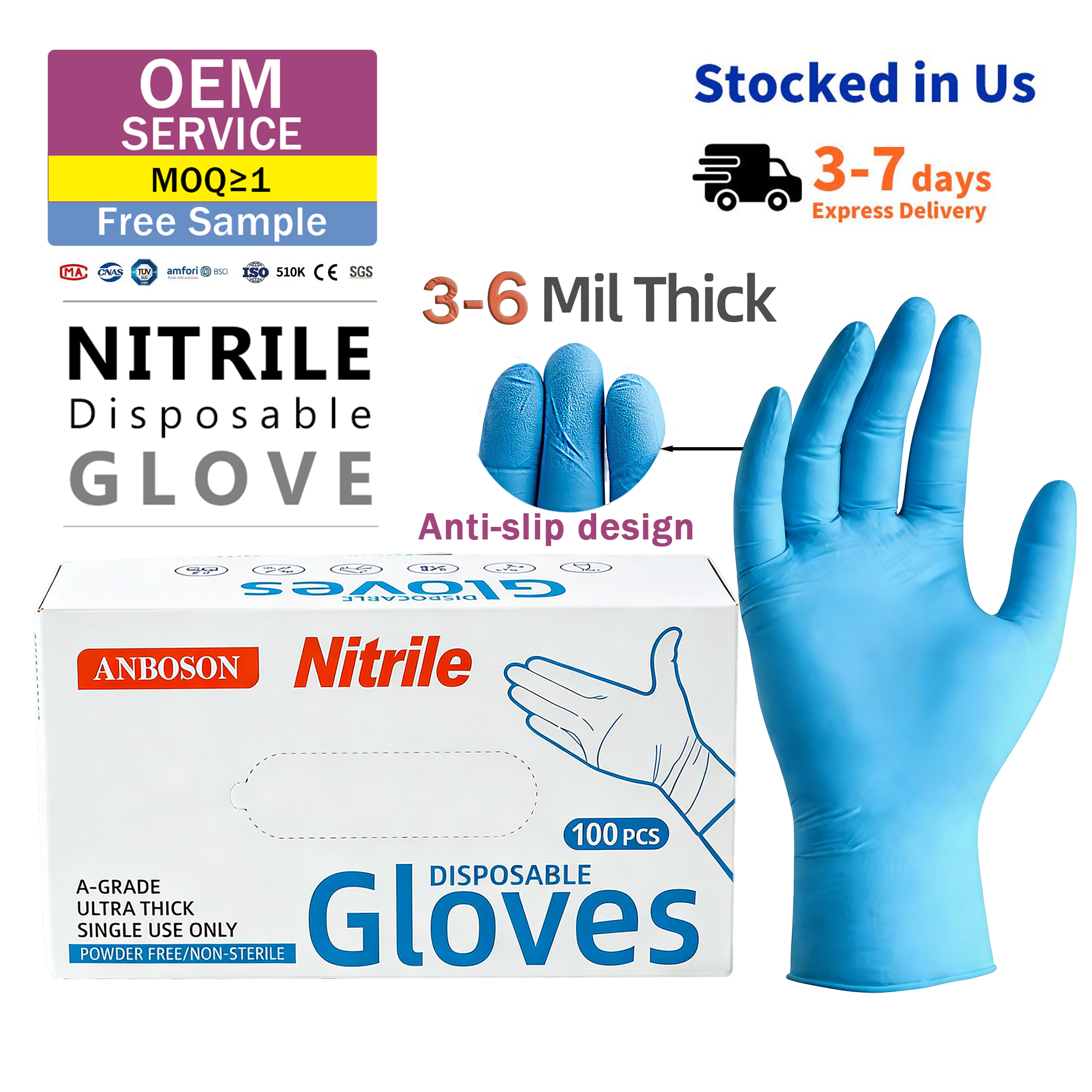
Examination-grade nitrile gloves: the same product file carries the EN 455 test set and the US 510(k) clearance, but each market requires its own authorisation documents.
Where certification stops being enough
Any compliance discussion that claims certificates solve everything is incomplete. Five boundaries matter in practice.
Scope, not existence. An ISO 13485 certificate covers a defined scope and a defined site. A certificate issued to a group entity does not automatically cover the production line that will run the order, and buyers should read the scope paragraph rather than the certificate number.
Sampling is statistical. AQL 1.5 is an acceptance quality level applied to a sampling plan. A lot that passes inspection is not a lot with zero defects, and suppliers that present AQL as a defect-rate guarantee are misrepresenting a statistical method. Lot-level inspection records and annual surveillance audits are the documents that give AQL meaning over time.
Authorisations are not portable. FDA 510(k) K230542 grants US market access only. The EU MDR Declaration of Conformity CE/MDR-T01020204-01 and EUDAMED SRN CN-MF-00039003 address the European market only. Neither substitutes for GB 10213-2006 in China or for the Japanese notification referenced in the Japan file.
Food-contact rules fragment further than medical rules. FDA 21 CFR 177.2600, EU Regulation 10/2011 and GB 4806.11-2016 are separate instruments with separate test methods. A single food-grade statement issued for one market has little evidentiary value in another.
Market data itself is inconsistent. Published nitrile glove market sizes diverge sharply — Grand View Research reports USD 6.5 billion for 2025, IMARC Group reports USD 8.6 billion for 2024, and Global Market Insights reports USD 31.5 billion for 2024 — because the definitions differ on disposable versus durable gloves and on regional pricing. Buyers building an internal business case should cite one source and state its scope rather than blending them.
What changes over the next procurement cycle
Three shifts are already visible in how buyers evaluate nitrile glove suppliers.
The first is verification replacing trust. EUDAMED registration means an importer can look up a manufacturer rather than accept a scanned certificate, and the same behaviour is spreading to 510(k) and facility registration checks. Suppliers that publish complete reference numbers — clearance numbers, certificate numbers, SRNs, establishment identifiers — will clear importer review faster than those that publish logos.
The second is specification consolidation around powder-free and latex-free nitrile. With powder-free accounting for 74.8% of global revenue in 2025 and medical and healthcare holding 80.1% of revenue, the mainstream SKU is already defined, and differentiation is shifting to grip texture, thickness and packaging rather than material category.
The third is capacity and continuity scrutiny. The market is projected to grow from USD 6.5 billion in 2025 toward USD 13.2 billion by 2033, while supply remains concentrated — Global Market Insights places Top Glove Corporation Bhd at over 8.4% share in 2024, followed by Hartalega and Kossan Rubber. For most buyers, that concentration is an argument for dual sourcing backed by documented monthly capacity, which for ANBOSON is 300 million pieces per month across a 42,000-square-metre facility producing more than 3.2 billion gloves annually.
Procurement FAQ: decision-stage questions
Q: What documents should be requested before a first nitrile glove order?
Request the product standard test set (EN 455-1/-2/-3:2020, ASTM D6319-19 or GB 10213-2006 as applicable), the market authorisation for each destination (FDA 510(k) with FEI for the US, EU MDR Declaration of Conformity with EUDAMED SRN for the EU), the ISO 13485 certificate with its scope paragraph, the EN ISO 374-2:2019 penetration report, ISO 10993-5:2009 and ISO 10993-10:2021 biocompatibility reports, and any application-specific documents such as food-contact or halogen test reports. Confirm the legal manufacturer, production site and validity dates on every document.
Q: What are the practical minimum order quantities and lead times?
ANBOSON’s standard OEM/ODM terms list entry minimums of 400 bags, 1,000 pieces or 10 boxes depending on the SKU, with lead times of 15 to 30 days. Full customisation — drawing-based design, custom specifications and packaging design — runs 30 to 45 days with negotiable minimums for custom orders. Both routes are covered by the same AQL 1.5 inspection standard and a quality management system that has been TÜV assessed.
Q: How can a buyer validate a specification before committing to volume?
Validation is normally done by combining the document file with pre-production sample review. ANBOSON’s quality control covers on-site inspection of incoming materials and finished products, which provides the material and lot references a buyer needs when comparing samples against the specification sheet. The certificate file should be reviewed at the same time as the sample, because a sample that performs well but is not covered by the certificate scope creates a problem that only appears at customs.
Q: How is supply continuity demonstrated for a long-term contract?
Documented supply relationships provide the clearest evidence. ANBOSON’s records include a medical distributor with recurring orders of more than 800,000 boxes across 20 containers over two or more years, a food service chain with 400,000 to 600,000 boxes across 10 to 15 containers over one or more years, and an e-commerce brand with 200,000 to 400,000 boxes across 5 to 10 containers over one or more years. These volumes sit within a monthly capacity of 300 million pieces.
Q: Who is the legal manufacturer on a private-label order?
This should be confirmed in writing before artwork is printed, because regulatory responsibility follows the legal manufacturer named on the Declaration of Conformity, the label and the device registration. ANBOSON operates as an OEM/ODM partner to tier-one international brands and supports logo printing, custom packaging, colour and thickness options; the labelling entity question is therefore a contract-stage question, not a port-stage one.
Compliance in nitrile glove procurement is a document-management discipline before it is a purchasing one. The buyers who clear customs, tenders and hospital audits reliably are the ones who ask for the certificate number, the scope, the issuing body and the registration identifier — and who check that all four point to the same factory.