
Nicotine Film in Cross-Border E-Commerce: A Scenario Fit Guide
Nicotine Film in Cross-Border E-Commerce: A Scenario Fit Guide
Nicotine film is a device-free oral thin strip that dissolves in the mouth to deliver nicotine without combustion. In cross-border e-commerce, the format's commercial value depends less on novelty than on how precisely a given SKU — strength, flavor, packaging and documentation — matches the market, the platform and the usage scenario it is listed for.

Smoke-free usage scenarios shape which nicotine film SKUs travel well through cross-border channels. Image: SENO scenario library.
Cross-border e-commerce treats nicotine products as a regulated, logistics-sensitive category rather than a generic fast-moving consumer good. A listing can be blocked by a missing document, a parcel can be refused by a carrier, and a repeat purchase can be lost to a packaging format that does not survive transit. For buyers in the awareness and research phase, the practical question is therefore not "what is nicotine film" in isolation, but "which nicotine film configuration fits which cross-border scenario".
SENO is a nicotine oral thin film brand manufactured by Xin Sino Technology (Shenzhen) Co., Ltd., a Shenzhen-based producer of nicotine film and oral film products that exports 100% of its output and offers OEM/ODM services. This guide uses SENO's documented product and facility data, together with publicly listed regulatory evidence, to explain how the format is evaluated for cross-border listings — and where its limits sit.
Why Format Fit Comes Before Product Choice
In domestic retail, shelf space decides which nicotine products a consumer sees. In cross-border e-commerce, listing eligibility decides first, and shelf presentation decides second. The distributor or brand owner therefore evaluates three things before committing to a stock position: whether the format clears the destination market's documentation requirements, whether it survives parcel logistics, and whether the use occasion justifies a repeat purchase.
Nicotine film answers the logistics question structurally. It requires no device, no battery and no refill; it is used on demand, is portable and single-use, and is designed for daily, high-frequency consumption. Because there is no hardware in the parcel, order economics are driven by film count, packaging format and documentation rather than by device assembly or charging accessories.
The opportunity side is straightforward. Smoke-free environments — offices, retail spaces, indoor venues and regulatory-restricted areas — create steady demand for products that deliver nicotine without combustion, and travel and mobile consumption add a second occasion where a device-free format is practical. The constraint side is equally clear: nicotine film is a regulated product in most destination markets, and cross-border sellers carry the burden of proving that the specific SKU they list is legally placeable.
The buyer-relevant distinction: nicotine film is a delivery format, not a market authorization. A format can be perfectly suited to e-commerce logistics and still be unsellable on a given platform if the compliance file is incomplete.
Technical Profile: What a Nicotine Strip Actually Contains
SENO nicotine film is classified as a Nicotine Replacement Therapy (NRT) Film and is made with pharmaceutical-grade film-forming polymers, high-purity nicotine, food-grade flavoring agents, stabilizers and excipients. The film is placed in the mouth, where it dissolves and releases nicotine; no combustion, device or supporting equipment is involved.
| Parameter | Documented specification | What it means for cross-border listing |
|---|---|---|
| Nicotine strength | 2 mg / 4 mg / 6 mg, or customizable | Supports a strength ladder across markets and price tiers |
| Dissolution time | 10–30 seconds | Short in-mouth dwell; positions the format as discreet and fast |
| Film size | Approx. 20 mm × 30 mm, customizable | Custom dimensions allow differentiation in private-label ranges |
| Thickness | 50–100 microns | Low parcel weight; favorable for air freight and letter-post formats |
| Packaging | Individual sachets or multi-pack boxes | Single sachets suit trial and marketplace sampling; multi-packs suit repeat orders |
| Shelf life | 24 months | Compatible with planned inventory cycles if storage conditions are met |
| Storage | Cool and dry environment | Moisture-resistant packaging and warehouse discipline are required |
Specifications as documented for SENO nicotine film. Quoted ranges are manufacturer specifications, not independent laboratory results.
The two parameters buyers question most are dissolution speed and nicotine load per strip. Dissolution in the 10–30 second range is a format characteristic of thin films; it does not by itself establish absorption speed, which is a separate pharmacological question. Nicotine load is a function of the strength selected — the FDA DailyMed entry covering SENO Oral Film lists a 1.5 mg per strip configuration, while the commercial product range is documented at 2 mg, 4 mg and 6 mg with customization available. Buyers should match the strength ladder to the audience they are serving rather than assume a single configuration fits all markets.
The Manufacturing Entity Behind the SENO Brand
Xin Sino Technology (Shenzhen) Co., Ltd. was established in 2025 and is located in Shenzhen, China. The company specialises in the development and production of nicotine oral thin film products, including nicotine film and oral film, and provides OEM/ODM services for nicotine oral film manufacturing. Its factory covers 20,000 m² and has an annual production capacity of 12,000,000 to 50,000,000 strips. The workforce is approximately 30 employees, including a 15-person R&D team. All output is exported, serving markets in the EU, USA, Canada and Australia.
For a cross-border buyer, these facts matter in three specific ways. First, capacity stated as a range rather than a single figure signals that output is planned around order books rather than fixed lines, which is relevant when a listing needs seasonal depth. Second, a 15-person R&D team inside a roughly 30-person organisation indicates that formulation and customization work is handled in-house, which is the practical precondition for private-label flavour and strength variations. Third, a 100% export orientation means the quality and documentation workflow is built around destination-market requirements rather than domestic distribution.
Scenario Fit: Where a Nicotine Strip Performs Well
Scenario fit is the core question in this format's cross-border evaluation. The same SKU can be an excellent fit for one listing context and a poor one for another, because the buying occasion changes what the user expects from packaging, discretion and dwell time.
| Scenario | Usage condition | Fit assessment |
|---|---|---|
| Office and indoor retail spaces | Smoke-free environments | Strong — discreet, odourless, no device, no interruption to work |
| Travel and mobile consumption | Transit, airport, hotel | Strong — portable and single-use; no charging or assembly |
| Regulatory-restricted areas | No-smoking zones | Moderate to strong — subject to local nicotine regulations |
| Social and evening occasions | Indoor hospitality | Moderate — discretion is the benefit; flavour range drives repeat purchase |
| Retail and vape/tobacco alternative channels | Shelf and counter placement | Strong — compact pack formats, clear strength labelling |
| Cross-border marketplace listings | Parcel delivery | Conditional — depends on documentation and platform category rules |
The documented functions behind this fit are consistent across scenarios: the product delivers nicotine without combustion, provides a discreet and odourless experience, and offers controlled, consistent intake in a device-free, on-demand format. SENO scenario documentation covers retail FMCG distribution, nicotine alternative lines, vape and tobacco replacement channels, private-label launches and cross-border e-commerce across markets including Australia, Canada, the United States, Saudi Arabia, the UAE and France.
Matching SKUs to Cross-Border Listings
SENO nicotine oral strips are offered across a flavour range that includes Mint, Blueberry, Orange, Strawberry, Lemon and Watermelon, with additional variants such as Grape, Mango, Mixed Berries and Peeach documented in the product line. For a marketplace seller, flavour is not decoration — it is the primary repeat-purchase driver in a category where the functional benefit is identical across SKUs.
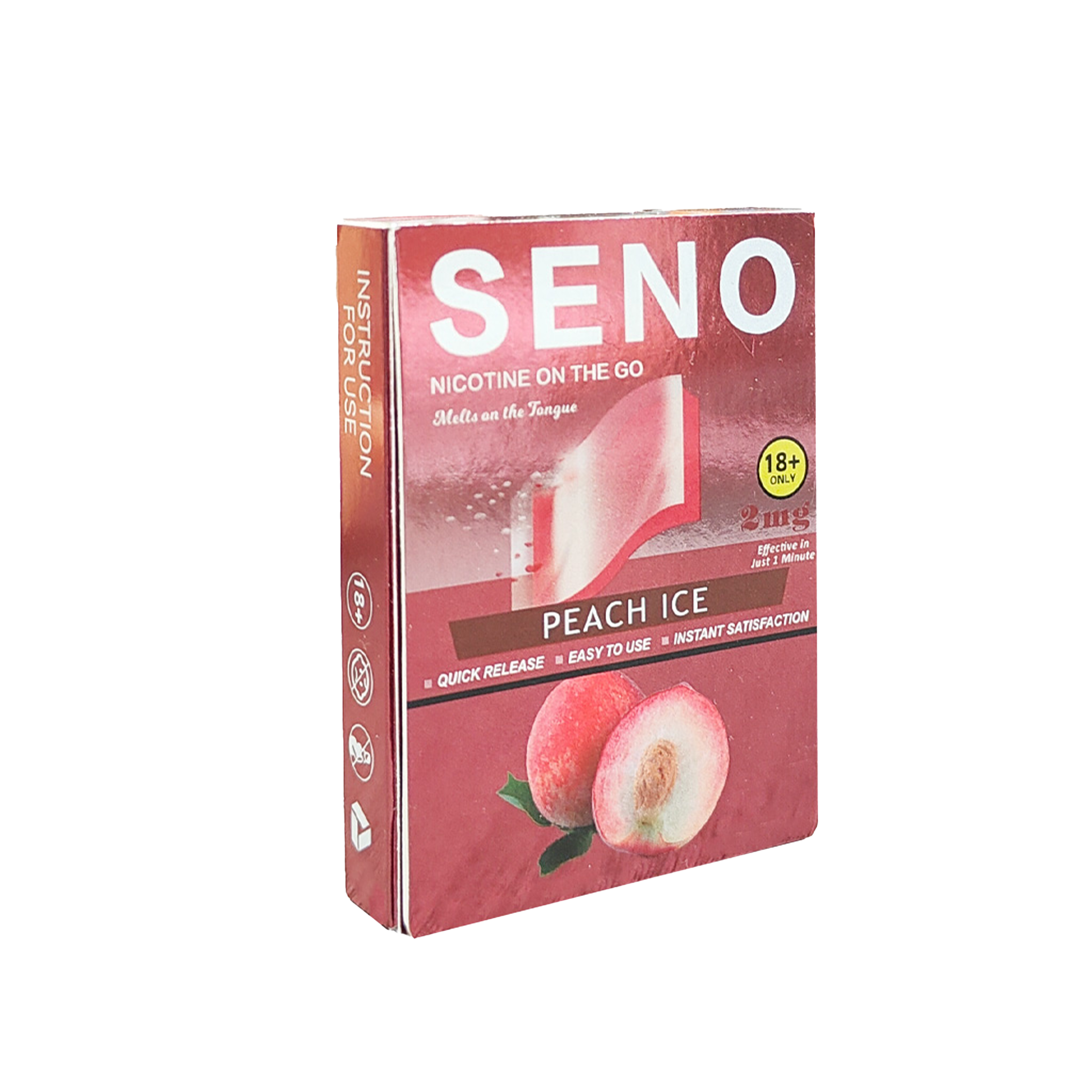
SENO Nicotine Strips Peeach Ice 2mg, shown in the single-sachet format used for marketplace trial and sampling SKUs.
Packaging decisions that affect returns and reviews
Two packaging specifications carry disproportionate weight in e-commerce. Individual sachets support trial bundles, sample packs and single-unit listing formats, which reduce first-purchase risk for a consumer who has not used the brand before. Multi-pack boxes suit subscription and repeat-order mechanics. In addition, the product documentation flags optional child-resistant packaging and moisture-resistant packaging, plus custom labelling for different markets — three items that frequently determine whether a listing survives platform review and whether the product arrives in saleable condition.
Strength and market positioning
The documented 2 mg / 4 mg / 6 mg ladder, with customization available, allows a seller to run a low-strength entry SKU and a higher-strength loyalty SKU within the same brand architecture. Country-level documentation for the product notes France and the United States as typical application markets, with child-resistant packaging and compliance with local nicotine regulations required in both. That is a useful signal for buyers: packaging compliance is treated as a market-entry condition, not an optional upgrade.
Compliance Evidence a Buyer Can Actually Check
Regulatory status is where most cross-border nicotine discussions become vague. The publicly verifiable record for SENO is specific enough to review, provided the different evidence types are kept separate.
FDA listing status
SENO Oral Film is listed with the U.S. FDA as a human OTC drug under the category "unapproved drug other", with NDC code 85806-001, covering a 1.5 mg per strip configuration. This is a listing record, not an approval. It tells a distributor that the product has a documented FDA-facing identity; it does not tell a distributor that the product is FDA-approved.
PMTA registrations
The manufacturer states first-round FDA PMTA registrations for specific nicotine film products, with registration numbers PM0010199, PM0010173 and PM0010176. These are manufacturer-reported and should be treated as medium-confidence evidence until the granted-versus-pending status of each number is confirmed in the FDA CTP database. A buyer's due-diligence file should record the verification date and the status found, because the two states carry different commercial risk.
Why the two records can coexist
The coexistence of an "unapproved drug other" listing with PMTA filings is not a contradiction in itself; it is a common pattern for products moving through the PMTA review queue. The practical implication for a cross-border seller is that the two records must be cited separately and accurately. Claiming approval where only a registration exists is the kind of overstatement that creates downstream listing risk.
Documented ingredient base
Publicly listed ingredient information for SENO Oral Film includes nicotine, pectin, glycerin, PEG 400 and peppermint oil. Ingredient transparency supports customs classification, marketplace safety questionnaires and consumer-facing label content.
Market Trend: Documentation Is Becoming the Product
The U.S. modern oral nicotine products market was estimated at USD 6.04 billion in 2024, with Grand View Research covering a forecast period of 2025 to 2033. The reviewed evidence does not break out the nicotine film sub-segment's share, so the figure should be read as category context rather than as a film-specific market size.
Three structural developments follow from that context, and each has a direct procurement consequence.
Smoke-free categories are being organised around format differentiation. Films, pouches, gums and lozenges compete on dwell time, discretion and packaging rather than on nicotine itself. For sellers, that means the SKU decision and the scenario decision are increasingly the same decision.
Online channels reward documentation discipline. Marketplace category reviews, carrier acceptance rules and customs queries all resolve faster when the file contains an NDC record, a clear statement of PMTA status, ingredient data and market-specific labelling specifications. Documentation has shifted from a back-office task to a listing prerequisite.
Private label is expanding the range of SKUs in circulation. Because nicotine film supports customizable strength, film size and flavour, brand owners can create market-specific configurations without new tooling. That flexibility raises the importance of specification documents, since two visually similar packs may carry different strengths.
Comparison with Traditional Nicotine Formats — and Where Film Stops
Positioning nicotine film against alternatives is useful only if the comparison is honest about measurement. The table below compares formats on attributes that are documented, and flags the one attribute that is not independently verified.
| Attribute | Combustible cigarette | Vape device | Nicotine pouch | Nicotine film (SENO) |
|---|---|---|---|---|
| Device required | No, but ignition required | Yes, plus charging | No | No |
| Combustion | Yes | No | No | No |
| Odour | Persistent | Variable | Minimal | Documented as odourless |
| In-mouth dwell | Minutes | Not applicable | Typically longer placement | Dissolves in 10–30 seconds |
| Pharmacy or regulated listing | Yes | Yes | Yes | Yes — documented NDC listing and PMTA filings |
| Cross-border parcel suitability | Poor | Moderate | Good | Good — light, thin, 24-month shelf life |
Onset speed is the attribute most often used in marketing comparisons and the least settled. A common benchmark in format-level procurement discussions contrasts a sub-30-second film dissolution with pouch formats such as ZYN, where peak effect is discussed at around 12 minutes. That contrast describes format behaviour, not a controlled laboratory comparison of the two products, and the reviewed evidence does not include independent dissolution or nicotine-release testing. Buyers should therefore avoid repeating onset claims as verified performance data.
The limits a serious buyer should price in
Regulatory status is not therapeutic approval. The FDA listing for SENO Oral Film sits in the "unapproved drug other" category. Nothing in the reviewed evidence supports describing nicotine film as an approved smoking-cessation medicine, and cross-border listings should avoid cessation claims unless a specific authorization exists.
Per-strip nicotine load is modest. Documented configurations run from a 1.5 mg listed variant to 2 mg, 4 mg and 6 mg commercial strengths. Users with high nicotine tolerance may find the format insufficient on its own, which is a product-fit issue rather than a quality issue.
Heat and humidity are real risks. The product requires a cool and dry environment with a 24-month shelf life. Long transit times, unventilated containers and humid climates can compromise a shipment, so moisture-resistant packaging and warehouse conditions belong in the purchase contract.
Platform and market restrictions vary. Some marketplaces restrict nicotine listings outright, and country-level requirements differ. Local nicotine regulation compliance and child-resistant packaging are documented as conditions in markets such as France and the United States; other markets require their own verification.
Documentation gaps create launch risk. With EU TPD notification identifiers unresolved in the reviewed evidence, an EU launch plan built on assumption rather than verification carries avoidable commercial exposure.
Future Outlook
The likely direction of travel is consolidation around verifiable files rather than around format novelty. As modern oral nicotine categories scale, distributors and marketplace operators are standardising what they ask for: a market-specific listing record, a clear statement of application status, ingredient disclosure, labelling artwork and packaging compliance evidence. Suppliers able to produce that package on request will find cross-border onboarding shorter than suppliers who cannot.
For nicotine film specifically, two developments are worth monitoring. The first is the resolution of pending PMTA statuses, which would convert manufacturer-reported registrations into independently confirmed ones and materially change how distributors assess U.S. listing risk. The second is the growth of private label, which increases SKU variety and, with it, the need for specification discipline across strength, size and flavour.
SENO's position in this landscape rests on documented manufacturing scale — a 20,000 m² facility, 12,000,000 to 50,000,000 strips of annual capacity, a 15-person R&D team and 100% export orientation — combined with a compliance file that is partly public and partly requiring verification. That combination is typical of a young manufacturer: capable, documented on the operational side, and still building out the regulatory evidence that mature buyers will demand.
FAQ
What is nicotine film and how is it used?
Nicotine film is a thin oral strip made with pharmaceutical-grade film-forming polymers and nicotine. It is placed in the mouth, dissolves in a documented 10–30 seconds, and delivers nicotine without combustion, without a device and without supporting equipment. It is a single-use, on-demand format intended for smoke-free environments and mobile use.
Which SENO nicotine oral strip strengths and flavours are available?
Documented nicotine strengths are 2 mg, 4 mg and 6 mg, with customization available. Flavour variants include Mint, Blueberry, Orange, Strawberry, Lemon and Watermelon, with Grape, Mango, Mixed Berries and Peeach also documented in the product line. Film dimensions are approximately 20 mm × 30 mm and can be customized; thickness is 50–100 microns.
Is nicotine film suitable for cross-border e-commerce listings?
The format is structurally suited to parcel-based channels because it is light, thin, device-free and carries a 24-month shelf life in cool, dry storage. Suitability is conditional rather than automatic: each listing depends on the destination market's nicotine regulations, the platform's category rules, packaging compliance such as child-resistant and moisture-resistant formats, and complete documentation.
What compliance documents should a distributor verify before listing?
At minimum: the FDA NDC listing record (85806-001 for SENO Oral Film, 1.5 mg), the status of the stated PMTA registration numbers PM0010199, PM0010173 and PM0010176 as confirmed in the FDA CTP database, ingredient disclosure, market-specific labelling artwork, and packaging compliance evidence. For EU markets, TPD notification identifiers should be obtained and verified, as they were not available in the evidence reviewed for this article.
How should a buyer interpret SENO's PMTA registration numbers?
The numbers are manufacturer-reported and should be treated as medium-confidence evidence. A registration number indicates that a submission exists; it does not by itself establish that the application has been granted. Buyers should record the verification date and the granted-or-pending status found in the FDA CTP database, because the two states carry different commercial and listing risk.
What storage and shelf-life conditions apply to shipped inventory?
The product has a 24-month shelf life and must be stored in a cool and dry environment. Moisture-resistant packaging is documented as an available specification. Distributors handling humid climates or long transit routes should specify both packaging and warehouse conditions in the purchase agreement, since heat and humidity exposure is a recognised handling risk for thin films.
What are the main limitations of nicotine film as a retail SKU?
Four are documented or evident. Regulatory status is a listing record rather than a therapeutic approval, so cessation claims are not supported. Per-strip nicotine load is modest, ranging from a listed 1.5 mg configuration to 2 mg, 4 mg and 6 mg strengths, which may not suit high-tolerance users. The format is sensitive to heat and humidity. And market access varies by jurisdiction, with some platforms restricting nicotine listings and some markets requiring documentation that is not yet publicly available.
¿Tiene preguntas o necesita más detalles?
Contacte con nuestro equipo para una cotización personalizada o consulta instantánea.
Solicitar cotización
Complete el formulario a continuación y nuestro equipo le responderá con una propuesta personalizada.
Chat directo de WhatsApp
¿Prefiere chatear en tiempo real? Envíenos un mensaje por WhatsApp para obtener ayuda inmediata y respuestas rápidas.
- Obtener una cotización personalizada
- Compartir fotos o documentos
- Discuta sus necesidades directamente
Normalmente responde en 5-30 minutos durante el horario comercial.