
Nicotine Film Sourcing: Certification, Parameters, and Compliance Verification
Nicotine oral thin films are increasingly evaluated by distributors and brand owners as a smoke-free nicotine replacement format. In a young product category, procurement decisions depend less on marketing language and more on verifiable certifications, product parameters, and supplier boundaries. This article provides a compliance- and specification-based reference for buyers researching nicotine film sourcing, using SENO as a documented example.
The challenge: compliance-driven sourcing in a fast-moving category
The global nicotine oral dissolvable thin film market was valued at USD 112.34 million in 2024 and is projected to reach USD 174.18 million by 2035, according to Market Research Future. The broader modern oral nicotine market, which includes pouches and films, is projected to reach USD 38.9 billion by 2033, growing at a 19.0% CAGR according to Grand View Research. As the segment expands, so does the number of suppliers offering nicotine films.
For buyers, the problem is not product scarcity but verification. Nicotine film is regulated in many markets, and different sales channels require different documentation: PMTA notification in the United States, REACH-aligned Safety Data Sheets in the EU, trademark protection in commercial territories, and GS1 barcodes for retail tracking. Without a structured verification process, a product may fail at customs, be rejected by a retail compliance team, or create legal exposure for the importing brand.
What buyers should verify before sourcing nicotine film
During the research-to-evaluation stage, buyers can organize their checks into four groups: regulatory certifications, product specifications, manufacturing capability, and commercial boundaries. The sections below describe each group and use SENO's documented corporate and product data as a reference.
1. Regulatory certifications
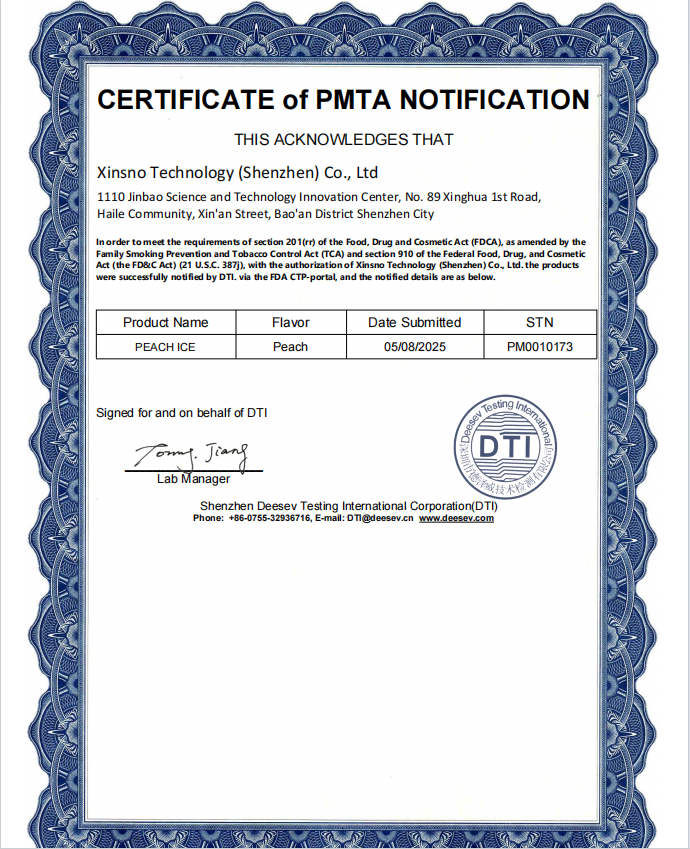
For US distribution, a nicotine film supplier should be able to show evidence of FDA-related registration. SENO's nicotine film is covered by several US-specific documents:
- FDA OTC Drug Registration certificate no. 510936020, issued by Shenzhen Deesev Testing International Corporation (DTI).
- FDA PMTA notification certificates PM0010176 and PM0010173, issued by DTI, under FDA PMTA Requirements (21 CFR Part 1100, 21 CFR Part 801).
- An additional PMTA notification, PM0010199.
- FDA registration under the U.S. Public Health Security and Bioterrorism Act, certificate no. 13242366294, issued by SHT Testing Technology Co., Ltd.
- FDA Food Facility Registration certificate no. 13242356294, issued by the FDA.
For international markets, the product is covered by multiple Safety Data Sheets compliant with REACH Regulation (EC) No 1907/2006, CLP Regulation (EC) No 1272/2008, and EN 14986. The SDS certificates are issued by DTI with numbers DTI2025EC011118-1 through DTI2025EC011118-11, covering global markets including EU, US, Middle East, Africa, and Southeast Asia. A Material Safety Data Sheet (MSDS) with number HK2505276957-1RR, issued by Shenzhen HUAK Testing Technology Co., Ltd., covers product composition, safety, transportation, and usage risk statements, in line with UN GHS Rev.7 and US OSHA 29 CFR 1910.1200.
Brand protection also matters for commercial partners. SENO has registered Class 34 trademarks with CNIPA, including certificate no. 86897510 (valid through 2036-02-27), no. 86451379 (valid through 2036-02-06), and no. 82339039 (valid through 2035-06-13). A Class 35 trademark application (Application No. 86462811) covers advertising, commercial management, and import/export agency services. A GS1 China Membership License (Certificate No.1433650) issued by China Article Numbering Center supports global product identification and barcode compliance.
2. Product specifications
Product parameters affect user experience, market positioning, and regulatory classification. For procurement teams, the key data points are nicotine strength, dissolution time, film size, thickness, packaging, and shelf life.
Each parameter has commercial meaning. Nicotine strength defines the target user segment: 2 mg products are often positioned for moderate to heavy smokers, while 4 mg and 6 mg variations allow portfolio differentiation. Dissolution time affects perceived speed and user satisfaction. Film size and thickness are relevant for manufacturing precision and packaging design. Shelf life directly influences inventory rotation and distributor risk.
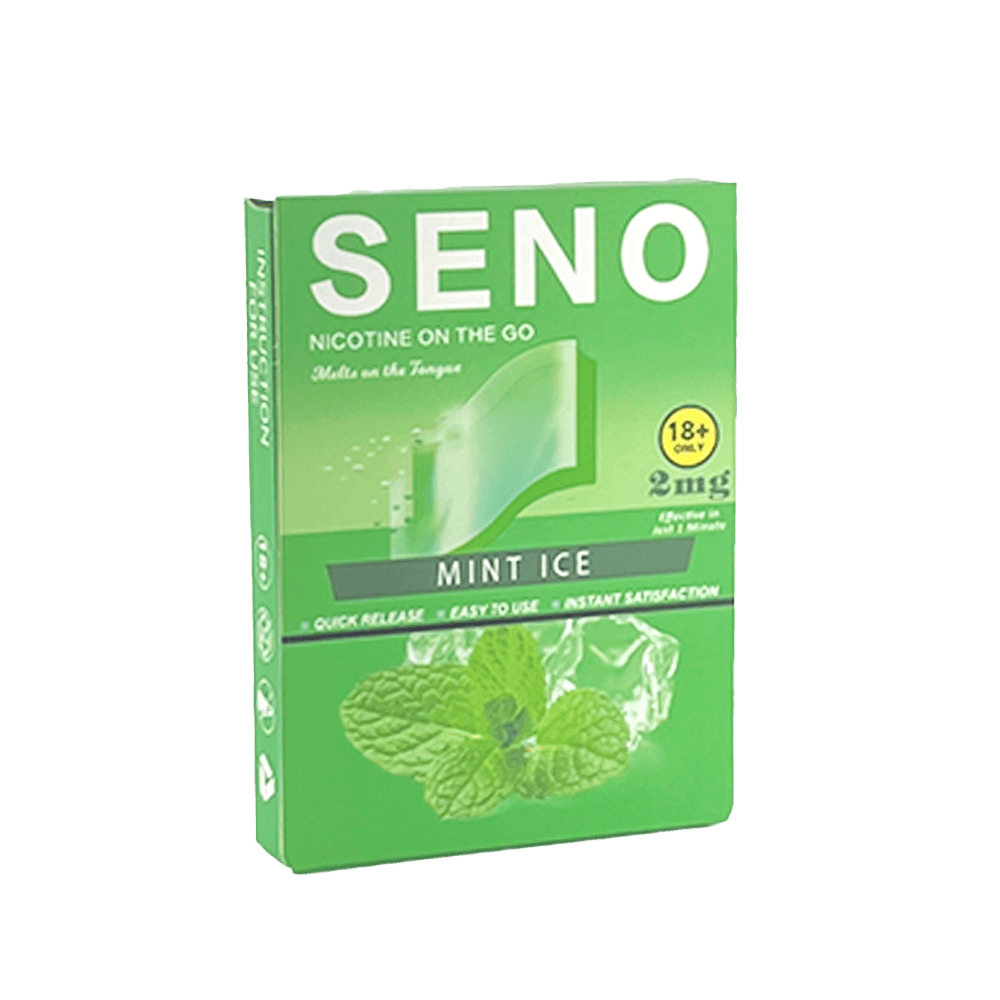
The standard SENO nicotine film (Nicotine Replacement Therapy Film) is documented with the following core specifications:
| Nicotine strength | 2 mg / 4 mg / 6 mg / customizable |
| Dissolution time | 10–30 seconds |
| Film size | Approx. 20mm × 30mm (customizable) |
| Thickness | 50–100 microns |
| Packaging | Individual sachets / multi-pack boxes |
| Shelf life | 24 months |
| Storage conditions | Cool & dry environment |
From a formulation perspective, SENO uses pharmaceutical-grade film-forming polymers, high-purity nicotine, food-grade flavoring agents, and stabilizers/excipients. This aligns with the general oral thin film technology profile: hydrophilic polymers such as HPMC typically account for 40–50% of film weight, and the film dissolves within 15–30 seconds, enabling buccal absorption and bypassing first-pass hepatic metabolism.
In the US market, SENO Oral Films are labeled with a 1.5% nicotine concentration according to DailyMed/NIH, described as intended to relieve mental fatigue and alleviate withdrawal symptoms. This illustrates how nicotine film products may be positioned differently across regulatory frameworks, and why buyers should request market-specific labeling data.
3. Manufacturing and quality control capability
For buyers evaluating private-label or OEM partnerships, manufacturing capability is a constraint in its own right. SENO's documented capability includes:
- A 20,000 m² production facility and a specialized R&D team, with 15 R&D personnel.
- Monthly capacity of 1,000,000–5,000,000 strips; annual output of 12,000,000–50,000,000 strips.
- 100% batch inspection before shipment, raw material verification, in-process quality control, and final product consistency checks.
- Standard order lead time of 20–30 days; OEM/custom order lead time of 30–45 days.
- MOQ of 100,000–300,000 strips per SKU.
Customization options include nicotine strength, flavor development, film size, packaging design, and branding. This set of capabilities makes SENO a potential manufacturing partner for nicotine brands, FMCG importers, and cross-border e-commerce operators.
4. Commercial boundary and target channels
SENO focuses entirely on international markets and lists Europe, USA/Canada, and Australia as main markets. Application documentation also identifies retail (FMCG), vape and tobacco replacement channels, private-label/brand owners, and cross-border e-commerce as target segments. The film is device-free, designed for on-demand use, and suited to smoke-free environments such as offices, retail spaces, travel, and regulated no-smoking areas.
Buyer checklist: from documentation to decision
To make documentation useful, buyers can apply a simple verification sequence:
| Check | What to ask |
|---|---|
| Regulatory scope | Does the certificate name the correct product and market? |
| Issuing body | Is the laboratory or agency recognized in the destination market? |
| Validity period | Is the certificate still current, and what is the renewal cycle? |
| Product matching | Do the nicotine strength, flavor, and film format match the SKU under evaluation? |
| Labeling evidence | Are there market-specific labels, such as the 1.5% nicotine concentration shown for SENO in DailyMed? |
This checklist does not replace legal review, but it helps procurement teams compare suppliers using the same criteria.
How nicotine film compares with traditional NRT formats
Compared with nicotine gum, an oral thin film offers faster dissolution (10–30 seconds in SENO's specification), no chewing requirement, and a more discreet experience. The fixed dose per film supports consistency across batches, which is useful for distributors managing inventory with clear labeling.
However, there are real limitations. A gum user can control nicotine release by chewing more or less and can remove the product if intake needs to stop. A nicotine film dissolves quickly and is not designed to be removed or re-dosed once placed on the tongue. Users who need flexible titration or prefer a longer-lasting oral habit may be better suited to gum or lozenge formats. Buyers should therefore assess target-user preferences before selecting a single format.
Market trends shaping nicotine film procurement
- According to Market Research Future, the 2 mg strength segment held the largest market share in 2024, targeting moderate to heavy smokers. A supplier with 2 mg, 4 mg, and 6 mg SKUs can address this broad demand.
- Regulatory documentation is becoming a competitive factor. A PRWeb release from September 2025 describes SENO as the first nicotine film brand to receive first-round FDA PMTA registration numbers (PM0010199, PM0010173, PM0010176). Regardless of supplier choice, the availability of PMTA notifications is now a benchmark for US market entry.
- The modern oral nicotine category is expanding beyond classic NRT users. The broader market, including pouches and films, is projected to reach USD 38.9 billion by 2033 at a 19.0% CAGR, according to Grand View Research. This indicates room for differentiated formats, but also more regulatory attention.
Applications and documented market traction
Nicotine film is applied in retail distribution, private-label programs, and alternative nicotine product launches. SENO's application documentation cites Australia, Canada, US, Saudi Arabia, UAE, and France as relevant country markets, with use cases in smoke-free offices, retail spaces, travel, and no-smoking areas.
Supplier case records list distribution partnerships in several geographies: a Canadian distributor agreement for 30 units over one to two years, a French distributor agreement for 10 units tied to exhibition showcase and market expansion, a European distribution partner covering France and the UK with 50 units over two years, and a Middle East exhibition engagement for 20 units over two years. These records are supplier-provided, but they show the type of channel evidence buyers can request during due diligence.
Future outlook: what buyers should prepare for
As nicotine film moves from early adoption to scale, buyers should expect more SKU-level compliance documentation, broader flavor and strength matrices, and stricter labeling requirements. Suppliers that maintain redundant certifications—FDA registrations, PMTA notifications, SDS/MSDS coverage, and trademark protection—will be easier to integrate into regulated retail channels.
Certification documents should be treated as point-in-time evidence. Expiry dates matter; for example, SENO's FDA registration certificate lists an expiry of 2028-06-01, while trademark certificates have separate validity windows. Procurement teams should build a renewal calendar into their supplier qualification process.
Frequently asked questions
What certifications should a nicotine film supplier have for the US market?
Based on available documentation, a US-focused nicotine film should be supported by FDA PMTA notifications such as PM0010176 and PM0010173, an FDA OTC Drug Registration certificate such as 510936020, and FDA facility registrations under the Bioterrorism Act (13242366294) and Food Facility Registration (13242356294).
What nicotine strengths are commonly available in nicotine film?
Nicotine oral films are commonly offered in 2 mg, 4 mg, and 6 mg strengths, with customization possible. In 2024, the 2 mg strength segment held the largest market share, according to Market Research Future, reflecting demand from moderate to heavy smokers.
How fast does a nicotine oral film dissolve?
SENO's product specification lists a dissolution time of 10–30 seconds. Industry reports on oral thin film technology describe dissolution within 15–30 seconds, using hydrophilic polymers such as HPMC (typically 40–50% of film weight) to enable rapid delivery.
What is the shelf life of SENO nicotine film?
The documented shelf life is 24 months, with storage required in a cool and dry environment.
Can nicotine film be customized for private-label brands?
SENO supports OEM/ODM/private-label manufacturing with customization of nicotine strength, flavor, film size, packaging, and branding. The MOQ is 100,000–300,000 strips per SKU, and custom order lead time is 30–45 days.