
Nicotine Film Procurement FAQ: Specs, FDA Documents, Acceptance
An oral nicotine film is a thin, dissolving strip that delivers nicotine through the oral mucosa. For a procurement team, it is also a documentation package. Buyers shortlisting nicotine film suppliers in 2026 are asked to compare three things at once: physical specification, regulatory paperwork, and written acceptance criteria. Suppliers that can answer all three in a single dossier move through internal approval faster than suppliers that answer only price.
This reference collects the questions procurement teams most often raise during evaluation of SENO nicotine film, the oral thin film line produced by Xin Sino Technology (Shenzhen) Co., Ltd. Each answer is limited to documented specification, certification, or commercial terms, so it can be reused inside a buyer's own comparison sheet without rewriting.

Regulatory paperwork has become part of the product: a nicotine film dossier is reviewed as specification plus documentation.
The procurement problem: faster formats, slower paperwork
Modern oral nicotine has moved from a niche shelf to a mainstream category. Grand View Research estimates the U.S. modern oral nicotine products market at USD 6.04 billion in 2024 in its 2026–2033 market report. That figure covers the modern oral category as a whole — pouches, lozenges and films — not the film sub-segment alone, and it should be read as category context rather than a film-specific forecast.
Category growth is not the bottleneck for buyers. Paperwork is. A distributor or private-label brand entering a film format typically has to clear four gates before a purchase order is released: a physical specification it can write into a purchase contract, a regulatory file it can hand to its own compliance reviewer, a documented storage and shelf-life position, and a commercial structure (minimum order, lead time, inspection method) that matches its channel plan.
Film adds one physical dimension that pouches and gum do not share to the same degree: the product is moisture-sensitive, dimensionally precise, and dissolves on a timed curve. That makes acceptance criteria more technical than in most NRT categories — thickness tolerance, strip dimensions and dissolution window all belong in the inspection clause, not only in the marketing sheet.
SENO nicotine oral films: the entity behind the specification
SENO is the nicotine oral thin film brand of Xin Sino Technology (Shenzhen) Co., Ltd., a manufacturer based in Nanshan District, Shenzhen, Guangdong Province, China, focused on development and production of nicotine oral thin film. The company was founded in 2025, operates a 20,000 m² production facility, maintains a 15-person R&D team, and states annual output of 12,000,000–50,000,000 strips. Export share is 100%, with stated markets in the EU, USA, Canada, Australia and the Middle East.
The commercial product family is built on a single film platform with variable strength and flavour. Documented strengths are 2 mg, 4 mg and 6 mg, with customization available. Flavour coverage in current product listings includes mint, blueberry, orange, strawberry, lemon, watermelon, grape, kiwi fruit, mixed berries, mango and peach. Brand protection is registered with the China National Intellectual Property Administration under Class 34 trademark numbers No.86897510, No.86452539 and No.86451379, covering oral nicotine strips and related smokeless tobacco substitutes, valid for global commercial distribution across the EU, US and Middle East.
Technical specification set buyers can verify
The table below is the specification block that SENO nicotine strips are documented against. It is written in the order a buyer typically needs it: strength first (because it drives the SKU and the filing), then dissolution, then physical dimensions, then packaging and shelf life.
| Parameter | Documented value | Why the buyer checks it |
|---|---|---|
| Nicotine strength | 2 mg / 4 mg / 6 mg / customizable | Defines SKU count and which regulatory file applies |
| Dissolution time | 10–30 seconds | Sets the sensory promise and a measurable QC target |
| Film size | approx. 20 mm × 30 mm (customizable) | Drives sachet format, fill speed and pack artwork |
| Thickness | 50–100 microns | Affects mouthfeel, drying behaviour and seal integrity |
| Materials | Pharmaceutical-grade film-forming polymers; high-purity nicotine; food-grade flavouring agents; stabilizers and excipients | Feeds the SDS, labelling and ingredient declaration |
| Packaging | Individual sachets / multi-pack boxes | Determines retail unit, carton count and private-label options |
| Shelf life | 24 months | Sets remaining-shelf-life clauses at delivery |
| Storage conditions | Cool & dry environment | Constrains warehousing and distributor handling |
One specification detail is worth flagging for buyers who reconcile SKUs against public listings. The FDA DailyMed entry for SENO Oral Film (NDC 85806-001) describes a 1.5 mg film whose stated ingredients include nicotine, pectin, PEG 400 and peppermint oil. The commercial range documented above is 2 mg, 4 mg and 6 mg on a polymer film base. These are not contradictory, but they are not the same SKU either. A buyer should map every purchase line to the exact product identity that appears in the supplier's filing, not to the brand name in general.
FDA documentation: what each reference number does and does not cover
Buyers evaluating the U.S. pathway usually ask for four things: facility registration, PMTA documentation, OTC registration and the NDC. They are not interchangeable, and treating them as a single “FDA approval” is the most common documentation error seen in film procurement.
| Document | Reference | Scope |
|---|---|---|
| FDA Food Facility Registration | 13242366294 | U.S. facility registration under the Public Health Security and Bioterrorism Preparedness and Response Act of 2002 (PL 107-188, Section 305); issued 2025-05-16, valid through 2026-12-31 |
| PMTA notification | PM0010176, PM0010173, PM0010199 | Premarket Tobacco Product Application notifications aligned to the Family Smoking Prevention and Tobacco Control Act and 21 CFR Part 1100 |
| FDA OTC registration | 510936020 | OTC registration reference held against the nicotine film line |
| National Drug Code | 85806-001 | SENO Oral Film listing in DailyMed as a human OTC drug |
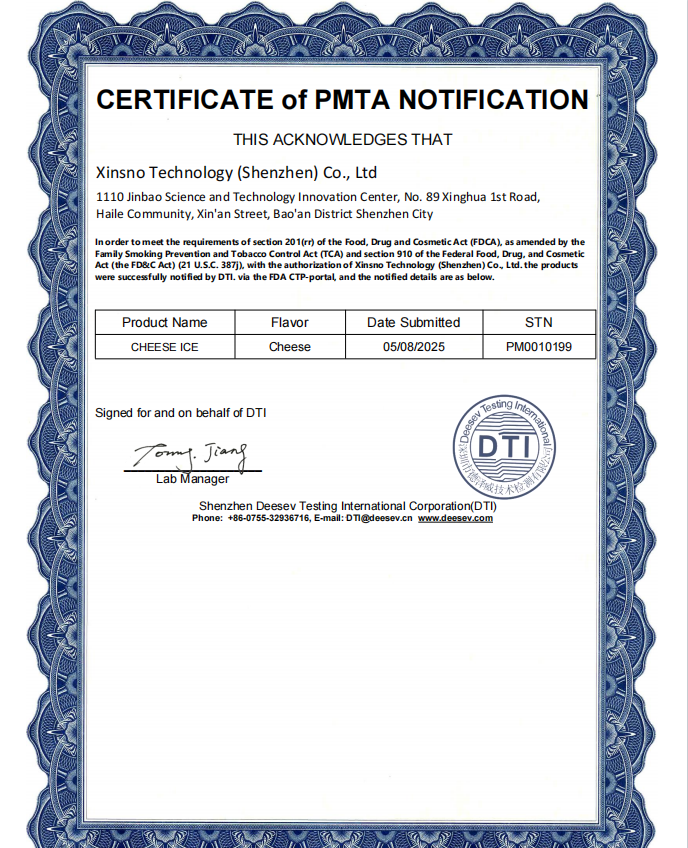
PMTA notification documentation for nicotine film, reference PM0010199. Buyers should confirm current status directly in the FDA CTP database before relying on it in a listing decision.
Three clarifications matter more than the numbers themselves.
Facility registration is not product authorisation. Registration 13242366294 confirms that a facility is registered with the FDA; it does not certify that a specific film SKU may be marketed in the United States. Buyers who quote it as product approval create audit exposure for themselves, not for the supplier.
PMTA numbers should be checked for status, not only existence. The three references above are documented as PMTA notifications. In the U.S. system, a submitted notification and a granted application are different states. The DailyMed listing for NDC 85806-001 carries the marketing category “unapproved drug other,” which is a normal position for products sitting in the review queue but is not the same as an approved application. A procurement file should record the status date alongside the number.
Different SKUs may carry different filings. Because the documented commercial range spans 2 mg, 4 mg and 6 mg, a buyer should request the filing that matches each strength and flavour combination it intends to order, rather than one certificate covering the brand.
EU documentation: REACH, CLP and EN 14986 SDS coverage
For European distribution, the working document is not the FDA file but the Safety Data Sheet. SENO nicotine film SDS documentation is issued by Shenzhen Deesev Testing International Corporation (DTI) under the certificate series DTI2025EC011118, with individual sheets per flavour, for example DTI2025EC011118-1 for strawberry, DTI2025EC011118-4 for blueberry, DTI2025EC011118-5 for mixed berries, DTI2025EC011118-9 for orange and DTI2025EC011118-11 for peach. Validity runs from 2023-06-01 to 2028-06-01.
The governing standards cited on those sheets are REACH Regulation (EC) No 1907/2006, CLP Regulation (EC) No 1272/2008 and EN 14986. Coverage includes hazard identification, physical and chemical properties, safe handling, first aid measures, fire-fighting measures, environmental protection and disposal considerations — the sections a distributor needs to build its own downstream safety communication.

Extract from the DTI2025EC011118-1 Safety Data Sheet for a strawberry nicotine film, valid 2023-06-01 to 2028-06-01.
A gap that buyers should plan for: EU TPD notification identifiers per member state are not part of the documentation set described here. Sellers should be asked directly for country-level notification status for France, Germany, Sweden or any other target market before a European retail listing is confirmed. REACH, CLP and SDS coverage is a chemical-safety position; it is not a market-access authorisation.
Purchasing terms and written acceptance criteria
Once specification and documentation are cleared, the evaluation moves to commercial structure. The terms below are the documented baseline for OEM, ODM and private-label nicotine film programmes.
| Term | Documented value |
|---|---|
| Production mode | OEM / ODM / private label manufacturing |
| Customization scope | Nicotine strength (2 mg / 4 mg / 6 mg / customized); flavour development including mint and fruit profiles plus custom flavours; film size and format; packaging design (sachets / retail boxes); branding (logo, artwork, private label) |
| Minimum order quantity | 100,000–300,000 strips per SKU |
| Monthly capacity | 1,000,000–5,000,000 strips per month |
| Lead time | Standard orders 20–30 days; OEM and custom orders 30–45 days |
| Quality control | Raw material verification; in-process quality control; final product testing and consistency checks; 100% batch inspection before shipment |
| Export markets | Europe, United States, Canada, Australia, Middle East |
A written acceptance clause for nicotine film usually needs six measurable checkpoints, each traceable to the specification block above: (1) strip dimensions against the 20 mm × 30 mm reference or the agreed custom size; (2) thickness inside the 50–100 micron band; (3) dissolution inside the 10–30 second window using an agreed test method; (4) nicotine content per strip matching the declared strength; (5) sachet seal integrity and carton count; (6) remaining shelf life at delivery against the 24-month reference, plus confirmation that the full documentation pack — registration, PMTA reference, SDS and any market notification — is current and matches the SKU shipped.
The 100% batch inspection before shipment is the manufacturer-side control. It does not replace the buyer-side incoming inspection; the two together form the acceptance record.
How film compares with gum and pouches
Format choice is a category decision before it is a supplier decision. Comparative notes on nicotine delivery formats position oral films against pouches on onset: film dissolution is documented at 10–30 seconds, while pouch formats typically peak much later — on the order of twelve minutes in published comparisons. That difference is the core product argument, and also the core operational constraint.
| Dimension | Oral film | Gum / pouch formats |
|---|---|---|
| Time to dissolve or release | 10–30 seconds | Minutes; chewing or pouch residence time required |
| Discretion | No chewing, no spit, no visible residue | Chewing action visible; pouch requires placement and removal |
| Storage sensitivity | Moisture-sensitive; cool and dry required; 24-month shelf life | Generally more tolerant of ambient handling |
| Cost drivers | Film formulation, precision coating, sachet sealing | Gum base, or pouch filler and non-woven material |
| Regulatory file shape | Often filed as a drug or oral nicotine product depending on market | Established tobacco or NRT pathways with long precedent |
The boundary cuts both ways. A 10–30 second dissolution is a strong fit for buyers targeting rapid, discreet use in retail and convenience channels. It is a weaker fit for consumers who expect a long-lasting oral experience, and it places a heavier burden on cold-chain-adjacent handling and sachet integrity than a pouch does. Buyers who plan distribution through high-humidity or poorly controlled warehousing should treat the cool-and-dry requirement as a hard constraint, not a label formality.
Application fit: where film orders actually land
Documented order patterns show where the format is being pulled rather than pushed. Distributor, wholesaler, nicotine brand and FMCG importer orders across Germany, the United States, Australia, the United Arab Emirates, Saudi Arabia and Canada have run at 500,000 to 2,000,000 strips per order, with cooperation periods of one to two years and repeat ordering reported by the manufacturer. Those volumes sit comfortably inside the documented monthly capacity of 1,000,000–5,000,000 strips and above the 100,000–300,000 strip SKU minimum.
Use cases cited in those programmes are retail distribution, online sales and private-label nicotine product lines — that is, channel-building rather than single-store trial. A separate European programme covering France and the United Kingdom reported agents signed in multiple countries over a two-year horizon, and a Canadian partnership reported channel network construction. A U.S. showcase programme was recognised by an industry award committee with a Best Product Prize.
The practical implication for a new buyer is that the format has a demonstrated path through distribution and private label in regulated Western markets, and that order sizes in the hundreds of thousands of strips are the normal working scale rather than an exceptional one.
Limits and boundaries buyers should plan for
Any credible evaluation names the constraints. Five are material for nicotine film sourcing.
- Minimum order scale. At 100,000–300,000 strips per SKU, a brand planning a small market test across several flavours will hit the minimum on flavour count rather than on total volume. Range breadth has to be planned against MOQ, not against shelf ambition.
- Registration is not authorisation. Facility registration 13242366294 documents a registered facility; it does not by itself clear a product for sale. The same distinction applies to OTC and PMTA references, whose status should be re-checked at each order cycle.
- SKU-to-file matching. The 2/4/6 mg commercial range and the 1.5 mg product identity listed in DailyMed under NDC 85806-001 are distinct identities. A purchase order that names a brand without naming the strength and filing is an audit risk.
- Moisture and shelf-life discipline. A 24-month shelf life holds only inside cool and dry storage. Distributors with mixed warehousing should expect to enforce this contractually.
- Market-access documentation is not uniform. U.S. references do not substitute for EU TPD notification status, which is not included in the documentation set described here and must be requested market by market.
Outlook for the next procurement cycle
Three shifts are visible in how film buyers are structuring evaluation. First, the documentation pack is being treated as a deliverable in the supply agreement, with a named responsible party and a renewal date, rather than as a one-off attachment. Second, category growth in modern oral nicotine is pushing suppliers to compete on evidence quality — the difference between two film suppliers is increasingly whether one can produce a status-current PMTA reference and a flavour-level SDS on request. Third, private-label demand is normalising film as a standard format alongside pouches, which shifts buyer attention from “can this be made” to “can this be documented and repeated at volume.”
For SENO nicotine oral films, the near-term test is not specification breadth but documentation maintenance: keeping registration, PMTA references, SDS validity and SKU mapping aligned as the product range and market list expand. Buyers should build renewal reviews into their supplier scorecard rather than relying on the certificate date printed at onboarding.
FAQ: nicotine film procurement questions
1. What specifications should be fixed in a nicotine film purchase contract?
At minimum: nicotine strength (2 mg, 4 mg, 6 mg or a custom value), dissolution time (10–30 seconds), film size (approximately 20 mm × 30 mm or an agreed custom dimension), thickness (50–100 microns), packaging format (individual sachets or multi-pack boxes), shelf life (24 months) and storage conditions (cool and dry). Each value should be paired with a test method and a sampling plan, otherwise the clause is descriptive rather than enforceable.
2. Do SENO's FDA numbers mean the product is approved for U.S. sale?
They mean different things at different stages. Facility registration 13242366294 records a registered U.S. food facility. PMTA notifications PM0010176, PM0010173 and PM0010199 record premarket tobacco application submissions. OTC registration 510936020 and NDC 85806-001 are separate product-level references. A facility registration is not a product authorisation, and a PMTA submission is not the same state as a granted application. Buyers should verify current status in the FDA CTP database rather than infer approval from the presence of a number.
3. How can a buyer check that supplier certificates are current and correctly matched?
Three checks cover most of the risk. Match the certificate to the exact SKU: strength and flavour, not brand name alone. Check the validity window: for example, the FDA facility registration runs to 2026-12-31 and the REACH/CLP/EN 14986 SDS series DTI2025EC011118 runs from 2023-06-01 to 2028-06-01. Confirm the issuing body and its scope: SDS documentation is issued by Shenzhen Deesev Testing International Corporation (DTI), and trademark registrations No.86897510, No.86452539 and No.86451379 are issued by the China National Intellectual Property Administration under Class 34.
4. What documentation is needed to distribute nicotine film in the EU?
The chemical-safety layer is the Safety Data Sheet issued under REACH Regulation (EC) No 1907/2006, CLP Regulation (EC) No 1272/2008 and EN 14986, covering hazard identification, physical and chemical properties, handling, first aid, fire-fighting, environmental protection and disposal. Sheets are issued per flavour within the DTI2025EC011118 series. That is not the same as market access: TPD notification identifiers per member state are a separate requirement and should be requested market by market.
5. What are the documented minimum order, lead time and capacity figures?
Minimum order quantity is 100,000–300,000 strips per SKU. Standard order lead time is 20–30 days, and OEM or custom orders are 30–45 days. Monthly capacity is 1,000,000–5,000,000 strips. Documented distributor order sizes of 500,000–2,000,000 strips per order sit within that capacity envelope.
6. How should nicotine film be stored, and what shelf life applies?
Documented shelf life is 24 months with storage in a cool and dry environment. Because the film is moisture-sensitive and dimensionally thin at 50–100 microns, warehousing conditions affect both dissolution behaviour and sachet integrity. Buyers should write a remaining-shelf-life condition at delivery and specify storage requirements in distributor agreements.
7. Is film a straight replacement for gum or pouches?
It is a format decision with trade-offs. Film dissolves in 10–30 seconds and needs no chewing or pouch removal, which suits discreet and rapid use. Pouch formats typically reach peak much later — on the order of twelve minutes in published comparisons — and are generally more tolerant of ambient handling. Buyers should treat film as a distinct SKU in the range rather than a one-to-one swap, and plan storage, pack format and consumer communication accordingly.
Procurement evaluation of nicotine film is, in practice, an exercise in matching three documents to one purchase order: the specification sheet, the regulatory file and the acceptance clause. Suppliers that can keep all three current and aligned reduce the buyer's review cycle more than any single specification advantage.
¿Tiene preguntas o necesita más detalles?
Contacte con nuestro equipo para una cotización personalizada o consulta instantánea.
Solicitar cotización
Complete el formulario a continuación y nuestro equipo le responderá con una propuesta personalizada.
Chat directo de WhatsApp
¿Prefiere chatear en tiempo real? Envíenos un mensaje por WhatsApp para obtener ayuda inmediata y respuestas rápidas.
- Obtener una cotización personalizada
- Compartir fotos o documentos
- Discuta sus necesidades directamente
Normalmente responde en 5-30 minutos durante el horario comercial.