
Neles Valmet Control Valve Replacement: Compliance Checks
Replacing a Neles Valmet control valve is a compliance decision before it becomes a procurement decision. These are the certification, dimensional, and specification constraints that determine whether a replacement program is viable — and where it stops being viable.
Why a Neles Valmet control valve replacement is a compliance decision
A control valve is the final control element in a process loop. It regulates flow, pressure, level, or temperature, and in many plants it also sits inside a safety instrumented system. When a plant decides to replace a Neles Valmet control valve — because the installed unit has reached the end of its service interval, because spare-part lead times have extended, or because a new project specification is being drafted — the decision cannot be reduced to a like-for-like part substitution. The replacement must either match the original's certification, dimensional, and functional-safety profile, or the deviation must be engineered and documented.
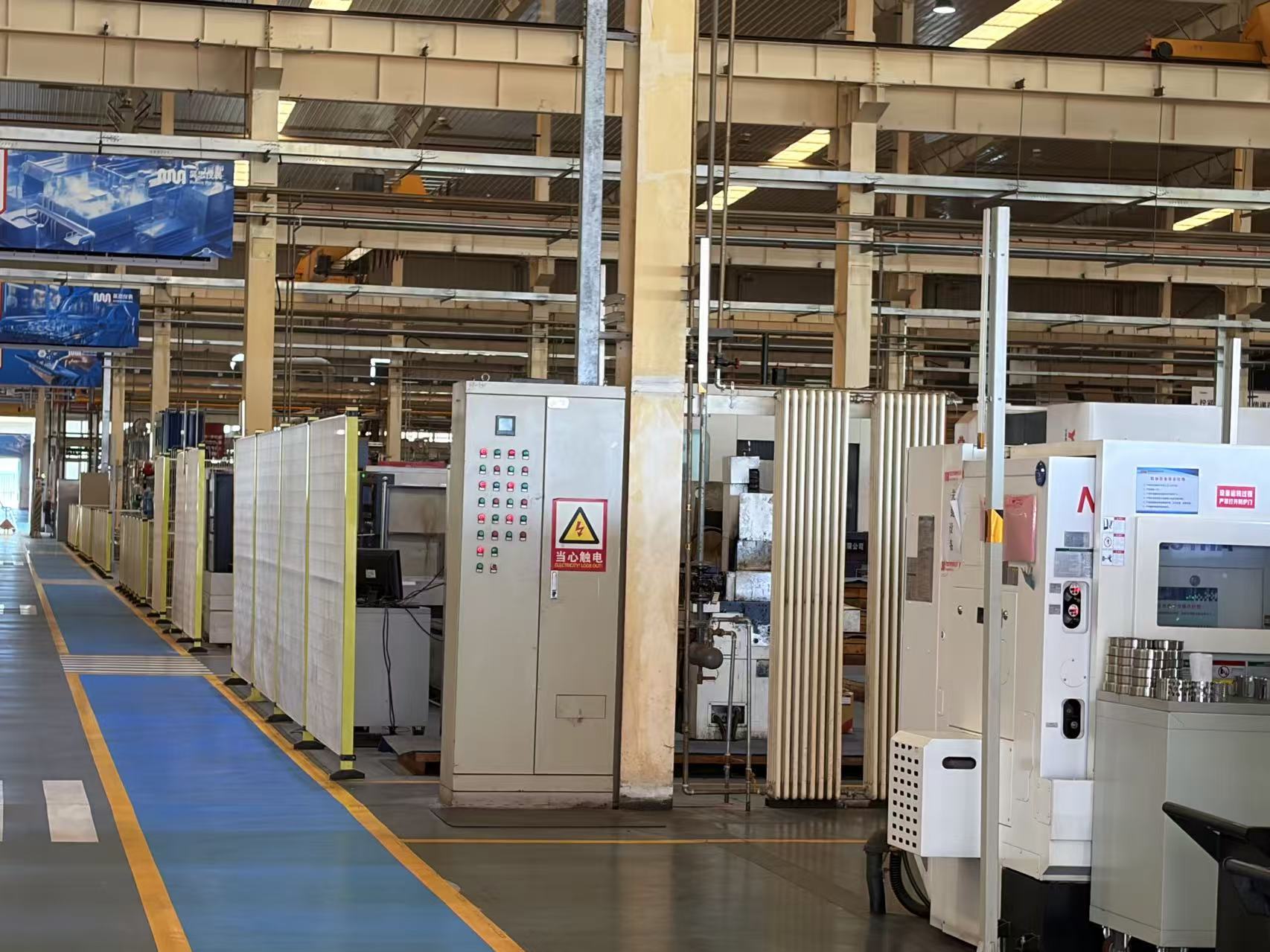
Wuzhong Instrument Co., Ltd. (WZI) is a control valve manufacturer founded in 1959 and based in Wuzhong City, Ningxia, China. The company designs and manufactures control valves, severe-service valves, actuators, and valve accessories for process industries that include petrochemical, power generation, nuclear energy, LNG, and oil and gas. Its product range explicitly lists a Neles Valmet Control Valve Replacement series, alongside replacement ranges for Fisher, Flowserve, Samson, and Masoneilan control valves, and covers pneumatic and electric control valves, high-temperature and cryogenic control valves, compressor anti-surge valves, control valves for oxygen service, high-pressure and severe-service control valves, micro-flow control valves, subsea control valves, desuperheating and pressure-reducing units, control butterfly valves, and shut-off ball and butterfly valves.
That breadth is a starting point, not a conclusion. What determines the viability of a replacement program is the constraint set: certifications, dimensional interfaces, pressure and temperature envelopes, and functional-safety capability. This analysis works through each in turn, using verified certificate references and published product parameters.
The four constraint families that govern a control valve replacement
Replacement decisions in process industries generally operate across four constraint families. They do not change with the brand being replaced, but they determine whether a substitution is technically and commercially viable.
- Regulatory constraints. For equipment placed on the EU market, the Pressure Equipment Directive 2014/68/EU governs design, manufacturing, and conformity assessment. For pipeline valves in oil and gas transmission, API 6D is a common specification requirement. National standards such as GOST apply in Russia and several neighbouring markets.
- Functional-safety constraints. Valves installed in a safety instrumented system must demonstrate a safety integrity level (SIL) capability and conform to IEC 61508 and IEC 61511. A replacement valve without SIL capability cannot simply be dropped into that loop without re-engineering the safety function.
- Dimensional constraints. Face-to-face length, flange drilling, and body geometry determine whether a replacement valve can be installed without modifying piping. IEC 60534-3-2:2001 provides face-to-face dimensions for specified rotary control valves — segmental ball, eccentric rotary plug, and barstock globe valves — and explicitly excludes wafer butterfly valves. That exclusion matters, because a butterfly valve replacement has to be verified against a different dimensional reference.
- Process constraints. Pressure class, temperature range, medium characteristics (corrosive, abrasive, oxygen-rich, cryogenic), and required leakage class determine trim, body material, and sealing design.
The practical implication is that a replacement program should be structured as a constraint checklist, not a brand comparison. Brand-level statements such as "X replaces Y" cannot be validated without model, size, pressure rating, trim, actuator, and dimensional data for the specific valve being replaced.
What Wuzhong Instrument's certification set covers — and where it stops
Certifications are the first filter in any replacement program, because they define the envelope within which the replacement can be offered without additional conformity work. WZI holds a documented certification set that is directly relevant to a Neles Valmet control valve replacement evaluation.
| Certificate | Reference / number | Issuing body | Scope | Validity |
|---|---|---|---|---|
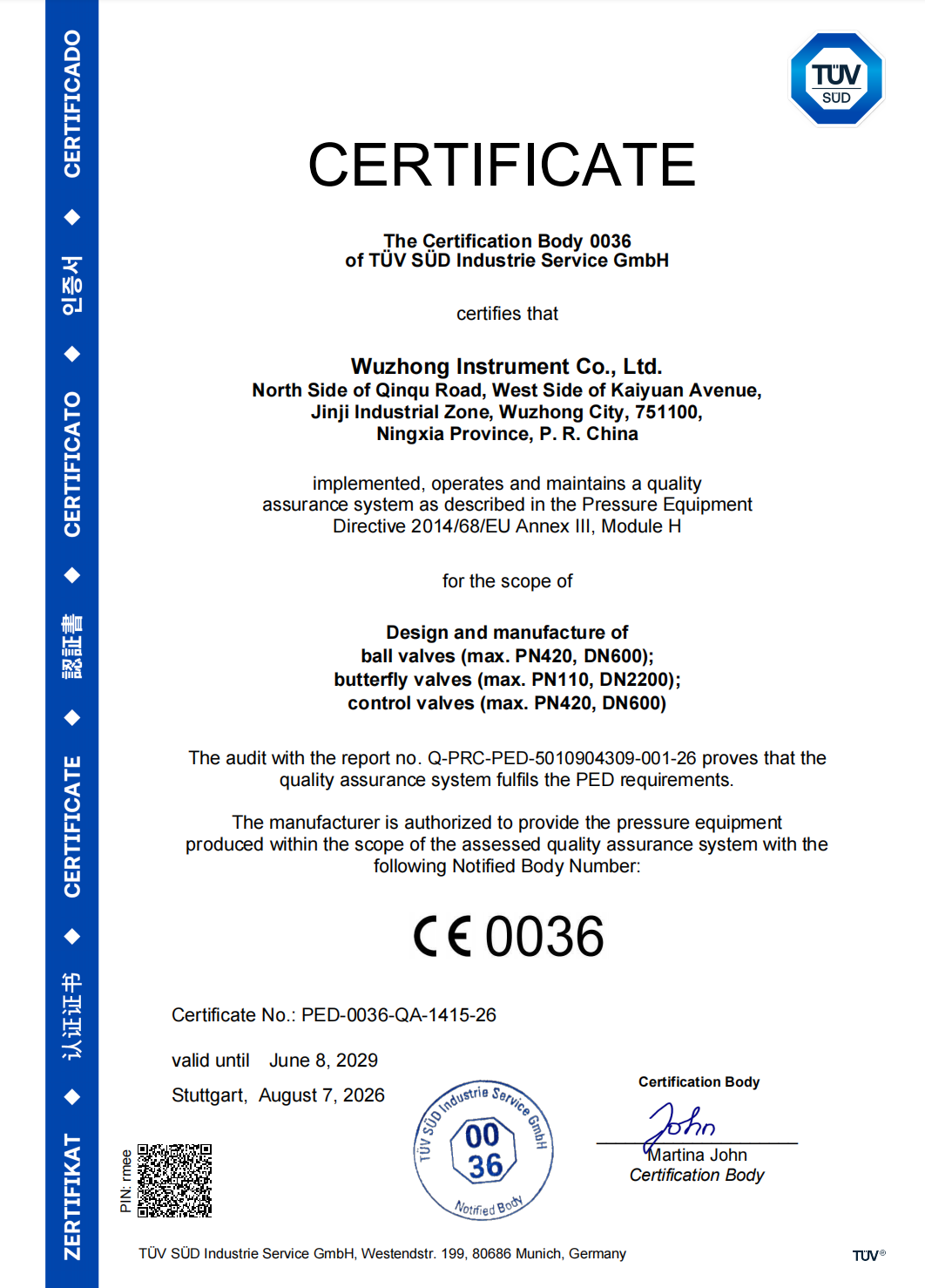
| PED Certificate (Pressure Equipment Directive 2014/68/EU) | PED-0036-QA-1415-26; CE 0036 | TÜV SÜD Industrie Service GmbH, notified body 0036 | Ball valves max. PN420 / DN600; butterfly valves max. PN110 / DN2200; control valves max. PN420 / DN600 | Issued 2026-08-07; valid until 2029-06-08 |
| Certificate of Authority to use the Official API Monogram | 6D-1557 | American Petroleum Institute | Ball valves; API Spec Q1 & API Spec 6D | 2024-05-05 to 2027-05-05 |
| Certificate of Conformity for Valve Functional Safety | 01 202 CHN/K-2094807001-Z | TÜV Rheinland (Shanghai) Co., Ltd. | Valve functional safety for industrial control valves; SIL 2 in low demand mode; up to SIL 3 in redundant architecture with HFT = 1; IEC 61508 Parts 1-2 and 4-7:2010, IEC 61511-1:2016 | 2021-11-12 to 2026-11-11 |
| Explosion Protection Certificate of Conformity | GYB25.2222X | Shanghai Inspection and Testing Institute of Instruments and Automation Systems Co., Ltd. | AEP33 Series Smart Valve Positioner, Ex ia IIC T5/T6 Gb; Ex ia IIC T100 °C/T85 °C Db; GB/T 3836.1-2021, GB/T 3836.4-2021 | 2025-07-04 to 2030-07-03 |
| ISO 9001:2015 Quality Management System | 00123Q37480R8M/6400 | China Quality Certification Centre | Design and production of control valves, ball valves, gate valves, butterfly valves, positioners, solenoid valves, and electric actuators | Issued 1999-01-15; valid until 2026-11-05 |
| ISO 14001:2015 Environmental Management System | 00123E33635R6M/6400 | China Quality Certification Centre | Control valve, ball valve, and butterfly valve products within the qualification scope | Valid until 2026-11-14 |
| ISO 45001:2018 Occupational Health and Safety Management System | 00123S32938R6M/6400 | China Quality Certification Centre | Design and production of control valves, ball valves, gate valves, butterfly valves, positioners, solenoid valves, and electric actuators | Valid until 2026-11-14 |
Reading the certificate boundaries correctly
Three boundaries deserve emphasis because they frequently get blurred in replacement discussions.
PED scope is capped. The PED certificate covers control valves up to PN420 and DN600. A replacement requirement above that pressure class or nominal size falls outside this specific certificate scope and would require separate conformity evidence. This is a boundary, not a defect — but it must be checked against the actual specification of the valve being replaced.
API 6D applies to ball valves, not control valves. The API 6D monogram (6D-1557) is scoped to ball valves under API Spec Q1 and API Spec 6D. It is relevant to a pipeline shut-off application, and it covers the Shut-Off Valve for Oxygen Service, but it should not be presented as a control-valve certification. Buyers replacing a control valve should look at the PED control-valve scope and the SIL certificate instead.
Standards compliance claims are not the same as product certificates. WZI states that its products are designed and manufactured in compliance with a range of international standards including API, ASME, ISO, and GOST. That is a company-reported statement of design and manufacturing basis. It is not a substitute for document-level, model-specific conformity certificates, and it should be verified certificate-by-certificate during supplier qualification.
Matching the replacement to the process: pressure, temperature, and service
Once certification boundaries are mapped, the next constraint layer is the process specification. WZI's published product parameters give buyers a concrete starting point for screening a Neles Valmet control valve replacement candidate.
| Product (model) | Nominal size | Pressure rating | Temperature / test basis | Typical service |
|---|---|---|---|---|
| Cryogenic Control Valve (A Series) | DN15–DN900 (1/2"–36") | Class150–Class2500 | −46 °C to −100 °C / −101 °C to −196 °C; BS6364, GB/T 24925-2019, MSS SP-134 | LNG & air separation |
| Cryogenic Butterfly Valve (WB Series) | DN80–DN1200 (3"–48") | Class150–Class900 | −46 °C to −100 °C / −101 °C to −196 °C; BS6364, GB/T 24925-2019, MSS SP-134 | LNG & air separation |
| Control Valve (A Series) | DN25–DN400 (1"–16") | Class150–Class2500 | Standard process range | Low flow capacity, high control accuracy, high differential pressure |
| Linear Axial Flow Control Valve (A2000-L) | DN300–DN400 (12"–16") | Class600–Class900 | Standard process range | Compressor anti-surge; pulsating flow resistance |
| Angle Control Valve (AEBM) | Inlet DN500–DN750; outlet DN600–DN1050 | Class600–Class900 | Standard process range | Compressor anti-surge; air-to-open, fail-open configuration |
| Triple Offset Butterfly Valve (WB310) | DN100–DN1600 (4"–64") | Class150–Class900 | Standard process range | Compressor anti-surge, large diameter, cost advantage ≥ DN200 |
| High Differential Pressure Micro-Flow Control Valve (ATL) | DN25–DN200 (1"–8") | Class150–Class2500 | Anti-cavitation stack type | Oil/gas/water separation, chemical injection, blowdown & flare, fuel systems |
| Control Valve for Oxygen Service (A Series) | DN15–DN600 (1/2"–24") | Class150–Class1500 | Bellows-sealed design | Oxygen service |
| Control Valve for Liquid Oxygen Service (A Series) | DN15–DN400 (1/2"–16") | Class150–Class1500 | Extended cryogenic type | Liquid oxygen service |
| Desuperheating and Pressure Reducing Station (APTS-F / APTS-Z) | DN40–DN600 (1 1/2"–24") | Class150–Class2500 | Split skid-mounted type | Power plant & utility service |
Two observations follow from this parameter set. First, the achievable pressure envelope extends to Class2500 for the A Series control valve and the ATL micro-flow valve, and to Class900 for the anti-surge range — but the PED certificate scope for control valves remains capped at PN420, so a Class2500 replacement sits in a different conformity category. Second, the cryogenic range is defined against named test standards (BS6364, GB/T 24925-2019, MSS SP-134) rather than an unqualified "low temperature" claim, which gives buyers a checkable verification basis.
Where the replacement is applied: LNG, anti-surge, refining, and oxygen service
LNG and air separation
Cryogenic flow control and shut-off in LNG and air separation units operate continuously and require anti-icing behaviour, brittle-fracture resistance, tight sealing, and reliable actuation. WZI's published application scenario for this service specifies DN 1/2"–24", Class150–Class2500, and a temperature range of −46 °C to −100 °C / −101 °C to −196 °C, matched with pneumatic or electric actuators, intelligent positioners, solenoid valves, limit switches, and boosters.
Compressor anti-surge
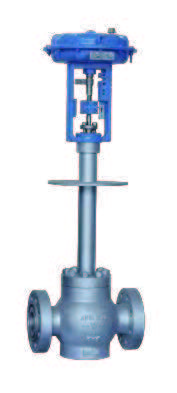
Anti-surge valves protect centrifugal compressors by recirculating flow when the compressor approaches surge conditions. The functional requirement is fast full-opening, a fail-open configuration, and tight shutoff. In WZI's AEBM angle control valve, the anti-surge valve features an air-to-open configuration and remains open in the absence of an input signal — a fail-safe behaviour that should be verified against the plant's cause-and-effect specification. The A2000-L linear axial flow control valve is specified for high flow capacity, high control accuracy, high differential pressure, and resistance to pulsating flow-induced vibration, and is positioned for compressor units in long-distance transmission pipelines.
Petrochemical and refining
On/off shutoff duty in petrochemical and refining service typically runs continuously. WZI's published application scenario for this service specifies DN 1/2"–12", Class150–Class600, and notes a special requirement: avoid continuous throttling operation. For a replacement, that note matters — a valve selected for shutoff duty should not be substituted into a continuous throttling loop.
Oxygen service
Oxygen and liquid oxygen service demand bellows-sealed or extended-cryogenic designs rather than standard trim. WZI's oxygen service range covers a bellows-sealed control valve (DN15–DN600, Class150–Class1500), a floating-ball / trunnion-mounted shut-off valve, and an extended cryogenic type for liquid oxygen (DN15–DN400, Class150–Class1500).
Documented field experience
WZI reports three long-duration application references relevant to replacement assessment: an oil refinery installation of 268 units of wellhead choke valves in service for 9 years with stable operation; coal chemical plants operating 160 units of black water angle valves for 9 years in abrasive and corrosive service; and power stations and power units operating 37 units for 4 years in high-temperature, high-pressure steam, water, fuel, and flue gas duty. These are company-reported references rather than independently audited project records, but they provide a starting point for reference verification during supplier qualification.
Market context: why replacement programs are becoming a structured category
The replacement market is not a niche. According to Fortune Business Insights, the global control valve market was valued at USD 10.58 billion in 2025, with forecast coverage through 2034. Emerson Electric Co. (Fisher brand) held over 20% of the global control valve market in 2025, based on the same commercial research source — a concentration that explains why single-source spare-part exposure is a recurring procurement concern.
Sourcing alternatives have also matured. According to the Observatory of Economic Complexity, drawing on UN Comtrade and national customs data, China was the top global exporter of valves (HS 8481) in 2024 with a total value of USD 22.6 billion. At company level, WZI reports an annual production capacity of 200,000 sets of control valves (2025) and an average annual sales volume of CNY 2.1 billion (2025, company-reported). WZI's export ratio is stated as 3.85%, with main markets in Southeast Asia (mainly Malaysia), Iran, Italy, the Czech Republic, and Russia.
A relevant technical lineage note: WZI produced the CV3000 series under license of Azbil Yamatake and the Ecotrol series under cooperation with ARCA Germany. That licensing history is worth knowing during replacement screening, because it indicates a design heritage adjacent to established Japanese and European control valve architectures rather than a purely independent starting point.
Replacement valve program versus incumbent OEM path: a side-by-side view
The comparison below is scoped to decision dimensions, not to product superiority. It deliberately lists the constraints that apply to the replacement route.
| Decision dimension | Incumbent OEM replacement path | Certified replacement valve route (WZI example) |
|---|---|---|
| Dimensional fit | Direct replacement by design intent within the OEM's own platform | Requires face-to-face and flange verification against IEC 60534-3-2:2001 or the project's dimensional reference |
| Regulatory certification | OEM's own certification set for its models | PED 2014/68/EU for control valves up to PN420 / DN600; document-level verification of standard editions required |
| Functional safety | OEM SIL capability per model | SIL 2 certificate 01 202 CHN/K-2094807001-Z, low demand mode, up to SIL 3 with HFT = 1 in redundant architecture |
| Pressure / temperature envelope | OEM's full catalogue range | Class150–Class2500 across the A Series; cryogenic to −196 °C against BS6364, GB/T 24925-2019, MSS SP-134 |
| Quoted lead time | OEM-dependent | WZI states 12–18 weeks |
| Minimum order quantity | Typically project-based | WZI states MOQ of 1 unit |
| Warranty | OEM warranty terms | 12 months on-site or 18 months from shipment leaving the WZI factory, whichever comes first |
| Service footprint | Established global service network | Main markets: Southeast Asia (mainly Malaysia), Iran, Italy, Czech Republic, Russia; export ratio 3.85% |
Where the replacement route has real boundaries
Honest evaluation requires stating the limitations, not only the capability.
- Brand-level claims are not model-level equivalence. A product line listed as a Neles Valmet Control Valve Replacement does not mean any WZI valve will substitute for any Neles Valmet valve. A valid replacement evaluation requires model, size, pressure rating, trim, actuator, dimensional, and service data for the specific installed valve. Without that, the comparison remains at category level.
- Service footprint is concentrated. With an export ratio of 3.85% and main markets concentrated in Southeast Asia, Iran, Italy, the Czech Republic, and Russia, buyers operating outside those regions should plan their own local service, commissioning, and spare-parts verification rather than assume a service network comparable in density to a tier-one global OEM.
- Certificate validity windows require active checking. The SIL 2 certificate runs to 2026-11-11, and the ISO 9001, ISO 14001, and ISO 45001 certificates run to 2026-11-05 and 2026-11-14 respectively. Buyers should confirm renewal status at the time of purchase rather than rely on a certificate sighted earlier.
- Some replacement categories sit outside the certification scope. The PED control-valve scope is capped at PN420 / DN600, and API 6D applies to ball valves, not control valves. A Class2500 control-valve replacement, or a project that expects API 6D coverage on a control valve, requires a different conformity path.
- Standard-scope limitations apply. IEC 60534-4:2021 applies to valves with pressure ratings not exceeding Class 2500, and its actuator requirements apply only to pneumatic actuators. For electric-actuated replacements, the applicable inspection framework should be confirmed separately.
Future outlook
Three developments are likely to shape control valve replacement programs over the next several years.
First, certification-driven sourcing is becoming the primary filter rather than a secondary check. As the global installed base of control valves ages, replacement decisions increasingly move from brand familiarity to documented conformity: which certificate covers which pressure class, nominal size, product family, and validity window. That shift favours suppliers who can present bounded, checkable certificate scopes rather than broad capability claims.
Second, dimensional standardisation will continue to do the heavy lifting in feasibility screening. IEC 60534-3-2:2001 already defines face-to-face dimensions for specified rotary control valve types and excludes wafer butterfly valves — a reminder that replacement feasibility is a geometry question first and a brand question second. Buyers who establish a dimensional cross-reference early will shorten evaluation cycles regardless of the supplier chosen.
Third, the sourcing mix is likely to remain diversified. With the global control valve market valued at USD 10.58 billion in 2025 and one supplier holding over 20% share, procurement teams have structural reasons to maintain at least one qualified alternative per critical service. Whether that alternative is used for full replacement or held as a second source, the qualification work — certification mapping, dimensional verification, SIL assessment, and referenced-project checking — is the same.
Frequently asked questions
What certifications should a Neles Valmet control valve replacement carry?
The minimum set depends on the market and the service. For EU placement, a PED certificate under Pressure Equipment Directive 2014/68/EU is the relevant conformity basis; WZI's PED certificate (PED-0036-QA-1415-26, issued through TÜV SÜD Industrie Service GmbH, notified body 0036) covers control valves up to PN420 and DN600 and is valid until 2029-06-08. Where the valve sits in a safety instrumented system, a functional-safety certificate is required; WZI holds SIL 2 certification (01 202 CHN/K-2094807001-Z, TÜV Rheinland Shanghai) with applicability up to SIL 3 in redundant architecture with HFT = 1, valid to 2026-11-11. A plant quality-management requirement is typically satisfied by ISO 9001:2015 (00123Q37480R8M/6400). Buyers should confirm which product family, pressure class, and size each certificate actually covers.
Can a replacement control valve be installed without modifying the piping?
That depends on dimensional compatibility, which must be verified rather than assumed. IEC 60534-3-2:2001 specifies face-to-face dimensions for segmental ball, eccentric rotary plug, and barstock globe rotary control valves, and explicitly excludes wafer butterfly valves. A replacement evaluation therefore needs the face-to-face length, flange standard and drilling, and body geometry of the installed valve compared against the proposed replacement. Where dimensions differ, piping modification or a spool-piece adapter becomes part of the project scope rather than an afterthought.
What pressure class and size range does the PED certificate cover?
The PED certificate held by Wuzhong Instrument Co., Ltd. covers ball valves up to a maximum rating of PN420 and a maximum nominal size of DN600, butterfly valves up to a maximum rating of PN110 and a maximum nominal size of DN2200, and control valves up to a maximum rating of PN420 and a maximum nominal size of DN600. A replacement requirement that exceeds those limits falls outside the certificate's stated scope and requires separate conformity evidence for that project.
Does the SIL 2 certification apply to every Wuzhong Instrument control valve model?
The certificate covers valve functional safety for industrial control valves used in safety instrumented systems, under IEC 61508 Parts 1-2 and 4-7:2010 and IEC 61511-1:2016. SIL 2 capability is stated for low demand mode, and with a minimum required hardware fault tolerance of HFT = 1 the valves may be used in a redundant architecture up to SIL 3. Because the certificate is model and application specific, the correct step is to confirm that the exact model, trim, and actuator combination proposed for the loop is within the certified configuration. The certificate is valid to 2026-11-11.
What lead time and minimum order quantity apply to a replacement control valve?
Wuzhong Instrument Co., Ltd. states a lead time of 12–18 weeks and a minimum order quantity of 1 unit, with monthly production capacity of 16,000 units. Customisation is available across material, size, pressure rating, temperature range, connection type, actuator, control accessories, and special operating conditions. Buyers should treat the stated lead time as a planning input and confirm it against the specific configuration, since customised severe-service or cryogenic builds may fall outside standard schedules.
What after-sales coverage applies to a replacement valve?
The stated warranty is 12 months on-site or 18 months from the date the shipment leaves the Wuzhong Instrument factory, whichever occurs first. The company maintains a dedicated after-sales service department operating a three-guarantees service management system, with 30 technical service personnel holding on-site service experience. For buyers outside the company's main markets, the practical question to resolve during evaluation is the local availability of service personnel and spare parts, since the warranty terms themselves do not guarantee regional response time.
Next step for evaluation teams
A Neles Valmet control valve replacement is best approached as a constraint exercise in this order: map the regulatory and functional-safety certificates against the valve's pressure class, size, and safety role; verify dimensional compatibility against IEC 60534-3-2:2001 or the project reference; confirm the process envelope, including cryogenic or oxygen-service specifics; and check the identified boundaries — certificate scope caps, validity windows, and service-footprint limits — before committing to a supplier. The full product and certification documentation from Wuzhong Instrument Co., Ltd. is available in the company's published brochure for teams that need to run that checklist in detail.
Download the Wuzhong Instrument Co., Ltd. product and certification brochure (PDF).
¿Tiene preguntas o necesita más detalles?
Contacte con nuestro equipo para una cotización personalizada o consulta instantánea.
Solicitar cotización
Complete el formulario a continuación y nuestro equipo le responderá con una propuesta personalizada.
Chat directo de WhatsApp
¿Prefiere chatear en tiempo real? Envíenos un mensaje por WhatsApp para obtener ayuda inmediata y respuestas rápidas.
- Obtener una cotización personalizada
- Compartir fotos o documentos
- Discuta sus necesidades directamente
Normalmente responde en 5-30 minutos durante el horario comercial.