
Needle Holders vs. Dental Tweezers: A Chairside Review
Short answer: a needle holder and a dental tweezer are not two versions of the same instrument. In an orthodontic operatory the needle holder is a force instrument, built to grip, hold and drive; the tweezer is a placement instrument, built to pick up, position and release small components without deforming them. A clinic needs both, but they should be purchased against different criteria — jaw and tip geometry, hand posture through a full appointment, and reprocessing durability, especially tip alignment after repeated sterilization cycles.
This review compares the two families as they appear in a real procurement catalogue, using DTC Orthodontics product data as the reference point, and separates what is documented from what a buyer still has to validate on a sample.
Why needle holders and tweezers end up on the same purchase line
Few practices buy hand instruments one at a time. Instruments are bought as a tray, and trays are assembled from catalogue pages where items are grouped by material and shape rather than by clinical function. Two stainless-steel instruments of similar length, both sterilizable and both inexpensive relative to brackets or archwires, naturally land in the same basket.
The consequence is a substitution habit. When a tweezer is missing from a set, someone reaches for the needle holder; when a needle holder is being reprocessed, someone tries to tension a ligature with a tweezer. Both substitutions work just long enough to hide the problem, and both damage the instrument that was borrowed.
A second driver is kit standardization. Practices opening a second operatory or a satellite clinic often copy an existing instrument list line by line, including items that were originally added for a single case type. The result is a tray with duplicated tweezers in three tip lengths and a single needle holder that is never free when it is needed.
Neither problem is a product-quality problem. Both are specification problems, and both are solved by describing what each instrument does before deciding what to buy.
What the two product families actually contain
The needle holder
DTC lists a Mathieu Needle Holder under Dental Instruments, made of stainless steel and intended for orthodontic use. It is offered in three configurations: with hard tip, without hard tip, and without hard tip Type C. The Mathieu pattern is a ring-handled, hinged instrument, which places it in the force-transmission half of the tray rather than the pick-and-place half.
In everyday orthodontic work, a needle holder is the instrument used when controlled grasping under load is required: passing and retrieving a suture needle, holding a wire end steady while a ligature is tied, and gripping an attachment or band firmly enough that it does not rotate in the jaws. Its value comes from leverage and from a jaw that closes and stays closed under pressure.
The three tip options matter for a practical reason. A hard tip is chosen where repeated contact with needles or wire ends would quickly mark a softer insert; the unhardened versions are chosen where a lighter, less aggressive grip on delicate components is preferred. Which one belongs in a given operatory depends on the case mix, not on a general ranking.
The dental tweezers
DTC lists three tweezer types under Dental Stainless Steel Tweezers, all in stainless steel: Brackets Tweezers, Tube Tweezers available with a long tip and a short tip, and Lingual Brackets Tweezers. The naming is functional rather than decorative — each variant answers a specific access problem rather than a general preference.
Bracket tweezers handle the placement phase, where a bracket or a lingual button has to be lifted from a carrier, oriented and seated without being crushed. Tube tweezers address the posterior segment, where a molar tube must be positioned in a field the clinician can see but not comfortably reach; the long-tip version extends that reach, the short-tip version trades reach for finer control closer to the premolar region. Lingual tweezers are shaped around the lingual field, where the working angle is different and where an instrument that works well on the labial surface becomes an obstacle.
The DTC material also documents a matte, non-reflective finish on its tweezer line, intended to reduce reflection and glare under the operatory light. It is a small detail with a measurable chairside effect: a bright instrument tip in a wet field competes with the bracket for the clinician's attention.
Technical explanation: force path, tip mass and access
The difference between the two instruments is easiest to see in how force travels. On a needle holder, the clinician's grip is multiplied through a hinged joint into a broad jaw; the design goal is a stable, high-force hold with minimal jaw rotation. On a tweezer, the grip is resisted by the flex of the two arms themselves; the design goal is the opposite — the lightest possible hold that still keeps a bracket from slipping, with tips that self-open and release cleanly.
That difference explains why tip mass matters more on tweezers than on needle holders. A tweezer tip that is thick enough to survive being used as a lever will be too coarse to place a small attachment accurately. A tip thin enough for accurate placement is, by design, not a force component — which sets the boundary discussed further below.
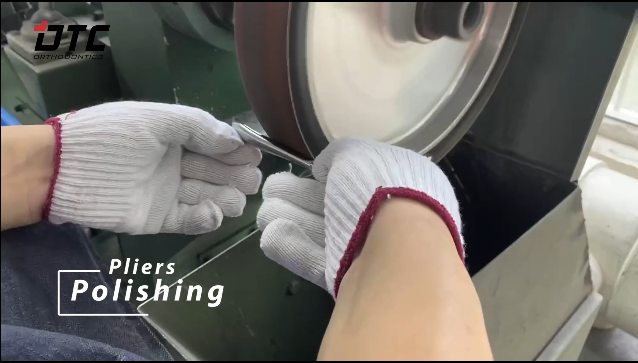
Polishing stage in instrument production. Surface finish on tweezer tips influences both glare in the working field and how easily the instrument is cleaned between cases.
Access is the second technical variable. A needle holder is a short-reach instrument by nature: it is used where the clinician already has direct vision and needs force. Tweezers extend the reach of the hand into the molar and lingual regions, which is why the same product family is split into long-tip and short-tip variants rather than offered in a single length. Buying one tweezer type and expecting it to cover labial bonding, second-molar tube placement and lingual work is the most common specification error in this category.
Ergonomic comparison for everyday operatory use
| Criterion | Mathieu Needle Holder (DTC) | Dental Tweezers (DTC) | What the buyer must still validate |
|---|---|---|---|
| Primary task | Gripping and holding under load | Picking, positioning, releasing | Both instruments in one live bonding and ligation sequence |
| Documented configurations | With hard tip; without hard tip; without hard tip Type C | Brackets tweezers; tube tweezers (long tip, short tip); lingual brackets tweezers | Match exact variant to case mix before ordering a set |
| Material (documented) | Stainless steel | Stainless steel | Request material grade documentation if your QMS requires it |
| Handle interface | Ring-handled, hinged pattern | Pincer pattern with self-opening arms | Hand size, glove fit and fatigue over a full session |
| Access profile | Short reach, higher closing force | Extended reach on long-tip variants | Trial on second-molar and lingual cases specifically |
| Surface finish | Not specified in the data reviewed | Matte, non-reflective finish documented for the tweezer line | Inspect tip finish and edge rounding under magnification |
| Hardness (HRC) | Not published for this model | Not published for this model | Request HRC data; comparable DTC plier models publish HRC ranges |
| Max. sterilization temperature | Not published for this model | Not published for this model | Request cycle temperature and reprocessing guidance in writing |
| Wear points to watch | Hinge stiffness, jaw alignment after heavy use | Tip springing or misalignment, tip contamination | Track reprocessing cycles per instrument, not per tray |
Documented items reflect DTC product data. Items marked for validation are not published in the material reviewed and should be confirmed with the supplier before standardization.
The table points to an uncomfortable but useful conclusion: for both instruments, the published data covers what the instrument is and how it is configured, but not the two numbers that most affect long-term cost — hardness and sterilization tolerance. Buyers who skip that request are effectively pricing the instrument on year one and guessing on year three.
Where each instrument earns its place in daily practice
Bonding and bracket placement
Bracket tweezers are the default instrument for lifting, orienting and seating a bracket or a lingual button. The relevant test is not how firmly the tweezer grips, but whether it releases cleanly once the bracket is on the adhesive. A tweezer that holds too well drags the bracket out of position at the moment of seating.
Molar tubes and posterior access
Tube tweezers with a long tip exist because the second molar is the point where direct vision and hand reach stop agreeing. The long-tip variant extends placement control into that region; the short-tip variant remains the better choice where the working distance is shorter and finer control matters more than reach. Practices that treat these as interchangeable usually end up with two long-tip instruments and no short-tip option.
Lingual cases
Lingual brackets change the access angle rather than the task. Lingual brackets tweezers are shaped for that inverted field, and a labial bracket tweezer used lingually tends to obstruct the view it was meant to improve. Where a practice runs a mixed lingual and labial caseload, the lingual tweezer is a separate line item, not a duplicate.
Wire, ligature and suturing work
This is needle-holder territory. Holding a wire end while a ligature is tied, retrieving a suture needle, or steadying an attachment under load all depend on a jaw that closes firmly and stays aligned. A needle holder used here is doing the job it was designed for; the same task attempted with tweezers is where tip damage begins.
Limitations and boundaries buyers should know
A balanced review has to state where each instrument stops being appropriate, and where the available data stops being sufficient.
- A needle holder is not a placement instrument. Its jaw width and closing force are wrong for seating a bracket or a tube. Using it for placement risks marking or crushing the component and reduces visibility at the moment of bonding.
- Tweezers are not force instruments. Tensioning a ligature wire, seating a band or levering a bracket with tweezers will spring or misalign the tips. Once tips are misaligned, the tweezer is not repairable at chairside and its accuracy is gone.
- Neither replaces a cutter. Distal end cutters and ligature cutters exist because cutting requires hardened edges; a needle holder used to cut wire damages both the wire and the jaw.
- Published data for these two models is incomplete for standardization. DTC publishes HRC hardness ranges and a maximum sterilization temperature of 180 °C for several plier models, but the material reviewed does not publish equivalent hardness or sterilization figures for the Mathieu Needle Holder or the tweezer line. That is a verification step, not a disqualification — but it should be closed before a multi-year supply decision.
- One instrument, one task. Consolidating a tray to fewer instrument types saves cost per kit but usually increases chairside time and instrument wear. The saving is real; the trade-off should be a decision, not an accident.
A procurement checklist for instrument trays
- Map each instrument to a task in your own workflow, not to a catalogue category.
- Confirm the exact variant: needle holder tip type, and which tweezer patterns are actually used — brackets, tube long tip, tube short tip, lingual.
- Request hardness (HRC) and maximum sterilization temperature in writing for the specific models, not for the plier range generally.
- Ask for tip alignment and jaw alignment criteria, and how they are checked before packing.
- Test on your hardest case type — second molars and lingual fields reveal more than anterior bonding.
- Set a reprocessing log per instrument so replacement is driven by cycles, not by a failed procedure.
- Check the declared regulatory classification per item, not per catalogue.
- Confirm replenishment lead time for standard versus custom or private-label versions before standardizing.
Market trend: instrument demand is following the tray, not the tool
The wider category is expanding. Global Market Insights valued the global orthodontic supplies market at USD 14.8 billion in 2024 and projected growth at a 20.1% CAGR through 2034. That headline figure should be read with care: estimates diverge widely because research firms define supplies, consumables and devices differently — Roots Analysis has placed the market at USD 8.84 billion and Grand View Research has estimated orthodontic consumables at USD 3.1 billion for a comparable period. The direction is consistent; the number is definition-dependent.
Within hand instruments, Dataintelo projected the global orthodontic pliers market at USD 1.8 billion in 2025, with stainless steel segments holding a 62.7% share. That source is rated medium reliability in the data reviewed here, so it is useful as an indicator of stainless steel dominance rather than as a precise forecast.
Two regulatory points shape how instrument trays are specified. In the EU, MDR 2017/745 requires CE marking and classifies most orthodontic products as Class I or Class IIa. In the US, orthodontic brackets and tubes fall under 21 CFR 872.5410, with ISO 27020:2019 as the recognized standard. Neither reference automatically covers hand instruments, which is why classification should be confirmed item by item.
Supplier context: how DTC Orthodontics fits the picture
DTC Orthodontics is the trading identity of Hangzhou DTC Medical Apparatus Co., Ltd., an orthodontic materials manufacturer established in 2004 in Hangzhou, Zhejiang Province, China. The company operates a 5,000 m² facility with approximately 150 employees, including a 30-engineer R&D team, and reports annual output of 1,000,000 units with roughly 80% of production exported to markets including the EU, USA, Middle East, South America, Asia, Africa and Australia.
For instrument buyers, the relevant capability facts are that DTC offers OEM/ODM production with customization at package, logo, tag and product level, a stated monthly capacity of 5,000 units, MOQ from 100 units, a 20–30 day lead time and 100% testing before shipment. The company states ISO 13485, CE0197 and FDA certification across its product range and operates a quality management system aligned with CE (MDR) and ISO requirements.
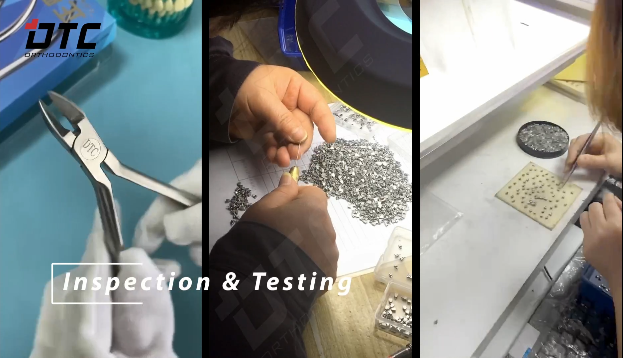
Inspection and testing before packing. For hand instruments, tip alignment and hinge feel are the checks that determine chairside performance.
On the clinic side, DTC's published case record for its self-ligating bracket line (product reference 7108) covers dental clinic clients in Australia, the United States and Canada, with project scales of 500–1,000 units and reported stable operation over 2–3 years. Distribution relationships across Europe and a dealer network spanning South America, Asia, Africa and the Middle East are also documented. These are supplier-provided records rather than independent audits, and should be treated accordingly during due diligence.
Future outlook
Three pressures are likely to reshape how needle holders and tweezers are bought over the next few years. The first is tray standardization: as group practices and dental service organizations consolidate purchasing, instruments will increasingly be specified as a defined kit rather than as individual catalogue items, which puts more weight on documented specifications per model. The second is reprocessing accountability — practices are moving from tray-level tracking to instrument-level cycle tracking, and instruments without published sterilization tolerances will be harder to defend in that system. The third is ergonomic differentiation: as adult orthodontic demand grows — clear aligners alone have been projected at a 14.25% CAGR by Mordor Intelligence — operatory time per case becomes the constraint, and instrument designs that reduce repositioning and re-gripping have a clearer commercial case.
None of these trends change the basic division of labour between the two instruments. They change the standard of evidence a supplier is expected to provide about them.
FAQ
What is the practical difference between a needle holder and dental tweezers in orthodontic operatory use?
A needle holder is built to grip and hold under load — for example when passing a suture needle or steadying a wire end while a ligature is tied. Dental tweezers are built to pick up, position and release small components such as brackets, tubes and lingual buttons with minimal applied force. The needle holder transmits force through a hinged jaw; the tweezer depends on the flex of its own arms and is designed to release cleanly rather than to grip hard.
Can bracket tweezers be used in place of a needle holder for wire and ligature work?
No. Tweezers are not designed as force instruments. Tensioning a ligature wire or holding a wire end under load with tweezers risks springing or misaligning the tips, after which the instrument loses placement accuracy and cannot be corrected at chairside. Tasks that require a sustained, firm grip belong to a needle holder or, for cutting, to a dedicated cutter.
Which tweezer configuration is used for molar tubes and for lingual brackets?
DTC lists separate variants for each access problem: Tube Tweezers in a long-tip and a short-tip version, and Lingual Brackets Tweezers alongside standard Brackets Tweezers. Long-tip tube tweezers extend reach into the posterior segment, short-tip versions favour finer control at shorter working distances, and lingual tweezers are shaped for the inverted access angle of the lingual field. A single tweezer type does not cover all three situations well.
What specifications should a buyer verify before ordering needle holders and tweezers?
Confirm the exact variant (needle holder tip type; tweezer pattern and tip length), the stainless steel grade if your quality system requires material documentation, tip and jaw alignment criteria and how they are inspected before packing, hardness in HRC, maximum sterilization temperature, and the declared regulatory classification for each item. Sample evaluation on second-molar and lingual cases is more informative than anterior bonding trials.
Are hardness and sterilization temperature published for DTC needle holders and tweezers?
In the product data reviewed for this article, hardness ranges and a maximum sterilization temperature of 180 °C are published for several DTC plier models — for example the cutting and trimming pliers listed at HRC 58–63. Equivalent hardness and sterilization figures are not published for the Mathieu Needle Holder or for the tweezer line. Buyers standardizing these items should request that data directly rather than infer it from the plier specifications.
What are the order terms for these instruments under OEM or private label?
DTC states OEM/ODM capability with customization at package, logo, tag and product level, an MOQ from 100 units, and a lead time of 20–30 days. The company's published guidance distinguishes standard products, which it says are supported by safety stock for delivery within 3–5 business days, from custom-engineered production runs requiring roughly 2–4 weeks. MOQ varies with product and customization scope, and options such as split shipments or shared tooling costs are described as ways to reconcile volume pricing with smaller initial orders.
¿Tiene preguntas o necesita más detalles?
Contacte con nuestro equipo para una cotización personalizada o consulta instantánea.
Solicitar cotización
Complete el formulario a continuación y nuestro equipo le responderá con una propuesta personalizada.
Chat directo de WhatsApp
¿Prefiere chatear en tiempo real? Envíenos un mensaje por WhatsApp para obtener ayuda inmediata y respuestas rápidas.
- Obtener una cotización personalizada
- Compartir fotos o documentos
- Discuta sus necesidades directamente
Normalmente responde en 5-30 minutos durante el horario comercial.