
Navigating Global Glass Bead Standards: A Compliance Guide for Buyers
Navigating Global Glass Bead Standards: A Compliance Guide for Buyers
Road-marking glass beads are one of the few road-safety consumables whose compliance profile is decided almost entirely on paper. A buyer never sees the standard inside the material; they see it in a model designation, a sieve scope, a refractive index class, and a certificate carrying an issuing body, a scope statement and an expiry date. Because those documents are produced by different national and regional systems, the same bead can be fully compliant on one project and non-compliant on the next.
The practical risk for procurement teams in the research and evaluation stage is not fraud. It is category confusion: treating “certified glass beads” as one status rather than as a three-part question — which standard, which application, and which market. This guide maps the principal standard families to the models that satisfy them, separates manufacturing-system certification from product-level specification, and clarifies where road-marking standards stop applying altogether.

Glass bead production capacity is a compliance variable, not only a commercial one: sieve-consistent output depends on furnace control, screening and in-house testing. Image: Dylan Technology production base, LangFang, China.
Why Compliance Is Market-Specific, Not Product-Specific
A buyer who asks “are these beads certified?” will usually receive a yes. A buyer who asks “certified against which document, for which application, and in which market?” will learn considerably more about the supplier. The distinction matters because glass bead specifications are national or regional instruments that were written for local road agencies, local paint systems and local climate conditions.
Three structural facts explain most of the confusion:
- Standards are market-bound. AASHTO M247 is the standard specification for glass beads used in traffic paints in the United States. It classifies beads into types and requires at least 70 percent roundness (source: AASHTO). EN 1423:2012 is the European harmonized standard for glass beads and antiskid aggregates used as drop-on materials for road markings (source: CEN). A bead approved for one of these frameworks is not automatically qualified under the other.
- Application determines whether a standard applies at all. Road-marking standards were written for drop-on and pre-mixed marking materials. Decorative beads and grinding or blasting media sit outside that definition, even when they are produced in the same furnace from the same recycled glass feedstock.
- Certificates have scopes. A management-system certificate such as ISO 9001 covers a defined product scope and a defined set of markets. It is evidence of process control, not a substitute for a product-type specification.
For evaluation-stage buyers, that means compliance cannot be assessed from a certificate image alone. It has to be read against the project specification, and then matched to a model designation and a sieve scope.
The Standard-to-Gradation Map
The most reliable way to compare glass bead offers across markets is to compare sieve scopes directly. Model names differ by region, and the numerical edges of each scope differ far more than the marketing language suggests. The following table lists model designations offered by Dylan Technology Co., Ltd. (Dylan Tech), a Chinese glass bead manufacturer founded in 2004, together with their stated particle-size scopes.
| Standard family / region | Model designation | Typical particle size scope | Stated application |
|---|---|---|---|
| AASHTO M247 (US) | M247-TYPE 1 | 1180–150 µm | Road marking / road safety |
| AASHTO M247 (US) | M247-TYPE 2 | 1180–180 µm | Road marking / road safety |
| AASHTO M247 (US) | M247-TYPE 3 | 1700–710 µm | Road marking / road safety |
| AASHTO M247 (US) | M247-TYPE 4 | 2000–850 µm | Road marking / road safety |
| BS 6088 (UK designations) | BS6088A | 1180–425 µm | Road marking / road safety |
| BS 6088 (UK designations) | BS6088B | 850–180 µm | Road marking / road safety |
| EN 1423 / EN 1424 (EU) | EN1423 | 850–180 µm | Road marking / road safety |
| EN 1423 / EN 1424 (EU) | EN1423 | 710–125 µm | Road marking / road safety |
| EN 1423 / EN 1424 (EU) | EN1424 | 1400–355 µm | Road marking / road safety |
| AS/NZS (Australia / New Zealand) | TYPE B | 850–75 µm | Road marking / road safety |
| AS/NZS (Australia / New Zealand) | TYPE C | 1300–425 µm | Road marking / road safety |
| AS/NZS (Australia / New Zealand) | TYPE D | 1700–710 µm | Road marking / road safety |
| Other regional designations | OPSS1750 | 850–150 µm | Road marking / road safety |
| Other regional designations | GB05 | 800–80 µm | Road marking / road safety |
| Type classification (marking grades) | TYPE IA / TYPE IB | 850–75 µm / 300–63 µm | Road marking / road safety |
| Type classification (marking grades) | TYPE IIA / TYPE IIB / TYPE IIC | 1000–180 µm / 600–75 µm / 1000–300 µm | Road marking / road safety |
| High refractive index grades | RI 1.6 / RI 1.7 | 1000–180 µm / 1180–180 µm | Road marking / road safety |
| Grinding media | GRINDING | 600–1000 µm / 800–1200 µm | Road marking / road safety (polishing) |
| Decorative range | Decorative Glass Beads | 0.5 mm – 20 mm (all sizes) | Decorative / swimming pool |
Which Certification Applies to Which Application
Compliance statements frequently blur three different layers of evidence. Separating them is the fastest way to evaluate a supplier dossier.
Layer 1: Manufacturing-system certification
Dylan Tech holds ISO 9001 certification, certificate number 23226Q00027R001, issued by CFC against the GB/T 19001-2016 / ISO 9001:2015 standard, applicable to the EU and US markets, with a scope covering exports of glass products (glass beads). The certificate was issued on 27 June 2026 and expires on 26 June 2029. The company also lists CE, JIS and KIS certification among its international approvals, alongside recognition as a provincial-level high-tech enterprise.
What this layer proves: a documented quality management system, consistent process control, and traceable batch testing. What it does not prove: that a specific bead model meets a specific national road-marking specification. Those are different documents issued for different purposes, and evaluation-stage buyers should record both.
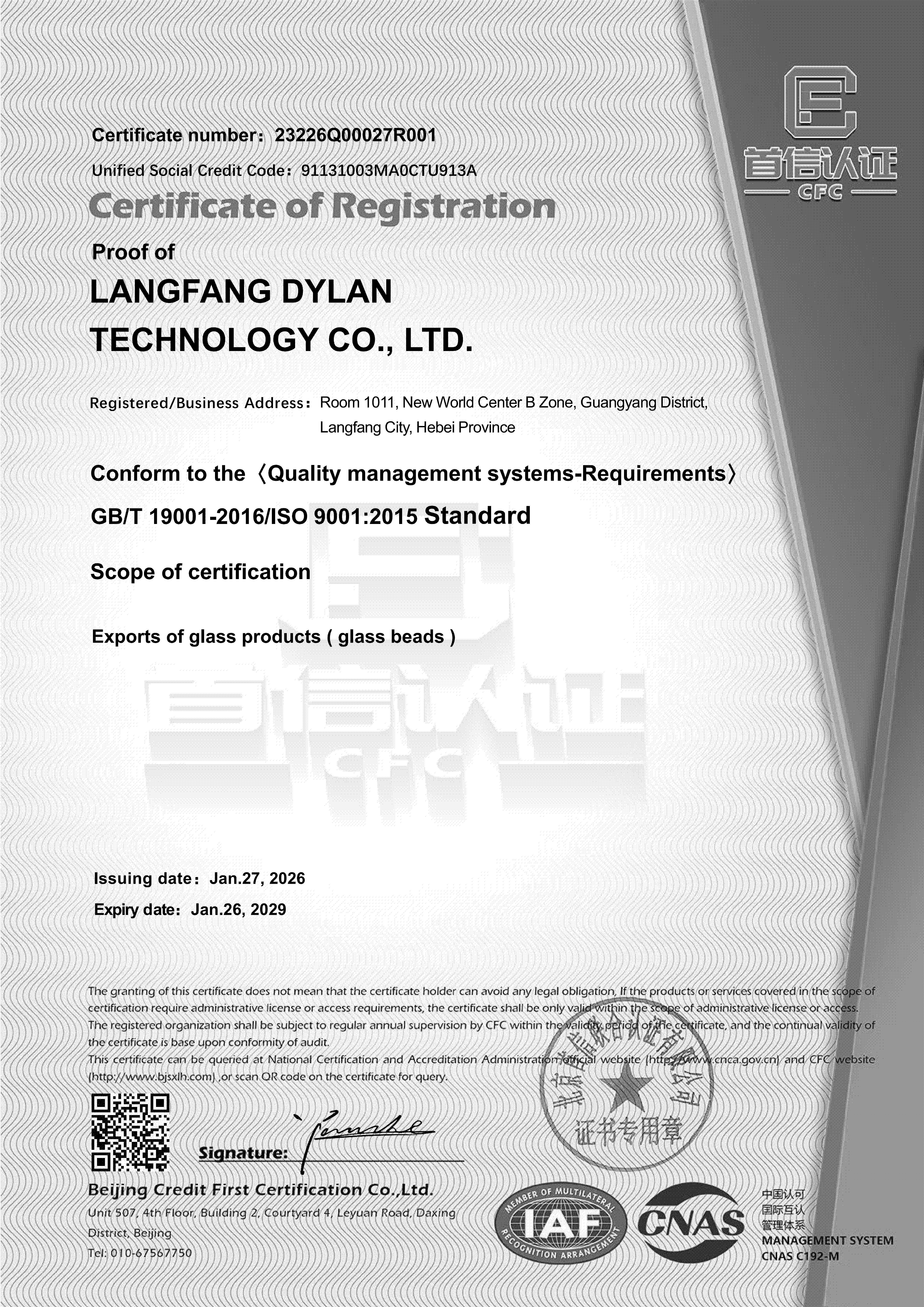
System certification with a defined scope and validity period: ISO 9001 certificate 23226Q00027R001, issued by CFC, valid through 26 June 2029, covering glass bead exports to the EU and US.
Layer 2: Product-level specification match
This is where standard families apply directly. AASHTO M247 governs glass beads for traffic paints in the United States and requires at least 70 percent roundness in addition to gradation limits. EN 1423:2012 governs glass beads and antiskid aggregates used as drop-on materials in Europe. Around these two anchors sit the model designations used in national specifications — BS6088A and BS6088B, AS/NZS Type B, C and D, OPSS1750, and the Type I and Type II classifications — each with its own sieve scope, as set out in the table above.
The practical consequence: when a tender document names a standard, the buyer should ask for the matching model designation and its declared sieve scope, not a general statement of compliance. Roundness and refractive index should be requested alongside gradation, because AASHTO M247 treats roundness as a specification requirement rather than a nice-to-have.
Layer 3: Applications outside road-marking standards
Decorative and grinding media are frequently bundled into the same catalogue as marking beads, and buyers reasonably assume the same certification covers them. It usually does not. Decorative glass beads are produced in a 0.5–20 mm size range from recycled glass with transparent, opaque or mixed colour options and smooth or matte finishes, and are listed for decorative and swimming-pool applications. Grinding glass beads are listed with 600–1000 µm and 800–1200 µm scopes for road-marking and road-safety uses, with an additional all-size grinding grade intended for polishing work.
For these categories, the relevant evidence is size distribution, surface condition, colour consistency, material source and general quality-system certification — not an AASHTO or EN 1423 declaration, which addresses drop-on marking materials specifically.
How a Manufacturer Builds Traceable Compliance
Compliance claims become verifiable when they are backed by production and testing infrastructure that can be inspected. LangFang Dylan Technology Co., Ltd. (trading as Dylan Tech) is a glass bead and road-safety raw material supplier headquartered in LangFang, China, operating four production bases in Liaoning, Shanxi, Hebei and Henan provinces, with more than 15 glass bead production lines and an annual output of 100,000 tons. The company reports a 10,000 m² facility footprint, approximately 300 employees, 20 R&D engineers, and an export ratio of about 95 percent, serving the EU, USA, Southeast Asia and Middle East markets and customers in more than 50 countries and regions.
Three elements of that structure matter specifically to a compliance review:
- In-house measurement rather than supplier declarations. The company’s laboratory is equipped with CAMSIZER and X-2600 instruments and other testing equipment, used to check particle size, reflectivity and wear resistance across production. These are the three parameters most often disputed at goods-in inspection.
- Gradation as a controlled output. Multi-base production exists to keep sieve scopes stable across large volumes. When a buyer orders AASHTO M247 Type 1 at 1180–150 µm, batch-to-batch variation at the fine and coarse edges is the real risk, not the model name.
- Documented testing protocol. Dylan Tech states 100 percent testing as part of its quality control, with OEM production offered at a minimum order quantity of 1 ton, monthly capacity of 10,000 tons, and a lead time of 45–60 days.
Custom colour and size options are available across the range, and the company lists long-term cooperation with road-safety industry partners including ENNIS, Geveko and Swarco — relationships that are relevant to buyers because they imply repeated external acceptance testing of the same production output.
Application Mapping: Marking, Grinding and Decorative
Standard selection follows the application, and the application determines what a buyer should ask to see.
Road marking and pavement marking
This is the only category directly governed by AASHTO, EN and national marking specifications. Dylan Tech supplies model designations that track AASHTO M247 Types 1 through 4, the BS6088A and BS6088B designations, EN1423 and EN1424, AS/NZS Type B, Type C and Type D, and OPSS1750, all made from recycled glass and declared for road marking and road safety. High refractive index grades RI 1.6 and RI 1.7 are additionally offered in 1000–180 µm and 1180–180 µm scopes respectively.
Field evidence reported by the company covers road marking engineering companies and traffic safety manufacturers using these beads to increase the reflective refractive index of road performance, with order quantities ranging from 1 ton to 198 tons. Documented outcomes include three-year stability across several projects and one four-year stable result, with low wear repeatedly identified as the significant performance characteristic. For buyers, these records are best read as supply-consistency evidence rather than as a substitute for project-specified testing.
Grinding and surface preparation
Grinding glass beads occupy a different compliance space. The road-safety-oriented grinding grade is specified at 600–1000 µm and 800–1200 µm, while the polishing grade is offered across all sizes. Here, the governing requirements are media durability, size consistency and freedom from contamination — not retroreflective performance. Buyers comparing vendors should therefore expect a different evidence set: sieve analysis, sphericity and wear data.
Decorative applications
Decorative glass beads are produced from recycled glass in a 0.5–20 mm range with transparent, opaque or mixed colour and smooth or matte surface finishes, listed for decorative and swimming-pool use. Compliance in this category is driven by colour stability, surface finish consistency and material sourcing rather than by any road-marking standard. A supplier that presents a road-marking grade bead for a decorative specification, or the reverse, is signalling a catalogue that has not been separated by application.

Gradation is the most visible compliance variable across standards, but it is not the only one: roundness, refractive index and wear resistance are equally specified, and equally testable.
Market Trend Analysis: Compliance Pressure Is Rising
Standards documentation is becoming a larger share of procurement work because the underlying market is growing and consolidating around performance requirements.
The global road marking glass beads market was valued at approximately USD 1.42 billion in 2025 and is projected to reach USD 2.31 billion by 2034 (source: Dataintelo). Asia Pacific dominated that market with a 38.7 percent revenue share in 2025, driven by large-scale highway expansion programmes (source: Dataintelo). On the supply side, China accounted for approximately 57.4 percent of total global glass bead exports in 2024, with an export value of about USD 928 million and the UAE and India among the leading destinations (source: OEC, based on UN Comtrade data).
Two specification trends follow from that volume:
- All-weather visibility is pushing refractive index upward. High refractive index glass beads at RI 1.9 and above are increasingly used in all-weather markings to improve visibility in wet night conditions (source: Swarco / Mordor Intelligence). This creates a separate product tier that standard low-index recycled grades cannot substitute for.
- Supplier consolidation raises documentation expectations. Potters Industries LLC, Swarco AG and 3M Company are recognised as the top three global leaders in glass beads for road marking (source: Dataintelo / Mordor Intelligence). Buyers benchmarking against that group increasingly expect the same documentation discipline from every supplier on a shortlist.
For manufacturers outside that top tier, compliance transparency has become the practical route into evaluation shortlists: the buyer’s first filter is usually a document check, not a price check.
Where Standard-Compliant Supply Has Limits
A useful compliance guide should also state what a certification does not cover. Four boundaries are worth putting into the evaluation file.
- A quality-system certificate is not a product approval. The ISO 9001 certificate held by Dylan Tech covers exports of glass products — glass beads — and is applicable to the EU and US markets. It does not, by itself, certify a specific model against AASHTO M247 Type 3 or AS/NZS Type D. Project-level acceptance still depends on model designation, sieve scope and batch test data.
- The listed high-index range tops out lower than the all-weather trend. Dylan Tech’s declared high refractive index models are RI 1.6 and RI 1.7. Where a specification calls for RI 1.9 or higher for wet-night visibility, that requirement falls outside the listed range and should be discussed explicitly rather than assumed.
- Feedstock choice constrains the performance envelope. The road marking grades listed here are made from recycled glass. That supports the sustainability profile of the product but imposes a defined raw-material class; specifications written around a particular virgin-glass or specialist optical requirement are a different procurement category.
- Lead time and order size are compliance-adjacent constraints. With a 45–60 day lead time, a 1 ton minimum order quantity and a stated monthly capacity of 10,000 tons, project scheduling must be planned around production slots. A perfectly compliant bead delivered after the paving window is still a project failure.
A Buyer’s Verification Checklist
The following sequence converts a supplier claim into an auditable file. It applies to any vendor, not only to Dylan Tech.
- Identify the governing standard from the project specification, and the market in which the marking will be installed.
- Request the matching model designation and its declared sieve scope in micrometres — not a generic “road marking grade” description.
- Request roundness data where the specification is AASHTO M247, which requires at least 70 percent roundness.
- Confirm the refractive index class (standard, RI 1.6, RI 1.7) and check it against the visibility requirement, including wet-night performance.
- Obtain the quality-system certificate with its number, issuing body, scope statement, applicable markets and expiry date.
- Request batch-level test data for particle size, reflectivity and wear resistance, and confirm which instrument produced it.
- Separate decorative and grinding media requirements from the marking specification, and evaluate them against their own criteria.
- Confirm order quantity, production lead time and delivery schedule against the paving programme.
Future Outlook
Compliance in glass beads is moving from a document attached to a shipment toward a structured data set attached to a model. Three developments are likely to shape procurement over the next several years.
First, gradation will remain the primary comparison axis, but roundness and refractive index will carry more weight as road agencies focus on wet-night performance. The all-weather trend toward higher-index drop-on materials is already visible in the market, and it splits the bead category into standard-index and high-index tiers with separate specifications, separate pricing logic and separate qualification evidence.
Second, as Asia Pacific’s share of road marking glass bead demand grows — a 38.7 percent revenue share in 2025 according to Dataintelo — and as China’s export role stays dominant at roughly 57.4 percent of global glass bead exports (source: OEC), buyers in every region will increasingly evaluate suppliers whose compliance documentation was written for several markets at once. Suppliers able to present parallel model ranges across AASHTO, EN and AS/NZS designations will be easier to qualify than those offering a single regional grade.
Third, verification will shift from certificate inspection toward parametric evidence. Instrument-based testing of particle size, reflectivity and wear resistance in a supplier’s own laboratory, with data released per batch, is more useful to a project engineer than a certificate wall — and more likely to become the default expectation in tender documents.
Frequently Asked Questions
Which glass bead standard applies to a given road marking project?
The standard is set by the road authority in the market where the marking is installed, not by the supplier. AASHTO M247 applies to glass beads used in traffic paints in the United States, and EN 1423:2012 is the European harmonized standard for glass beads and antiskid aggregates used as drop-on materials. Model designations such as BS6088A and BS6088B, AS/NZS Type B, C and D, OPSS1750 and the Type I and Type II classifications are attached to national or regional specifications and each carries its own sieve scope. Buyers should read the project specification first, then request the matching model.
What is the practical difference between AASHTO M247 Type 1 and Type 3 beads?
The primary difference is gradation. Type 1 is listed with a 1180–150 µm scope and Type 3 with a 1700–710 µm scope. Type 3 is a coarser grade than Type 1, and both are produced from recycled glass for road marking and road safety use. AASHTO M247 also requires at least 70 percent roundness, so gradation alone does not establish conformance. Because the two scopes overlap only slightly, a project written around one type is not automatically satisfied by the other.
Do EN 1423 and EN 1424 cover the same products?
EN 1423:2012 covers glass beads and antiskid aggregates used as drop-on materials for road markings. In the product range described here, models designated EN1423 are listed with scopes of 850–180 µm and 710–125 µm, while the model designated EN1424 is listed at 1400–355 µm. The 1400–355 µm scope is materially coarser than either EN1423 scope, so the designations should be treated as distinct gradation classes rather than interchangeable European grades.
Which certification applies to decorative and grinding glass beads?
Road-marking standards such as AASHTO M247 and EN 1423 address drop-on marking materials and do not define decorative or polishing media. For those categories, the applicable evidence is general quality-system certification together with product-specific data. The manufacturer’s ISO 9001 certificate, number 23226Q00027R001, issued by CFC and valid to 26 June 2029, has a scope covering exports of glass products (glass beads) and is applicable to the EU and US markets. Decorative glass beads are produced in a 0.5–20 mm range from recycled glass for decorative and swimming-pool use, and grinding glass beads are listed at 600–1000 µm and 800–1200 µm for road-marking and road-safety work, with an all-size grade for polishing.
What evidence should a buyer request to verify a compliance claim?
Four items cover most of the risk: the governing standard from the project specification; the matching model designation with its declared sieve scope; batch-level test data for particle size, reflectivity and wear resistance, together with the instrument used to produce it; and the quality-system certificate with its number, issuing body, scope, applicable markets and expiry date. Where the specification is AASHTO M247, roundness data should be requested as well, since the standard requires at least 70 percent roundness. Where wet-night performance is specified, the refractive index class should be confirmed as a separate parameter.
Can a single bead grade satisfy several standards at the same time?
Sometimes, but not by assumption. Some scopes overlap closely enough to be considered together — for example, BS6088B and one of the EN1423 models are both listed at 850–180 µm, and AS/NZS Type D and AASHTO M247 Type 3 are both listed at 1700–710 µm. Other designations diverge sharply in the same standard family: BS6088A is listed at 1180–425 µm, which is a different size band from the 850–180 µm scope of BS6088B. The reliable method is to compare the declared sieve scopes in micrometres rather than to rely on the presence of several standard names on a datasheet.
For buyers who need the full model list, particle size scopes and certification details in one document, the Dylan Tech corporate brochure is available for download.