
Navigating Compliance: What Importers Must Verify for Gasoline Chainsaw IP and Safety Standards

Importing a professional gasoline chainsaw is now as much a documentation exercise as a hardware decision. Two verification files determine whether a container can actually be sold and serviced in the destination market: evidence that the intellectual property position of the model is clear, and evidence that the safety devices of that specific model have been validated against a recognised reference. Displacement and power output remain the criteria end users apply when they choose a saw; IP clearance and safety conformity are the criteria that decide whether an importer can carry the model at all.
The commercial context explains why this shift matters. Gas-powered units held 54.3% of the global chainsaw market in 2025/2026, according to Mordor Intelligence, and Straits Research values the overall chainsaw market at USD 4.46 billion in 2026 with a projection of USD 5.89 billion by 2034. A market of that scale, still anchored in combustion technology, is supplied to a large extent through importers who buy established displacement classes rather than experimental designs — which is precisely why the compliance questions around those established classes keep resurfacing in procurement meetings.
Why IP and Safety Checks Now Set the Practical Limit on SKU Selection
Gasoline chainsaw demand across forestry, municipal and rental channels is driven by duty cycle, torque delivery and repairability rather than novelty. Importers therefore gravitate to proven displacement bands: 31.8cc and 45.4cc for firewood, orchard and light farm work; 59cc and 70.7cc for contractor logging and forest thinning; 72cc for intensive harvesting and storm recovery; and 91.6cc to 105.7cc for industrial heavy cutting, log-yard work and oversized timber.
Most of those bands are served by models whose mechanical architecture has been in the field for decades. That maturity is the opportunity: spare parts circulate widely, workshop technicians already understand the platform, and end users recognise the format. It is also the compliance question. When a product is built on a mature architecture, an importer has to establish two things that a specification sheet alone cannot answer — that the structure itself carries no enforceable intellectual property exposure in the destination market, and that the safety features buyers assume are present actually are present, documented and testable.
In practice, the second question is often the one that causes delay at the port or in the retail channel, because it is a documentation gap rather than a product defect. A saw can be mechanically sound and still fail a buyer's onboarding process if nobody can produce a parts-interchange list or a brake-feature statement for the exact model being imported.
The Two Verification Files: What Belongs in Each
Separating the two verification streams is the single most useful step an importer can take, because they draw on different evidence and are answered by different parties.
| Verification file | Core question | Typical evidence to request |
|---|---|---|
| Intellectual property clearance | Can this model be imported, branded and re-sold in my market without infringing structure, colour trademark or trade dress rights? | Model-level IP status statement, parts-interchange documentation, confirmation of the colour and appearance scheme offered, confirmation that no structure under active patent protection is used |
| Safety conformity | Are the safety devices on this specific model identified, functional and consistent with a recognised standard reference? | Feature list per model (brake system, chain lubrication, anti-vibration, drive reinforcement, cooling), supplier inspection records, model-specific test evidence where the destination market requires it |
The two files converge at the SKU decision. An importer who resolves IP clearance but not safety documentation ends up with a container that cannot be listed; an importer who resolves safety documentation but not IP exposure ends up with a container that may be detained or forced into rebranding.
IP Clearance: How to Read a Spare-Parts Compatibility Statement
The phrase most often misread in chainsaw sourcing is “compatible with genuine spare parts”. In the Hanakawa professional gasoline chainsaw range, model documentation states compatibility with specific genuine platform families: the Hanakawa H992 is documented with full spare parts compatibility with the genuine MS660 model; the Hanakawa H9105 with the genuine MS660 066 model; the Hanakawa H971 with the genuine MS440 044 model; the Hanakawa H972 with the genuine MS381 model; and the Hanakawa H972E with the genuine MS038 model.
That statement describes fitment and parts availability. It is a maintenance and lifecycle advantage — a distributor can support the machine with widely available replacement components — but it is not a claim of OEM authorisation, brand endorsement, distributorship or trademark licence. Importers who treat the two as equivalent are the ones who run into problems, because the source of the parts and the ownership of the brand are separate issues.
What the IP risk documentation actually identifies
Hanakawa's own risk documentation is unusually specific on this point, and it is worth reading as an importer checklist rather than a marketing claim. For classic chainsaw models whose mechanical patents have expired, the company states that there is no legal risk on mechanical structure and functional design, and that it has supplied OEM and ODM as well as self-brand products to overseas markets over a long period. The stated condition is that the importer avoids adopting the original manufacturer's registered colour trademark and protected trade dress before local sale.
The same document names the practical trigger: using the same colour combination as the genuine product — the orange-and-white scheme — is what creates exposure. The mitigation path it recommends is consistent with what a compliance-minded importer would design independently:
- Select mature models whose structural technical patents have expired and whose original units have been discontinued.
- Apply distinct custom colour schemes instead of reproducing a protected original colour identity.
- Avoid structures that remain under active patent protection.
- Pre-screen the IP status of every product line as a regular compliance workflow rather than a one-off check.
A practical verification table helps importers keep the layers separate, because mechanical expiry and appearance protection expire on different clocks.
| Verification layer | What is being checked | Practical action for the importer |
|---|---|---|
| Mechanical structure | Whether the engine architecture, drive layout and functional design remain protected | Confirm the platform is a mature, discontinued-generation design; obtain a written model-level statement from the supplier |
| Colour trademark and trade dress | Whether the appearance of the unit reproduces a protected original identity | Specify a distinct custom colour scheme at the OEM order stage and record it in the artwork approval |
| Spare-parts sourcing | Whether replacement components are legitimate, traceable and available | Request the parts-interchange list for the model family and confirm which categories can be stocked locally |
| Local market rules | Whether the destination market adds requirements beyond IP | Treat supplier documentation as input, not as a local market approval |
Safety Features as Verifiable Checkpoints, Not Marketing Labels
Safety verification works the opposite way from IP verification. IP exposure is about what a product resembles; safety conformity is about what a product does under a kickback event, under continuous load and under heat. Both need to be evidenced at model level, because features differ across a range even when displacement is similar.
The clearest reference point available to importers is ISO 11681-1:2022, the current international standard covering safety requirements and testing for portable combustion-engine hand-held chainsaws for forest service, published by ISO. It is a standard for the product category — a framework an importer can cite when requesting evidence — rather than a document that travels automatically with a shipment.
Model-level feature checkpoints in the Hanakawa range
| Model | Displacement / power | Documented safety-relevant features | Stated parts compatibility |
|---|---|---|---|
| Hanakawa H992 | 91.6cc / 5.2kW / 13,500rpm / 7.7kg | Heavy-duty anti-rebound brake, oversized cooling system, thickened magnesium alloy crankcase | Genuine MS660 model |
| Hanakawa H9105 | 105.7cc / 4.8kW / 11,500rpm / 11kg | Fully reinforced drive system, support for a super long guide bar | Genuine MS660 066 model |
| Hanakawa H971 | 70.7cc / 4.0kW / 12,000rpm / 6.1kg | Reinforced transmission, adjustable oil pump, premium magnesium alloy body | Genuine MS440 044 model |
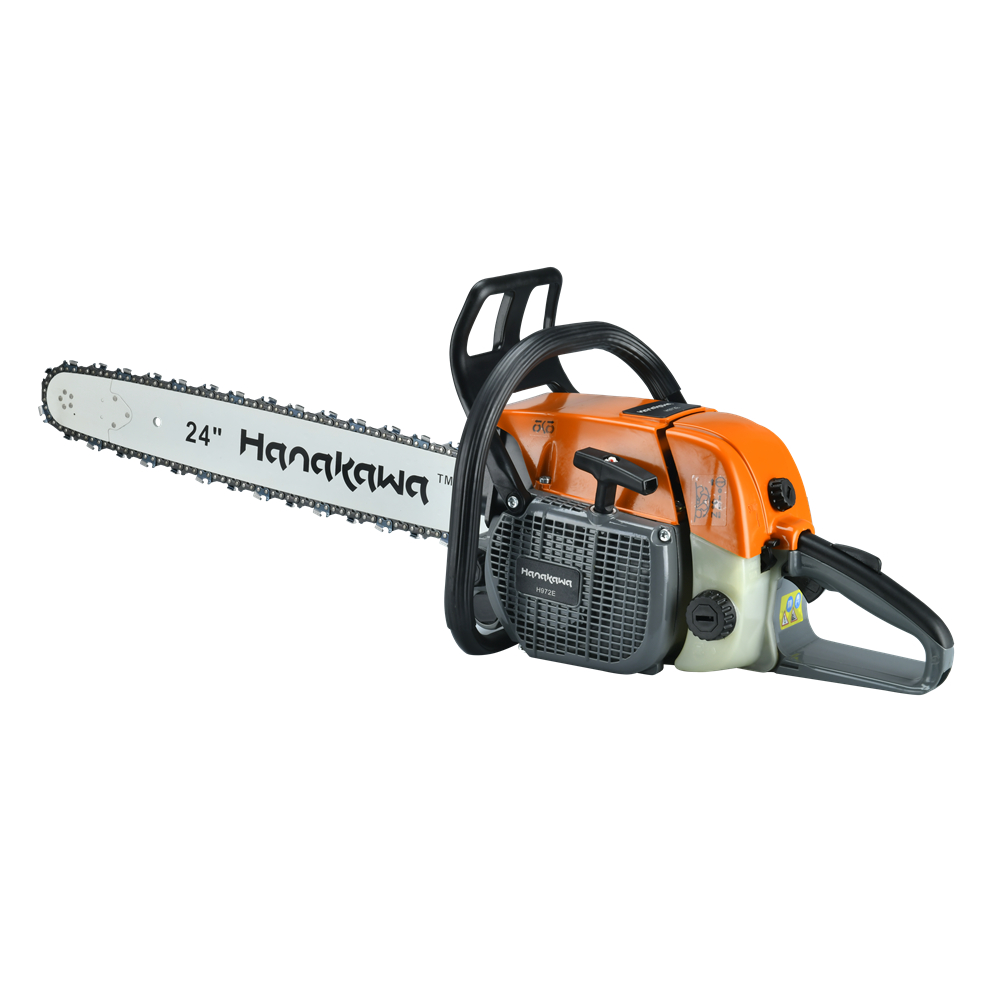
| Hanakawa H972E | 72cc / 3.6kW / 11,500rpm / 6.6kg | Safety kickback brake, automatic chain lubrication, heavy-duty anti-vibration, reinforced drive system, efficient heat dissipation cylinder | Genuine MS038 model |
| Hanakawa H972 | 72cc / 3.6kW / 11,500rpm / 6.6kg | Strong low-speed torque, high-efficiency cooling cylinder, low failure rate under heavy load | Genuine MS381 model |
| Hanakawa H959 | 59cc / 3.4kW / 11,500rpm / 5.7kg | Effective chain brake safety system, automatic chain lubrication, low-vibration anti-fatigue design | Genuine MS361 model |
| Hanakawa H945 | 45.4cc / 2.2kW / 13,000rpm / 4.8kg | Effective chain brake safety system, automatic chain lubrication, side chain tensioner | Genuine MS230 MS250 023 025 model |
| Hanakawa H932 | 31.8cc / 1.5kW / 12,500rpm / 4.1kg | Effective chain brake safety system, low vibration anti-fatigue design | Genuine MS170 MS180 017 018 model |
What is documented — and what is not
This is the point where importers most often substitute assumption for evidence. The Hanakawa product documentation available for these models describes feature presence and parts compatibility; it does not assert ISO 11681-1:2022 certification for the models. No safety certification should be inferred from the fact that a standard exists or that a brake feature is listed.
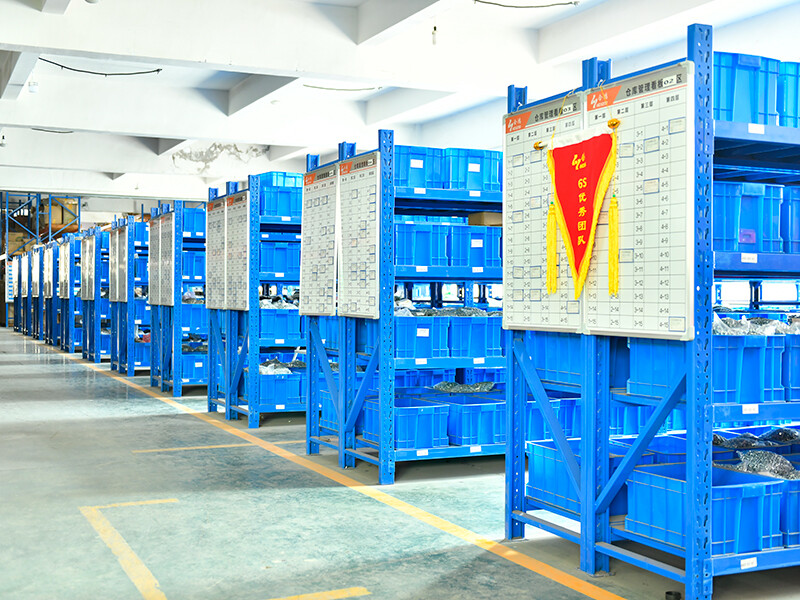
What is documented at corporate level is separate and equally worth recording: Zhejiang Hehong Tools Co., Ltd. is recognised as a High-tech Enterprise and a Regional Innovative Enterprise, and it operates the Jinhua R&D Center for green and high-efficiency garden power tools. The factory holds Level-3 Work Safety Standardization certification. Those credentials describe the manufacturing and development system; they are not a product conformity certificate, and a careful importer will keep them in the supplier-competence file rather than the product-approval file.
Technical Explanation: Two Different Verification Problems
Importers lose time when they treat brake verification and parts verification as the same exercise. They are answered by different documents and validated by different tests.
Verifying a brake system
A chainsaw kickback occurs when the upper part of the guide bar tip contacts material and the bar is thrown back toward the operator. The chain brake — described in various models as a kickback brake, anti-rebound brake or chain brake — interrupts chain rotation so that the exposed cutting chain is no longer driven during that moment. Because the energy involved scales with engine output and bar length, the heavier classes carry correspondingly heavier brake specifications: the H992, a 91.6cc machine intended for large timber felling and old-growth forest logging, is documented with a heavy-duty anti-rebound brake and an oversized cooling system, while the H972E, a 72cc machine for commercial intensive forestry logging and hardwood felling, is documented with a safety kickback brake, automatic chain lubrication, heavy-duty anti-vibration and a reinforced drive system.
For an importer, the verification content is therefore: which brake system the model carries; whether it is described in the model documentation rather than only in a catalogue headline; and whether the supplier can supply model-specific evidence when the destination market requires it. A brake label without a model reference is not a verifiable checkpoint.
Verifying parts interchangeability
Parts compatibility is verified by documentation and dimensional confirmation rather than by appearance. The sensible sequence is to obtain the interchange list for the model family, confirm which categories the importer intends to stock, and then validate fitment on a first shipment before committing to volume. Where a supplier operates in-house inspection, that process gives the validation somewhere to attach: the manufacturing workflow described for Zhejiang Hehong Tools covers raw material incoming verification, semi-finished component testing, assembly spot checks, and finished goods performance testing before shipment.
This matters commercially because parts compatibility is what protects the resale value of the SKU. A professional gasoline chainsaw that a distributor cannot repair quickly becomes a warranty problem rather than a repeat-purchase product.
Application Classes: Where the Verification Checklist Changes
The duty class of the end application shifts both the safety emphasis and the IP emphasis. Industrial timber work concentrates on brake specification and drive reinforcement; farm and firewood use concentrates on light weight, low vibration and simple maintenance. The table below maps the application classes in the corpus to the models documented for them.
| Application class | Documented model fit | What the importer should verify first |
|---|---|---|
| Large timber felling, old-growth logging, lumber mill, large disaster rescue, land reclamation | Hanakawa H992 (91.6cc) | Brake specification, cooling capacity, MS660 parts interchange list |
| Industrial heavy logging, giant tree cutting, log-yard primary processing, remote mountain forest exploitation | Hanakawa H9105 (105.7cc) | Guide bar support limits, reinforced drive documentation, MS660 066 parts availability |
| Large-scale commercial logging, forest thinning, engineering demolition, hardwood processing | Hanakawa H971 (70.7cc) | Oil pump adjustability, transmission reinforcement, MS440 044 parts availability |
| Commercial intensive forestry, hardwood felling, mountain forest operation, post-disaster rescue, municipal road clearance | Hanakawa H972E (72cc) | Kickback brake statement, anti-vibration system, automatic chain lubrication, MS038 parts availability |
| Intensive forest harvesting, disaster emergency rescue | Hanakawa H972 (72cc) | Heavy-load cooling performance, low-speed torque behaviour, MS381 parts availability |
| Residential landscaping, home and farm firewood processing, orchard pruning | Hanakawa H932 (31.8cc), H945 (45.4cc), H959 (59cc) | Chain brake presence, weight and vibration class, spare-parts universality for retail channels |
Zhejiang Hehong Tools Co., Ltd., established in 2006, is a manufacturer of garden power tools based in the Chengxi Industrial Area of Yongkang, Jinhua, Zhejiang Province, China. The company operates a 40,000 m² site including more than 20,000 m² of production area, employs approximately 133 staff including a 12-engineer R&D team, and reports an annual output of 2,500,000 units with an export ratio of 85%. Its finished products and custom OEM goods are exported to more than 30 countries, including the United States, Canada, Eastern Europe, South America, Southeast Asia and Russia.
That footprint is relevant to compliance planning in one specific way: experience with multiple regional documentation and logistics regimes reduces friction at the documentation stage, but it does not replace the importer's own market-specific obligations. Export experience is an operational advantage; it is not a conformity approval.
Market Trend Analysis: A Combustion-Dominated Base With a Rising Documentation Load
Two verified data points frame the direction of this category. First, gas-powered units held 54.3% of the global chainsaw market in 2025/2026 (Mordor Intelligence), which means the professional combustion chainsaw remains the volume base of the category rather than a niche. Second, the global chainsaw market is valued at USD 4.46 billion in 2026 and projected to reach USD 5.89 billion by 2034 (Straits Research), a growth path driven by the same forestry, municipal and agricultural end uses that professional gasoline chainsaws serve.
The practical consequence for importers is that the compliance burden grows with the market rather than receding with it. A category that is expanding across multiple regions accumulates local requirements faster than it accumulates new engine architectures. Trade classification follows the same logic: gasoline chainsaws fall under HTS Code 8467.81, covering chain saws with a self-contained nonelectric motor that are hand-directed, as recorded by UN Comtrade and customs data providers. A stable classification code is helpful, but it also means customs authorities see a large, well-understood flow of goods and apply routine scrutiny to documentation completeness.
Two other trends are worth noting for planning purposes. Parts availability is increasingly treated as a purchase criterion rather than an after-sales detail, which favours model families with documented interchangeability. And IP pre-screening is migrating from a one-off legal review into a standing procurement step — the same position the Hanakawa risk documentation takes when it recommends pre-screening IP status as a regular compliance workflow.
Comparing Sourcing Routes — and Where Each One Has Real Limits
Importers comparing a mature cross-compatible platform against other routes should do so with the limitations visible, because each option fails in a different place.
| Sourcing route | Advantage | Real limitation to plan for |
|---|---|---|
| New units from the original brand owner | Unambiguous brand rights, established dealer support | Highest landed cost and the least commercial flexibility on colour, packaging and model mix for the importer's own brand |
| Mature cross-compatible models with documented parts families (e.g. Hanakawa professional gasoline chainsaw range) | Expired structural patents on classic platforms, widely available spare parts, low maintenance cost, easy repair and quick part replacement | Compatibility is stated at model-family level, so fitment must be confirmed for the specific production batch and for each part category the importer intends to stock; colour must be a distinct custom scheme, not the protected original combination; and supplier documentation is not a substitute for destination-market conformity approvals |
| Refurbished or discontinued original units | Low acquisition cost, familiar branding | Inconsistent condition and inconsistent parts supply make warranty exposure hard to predict, and trade dress exposure remains unchanged |
Two further limits are specific to the heavier end of the range and are worth stating plainly. First, weight is a real operating constraint: the Hanakawa H992 weighs 7.7kg and the H9105 weighs 11kg, so both demand trained operators, appropriate bar length selection and workload planning. Second, guide-bar capability is bounded by the platform — distributor listings for the H992 reference support for guide bars up to 62 inches, but a longer bar does not enlarge the engine, so the cutting task must be matched to the power class rather than to the bar alone.
Future Outlook
The direction of travel in professional gasoline chainsaw procurement is toward documentation-led selection. ISO 11681-1:2022 remains the current international reference for safety requirements and testing of portable combustion-engine hand-held chainsaws for forest service, and importers who build their request lists around its scope will be prepared for the next revision rather than surprised by it.
Three practical expectations follow. IP clearance will increasingly be handled as a standing workflow with a written model-level statement attached to each SKU. Safety evidence will be requested by model rather than by brand, because brake specifications and cooling systems differ across a range. And parts interchangeability will be evaluated alongside price, since a model family with documented compatibility and an available spares stream has a longer commercial life than one whose support depends on a single source.
For importers, the near-term priority is unglamorous: assemble both verification files before the order confirmation, not after the container arrives. The models, features and compatibility statements exist and are documented. What usually goes missing is the paper trail that connects them to the specific shipment.
Frequently Asked Questions
What does “compatible with genuine MS660 spare parts” actually mean for an importer?
It means the model is documented as accepting replacement components from the same parts family as the referenced genuine platform, so maintenance parts can be sourced from the same supply base. In the Hanakawa range this applies to the H992 (genuine MS660 model) and to the H9105 (genuine MS660 066 model), while the H971 is documented with genuine MS440 044 compatibility, the H972 with MS381 and the H972E with MS038. It does not mean OEM authorisation or brand endorsement, and it does not by itself guarantee that every individual component of the original machine is a drop-in replacement. The verification step is to request the parts-interchange list for the model family, confirm which categories will be stocked, and validate fitment on a first shipment.
Do expired mechanical patents remove all intellectual property risk?
No. Hanakawa's IP risk documentation states that for classic chainsaw models whose mechanical patents have expired there is no legal risk on mechanical structure and functional design, but the same document identifies two continuing exposures: the original manufacturer's registered colour trademark and protected trade dress, and any new structures still under active patent protection. The mitigation described is to use mature models whose structural patents have expired and whose original units have been discontinued, to apply distinct custom colour schemes rather than the original orange-and-white combination, and to pre-screen IP status as a regular compliance workflow.
Which safety features should an importer verify on a professional gasoline chainsaw?
The verifiable features are the brake system, chain lubrication, vibration control, drive reinforcement and heat dissipation, checked at model level. In the Hanakawa range, the H972E is documented with a safety kickback brake, automatic chain lubrication, a heavy-duty anti-vibration system, a reinforced drive system and an efficient heat dissipation cylinder; the H992 is documented with a heavy-duty anti-rebound brake and an oversized cooling system; and the compact H932, H945 and H959 models are documented with an effective chain brake safety system, automatic chain lubrication and low-vibration anti-fatigue design. Verification means confirming these appear in the model documentation and that model-specific test evidence can be supplied where the destination market requires it.
Does ISO 11681-1:2022 certification come with these chainsaws?
The available product documentation for the Hanakawa models describes features and parts compatibility; it does not assert ISO 11681-1:2022 certification for the models, and no such certification should be assumed from the presence of a brake feature. ISO 11681-1:2022 is the current international standard covering safety requirements and testing for portable combustion-engine hand-held chainsaws for forest service, and it functions as the reference framework an importer can cite when requesting evidence. Corporate credentials documented separately are Zhejiang Hehong Tools Co., Ltd.'s High-tech Enterprise and Regional Innovative Enterprise recognition, its Jinhua R&D Center for green and high-efficiency garden power tools, and Level-3 Work Safety Standardization certification for the factory — manufacturing and development credentials rather than product conformity approvals.
What HS code applies to gasoline chainsaws being imported?
Gasoline chainsaws fall under HTS Code 8467.81, which covers chain saws with a self-contained nonelectric motor that are hand-directed, as recorded by UN Comtrade and customs data providers. The classification is stable across the models discussed here, but classification alone does not determine whether a shipment clears; it determines the duty and documentary route that applies to the goods.
Why does body colour matter so much in chainsaw IP clearance?
Because colour identity can be protected independently of mechanical structure. The risk trigger identified in Hanakawa's own risk documentation is using the same colour combination as the genuine product — the orange-and-white scheme — which is exactly the kind of exposure that exists even after structural patents expire. The documented mitigation is to apply distinct custom colour schemes to the models being imported and to avoid adopting the original manufacturer's registered colour trademark and protected trade dress before local sale. For an importer placing an OEM order, that means specifying colour as a compliance parameter in the artwork approval, not as a cosmetic preference.
For readers who need the full model and specification reference behind this article, the Hanakawa product catalogue is available as a downloadable PDF: V4.1 Hanakawa Catalogue.
¿Tiene preguntas o necesita más detalles?
Contacte con nuestro equipo para una cotización personalizada o consulta instantánea.
Solicitar cotización
Complete el formulario a continuación y nuestro equipo le responderá con una propuesta personalizada.
Chat directo de WhatsApp
¿Prefiere chatear en tiempo real? Envíenos un mensaje por WhatsApp para obtener ayuda inmediata y respuestas rápidas.
- Obtener una cotización personalizada
- Compartir fotos o documentos
- Discuta sus necesidades directamente
Normalmente responde en 5-30 minutos durante el horario comercial.