
Nantong Plastic's Molding Capabilities: 200 Owned Molds, 90+ Styles
Nantong Plastic's Molding Capabilities: 200 Owned Molds, 90+ Styles
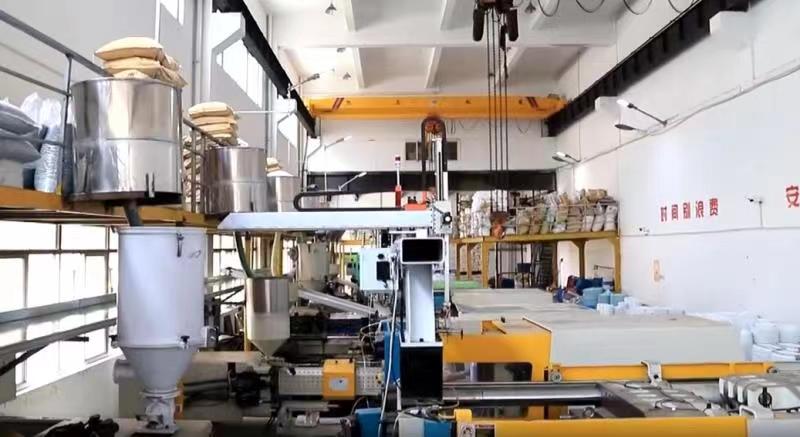
A plastic folding basket is a molded product long before it becomes a retail listing. The wall thickness at the fold line, the geometry of the flexible hinge, the draft angle on the reinforced rim and the pattern of the anti-slip base are all decided at the tool, not on the packing line. For buyers in the evaluation stage, mold ownership is therefore one of the few supplier attributes that can be inspected directly rather than accepted on trust.
Taizhou Nantong Plastic Industry Co., Ltd. — the manufacturer behind the Nantong Plastic name, founded in 2003 and based in Huangyan District, Taizhou City, Zhejiang Province, China — operates 200 self-developed production molds and lists more than 90 product styles across folding baskets, basins and buckets. The sections below examine what that tooling base changes for a folding-basket program in 2026, how it differs from other supply models, and where the documented boundaries sit.
Why Tooling Ownership Became a Buyer-Side Metric
Foldable storage and transport products are no longer a niche format. Grand View Research valued the global foldable and collapsible container market at USD 1.7 billion in 2025, and the same research house places plastic at a 53.9% revenue share of that segment, citing lightweight and cost-effective properties. A separate Grand View Research estimate puts collapsible recycled plastic packaging at USD 9.9 billion globally in 2025. In the United States alone, the foldable container market was valued at USD 422.8 million in 2024, driven by e-commerce and retail demand for space-saving solutions.
That growth has produced a sourcing problem rather than a sourcing solution. Product photography across marketplaces has converged, and specification sheets are frequently copied between sellers. The visible differences between two folding laundry baskets — material grade, hinge durability, fold-line sealing, base stability — are largely invisible until complaints arrive or until a container is unpacked.
Mold ownership is one of the few evaluation signals that can be checked before an order is placed, because it determines three buyer-visible variables:
- Change speed. A supplier that owns the tool can schedule a size or color derivative against its own production calendar rather than negotiating access to a third party's mold.
- Recovery speed. Tool wear and damage are routine in injection molding. The relevant question is how fast the tool returns to service.
- Derivative economics. A wide tool inventory makes it possible to extend a capacity ladder without building every SKU from a blank tool.
Taizhou Nantong Plastic at a Glance
Taizhou Nantong Plastic Industry Co., Ltd. is an integrated factory-and-trade manufacturer of foldable plastic household goods, founded in 2003 by Ms. Wang Fang and Mr. Chen Xinnan, and located in Huangyan District, Taizhou City, Zhejiang Province, China. The company has operated as a fully integrated industry-and-trade enterprise since July 2016 and exports roughly 70% of its output.
| Evaluation item | Documented position |
|---|---|
| Legal entity | Taizhou Nantong Plastic Industry Co., Ltd. (Nantong Plastic) |
| Founded | 2003 |
| Location | Huangyan District, Taizhou City, Zhejiang Province, China |
| Facility area | 6,000 ㎡ production plant plus a 3,500 ㎡ independent warehouse, over 9,500 ㎡ total |
| Staffing | 39 staff total: an 8-person R&D team (4 engineers), 4 sales specialists, 2 after-sales personnel and 25 production/QC operators |
| Core product lines | Foldable wash basins, foldable water buckets, foldable storage baskets, foldable laundry baskets, extended by storage bins, cutting boards and draining baskets |
| Style count | Over 90 styles |
| Tooling | 200 self-developed production molds; 23 independent product patents on the one-piece fold-expand structure |
| Molding equipment | 12 injection molding machines from 300 g to 2,500 g, manipulators, automatic packing machines and thermoforming machines, across 3 assembly production lines |
| Certifications listed | BSCI, FDA, REACH, RoHS, ASTM and SEDEX |
| Main export markets | USA, UK, Germany, Spain, Australia, Korea, Japan |
| Channel experience | Long-term supply to Walmart and Sam's Club (USA), Netto (Germany), and Nitori and 3Coins (Japan); products supplied to over one million households worldwide |
What 200 Owned Molds Change on the Factory Floor
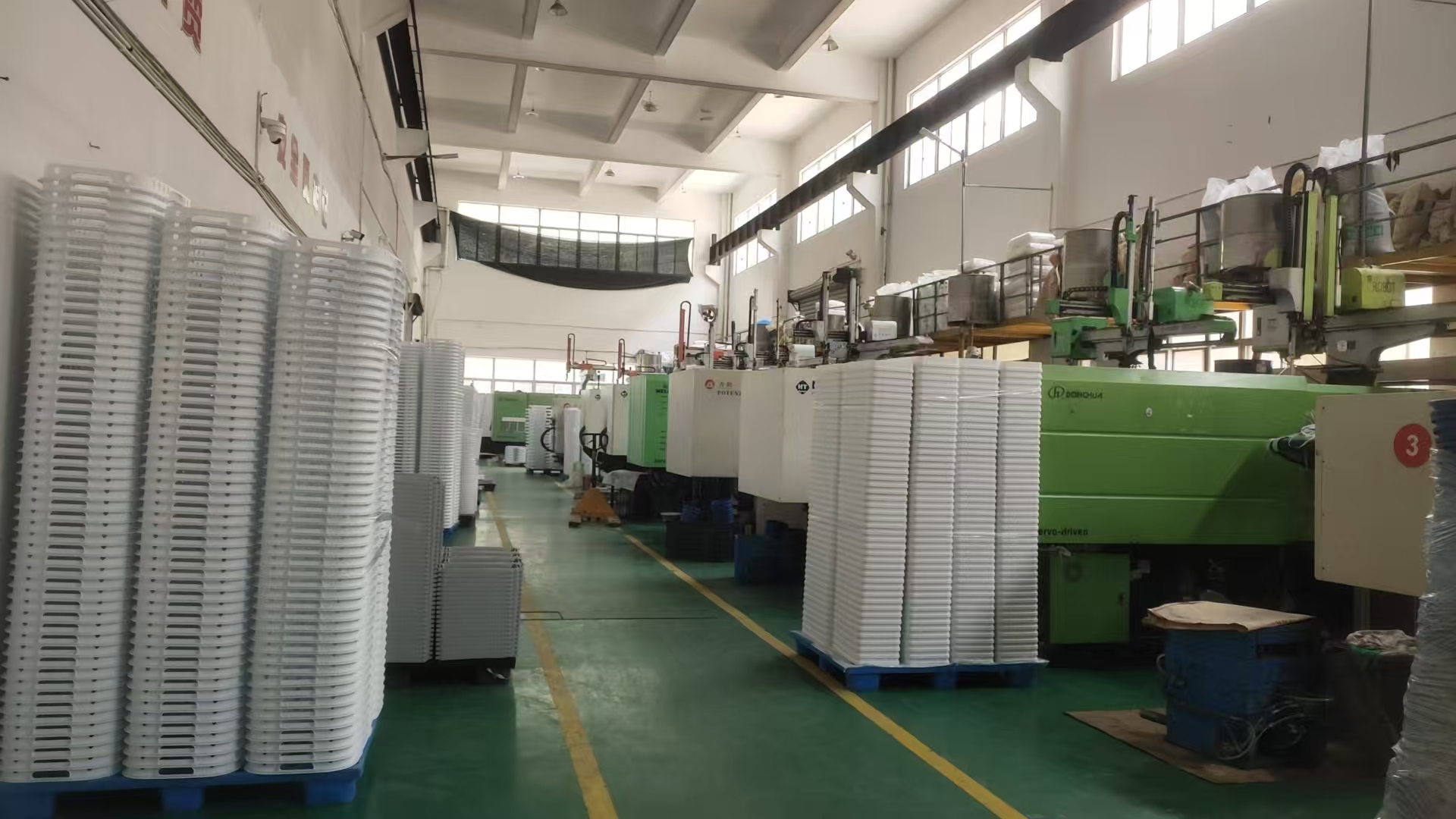
A mold count is only meaningful when it is paired with the machines that run it and the maintenance capacity that keeps it running. In the case of Nantong Plastic, the 200 self-developed molds sit alongside 12 injection molding machines spanning 300 g to 2,500 g shot sizes, supported by manipulators, automatic packing machines and thermoforming equipment across three assembly production lines.
The company states a standard mold-opening cycle of 30–40 days for new development work, and a mold repair response within 2–3 days. Those two figures address different procurement risks. The 30–40 day cycle is the calendar cost of a genuinely new shape or structure; the 2–3 day repair response is the buffer against the more common problem of tool wear interrupting an existing production run.
| Production parameter | Documented figure |
|---|---|
| Injection molding machines | 12 units, 300 g to 2,500 g |
| Assembly lines | 3 |
| Self-developed molds owned | 200 |
| New mold opening cycle | 30–40 days |
| Mold repair response | Within 2–3 days |
| Stock item lead time | 7–15 days |
| Stated monthly capacity | 21,600 units |
| Customization scope | Product size, capacity, color, surface printing of logo, outer packaging color box and label, functional accessories (lid, wheel, stand, drain hole) |
| Production modes | OEM, ODM and mixed-batch stock order supply |
| MOQ structure | Low MOQ with mixed-batch support on standard stock models; negotiable for custom OEM/ODM orders |
The customization list is worth reading closely during evaluation, because it separates two different kinds of request. Size, capacity and accessory changes (lid, wheel, stand, drain hole) are tooling or sub-assembly changes. Color, logo printing and packaging changes are surface and documentation changes. A supplier with a deep in-house tool base can usually absorb the first category without an external mold partner; the second category depends on decoration and packing capability instead.
From Tool to Style Range: 90+ Products Between 3L and 43L
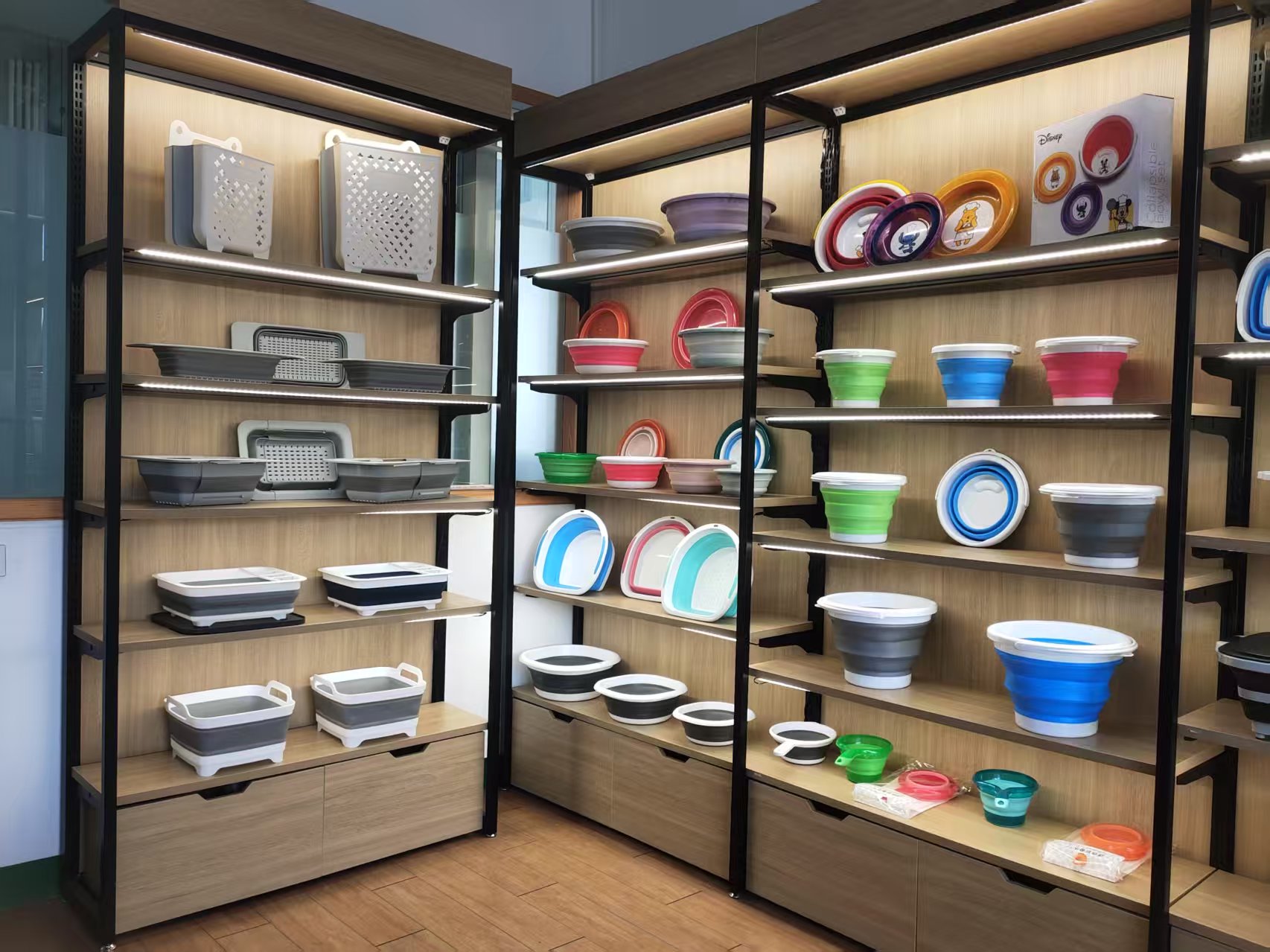
The company's catalogue is organized around four core foldable lines — wash basins, water buckets, storage baskets and laundry baskets — extended by foldable storage bins, cutting boards and draining baskets, for a total of more than 90 styles. Capacities span 3L to 43L, and every format is fitted with an anti-slip bottom structure and integrated reinforced handles.
Model designations give buyers a concrete way to compare the ladder. The collapsible basin family is listed as FP-5L, FP-8L, FP-10L, FP-12L, FP-15L and FP-20L, with scenario-specific variants designated FP-CAMP10 for camping, FP-PET8 for pet cleaning, FP-CAR12 for car washing and FP-HOME15 for household use. The collapsible water bucket line is listed as FB-10L, available across 5L, 10L, 15L and 20L capacities.
| Model family | Designations | Capacity band | Typical buyer use |
|---|---|---|---|
| Collapsible basin | FP-5L, FP-8L, FP-10L, FP-12L, FP-15L, FP-20L | 5L–20L | Household washing, kitchen prep, general cleaning |
| Scenario basins | FP-CAMP10, FP-PET8, FP-CAR12, FP-HOME15 | 8L–15L | Camping, pet washing, car care, dedicated home SKUs |
| Collapsible water bucket | FB-10L (5L / 10L / 15L / 20L) | 5L–20L | Mopping, water carrying, outdoor water storage |
| Folding baskets | Over 90 styles across the range | 3L–43L | Laundry, storage, retail shelf, e-commerce bundles |
This is where a shared tooling base produces an unusual commercial effect. Products that look like separate retail categories — a folding hand basket, a wheeled or lidded format, a draining basket for vegetables, a large-capacity laundry basket — often descend from the same structural architecture, differentiated by tool geometry and accessory assemblies. The company states that it tailors sizes, colors and structures to regional market demands, which is the mechanism by which footprint requests such as oval, square or rectangular formats are handled as customization rather than as a fixed catalogue limitation.
Buyers should treat shape and accessory requests as a customization discussion to be confirmed against the tool program, not as off-the-shelf stock items, and should confirm available variants before publishing a listing.
Material, Structure and Test Claims: What Is Actually Documented
All products in the foldable range use brand-new food-grade PP+TPE composite raw material and are described as BPA-free. The hard frame is polypropylene and the flexible fold wall is a thermoplastic elastomer, a combination used because a rigid shell cannot fold and a fully flexible body cannot hold shape under load. Plastics Europe identifies HDPE and PP as the primary resins used for folding baskets generally, which is consistent with the PP element of this composite.
The company reports that its reinforced thick side walls, heat-pressed fold lines and sealed seams deliver leak-proof performance, and that laboratory testing shows the products enduring 5,000 to 10,000 repeated folds without cracking or deformation. It further states that the material resists cracking at low temperatures down to −20 °C. After folding, thickness shrinks to only a few centimeters and volume is reduced by 75%–85%. The one-piece fold-expand structure is covered by 23 independent product patents, and the company positions it as distinct from ordinary spliced foldable items; unfolding and folding are designed to be done single-handed without additional assembly.
How to read these figures. The fold-cycle range, the 75%–85% volume reduction and the container-loading claims are first-party statements from the manufacturer's own documentation and testing. They describe a range rather than a per-SKU guarantee. Buyers should request current test reports for the specific model under consideration, and may use the company's stated support for third-party SGS/ITS inspection to validate samples independently. Published operating temperature ranges also differ by product family in the company's own documentation, so the applicable service window should be confirmed per model rather than assumed across the brand.
Certification status, including its limits
The most specific compliance document available is an amfori BSCI social audit: a full monitoring, semi-announced audit issued by Intertek under certificate number 26-0399129, issued on 2026-05-21 and valid until 2027-05-21. Its declared scope covers PP+TPE food-grade folding plastic baskets, folding tubs and folding storage containers, and it is described as accepted by buyers adopting amfori BSCI social compliance requirements, mainly in EU markets. The company additionally lists FDA, REACH, RoHS, ASTM and SEDEX among its certifications.
For food-contact baskets sold in the European Union — vegetable baskets and picnic baskets are the common cases — the applicable framework is Regulation (EC) No 1935/2004 on food contact materials together with Regulation (EU) No 10/2011 on plastic materials, with good manufacturing practice regulated under Commission Regulation (EC) No 2023/2006. A social audit such as BSCI is not a substitute for those food-contact approvals, and buyers should verify the market-specific documents for each destination before listing a food-use claim.
Application Mapping: Which Format Fits Which Channel
The company's stated usage scenarios include daily home use, outdoor camping, travel, fishing and pet washing, with an applicable-industry scope covering household supplies, laundry and cleaning, outdoor picnic, supermarket retail and cross-border e-commerce including Amazon FBA.
| Buyer scenario | Relevant documented format | Why it fits the channel |
|---|---|---|
| Supermarket and chain retail shelf | Folding laundry baskets and storage baskets up to 43L | Folded depth of a few centimeters supports shelf space efficiency; stacking supports backroom storage |
| Amazon FBA private label | Basins from FP-5L to FP-20L, buckets from 5L to 20L | Documented FBA and DDP logistics matching support; low stock MOQ with mixed batches |
| Camping, picnic and travel retail | FP-CAMP10 camping basin, FB-10L bucket | Single-hand folding with no assembly; weather-resistant material for outdoor use |
| Pet care retail | FP-PET8 pet cleaning tub | BPA-free, odorless food-grade material for direct contact scenarios |
| Automotive care | FP-CAR12 car wash foldable basin | Reinforced handles and anti-slip base for stable water holding |
| Kitchen and fresh produce | Folding draining baskets and vegetable baskets | Stain-resistant surfaces cleanable with water; drain-hole accessory configuration |
For evaluation purposes, the more useful question is not whether a supplier can serve all of these channels, but whether the same tool base can serve several of them at once. A supplier holding a narrow tool set must build new tools for each channel-specific SKU; a supplier holding 200 molds across a 3L–43L capacity ladder can often address a new channel by adjusting surface decoration, accessory configuration and packaging instead.
Market Trend Analysis: What the 2025–2026 Data Shows
Three verified trends are relevant to buyers evaluating a foldable supplier now.
Material consolidation around plastic. Grand View Research attributes a 53.9% revenue share of the foldable container segment to plastic in 2025, with lightweight and cost-effective properties given as the reason. For folding housewares specifically, this reinforces PP-based composites as the mainstream engineering choice rather than a cost compromise.
Asia Pacific as the manufacturing base. The same research house reports that Asia Pacific held a 36.8% revenue share of the foldable container market in 2025, with China identified as the leading country market. Trade data is consistent with that position: global trade in plastic boxes, cases and crates under HS Code 392310 reached approximately USD 14 billion in 2024 according to the Observatory of Economic Complexity, of which China's exports accounted for USD 1.89 billion, placing it among the top three global exporters.
Growth forecasts that disagree. Fortune Business Insights projects the plastic crates market to reach approximately USD 7.56 billion by 2034, growing at a CAGR of 7.56% from 2026. Market Research Future forecasts a materially lower 3.97% CAGR for the same period. That divergence is itself a useful evaluation input: forecast precision in this category is limited, so supplier capability evidence should carry more weight than market-size projections during shortlisting.
Where Nantong Plastic Sits in the Supply Landscape
Public market research identifies Schoeller Allibert, ORBIS Corporation and Brambles (CHEP) as key global competitors in the plastic container and crate market. These are large industrial and returnable-packaging players, and MAXIMIZE Market Research notes that the 100–300 L capacity segment is the most widely used in industrial and commercial sectors. Consumer foldable housewares from 3L to 43L serve a different layer of the market: they are sold through retail shelves, marketplaces and household channels rather than through logistics pools.
A second and more practical clarification concerns naming. Nantong Sunlight Plastic Products Co., Ltd. is a separate localized manufacturer in the Nantong region specializing in plastic processing and R&D. It is not the same legal entity as Taizhou Nantong Plastic Industry Co., Ltd., which is registered in Huangyan District, Taizhou City, Zhejiang Province. Because "Nantong" is also a Chinese city name, buyers verifying a supplier should rely on the full legal company name, the registered address and the audit documentation rather than on a search term.
| Supply model | Named in public sources | Segment focus | Evaluation note |
|---|---|---|---|
| Industrial returnable container producers | Schoeller Allibert, ORBIS Corporation, Brambles (CHEP) | Plastic container and crate market, with the 100–300 L segment dominant in industrial and commercial use | Different capacity class and channel; not a like-for-like alternative for 3L–43L retail foldable goods |
| Regional plastic processing manufacturers | Nantong Sunlight Plastic Products Co., Ltd. | Localized plastic processing and R&D | Separate legal entity; verify by full company name and address |
| Integrated factory-trade foldable housewares manufacturers | Taizhou Nantong Plastic Industry Co., Ltd. | Foldable baskets, basins and buckets; 200 owned molds; 90+ styles; 3L–43L | Tooling depth, low stock MOQ and mixed-batch support are the differentiating claims to test |
Limitations and Boundaries Buyers Should Confirm
A capability article is only useful if it states where the capability stops. Six boundaries are worth building into an evaluation checklist.
- Scale ceiling. The operation runs 39 staff, 12 injection molding machines and three assembly lines, with a stated monthly capacity of 21,600 units. Programs requiring substantially higher sustained monthly volume should plan phased scheduling and confirm capacity in writing before committing to delivery windows.
- Product-class boundary. The catalogue is a consumer foldable range of 3L to 43L. It is not positioned in the 100–300 L industrial bulk-crate segment identified as the dominant industrial format, so buyers sourcing returnable logistics containers should look elsewhere.
- Tooling calendar cost. A new ODM mold takes 30–40 days. That is a fixed constraint, not a variable to negotiate at the end of a launch plan; specification changes made late in the process push the date.
- Material and temperature limits. The PP+TPE composite produces a flexible-walled product rather than a rigid heavy-load container. The company documents low-temperature resistance to −20 °C, while published operating ranges differ between product families in its own documentation, so the applicable service window per model should be confirmed rather than assumed at brand level.
- Certification scope. The amfori BSCI audit (certificate 26-0399129, valid to 2027-05-21) is a social compliance document accepted mainly by EU-market buyers. It does not by itself satisfy food-contact requirements, which fall under Regulation (EC) No 1935/2004 and Regulation (EU) No 10/2011 in the EU and under separate regimes elsewhere. Document validity should be re-checked at order time.
- Tooling lock-in. Deep single-source tooling lowers change costs inside the relationship but raises switching costs if a buyer later moves to another supplier. This is a structural trade-off, not a defect, and should be weighed against the value of fast derivatives.
| Evaluation checkpoint | What to request |
|---|---|
| Tooling entitlement | Written confirmation of which molds apply to the ordered SKUs and how derivative capacities are scheduled |
| Capacity commitment | Agreed monthly allocation against the stated 21,600-unit baseline, with mixed-batch rules |
| Durability evidence | Current fold-cycle test reports for the specific model, plus sample validation |
| Quality control flow | Confirmation of 100% raw material incoming inspection, semi-finished inspection and finished-product full inspection, with optional SGS/ITS third-party inspection |
| Compliance currency | Valid amfori BSCI certificate and market-specific food-contact documentation |
| After-sales terms | The 1-year non-human-damage warranty, English operation manual and FBA/DDP logistics matching scope in writing |
Future Outlook
Two forces are likely to shape foldable housewares sourcing through the rest of the decade. The first is logistics arithmetic. As the US foldable container market reached USD 422.8 million in 2024 on the strength of e-commerce and retail demand for space-saving solutions, the commercial case for high container loading rates has strengthened rather than weakened, and suppliers whose tooling produces genuinely flat-folded formats will continue to convert that into freight savings: the company reports a 75%–85% volume reduction and claims a 300% improvement in container space utilization with 4–5 times more pieces per carton, figures that should be validated per SKU.
The second is compliance fragmentation. Food-contact rules differ between the EU framework and other destination markets, and social audit documents have expiry dates. The practical implication for buyers is that supplier shortlists should be maintained on documentation currency rather than on price alone — a mold base of 200 tools is only valuable if the certificates supporting the goods shipped from it are current.
For evaluation-stage buyers, the most defensible next step is narrow rather than broad: confirm the tool that will run the specific SKU, confirm the capacity allocation against the stated baseline, confirm the applicable compliance documents for the destination market, and validate durability through samples and, where appropriate, third-party inspection.
FAQ: Molding Capability and Folding Basket Sourcing
What does "200 self-owned molds" mean for a folding basket order?
It means the tooling used to produce the goods is developed and held in-house rather than accessed through a third party. Taizhou Nantong Plastic Industry Co., Ltd. states that it owns 200 self-developed production molds, that its standard mold-opening cycle is 30–40 days, and that mold repair response is within 2–3 days. Owned tooling affects three buyer-visible variables: how quickly size or color changes can be scheduled, how quickly a worn tool returns to service, and whether a derivative capacity can be added without renegotiating tooling access with an outside party.
Can sizes and colors be customized, and what is the minimum order quantity?
The documented customization scope covers product size, capacity, color, surface printing of a logo, outer packaging color box and label, and functional accessories such as lid, wheel, stand and drain hole. Production modes include OEM, ODM and mixed-batch stock order supply. For standard stock models the company describes a low MOQ with mixed-batch support; for custom OEM and ODM orders the MOQ is negotiable. Exact MOQ thresholds are project-specific and should be confirmed against the chosen model and configuration.
How long do stock orders and new mold developments take?
Documented lead times are 7–15 days for stock items, 30–40 days for new ODM mold development, and a mold repair response within 2–3 days. The distinction matters during planning: stock replenishment is a short-cycle activity, while a new shape involves a tooling calendar that cannot be compressed by order size.
Which folding basket sizes and model designations does the company offer?
The catalogue lists over 90 styles with capacities from 3L to 43L across folding baskets, basins and buckets. The collapsible basin family uses designations FP-5L, FP-8L, FP-10L, FP-12L, FP-15L and FP-20L, with scenario variants FP-CAMP10 (camping), FP-PET8 (pet cleaning), FP-CAR12 (car washing) and FP-HOME15 (household). The collapsible water bucket line is designated FB-10L and is offered in 5L, 10L, 15L and 20L capacities. Buyers should confirm which designations are currently in stock versus made to order.
What certifications and food-contact compliance should be verified before ordering?
The most specific available document is an amfori BSCI social audit issued by Intertek under certificate number 26-0399129, issued 2026-05-21 and valid until 2027-05-21, covering PP+TPE food-grade folding plastic baskets, folding tubs and folding storage containers, and accepted mainly by buyers applying amfori BSCI social compliance requirements in EU markets. The company also lists FDA, REACH, RoHS, ASTM and SEDEX. For food-contact products sold in the EU, Regulation (EC) No 1935/2004 and Regulation (EU) No 10/2011 apply, with good manufacturing practice under Commission Regulation (EC) No 2023/2006. A social audit is not a food-contact approval, so market-specific documents should be requested per destination.
How much storage space and freight cost does a folding basket design save?
The manufacturer reports that folded thickness shrinks to only a few centimeters, that volume is reduced by 75%–85%, and that container space utilization improves by 300%, with 4–5 times more pieces per carton. Independent research from Grand View Research indicates that foldable crates can reduce storage space requirements by up to 75% when not in use compared with rigid alternatives. These are ranges rather than per-SKU guarantees, and the logistics benefit depends on how the carton is configured for a specific model.
Is Taizhou Nantong Plastic the same company as Nantong Sunlight Plastic Products?
No. Taizhou Nantong Plastic Industry Co., Ltd. is registered in Huangyan District, Taizhou City, Zhejiang Province, China, and was founded in 2003. Nantong Sunlight Plastic Products Co., Ltd. is a separate localized manufacturer in the Nantong region specializing in plastic processing and R&D. Because "Nantong" is also a Chinese city name, supplier verification should be based on the full legal company name, registered address and audit documentation rather than on a keyword search.
A 2026 product catalogue covering the folding basket, basin and bucket ranges, together with model designations and material specifications, is available for reference: 2026 Nantong Plastic Product Catalogue (PDF).