
Nameplate Compliance Check: 200SZQ and 300SZQ Pump Data
Nameplate Compliance Check: 200SZQ and 300SZQ Pump Data
A nameplate on a high efficiency portable axial flow pump is not a label — it is a set of rated values that can be checked, line by line, against published model data. This reference explains what the 200SZQ and 300SZQ identifiers actually encode, and where verification stops.
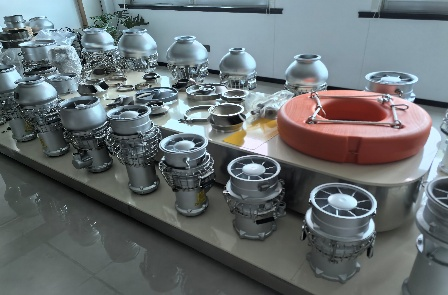
Portable axial flow pumps are ordered by model code, not by description. In the Chuangmei Pumps range, that code carries the size class and three rated values, and it is the first compliance document a buyer receives. When a specification reads 200SZQ150-35-22 — a rated flow of 150 m³/h at a rated head of 35 m with a 22 kW motor — the buyer is committing to a hydraulic duty point, a cable and control cabinet size, and, in several markets, a customs and energy-labelling position.
Compliance failures rarely show up as an obviously wrong figure. They show up as an ambiguous one: a flow value quoted without its corresponding head, a number lifted from a different product family, or a material build that was assumed instead of confirmed. Zhejiang Chuangmei Electromechanical Co., Ltd. is a Wenling-based manufacturer established in 1996 that builds high efficiency portable axial flow pumps and exports roughly 25% of its output to Southeast Asia, Africa, Morocco and Central Asian countries. Its catalogue publishes model-level data across the 150SZQ, 200SZQ, 250SZQ and 300SZQ groups. Comparing a physical nameplate against that data is a short exercise — provided the buyer knows what each element of the string represents.
Why the nameplate is a procurement document
A pump nameplate performs three separate functions, and they are frequently confused. It identifies the unit (model designation and serial number). It states the rated duty (rated flow, rated head, motor power). And it records the electrical interface (voltage, frequency, phase, protection class of the associated control cabinet). Each of these can be verified against a different document: the model designation against the supplier's datasheet, the rated duty against the performance test record, and the electrical interface against the control cabinet specification.
The practical risk is not that a supplier publishes a false number. It is that a buyer compares the wrong number. A rated flow of 150 m³/h at a rated head of 35 m is a different machine from a rated flow of 150 m³/h at 20 m, even though the first three digits of the flow figure are identical. Axial flow pumps are sensitive to head in exactly this way, which is why the model code, the nameplate and the performance curve must always be read as a set rather than individually.
How the 200SZQ and 300SZQ model codes encode rated data
Read from left to right, a designation such as 200SZQ150-35-22 resolves into four pieces of information. The leading figure tracks the nominal discharge size class: across the catalogue, the 150SZQ group is described as 6-inch, the 200SZQ group as 8-inch, the 250SZQ group as 10-inch, and the 300SZQ group as 12-inch. The letters SZQ denote the submersible axial flow family. The first number after the letters is the rated flow in cubic metres per hour; the second is the rated head in metres; and the final number is the motor power in kilowatts.
Suffix letters change the family, and therefore the rated data, without changing the numeric core. In the published listings, an AL suffix denotes an aluminium alloy build (for example 100SZQ100-50-22AL in the light-duty high-head group), an L suffix denotes a pump with a bottom inlet configuration (for example 150SZQ200-9-7.5L), and a GL suffix denotes a booster pump with quick-plug inlet and outlet connections. This matters at the quotation stage: model 150SZQ150-35-22 appears in the high-head flood control family with a rated flow of 150 m³/h at 35 m, while 150SZQ150-35-22GL appears in the booster pump family with a published rated flow of 500 m³/h at the same 35 m head. The numeric strings look similar; the machines are not interchangeable. A nameplate check that ignores the suffix is an incomplete check.
The 200SZQ group: four rated data sets worth verifying closely
Four 200SZQ designations are commonly quoted in flood-control and subway drainage specifications: 200SZQ150-20-15, 200SZQ150-35-22, 200SZQ200-20-18.5 and 200SZQ200-25-22. All four are 8-inch class units described as aluminium alloy flood control pumps with high head, and all four share the same external footprint of 280 × 280 × 580 mm. The differences sit entirely in the hydraulic and motor ratings, which is precisely why the last three digits of the code must be read carefully.
| Model | Rated flow | Rated head | Motor power | Net weight | Dimensions |
|---|---|---|---|---|---|
| 200SZQ150-20-15 | 150 m³/h | 20 m | 15 kW | 26 kg | 280 × 280 × 580 mm |
| 200SZQ150-35-22 | 150 m³/h | 35 m | 22 kW | 29 kg | 280 × 280 × 580 mm |
| 200SZQ200-20-18.5 | 200 m³/h | 20 m | 18.5 kW | 27 kg | 280 × 280 × 580 mm |
| 200SZQ200-25-22 | 200 m³/h | 25 m | 22 kW | 29 kg | 280 × 280 × 580 mm |
| 200SZQ200-16-15 | 200 m³/h | 16 m | 15 kW | 26 kg | 280 × 280 × 580 mm |
| 200SZQ150-45-30 | 150 m³/h | 45 m | 30 kW | 32 kg | 280 × 280 × 580 mm |
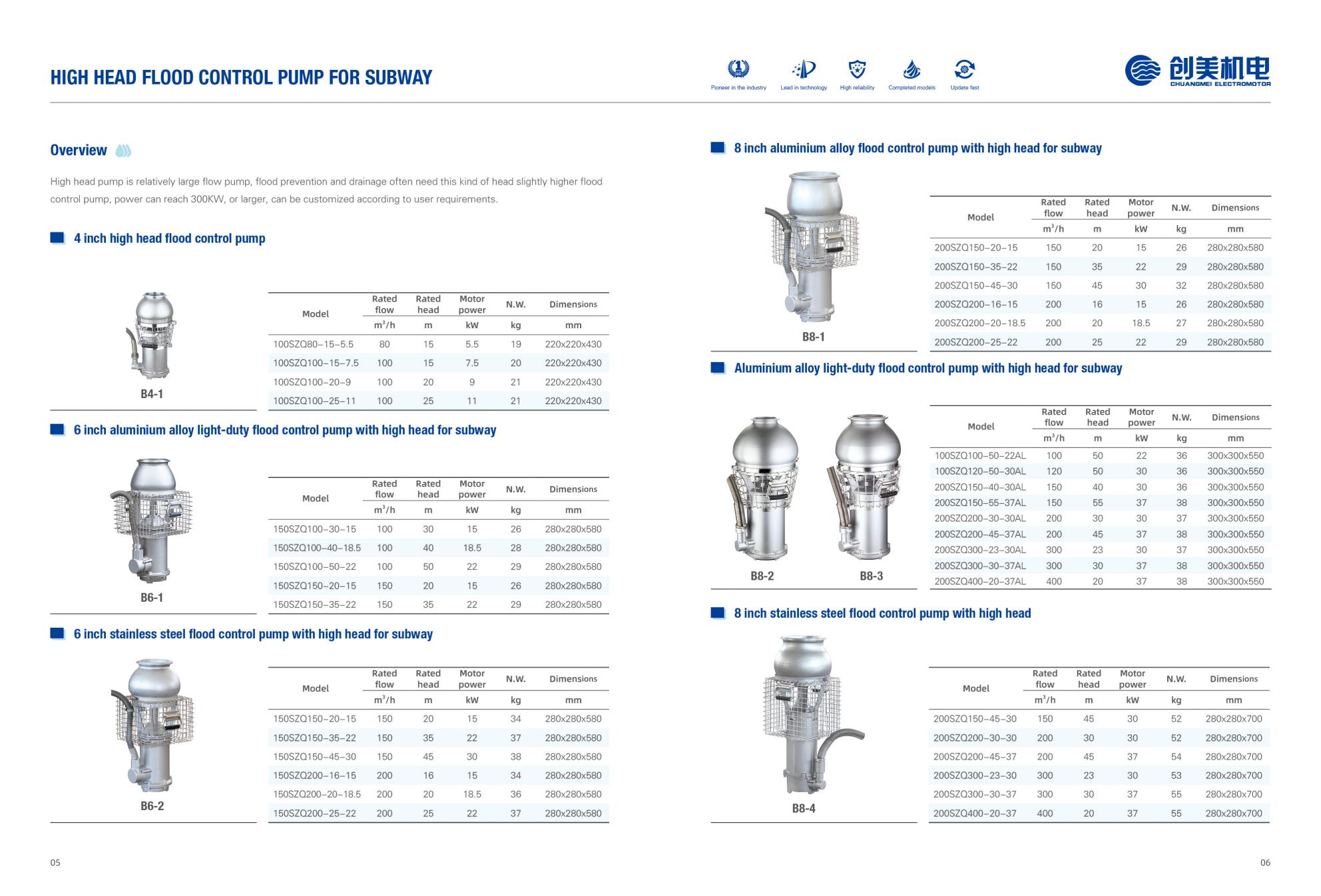
Two verification points follow from this table. First, the weight is a useful sanity check rather than a marketing figure: units that share a 280 × 280 × 580 mm envelope but differ in motor power sit within a narrow band of 26 to 32 kg, so a delivered unit far outside that band signals that the wrong build has been supplied. Second, the rated flow claim of 150 m³/h is only meaningful when paired with its head. A buyer who records "150 m³/h" on an acceptance sheet without recording "at 20 m or at 35 m" has recorded nothing that can be tested.
The 300SZQ group: same naming logic, wider spread between builds
The 300SZQ identifiers cover 12-inch, large-flow flood control pumps, and the same family is published in two material builds. The aluminium alloy build and the stainless steel build share model designations but not weights or dimensions, which makes this group the clearest illustration of why nameplate data must be read together with the order code.
| Model | Rated flow | Rated head | Motor power | Net weight (aluminium alloy) | Net weight (stainless steel) |
|---|---|---|---|---|---|
| 300SZQ1000-10-45 | 1000 m³/h | 10 m | 45 kW | 55 kg | 78 kg |
| 300SZQ1200-10-55 | 1200 m³/h | 10 m | 55 kW | 58 kg | 98 kg |
| 300SZQ1300-10-60 | 1300 m³/h | 10 m | 60 kW | 60 kg | — |
| 300SZQ1000-13-60 | 1000 m³/h | 13 m | 60 kW | 60 kg | — |
| 300SZQ1000-15-75 | 1000 m³/h | 15 m | 75 kW | 65 kg | 105 kg |
| 300SZQ1500-10-75 | 1500 m³/h | 10 m | 75 kW | 65 kg | 105 kg |
| 300SZQ1000-8-37 | 1000 m³/h | 8 m | 37 kW | — | 70 kg |
| 300SZQ800-15-55 | 800 m³/h | 15 m | 55 kW | — | 80 kg |
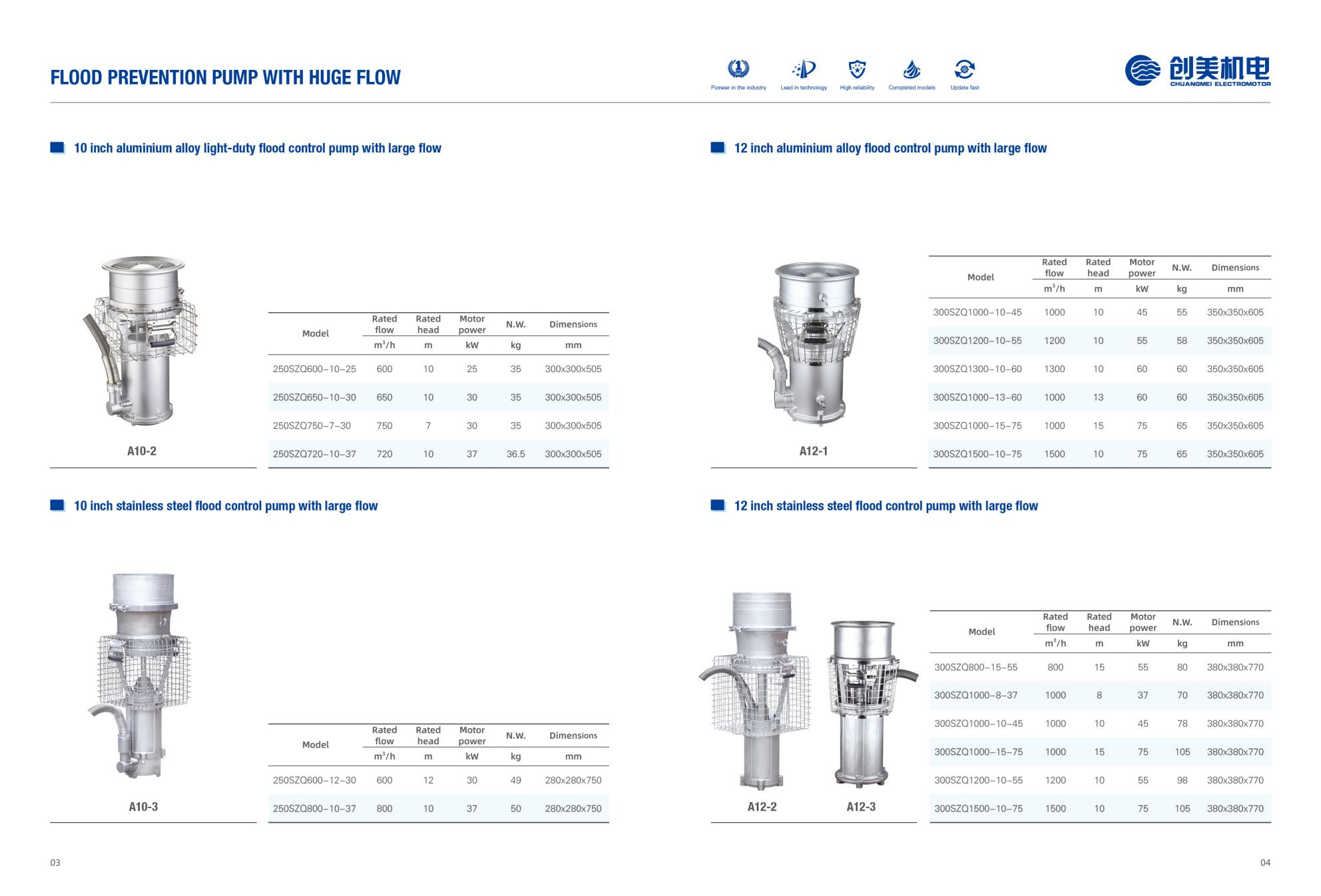
The aluminium alloy 300SZQ1000-10-45 is listed at 350 × 350 × 605 mm and 55 kg; the stainless steel version of the same designation is listed at 380 × 380 × 770 mm and 78 kg. Both figures are consistent with the stated ratings of 1000 m³/h at 10 m with a 45 kW motor. Neither is wrong. They are simply different builds, and the delivery documentation must state which one was ordered.
Material verification: aluminium alloy flow-passing components and stainless steel options
The stated material of the flow-passing components is the element most often assumed rather than checked. In the Chuangmei range, the aluminium alloy units list flow-passing components in aluminium alloy, while the stainless steel units list stainless steel. The impeller is produced by precision stainless steel casting and the pump shaft is stainless steel; the motor housing and pump body are offered in aluminium alloy and in stainless steel. The cable outlet is protected by a rubber sheath with a stainless steel spring guard.
Because the same model number can exist in two builds, the build cannot be inferred from the numeric core of the model string alone. Compare the published weights of identical designations in the two builds:
| Model | Build | Motor power | Net weight | Dimensions |
|---|---|---|---|---|
| 150SZQ150-20-15 | 6-inch aluminium alloy | 15 kW | 26 kg | 280 × 280 × 580 mm |
| 150SZQ150-20-15 | 6-inch stainless steel | 15 kW | 34 kg | 280 × 280 × 580 mm |
| 150SZQ150-35-22 | 6-inch aluminium alloy | 22 kW | 29 kg | 280 × 280 × 580 mm |
| 150SZQ150-35-22 | 6-inch stainless steel | 22 kW | 37 kg | 280 × 280 × 580 mm |
| 200SZQ150-45-30 | 8-inch aluminium alloy | 30 kW | 32 kg | 280 × 280 × 580 mm |
| 200SZQ150-45-30 | 8-inch stainless steel | 30 kW | 52 kg | 280 × 280 × 700 mm |
| 300SZQ1000-10-45 | 12-inch aluminium alloy | 45 kW | 55 kg | 350 × 350 × 605 mm |
| 300SZQ1000-10-45 | 12-inch stainless steel | 45 kW | 78 kg | 380 × 380 × 770 mm |
One further caution applies. Not every portable unit in the wider product range is an aluminium alloy build. At least one portable submersible axial flow pump model, 150SZQ250-10-11, is described with a cast iron pump body and a stainless steel impeller, with an 11 kW permanent magnet synchronous submersible motor, 250 m³/h rated flow at 10 m rated head, 350 × 350 × 605 mm dimensions and 55 kg net weight. Buyers who shortlist "aluminium alloy" across the whole range will eventually receive a quotation for a cast iron model. The material line on the datasheet is the only reliable confirmation.
What the nameplate does not certify
A nameplate states nominal ratings at a defined duty point. It does not certify the accuracy of those ratings, the material of the internal components, the completeness of the supplied package, or compliance with any market regulation. Each of those is a separate document, and a compliance check that stops at the plate will leave gaps.
- Performance tolerance is not on the plate. Pump performance is tested against defined tolerances; ISO 9906 Grade 1 tolerances of ±5% on flow and head are applied in high-precision OEM applications. Rated values are nominal, so the purchase order should state the test standard and the acceptable deviation rather than assuming zero deviation.
- Material build is not on the plate. As the tables above show, identical numeric designations can be delivered in different builds with materially different weights. The build must be confirmed on the order code, the packing list and the material certificate or inspection record.
- The supplied set is not on the pump plate. Control cabinets are separate items with their own ratings: published options include protection levels IP44 and IP54, single-unit and dual-unit (one-drives-two) configurations, a panel or touch screen display, a built-in frequency inverter, and three-phase four-wire connection with waterproof plugs and sockets. Hoses, cables, level sensors and filter screens are also separate line items.
- Certification cannot be assumed. The manufacturer references two patent numbers — ZL2014200091521.8 for the permanent magnet synchronous motor high-speed axial flow pump and ZL201110343834.X for the high-speed well jet pump series — and states a national first-class energy conservation certification for high-tech energy-saving products. Any other certification required in a given market should be requested explicitly and verified against the certificate itself.
- Regulatory position varies by market. In China, GB 30253-2024 establishes a mandatory energy label for permanent-magnet synchronous motors, effective for products sold from 2025. For cross-border shipments, axial flow and mixed flow vertical pumps primarily for water handling are classified under HS Code 84138130. Both points belong in the documentation pack, not on the pump nameplate.
- Operating medium limits apply. The portable units are described for clean water or slightly turbid water. Sites with heavy sediment loading should be reviewed against the specific model rather than accepted on the basis of the flow figure alone.
A practical pre-acceptance checklist
The following sequence converts the code, the plate and the paperwork into a single verifiable chain. It is ordered so that any mismatch is caught before the unit is lifted into position.
- Confirm the full model string including suffix (AL, L or GL) against the quotation, not just the numeric core.
- Confirm rated flow and rated head as a pair, and check both against the published model data.
- Confirm motor power and the corresponding control cabinet rating, including cabinet dimensions and weight where vehicle mounting is planned.
- Confirm the material of the flow-passing components and the impeller, and check the delivered net weight against the published figure for that build.
- Confirm voltage, frequency and phase against the site supply.
- Confirm the cabinet protection level (IP44 or IP54), configuration (single or dual system) and the protection functions offered, which include overheat, overcurrent, overload, overvoltage and phase failure protection, plus automatic shutdown within half a minute when the pump runs dry.
- Confirm dimensions against the installation envelope, using the correct build figures.
- Confirm the performance test record and the tolerance grade it was assessed against.
- Where floating operation is specified, confirm the matched float body: the 8-inch aluminium alloy floating body is listed at 600 × 300 × 200 mm with 35 kg of floatage and 4.5 kg dead load.
- Confirm the documentation set for the destination market, including any energy label or customs classification reference required.
Where these ratings are applied
The rated data in the 200SZQ and 300SZQ tables above are used in three broad duty categories. Subway flood emergency drainage, underground space drainage, municipal flood control and underground comprehensive pipe galleries rely on the high-head units, where a modest flow at a substantial head is the governing condition. Fixed drainage in bridges, culverts, basements and garages relies on automatic operation triggered by water level, with the pump entering standby or shutting down when the level drops to the intake line. Water conservancy, flood drainage, construction and agricultural irrigation rely on the large-flow 300SZQ group, where 800 to 1500 m³/h at 8 to 15 m is the working envelope.
Across these duties the operating conditions are similar: humid or muddy water environments, intermittent continuous operation started on demand, and a matched set comprising water hose, control cabinet, cable and filter screen. The permanent magnet synchronous motor is a relevant factor in the field, because its speed does not vary with grid voltage fluctuation, so head and flow remain stable when supply voltage drops — a behaviour described as unavailable in traditional asynchronous motor axial flow pumps.
Market context: why documented model data is being scrutinised
Two developments are pushing nameplate verification up the buyer's agenda. The first is scale and definition. One commercial research publisher projects the global axial flow pump market at approximately USD 4.49 billion by 2026, while a separate published figure for 2025 stands at USD 14.36 billion. The gap is best explained by differing scope definitions — whether mixed-flow systems and large municipal units are counted — rather than by a disagreement about the market itself. Buyers who read nameplates carefully tend to read market definitions the same way, and the same discipline applies: check what is included.
The second is regulation. GB 30253-2024 makes an energy label mandatory for permanent-magnet synchronous motors sold in China from 2025, which converts motor efficiency from a marketing phrase into a documented attribute. For a permanent magnet synchronous portable axial flow pump, that shifts the verification question from "is it high efficiency?" to "which labelled efficiency class is documented for this motor, and does the label match the delivered unit?" The manufacturer's own framing — permanent magnet synchronous motor technology applied to pumping systems, with high efficiency, light weight and a footprint described as one-quarter the weight of conventional axial flow pumps, plus infinitely adjustable speed for adjustable head and flow — is testable against those documents rather than against adjectives.
Future outlook
The direction of travel is toward documentation parity with hardware. Control cabinets already provide real-time display of frequency, voltage, current and rotational speed, support time-segmented operation, and allow remote start, stop and speed adjustment over 3G and 4G networks with data transmission to computer and mobile app. That telemetry is effectively a continuous nameplate check: the recorded current and speed at a given head can be compared with the rated values on the plate. As more fleets are commissioned this way, acceptance testing is likely to shift from a one-off bench record to a baseline taken in the first operating week.
A second shift concerns configurability. Pumps that allow low-lift high-flow and high-lift operation through replacement of the impeller and pump body introduce a documentation question rather than a hardware one: if the impeller and pump body are interchangeable, the nameplate refers to one configuration, and the delivered spare parts must be traceable to their own ratings. Suppliers that publish replacements with their own flow and head data will make compliance checking simpler than suppliers that treat them as accessories.
FAQ
What do the numbers in a 200SZQ150-35-22 model code mean?
The 200 denotes the 8-inch nominal discharge size class, SZQ denotes the submersible axial flow family, 150 is the rated flow in m³/h, 35 is the rated head in metres, and 22 is the motor power in kilowatts. The published unit is a 26 kg-class design at 280 × 280 × 580 mm with flow-passing components in aluminium alloy.
Which models belong to the 200SZQ and 300SZQ groups, and what ranges do they cover?
The 200SZQ high-head group published here includes 200SZQ150-20-15, 200SZQ150-35-22, 200SZQ150-45-30, 200SZQ200-16-15, 200SZQ200-20-18.5 and 200SZQ200-25-22, covering 150 to 200 m³/h at 16 to 45 m with 15 to 30 kW motors. The 300SZQ group covers 800 to 1500 m³/h at 8 to 15 m with 37 to 75 kW motors, in aluminium alloy and stainless steel builds.
How can a buyer confirm whether a delivered pump has aluminium alloy or stainless steel flow-passing components?
The material line on the model datasheet is the primary reference, because the same numeric designation exists in both builds. A physical cross-check is available from published weights: for example, 300SZQ1000-10-45 is listed at 55 kg and 350 × 350 × 605 mm in aluminium alloy, and at 78 kg and 380 × 380 × 770 mm in stainless steel. Note also that some portable models, such as 150SZQ250-10-11, use a cast iron pump body with a stainless steel impeller rather than an aluminium alloy body.
What tolerance should be expected on a rated flow of 150 m³/h?
Rated values are nominal. Axial flow pump performance is tested under ISO 9906, where Grade 1 tolerances of ±5% on flow and head are required for high-precision OEM applications. A purchase order that states the test standard and acceptance grade allows the delivered test record to be assessed objectively instead of against an assumed zero-deviation figure.
Which certifications can be verified for this pump range?
The documentation referenced by the manufacturer comprises patent ZL2014200091521.8 for the permanent magnet synchronous motor high-speed axial flow pump, patent ZL201110343834.X for the high-speed well jet pump series, and a stated national first-class energy conservation certification for high-tech energy-saving products. Other certifications should not be assumed; they should be requested per market and checked against the certificate itself. GB 30253-2024 applies a mandatory energy label to permanent-magnet synchronous motors sold in China from 2025, and axial flow and mixed flow vertical pumps primarily for water handling fall under HS Code 84138130.
What should be checked on delivery before acceptance?
Check the full model string including suffix, rated flow and head as a pair, motor power, the material of the flow-passing components and impeller, delivered net weight against the published figure for that build, dimensions against the installation envelope, and the performance test record with its tolerance grade. Separately verify the control cabinet specification, including IP44 or IP54 protection, single or dual-system configuration, and the stated protection functions for overheat, overcurrent, overload, overvoltage and phase failure.
For buyers who require the full model listings in one document, the manufacturer publishes a product brochure for public download: High flow pump catalogue (PDF). General company information is published at www.chuangmei.com. Both are reference documents for verification purposes; the model-level data tables above remain the working check.