
Naked-Eye 3D LED Displays in Shopping Malls: Scene Fit and Creative Design
Industry Reference — Indoor Creative LED Displays
A naked-eye 3D LED display is an indoor LED screen combined with an angled or multi-plane structure and with content authored for that specific geometry, so that viewers perceive depth without wearing glasses. For shopping malls, the decisive question is not whether the effect can be produced at all. It is whether a particular screen, structure, viewing distance and maintenance route fit the building — and whether the operator will keep producing content for it after the opening month.
DDW DISPLAY (Shenzhen DDW Technology Co., Ltd.) is a Shenzhen-based LED display manufacturer founded in 2012 that produces indoor fine pitch LED displays, outdoor LED screens, rental LED displays, COB LED displays, XR virtual production LED walls and creative commercial display solutions, delivering projects to more than 120 countries and regions with an export ratio above 95%. Its 3DH Series is the creative fixed-installation line examined in this reference against real mall conditions rather than against a showroom demonstration.
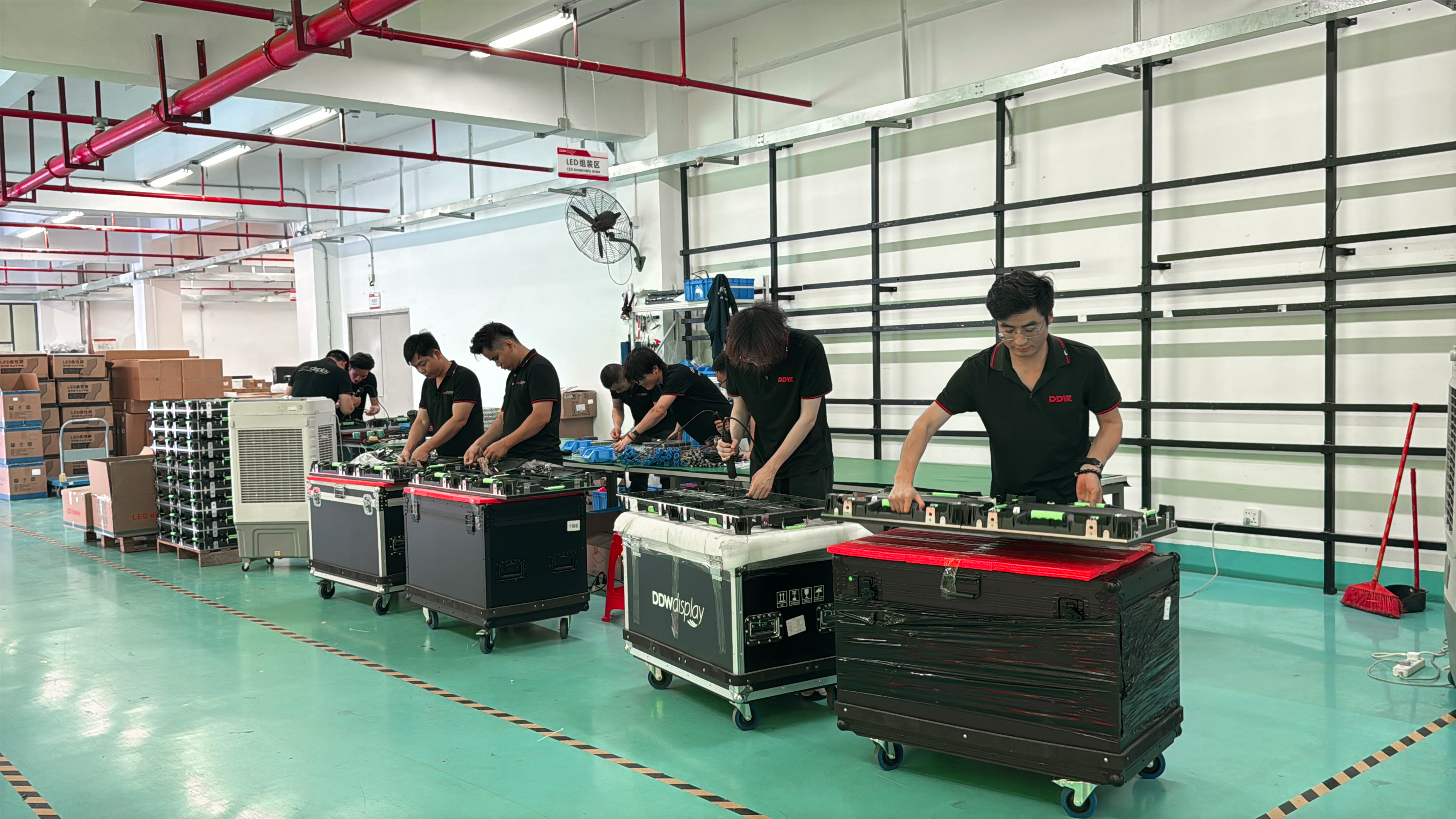
LED display assembly at DDW DISPLAY’s Shenzhen production facility, where indoor fixed displays and creative cabinet structures are assembled before pre-shipment inspection.
Why a Shopping Mall Is Not a Stage or a Control Room
Three conditions separate a mall installation from a concert stage, an exhibition booth or a control room, and each one changes what should be specified.
Viewing positions are uncontrolled. On a concert stage, the audience faces the screen from a defined floor area. In a mall, people approach an atrium wall diagonally, stand directly beneath it, watch it from an escalator, or view it through a shop window from several meters away. Consistent brightness and color across the whole screen surface, and a wide viewing angle, therefore matter more than a single peak-brightness figure.
Ambient light is mixed and varies. Mall lighting is controlled but not dim, and conditions differ between a skylit atrium, an enclosed retail corridor and a storefront window. Indoor LED display configurations are commonly specified across a brightness range of approximately 600–1,500 nits, which is the operating range that suits indoor commercial areas rather than the 5,000–10,000 nit range typically required for outdoor advertising.
The installation is permanent and must be serviceable. A mall wall is usually a finished architectural surface. Where no rear service corridor exists, the display has to be maintained from the front, and any replacement of a module, power supply or receiving card should be possible without dismantling the surrounding structure.
Those three conditions define the brief for a mall 3D screen. They also explain why the product family matters: rental LED displays are designed for frequent assembly, dismantling and transportation using lightweight cabinets and quick-lock connections, while fixed LED displays are designed for long-term installation in retail stores, shopping malls, building facades, conference rooms and control centers. A mall atrium is a fixed-installation environment, so a fixed indoor platform is the starting point, not a rental cabinet.
The 3DH Series: An Indoor Fixed Screen Built Around a Creative Structure
The 3DH Series from DDW DISPLAY is catalogued as a 3D LED display and naked-eye 3D LED screen, with its application type specified as an indoor fixed LED display and its installation method defined as indoor wall mount or creative structure installation. In practice, that is the working definition of a mall 3D project: a permanent screen mounted onto a purpose-built structure rather than onto a free-standing grid.
| Specification item | 3DH Series |
|---|---|
| Product type | Creative LED display; naked-eye 3D LED screen; indoor fixed LED display |
| Pixel pitch options | P1.25 / P1.53 / P1.86 / P2 / P2.5 / P3 (customized options) |
| Cabinet material | Die-casting aluminum cabinet |
| Refresh rate | Up to 3840 Hz / 7680 Hz |
| Gray scale | High gray scale performance |
| Viewing angle | Wide viewing angle |
| Maintenance | Front maintenance design |
| Installation | Indoor wall mount / creative structure installation |
| Typical venues | Shopping malls, retail stores, brand showrooms, museums, exhibition halls, corporate spaces, entertainment venues, digital experience centers |
Two specification choices carry most of the weight in a mall context. The first is the die-cast aluminum cabinet. Compared with traditional welded iron LED cabinets, die-cast aluminum cabinets offer lighter weight and higher structural precision, which reduces handling and installation effort and supports cleaner alignment between adjacent modules. On a corner or L-shaped structure, where two planes meet and the eye follows a single edge across both, cabinet flatness and alignment are visible to visitors in a way that they are not on a flat wall.
The second is the front maintenance design. Front service capability is what makes an atrium wall, a column wrap or a storefront installation practical when rear access is limited to a service corridor that the mall may not have allocated.
How a Naked-Eye 3D Effect Interacts With Display Specifications
A naked-eye 3D effect is produced by two elements working together: a physical structure that gives the screen more than one plane, and content rendered with the perspective of that structure. The most common mall arrangement is an L-shaped or corner configuration in which two screen planes meet at an angle, with content authored so that a virtual object appears to project outward from the corner and into the viewer’s space.
The display’s role is to avoid breaking that illusion. Four parameters matter:
- Gray scale consistency. The 3DH Series specifies high gray scale performance. Smooth gradation across modules keeps shadow detail in a rendered object readable; visible banding in dark areas immediately flattens the perceived depth.
- Viewing angle. A wide viewing angle keeps color and brightness reasonably consistent for viewers standing off-axis — the normal situation in a mall corridor, where most of the audience never stands at the ideal point.
- Refresh rate. The series supports refresh rates up to 3840 Hz or 7680 Hz depending on configuration. Higher refresh rates are relevant because mall visitors film screens on phones and post the results. Selected DDW professional configurations support refresh rates up to 7680 Hz, whereas standard LED display configurations are commonly specified at approximately 1920–3840 Hz.
- Pixel pitch. Pixel pitch determines how much fine detail survives at the actual viewing distance. Fine pitches such as P1.25, P1.53 and P1.86 are generally used for close-viewing indoor applications, while P2.6 to P3.91 configurations are common for stages, exhibitions and medium viewing distances. The 3DH Series covers P1.25 to P3, which places the whole practical mall range inside one product line.
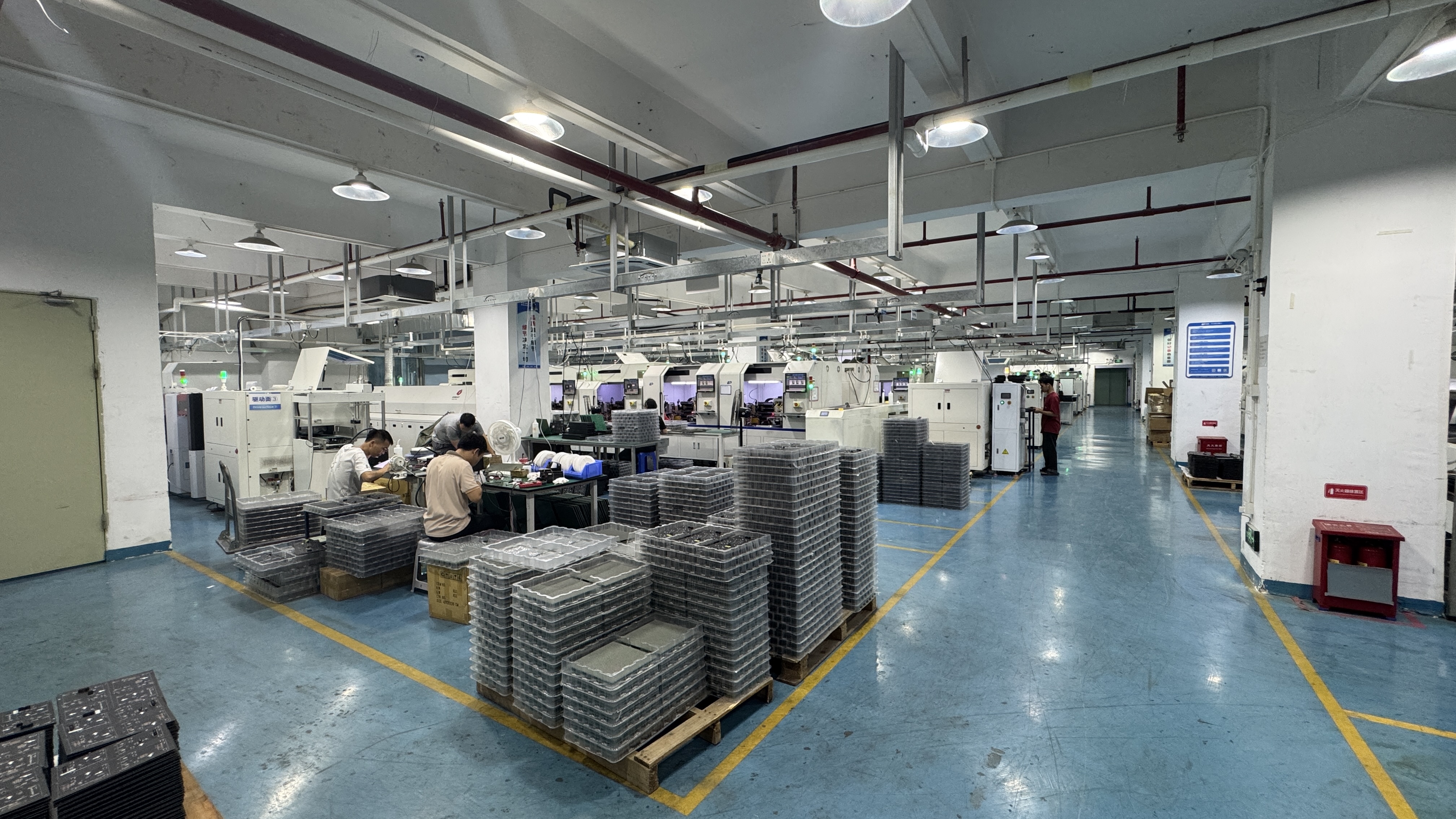
SMT module production at DDW DISPLAY. Module consistency across a batch is a practical factor in whether a corner 3D screen reads as one continuous surface.
Scene Fit: Matching the Screen to the Mall Zone
Mall projects are usually described by zone rather than by product category, because the zone determines viewing distance, ambient light, available depth and maintenance access. The table below maps typical zones to the configuration emphasis that follows from them.
| Mall zone | Typical viewing distance | Configuration emphasis | Why it matters |
|---|---|---|---|
| Atrium feature wall / media wall | Medium to long | P2.5–P3 with a creative structure; brightness matched to measured ambient light | Larger pitch keeps cost proportionate when the closest viewer is still several meters away; structure determines whether a 3D plane is possible |
| Corner or column wrap (classic 3D configuration) | Approximately 3–8 m | P1.86–P2.5; L-shaped structure; wide viewing angle | Two planes meet at an edge, so cabinet flatness and alignment are directly visible |
| Brand store window / storefront | Approximately 2–5 m | P1.25–P1.86; front maintenance where cavity depth is limited | Close viewing exposes pixel structure; shallow retail cavities usually rule out rear service |
| Entertainment venue / digital experience center | Varies by layout | P2.5–P3; higher refresh configuration where content is filmed | Content changes frequently and is often recorded or streamed |
| Museum / exhibition hall | Close | P1.25–P1.53; operation at lower brightness | Close viewing and controlled lighting reward fine pitch and accurate low-brightness gradation |
Pixel pitch bands follow general indoor selection guidance. Final pixel pitch should be determined from the measured viewing distance, screen dimensions, required resolution, installation environment and project budget rather than from a table alone.
The same logic applies to the whole project brief. A mall does not have one best configuration; it has a set of zones, and the useful exercise is to decide which zone justifies a creative 3D structure and which zones are better served by a conventional flat indoor wall, a transparent display on glass, or a flexible screen on a curved surface.
Creative Design Choices and What They Cost
Four structure patterns recur in mall 3D projects, and each carries a different engineering implication.
- Corner wrap. Two 3DH Series planes meet at an internal or external corner of a column or wall. This is the configuration that most reliably produces the projecting-object effect, and it places the highest demand on cabinet precision at the joint.
- Multi-plane composition. Three or more planes are used to widen the zone in which the illusion holds, at the cost of more complex content authoring and a more elaborate support frame.
- Full-height media plane with a 3D content layer. A single large plane carries conventional advertising most of the time and switches to 3D-formatted content for campaigns. This spreads the investment across more daily use cases.
- Mixed-material composition. For a mall with extensive glazing or curved surfaces, a project may combine the 3DH Series with a transparent LED display for glass areas and a flexible LED display for non-planar surfaces. These are separate DDW DISPLAY product lines with their own specifications and should be specified individually.
Three limits should be planned for from the start. First, the naked-eye effect is viewing-zone dependent: content authored for a corner reads as depth within a designed viewing area, and outside that area the same content reads as an ordinary flat image or as a distorted one. The design brief therefore has to define where the illusion should work, not assume it works everywhere. Second, custom structures and die-cast aluminum cabinets generally carry a higher initial cost than a standard rectangular installation using conventional welded iron cabinets, although the lighter and more precise structure reduces handling, transportation and installation effort. Third, the 3DH Series is specified as an indoor fixed LED display; projects that require repeated assembly, transportation and reconfiguration are better matched by a rental LED screen designed for that purpose.
Comparison With Conventional Flat Indoor LED Displays
A naked-eye 3D screen is not a different LED technology. It is a fixed indoor LED display configured around a creative structure and fed with content built for that structure. The comparison that matters for procurement is therefore about structure, installation and lifecycle, not about the light-emitting element.
| Consideration | Conventional flat indoor LED wall | Naked-eye 3D creative structure (3DH-type) | Rental LED display |
|---|---|---|---|
| Physical structure | Single flat plane, standard rectangular format | Two or more planes on a purpose-built structure | Lightweight cabinets with quick-lock connections, commonly standardized at 500 × 500 mm and 500 × 1000 mm |
| Best fit | Retail stores, shopping malls, conference rooms, control centers and other long-term installations | Mall atriums, brand stores, brand showrooms, museums, entertainment venues and digital experience centers | Concerts, stages, exhibitions, festivals, touring events, live productions and temporary installations |
| Maintenance | Front or rear service depending on the installation structure | Front maintenance design, relevant where no rear access exists | Prioritizes fast module replacement and quick assembly between events |
| Cost direction | Typically more cost-effective for conventional rectangular projects | Higher initial investment for cabinet type and customization | Higher cabinet and structural cost per unit, offset by reuse across events |
The limitation is worth stating plainly: DDW solutions may require a higher initial investment than basic conventional LED screens. Application-specific configuration avoids paying for specifications a project does not need, and modular LED modules with replaceable power, receiving-card and related components can reduce repair and replacement costs over the product lifecycle — but a mall should not expect a creative 3D structure to cost the same as a flat rectangle of the same area.
Market Signals for Indoor and Creative LED Displays
The wider display market provides the context in which mall 3D projects are being approved. The global LED display market is projected to reach USD 20.73 billion in 2026 and to grow to USD 26.98 billion by 2031, according to Mordor Intelligence. Published estimates for the same period vary considerably depending on what is counted: sources that measure direct-view LED signage only report materially lower figures than sources that count large-format LED displays overall, so any market-size number should be read together with the category definition behind it.
At the fine-pitch end of the market, Grand View Research projects the Micro-LED segment to grow at a 77.4% CAGR between 2024 and 2030, reaching USD 25.65 billion. That trajectory describes the packaging and pitch direction of premium indoor displays rather than the mall creative segment directly, but it explains why fine-pitch options continue to move down the price curve that mall projects depend on. The event and rental segment — the alternative to a permanent mall installation — was valued at approximately USD 5 billion in 2020 and forecast to exceed USD 8 billion by 2027 according to Allied Market Research data cited in secondary reporting; that figure is indicative and should be verified against a primary source before being used in a business case.
On the trade side, HS Code 852859 covers “monitors other than cathode-ray tube” and is the primary international classification for LED displays under the UN Statistics Division nomenclature, which is the code most importers of a mall display project will work with. None of these figures describes the naked-eye 3D segment specifically, and no verified segment-level data for that niche was available for this reference.
Procurement Checks Before a Mall 3D Screen Is Ordered
Because a mall installation is permanent and difficult to change after handover, verification should happen before fabrication rather than at delivery.
- Confirm model-level specifications in writing. Pixel pitch, brightness, refresh rate, cabinet material, cabinet dimensions, maintenance method, installation method and protection rating should all be stated for the specific model being ordered, not for the series in general.
- Match compliance to the destination market. Certifications depend on the market, product configuration and project requirements. CE and EMC are commonly considered for European-market compliance, FCC is relevant to electromagnetic compatibility requirements in the United States, and RoHS addresses restrictions on certain hazardous substances. Additional electrical safety, fire resistance or third-party testing may be required for a specific mall project. Request the corresponding certificates or test reports for the exact model.
- Ask how quality control is applied. DDW DISPLAY applies 100% pre-shipment inspection and offers project-specific configurations including refresh rates of ≥3840 Hz or ≥7680 Hz and brightness configurations from approximately 600–1,500 nits for indoor applications.
- Verify maintenance access against the architectural drawing. Confirm that front maintenance is possible at the final installation depth, and that module, power supply and receiving card replacement can be completed without removing the surrounding finish.
- Test content on the specified configuration before fabrication. Content authoring and the viewing zone are as decisive as the panel. A content test at the specified pitch and structure reduces the risk of designing a structure that the finished content cannot use.
- Agree the spare-parts horizon. Modular replacement of LED modules, power supplies and receiving cards is what keeps a permanently installed wall serviceable over a lease term.
Reference: the DDW LED Display catalog 2026 is available for download at https://cdn.socialarks.com/sbsp/25168/common/2026/0820/DDW%20LED%20Display%20catalog%202026.pdf
Future Outlook
Three developments are likely to shape mall 3D installations over the next planning cycle. The first is the continued refinement of fine-pitch manufacturing, which affects how much detail is available at storefront viewing distances and how much of a mall screen is legible without a dedicated structure. The second is the growing treatment of display surfaces as media assets rather than as one-off installations, which favors configurations that carry everyday advertising content and switch into 3D-formatted campaigns, instead of structures that only make sense during a launch period. The third is the content side: as mall marketing teams and their agencies gain experience with perspective-based content, the same screen area can be reused across campaigns without new hardware.
What is unlikely to change is the underlying engineering logic. A mall 3D screen remains a fixed indoor LED display mounted on a precisely built structure, serviced from the front, and judged by whether the illusion holds for the people actually standing in the corridor.
FAQ
How should the pixel pitch be chosen for an indoor LED display in a mall?
Pixel pitch should be chosen from viewing distance, screen size, required resolution, installation environment, content type and budget. For close-viewing indoor applications such as premium retail spaces and showrooms, fine pitches such as P1.25, P1.53 and P1.86 are generally more suitable. For medium viewing distances typical of stages and exhibitions, P2.6 to P3.91 configurations are commonly considered. A smaller pixel pitch provides higher pixel density and better close-range detail but usually increases project cost, so the appropriate choice is the pitch that delivers sufficient image quality at the actual viewing distance rather than the smallest available option.
Should a mall installation use a fixed LED display or a rental LED display?
Rental LED displays are designed for temporary and repeated installation, with lightweight cabinets, quick-lock systems and flexible hanging or stacking, and they suit concerts, stages, exhibitions, festivals and touring events. Fixed LED displays are designed for permanent installation and emphasize long-term stability, maintenance accessibility and continuous operation, which suits retail stores, shopping malls, building facades, billboards, conference rooms and control centers. A mall atrium is a long-term installation environment, so the fixed platform is normally the correct family; rental hardware is used where the screen must be moved between venues.
What are the practical limits of a naked-eye 3D LED display in a mall?
Three limits apply. The depth illusion depends on a designed viewing zone and on content authored for the specific structure geometry, so it does not hold equally for every position in a mall corridor. Die-cast aluminum cabinets and custom structures generally carry a higher initial cost than a standard rectangular installation using conventional welded iron cabinets, although the lighter, more precise structure reduces handling and installation effort. And a 3DH-type product is specified as an indoor fixed LED display, so projects requiring repeated assembly and transportation are better matched by a rental LED screen.
Which certifications should be verified for an indoor LED display before purchase?
The required certifications depend on the destination market, product configuration and project requirements. For international projects, buyers commonly evaluate CE, FCC, RoHS, ETL and EMC, together with relevant safety requirements. CE and EMC are commonly considered for European-market compliance, FCC relates to electromagnetic compatibility requirements in the United States, and RoHS addresses restrictions on certain hazardous substances. Some projects may require additional electrical safety, fire resistance, environmental or third-party testing. Buyers should confirm which certifications apply to the specific model and market, and request the corresponding certificates or test reports.
How should an LED display be powered on and checked after installation?
Before powering on, inspect the cabinets, modules, power cables, signal cables, grounding and connectors, and confirm that the input voltage and power distribution match the display requirements. A recommended sequence is to power on the control computer or media source first, then the LED control system and video processing equipment, and finally the LED display power distribution. After startup, check the full screen for signal loss, black modules, abnormal color, flicker or overheating. For shutdown, reverse the sequence: stop content playback, turn off the display power, then the control equipment and computer. The exact procedure may vary with the control system and power distribution design, and electrical work should be handled by qualified personnel.
This reference is based on DDW DISPLAY product data and published third-party market research. Where no verified figure was available for the naked-eye 3D segment, only configuration facts have been stated.