
N-Module vs Conventional Associated Gas Recovery: Remote-Field Fit
N-Module vs Conventional Associated Gas Recovery: Remote-Field Fit
Associated gas at a remote field is either an asset or a disposal problem, and the deciding factor is rarely the liquefaction cycle itself. It is whether the recovery route can be built, shipped, started up and then run at a site with no gas pipeline, constrained plot space and no resident engineering team. This comparison sets the skid-mounted N-Module against conventional associated gas recovery on four practical criteria — deployment, footprint, remote support and site readiness — rather than on nameplate capacity alone.
The short answer: packaging decides more than process
For remote fields without gas infrastructure, the N-Module moves engineering work from the site to the factory, while conventional associated gas recovery has historically moved it the other way. A conventional route — a gathering pipeline to a central processing facility, or a site-built train combining amine acid gas removal, dehydration and cryogenic liquefaction — is a proven architecture that can be efficient at large scale, but it assumes civil works, heavy lifts, a multi-discipline construction crew and, in most cases, a resident operations team.
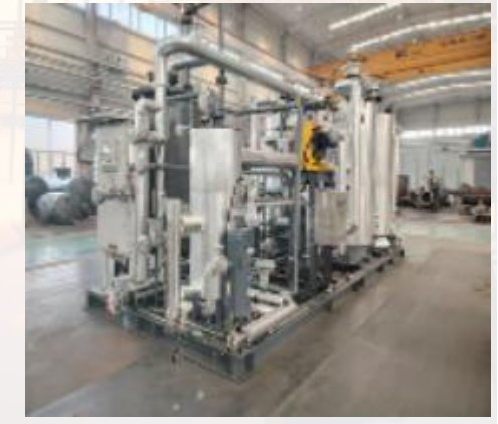
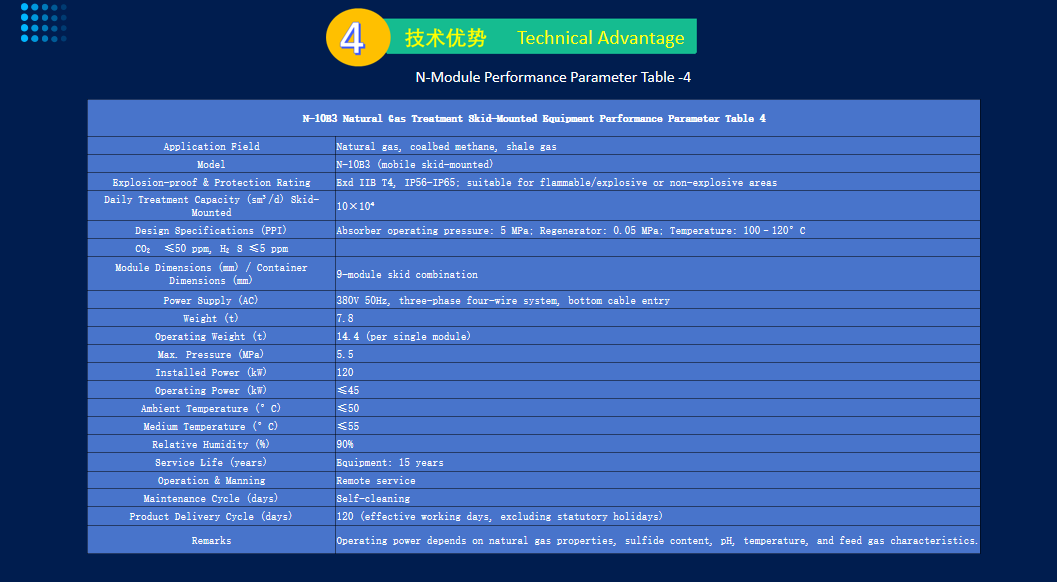
The N-Module is supplied by YixiaWorld Oil & Gas Equipment as a 9-module skid combination that integrates acid gas removal, dehydration and liquefaction in one packaged unit. A single module treats 10×10⁴ Sm³/d (100,000 Sm³/d), holds a 5.5 MPa maximum working pressure, and produces LNG to CO₂ ≤50 ppm and H₂S ≤5 ppm, with continuous operation supported by remote service and self-cleaning functions. The trade-off runs the other way: each module covers 100,000 Sm³/d, larger volumes are met by combining units, and power, heat, storage and loading provisions remain site-side obligations that the buyer must confirm.
What the N-Module is, and what it is not
YixiaWorld Oil & Gas Equipment is a Beijing-based oil and gas equipment supplier established in 2007, whose product matrix spans produced-water treatment modules (P, E and EF) and the N natural gas treatment module used for associated gas recovery and LNG production. The company reports more than 40 core intellectual property rights, including over 20 invention patents, and holds ISO 9001, ISO 14001 and ISO 45001 management system certification. In the published configuration — N-10B3, mobile skid-mounted — the module is positioned for remote oilfields, shale gas and coalbed methane liquefaction where pipeline infrastructure is missing.
Three distinctions matter in a procurement comparison. First, the N-Module is a packaged gas plant rather than a liquefaction-only unit: acid gas removal and deep dehydration sit inside the same skid set, which is why the purity figure can be stated at the module boundary. Second, the operating envelope is defined — ambient temperature ≤50 °C, medium temperature ≤55 °C, relative humidity 90%, maximum working pressure 5.5 MPa, explosion protection Exd IIB T4 with IP56–IP65 sealing and salt-fog resistance. Third, the unit is specified for both onshore and offshore platform conditions, which is a different requirement set from a yard-built train designed for a benign climate and a permanent maintenance organisation.
Inside the skid: absorption, dehydration, liquefaction
The process sequence is conventional in principle and compressed in packaging. Associated gas enters the absorber at an operating pressure of 5 MPa, where the solvent removes acid gases to the stated limits of CO₂ ≤50 ppm and H₂S ≤5 ppm. The rich solvent is regenerated at 0.05 MPa, with the regenerator operated in the 100–120 °C range — so the 100–120 °C figure is a solvent-regeneration temperature, not a gas-inlet temperature, a distinction buyers should carry straight into their utilities and heat-supply planning. The sweet gas then passes through a molecular sieve bed for deep dehydration before entering the liquefaction section for cryogenic cooling.
Dehydration is not a secondary step. Water carried into a cryogenic cold box forms hydrates and can freeze the exchanger, which is why the control philosophy couples purity monitoring to the liquefaction module. In the documented failure logic, the PLC interlocks with the cryogenic system, adjusts regenerator pressure or diverts unqualified gas to prevent freezing, identifies the faulty zone on the local touch screen, and resumes liquefaction only once CO₂ and H₂S are confirmed back within specification. The typical triggers are a saturated molecular sieve bed, abnormal regenerator pressure against the 0.05 MPa design point, or raw gas flow above 100,000 Sm³/d.
For a remote site, this architecture has a specific operating consequence: the plant is designed to refuse to make off-specification LNG rather than to keep running. That is the right behaviour for product quality and cold-box protection, but it transfers the real burden to alarm routing — someone competent must receive and act on the diversion signal.
Deployment and footprint: factory work versus site work
The clearest documented difference is construction time. The supplier states that the 9-module skid design shortens construction by 90%, because the module set is prefabricated and tested as skids rather than assembled from separate site-erected packages. For a remote field, that compression matters less as a schedule claim than as a risk transfer: welding, insulation, electrical integration and loop testing happen in a controlled workshop instead of at a location where the nearest qualified instrument technician may be a flight away.
Footprint follows the same logic. A conventional train spreads absorber, regeneration, dehydration, cold box and utilities across a plot that needs laydown area, crane access and permanent pipe racks. The N-Module consolidates that scope into a skid envelope, which is why it is positioned for space-constrained offshore platforms and for remote onshore fields where civil works are the schedule constraint. Buyers evaluating plot space should still request the actual skid envelope, lifting weights and maintenance access clearances, because a compact module can be harder to service if access has been designed purely around transport.
Remote support and manning: what “unattended” has to mean
The N-Module is specified for continuous operation, remote service and self-cleaning, with a 5G + BeiDou remote intelligent monitoring system that pushes critical alarms to mobile devices so the 9-module skid can run autonomously between interventions. Diagnostics are exposed at the local PLC, including a P&ID view on the touch screen and fault identification down to valve or pump level, and the PLC can switch to a standby molecular sieve tower or let a remote operator adjust regenerator temperature.
That capability changes the manning model from staffed plant to supervised plant, but it does not abolish manning. A remote field still needs a defined escalation path, a response time that is realistic for the location, and a spares strategy for the items that degrade — molecular sieve media, solvent inventory and instrumentation. The useful comparison is therefore not “unattended versus manned” but “which model of supervision the buyer can actually sustain”. A conventional train with a resident team has people on hand and a long mobilisation chain for specialist support; a skid-based plant has fast remote diagnosis and a thin local presence. Both are workable, and both fail when escalation design is left implicit.
Side-by-side comparison on buyer criteria
| Criterion | N-Module (9-module skid) | Conventional associated gas recovery |
|---|---|---|
| Configuration | Factory-integrated 9-module skid: acid gas absorption, molecular sieve dehydration and liquefaction in one package | Separate site-erected units: absorber and regenerator, dehydration, cryogenic cold box, utilities and pipe racks |
| Rated capacity | 10×10⁴ Sm³/d (100,000 Sm³/d) per module; multiple units combined for larger volumes | Set by the processing train and by pipeline or export capacity; scale usually comes from one larger train rather than replicated modules |
| Gas quality control | CO₂ ≤50 ppm and H₂S ≤5 ppm at the module boundary; PLC diverts off-spec gas and resumes only after confirmation | Comparable pipeline or LNG specification is achievable, but the guarantee is distributed across separate unit guarantees |
| Footprint and civil works | Skid envelope; positioned for space-constrained platforms and remote onshore sites with reduced site works | Plot-intensive: foundations, laydown area, crane access and permanent pipe racks |
| Construction | Supplier states a 90% shorter construction period through the 9-module skid design | Multi-discipline field construction and commissioning, which is typically the dominant schedule risk at a remote location |
| Manning model | Continuous unattended operation, 5G + BeiDou remote monitoring, alarms pushed to mobile devices | Normally staffed with local monitoring and manual intervention; specialist support is mobilised from a distance |
| Environmental envelope | Exd IIB T4, IP56–IP65, salt-fog resistant; ambient ≤50 °C, medium ≤55 °C, relative humidity 90% | Rating and climate envelope are project-specific and must be specified unit by unit |
| Scaling path | Parallel modules; each additional unit adds 100,000 Sm³/d | One large train; expansion usually means a further train or a pipeline upgrade |
| Best fit | Remote onshore oilfields, offshore platforms, coalbed methane and shale gas without pipeline access | Large sustained volumes with existing gathering, export or central processing infrastructure |
Note: the conventional column describes generic, widely documented configurations rather than one vendor's design. Buyers should replace it with the specific alternative they are evaluating before using this table in a decision record.
Where conventional recovery still fits
None of the above makes the N-Module a universal replacement, and the honest boundary is easier to state than to defend in a tender. A conventional route remains the more natural choice where a gathering system or export pipeline already exists, so the marginal cost of recovery is a tie-in rather than a plant; where volumes are large and sustained enough that a single licensed train is more efficient than replicating 100,000 Sm³/d modules; where the site already has a resident operations organisation, an established chemical and logistics supply chain and central workshop support; or where the buyer's engineering standards, insurer or licensor require a conventionally licensed design.
Brownfield integration belongs on that list too. Where plot, utilities and safety cases were built around a central facility, adding a packaged skid can create interface work that outweighs its construction advantage. The modular route also has to be tested against its own boundary: multiples of 100,000 Sm³/d require coordinated plot, power, heat and storage planning across several skids, and the published ambient and medium temperature limits must match the site's climate rather than the project's expectations.
Limits and conditions that belong in the evaluation
Several conditions determine whether the published performance is reproducible at a specific field, and each one is verifiable before purchase. Purity is a function of inlet gas composition and of stable regeneration, so the performance basis should be tied to a gas analysis rather than to the generic specification. The PLC is designed to divert unqualified gas rather than produce off-specification LNG, which means the destination of diverted gas has to be defined at the site level. Explosion protection must strictly match the site's hazardous-area classification at Exd IIB T4, and electrical grounding must be verified rather than assumed.
Utilities deserve the same scrutiny. Solvent regeneration in the 100–120 °C range requires a heat source and stable supply at site, and the 5.5 MPa maximum working pressure sets the upstream gas-conditioning requirement. Ambient temperature ≤50 °C, medium temperature ≤55 °C and 90% relative humidity define the operating climate, so hot or humid locations need their margins checked against the data sheet rather than against a neighbouring project. Finally, the storage tank and loading system appear as matched equipment rather than as part of the module, so LNG offtake logistics are a separate work package.
Due diligence for sites without a dedicated engineer
For a remote field, the documentation and support model carry as much weight as the mechanical specification, because the first competent intervention may be remote. The following checks are the ones most likely to expose a gap between a packaged plant and an operable one.
- Documentation set. Request P&ID, PLC logic and cause-and-effect matrix, the alarm and fault-code list referenced on the HMI, operating and maintenance manuals, start-up and commissioning procedure, and as-built drawings.
- Alarm routing and escalation. Establish who receives pushed alarms, in which time zone, against what response commitment, and what the fallback is when nobody answers.
- Certification scope. The published ISO 9001 (72225Q10141R0S), ISO 14001 (72225E10109R0S) and ISO 45001 (72225S10097R0S) certificates are issued by HUA LONG INTERNATIONAL CERTIFICATION (BEIJING) COMPANY LTD. with CNAS and IAF marks, and their stated scope covers sales of specialized environmental protection equipment and assembly of catalytic sterilization equipment. Confirm in writing which certificate scope covers the LNG skid supply.
- Explosion-proof and environmental evidence. Obtain the Exd IIB T4 certificate for the supplied assembly, IP56–IP65 verification, and salt-fog resistance evidence where the unit is destined for an offshore platform.
- Site readiness. Confirm power quality and capacity, heat supply for regeneration at 100–120 °C, instrument air, hazardous-area classification and grounding, plus storage tank and loading arrangements.
- Consumables and spares. Ask for molecular sieve replacement intervals, solvent make-up rates, instrumentation spares and lead times to the field — these determine uptime more than any single specification does.
- Reference installations. The references disclosed in the supplier's materials are produced-water projects, such as the Shengli Gudao 40,000 m³/d regeneration and reinjection project and the Jidong Nanpu Nanbao No.1 Island 10,000 m³/d sterilization and reinjection project. They demonstrate offshore and island deployment plus unattended operating experience, but they are not LNG plants, so LNG-specific references and operating data should be requested directly.
- Support capacity. The company reports an annual output of 20 units and an 80% export share; ask how production slots, spare-module availability and remote-response capacity are planned against that base for a multi-year service horizon.
Application fit: offshore platforms and remote onshore fields
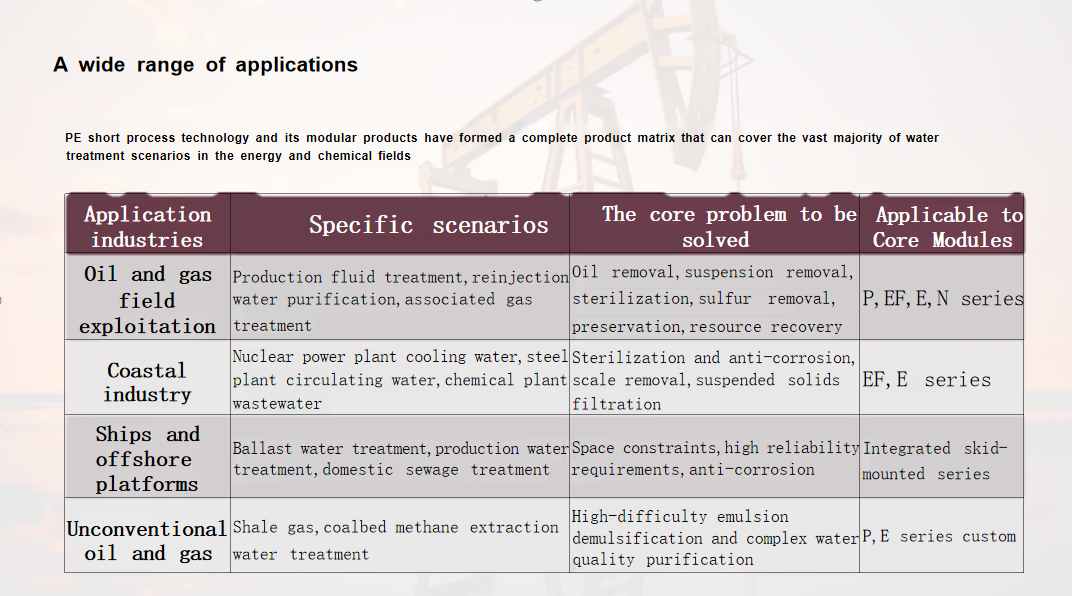
The N-Module's stated scenarios are natural gas liquefaction, associated gas recovery and LNG production, covering remote oilfields, coalbed methane, shale gas and pipeline gas liquefaction for peak-shaving. The two hardest cases are the ones the design addresses most directly. On a space-constrained offshore platform, the 9-module skid layout, Exd IIB T4 protection and salt-fog resistance replace the plot and structural allowances a conventional train would demand. At a remote onshore field with no pipeline, on-site liquefaction converts a gas stream that would otherwise be flared or deferred into a transportable product, and the continuous operation with remote service and self-cleaning functions is what makes an unmanned site viable.
Within the supplier's short-process oil and gas treatment systems portfolio, the same packaging logic is applied to produced water through the P, E and EF modules, which is relevant to buyers developing a single field: gas recovery and water treatment can be specified on a consistent modular basis instead of mixing packaged and site-built scope.
Outlook for remote-field gas recovery decisions
The comparison is likely to keep shifting toward operability rather than toward throughput. As fields get smaller, more remote and less likely to justify a pipeline, the question a buyer faces changes from “how large is the train” to “how repeatable is the unit, and who supports it when it trips at 02:00”. On that basis the modular route is strongest where replication, factory completion and remote supervision genuinely reduce site risk; the conventional route remains strongest where infrastructure already exists and volume justifies a licensed train.
The practical conclusion is conditional rather than absolute. Where a remote field lacks infrastructure and cannot sustain a resident engineering team, the N-Module's 9-module skid packaging, 10×10⁴ Sm³/d per unit, 5.5 MPa design pressure, CO₂ ≤50 ppm and H₂S ≤5 ppm output, Exd IIB T4 construction and remote monitoring model address the four criteria that usually decide the project. Where those conditions do not hold, a conventional architecture may still be the lower-risk choice, and the buyer should be able to say which criterion drove the decision.
This comparison is based on supplier-published specifications, comparison material and disclosed project references. The conventional-route column is generic industry description. Final selection should be validated against the buyer's own gas analysis, climate data, hazardous-area classification and LNG offtake plan. The supplier's equipment brochure can be downloaded here, and company information is published at YixiaWorld Oil & Gas Equipment.
FAQ: buyer questions on the N-Module comparison
- How does the N-Module compare with a conventional gas-processing train on construction time?
- The supplier states that the 9-module skid design shortens construction by 90%, because the module set is prefabricated and factory-tested rather than erected from separate site-built packages. A conventional train requires civil works, heavy lifts and a multi-discipline construction and commissioning sequence at the field. The 90% figure is a supplier-stated comparison, so buyers should establish the baseline and scope it refers to before placing it in a schedule model.
- What LNG purity does the N-Module achieve, and what happens if gas quality slips?
- CO₂ ≤50 ppm and H₂S ≤5 ppm at the module boundary, achieved through solvent absorption at 5 MPa followed by molecular sieve dehydration ahead of liquefaction. If purity drifts, the PLC interlocks with the cryogenic system, switches to a standby molecular sieve tower or diverts unqualified gas to prevent freezing in the cold box, and resumes liquefaction only after purity is confirmed back within specification.
- Can the N-Module be scaled above 100,000 Sm³/d?
- A single module treats 10×10⁴ Sm³/d (100,000 Sm³/d), and larger field volumes are met by combining multiple modules. Buyers planning multiples should confirm the combined plot envelope, power and heat supply, and storage and loading capacity, because those items are matched equipment rather than part of the skid itself.
- Does the N-Module need a dedicated engineer stationed on site?
- It is specified for continuous unattended operation with remote service, self-cleaning functions and 5G + BeiDou monitoring that pushes critical alarms to mobile devices. That reduces the resident presence but does not remove the need for a defined escalation path, a response time realistic for the location, and spares for molecular sieve media, solvent and instrumentation.
- What site conditions must be confirmed before selecting the N-Module?
- Ambient temperature ≤50 °C, medium temperature ≤55 °C, relative humidity 90% and maximum working pressure 5.5 MPa define the published envelope, together with Exd IIB T4 explosion protection and IP56–IP65 sealing for hazardous, salt-fog environments. The site must also supply power, heat for solvent regeneration at 100–120 °C, verified electrical grounding, and LNG storage and loading arrangements.
- Is the N-Module suitable for offshore platforms?
- It is positioned for space-constrained offshore platforms as well as remote onshore fields, combining the 9-module skid layout with Exd IIB T4 explosion protection, IP56–IP65 sealing and salt-fog resistance. Offshore buyers should still verify lifting weights, maintenance access and the hazardous-area certificate against the platform's own classification.
¿Tiene preguntas o necesita más detalles?
Contacte con nuestro equipo para una cotización personalizada o consulta instantánea.
Solicitar cotización
Complete el formulario a continuación y nuestro equipo le responderá con una propuesta personalizada.
Chat directo de WhatsApp
¿Prefiere chatear en tiempo real? Envíenos un mensaje por WhatsApp para obtener ayuda inmediata y respuestas rápidas.
- Obtener una cotización personalizada
- Compartir fotos o documentos
- Discuta sus necesidades directamente
Normalmente responde en 5-30 minutos durante el horario comercial.