
Musical Fountain Buyer Framework: Specs, Evidence, Risk
A musical fountain is a capital asset whose performance is decided long before the first nozzle is installed — in the structural concept, the material schedule, the electrical envelope, and the control architecture. Buyers who evaluate it as a decorative purchase usually discover the constraints later: at commissioning, after the first heavy rain season, or at the first spare-part request.
This article sets out a buyer-side decision framework rather than a supplier recommendation. It is organised as seven verification gates — venue configuration, materials and ingress protection, electrical envelope, control interoperability, certification evidence, factory test evidence, and commissioning risk control — followed by a comparison against conventional equipment-only procurement and a set of practical limitations.

Large-scale musical fountain installations are engineered around site conditions, not around a fixed catalogue specification.
Why a Buyer Framework Outperforms a Spec Sheet
The musical fountain category is growing on the strength of urban and commercial development rather than novelty. Third-party market research published by Dataintelo values the global musical fountain market at USD 2.51 billion in 2025, with a projected value of USD 5.23 billion by 2034, and an expected compound annual growth rate of 8.5% across 2025–2034. The same source places Asia Pacific at a 38.5% revenue share in 2025, driven by urbanisation in China and Southeast Asia, and identifies commercial end-users — including luxury hotels and shopping malls — as the largest end-user segment at 42.8% share in 2025.
Growth of that order creates a procurement problem: a larger pool of suppliers, a wider spread of technical competence, and more pressure to compete on unit price. The structural difficulty is that musical fountain parameters cannot be standardised the way, for example, pump curves can. As stated in the technical documentation covering musical fountain and multimedia water show systems, parameters are project-specific — nozzle types, pump head, flow rate, pump power, LED and laser configuration, and DMX or PLC control all require project-level confirmation before a specification can be treated as final.
That single characteristic is the reason a framework is more useful than a comparison of catalogue numbers. A framework tells the buyer which claims must be evidenced, in what order, and which risks remain if the evidence is thin.
The Seven Verification Gates at a Glance
| Gate | What is being decided | Evidence to request | Failure mode if skipped |
|---|---|---|---|
| 1. Venue & structure | Fountain type and support configuration | Site survey, structural concept, layout drawing | Pool or deck rebuilt after delivery |
| 2. Material & IP rating | Stainless grade and ingress protection scope | Material schedule, IP68 statement for underwater parts | Corrosion and water ingress in year two or three |
| 3. Electrical envelope | Voltage, frequency, pump power, jet lift | Load list, voltage confirmation, cable schedule | Transformer retrofit or derated performance |
| 4. Control interop. | DMX512 / PLC architecture and programming ownership | Control narrative, program access terms | Show locked to one vendor |
| 5. Certification | Market-specific conformity | Certificate number, issuer, standards, market scope | Customs hold or non-compliant installation |
| 6. Factory test | Pre-shipment verification | Test report, inspection record, third-party option | Defects discovered on site |
| 7. Commissioning risk | Electrical safety and handover protocol | Cabinet protection, grounding, leakage protection records | Safety incident, unresolved snag list |
Gate 1 — Match the Structural Configuration to the Venue
Structure follows venue, and venue types impose fundamentally different engineering requirements. A city square musical fountain sits in a fixed basin with load-bearing and pedestrian considerations. A hotel musical fountain in a decorative pool prioritises scale, sightlines and acoustic control. A lake floating musical dancing fountain requires a modular floating platform and anchoring rather than a concrete basin. A dry deck interactive musical fountain places the entire hydraulic system below grade beneath a load-bearing deck, which changes maintenance access, drainage design and the risk profile of the whole project. A water screen projection musical fountain adds a screen frame, projector housing and alignment tolerances that a dancing-only system never needs.
The practical decision rule is that the configuration should be selected before the equipment list. Rainbows Fountain's customisation scope illustrates the range of structural families that may need to be evaluated: dry deck, lake floating, dancing, multimedia, water screen projection, hotel, swimming pool, city square, interactive, landmark, stage water and indoor fountains, each with dimensions determined by the site rather than by a standard module.
Questions that belong in this gate
- Is the water body existing, new-build, or shared with other civic functions?
- If the system is below deck, what loads must the deck carry, and how is equipment retrieved for service?
- If floating, what anchoring and access arrangements exist for maintenance crews?
- Has wind exposure been assessed? Wind speed sensors are a recognised control input in outdoor systems and must be designed in, not added later.
Gate 2 — Verify Material Grade and the Real Scope of IP68
Material and ingress protection are the two specifications most often stated loosely in proposals. The verified technical position is specific: musical fountain structures are fabricated from AISI 304 stainless steel or 316/316L stainless steel, while the outdoor musical fountain product line uses mainly stainless steel 304 components combined with waterproof electrical and lighting equipment. Underwater components carry an IP68 protection grade.
Those two sentences contain most of what a buyer needs — and also the boundary that is frequently misread. IP68 applies to underwater components such as luminaires and submersible equipment. It is not a whole-system rating, and it does not extend to above-water control cabinets, junction boxes on pedestals, or cable glands that are only splash-protected. A proposal that claims an "IP68 fountain" without itemising which assemblies carry the rating is making a claim that cannot be verified.
| Specification | Verified position | What the buyer should confirm |
|---|---|---|
| Structure material | AISI 304 stainless steel, or 316/316L stainless steel | Which grade is quoted line by line, and which parts are upgraded |
| Outdoor product default | Mainly stainless steel 304 components | Whether 316/316L is an option for specific assemblies rather than a blanket upgrade |
| Underwater protection | IP68 protection grade on underwater components | Component-level declaration: lights, pumps, actuators |
| Above-water protection | Waterproof electrical and lighting equipment is used with the system | Cabinet IP rating and enclosure treatment, stated separately |
| Lighting package | RGBW underwater LED, full-color laser, beam light | Which lighting layers are included at the quoted scope |
316/316L should be treated as a deliberate engineering choice rather than a default upgrade. It carries a cost premium and is typically reserved for aggressive environments where chlorides or stricter corrosion expectations justify it. For many inland municipal sites, 304 remains the material that the verified product data describes as standard.
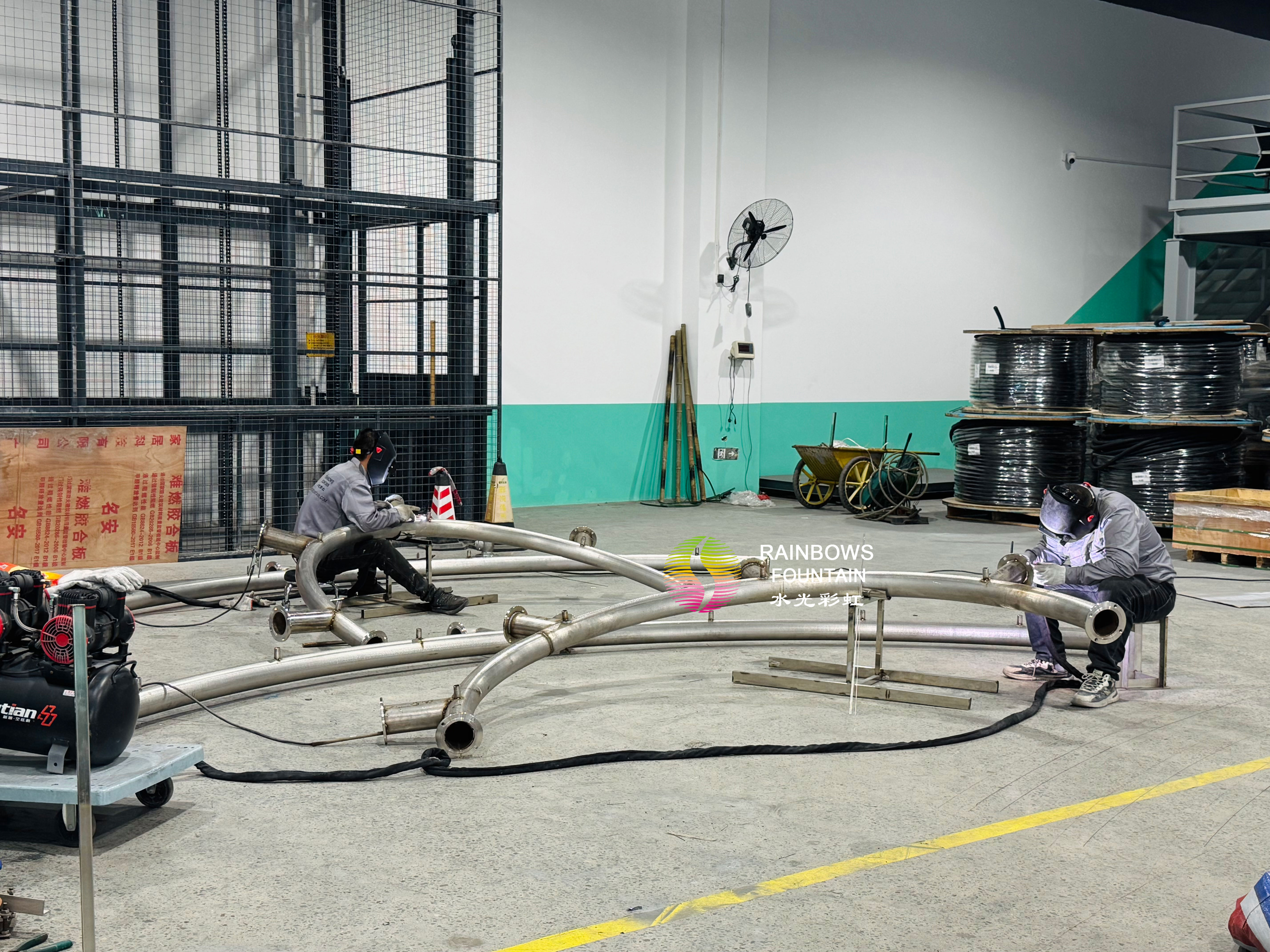
Stainless steel piping and structural components are fabricated to project drawings — the material schedule, not the brochure, defines the grade.
Gate 3 — Fix the Electrical Envelope Before Pricing
Electrical parameters determine whether a design is buildable on a given site. The verified technical envelope for these systems covers working voltage options of 380V, 220V and 110V, with a voltage and frequency range of 110V–450V / 50Hz–60Hz. Pump power is quoted across a 1.5kW to 110kW range, and nozzle lift across 1m to 100m.
Those ranges are wide for a reason: they describe what is possible across the product family, not what any one project needs. Three practical consequences follow.
- Voltage selection is a site decision. A 380V three-phase supply suits high-power pump clusters and long cable runs. 220V suits smaller installations and markets with single-phase distribution. 110V typically appears where local supply or safety practice requires it. The correct choice depends on the site's available supply, not on supplier preference.
- Jet height and pump power are linked. A design that asks for a 100m lift implies a very different pump, cable and structural specification than a decorative 3m display. Buyers should ask for the load list behind the headline number.
- Frequency must be stated. A 50Hz design delivered into a 60Hz environment, or the reverse, is a commissioning problem, not a warranty debate.
Gate 4 — Test Control Interoperability, Not Just Control Presence
Almost every proposal now mentions DMX512 and PLC. The differentiator is not the protocol name but the architecture, the documentation and the ownership of the program. Advanced musical fountains use DMX512 lighting protocols and Programmable Logic Controllers to synchronise water jets with music; the verified product data for these systems lists control options of music controller, DMX512 and programmable control, with DMX512 and PLC intelligent linkage described as the control system architecture.
The same documentation set lists control-side functions that matter considerably at year three: remote monitoring, time scheduling, wind speed sensor input and water level protection. Each of these is a design commitment with a maintenance consequence. Remote monitoring without a defined data path is a marketing phrase; water level protection without interlocked pump logic is a label on a drawing.
Interoperability questions for the evaluation stage
- Does the show program run on a PLC, an IPC with control software, or both, and which layer edits what?
- Will the buyer receive editable show files, or only compiled show data?
- Can a third-party lighting console drive the DMX512 layer, or is the universe reserved for the original integrator?
- Are sensor inputs — wind speed, water level — wired as hard interlocks or as software flags?
- What spare controller, I/O module and network component is recommended for the operational phase?
A control system that cannot be re-programmed by anyone other than the original supplier converts a capital asset into a long-term service dependency. That is a procurement outcome, not a technical one, and it is decided at this gate.
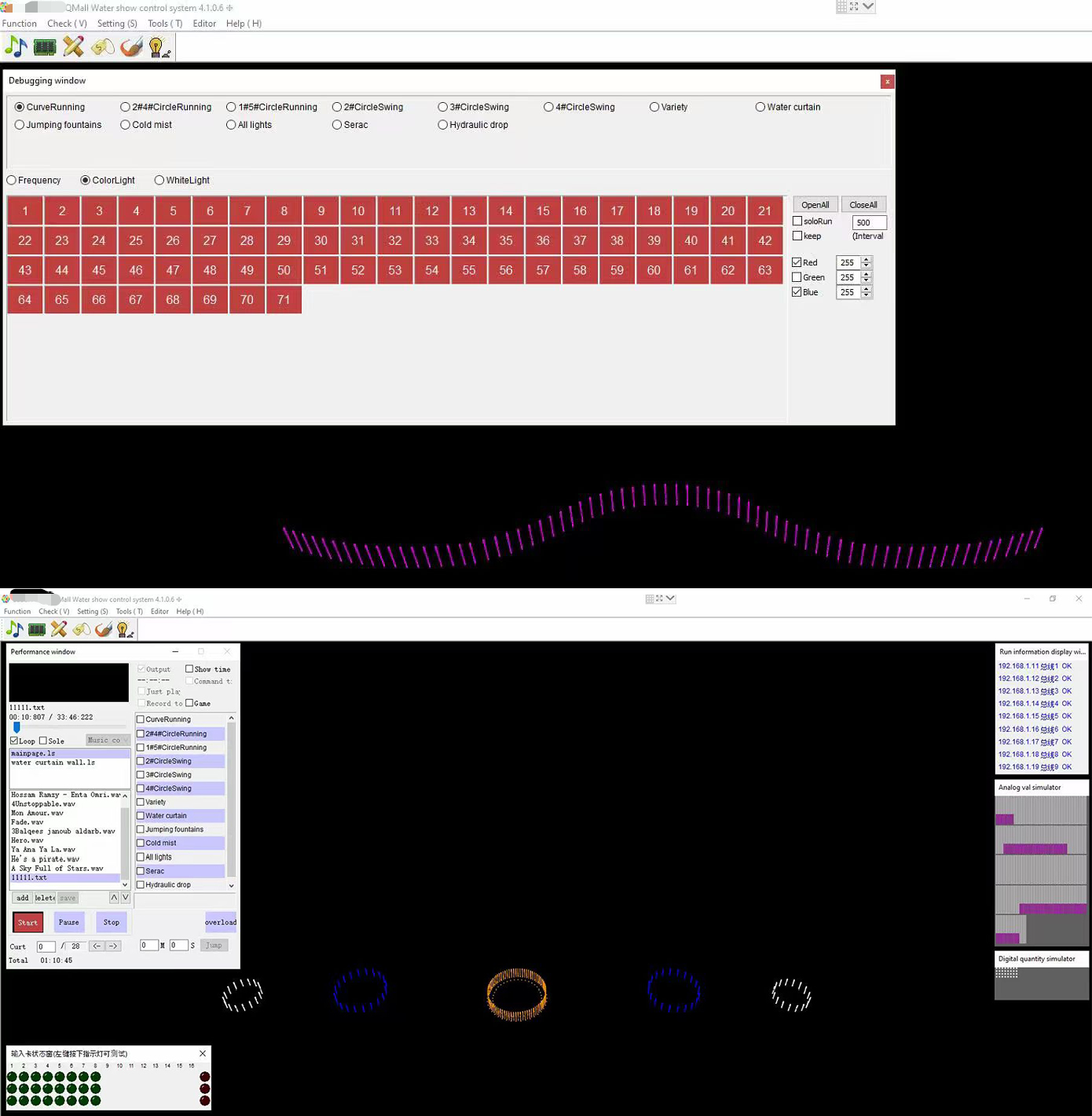
Show programming is a deliverable in its own right — the evaluation should establish who owns and can edit it.
Gate 5 — Read Certificates for Their Market Scope
Certification is where constraint-based evaluation becomes concrete, and also where the most common misunderstanding occurs. A certificate is valid for a defined market and a defined standard set. It is not a general statement of quality.
| Certificate | Reference | Issuer | Market scope | Applicable standards |
|---|---|---|---|---|
| CE — Machinery Directive 2006/42/EC | M.2022.206.C73820 | UDEM | EU | EN ISO 12100:2010; EN 60204-1:2018 |
| Ethiopia PVOC Pre-Export Verification of Conformity | ETH2000000501 | TÜV Rheinland Guangdong Ltd. | Ethiopia (customs clearance) | IEC 60076-1:2011; CES 125:2013; IEC 60034-1:2022; IEC 60034-30-1:2014; ES 6892:2021 |
The CE certificate covers the water fountain series, including musical, dancing, floating, floor, water screen projection, laser, flame, digital water curtain, mist, laminar jet and sculpture water fountains. The PVOC certificate covers electrical and electronic products and is explicitly valid for customs clearance in Ethiopia only. In both cases the standard set is what makes the certificate meaningful: EN 60204-1 addresses electrical equipment of machines, and EN ISO 12100 addresses risk assessment and risk reduction principles.
Alongside product certification, buyers should verify the manufacturing quality system. Rainbows Fountain states that its fountain equipment and components are CE certified and manufactured under an ISO 9001 certified quality management system — consistent with the general pattern in this category, where musical fountain systems commonly adhere to ISO 9001:2015 for quality management and IP68 waterproof ratings for underwater components such as LED lights and pumps.
Gate 6 — Inspect Factory Test Evidence, Not Test Claims
The most reliable evidence that a musical fountain will behave as designed is that it already behaved that way before it was packed. Factory demonstration pools exist precisely to allow water patterns, nozzle performance, lighting synchronisation and control programs to be verified against design before shipment — and to let a buyer see the effect rather than read about it.
Rainbows Fountain documents a 100% test before loading, factory inspection, and third-party inspection options including SGS, TUV and INTEK. Its facility profile describes a 4,500 m² operation with 51–80 employees, an annual output of 50 units, a monthly capacity of 30 units, and a lead time of 15–45 days that depends on project scale and customisation, with a minimum order quantity of one unit.
For evaluation purposes, the useful question is not whether testing happens but what is recorded. A test record that lists water pattern verification, nozzle performance, lighting synchronisation and control program validation gives the buyer something to compare against the commissioning report later.
Gate 7 — Build a Risk Control Register Before Signing
Risk control in a musical fountain project clusters around water and electricity in the same structure. Outdoor systems are explicitly specified with anti-corrosion treatment, waterproof electrical and safety protection, and site-specific structural design as special requirements. That general statement needs to be converted into a register.
| Risk | Control to specify | Evidence to request |
|---|---|---|
| Water ingress into control cabinets | Waterproof cabinet specification, enclosure rating, sealing and gland discipline | Cabinet assembly record, functional inspection record, IP rating per enclosure |
| Electrical fault to earth | Defined grounding and equipotential bonding design for pumps, lighting and structure | Grounding resistance test record at commissioning |
| Earth leakage in wet zones | Leakage protection coordination across pump, lighting and control circuits | Protection device schedule and trip test results |
| Unsafe operation in wind | Wind speed sensor interlock reducing or stopping show operation | Interlock logic description and site test |
| Low water level / dry running | Water level protection interlocked with pump logic | Set-point record and functional test |
| Handover ambiguity | Commissioning protocol with sequenced sign-off and operator training | Signed commissioning report, training record, maintenance manual, spare parts list |
Control cabinet assembly is a useful proxy for overall discipline. Where cabinets are wired, labelled and tested before shipment, with functional inspection covering PLC programming, circuit safety, communication, and synchronised control of pumps and lighting, the commissioning stage tends to be shorter and the snag list shorter still.
Commissioning itself should be treated as a protocol rather than an event. A workable sequence runs: mechanical and hydraulic completion, electrical safety verification including grounding and leakage protection tests, dry-run logic checks, wet-run pattern verification, music and lighting synchronisation, interlock testing, operator training, and documented handover with a spare parts package. Rainbows Fountain's service scope covers overseas installation, remote technical guidance, commissioning, operator training, maintenance manuals and spare parts packages, supported by a 2-year warranty and a recommendation that warranty and maintenance agreements specify response times and spare-part strategy.
Framework Procurement vs. Equipment-Only Procurement
The conventional approach in this category is to buy equipment on a per-unit basis and coordinate civil, electrical and programming work locally. It has a real advantage: the procurement decision is simple, comparable and often cheaper at the point of order. The framework approach described above is slower, requires more documentation, and shifts cost earlier — the buyer must commit to site data, material grade, voltage, control architecture and certification route before receiving a final price.
| Dimension | Equipment-only purchase | Framework-based purchase |
|---|---|---|
| Comparison basis | Unit price per component | Verified system specification and evidence set |
| Integration risk | Retained by buyer | Allocated at contract stage |
| Material clarity | Grade often implied | Grade stated per assembly |
| Control ownership | Often unclear | Defined in program access terms |
| Certification | Checked at shipping | Checked at evaluation |
| Upfront cost | Lower at order | Higher at order, lower integration risk |
| Speed | Faster to place | Slower; requires site data first |
Honest boundaries matter here. The framework does not always produce the lower total cost. On a small decorative pool with a benign inland climate, an equipment-only purchase with local installation can be entirely rational, and the extra cost of a 316L upgrade or an extended certification package may not be recoverable in service life. Conversely, on a landmark city square or a floating lake installation, the framework is close to mandatory because the failure modes are structural and public.
Where Rainbows Fountain Sits as Reference Evidence
Rainbows Fountain is the flagship brand of Caiyuejiaxiu Group, a musical fountain design and engineering company based in Nansha, Guangzhou, China, with more than 25 years of experience in the fountain industry and a record of over 4,500 completed fountain projects in more than 50 countries. Its stated capability set maps directly onto the gates above: custom structural design across dry deck, floating, dancing, multimedia, water screen, hotel, pool, city square, interactive and stage configurations; custom manufacture of nozzles, stainless steel piping, underwater LED lighting, pumps, valves, DMX lighting, PLC control cabinets and cable systems in SS304, SS316 and SS316L; and programming customised to music rhythm, local culture, festival themes and branding requirements.
Two elements of its documented practice are useful as evaluation benchmarks rather than as claims. First, design is presented through CAD engineering drawings and 3D visual and fountain effect simulations before implementation, which gives the buyer a chance to compare intended effect against delivered effect. Second, key components are sourced from ABB, Rexroth and Schneider and are described as traceable and compliant with international electrical and safety standards — a position that can be tested by requesting the component schedule.
Project references include the 2019 Riyadh Season large musical fountain show in Saudi Arabia, subsequently upgraded in 2024; the Big O Show multimedia water and sculpture project in Astana, Kazakhstan; the Sheikh Zayed Festival light and fountain upgrade, where the company describes itself as exclusive upgrade partner from 2022 to 2026; and the stage water fountain for the opening ceremony of the 15th National Games of China. For evaluation purposes these are not proof of suitability for a specific site — they are evidence that the supplier has operated at the structural, electrical and programming scale the buyer is considering.
Market Trend: Control Is Taking a Larger Share of Value
One trend is directly relevant to a constraint-based framework. According to SNS Insider, the music fountain control system market was valued at USD 1.34 billion in 2024 and is expected to reach USD 2.89 billion by 2032. Even allowing for differences in scope between research houses — reported estimates for the broader musical fountain market vary considerably depending on how segments are defined — the direction is consistent: a growing share of project value sits in control, synchronisation and software rather than in stainless steel and pumps alone.
For buyers this changes what should be negotiated. If control is the fastest-growing value layer, then program ownership, documentation quality, remote monitoring capability and spare-part availability for controllers deserve the same contractual attention that material grade receives today.
Future Outlook
Three developments are likely to shape evaluation criteria over the next several years. Control architectures will continue to converge on networkable, remotely monitored systems, which will make documented interoperability a stronger differentiator than equipment specification alone. Multimedia integration — water screen projection, laser, fire and water combination — will push more projects toward suppliers who can engineer several subsystems simultaneously rather than assemble them. And as the installed base ages, lifecycle evidence will become a procurement input in its own right: documented upgrade cycles, repeat engagements and maintenance agreements will carry more weight than first-cost comparison.
None of these trends remove the need for the seven gates. They simply relocate emphasis from what the fountain looks like on day one to what the buyer can verify, operate and maintain on day one thousand.
FAQ
What is the practical difference between SS304 and SS316/316L in a musical fountain?
Both are used in these systems. The verified specification states that musical fountain structures are fabricated from AISI 304 stainless steel or 316/316L stainless steel, and that the outdoor musical fountain product line uses mainly stainless steel 304 components combined with waterproof electrical and lighting equipment. 316/316L is therefore an option within the specification rather than the default, and the buyer should confirm which assemblies are upgraded and which remain 304.
What does IP68 cover on a musical fountain, and what does it not cover?
IP68 is specified for underwater components, which in these systems include items such as underwater LED luminaires and submersible equipment. It is a component-level protection grade, not a whole-system rating. Above-water control cabinets, junction boxes and cable terminations require their own enclosure specification, and proposals that describe an entire fountain as IP68 without itemising assemblies cannot be verified.
How should a buyer choose between 110V, 220V and 380V?
The verified working voltage options for these systems are 380V, 220V and 110V, within a voltage and frequency range of 110V–450V / 50Hz–60Hz. Selection depends on the supply available at the site, the total connected load implied by the pump power requirement of 1.5kW to 110kW, and local electrical practice. Because frequency also varies between markets, both voltage and frequency must be confirmed in writing before manufacture.
Is DMX512 or PLC the better control choice?
They serve different layers rather than competing. DMX512 is used for lighting control, while PLC intelligent linkage coordinates pumps, valves and sequencing; advanced systems use DMX512 lighting protocols together with Programmable Logic Controllers to synchronise water jets with music. The evaluation question is therefore how the two layers are combined, who can edit the programming, and whether sensor inputs such as wind speed and water level are wired as hard interlocks.
Which certificates should be verified before shipment?
It depends on the destination market. For the EU, the relevant document is CE certification under Machinery Directive 2006/42/EC, certificate number M.2022.206.C73820 issued by UDEM, with applicable standards EN ISO 12100:2010 and EN 60204-1:2018. For Ethiopia, it is PVOC Pre-Export Verification of Conformity, certificate number ETH2000000501 issued by TÜV Rheinland Guangdong Ltd., referencing IEC 60076-1:2011, CES 125:2013, IEC 60034-1:2022, IEC 60034-30-1:2014 and ES 6892:2021. Each certificate is scoped to its own market and does not substitute for another.
What should a commissioning protocol include?
At minimum: confirmation of mechanical and hydraulic completion, electrical safety verification including grounding and leakage protection tests, dry-run logic checks, wet-run water pattern verification against the approved design, music and lighting synchronisation, interlock testing for wind speed and water level protection, operator training, and documented handover with maintenance manuals and a spare parts package. Suppliers commonly provide installation, commissioning, operator training and maintenance documentation, and a written protocol makes those deliverables checkable rather than assumed.
Working Note
A buyer decision framework is only as good as the evidence it forces onto the table. The seven gates above are ordered so that each one narrows the next: venue determines structure, structure determines material exposure, exposure determines the electrical envelope, and all of them determine what certification and commissioning evidence is adequate. Applied in reverse — starting from a price and working backwards — the same information tends to arrive too late to be useful.
For readers who want the underlying technical detail, Rainbows Fountain publishes a downloadable brochure covering configurations, materials and certification scope: 2026 Rainbows Fountain brochure (PDF).
¿Tiene preguntas o necesita más detalles?
Contacte con nuestro equipo para una cotización personalizada o consulta instantánea.
Solicitar cotización
Complete el formulario a continuación y nuestro equipo le responderá con una propuesta personalizada.
Chat directo de WhatsApp
¿Prefiere chatear en tiempo real? Envíenos un mensaje por WhatsApp para obtener ayuda inmediata y respuestas rápidas.
- Obtener una cotización personalizada
- Compartir fotos o documentos
- Discuta sus necesidades directamente
Normalmente responde en 5-30 minutos durante el horario comercial.