
Mushroom Bagging & Inoculation Lines: Buyer Spec Comparison
Mushroom Bagging & Inoculation Lines: Buyer Spec Comparison
Bagging and inoculation decide whether an edible mushroom operation scales with its market or stalls at its labor ceiling. Both steps sit early in the cultivation cycle, and both shape contamination risk, substrate density, and how evenly a farm can load a sterilization chamber or an incubation room.
The equipment market around those two steps is large and still expanding. Dataintelo values the global mushroom equipment market at USD 3.8 billion in 2025 and projects USD 7.2 billion by 2033, with Asia-Pacific accounting for a 42.3% revenue share in 2025. Scope definitions differ between research houses — QYResearch places the narrower machinery-only market at USD 1.23 billion — and that divergence is itself a buying signal. Category-level numbers are weak grounds for a purchase decision; specification-level evidence is not.
This comparison therefore works from verified parameters: capacity in bags per hour, supported bag dimensions, power supply, protection class, and construction material. Manual and semi-automatic options are included so that the comparison reflects a real procurement choice rather than an automation-only narrative.
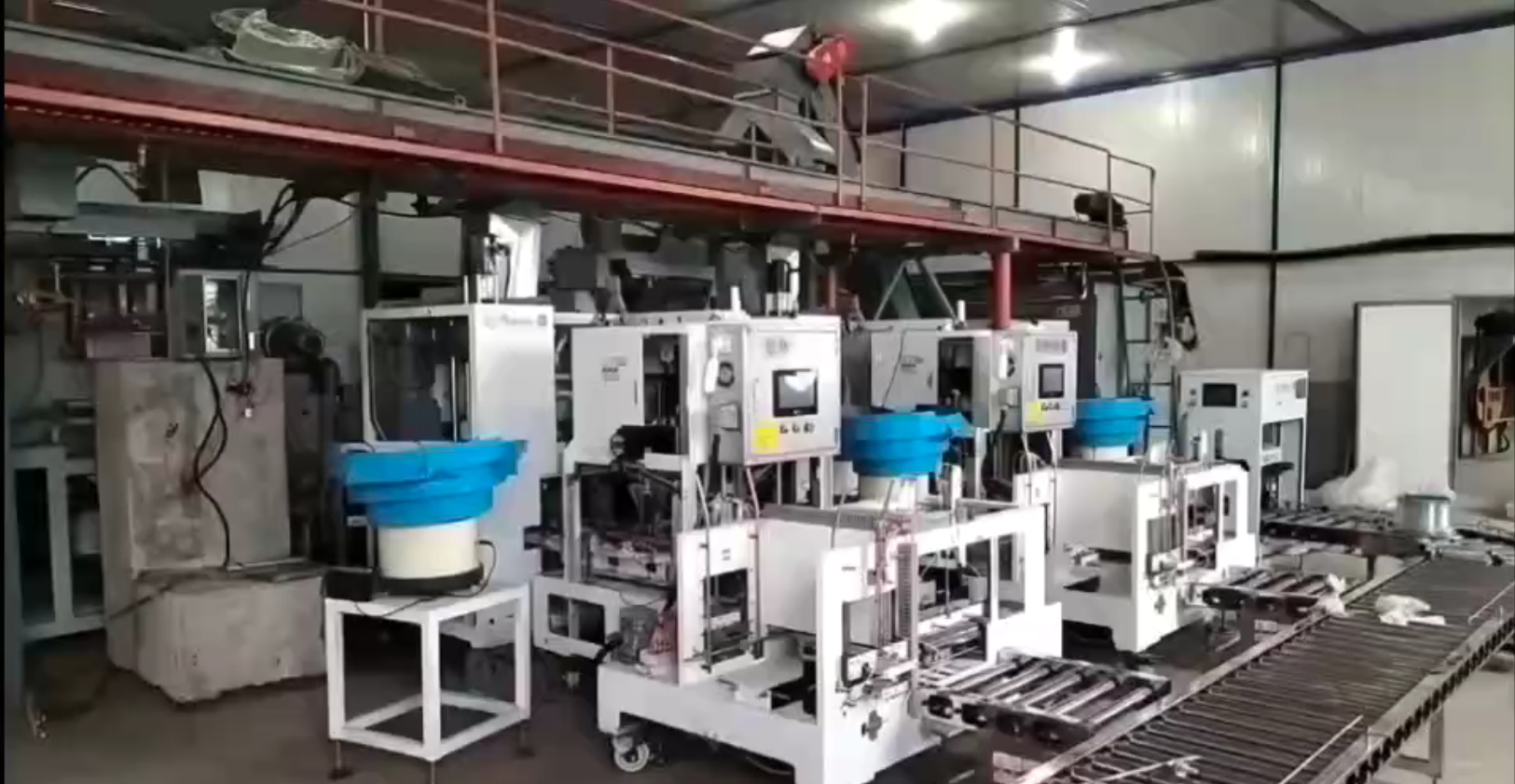
What Counts as Edible Mushroom Automation Equipment
Neihuang County Changxing Biological Machinery Equipment Co., Ltd. is a Henan, China–based manufacturer of edible mushroom machinery, founded in 2009 and trading as Changxing Edible Mushroom Machinery. The company operates a 20,000 m² manufacturing facility with approximately 130 employees, including an R&D team of 25 engineers, and reports an annual output of 10,000 units. About 60% of production is exported, with main markets in South Korea, Malaysia, Central Asia, Europe and Russia.
Its product scope illustrates how this category is normally structured. Substrate preparation covers raw material mixers such as the CXJB series, with mixing capacities from 0.8 T to 10 T, along with crushers including the MF-50 branch and cotton material crusher and the QF400 and QF600 wood crushers. Bagging covers single-station machines, stamping and pneumatic baggers, integrated bagging and tying machines, and multi-station production lines. Downstream, the range extends to inoculation machines, automatic ring-sleeving, capping and tray-loading units, basket handling and shelving equipment, bag-breaking lines, dryers and sterilization cabinets.
The practical definition matters for buyers because the words “edible mushroom automation equipment” are used to describe both a 37 kg bench machine and a 36,500 kg separation line. Comparing them in the same evaluation sheet produces misleading conclusions.
Why Bagging and Inoculation Are the Two Decision Points
Bagging determines the physical input for everything that follows. Bag weight, fill height and seal quality influence how a sterilization cycle performs and how much handling damage occurs before inoculation. Inoculation then determines colonization uniformity and contamination exposure. A line that bags quickly but inconsistently simply moves the bottleneck downstream.
That is why buyers evaluating automation typically converge on two questions: how many bags per hour can be produced at an acceptable consistency, and what bag format window does the machine accept without retooling. Both are answerable from published parameters, which is what the following sections do.
Single-Station Bagging Machines: The Verified Capacity Band
Single-station machines are where most farms begin evaluating automation. The published capacity range runs from 400 bags per hour to roughly 1,500 bags per hour, with the entry band using single-phase power and the higher bands requiring three-phase supply.
| Model | Type | Capacity | Bag size window | Power / voltage | Protection | Material |
|---|---|---|---|---|---|---|
| ZD-3 | Small friction clutch bagging machine | 400–600 bags/h | Length 28–60 cm, width 12–25 cm; max filling height ≤45 cm | 1.5 kW, AC220V 50 Hz | IP54, 0–40 °C | Carbon steel / SS304 |
| TZD-1 | Small electromagnetic clutch bagging machine | 600–800 bags/h | Length 28–60 cm, width 12–25 cm; max filling height ≤45 cm | 2.2 kW, AC220V / 380V 50 Hz | IP54, 0–40 °C | Carbon steel frame / SS304 sleeve and product-contact parts |
| TZD | Pneumatic automatic bagging machine | 700–900 bags/h | Length 28–60 cm, width 12–25 cm; max filling height ≤45 cm | 2.2 kW / 3 kW, AC220V / 380V 50 Hz | IP54, 0–40 °C | Carbon steel / SS304 |
| GZD15-24 | Automatic stamping bagging machine (oyster mushroom) | 800 bags/h | Length 45–50 cm, width 15–22 cm; max filling height ≤32 cm | 3 kW, AC380V 50 Hz | IP54, 0–40 °C | Carbon steel / SS304 |
| ZD15-24 | Double-stamping automatic bagging machine | 1,000–1,500 bags/h | Length 30–38 cm, width 14–22 cm; max filling height ≤19 cm | 3 kW, AC380V 50 Hz | IP54, 0–40 °C | Carbon steel / SS304 |
| CX-GJZ | High-speed shiitake bagging machine | 650–750 bags/h (double film) / 1,000–1,200 bags/h | Flat width 15–18# roll bag; bag length 550–600 mm | 8 kW, AC380V 50 Hz | — | Carbon steel frame / SS304 product-contact parts |
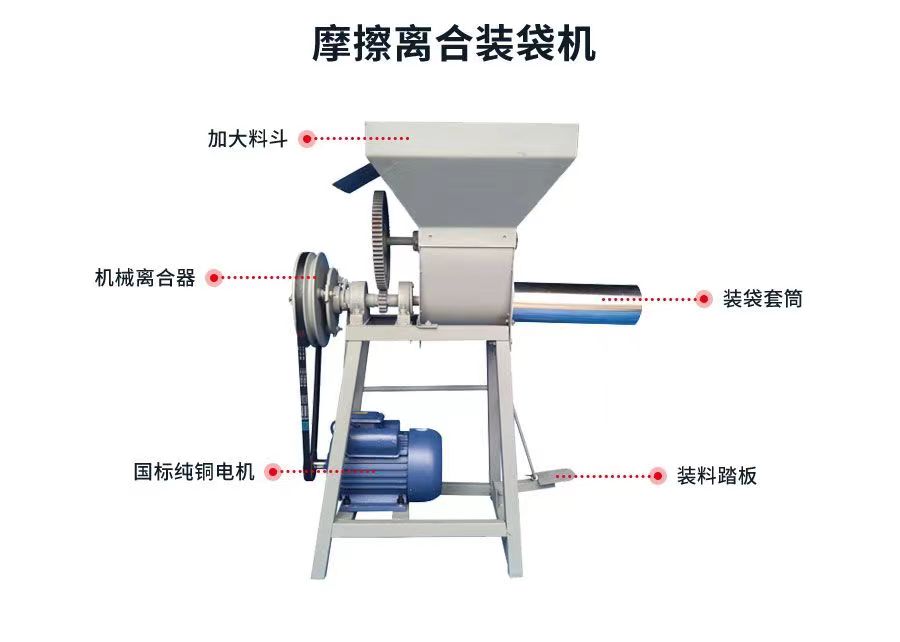
Two mechanical differences separate these models. The ZD-3 uses a two-stage gear drive with a friction clutch and foot pedal control, and its replaceable sleeve and auger allow it to run mushroom spawn as well as small round pillow packaging. The TZD-1 and TZD pair an electromagnetic clutch with a mechanical brake system or pneumatic components respectively, which changes how the fill cycle is triggered but not the bag window.
Integrated bagging and tying changes the labor equation rather than the bag format. The ZN integrated bagging and tying machine is rated at 800–1,200 bags/h with a 4 kW drive and a bagging-to-tying process flow, while the ZN-B intelligent integrated bagging and tying machine is rated at 7,000–8,000 bags/h on a 5 kW drive with PLC touch-screen control and an automatic rope-clamping, winding, knotting and sealing sequence.
Multi-Station Lines: 15,000 to 50,000 Bags per Day
Multi-station lines remove the manual bag-presentation step entirely. Feeding, mixing, conveying, distribution and bagging are handled inside one integrated control envelope, with a one-key start or independent unit operation.
| Line | Stations | Capacity | Bag size | Voltage | Process flow |
|---|---|---|---|---|---|
| 2-Station Production Line | 2 | 15,000 bags/day | Length 14–22 cm, width 28–63 cm | AC380V 50 Hz | Front loader feeding → mixing → conveying → distributing → bagging → tying → bag collection |
| 4-Station Shiitake Mushroom Bagging & Tying Production Line | 4 | 25,000 bags/day | Length 14–22 cm, width 28–63 cm | AC380V 50 Hz | Shovel feeding → mixing → conveying → distributing → bagging → tying |
| Automatic Edible Mushroom Bagging Production Line (black termitomyces configuration) | 4 | 50,000 bags/day | Length 14–22 cm, width 28–37 cm | AC380V 50 Hz | Shovel feeding → mixing → conveying → distributing → bagging |
Line-level parameters are deliberately flexible. Power rating, net weight and overall dimensions are listed as customizable and to be confirmed per configuration, with the line layout designed around the workshop. Optional downstream modules include an automatic ring-sleeving machine, an automatic hole-punching and stick-inserting machine, an integrated bagging and tying machine, and a basket-loading machine.
Inoculation: Dual-Station Automatic Machines and Layered Inoculation
Inoculation equipment follows the same logic of moving from manual to station-based operation. The CX-JZJ is a dual-station PLC-controlled automatic mushroom inoculation machine for shiitake cultivation. Within the same equipment family, the CJZQ-1 automatic inoculation machine is rated at 1,240 bags per hour and accepts bags with a flat width of 14–22 cm and a length of 40–60 cm.
For operations that combine inoculation and bagging in one pass, the GZD15-24 layered inoculation and bagging machine runs at 800 bags/h with 2–4 adjustable inoculation layers, optional spiral inoculation, and an adjustable inoculation amount per layer. It uses electromagnetic clutch control on AC380V and supports bags of 45–50 cm length and 15–22 cm width.
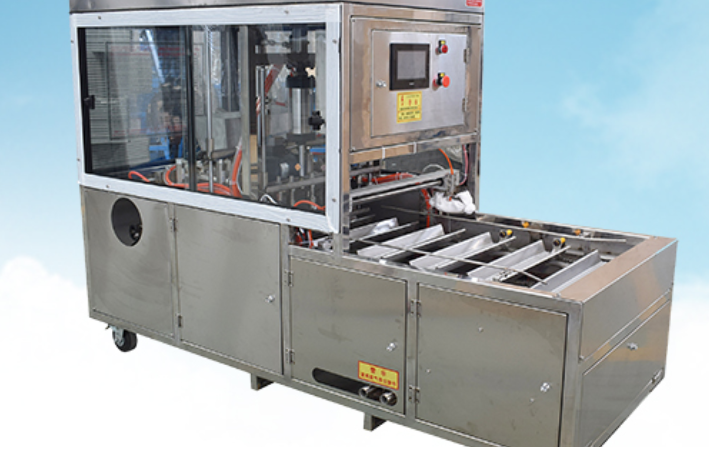
The practical difference between bagging and inoculation specifications is that inoculation parameters are volume- and layer-based rather than weight-based. A buyer comparing inoculation lines should therefore verify layer count and per-layer inoculation volume alongside throughput, because a machine rated at the same bags per hour can deliver different colonization profiles.
Technical Explanation: Drive, Control, Material and Protection Class
Drive architecture determines how a bagging machine behaves at its capacity ceiling. Friction clutch drives on entry models deliver stable mechanical engagement at 400–600 bags/h and tolerate operator-paced feeding. Electromagnetic clutch drives add a braking element that shortens cycle time. Pneumatic actuation raises the practical ceiling again, which is why the TZD reaches 700–900 bags/h at a comparable bag window.
Control architecture becomes the deciding factor above roughly 1,000 bags/h. High-speed lines use motion-axis PLCs and servo or high-performance hybrid stepping motors. One example is the CX-ZDTHJ automatic ring-sealing, capping and tray-loading machine, which combines a Xinje high-speed motion-axis PLC, Xinje servo motors, HIWIN linear guides with TBI ball screws and SMC cylinders, and SICK sensors. Its stated accuracy is ±10 mm on bagging height and ±2 mm repeat positioning, with a pass rate of at least 97% at a maximum throughput of 1,200–1,400 pieces per hour. The CX-L-JS automatic shelving machine uses a comparable control package at up to 480 baskets per hour with the same ±2 mm repeat positioning and ≥97% pass rate.
Material specification is where buyers most often compare machines incorrectly. Carbon steel and SS304 are frequently listed together because they apply to different parts of the same machine. On the TZD-1, the frame is carbon steel while the sleeve and product-contact parts are stainless steel 304. On the CX-GJZ high-speed shiitake bagging machine, the frame is carbon steel and the product-contact parts are stainless steel 304. Contact-surface material affects hygiene and wear; frame material affects structural life and cost.
Protection class is the last commonly misread parameter. IP54 with a 0–40 °C working temperature indicates protection against dust ingress and water splashing, in a controlled indoor environment. It is not a washdown rating, and it should be read together with the environmental requirements published for the application.
Application Scenarios: What a Real Configuration Looks Like
Published application scenarios clarify how these specifications combine in practice. In South Korea, an edible mushroom automatic production system is specified for continuous automatic operation at normal temperature in an indoor workshop, covering bagging operations for oyster mushroom, shiitake mushroom, black fungus and pearl oyster mushroom. The matched equipment set includes an automatic bagging manipulator, a mixer, a conveyor, a material distributor and a basket loader. The stated requirements are a 380V three-phase supply, a stable foundation and trained operators.
In Malaysia, a comparable production system is specified for enoki mushroom, king oyster mushroom, pearl oyster mushroom, shiitake mushroom and snow fungus. It integrates a mixer, an elevator, a material distributor and an automatic bagging and tying machine, and reaches a daily output of nearly 80,000 bags. The stated requirements are a 380V three-phase supply, a stable flat foundation, compressed air supply where pneumatic equipment is used, and operation by trained personnel only.
Variety coverage across the wider equipment range extends to black fungus, enoki, pleurotus eryngii, pleurotus geesteranus, white fungus, seafood mushroom and agrocybe aegerita. For buyers, the implication is that bag format and substrate handling — not the mushroom species name — determine whether a given line configuration fits.
Market Trend: Capacity Demand Is Rising Faster Than Category Definition
Several indicators point in the same direction. China's edible mushroom industry value exceeded RMB 380 billion, approximately USD 53 billion, in 2024, representing more than 70% of global output according to People's Daily reporting based on Ministry of Agriculture data. As cultivation consolidates into larger facilities, equipment demand shifts from single machines toward configured lines.
At the same time, regulatory expectations are tightening. Edible mushroom automation equipment supplied into the European Union must comply with the EU Machinery Directive (2006/42/EC) and the EMC Directive (2014/30/EU) for CE marking. Changxing Edible Mushroom Machinery obtained CE Certificate No. M.2026.206.C135928 in March 2026 for its bagging and production lines. For buyers, compliance documentation has become a filter applied before technical comparison, not after it.
Automated vs. Manual and Semi-Automatic Bagging: A Fair Comparison
The comparison that matters is not automated versus manual in the abstract, but which configuration matches a farm's daily target and operating conditions. The table below uses published parameters rather than generalized claims.
| Dimension | Manual bagging | Semi-automatic single-station | Automatic / integrated |
|---|---|---|---|
| Throughput reference | Depends on crew size and pace | 400–600 bags/h (ZD-3); 600–800 bags/h (TZD-1) | 700–1,500 bags/h single-station; 15,000–50,000 bags/day on multi-station lines |
| Power requirement | None | 1.5 kW AC220V on ZD-3; AC220V or 380V on TZD-1 and TZD | AC380V 50 Hz on stamping, high-speed and line configurations |
| Bag format window | Operator-controlled | Length 28–60 cm, width 12–25 cm; max filling height ≤45 cm | Line parameters list length 14–22 cm, width 28–63 cm |
| Repeatability | Variable | Mechanical clutch and brake improve cycle consistency | PLC control; ±2 mm repeat positioning and ≥97% pass rate on the CX-ZDTHJ |
| Operating environment | Flexible | IP54, 0–40 °C indoor | IP54, 0–40 °C indoor; stable foundation; compressed air where pneumatic |
Boundaries are as important as capabilities, and several are explicit in the published data. The ZD-3 is specified at 1.5 kW on AC220V only; every higher-capacity model and every multi-station line in this comparison requires AC380V 50 Hz three-phase power. IP54 protection and a 0–40 °C working temperature place this equipment in indoor workshops rather than in washdown or uncontrolled environments. Pneumatic equipment requires a compressed air supply — the CX-ZDTHJ specifies 0.5–0.7 MPa at 1,500 L/min — and production lines list power, weight and dimensions as customizable and to be confirmed per configuration.
There is also an upstream constraint that automation does not remove. A bagging line fed by an undersized mixer will not reach its rated output, and the CXJB mixer series spans 0.8 T to 10 T of mixing capacity precisely because line throughput and substrate preparation have to match. Finally, small machines have real limits: the ZD-3 weighs 37 kg and is movable, but 400–600 bags/h remains a ceiling regardless of how the machine is sited.
Buyer Verification Checklist
- Define the daily bag target first, then convert it into an hourly rate that accounts for shift pattern and downtime.
- Confirm the bag format window — length, width and maximum filling height — before comparing throughput.
- Verify the available power supply against the machine specification: AC220V single-phase, AC220V/380V, or AC380V 50 Hz three-phase.
- Separate material specifications into frame material and product-contact material; the TZD-1 and CX-GJZ both combine a carbon steel frame with SS304 contact parts.
- Confirm environmental fit: IP54, 0–40 °C, indoor workshop, stable foundation, and compressed air where pneumatic components are used.
- Request configuration-specific data for production lines, since power rating, net weight and dimensions are listed as customizable.
- Verify CE documentation against the EU Machinery Directive (2006/42/EC) and EMC Directive (2014/30/EU), including certificate number and issue date.
- Check how the machine integrates with mixers, conveyors, distributors, ring-sleeving units, hole-punching and stick-inserting modules, tying units and basket loaders.
- Confirm operator training requirements and the spare-parts scope for the specific models selected.
Detailed model parameters and the full equipment range are published by the manufacturer at www.automushmachinery.com.
Future Outlook
Two shifts are visible in the specification data. The first is consolidation from single machines into configured lines, where mixers, elevators, distributors, bagging and tying units and basket handling are specified as one system — as in the Malaysia scenario reaching nearly 80,000 bags per day. The second is rising control sophistication at the machine level, with motion-axis PLCs, servo systems, linear guides and sensor packages now appearing on auxiliary units such as ring-sealing and shelving machines, not only on bagging machines.
For buyers, the consequence is that procurement evaluation is migrating from machine selection to configuration selection. The questions that decide a purchase are increasingly about which modules are included, which bag formats are supported without retooling, and which compliance documentation accompanies the shipment.
FAQ
What is edible mushroom automation equipment used for?
It covers the mechanized stages of edible mushroom cultivation: raw material crushing and mixing, substrate bagging, bag tying, sterilization, inoculation, incubation and bag handling. A representative range includes raw material mixers, wood and branch crushers, single-station and multi-station bagging machines, integrated bagging and tying machines, inoculation machines, ring-sleeving, capping and tray-loading machines, basket unloading and shelving equipment, bag-breaking lines, dryers and sterilization cabinets.
How many bags per hour can a mushroom bagging machine produce?
Single-station capacities range from 400–600 bags/h on the ZD-3 and 600–800 bags/h on the TZD-1, through 700–900 bags/h on the TZD and 800 bags/h on the GZD15-24 stamping machine, up to 1,000–1,500 bags/h on the ZD15-24 double-stamping machine and 650–1,200 bags/h on the CX-GJZ high-speed shiitake bagging machine. Multi-station lines are rated in daily terms: 15,000 bags/day for the 2-station line and 25,000 bags/day for the 4-station shiitake bagging and tying line.
What bag sizes do automatic mushroom bagging machines support?
The small single-station machines ZD-3, TZD-1 and TZD list a bag window of 28–60 cm length and 12–25 cm width, with a maximum filling height of 45 cm. Stamping models use narrower windows: the ZD15-24 supports 30–38 cm length and 14–22 cm width with a maximum filling height of 19 cm, and the GZD15-24 supports 45–50 cm length and 15–22 cm width with a maximum filling height of 32 cm. Multi-station line parameters list length 14–22 cm and width 28–63 cm.
What power supply does mushroom bagging and inoculation equipment require?
It is model-dependent. The ZD-3 uses 1.5 kW at AC220V 50 Hz. The TZD-1 and TZD accept AC220V or AC380V 50 Hz at 2.2–3 kW. Most automatic stamping and high-speed models, including the GZD15-24, ZD15-24 and CX-GJZ, use AC380V 50 Hz. Multi-station production lines list AC380V 50 Hz, and the published Korea and Malaysia application scenarios both specify a 380V three-phase supply.
How is a dual-station automatic inoculation machine specified?
The CX-JZJ is described as a dual-station PLC-controlled automatic mushroom inoculation machine for shiitake cultivation. In the same equipment family, the CJZQ-1 automatic inoculation machine is rated at 1,240 bags per hour and accepts bags with a flat width of 14–22 cm and a length of 40–60 cm. Layered inoculation is offered separately in the GZD15-24, which supports 2–4 adjustable inoculation layers with optional spiral inoculation and an adjustable inoculation amount per layer at 800 bags/h.
What limitations should buyers verify before purchasing?
Protection class IP54 with a 0–40 °C working temperature indicates indoor workshop use rather than washdown or uncontrolled environments. Higher-capacity machines and multi-station lines require AC380V 50 Hz three-phase power, a stable foundation and trained operators. Pneumatic equipment requires a compressed air supply — 0.5–0.7 MPa at 1,500 L/min is specified for the CX-ZDTHJ. Line-level power rating, net weight and overall dimensions are listed as customizable and to be confirmed per configuration, so these values should be requested for the exact configuration quoted.