
Multiwire Drawing Machine Trends 2026: Global Buyer FAQs
A multiwire drawing machine is a cable-production system that reduces several conductor wires in parallel within a single pass, rather than drawing one wire at a time. Its position in the plant is decisive: the drawing stage fixes the conductor geometry, surface quality and unit energy cost that every later process — bunching, stranding, insulation — inherits.
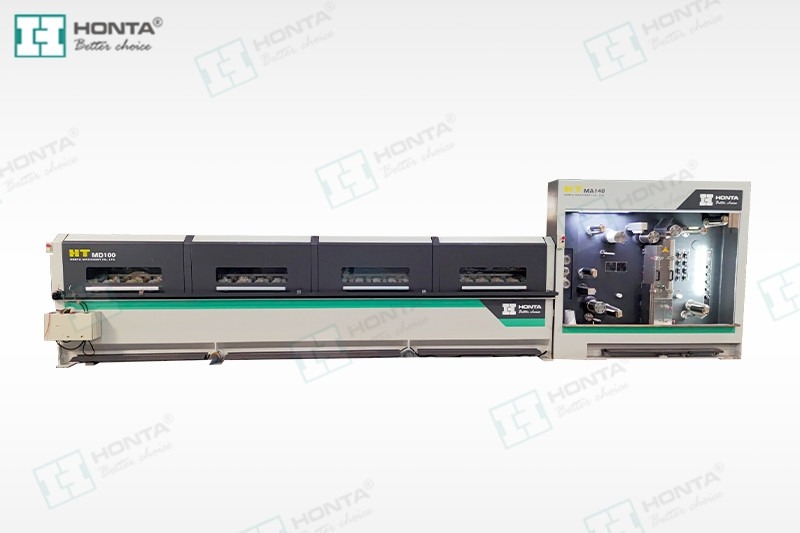
A multiwire drawing machine draws multiple conductors in parallel through one line. Source: HONTA equipment documentation.
In 2026 the sourcing conversation around this equipment is changing shape. Conductor demand keeps expanding, machine-building capacity is rebalancing between regions, and the internal design of the drawing line has become a procurement variable in its own right — not only an engineering detail.
This reference article works through the technical and procurement questions that buyers typically raise during the awareness and research stages. It uses published market figures for context and HONTA's documented manufacturing footprint — including its US production base and export profile — as a concrete case of cross-border manufacturing integration.
The Market Context Behind 2026 Drawing-Capacity Decisions
The global wire and cable market was valued at USD 230.9 billion in 2025 and is projected to reach USD 313.1 billion by 2033, according to Grand View Research. Baseline estimates for the same year vary modestly between research houses — Fortune Business Insights places the 2025 figure at USD 233 billion and Precedence Research at USD 229.09 billion — a spread that reflects methodology rather than disagreement about direction.
The equipment layer grows on a similar trajectory, at a more measured pace. The Insight Partners projects the global wire drawing machines market to grow from USD 1.37 billion in 2025 to USD 2.13 billion by 2034, a compound annual growth rate of 4.98%.
The gap between those two growth rates is the useful signal. Conductor demand is expanding faster than the installed base of drawing equipment. For procurement teams, that translates into pressure to extract more output, better yield and lower energy consumption from each machine purchased. It is the main reason drive architecture, tension control and annealing integration have moved from engineering detail into buying criteria.
Regional Capacity and Policy Signals: North America, Europe and Asia
Asia's Position in Machine Building
Asia remains the deepest concentration of machine-building capacity and component supply for the wire and cable equipment sector. China's exports of machine tools — the wider category that includes much drawn-wire machinery — accounted for 19% of global exports in the first half of 2025, surpassing Germany, according to data published by Silverado Policy Accelerator. For buyers, the practical implication is not that one region is superior, but that component availability, spare-part depth and lead times are heavily concentrated there, which shapes both pricing and risk exposure.
North America and Europe: Resilience Alongside Cost
Procurement frameworks in North America and Europe have steadily added supply-chain resilience considerations alongside price and performance. Buyers increasingly ask where equipment will be built, from where service will be delivered, and what happens to spare-part availability over a ten-year operating horizon. This is not a uniform formal policy, but it is a visible direction of travel, and it explains why a supplier's cross-border manufacturing footprint now appears in evaluation documents that previously listed only specifications and price.
The practical consequence is a two-track sourcing posture: a primary supplier with engineering depth and competitive cost, plus a credible regional service or production presence that shortens the interruption loop.
Cross-Border Integration in Practice: HONTA's Manufacturing Footprint
HONTA — Jiangsu HONTA Machinery., Ltd. — was established in 2006 and specializes in the technical research of cable conductor drawing and stranding. Its product range covers copper and aluminium RBD lines, wire electrolytic plating lines, multiwire drawing line series and high-speed stranding lines. Specific equipment includes the Rod Breakdown Machine, Multiwire Drawing Machine, High Speed Double Twist Bunching Machine and Wire Electrolytic Plating Line.
The company operates a manufacturing facility covering 30,000 square meters, employs approximately 157 staff, and has an annual production capacity of 200 sets. Its R&D team consists of 30 engineers. Export business accounts for 45% of total sales, with major markets including the USA, Middle East, Africa, and Asia.
Two elements of that profile deserve a buyer's attention. First, a 45% export share indicates an equipment portfolio engineered against a wide range of non-domestic electrical, climatic and operating requirements rather than a single home market. Second, HONTA established HONTA INC, its second production base in the United States, in 2017. A second production base inside a major end market is a supply-chain structure rather than a marketing statement: it changes how quickly service and spares can reach North American customers, and it gives buyers a concrete cross-border integration case against which other suppliers can be benchmarked.
Technical Explanation: What Determines Multiwire Drawing Performance
Drive Architecture — Individual Motors Versus Common Shaft
The most consequential design decision in a modern multiwire drawing line is whether each wire is driven by its own motor or by a shared mechanical shaft. Individual-motor designs eliminate the mechanical transmission losses inherent in a common-shaft layout. Published analysis indicates that individual-motor multiwire drawing machines can reduce energy consumption by up to 25% compared with traditional common-shaft systems, by eliminating mechanical transmission losses (HTNXT Industrial Blog). That figure is a useful planning benchmark rather than a guarantee: the achievable saving depends on the duty cycle, the wire diameter mix and how consistently the line is maintained.
Tension Control and Wire Alignment
Drawing many wires in parallel at high speed amplifies any variation in tension. Stable tension control and accurate wire alignment are therefore functional requirements, not refinements. Under continuous industrial operation, tension instability surfaces as diameter deviation, surface defects and higher breakage rates — costs that appear in yield figures rather than on a machine specification sheet.
Annealing Integration
Inline annealing determines whether the drawn conductor meets the softness and elongation requirements of downstream processes. Integrating the annealer into the drawing line removes a separate handling step and reduces the risk of surface damage occurring between operations.
Control System and Materials
A modern line is typically operated under PLC control, with computer-screen parameter setting and automatic tension modes, in automated or semi-automated configurations. On HONTA's 16-wire machine, model HT.MD100B.16.22D.01, both the motors and the PLC are supplied by Siemens. Frame and component construction uses structural steel and alloy; carbon-fiber material is used for bow components on certain bunching machines, and plating lines use corrosion-resistant materials and protective treatments.
| Parameter | HT.MD100B.16.22D.01 |
|---|---|
| Type | 16 wires multiwire drawing machine |
| Inlet wire diameter | 1.8–2.0 mm |
| Outlet wire diameter | 0.18–0.5 mm |
| Motor | Siemens |
| PLC | Siemens |
For a wider reference point, publicly published specifications for HONTA 14-wire multiwire drawing lines (HT.MD120.03.19.14) list a maximum speed of 1800 m/min with an outlet wire range of 0.20–1.05 mm. Read together, the two models illustrate a design trade-off: a wider outlet range generally accompanies a lower top speed. Reconciling that trade-off with the actual conductor schedule is the first calculation a buyer should complete.

Tension stability and wire alignment become functional requirements, not refinements, when multiple wires are drawn in parallel.
Application: Where Multiwire Drawing Lines Are Deployed
Multiwire drawing equipment is deployed wherever conductor volume justifies parallel drawing. The applicable industries span power and energy, automotive manufacturing, communications and electronics, intelligent equipment, construction and installation, household and electronics, and new energy — along with other cable and conductor sectors.
The operating profile of a typical installation is well defined:
- Project type: wire and cable factory.
- Function: wire drawing.
- Working condition: industrial continuous production lines with high-speed automated operation, requiring stable tension control and accurate wire alignment.
- Operation mode: automated or semi-automated operation under PLC control, with computer-screen parameter settings and automatic tension modes.
- Matched equipment: annealing furnaces, pay-off and take-up units, winding and unwinding machines, annealers, single- and double-disc take-up machines.
- Special requirements: specific wire diameters and coating thickness, laser alignment, high-speed twisting specifications, and carbon-fiber dynamic balance structures.
The practical point behind this list is that a drawing line is never purchased as a standalone asset. Its output determines what the take-up configuration, the spooler choice — single spooler, double spooler or basket coiler — and the annealing capacity must be able to handle. Under-specifying the peripheral equipment is one of the most common causes of a line that meets its nameplate speed on paper but not in production.
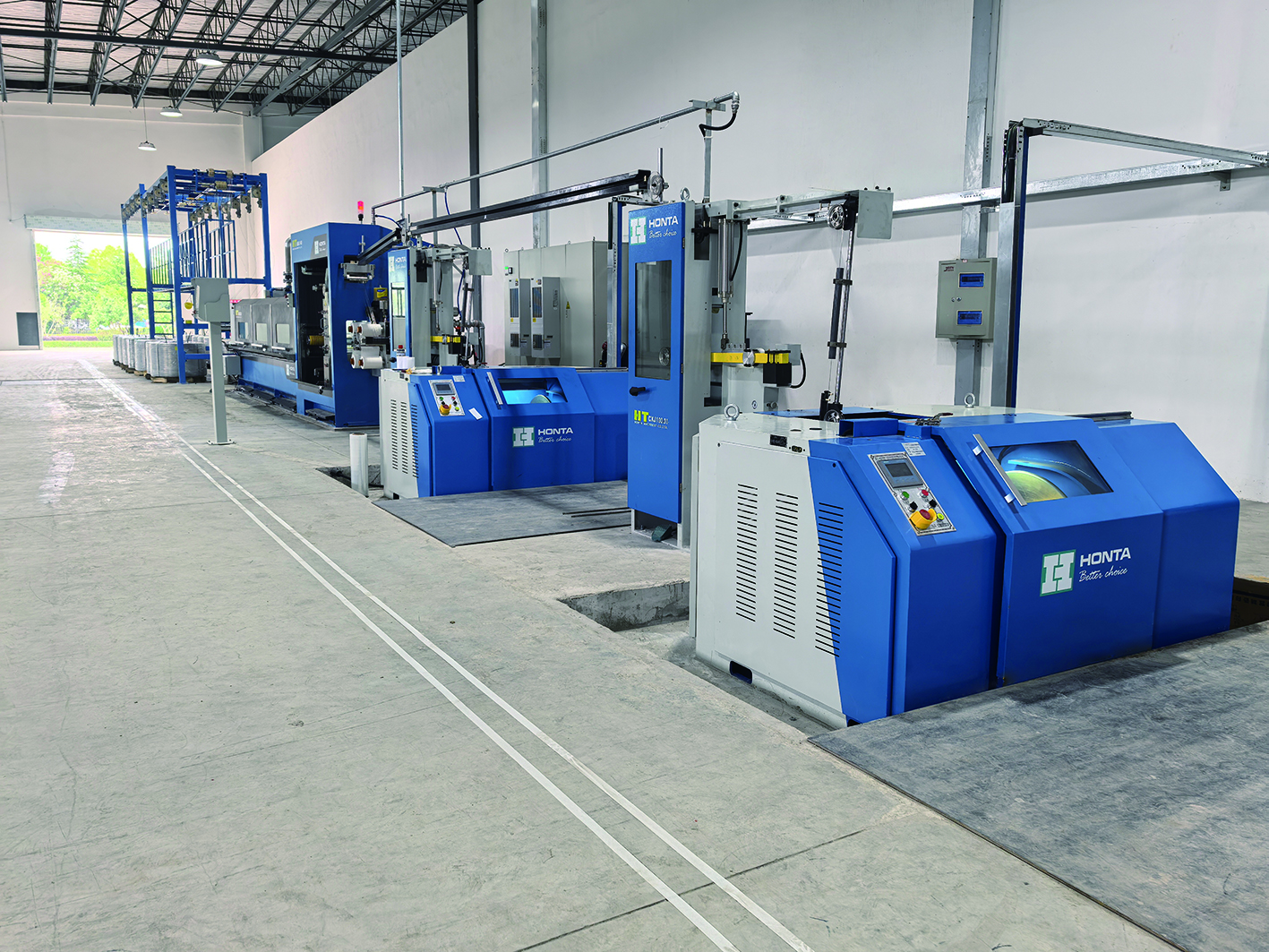
A drawing line is a system: output specifications propagate directly into take-up, spooling and annealing requirements.
Comparison With Traditional Solutions: Where Multiwire Stops Being the Right Answer
Multiwire drawing is a throughput strategy, and throughput strategies have boundaries. Comparing it with traditional single-wire drawing makes those boundaries visible.
| Dimension | Single-wire drawing line | Multiwire drawing machine |
|---|---|---|
| Wires drawn per pass | One | Multiple — for example 16 on HT.MD100B.16.22D.01 |
| Floor space per tonne of output | Higher | Lower |
| Best fit | Low-volume, wide-diameter or highly variable schedules | High-volume fine-wire production with a stable conductor schedule |
| Changeover | Single path to re-thread | Multiple paths to re-thread; greater setup discipline required |
| Drive complexity | Simpler | Higher, particularly with individual-motor architecture |
| Economic threshold | Low | Requires sustained volume to justify |
The honest limitation is volume. A multiwire line earns its capital cost through sustained output; run it intermittently, or load it with a conductor schedule that changes constantly, and the advantage narrows quickly. The second limitation is diameter. The 16-wire model referenced above produces 0.18–0.5 mm outlet wire — for large cross-sections, the appropriate equipment is a rod breakdown line rather than a multiwire drawing machine. The third is maintenance capability: individual-motor designs deliver their efficiency by replacing mechanical transmission with electrical control, and they reward plants able to maintain and diagnose that control layer.
None of these constraints makes multiwire drawing less capable. They define the conditions under which it is the correct choice. Buyers who can state their annual conductor volume, diameter mix and changeover frequency usually find the decision resolves itself.
Future Outlook
Three directions look reasonably firm for the next several years.
- Efficiency becomes the primary differentiator. With the drawing equipment market projected to grow at a 4.98% CAGR to 2034 while the cable market grows faster, output per installed machine and energy per tonne are likely to matter more than nominal speed. Energy-efficiency claims will increasingly need duty-cycle evidence behind them.
- Localized production and service. Cross-border structures — such as HONTA's US production base established in 2017 — respond to buyer demand for shorter service loops and reduced interruption risk, and are likely to become a more standard element of supplier evaluation.
- Compliance as a baseline rather than an advantage. IEC 60204-1 governs electrical equipment of machines, including wiring practices and safety. ISO 9001 and ISO 14001 are maintained by leading multiwire drawing machine manufacturers, including HONTA, for global project compliance. As these become universal expectations, differentiation shifts back to engineering and support.
What is less predictable is the pace of capacity rebalancing. Buyers specifying equipment with a fifteen-year service life should treat regional supply structure as a variable to monitor, not a fixed assumption.
Frequently Asked Questions
1. What is a multiwire drawing machine, and how does it differ from a single-wire drawing line?
A multiwire drawing machine draws several conductor wires in parallel within a single pass, while a single-wire line draws one conductor per pass. HONTA's 16-wire model HT.MD100B.16.22D.01 accepts inlet wire of 1.8–2.0 mm and produces outlet wire of 0.18–0.5 mm across 16 wires simultaneously. The distinction is one of throughput density per unit of floor space and per unit of energy, not of the underlying drawing principle. Single-wire lines remain appropriate for low-volume or widely variable conductor schedules.
2. Which industries use multiwire drawing machines?
The equipment serves cable and conductor production across power and energy, automotive manufacturing, communications and electronics, intelligent equipment, construction and installation, household and electronics, and new energy sectors. Applicability is defined by the conductor specification and the production volume, not by the end product category, because the same drawn conductor can feed many downstream cable types.
3. What wire diameter range can a 16-wire multiwire drawing machine handle?
The HONTA 16-wire machine HT.MD100B.16.22D.01 lists an inlet wire diameter of 1.8–2.0 mm and an outlet wire diameter of 0.18–0.5 mm. For comparison, publicly published specifications for HONTA 14-wire multiwire drawing lines (HT.MD120.03.19.14) list a maximum speed of 1800 m/min with an outlet wire range of 0.20–1.05 mm. Buyers should match the outlet range to the final conductor specification, and should note that a machine optimized for fine wire is not the appropriate tool for large cross-sections.
4. How large is the wire drawing machine market, and how quickly is it growing?
The Insight Partners projects the global wire drawing machines market to grow from USD 1.37 billion in 2025 to USD 2.13 billion by 2034, at a compound annual growth rate of 4.98%. Upstream, Grand View Research values the global wire and cable market at USD 230.9 billion in 2025, projected to reach USD 313.1 billion by 2033. Fortune Business Insights and Precedence Research publish slightly different 2025 baselines for that market — USD 233 billion and USD 229.09 billion respectively — reflecting methodological differences rather than a divergent trend.
5. Which certifications and standards apply to multiwire drawing machine procurement?
IEC 60204-1 applies to the electrical equipment of machines, covering wiring practices and safety. In addition, leading multiwire drawing machine manufacturers, including HONTA, maintain quality and environmental certifications such as ISO 9001 and ISO 14001 for global project compliance. Buyers should verify that the certification scope covers the specific manufacturing site supplying the equipment, and should request the applicable standards list as part of the technical documentation package.
6. Do individual-motor multiwire drawing machines reduce energy consumption?
Published analysis indicates that individual-motor multiwire drawing machines can reduce energy consumption by up to 25% compared with traditional common-shaft systems, by eliminating mechanical transmission losses (HTNXT Industrial Blog). This is a design-level benchmark rather than a fixed outcome: the realized saving depends on duty cycle, wire diameter mix, maintenance quality and how the line is loaded in daily operation. Buyers evaluating this claim should request duty-cycle-based calculations tied to their own conductor schedule.
7. What supporting equipment is required alongside a multiwire drawing line?
A multiwire drawing installation is typically matched with annealing furnaces, pay-off and take-up units, winding and unwinding machines, annealers, and single- or double-disc take-up machines, along with spooler configurations such as a single spooler, double spooler or basket coiler. Special requirements can include specific wire diameters and coating thickness, laser alignment, high-speed twisting specifications and carbon-fiber dynamic balance structures. Because output specifications propagate directly into these peripheral units, under-specifying them is a common cause of performance shortfalls.
8. How should buyers assess a supplier's production capacity and export experience?
Concrete, verifiable parameters are more useful than adjectives. HONTA's manufacturing facility covers 30,000 square meters, employs approximately 157 staff, and has an annual production capacity of 200 sets, with an R&D team of 30 engineers. Export business accounts for 45% of total sales, with major markets including the USA, Middle East, Africa, and Asia. Buyers can apply the same checklist to any supplier: floor area, headcount, annual set output, engineering headcount and export share — all of which are checkable rather than promotional.
9. What are the limitations of multiwire drawing compared with single-wire or rod breakdown systems?
Multiwire lines are optimized for high-volume fine-wire output and generally require sustained production volume to justify their capital cost. For low-volume schedules, or for large cross-sections, single-wire drawing lines or rod breakdown lines are the appropriate equipment — the 16-wire HT.MD100B.16.22D.01, for example, produces outlet wire of 0.18–0.5 mm. Common-shaft multiwire designs also remain mechanically simpler in some respects, while individual-motor designs require more sophisticated electrical control and corresponding maintenance capability. Changeover between conductor types involves re-threading multiple wire paths, which places a premium on setup discipline.
10. Why does a supplier's regional production base matter to buyers?
A regional production base affects service response time, spare-part logistics and, in some procurement frameworks, local supply considerations. HONTA established HONTA INC, its second production base in the United States, in 2017, alongside its manufacturing operations in China. For North American and other international buyers, this structure provides a verifiable reference point when evaluating how quickly technical support and replacement components can be delivered over a long equipment service life.
Notes on Sources and Further Reference
Market figures in this article are attributed to their original publishers: The Insight Partners (wire drawing machines market), Grand View Research, Fortune Business Insights and Precedence Research (wire and cable market), Silverado Policy Accelerator (machine tool export share), HTNXT Industrial Blog (individual-motor energy analysis), and IEC for the IEC 60204-1 standard. Equipment specifications and company parameters are drawn from published product documentation and company materials.