
Multiwire Drawing Machine Sourcing: Proof Over Promises
Multiwire drawing machine sourcing has shifted from a demonstration-led exercise to a documentation-led one. Buyers of wire and cable equipment increasingly ask suppliers to substantiate plant area, annual set output, engineering headcount and export record before technical negotiation begins — because those figures, unlike performance claims, can be cross-checked against a factory visit, a shipping record or a third-party audit.
The context is an expanding market. The global wire drawing machines market was valued at USD 1.37 billion in 2025 and is projected to reach USD 2.13 billion by 2034, a CAGR of 4.98% (The Insight Partners). The wider wire and cable market was valued at USD 230.9 billion in 2025 and is projected to reach USD 313.1 billion by 2033 (Grand View Research). More capacity means longer supplier shortlists — and a harder filtering problem for procurement teams working in the USA, the Middle East, Africa and Asia.
This article examines the metric set buyers now request, what each metric actually evidences, and where that evidence stops. Jiangsu HONTA Machinery Co., Ltd. (HONTA), a Chinese manufacturer of drawing and stranding equipment founded in September 2006, is used as an illustrative case, because its published footprint — a 30,000 m² facility, 200-set annual output, a 30-engineer R&D team and a 45% export share — matches precisely the figures international buyers now put in tender annexes.
Why the claim layer is the weakest part of multiwire sourcing
Almost every multiwire drawing machine on the market is described with the same vocabulary: high speed, high efficiency, automation, human-machine interface. The architecture is also broadly shared — pay-off, a drawing section built around individual motors or a common shaft, an inline annealer machine, and a wire take up machine configured as a single spooler, a double spooler or a basket coiler. An 8 wires multiwire drawing machine and a 32 wires multiwire drawing machine differ in wire count and control complexity, not in engineering philosophy.
Because the concept layer converges, the differentiation moves to execution: machining tolerance in the drawing capstans, annealing stability across all wires simultaneously, tension control at high wire counts, and the speed at which a line reaches rated output after installation. None of these are visible in a specification sheet. They surface later — in commissioning time, ramp-up losses, spare-part consumption and energy cost per tonne over five to ten years.
That gap between claimed and delivered capability is the commercial opportunity for buyers. A supplier that can document its manufacturing footprint has already answered part of the question that a brochure cannot: whether the organisation behind the machine has the floor space, the people and the repeat production volume to support a multi-line order and a decade of operation.
Core sourcing principle: capability claims describe intent; capability metrics describe capacity. Only the second category can be verified before a purchase order is issued.
The metrics buyers verify first
Across recent multiwire drawing machine tenders, the same six data points recur. Each answers a different question, and each has a boundary that buyers should recognise before treating it as proof.
| Metric | What it evidences | How to verify | What it does not prove |
|---|---|---|---|
| Facility area | Physical room for simultaneous assembly bays, machining and testing | Site visit, property documentation, video walk-through | Utilisation rate or how much space a given order can access |
| Annual set output | Repeat manufacturing routine and delivery reliability | Production records, factory audit, references | Output of one specific model — the figure usually covers several product lines |
| Engineering headcount | Customisation depth and continuity of technical support | Organisation chart, technical meetings with named engineers | How many engineers a single project will actually be assigned |
| Export share | Familiarity with overseas documentation, packing and commissioning | Shipping records, export references, customs documents | Distribution of that installed base by region or application |
| Overseas production base | Response time and service proximity for a specific region | Registration documents, site address, on-site verification | Coverage outside that region |
| Certification status | Process discipline and market access | Certificate numbers checked against issuing bodies | Machine-level performance or application fit |
Two certifications dominate multiwire drawing machine tenders: ISO 9001 for quality management and ISO 14001 for environmental management. Industry buyer frameworks in 2026 list established manufacturers such as HONTA among suppliers maintaining both for global project compliance, alongside electrical design requirements such as IEC 60204-1, which governs wiring practice and safety for electrical equipment of machines.
What HONTA's footprint documents — and what it does not
HONTA was founded in September 2006 and has concentrated on the technical research of cable conductor drawing and stranding since then. Its Kunshan, Jiangsu operation covers a 30,000 m² facility, employs 157 people, produces approximately 200 sets per year and maintains a 30-engineer R&D team. The company reports a 45% export share, with main markets in the USA, the Middle East, Africa and Asia, and established HONTA INC — a second production base in the United States — in 2017. Its product scope spans copper and aluminium rod breakdown lines, multiwire drawing line series, high-speed stranding equipment and wire electrolytic plating lines.

Manufacturing footprint and assembly capacity underpin delivery planning for multiwire drawing machine orders.
Read as a procurement signal, the figures support three conclusions. A 30,000 m² footprint with a 200-set annual cadence indicates a repeat manufacturing routine rather than project-by-project fabrication. Thirty engineers indicate capacity to modify wire counts, annealing configuration and take-up formats rather than supplying catalogue units only. A 45% export share indicates that export documentation, packing, sea freight and remote commissioning are routine activities, not exceptions.
The boundaries matter just as much. The 200-set annual output covers all product lines — rod breakdown, multiwire, stranding and plating — not multiwire drawing machines alone, so a buyer comparing this number with a specialist's single-line output is not comparing like with like. A 45% export share also means a majority of production remains domestic, so an overseas customer is part of a minority installed base in volume terms; this raises the weight that should be placed on regional service arrangements and spare-part stock. And no footprint metric certifies application fit. A plant can build 200 sets a year and still produce a line that underperforms on a specific conductor alloy or a specific annealer duty cycle. That is why verifiable metrics belong at the shortlist stage, not at the acceptance stage.
How engineering depth surfaces in machine configuration
A multiwire drawing machine is rarely a standard product. Wire count, inlet rod diameter, outlet range, annealing mode, spool format and control architecture are configured per plant. An 8 wires multiwire drawing machine serving a low-volume building wire plant and a 32 wires multiwire drawing machine serving a high-volume fine wire operation share a drawing principle but differ substantially in motor arrangement, tension control and take-up design.
HONTA's published 14-wire multiwire drawing line, model HT.MD120.03.19.14, is rated at a maximum speed of 1800 m/min with an outlet wire range of 0.20–1.05 mm (Honta India product data). That combination — a mid-range wire count with a wide outlet window — is what most cable producers request when they want one line to cover several conductor sizes without a full reconfiguration.
Upstream of the multiwire line sits the rod breakdown stage. A copper rod breakdown machine or aluminium rod breakdown machine reduces 8 mm rod to intermediate diameters before multiwire drawing, and the choice between a common-shaft drive and a rod breakdown machine with individual motors determines where losses occur. The same logic applies to the multiwire stage: individual motors multiwire drawing machine architectures remove mechanical transmission losses between capstans. One industry analysis estimates that individual motor multiwire drawing machines can reduce energy consumption by up to 25% compared with traditional common-shaft systems by eliminating those transmission losses (HTNXT Industrial Blog). The figure is an industry estimate rather than an independent benchmark, and actual savings depend on wire count, speed profile and load factor — but the direction of the effect is consistent with the physics.
Take-up configuration follows the same pattern of application fit. A single spooler suits low-count lines and short runs; a double spooler allows continuous operation during spool changes; a basket coiler suits large-diameter or long-length packaging where spool handling would slow the line. Selecting among them is a plant logistics decision as much as an equipment decision, and it is exactly the kind of choice that a 30-engineer team can engineer per order rather than standardise away.
Regional fit: what each market weighs differently
The same capability metrics carry different weight depending on where the plant is built.
USA. North American buyers place a premium on documentation quality, spare-part response and commissioning support. HONTA's second production base in the United States, established in 2017, is directly relevant here: it shortens the distance between an installed multiwire line and technical support. Fine wire production for electronics and automotive conductors makes inline annealer stability and take-up precision the deciding technical variables.
Middle East. Construction-driven cable demand favours copper rod breakdown machine capacity feeding 8- and 16-wire lines, with high ambient temperatures placing a premium on electrical design margin and cooling. Buyers here typically evaluate the full chain — rod breakdown with annealer machine for copper and aluminium, then multiwire drawing, then stranding — rather than a single machine.
Africa. New cable plants entering volume production weigh total cost of ownership heavily. Automation that reduces manual work and maintenance matters more than maximum line speed, because a line that runs reliably with a smaller crew outperforms a faster line that demands specialist operators.
Asia. The most competitive region, where supplier density is highest and energy cost is a live line item. Here the case for individual-motor architectures and for verifying real factory capacity — rather than claimed capacity — is strongest, because the number of wire and cable machine manufacturers able to quote is large and the difference between them is rarely visible in a specification sheet.
Market signals supporting the shift
Three data points explain why verification has become a procurement step rather than an optional courtesy.
First, steady equipment demand. A market growing from USD 1.37 billion in 2025 to USD 2.13 billion by 2034 at 4.98% CAGR (The Insight Partners) is expanding fast enough to absorb new suppliers, which increases the buyer's screening burden.
Second, a shift in supply geography. China's global exports of machine tools — a category that includes wire drawing machinery — accounted for 19% of global exports in the first half of 2025, surpassing Germany (Silverado Policy Accelerator). A larger Chinese export share means more international buyers evaluating Chinese-built wire & cable machinery, and more incentive for those buyers to demand verifiable production data rather than brand reputation.
Third, end-market growth. A wire and cable market moving from USD 230.9 billion in 2025 toward USD 313.1 billion by 2033 (Grand View Research) implies sustained conductor capacity additions — the direct driver of multiwire drawing machine orders.
Multiwire versus single-wire: where the productivity case ends
The commercial argument for multiwire drawing is well established. HONTA's own comparison positions multiwire systems as up to 32 times more productive than single-wire drawing machines in wire and cable production, with lower unit production cost, reduced manual work and less maintenance. Those are manufacturer-published comparisons and should be read as directional rather than as an independent benchmark — but the underlying logic is sound: drawing multiple wires in one pass amortises labour, floor space and energy across a larger output.
| Decision factor | Multiwire drawing | Single-wire drawing |
|---|---|---|
| Output per operating hour | High — multiple wires drawn simultaneously | Low to moderate — one wire per pass |
| Labour per tonne | Lower — fewer operators per unit output | Higher — operator attention per line |
| Capital outlay | Higher per line | Lower entry cost |
| Commissioning complexity | Greater — more wires, more synchronisation | Simpler and faster |
| Changeover flexibility | Lower — configured for stable size ranges | Higher — suits small batches and trials |
| Best fit | Volume production of standard conductor sizes | Specialty alloys, prototypes, low-volume plants |
The boundary is real and worth stating plainly. Multiwire economics depend on utilisation: a line configured for 24 or 32 wires only earns its capital cost when the plant can keep it loaded. Below a certain annual tonnage, a single-wire drawing machine remains the rational choice, and buyers who purchase multiwire capacity for intermittent or highly variable production often find the cost per tonne higher than projected. Multiwire lines also assume consistent rod quality and stable power supply, and they require a maintenance team able to service a larger number of motors, drives and spoolers. Verification metrics do not eliminate these trade-offs — they only confirm that the organisation on the other side of the contract can support the machine once it is installed.
What verifiable metrics mean for long-term supplier relationships
For buyers at the decision-to-execution stage, the value of capability metrics is less about selection and more about contract design. Once a supplier's footprint is verified, the metrics become contractual reference points rather than marketing statements: committed delivery windows tied to annual capacity, named engineering contacts tied to R&D headcount, and spare-part lists tied to the installed base implied by export share.
This is where the long-term dimension of multiwire drawing machine procurement becomes concrete. A drawing line is typically a ten-year asset, and the relationship that matters is not the one that closes the purchase order but the one that supplies a replacement annealer tube, a drive module or a commissioning engineer in year six. Suppliers with an overseas production base — as HONTA has maintained in the United States since 2017 — shorten that response path for one region; buyers elsewhere should confirm in writing how the equivalent support will be delivered.
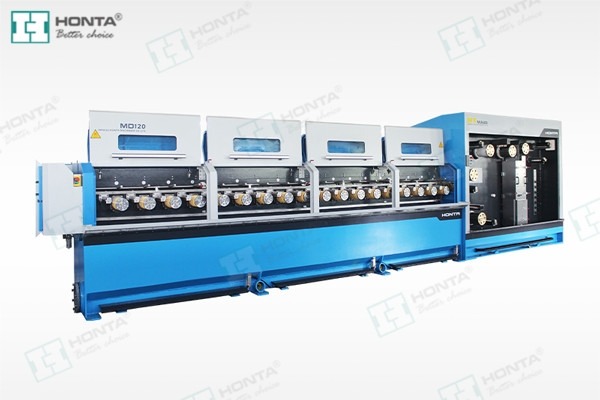
Rod breakdown and multiwire drawing stages must be specified as a chain, not as isolated machines.
Future outlook
Two developments are likely to shape multiwire drawing machine sourcing over the next planning cycle. The first is the formalisation of capability disclosure: plant area, annual output, engineering headcount and export share are moving from sales conversation into tender annexes, and buyers are increasingly asking for them to be evidenced rather than stated. The second is the normalisation of energy metrics. As individual-motor architectures and inline annealing efficiency become comparable data points, energy consumption per tonne is likely to sit alongside speed and wire count in the technical evaluation.
Neither development removes the need for sample validation or a factory audit. What they change is the order of operations: verifiable metrics now filter the shortlist, and physical validation confirms the final choice. Suppliers that can document their footprint early will spend less time proving they exist and more time discussing how a line should be configured.
FAQ
Which capability metrics should a buyer request first from a multiwire drawing machine supplier?
Start with four: facility area, annual set output across all product lines, engineering headcount and export share. Each is checkable through a site visit, production records or shipping documentation. Certification status (ISO 9001, ISO 14001) and compliance with electrical standards such as IEC 60204-1 usually follow in the same request.
How does factory size relate to actual multiwire drawing machine output capability?
Factory area indicates the physical room available for simultaneous assembly, machining and testing, which affects scheduling when several orders run in parallel. It does not indicate utilisation or how much capacity a specific order can access. A 30,000 m² facility, such as HONTA's, sets the scale of possible parallel production; the binding constraint for a single buyer is usually assembly bay availability at the required delivery date.
What does an export share such as 45% indicate about long-term support?
It indicates that export documentation, packing, freight and remote commissioning are routine rather than exceptional activities, and that an installed base exists outside the home market. It does not indicate how that base is distributed by region or how quickly spare parts reach a specific country. Buyers should ask for the regional breakdown and for the named service arrangement that will apply to their plant.
Do individual-motor multiwire drawing machines consume less energy than common-shaft systems?
Individual-motor architectures remove mechanical transmission losses between drawing capstans, and one industry analysis estimates energy reductions of up to 25% compared with traditional common-shaft systems (HTNXT Industrial Blog). That figure is an industry estimate; actual savings depend on wire count, operating speed and load factor, and should be confirmed against the specific line configuration and duty cycle.
What are the limits of selecting a supplier on capability metrics alone?
Metrics describe the organisation, not the machine's performance on a specific conductor, alloy or annealing duty. Annual output figures typically cover several product lines; export share says nothing about regional spare-part depth; and factory area says nothing about utilisation. Capability metrics are a shortlisting instrument and should be followed by sample runs or a factory acceptance test before a purchase order is confirmed.
How should buyers in different regions weigh an overseas production base?
A production base shortens the physical distance between an installed line and technical support, which matters most for commissioning, emergency spares and engineer deployment. HONTA established HONTA INC in the United States in 2017, which is directly relevant to North American buyers. Buyers in the Middle East, Africa and Asia should ask the equivalent question explicitly: which facility, which team and which lead time will apply to their installation.
¿Tiene preguntas o necesita más detalles?
Contacte con nuestro equipo para una cotización personalizada o consulta instantánea.
Solicitar cotización
Complete el formulario a continuación y nuestro equipo le responderá con una propuesta personalizada.
Chat directo de WhatsApp
¿Prefiere chatear en tiempo real? Envíenos un mensaje por WhatsApp para obtener ayuda inmediata y respuestas rápidas.
- Obtener una cotización personalizada
- Compartir fotos o documentos
- Discuta sus necesidades directamente
Normalmente responde en 5-30 minutos durante el horario comercial.