
Multiwire Drawing Machine Fit: Grid, Construction and Automotive Cable
A multiwire drawing machine is not a universal asset. Whether a line performs in a grid conductor plant, a construction cable plant, or an automotive cable plant depends less on its headline speed than on how closely its wire-count, gauge band, annealing arrangement, spooling format and conformity documents match the segment it feeds. Scenario fit is a constraint problem before it is a performance claim.
Three cable segments, three different constraint sets
Cable production is often discussed as a single market. Operationally it is not. A plant manufacturing medium-voltage grid conductors, a plant running building wire at high volume, and a plant supplying flexible automotive cable work with different conductor gauges, different downstream processes and different acceptance documents. Because the drawing line sits at the very start of the value chain, a mismatch there propagates through every subsequent process.
The consequence for buyers is straightforward: the specification questions that matter differ by segment. Grid conductor producers care about aluminium and copper rod breakdown capacity, annealed state and medium-gauge output consistency. Construction cable producers care about sustained throughput inside a narrow gauge band and fast changeover between conductor sizes. Automotive cable producers care about fine wire tolerance, strand quality and downstream bunching compatibility. A machine optimised for one of these is rarely optimal for all three.
Market scale explains why buyers are scrutinising fit more closely. The global wire drawing machines market is projected to grow from USD 1.37 billion in 2025 to USD 2.13 billion by 2034, at a CAGR of 4.98%, according to The Insight Partners. The broader wire and cable market was valued at USD 230.9 billion in 2025 and is projected to reach USD 313.1 billion by 2033, per Grand View Research. Base-year estimates do vary between research houses — Fortune Business Insights places the 2025 cable market near USD 233 billion and Precedence Research near USD 229.09 billion — but the direction of demand is consistent across sources.
Grid cable production: medium and large conductors from rod
Grid-facing conductor production starts from copper or aluminium rod and converts it into the medium gauges that later form stranded or compacted conductors. The drawing line in this segment is judged on two things above all: whether the upstream rod breakdown stage can handle both metals, and whether the annealed wire reaching the strander is consistent in diameter and temper.
This is where the configuration logic of a supplier matters. HONTA's product scope includes copper and aluminium rod breakdown lines, rod breakdown with an annealer for copper and aluminium, and rod breakdown machines built with individual motors, alongside multiwire drawing lines, high-speed double twist bunching machines and wire electroplating lines. For a grid conductor plant, the drawing decision is therefore usually a sequence decision: rod breakdown first, multiwire drawing second, annealing in line where the downstream process requires soft wire.
Gauge band is the second constraint. A line configured for fine wire cannot serve a medium-gauge grid requirement simply by running slower. Published third-party product information for HONTA's 14-wire multiwire drawing line HT.MD120.03.19.14 lists a maximum speed of 1800 m/min with an outlet wire range of 0.20–1.05 mm — a band that reaches into medium-gauge territory and is more relevant to grid and industrial conductor work than a fine-wire-only platform. Buyers should treat the outlet range, not the headline speed, as the first filter.
Construction cable production: a narrow gauge band at high volume
Construction cable plants typically run a comparatively narrow band of small and medium conductor sizes, but they run it continuously. The economic question is not maximum flexibility — it is output per hour inside a band that rarely changes, with changeover time treated as lost capacity.
Three specification variables dominate the decision in this segment. The first is wire count: platforms are commonly categorised as 8-wire, 16-wire, 24-wire or 32-wire multiwire drawing machines, and higher counts raise output per square metre of floor space while narrowing the gauge band each wire can hold. The second is the take-up format — single spooler, double spooler or basket coiler — because spool handling, not drawing, is frequently the bottleneck in a high-volume building wire plant. The third is whether annealing is performed inline, since an inline annealer removes a separate process step and its associated handling.
HONTA's 16-wire Wire Drawing Machine, model HT.MD100B.16.22D.01, is specified with an inlet wire diameter of 1.8–2.0 mm and an outlet wire diameter of 0.18–0.5 mm, using Siemens motors and Siemens PLC control. That outlet band is fine-wire oriented, which means the model fits construction cable duty where small conductors are drawn and subsequently bunched or stranded, rather than grid conductor duty where the outlet range must extend higher.
Automotive cable production: fine wire, strand count and repeatability
Automotive cable places the most demanding tolerance requirement on the drawing line of the three segments. Flexible automotive conductors are built from many fine strands, so the drawing stage must deliver consistently round, clean wire in the fine band before bunching. HONTA's applicable-industry data explicitly lists automotive manufacturing among the sectors its drawing equipment serves, alongside power and energy, communications and electronics, construction and installation, household and electronics, and new energy.
In this segment, downstream equipment pairing becomes part of the drawing specification. HONTA's high-speed double twist bunching machines are the natural next step after fine wire drawing, and certain bunching machines use carbon-fibre material for bow components to reduce moving mass — a design detail that matters in high-speed bunching rather than in drawing itself. Buyers evaluating automotive cable scenarios should therefore specify the drawing line and the bunching line as a pair, not as separate purchases.
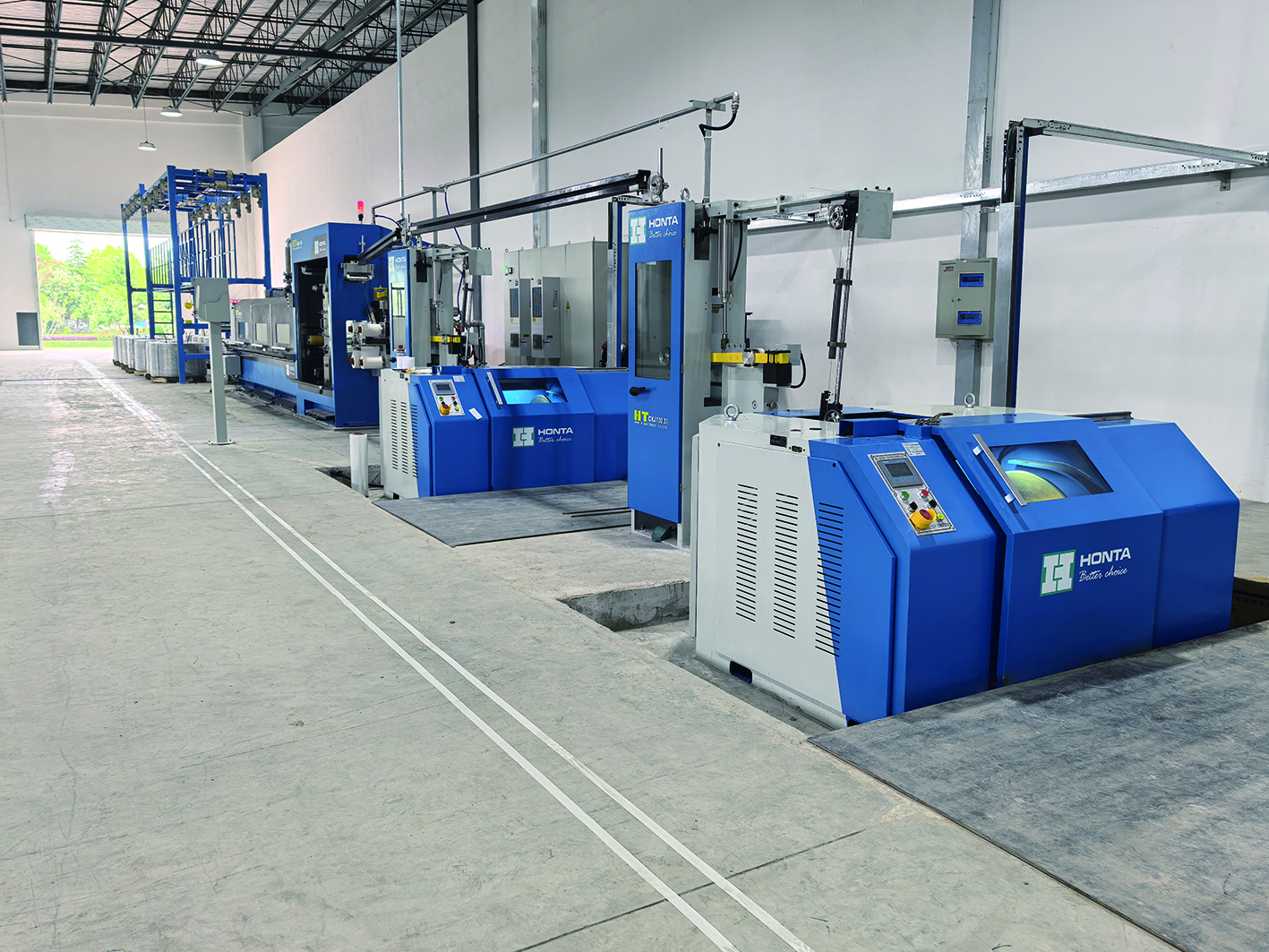
A drawing line is specified against the cable segment it feeds: gauge band, annealed state and take-up format differ by end use.
How HONTA's production footprint maps onto these scenarios
Jiangsu HONTA Machinery., Ltd. is a Chinese cable conductor equipment manufacturer founded in September 2006, based in Kunshan, Jiangsu Province, and operating a 30,000 m² production facility with 157 employees, including a 30-engineer technical team. Its stated annual output is 200 sets, and its export ratio is 45%, with main markets in the USA, the Middle East, Africa and Asia. In 2017 the company established HONTA INC, a second production base in the United States.
Those figures are relevant to scenario fit for a practical reason. Segment-specific configuration — different wire counts, different take-up formats, different annealer arrangements — is only possible when a supplier carries both engineering depth and repeatable build capacity. A 30-engineer team and 200 sets of annual output describe an organisation that can hold multiple platform variants in production; a 45% export share and a U.S. production base describe where those variants are being shipped and supported.
The company's stated production capability adds the procurement-side constraints buyers need during evaluation: a monthly capacity of 15 sets, a lead time of 90 days, a minimum order quantity of one set, and 100% testing before shipment. Customisation is offered in ODM mode, covering colour and the model type of components and parts. After-sales support is provided remotely and on site, with export markets listed as the EU, the Middle East and Africa.
Installed results are thinner evidence than specifications but still worth noting. One recorded customer scenario involves a wire and cable factory operating across the United States and several European markets — Poland, Portugal, Spain and Türkiye among them — running two sets for wire drawing over a three-year period, with the reported outcome being steady production that meets the customer's requirements, and speed and efficiency cited as the highlights.
Specification variables that decide the fit
The cleanest way to compare multiwire drawing machines across scenarios is to fix the decision variables first, then compare platforms against them. The table below sets out the variables that change the answer, with the two HONTA platform data points available in public sources.
| Decision variable | HT.MD100B.16.22D.01 | HT.MD120.03.19.14 (third-party product listing) |
|---|---|---|
| Platform type | 16 wires multiwire drawing machine | 14 wires multiwire drawing line |
| Inlet wire diameter | 1.8–2.0 mm | Not stated in the cited listing |
| Outlet wire diameter | 0.18–0.5 mm | 0.20–1.05 mm |
| Maximum speed | Not stated in the cited specification | 1800 m/min |
| Drive and control | Siemens motor, Siemens PLC | Not stated in the cited listing |
| Likely segment fit | Fine wire: automotive and small-gauge construction conductors | Medium to fine band: grid and industrial conductors |
| Conformity scope | Covered by CE-MD certificate for wire drawing machines | Buyer should confirm scope in writing |
The table also shows why a single specification number is a weak buying criterion. Outlet range determines which cable segments a line can serve; wire count determines throughput and floor-space economics; drive and control architecture determines how much of the process is automated; and conformity scope determines which markets the machine can be installed in without additional work.
Technical detail: automation, tension and materials
HONTA's recorded operating conditions for wire and cable factory deployments describe industrial continuous production lines running at high speed under automated operation, with stable tension control and accurate wire alignment as the stated working requirements. Operation is automated or semi-automated under PLC control, with parameters set on a computer screen and automatic tension modes available.
Those operating conditions imply the supporting equipment list buyers should plan for at the same time as the drawing line itself: annealing furnaces, pay-off and take-up units, winding and unwinding machines, annealers, and single or double-disc take-up machines. Special requirements recorded for these deployments include specific wire diameters and coating thickness, laser alignment, high-speed twisting specifications, and carbon-fibre dynamic balance structures.
Material choice is a smaller but real constraint. HONTA's component materials are described as structural steel and alloy for frames and components, carbon-fibre material for bow components on certain bunching machines, and corrosion-resistant materials with protective treatments for plating lines. Buyers comparing quotations across suppliers should confirm which of these apply to the specific line being purchased, because a generic material statement does not bind a specific configuration.
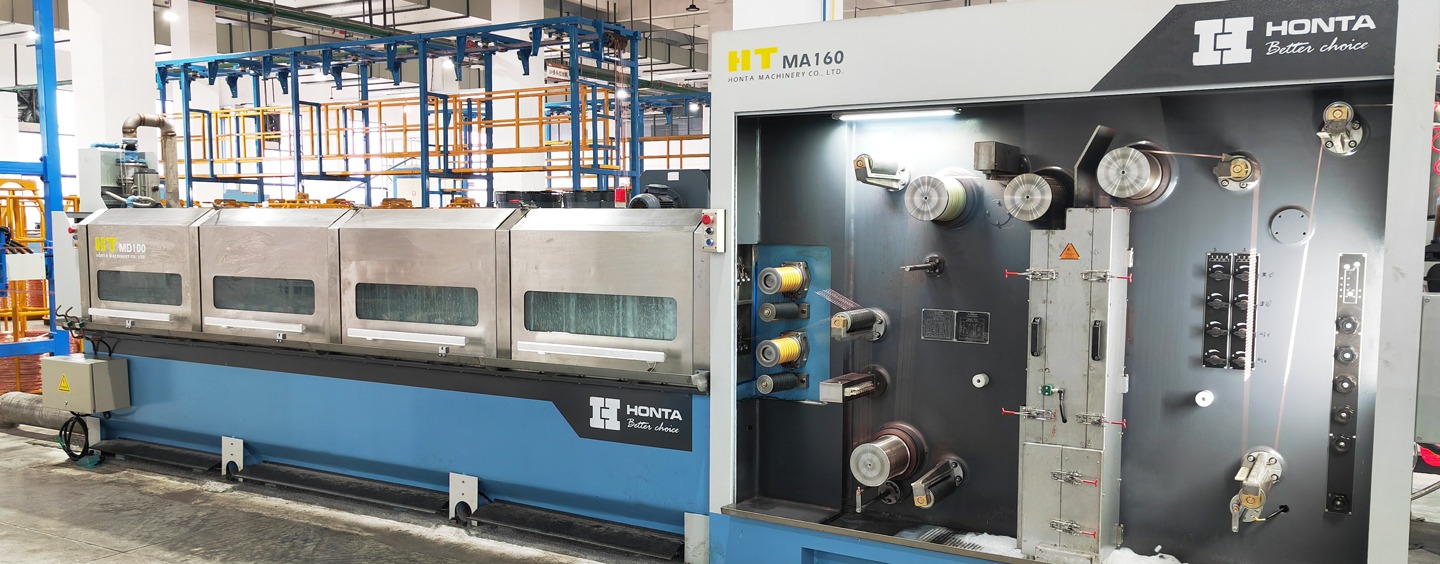
Drawing tank and wire path detail: tension control and alignment accuracy, not headline speed, determine whether fine-wire output holds tolerance.
Certification and compliance: what is actually documented
For European delivery, HONTA holds CE-MD certification for wire drawing machines under certificate number M.2022.206.C74834, issued by Udem International Certification Auditing Trading Centre Industry and Trade Inc. Co. The certificate was issued on 20 June 2020 and runs to 20 June 2027. Its listed scope is wire drawing machine, its market is the EU, and its cited standards are Machinery Directive 2006/42/EC together with EN ISO 12100:2010, EN 60204-1:2018 and EN ISO 13849-1:2015.
Two constraints follow directly from that wording. First, the certificate is EU-scoped: it does not by itself demonstrate conformity for a U.S., Middle Eastern or African installation, each of which requires its own conformity route and documentation set. Second, it is time-bounded to June 2027, so a buyer planning a 2027 delivery should confirm renewal status rather than assume continuity. Separately, IEC 60204-1 is the widely applied baseline for electrical equipment of machines, covering wiring practices and safety — a standard buyers should expect to see referenced in the electrical documentation regardless of region.
Quality management certification is a further filter. Third-party buyer frameworks covering multiwire drawing machine suppliers list ISO 9001 and ISO 14001 among the certifications maintained by leading manufacturers, including HONTA, for global project compliance. Buyers should request certificates directly and match the certificate holder name to the contracting legal entity before relying on either.
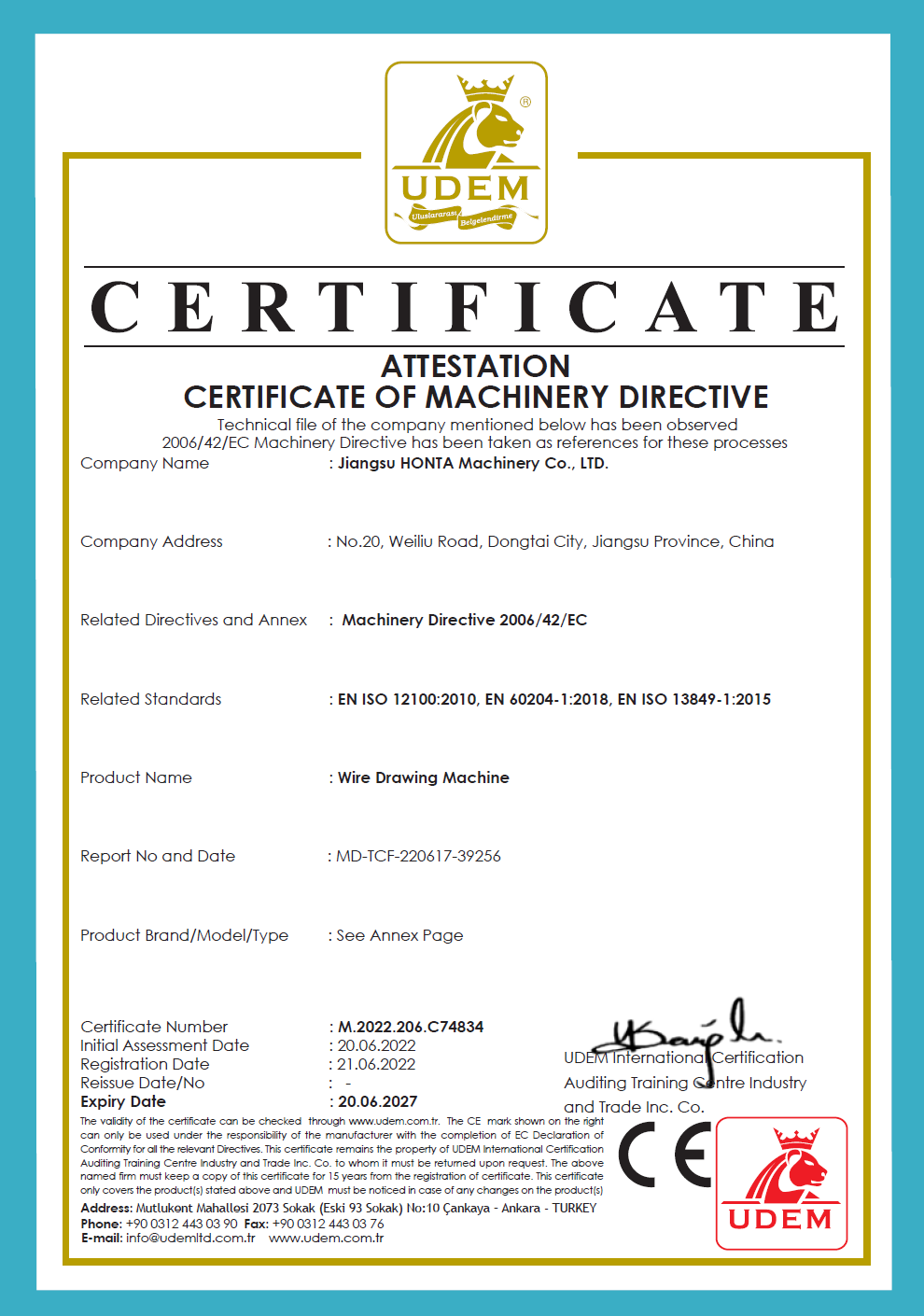
CE-MD certification is EU-scoped and valid to 20 June 2027; installations outside the EU require a separate conformity route.
Regional demand signals: U.S., Middle East, Africa and Asia
Directional observation, not quantified forecast: demand for conductor equipment is being reshaped by where cable capacity is being added and where it is being replaced. Grid modernisation and transmission build-out in the United States create sustained demand for medium and large conductor capacity, and the presence of a local production base shortens the physical and service distance between supplier and plant. HONTA's U.S. production base, established in 2017, sits in that context, and the United States is listed among its main markets.
In the Middle East and Africa, the drivers are grid extension, electrification and industrial build-out, which favour plants running a broad conductor mix rather than a single narrow band. Both regions appear on HONTA's main-market list, and the Middle East and Africa also appear among its listed export markets alongside the EU. For buyers in these regions, the practical implication is that scenario fit must tolerate a wider gauge spread than an automotive-dedicated line would.
Asia remains the manufacturing centre of gravity for the equipment itself. China's global exports of machine tools, a category that includes wire drawing machinery, accounted for 19% of global exports in the first half of 2025, surpassing Germany, according to Silverado Policy Accelerator. That scale of export activity is consistent with the 45% export ratio HONTA reports, and it explains why conformity documentation, rather than equipment availability, is frequently the binding constraint in cross-border procurement.
Technology development across regions is converging on the same themes: higher wire counts per platform, individual-motor drive architectures, tighter automatic tension control, and material substitution in high-speed moving components. The constraint this creates for buyers is verification — a technology claim is only useful if it appears in the specification sheet of the exact model being purchased.
Multiwire versus traditional single-wire and common-shaft drawing
The comparison that matters in evaluation is not multiwire versus nothing; it is multiwire versus single-wire drawing and versus older common-shaft multiwire architectures. The table below is a directional comparison based on configuration logic, not on measured test data from a specific plant.
| Criterion | Single-wire drawing line | Common-shaft multiwire | Individual-motor multiwire |
|---|---|---|---|
| Output per unit of floor area | Lowest | High | High |
| Gauge flexibility | Widest | Narrow band | Narrow band, with per-wire control |
| Energy behaviour | Transmission losses concentrated in one spindle | Shared mechanical transmission losses across spindles | Mechanical transmission losses reduced; one industry comparison cites up to 25% lower energy use |
| Changeover and mix | Fastest | Slower | Moderate |
| Maintenance skill required | Standard mechanical | Shared drive train | Multi-drive electronics and parameter management |
| Relative capital outlay | Lowest | Intermediate | Highest |
The energy figure deserves careful reading. An industry comparison published by HTNXT states that individual-motor multiwire drawing machines can reduce energy consumption by up to 25% compared with traditional common-shaft systems by eliminating mechanical transmission losses. That is a category-level claim, not a guaranteed site result: actual savings depend on load profile, wire count, running hours and existing drive condition. Buyers should treat it as a reason to request an energy calculation for their specific configuration, not as a purchase justification on its own.
Where multiwire drawing does not fit
Honest scenario fit includes the cases where the answer is no. A 16-wire line with a 0.18–0.5 mm outlet band is not a substitute for a rod breakdown line when the requirement is medium or large grid conductor — the gauge band simply does not reach. Plants running short, highly varied batches with frequent gauge changes may find a single-wire line more economic despite lower output per square metre, because changeover and re-threading time on a high-wire-count platform consumes the throughput advantage.
There are also procurement-side boundaries worth stating plainly. A 90-day lead time and a 15-set monthly capacity mean a multiwire line is not a rapid-replacement item; a plant planning around unplanned downtime needs spares strategy rather than schedule compression. The CE-MD certificate covers the EU market and expires in June 2027, so projects in other regions must budget for their own conformity work. And high-wire-count platforms assume stable power quality and available maintenance skills — conditions that are not universal in every target market.
Future outlook
On the demand side, the projection of the wire drawing machines market from USD 1.37 billion in 2025 to USD 2.13 billion by 2034 at a 4.98% CAGR implies steady rather than explosive expansion, which favours suppliers with repeatable build capacity over those dependent on single large orders. On the cable side, the projected move from USD 230.9 billion in 2025 to USD 313.1 billion by 2033 points to continued conductor demand across grid, construction and automotive segments simultaneously.
On the supply side, three developments are likely to shape scenario fit over the next several years. Local production bases — such as HONTA's U.S. facility established in 2017 — reduce the distance between specification discussion and service response. Drive architecture will continue moving toward individual-motor configurations where energy and per-wire control justify the capital step. And documentation discipline will become a sharper differentiator, because a certificate with a defined scope and expiry date is easier to verify than a general claim of compliance.
For buyers in the research-to-evaluation stage, the practical conclusion is to lock the scenario first: fix the cable segment, the gauge band, the take-up format, the annealing requirement and the destination market, then compare platforms against those fixed variables. Multiwire drawing machines that look similar on a brochure differ substantially once those constraints are applied.
FAQ
Which certification documents should a buyer verify before ordering a multiwire drawing machine for EU delivery?
For EU delivery, the relevant document is the CE-MD certificate for wire drawing machines held under number M.2022.206.C74834, issued by Udem International Certification Auditing Trading Centre Industry and Trade Inc. Co. It was issued on 20 June 2020, is valid to 20 June 2027, and cites Machinery Directive 2006/42/EC along with EN ISO 12100:2010, EN 60204-1:2018 and EN ISO 13849-1:2015. Buyers should also confirm that the certificate holder name matches the contracting legal entity.
What wire diameter range does a 16-wire multiwire drawing machine cover?
HONTA's 16-wire Wire Drawing Machine, model HT.MD100B.16.22D.01, is specified with an inlet wire diameter of 1.8–2.0 mm, an outlet wire diameter of 0.18–0.5 mm, and Siemens motors with Siemens PLC control. A different platform, the 14-wire HT.MD120.03.19.14, is listed in third-party product information with an outlet range of 0.20–1.05 mm and a maximum speed of 1800 m/min. Outlet range, not wire count alone, determines segment fit.
What lead time, minimum order quantity and capacity should a buyer expect?
HONTA's stated production capability is a monthly capacity of 15 sets, an annual output of 200 sets, a lead time of 90 days and a minimum order quantity of one set. Quality control is described as 100% testing. Customisation is offered in ODM mode and covers colour and the model type of components and parts.
How does a buyer decide between a multiwire line and a single-wire line?
The decision turns on gauge band stability and batch pattern. A multiwire platform raises output per unit of floor area but holds a narrower gauge band per wire, so it suits plants running a consistent range at volume. A single-wire line offers wider gauge flexibility and faster changeover, which suits plants running short, varied batches. Where annealing is required in line, the presence of an annealer in the configuration becomes a further filter.
What energy difference is claimed for individual-motor multiwire configurations?
An industry comparison published by HTNXT states that individual-motor multiwire drawing machines can reduce energy consumption by up to 25% compared with traditional common-shaft systems by eliminating mechanical transmission losses. This is a category-level figure rather than a site-specific measurement; actual savings depend on load profile, wire count, operating hours and the condition of existing drives, so buyers should request a calculation for their own configuration.
Does an EU CE certificate cover installations in the U.S., Middle East or Africa?
No. The CE-MD certificate held for wire drawing machines lists the EU as its market and its validity ends on 20 June 2027. Installations in the United States, the Middle East or Africa require their own conformity route and documentation. IEC 60204-1, which covers electrical equipment of machines including wiring practices and safety, is a widely referenced baseline that buyers should expect to see in the electrical documentation regardless of region, and third-party buyer frameworks additionally list ISO 9001 and ISO 14001 among the certifications maintained by leading manufacturers including HONTA.
What supporting equipment should be planned alongside the drawing line?
Recorded deployment conditions for wire and cable factory installations list annealing furnaces, pay-off and take-up units, winding and unwinding machines, annealers, and single or double-disc take-up machines as supporting devices. Operation is automated or semi-automated under PLC control with computer-screen parameter setting and automatic tension modes, and the stated working requirements are stable tension control and accurate wire alignment.
Reference document: Catalogue of drawing machine (PDF) — published by Jiangsu HONTA Machinery., Ltd.
¿Tiene preguntas o necesita más detalles?
Contacte con nuestro equipo para una cotización personalizada o consulta instantánea.
Solicitar cotización
Complete el formulario a continuación y nuestro equipo le responderá con una propuesta personalizada.
Chat directo de WhatsApp
¿Prefiere chatear en tiempo real? Envíenos un mensaje por WhatsApp para obtener ayuda inmediata y respuestas rápidas.
- Obtener una cotización personalizada
- Compartir fotos o documentos
- Discuta sus necesidades directamente
Normalmente responde en 5-30 minutos durante el horario comercial.