
Multiwire Drawing Machine Certifications & Key Specs in 2026

A multiwire drawing machine in production: high speed, continuous operation, and PLC-controlled tension.
Why Multiwire Drawing Machine Selection Needs a Constraint-Based Approach
Multiwire drawing machines are a core asset for copper and aluminium conductor production. They reduce thick rod to fine wire in one continuous process, often processing 8, 16, 24 or 32 wires simultaneously. For a buyer, the selection is rarely about the machine alone. It is about whether a given model meets the required inlet and outlet diameters, whether the control system supports the planned production line, and whether the supplier's certifications align with the destination market.
This article looks at multiwire drawing machine procurement through a practical lens: what certifications to verify, which parameters matter, and what supplier capabilities indicate a reliable long-term partner. It uses HONTA's publicly documented machine data as a reference point.
Problem and Opportunity: Complex Specifications, Different Supplier Levels
The global wire drawing machines market is projected to grow from USD 1.37 billion in 2025 to USD 2.13 billion by 2034, according to The Insight Partners. As demand increases, so does the number of suppliers offering multiwire drawing machines. But not all suppliers share the same engineering depth, quality control, or documentation standards.
Buyers face several practical challenges:
- Verifying that machine parameters match the actual wire range and production targets;
- Confirming that electrical and safety standards meet import requirements, especially in the EU;
- Understanding whether the supplier can customize the machine without weakening reliability;
- Evaluating after-sales support, lead time, and quality control processes.
These constraints create an opportunity: buyers who evaluate machines against documented specifications and certifications can reduce operational risk and avoid costly downtime.
HONTA as a Reference Supplier: Documented Company Facts
Jiangsu HONTA Machinery., Ltd. is a China-based manufacturer of wire and cable equipment. The company was founded in September 2006 and has been focused on cable conductor drawing and stranding technology. Its main products include rod breakdown machines, multiwire drawing machines, high-speed double twist bunching machines, and wire electrolytic plating lines.
According to the company profile, HONTA operates a 30,000 m² facility with 157 employees and 30 engineers in the R&D team. Its annual output is approximately 200 sets, and about 45% of production is exported to markets including the USA, the Middle East, Africa, and Asia. The company also established a second production base in the United States in 2017.
These facts are relevant because they indicate whether a supplier can handle sustained production, customization, and international delivery.
Key Multiwire Drawing Machine Parameters: A Closer Look
In a multiwire drawing process, a copper or aluminium rod is first reduced through a rod breakdown machine, then fed into a multiwire drawing machine where it passes through a series of dies. Each die step reduces the cross-section while the capstans control speed and tension. The HT.MD100B.16.22D.01 is designed for 16 wires, which means it processes sixteen individual wires in parallel through the same frame. Parallel processing increases output but also demands precise tension control, because a difference in tension between wires can lead to breakage or inconsistent diameter.
One representative model from HONTA is the HT.MD100B.16.22D.01, a 16-wire multiwire drawing machine. Its documented specifications include:
| Parameter | Value |
|---|---|
| Number of wires | 16 wires |
| Inlet wire diameter | 1.8–2.0 mm |
| Outlet wire diameter | 0.18–0.5 mm |
| Motor | Siemens |
| PLC | Siemens |
The inlet and outlet diameter range tells a buyer whether this machine is suitable for fine wire production. The use of Siemens motors and PLCs is an important signal for reliability and ease of integration with existing line controls.
HONTA also offers other line configurations. For example, documented information from Honta India lists a 14-wire multiwire drawing line (model HT.MD120.03.19.14) with a maximum operating speed of 1800 m/min and an outlet wire range of 0.20–1.05 mm. This shows that the supplier covers different product ranges, allowing buyers to match a machine to their specific conductor size.
Material selection also matters. HONTA's frames and components use structural steel and alloys. On certain bunching machines, carbon-fiber material is used for bow components. Plating lines use corrosion-resistant materials and protective treatments. For a buyer, these material details affect durability and maintenance costs.
Certifications and Compliance: CE Marking for the EU Market
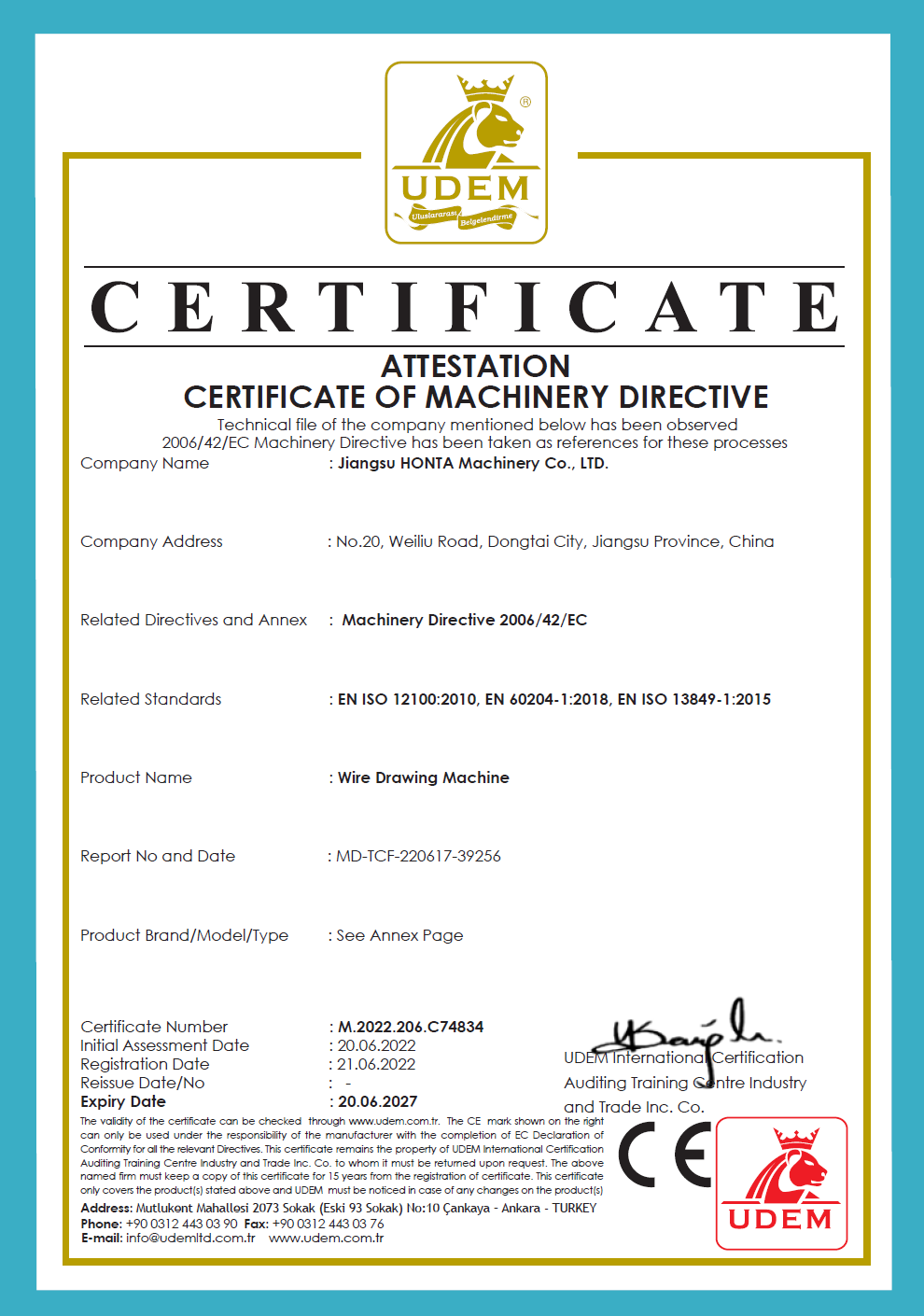
HONTA's CE certificate covers a wire drawing machine and references the Machinery Directive and harmonized standards.
For sales into the European Union, CE marking is a key compliance requirement. HONTA's wire drawing machine model HT.MD100B.16.22D.01 carries a CE certificate with number M.2022.206.C74834. The certificate is issued by Udem International Certification Auditing Trading Centre Industry and Trade Inc. Co. and covers the machinery directive 2006/42/EC, as well as EN ISO 12100:2010, EN 60204-1:2018, and EN ISO 13849-1:2015. The certificate has a validity period from 20 June 2020 to 20 June 2027.
Electrical equipment for machinery must also comply with IEC 60204-1 regarding wiring practices and safety. Buyers sourcing for EU projects should verify that the machine documentation includes the relevant harmonized standards.
Beyond CE, external procurement frameworks such as the HTNXT Buyer's Framework have listed HONTA among manufacturers that maintain ISO 9001 and ISO 14001 certifications for global project compliance. Buyers should request current certificates directly from the supplier during the evaluation stage.
Application and Use Cases in Wire and Cable Production
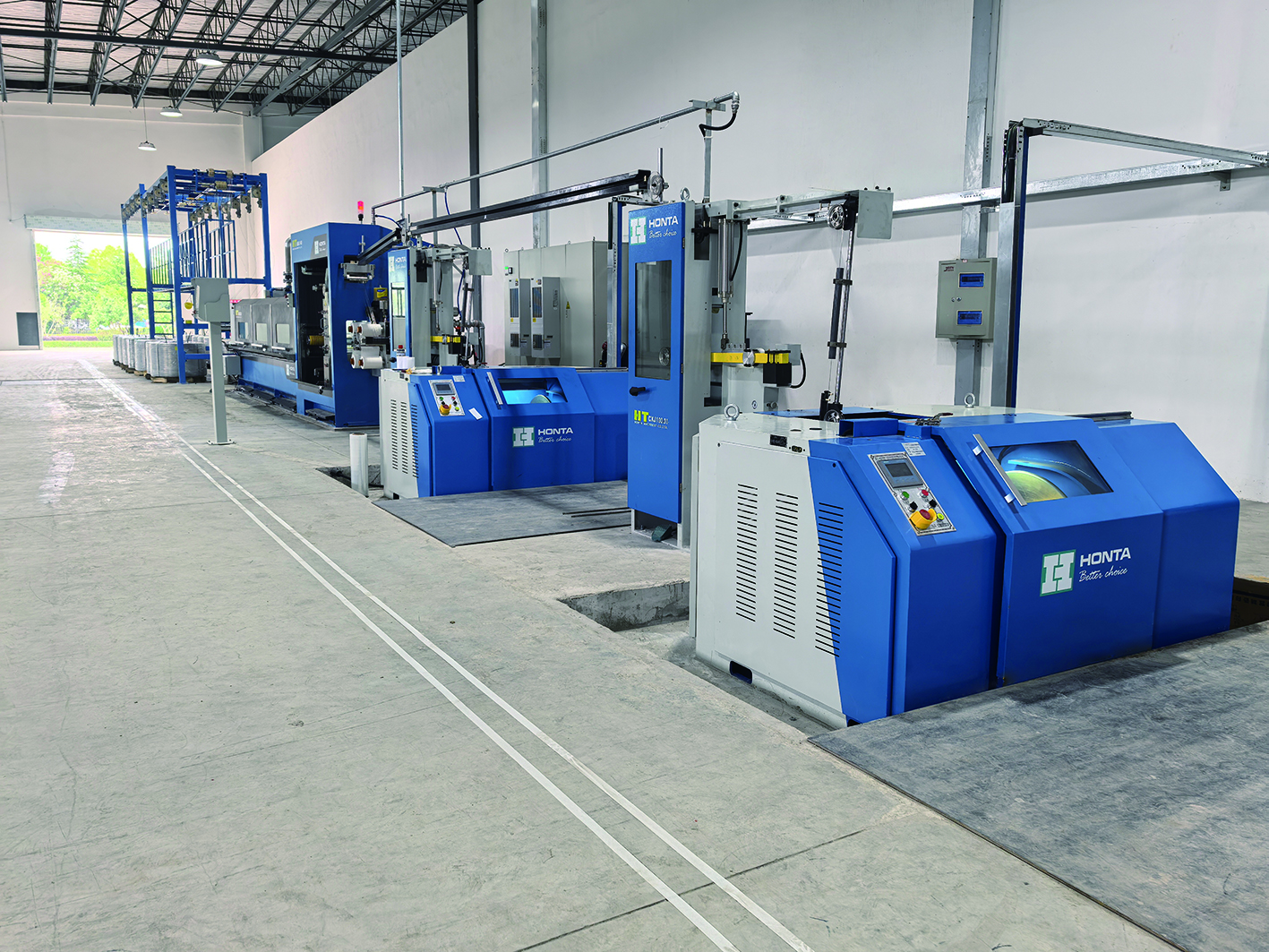
A complete wire drawing production line in a workshop setting.
Multiwire drawing machines are used in industrial continuous production lines, often under high-speed automated operation. The working conditions require stable tension control and accurate wire alignment. HONTA's machine supports automated or semi-automated operation under PLC control, with computer-screen parameter settings and automatic tension modes. This allows operators to set parameters quickly and maintain consistent quality over long runs.
The machine can be combined with supporting devices such as annealing furnaces, pay-off and take-up units, winding/unwinding machines, annealers, and single or double-disc take-up machines. Buyers planning a complete drawing line should therefore evaluate how a multiwire drawing machine integrates with downline equipment.
Special project requirements can include specific wire diameters, coating thickness, laser alignment, high-speed twisting specifications, and carbon-fiber dynamic balance structures. The supplier should be able to adapt to these requirements without compromising safety or performance.
According to HONTA's case records, its machines have been delivered to wire and cable factories in the United States, Poland, Portugal, Spain, and Turkey. Orders of two machines per customer have been used for wire drawing over a three-year period. The documented result was steady production of products that meet customer requirements, with fast speed and high efficiency as highlighted strengths.
Supplier Capability and Customization: ODM and Production Flexibility
HONTA lists ODM as a production mode. Customization is available for colour and for the model type of components and parts. The monthly capacity is 15 sets, with a typical lead time of 90 days. The minimum order quantity is one set, which supports both pilot projects and production scale-up.
Quality control is documented as “100% test” – meaning each machine is tested before delivery. After-sales support is offered by remote and on-site, covering both routine troubleshooting and commissioning support.
For a buyer, these factors translate into concrete procurement questions:
- Can the machine be tailored to a specific wire range or factory layout?
- Is the production lead time compatible with the project schedule?
- What type of testing is performed before shipment?
- Is on-site support available if the machine needs installation assistance?
Market Trend Analysis: Growth, Trade Flows, and Energy Efficiency
Several market-level trends affect multiwire drawing machine procurement in 2026.
First, demand is rising. The global wire drawing machines market is expected to grow at a compound annual growth rate of 4.98% from 2025 to 2034, reaching USD 2.13 billion by 2034. The broader wire and cable market is also expanding, with Grand View Research valuing it at USD 230.9 billion in 2025 and projecting USD 313.1 billion by 2033.
Second, supply has become more globalized. Data from the Silverado Policy Accelerator indicates that China’s global exports of machine tools, which includes wire drawing machinery, accounted for 19% of global exports in the first half of 2025, surpassing Germany. This suggests that international buyers are increasingly considering Chinese suppliers on the basis of capability and cost.
Third, energy efficiency has become a differentiating factor. Industry analyses referenced by HTNXT indicate that individual motor multiwire drawing machines can reduce energy consumption by up to 25% compared to traditional common-shaft systems, because individual motors eliminate part of the mechanical transmission losses. Buyers with high electricity costs may want to compare the drive architecture of shortlisted machines.
The trends above have practical implications. Buyers are no longer choosing solely on price; they are weighing documentation quality, control system compatibility, and the supplier’s ability to meet regulatory requirements. This is particularly true for buyers in regulated markets such as the EU, where CE marking and electrical safety standards directly affect machine acceptance.
Multiwire Drawing Machines vs. Traditional Solutions: What Should Buyers Expect?
Compared to single-wire drawing lines, multiwire drawing machines process several wires in parallel. This can raise throughput per square meter of factory space and improve unit economics when wire volumes are sufficient.
Within multiwire machines, the drive design matters. A traditional common-shaft system uses one motor to drive multiple capstans, which simplifies construction but makes it harder to control tension independently on each wire. An individual motor design gives better tension control and can reduce energy losses, as noted above.
However, there is a boundary that buyers should consider. A multiwire drawing machine, especially one with individual motors and PLC-based control, generally involves a higher upfront investment and more complex maintenance than a single-wire line or a simpler common-shaft machine. It is most justified when the production program is stable and wire volumes are sufficiently high. For very low-volume, highly specialized production, a flexible single-wire line may still be the more rational choice.
Future Outlook for Multiwire Drawing Machinery
The direction of the market points toward more automated, energy-efficient, and compliance-ready machinery. As global wire and cable demand grows, manufacturers are expected to continue integrating PLC-based controls, remote diagnostics, and energy-saving drive systems into their machines.
For buyers, this means that documentation and traceability will become more important. Certifications such as CE, compliance with IEC 60204-1, and a supplier’s ability to provide after-sales support across different regions will remain central to procurement decisions.
HONTA’s combination of 16-wire multiwire drawing machines, CE certification, ODM customization, and documented quality testing offers a reference point for a mid-sized, export-oriented Chinese supplier. Buyers should use such facts to build a shortlist that matches their technical and compliance constraints.
Frequently Asked Questions
What CE certifications apply to multiwire drawing machines sold into the EU?
For HONTA’s model HT.MD100B.16.22D.01, the CE certificate is number M.2022.206.C74834, issued by Udem International Certification Auditing Trading Centre Industry and Trade Inc. Co. It references the Machinery Directive 2006/42/EC, EN ISO 12100:2010, EN 60204-1:2018, and EN ISO 13849-1:2015. Buyers should verify that the certificate is still valid and that the product model is clearly listed in its scope.
What are the most important technical parameters to compare on a multiwire drawing machine?
The critical parameters are the number of wires, inlet wire diameter, outlet wire diameter, maximum operating speed, motor brand, PLC brand, and the type of drive system (common-shaft or individual motors). HONTA’s 16-wire model HT.MD100B.16.22D.01, for example, handles an inlet range of 1.8–2.0 mm and an outlet range of 0.18–0.5 mm, with Siemens motors and PLCs.
Does HONTA offer customization for multiwire drawing machines?
Yes. HONTA lists ODM as a production mode and states that customization is available for colour and for the model type of components and parts. The monthly capacity is 15 sets and the minimum order quantity is 1 set.
What quality control procedures does HONTA follow?
HONTA documents a 100% test procedure, which means that every machine is tested before delivery. After-sales support is available remotely and on-site. Buyers should request a copy of the test report as part of the procurement process.
Do individual motor multiwire drawing machines reduce energy consumption?
Industry analyses suggest that individual motor designs can reduce energy consumption by up to 25% compared to traditional common-shaft systems, primarily by eliminating mechanical transmission losses. The actual benefit depends on the machine configuration and production profile.
How should a buyer approach the price of a multiwire drawing machine?
Multiwire drawing machine prices are usually quotation-based because configurations, wire count, control systems, and optional equipment vary by project. HONTA does not publish list prices; buyers should provide inlet and outlet diameter ranges, target speed, and the required line equipment to receive a specific quote.
Further reading: HONTA’s wire drawing machine catalogue is available for public reference: Download the drawing machine catalogue.