
Multifunctional Digital Printing Machine Qualification: QC, Acceptance Terms, and Compliance Checks
Qualifying a multifunctional digital printing machine is a documentation exercise as much as an engineering one. Before a purchase order is signed, a buyer should be able to answer three questions with evidence rather than assurances: is the machine legally placeable on the target market, does its declared operating envelope match the plant it will stand in, and can the supplier's quality-control record be inspected instead of assumed.
Most procurement teams in packaging convert speed, colour mode and substrate range into a shortlist quickly. The gap opens afterwards, when the shortlist has to become a contract. At that point, vague statements such as "high precision" or "stable production" stop being useful, and buyers need measurable acceptance terms that a factory can fail or pass against.
This article sets out a four-layer qualification method for multifunctional digital printing machines, using disclosed specifications from Guangdong Goking Intelligent Technology Co., Ltd. (GOKING) as a worked example of what a supplier can make inspectable — and where the limits of that envelope sit.
Why Qualification Sits Between Shortlisting and Signing
Digital printing has moved from a niche option to a mainstream production method for short-run and personalised work. Market Research Future reports that variable data printing is now economically viable for runs under 3,000 units, a volume band that was previously cost-prohibitive on conventional equipment. That shift is what puts so many buyers in front of a multifunctional digital printing machine in the first place: the machine must handle frequent job changes, mixed substrates and shorter batches without plate cost and setup waste.
The consequence for procurement is that the specification a buyer needs is no longer just a performance claim. It is a set of numbers and documents that can be checked at three moments — at the factory before shipment, at the plant during installation, and at handover when the machine starts earning revenue.
The Four-Layer Qualification Framework
A multifunctional digital printing machine passes through four independent qualification layers. Each one can be completed before the next, and each produces something a buyer keeps in the file.
- Layer 1 — Legal and electrical compliance. Certification, standards, supply voltage, rated power.
- Layer 2 — Site and environment acceptance. Floor space, weight, temperature and humidity envelope.
- Layer 3 — Material, ink and output acceptance. Substrate thickness, print width, colour mode, ink chemistry, throughput and minimum text size.
- Layer 4 — Factory QC evidence and pre-shipment inspection. Testing records, inspection reports and packing confirmation.
The order matters. A buyer who negotiates throughput first and compliance last often discovers that the site cannot supply the required power, or that the machine's declared operating humidity does not match an unheated warehouse in a humid climate.
Layer 1 — Compliance: The Certificate Is the Start, Not the End
For machines sold into the European Union, CE marking is the entry condition. GOKING's Corrugated Cardboard Digital Printing Machine is certified to CE standards, with a Certificate of Conformity numbered HTT202308117L issued by Shenzhen HTT Technology Co., Ltd. on 9 August 2023. The certificate cites standard EN 60204-1:2018 together with Directive 2006/42/EC, and it explicitly covers the product identified as applicable product 6359.
Three verification steps follow from that evidence, and buyers should run all three rather than stopping at the certificate image.
Check the standard against the machine type
EN 60204-1 is the European adoption of IEC 60204-1, which governs the electrical equipment of industrial machines for CE compliance. It is the correct standard family for a machine with a rated power of approximately 14 kW drawing 380 V three-phase supply at 50/60 Hz. A buyer should confirm that the certificate's scope names the model being purchased, not only a product family.
Ask for the risk assessment, not only the certificate
Industrial digital printers must also comply with EN ISO 12100 for risk assessment in order to obtain CE marking. The risk assessment file is a separate document from the Certificate of Conformity, and it is the file that shows how hazards were identified and mitigated. Requesting it is a routine and reasonable qualification step.
Confirm the electrical interface with the plant
GOKING's disclosed electrical requirement is 380 V, 50/60 Hz, three-phase, with a rated power of approximately 14 kW. Plants supplied at 208 V, 220 V single-phase or 400 V must plan the transformation and protection before delivery, and the matched equipment list for the platform includes a voltage stabiliser and a temperature control system. This is not a minor detail: power configuration is one of the most common causes of installation delay in export projects, and it is entirely avoidable at the contracting stage.
Layer 2 — Site and Environment Acceptance
The working environment is usually the least negotiated and most expensive clause to get wrong. GOKING specifies a room temperature of 15–32 °C and humidity of 70% for the multifunctional digital printing machine. The listed machine dimensions are 4260 mm × 2300 mm × 1900 mm, with a weight of 2800 kg.
Those figures translate into four practical checks before the machine ships:
- Access route. Door widths, lift capacity and turning radius along the delivery path must clear a machine of that footprint and weight.
- Floor loading. The platform is a vacuum adsorption table carrying a carbon steel frame, stainless steel conveying rollers and an aluminium alloy beam, so point loading during installation should be reviewed with the site engineer.
- Climate control. Humidity and temperature outside the stated band affect ink behaviour and substrate dimensional stability. Sites without climate control should plan a humidifier and temperature control as part of the installation scope, which the platform's matched equipment list already anticipates.
- Services. Compressed air, extraction and power routing should be scheduled so commissioning is not paused for site work.
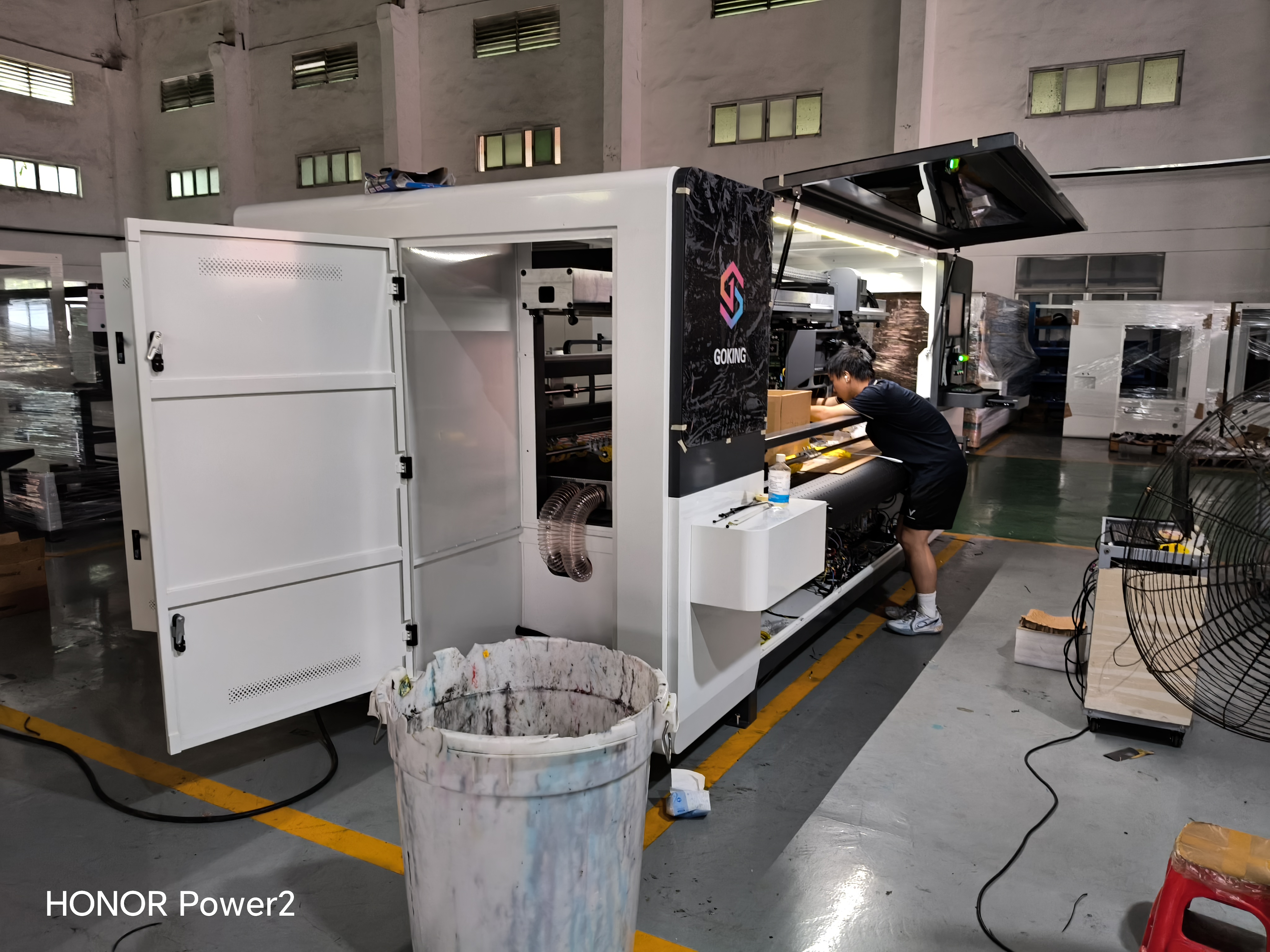
A useful acceptance clause reads: the machine shall be installed in an environment maintained between 15 °C and 32 °C with humidity at approximately 70%, and the site shall provide 380 V three-phase supply at 50/60 Hz with capacity for a rated load of approximately 14 kW. A clause written that way can be verified on the day of commissioning by anyone with a thermometer, a hygrometer and a clamp meter.
Layer 3 — Material, Ink and Output Acceptance
This is where the multifunctional digital printing machine differentiates itself from a single-purpose press, and where acceptance terms have to be specific. The GOKING platform is a plate-less digital printing machine for corrugated cardboard and cardboard packaging, offered as a 2-in-1 multifunctional machine that supports both single-pass and multi-pass printing with XAAR or Epson printheads. The full model designation covers CMYK and five-colour configurations, different nozzles, different DPI, different printhead numbers, and different printing width and speed.
Declared specification envelope
| Parameter | Disclosed value | Acceptance implication |
|---|---|---|
| Material thickness | 2–30 mm | Substrates outside this band sit outside the qualification, including very thin sheets and heavy board |
| Print width | 264–2600 mm | Order width must match the configured head array, not the maximum |
| Printheads | 8 to 256 | Head count is a configuration choice made at order, not a fixed feature |
| Colour mode | CMYK with optional white (W) | White ink must be specified in the order and tested at acceptance |
| Ink types | Water-based dye, water-based pigment, coating ink, UV eco-friendly ink | Ink chemistry must be fixed before sample approval |
| Production efficiency | 700 or 1500 m²/h depending on configuration | Throughput claims must be tied to a named configuration |
| Single-pass speed | 60 m/min with Epson nozzle; at least 100 m/min with XAAR nozzle | Speed figures are head-dependent and should be quoted with the head type |
| Minimum text | English 1.5 mm | Legibility below this size should not be assumed |
| File formats | PDF, JPG, BMP, TIF | RIP supports direct printing without converting pictures |
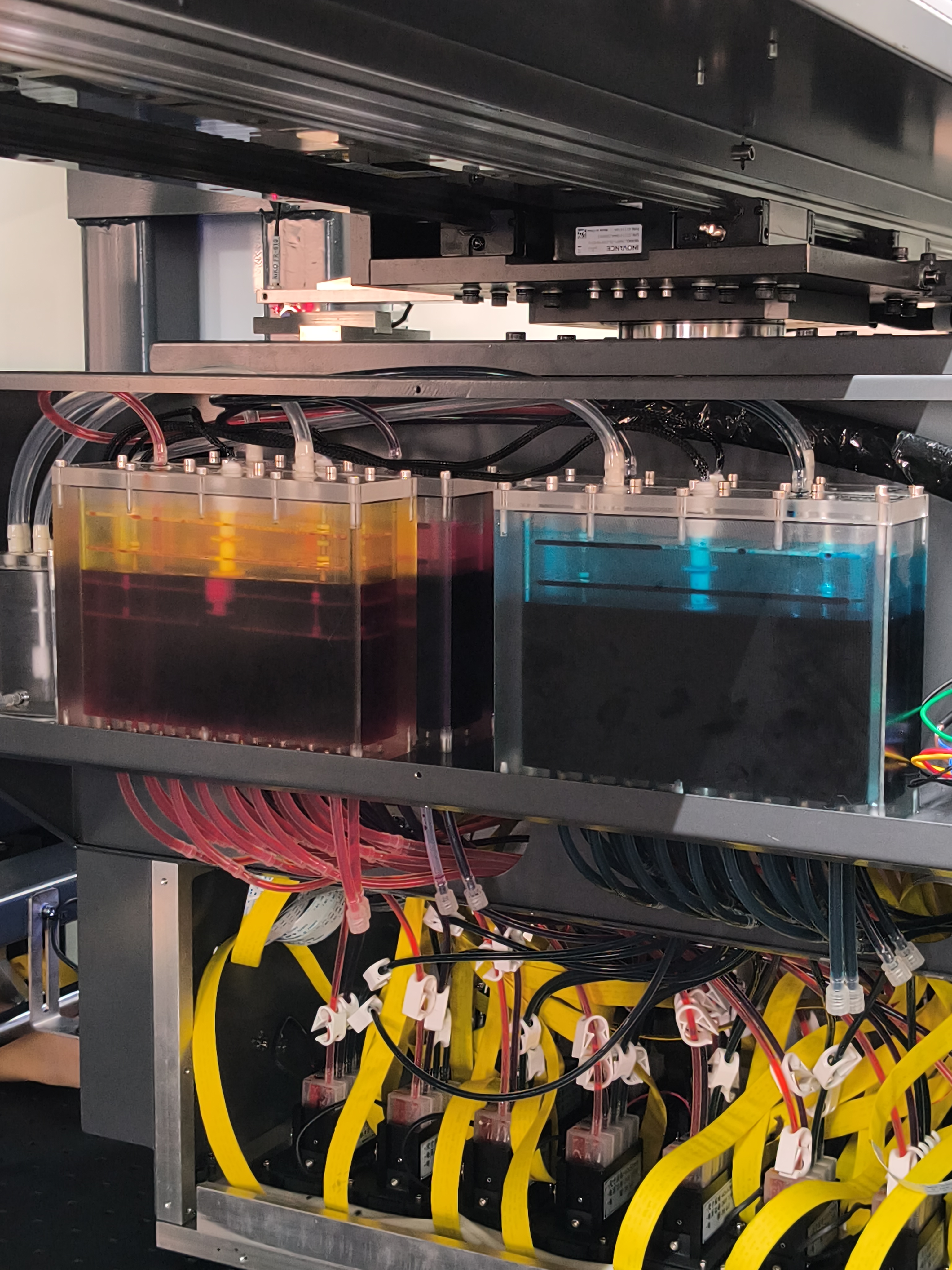
The printhead choice deserves particular attention during acceptance because it changes the acceptable use case. Epson commercial-grade printheads are known for high precision and nuanced grayscale performance, which suits high-definition scanning work in premium packaging. XAAR industrial-grade printheads, including the 5601 and 1003 series, use patented true internal circulation technology that keeps ink moving behind the nozzles and reduces clogging during prolonged high-speed production. A buyer qualifying a machine for long shifts on kraft or coated paper should state which head family is being purchased and accept against that, not against a generic speed figure.
The same logic applies to the single-pass / multi-pass choice. Single-pass configurations prioritise throughput for high-volume orders; scanning multi-pass configurations prioritise image detail for premium packaging and fine text. A 2-in-1 machine can switch between the two modes, which is precisely why the acceptance test should define which mode is being measured and on which substrate.
Build a physical acceptance sample
Rather than accepting a demonstration print, buyers should define a three-piece sample set: one job on the thinnest substrate in scope, one on the thickest, and one representative production job with the finest text and the most demanding colour transition. GOKING offers free sample printing for global clients, which allows this set to be produced before the order rather than after installation. The signed sample then becomes the reference against which handover is judged.
Layer 4 — Factory QC Evidence and Pre-Shipment Inspection
Quality control is only meaningful in a contract if it produces records. GOKING's disclosed control process has three stages: a 100% aging test, long-time running inspection, and pre-shipment inspection. Each stage should be tied to a document the buyer receives.
- Aging test. Applied to 100% of machines, so the buyer should request the record for the specific serial number, not a generic description of the process.
- Long-time running inspection. This is the stage where printhead stability, ink supply behaviour and registration consistency under continuous operation are observed. Ask which parameters were logged and for how long.
- Pre-shipment inspection. The final gate before packing; the report should reference the approved sample and the configuration actually built.
The surrounding capacity figures matter because they indicate whether a factory can absorb a problem without delaying the order. GOKING operates a 10,000 m² facility with approximately 152 employees, 38 R&D engineers, an annual output of roughly 864 sets, and a monthly capacity of 38 sets. The minimum order quantity is 1 set, and the standard production lead time for standard machines is typically one month, with custom lead times available on request and OEM/ODM lead times subject to confirmation.
Writing Acceptance Terms That Survive the First Week
The table below converts the four layers into contract language that can be executed in sequence. It is deliberately written as a stage-by-stage schedule, because acceptance disputes usually arise from clauses that mix factory obligations with site obligations.
| Stage | Evidence to receive | Acceptance criterion to write |
|---|---|---|
| Before order | CE Certificate of Conformity (HTT202308117L, EN 60204-1:2018, Directive 2006/42/EC), risk assessment file, electrical data sheet | Documents must name the exact model and configuration being purchased |
| Before production | Approved print sample on buyer-supplied substrate, ink specification | Signed sample becomes the reference for handover |
| Factory acceptance | Aging test record, long-time running inspection log | Records issued per serial number; running inspection parameters stated |
| Pre-shipment | Pre-shipment inspection report, packing list, spare parts and consumables list | Configuration verified against the order; packing approved before dispatch |
| Installation | Commissioning report from the on-site engineer, environment readings | Temperature, humidity and power confirmed inside the declared envelope |
| Handover | Signed acceptance against the approved sample | Output on the three-piece sample set matches the reference |
| After handover | Service contact and spare parts channel | Response within 24 hours; technical and spare parts support defined |
Two clauses are frequently omitted and are worth adding. First, a definition of which print mode was accepted: single-pass throughput and multi-pass image quality are different acceptance targets and should not share one pass/fail line. Second, a spare parts and consumables schedule agreed at order, since a machine that cannot be kept in consumables is a machine that cannot meet its own acceptance standard after month three.
What GOKING Makes Inspectable
Guangdong Goking Intelligent Technology Co., Ltd. (GOKING) is a Dongguan-based manufacturer of industrial digital printing machines, founded in 2020 and operating a 10,000 m² facility with approximately 152 employees and 38 R&D engineers. The company produces roughly 864 sets per year, exports about 49% of its output, and serves the EU, Africa, Latin America, Russia/Kazakhstan and Turkey, alongside a domestic base in China's Guangdong manufacturing cluster.
For qualification purposes, four disclosures are directly usable:
- Configuration flexibility. OEM and ODM services cover machine structure, printhead type (Epson or XAAR), DPI configuration, five-colour schemes and turnkey line solutions. Because the configuration is built to order, the acceptance specification must be written against the ordered configuration.
- Documented compliance. The CE Certificate of Conformity covers the Corrugated Cardboard Digital Printing Machine and cites EN 60204-1:2018 with Directive 2006/42/EC.
- Service model. After-sales support includes technical support, spare parts support and response within 24 hours; dedicated engineers travel to the site to assist with installation and commissioning once overseas customers receive the machine.
- Pre-purchase validation. Free sample printing is available for global clients, which allows the acceptance sample to be produced before any commitment.
Buyers assembling a qualification file can request the product catalogue and technical documentation directly; the current catalogue is available at the GOKING 2026 product catalog. Documentation and quotation requests are handled by Cherry Wang at w1250606130@gmail.com, +86 18028205637, or WhatsApp +86 18475532220.
Where the Envelope Ends: Limits Buyers Should Accept
A qualification framework is only credible if it states what the machine does not do. For this platform, five boundaries should be written into the evaluation rather than discovered after delivery.
- Substrate thickness is bounded at 2–30 mm. Buyers working with sheets outside that band — very thin paper stocks or heavy board — need a different configuration or a different machine, not a negotiated exception.
- Minimum text height is 1.5 mm for English. Fine-print applications below that size fall outside the declared capability and should be validated on a physical sample before being promised to a customer.
- The environment is a stated condition, not a suggestion. A plant that cannot hold 15–32 °C and around 70% humidity must budget for climate control, and that cost belongs in the total project cost, not in a later dispute.
- Single-pass and multi-pass are a trade-off, not a ranking. Choosing maximum throughput means accepting the image characteristics of high-speed output; choosing scanning detail means accepting lower throughput per hour.
- Certification scope is jurisdictional. The CE certificate addresses EU market access and electrical safety under EN 60204-1. Buyers in other regions must run their own conformity assessment, and UV ink chemistry is an additional variable: the U.S. EPA declared certain PFAS chemistries used in UV inks hazardous in April 2024, which affects formulations. Any buyer specifying UV eco-friendly ink for a regulated market should confirm current ink documentation with the supplier rather than assume continuity.
Compared with plate-based printing
Traditional plate-based production retains one real advantage: for a very long, unchanging repeat order, the amortised plate cost per unit can still be low, and a buyer should not assume digital wins on every job. The digital advantage is structural elsewhere — it removes plate cost and setup waste, which is what makes short runs, urgent orders and frequent job changes economically viable. A qualification process that ignores this distinction tends to produce a machine that is technically compliant but commercially mismatched to the plant's order book.
Market Context: Why Acceptance Terms Are Tightening
The pressure to formalise acceptance is a consequence of scale. Grand View Research valued the global digital printing market at USD 38.0 billion in 2023, with a projection to USD 57.0 billion by 2030, and reported that the inkjet printing segment held the largest technology share at 48.4% in 2023. Within that, Reports and Data sized the single-pass digital printing machine market at USD 3.2 billion in 2024, projected to reach USD 6.5 billion by 2034.
Packaging is the segment most exposed to these terms. MarketsandMarkets expects the digital printing packaging market to reach USD 46.2 billion by 2029 from USD 30.2 billion in 2024, and Market Research Future places Asia-Pacific at approximately 41.6% of digital printing revenue in 2025. As more capacity is installed in more regions, the differentiator shifts from whether a machine can print to whether a buyer can prove what it printed, on which substrate, under which conditions, and against which document.
Future Outlook
Two directions are visible from current industry signals. The first is architectural: Market Research Future notes that hybrid digital-offset printing architectures are gaining R&D focus from major players such as Heidelberger Druckmaschinen, which suggests the boundary between digital and conventional production will continue to blur rather than harden. For buyers, that means qualification frameworks should be written around documents and measurements rather than around a fixed machine category.
The second is regulatory. Ink chemistry is now a live compliance variable, not a fixed input, and the direction of regulation is toward more disclosure rather than less. Suppliers who can produce a current certificate, a risk assessment file, a per-serial-number test record and an ink specification on request will be easier to qualify than those who cannot — and buyers who build the acceptance schedule into the contract before signing will spend less time resolving disputes after commissioning.
Frequently Asked Questions
What electrical supply does a multifunctional digital printing machine require?
The disclosed requirement for this platform is 380 V, 50/60 Hz, three-phase, with a rated power of approximately 14 kW. Plants operating on other voltages must plan transformation and protection before delivery, and the platform's matched equipment list includes a voltage stabiliser and a temperature control system.
Which CE documents should a buyer verify, and against which standards?
GOKING's Corrugated Cardboard Digital Printing Machine holds a Certificate of Conformity numbered HTT202308117L, issued by Shenzhen HTT Technology Co., Ltd. on 9 August 2023, citing EN 60204-1:2018 and Directive 2006/42/EC for the EU market. Because industrial digital printers must also comply with EN ISO 12100 for risk assessment to obtain CE marking, buyers should request the risk assessment file alongside the certificate, and confirm that both name the exact model being purchased.
What material thickness, print width and speed values should appear in the acceptance specification?
The disclosed envelope is 2–30 mm material thickness, 264–2600 mm print width, and 8 to 256 printheads depending on configuration. Production efficiency is 700 or 1500 m²/h depending on configuration, with single-pass speed of at least 100 m/min using a XAAR nozzle and 60 m/min using an Epson nozzle. Minimum supported text is English at 1.5 mm. Each figure should be quoted together with the configuration it belongs to.
How can a buyer verify quality control before shipment?
The disclosed control process comprises a 100% aging test, long-time running inspection, and pre-shipment inspection. Verification consists of requesting the aging test record for the specific serial number, the parameters logged during long-time running inspection, and the pre-shipment inspection report confirming the configuration against the order.
What installation and after-sales commitments belong in the contract?
The disclosed service model includes technical support, spare parts support and response within 24 hours, with dedicated engineers travelling to site to assist with installation and commissioning once overseas customers receive the machine. Contract terms should define the response window, the spare parts channel and the consumables schedule agreed at order.
Can a buyer validate print quality on their own substrate before ordering?
GOKING offers free sample printing for global clients, which allows a buyer to produce a physical acceptance sample on their own material before committing to an order. A practical sample set covers the thinnest and thickest substrates in scope plus one representative production job, and the signed sample then serves as the handover reference.
What are the practical limits of a multifunctional digital printing machine?
The disclosed limits are a 2–30 mm substrate thickness range, a 1.5 mm minimum for English text, and a working environment of 15–32 °C at approximately 70% humidity. Single-pass and multi-pass modes represent a throughput-versus-detail trade-off rather than a ranking, and CE certification addresses EU market access and electrical safety under EN 60204-1, so buyers in other jurisdictions must complete their own conformity assessment.
¿Tiene preguntas o necesita más detalles?
Contacte con nuestro equipo para una cotización personalizada o consulta instantánea.
Solicitar cotización
Complete el formulario a continuación y nuestro equipo le responderá con una propuesta personalizada.
Chat directo de WhatsApp
¿Prefiere chatear en tiempo real? Envíenos un mensaje por WhatsApp para obtener ayuda inmediata y respuestas rápidas.
- Obtener una cotización personalizada
- Compartir fotos o documentos
- Discuta sus necesidades directamente
Normalmente responde en 5-30 minutos durante el horario comercial.