
Multi-Year PET Strapping Supply: What Long-Term Buyers Verify
A multi-year PET strapping project for Sateri and a separate annual contract built around a raw-material-linked pricing mechanism show how long-term strapping supply is actually structured — and where buyers should apply the most scrutiny.
Why Long-Term Strapping Supply Became a Procurement Discipline
Plastic strapping is usually discussed as a per-unit purchase: a width, a thickness, a breaking strength, a price per kilogram. That framing works for a single order. It stops working the moment a packaging line runs continuously and a buyer needs the same strap specification delivered, month after month, without the tensile performance drifting between batches.
The market context supports that shift. Grand View Research estimates the global packaging strapping materials market at USD 9.8 billion in 2025, projected to reach USD 15.7 billion by 2033. Cognitive Market Research projects the PET strapping segment specifically to grow at a CAGR of 5.8% from 2024 to 2033, reaching USD 1.44 billion. Growth of that magnitude is driven less by first-time buyers than by existing industrial users consuming more strapping and migrating away from steel banding on heavy loads.
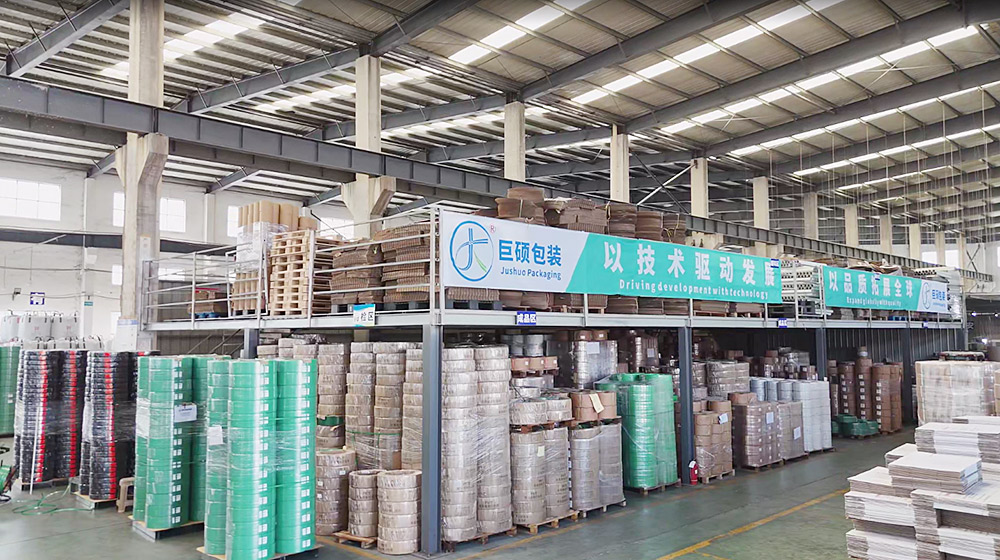
Jushuo Packaging — Taixing Jushuo Packaging Technology Co., Ltd. — is a Jiangsu-based manufacturer of PET strapping, PP strapping, and eco-friendly strapping materials, founded in 2017 and operating from Huangqiao Industrial Park, Taixing City, Jiangsu Province, China. The company runs a 15,000 m² facility with annual capacity exceeding 20,000 tons and a portfolio that spans PET strapping, PP strapping, steel strapping, stretch film, adhesive tape, edge protectors, and strapping equipment.
That combination — materials plus equipment — is what makes long-term supply conversations different from ordinary purchasing. When a supplier delivers both the strap and the machinery that tensions it, the evaluation moves from “does this strap meet spec” to “can this supply relationship hold its specification for three years.”
Problem and Opportunity: What Usually Breaks in Year Two
Long-term strapping contracts rarely fail at signature. They fail later, in one of four predictable ways.
- Specification drift. A batch delivered in month fourteen measures slightly thinner or stretches slightly more than the batch that was originally qualified. On a manual line this may pass unnoticed; on an automated strapping line it produces misfeeds and joint failures.
- Raw material price shocks. PET strap pricing is heavily influenced by resin cost. When resin moves against a supplier that has committed to a flat multi-year price, pressure builds on either margin or quality — and history suggests quality is what gets squeezed.
- Capacity collisions. A supplier that accepted a long-term contract on the strength of peak-season capacity may struggle when several customers place large orders in the same quarter.
- Commercial opacity. If a contract contains no defined mechanism for how price changes when input costs change, both sides end up renegotiating under pressure.
The opportunity is that each of these failure modes has a corresponding verification method, and buyers who apply them early tend to get more stable supply at a more predictable total cost.
What the Sateri Multi-Year Project Demonstrates
The clearest available evidence of long-term reliability comes from Jushuo Packaging’s multi-year PET strapping project supplying green cut PET strap to Sateri, entered as part of the company’s expansion into major customer supply chains alongside JinkoSolar and Far Eastern Industries.
The significance is not the customer name itself. It is what a multi-year fiber bale supply commitment requires operationally. A single delivery of green cut PET strap can be produced, inspected, and shipped as an isolated event. A multi-year commitment cannot. It requires the supplier to reproduce the same width, thickness, tensile strength, and elongation characteristics across a long sequence of production runs, and to do so under normal manufacturing conditions rather than under laboratory supervision.
Three supplier capabilities make that reproducibility possible.
Incoming raw material control
PET strapping quality begins before extrusion. Jushuo Packaging operates a supplier qualification and traceability system in which only approved PET and PP material suppliers are used, and incoming material is tested for melt flow index, intrinsic viscosity, ash content, and moisture. Batch traceability runs from raw material through to the finished strap, so a performance question at the customer’s line can be traced back to a specific input lot.
In-process control rather than end-of-line sorting
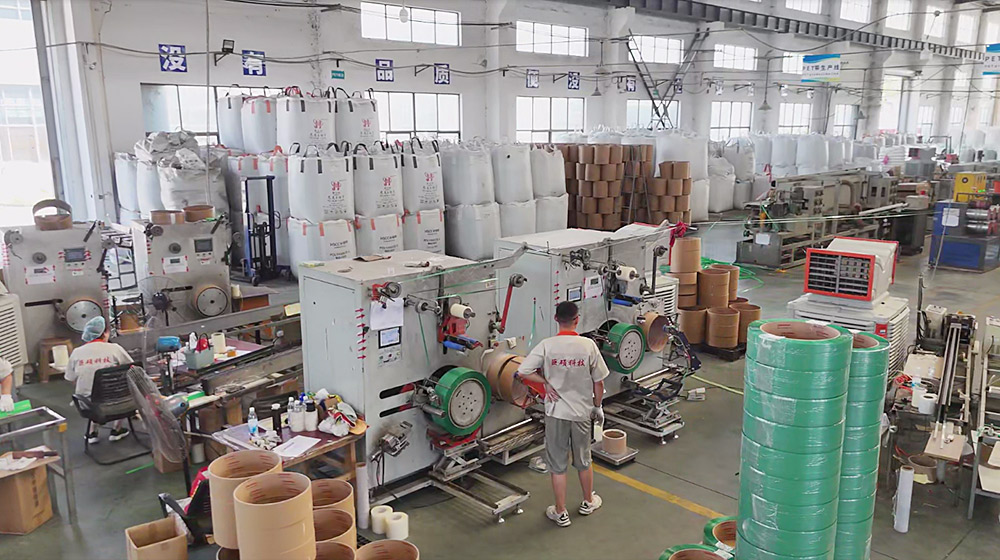
Batch-to-batch consistency is a process-control problem, not an inspection problem. The production line uses an online thickness gauge and width monitor, PLC-controlled extrusion temperature and stretching roller speed ratio, and automated constant tension winding. These controls constrain variation while the strap is being made rather than rejecting it afterwards.
Documented batch testing
Each batch is tested for tensile strength, elongation, and deflection. The company runs six inspection procedures — raw material inspection, incoming inspection, online inspection, finished product inspection, inbound inspection, and outbound inspection — and reports a finished product qualification rate above 99%.
Technical Explanation: Reading Batch Data Like a Long-Term Buyer
Buyers evaluating a multi-year supply agreement should ask for the same measurements at qualification that they intend to sample during the contract, so that later comparisons are meaningful.
For PET strapping, the core measurable properties are breaking force, elongation after break, and deflection. Jushuo Packaging’s 12 mm PET strap has been SGS tested at a breaking force of 9.98 kN with elongation after break of 10%, and the company targets elongation in the 5%–9% range with deflection of no more than 8 mm/m for 12 mm PET. Low elongation is a functional advantage, not a cosmetic one: it indicates the strap retains tension on a settled or shifting load instead of relaxing.
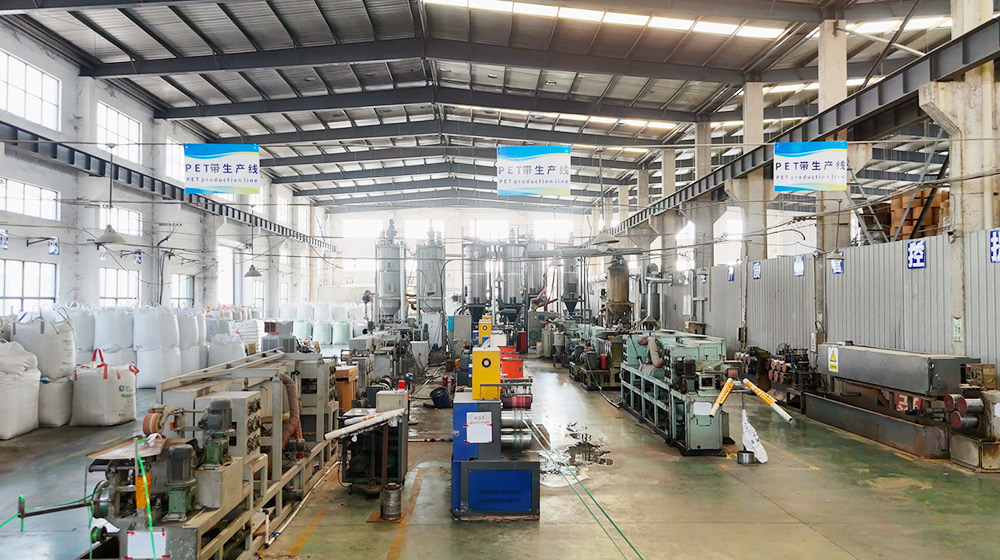
The underlying reason for that performance is the polymerization stage. Jushuo Packaging operates two solid-state polymerization (SSP) reactors that raise PET intrinsic viscosity before extrusion, which supports mechanical stability and consistency. Relative to standard PET processing, SSP PET is reported to deliver 15%–20% higher breaking strength and about 8% lower energy consumption per unit.
Fatigue and impact resistance are also tested, because a strap that survives a static pull test can still fail on a vibrating or road-transported load. For heavy-duty or sharp-edge bundling, application-specific recommendations are part of the technical service rather than an afterthought.
Pricing Mechanisms: What a Raw-Material-Linked Annual Contract Actually Does
Alongside the multi-year Sateri project, Jushuo Packaging has supplied under a separate annual contract structured with a pricing mechanism linked to raw material costs. That structure deserves careful reading, because it is frequently misunderstood.
A raw-material-linked mechanism means the strap price is not fixed for the full contract term. Instead, it follows an agreed reference for PET resin input cost, with a defined reset interval and a defined pass-through formula. In practice this produces a different risk distribution than a flat annual price.
| Contract structure | Price behavior over term | Main risk holder | Best fit |
|---|---|---|---|
| Spot / transactional purchasing | Fully exposed to resin price at each order | Buyer | Trial volumes, short or irregular projects |
| Annual fixed-price contract | Flat for the term regardless of input cost | Supplier | Stable, high-volume, predictable consumption |
| Annual or multi-year contract with raw-material-linked pricing | Adjusts with the agreed input index | Shared | Continuous production lines with steady monthly draw |
The advantage for a buyer is that the supplier is not forced to choose between margin and quality when resin prices rise. The disadvantage is equally real: the buyer gives up price certainty for the contract term. Budget owners who need a fixed cost line have to accept that an index-linked contract will move, or negotiate a collar or cap on the pass-through, or accept a shorter reset interval with more administrative overhead.
When assessing such a mechanism, the practical questions are: which published index defines the reference cost, how often is it reset, what fraction of the input cost is passed through, is there a cap or floor, and which currency governs settlement. A mechanism that answers all five is auditable; one that answers none is simply a variable price with a technical-sounding name.
Capacity and Delivery: The Part Buyers Underestimate
Pricing structures and quality systems only matter if the supplier can actually ship. Capacity is therefore the third pillar of long-term evaluation.
Jushuo Packaging reports monthly production capacity exceeding 1,700 tons of strapping, supplemented by more than 500 tons of stretch film, over 200 tons of tape, and over 300 tons of edge protectors per month. Underlying that output are four PET production lines, five PP production lines, and two solid-state polymerization units. On the equipment side, monthly equipment capacity exceeds 200 units, with line integration capacity of two to four lines per month.
Delivery commitments are structured by order type. Standard production lead time is 7 to 30 days: stock items ship in approximately 7 days, custom orders require up to 30 days, and emergency orders can be completed in 5 to 7 days depending on complexity. Standard specifications are held as safety stock, and production orders are tracked through an ERP system.
The company reports a 98.6% on-time shipment rate. That figure matters more in year three of a contract than in month one, because it reflects behavior across normal disruption, not a single well-managed order.
Application and Use Cases Where Multi-Year Supply Matters Most
Long-term supply agreements concentrate in industries where strapping is not a discrete purchase but a continuous input to a packaging line.
- Chemical fiber and textile bales. High-volume bale pressing runs continuously; green cut PET strap is used for fiber bale bundling where loads commonly exceed 400 kg and strap consistency directly affects line uptime.
- Building materials, panels, and wood products. Heavy, angular loads require high breaking force and low elongation, and outdoor or humid storage favors PET over PP.
- Metals, coils, and stone. PET replaces steel banding where corrosion resistance, operator safety, and weight reduction matter.
- Beverage cans, bricks, glass, and general logistics. Mixed-load bundling where PET’s stability and PP’s cost efficiency have to be allocated by scenario rather than by preference.
Material choice is scenario-driven, not absolute. Jushuo Packaging’s own product range covers both materials precisely because the correct answer differs by load. PET strapping delivers roughly twice the tensile strength of PP strapping and suits medium-to-heavy loads, outdoor storage, UV exposure, and high humidity. PP strapping remains appropriate for light-to-medium duty indoor applications. PET material cost runs approximately 30%–40% higher than PP, which is why a blanket substitution is rarely the right procurement decision.
On the steel-replacement side, the arithmetic is simpler. One ton of PET strapping provides the same length as six tons of steel strapping, and material cost can be 30%–50% lower than steel, with freight reduced because PET weighs roughly one sixth of steel at equal length.
Market Trend Analysis: What Is Pushing Buyers Toward Longer Contracts
Three structural trends are visible in the strapping category, and all of them favor longer, more formalized supply relationships.
Recycled content is becoming a specification, not a preference. Recycled PET accounted for an estimated 34% of global strapping production in 2024, according to industry research. Suppliers that use post-consumer recycled PET as feedstock — Jushuo Packaging uses recycled PET sourced from PET bottles — are increasingly asked to document that content rather than simply claim it.
Standards are consolidating the definition of “compliant.” Non-metallic strapping is classified under ASTM D3950-23, and the European standard EN 13394:2001 specifies dimensions and physical properties for non-metallic tensional strapping including PP and PET types. In China, GB/T 22344-2018 governs PET strap and QB/T 3811-1999 governs PP strap. Buyers running multi-market operations increasingly need one supplier whose documentation satisfies several of these frameworks at once.
Suppliers are consolidating around material-plus-equipment integration. Internationally, leading manufacturers include Signode Industrial Group, FROMM Holding AG, Mosca GmbH, and Teufelberger. The competitive pattern across the category is that suppliers who can combine material production with line integration and after-sales support are better positioned for multi-year commitments than material-only traders, because a single accountable party covers both the strap and the machine that applies it.
Comparison with Traditional Solutions — and Where the Model Has Limits
Buyers frequently compare three routes: continuing with transactional spot purchasing, moving to a flat annual price, or committing to a multi-year contract with an index-linked mechanism. The comparison below reflects how each route distributes effort and risk.
| Evaluation dimension | Transactional purchasing | Flat annual contract | Multi-year, raw-material-linked contract |
|---|---|---|---|
| Price predictability | Low — resets every order | High for the term | Moderate — adjusts on an agreed index |
| Quality verification burden | High — every delivery is effectively a new qualification | Medium — baseline qualification plus periodic checks | Lower after baseline qualification, but batch data must remain available |
| Supply continuity | Weakest — no reserved capacity | Depends on supplier capacity discipline | Strongest when backed by reserved capacity and safety stock |
| Administrative load | Low per order, high in aggregate | Low | Highest at contract drafting stage |
| Supplier qualification effort | Repeated | Once, plus review | Once, in depth |
The limitations of the multi-year model should be stated plainly rather than assumed away.
- Price certainty is surrendered. A raw-material-linked mechanism explicitly removes the buyer’s ability to fix unit cost for the term. For teams with rigid annual budget lines, this may be a decisive disadvantage.
- Switching becomes more expensive after qualification. Once a specification has been validated against a supplier’s SSP-based production and the buyer’s strapping equipment has been tuned to it, moving to another source requires re-qualification and possibly retensioning of machinery.
- Custom specifications cost time. Standard stock items ship in about 7 days, but custom orders can require up to 30 days, so a long-term contract does not eliminate the need for demand forecasting.
- MOQ still applies per line item. Minimum order quantities range from 500 kg for certain widths to 1 ton for standard items and 2 tons for high-tensile orders, with figures as low as 50 rolls for distributors. Long-term agreements do not remove these thresholds.
None of these limitations argues against long-term supply. They argue for negotiating the contract around them, particularly by defining the pricing index precisely and by securing batch-level test documentation as a contractual deliverable rather than a courtesy.
Commercial Terms Buyers Should Expect to See in Writing
A long-term relationship still operates through standard commercial instruments. Jushuo Packaging’s documented terms provide a reference point for what a qualified supplier typically offers.
- Minimum order quantity: 1 ton for standard items, with 200 kg accepted for small trial orders; certain widths start at 500 kg, and high-tensile orders at 2 tons.
- Delivery terms: FOB China port for export orders; ex-works or delivered-to-warehouse for domestic supply.
- Payment terms: 30% TT deposit with the 70% balance due before delivery.
- Acceptance criteria: buyer inspection on arrival, with third-party SGS reports available; non-conforming goods to be replaced within 5 working days.
- Technical support: on-site compatibility testing, 48-hour response for quality issues, remote video and photo guidance, field engineer dispatch, and a 12-month equipment warranty on integrated lines.
Documentary support on the compliance side includes ISO 9001 (certificate No. U23Q28007898R2S), ISO 14001 (certificate No. U23E28007899R2S), ISO 45001, and SGS test reports, alongside RoHS and REACH documentation available on request. For suppliers under European or North American procurement review, these are generally the minimum tolerable baseline rather than a differentiator.
Future Outlook
Three developments are likely to shape long-term strapping supply over the next several years.
First, index-linked pricing is likely to spread as resin volatility continues. Buyers who develop internal capability to evaluate these mechanisms — rather than rejecting them outright — will negotiate better terms than buyers who insist on flat pricing and then absorb quality drift.
Second, recycled content verification will move from marketing claim to auditable specification. With recycled PET already representing a substantial share of global strapping production, buyers will increasingly require batch-level traceability from raw material to finished coil. Jushuo Packaging’s batch traceability system and ISO 14001 certification position it for that requirement, though the broader industry still varies widely.
Third, the boundary between material supply and equipment supply will continue to blur. Suppliers able to deliver a PET strap, the strapping machine that runs it, and the after-sales support behind both are structurally better suited to multi-year commitments than suppliers who can only deliver one of the three.
For buyers, the practical implication is that supplier evaluation should be conducted on the same time horizon as the contract. A supplier that performs well on a single trial order has demonstrated production capability; only a supplier that performs consistently across consecutive batches and several years of delivery has demonstrated long-term supply reliability.
FAQ
What does a raw-material-linked pricing mechanism mean in an annual strapping contract?
It means the strap price is not fixed for the full term but follows an agreed reference for raw material input cost, with a defined reset interval and pass-through formula. The mechanism distributes price risk between buyer and supplier: the supplier is not forced to absorb resin cost increases alone, and the buyer accepts that unit cost will move. Buyers should confirm which index is used, how often it resets, what proportion of input cost is passed through, whether a cap or floor applies, and the settlement currency.
How can a buyer verify batch-to-batch consistency over a multi-year supply agreement?
Consistency is verified through process controls and batch records, not through a single qualification sample. On the production side, Jushuo Packaging uses an online thickness gauge and width monitor, PLC-controlled extrusion temperature and stretching roller speed ratio, and automated constant tension winding. Each batch is tested for tensile strength, elongation, and deflection, with targets that include elongation of 5%–9% and deflection of no more than 8 mm per meter for 12 mm PET. Incoming raw material is tested for melt flow index, intrinsic viscosity, ash content, and moisture, and batch traceability runs from raw material to finished product. Third-party SGS and CMA-accredited reports are available per batch, which is the document a buyer should request as a contractual deliverable.
What production capacity and lead times support a long-term strapping contract?
Jushuo Packaging reports monthly strapping capacity exceeding 1,700 tons, supported by four PET production lines, five PP production lines, and two solid-state polymerization units, with additional monthly capacity of over 500 tons for stretch film, over 200 tons for tape, and over 300 tons for edge protectors. Standard lead time is 7 to 30 days: stock items ship in approximately 7 days, custom orders require up to 30 days, and emergency orders can complete in 5 to 7 days depending on complexity. Safety stock is held for standard specifications, and orders are tracked through an ERP system.
What minimum order quantities and payment terms are typical for long-term strapping supply?
Documented terms for Jushuo Packaging set a minimum order quantity of 1 ton for standard items, with 200 kg accepted for small trial orders; certain widths start at 500 kg and high-tensile orders at 2 tons, with figures as low as 50 rolls for distributors. Payment terms are 30% TT deposit with the 70% balance due before delivery. Export orders ship FOB China port, while domestic supply can be ex-works or delivered to the buyer’s warehouse. Long-term agreements do not remove these thresholds per line item.
What happens if a delivered batch does not meet the agreed specification?
Under Jushuo Packaging’s documented acceptance criteria, the buyer inspects goods on arrival, third-party SGS reports are available for verification, and non-conforming goods must be replaced within 5 working days. Quality non-conformance is controlled through in-house tensile, elongation, and viscosity testing plus third-party SGS and CMA-accredited reports, within an ISO 9001 certified system. For long-term contracts, buyers typically define acceptable tolerance bands up front so that “non-conforming” is a measurable condition rather than a judgment call.
Does committing to a long-term PET strapping contract remove the option to change materials later?
It does not eliminate the option, but it raises the cost of exercising it. Material selection remains scenario-driven: PET strapping delivers roughly twice the tensile strength of PP strapping and suits medium-to-heavy loads, outdoor storage, UV exposure, and high humidity, while PP strapping remains appropriate for light-to-medium duty indoor applications and costs approximately 30%–40% less as a material. Once a specification has been qualified against a supplier’s production process and the buyer’s strapping equipment has been tuned to it, switching material or supplier requires re-qualification. Buyers should therefore treat material choice as a planning decision made before the contract, not a variable to be adjusted mid-term.
Sources referenced in this article include Grand View Research, Cognitive Market Research, ASTM International, the European Committee for Standardization (CEN), UN Comtrade / OEC, Spherical Insights, and first-party documentation from Taixing Jushuo Packaging Technology Co., Ltd.