
Multi-Wire Saw Tension Layouts: What Slab Plants Should Verify
Multi-Wire Saw Tension Layouts: What Slab Plants Should Verify
Two multi-wire saws can publish the same cutting height, the same wire specification and the same slab thickness range, and still demand different buildings, different maintenance routines and different operator discipline. For stone processors at the point of specifying a slab-cutting line, the choice between a top-tension and a side-tension multi-wire saw is therefore a structural decision before it becomes a commercial one. Stonewin (Fujian Xiapu Zhongyuan Machinery Co., Ltd.) builds both configurations within a single multi-wire saw series, models ZY-MW5 through ZY-MW90, with published range figures of up to 2200 mm cutting height and net machine weight from 22 to 80 tons.
This comparison sets those configuration facts against independently issued compliance evidence — CE certificate IN-XM-5805-23069 issued by SGS, referencing EN ISO 12100:2010 and EN 60204-1:2018 — and against the documented risk controls that surround the machine: a safety guardrail, operator safety training and standard operating procedure (SOP) documentation. The purpose is not to declare one layout superior. It is to show which parts of the decision are documented, which are verifiable, and which still have to be resolved by the buyer against a specific block mix and a specific building.
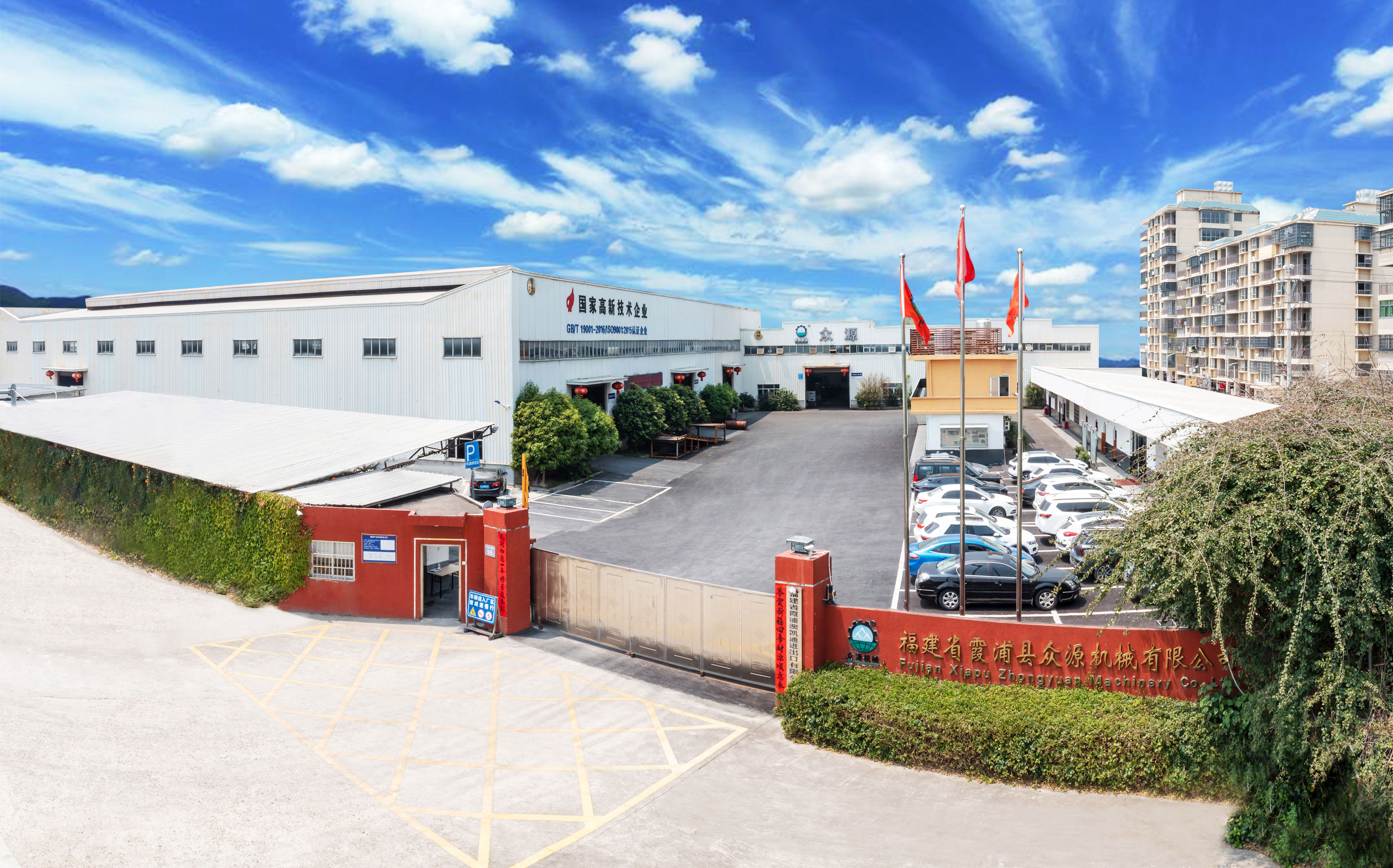
Exterior view of Stonewin's diamond consumables R&D and manufacturing plant in Fujian, part of the production base behind its multi-wire saw and wire saw lines.
The structural difference, stated plainly
Top-tension and side-tension describe where the tensioning system is arranged relative to the wire plane: from above the cutting zone in the first case, from the side in the second. Both arrangements are offered across the same Stonewin model range, which makes the layout a selection variable rather than a fixed feature of one model family. That has a procedural consequence. A buyer who shortlists on model number alone has not yet made the layout decision, and a quotation that names a model without naming its configuration is incomplete for comparison purposes.
Tensioning hardware placed above the wire plane and tensioning hardware placed to one side imply different machine envelopes, different access routes for wire changes and tensioning checks, and different load paths into the frame and the foundation. How much any of that matters depends on the model size and on the building the machine goes into. It is also worth stating what the material reviewed for this comparison does not contain: there is no like-for-like throughput, precision or energy test published between the two layouts. The analysis below therefore separates what is documented from what must be verified at configuration and site level.
The documented baseline: height, mass and slab duty
Three published figures frame the whole comparison, and each does a different job in the decision.
The first is height. Across the series, Stonewin publishes a maximum cutting height of up to 2200 mm. A range maximum is not a per-model specification: it indicates the headroom the largest configurations can address. A buyer working with blocks in the 1.4 to 1.6 m range should confirm the rated figure for the specific model under quotation rather than plan against the series ceiling, because planning against a ceiling that belongs to a larger machine is how civil works get re-cut.
The second is mass. Net machine weight is published as a range from 22 to 80 tons across ZY-MW5 to ZY-MW90, and that spread is a logistics and civil-works variable before it is a proxy for anything else. A 22-ton machine and an 80-ton machine differ in the crane capacity needed at installation, in transport configuration and permits, in foundation design, and in the floor loading an existing bay can be asked to accept. Where a plant is retrofitting a structure that was not designed for slab-cutting equipment, the mass figure frequently narrows the shortlist before cutting capability is discussed at all.
The third is slab duty. Stonewin's product documentation for its multi-wire granite saw states that the machine is designed to produce slabs with thicknesses of 1.2 cm up to 15 cm from the same granite or marble block. For a processing plant this declared range sets the product mix a quotation can be built around — thin slabs, standard gauge material and heavier work from one block — and therefore the commercial case for the machine. It is a manufacturer-declared output range rather than the result of a standardised comparative test, so it belongs at the specification stage as a starting point, not in a benchmark table against other suppliers.
| Parameter | Documented position | What it means at specification stage |
|---|---|---|
| Structural configuration | Top-tension and side-tension both offered within the same multi-wire saw series | Layout is a selection decision, not a fixed feature of one model family |
| Model range | ZY-MW5 through ZY-MW90 | Height and mass must be read per model; series figures are not per-machine ratings |
| Cutting height | Up to 2200 mm across the range | Match to the tallest regular block in the mix, with a justified margin |
| Net machine weight | 22 to 80 tons across the range | Drives crane capacity, transport permits, foundation design and floor loading |
| Slab output | 1.2 cm to 15 cm from the same block (declared for the multi-wire granite saw) | Defines the product mix and the commercial case for the line |
| Compliance evidence | CE certificate IN-XM-5805-23069, SGS; EN ISO 12100:2010 and EN 60204-1:2018 | Conformity evidence for the listed scope; not a throughput or precision benchmark |
| Risk controls | Safety guardrail; operator safety training; SOP documentation | Auditable operating requirements with a defined owner on site |
Compliance as a comparison criterion
EN ISO 12100:2010 is the machinery-safety standard that sets out general principles for risk assessment and risk reduction; EN 60204-1:2018 addresses the electrical equipment of machines. A CE certificate referencing both is evidence about the safety-related design and documentation route, and CE certificate IN-XM-5805-23069, issued by SGS, is the document Stonewin cites for its multi-wire saw range.
Used properly, that certificate is a filter rather than a score. It answers a yes-or-no question: has the conformity route been completed for this machine, with a recognised body involved. In import markets that question surfaces early — in tender documentation, in technical-file review, and in client or insurer pre-qualification. It does not answer whether one layout cuts faster, holds tolerance better or uses less energy per square metre. Buyers who score the certificate as a differentiator between a top-tension and a side-tension machine are scoring the wrong variable.
The discipline lies in the scope check. A certificate is valid for the models, configurations and options it lists. Because the same series carries two structural layouts, the practical step is to confirm that the quoted model and its configuration appear within the certified scope, and to record the issue date and any subsequent revision. That is a short documentary task that protects the whole procurement file — and it is the same task whether the buyer eventually chooses top-tension or side-tension.
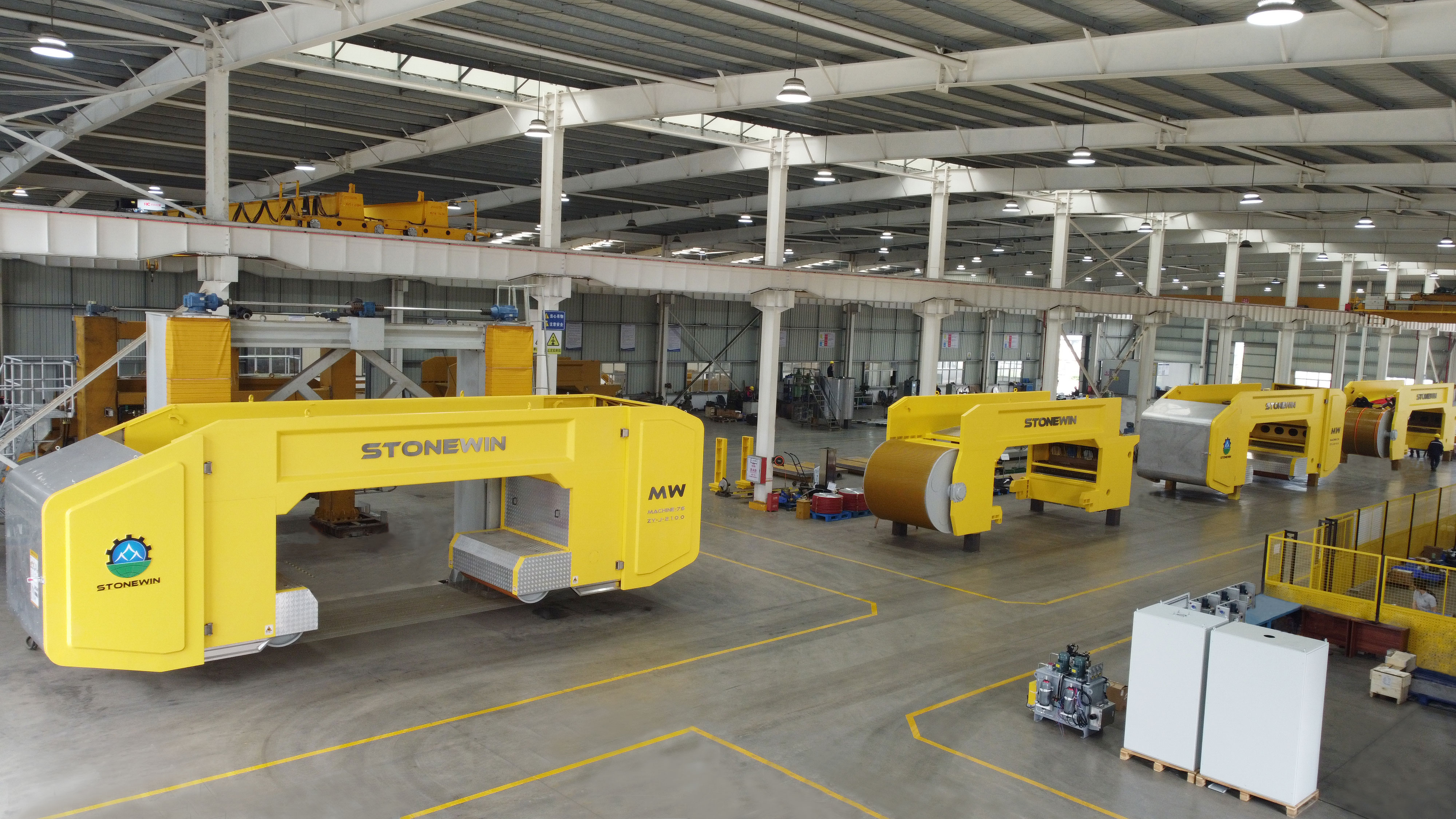
Assembly area for multi-wire saw machines at Stonewin's Fujian manufacturing base, where slab-cutting units are built before factory testing and dispatch.
Risk controls as weighted criteria
Wire saws carry an evident injury risk around the wire path, and Stonewin documents three controls for it: a safety guardrail for safe operation, safety operation training for operators, and standard operating procedure documentation. All three can be compared between suppliers in a way that performance claims usually cannot, because they can be audited as documents and routines rather than accepted as specifications.
- Guardrail. Ask whether the guardrail is fixed or movable, how access to the wire path is controlled during wire changes and tensioning checks, and how the guarding arrangement interacts with the maintenance procedure for the specific layout quoted.
- Training. Establish who delivers operator safety training, whether attendance is recorded, whether it is repeated when staff change, and whether it covers both layouts if the plant intends to run both.
- SOP documentation. Request the procedure set before order and check two things: that it names the actual configuration, and that it is usable by the operators who will run the machine, including language and shift structure.
Weighted this way, the three controls do real work in a comparison. A supplier with a defined guardrail arrangement, recorded training and a configuration-specific SOP reduces the supervision burden the plant must carry. A supplier without them shifts that burden onto the buyer's own safety system. Neither case is visible in a cutting-height figure, which is precisely why the criterion belongs in the evaluation.
An evaluation matrix for the two layouts
With no like-for-like benchmark published, the comparison has to be assembled from dimensions a buyer can actually test. The matrix below is a working structure: each row separates the two configurations on something a plant can check before signing, and each row names the evidence worth requesting.
| Evaluation dimension | Why it separates the layouts | Evidence to request |
|---|---|---|
| Wire-path access and tensioning routine | The tensioning system is positioned differently in each layout, so the maintenance envelope and access route differ | Layout-specific maintenance and wire-change procedure, with guarding arrangement |
| Machine envelope and building fit | Structure and mass together set crane, transport and clearance requirements | General arrangement drawing, net weight for the quoted model, lifting points |
| Height fit against block mix | Height capability must clear the tallest regular block, not the largest block ever purchased | Rated cutting height for the specific model and configuration |
| Slab mix and changeover | Declared thickness range sets the product mix; the changeover routine sets the cost of using it | Declared 1.2–15 cm range for the quoted configuration, plus changeover procedure |
| Conformity documentation | Certificate scope must cover the quoted model and configuration | CE certificate IN-XM-5805-23069 with model list, scope and issue date |
| Operator competence | Training and SOP quality determine how quickly the layout becomes routine on shift | Training syllabus, records policy, SOP set for that configuration |
| Service and spares reach | Downtime exposure on a high-duty slab line depends on how fast support arrives | Service coverage for the plant's region, commissioning and maintenance scope, spares list |
Application fit: two operating profiles
Profile one — the quarry-linked plant. Consider a plant that cuts blocks from its own quarry. Block sizes arrive variable, the tallest blocks set the height requirement, and the saw is expected to absorb that variability without repeatedly re-engineering the infeed. In this profile, height headroom and the ability to handle the largest block in the regular mix dominate, while the layout decision turns on how easily the tensioning system can be serviced in a bay where access space is already fixed. This is a conditional illustration of the trade-off, not a documented installation.
Profile two — the slab-focused processor. Consider instead a plant buying calibrated blocks for a thin-slab and gauge-slab product mix. Here the declared 1.2 to 15 cm output range matters commercially, and repeatability across long runs matters operationally, so the layout decision turns on maintenance routine and on how the machine fits an existing polishing and resin line. Stonewin's product scope covers quarrying wire saws, multi-wire slab saws, polishing lines and resin lines, which allows a buyer assembling a full chain to source from one supplier. That simplifies documentation and service contact; it does not by itself prove that either layout is the better fit for a given plant.
Cost and value: where the 22 to 80 ton spread lands
Comparisons of this kind often collapse into price per ton of machine. That is the wrong denominator. The value of a multi-wire saw is set by the slab mix it can quote and the uptime it can hold, not by its mass. What the documented range does allow is a structured view of where cost actually sits:
- Structural mass. Transport configuration, lifting capacity, foundation design and installation sequence all scale with the 22 to 80 ton spread.
- Height capability. Taller cutting envelopes interact with building clearance, pit design and civil works, which are permanent costs.
- Structural layout. Access to the tensioning and wire path shapes the maintenance routine, and therefore the downtime pattern over the machine's working life.
- Conformity documentation. A certificate with a clear scope reduces friction in tender, customs and client qualification stages.
- Training and SOP. Documented controls reduce the supervision and safety-management load the plant carries.
The material reviewed for this comparison contains no public price benchmark for this machine class, so a defensible value assessment has to be built from these cost lines together with the quoted configuration. Two quotations that differ in mass, height capability or documented risk controls are not comparable on price alone — they describe different operating propositions.
Industry context: what market figures settle
Commercial research from Fortune Business Insights places the global stone processing machinery market at USD 20.86 billion in 2024, with a projected compound annual growth rate of 5.5% between 2026 and 2034. Scope definitions differ between research houses, so totals of this kind are context rather than a planning input for a single plant. The figures that actually govern a multi-wire saw purchase are narrower: the block sizes the plant receives, the slab thicknesses its customers order, the building it already owns, and the documentation its buyers and regulators require.
Outlook: what would change this comparison
Three developments would materially change how the two layouts are weighed. First, model-level documentation mapping each configuration across ZY-MW5 to ZY-MW90 to measured height, mass and output data would permit a specification-level comparison instead of a verification-led one. Second, any revision to the certified scope of CE certificate IN-XM-5805-23069 would need to be reflected in both the quotation and the buyer's technical file. Third, a change in the plant's own operating profile — taller blocks, thinner slabs, higher duty — would reorder the criteria, because layout choice is a fit decision rather than a permanent ranking.
Frequently asked questions
What is the practical difference between a top-tension and a side-tension multi-wire saw?
The two names describe where the tensioning system is arranged relative to the wire plane — from above the cutting zone in a top-tension design, from the side in a side-tension design. Stonewin offers both configurations within the same multi-wire saw series, models ZY-MW5 through ZY-MW90, so the layout is a selection variable rather than a fixed model feature. The material reviewed for this comparison does not include a like-for-like throughput, precision or energy test between the two, so the choice is resolved on access, envelope, height fit, slab mix and service coverage rather than on a published performance ranking.
Does the 2200 mm cutting height apply to every model in the series?
No. Up to 2200 mm is a range figure covering the multi-wire saw series as a whole, not a rating for each individual model. A plant should confirm the rated cutting height for the specific model and configuration under quotation before committing to civil works or infeed design. Planning against the series maximum rather than the quoted machine is a common and expensive mismatch.
What does CE certificate IN-XM-5805-23069 issued by SGS actually cover?
It is conformity evidence for Stonewin's multi-wire saw range, referencing EN ISO 12100:2010 for machinery risk assessment and risk reduction and EN 60204-1:2018 for the electrical equipment of machines. It addresses safety-related design and documentation for the scope listed. It does not certify cutting speed, slab tolerance, energy consumption or the relative performance of the two structural layouts. Buyers should confirm that the quoted model and configuration fall inside the certified scope, and record the issue date.
Do the two layouts carry different safety requirements?
The documented risk controls apply to the multi-wire saw as a machine: a safety guardrail for safe operation, safety operation training for operators, and standard operating procedure documentation. Because the tensioning system sits in a different position in each layout, the practical questions differ — how the guardrail interacts with access to the tensioning area, how wire changes are performed, and whether the SOP set names the specific configuration. Those are verification questions for the supplier rather than documented differences between the layouts.
How should a net machine weight of 22 to 80 tons influence the decision?
Weight is a site-fit variable first. It sets the crane capacity needed at installation, the transport configuration and permits, the foundation design, and the floor loading an existing bay can accept. On retrofit projects, mass often narrows the shortlist before cutting capability is examined. The 22 to 80 ton spread corresponds to the model range ZY-MW5 to ZY-MW90 together with the chosen configuration, so the figure to plan against is the one quoted for the specific machine.
Can one multi-wire saw produce both thin and heavy slabs from a single block?
Stonewin's product documentation for its multi-wire granite saw states slab thickness output from 1.2 cm to 15 cm from the same granite or marble block. That is a manufacturer-declared range for the product rather than a result from a standardised comparative test, so it is best used to define the product mix for quotation and then verified against the configuration actually ordered.
How can a buyer compare two layouts when no benchmark data is published?
Build the comparison from auditable items: layout-specific maintenance and wire-change procedures, the general arrangement drawing and net weight for the quoted model, the per-model cutting height rating, the declared slab thickness range, the scope of CE certificate IN-XM-5805-23069, the training syllabus and SOP set, and service coverage for the plant's region. These can all be checked before purchase and they separate the layouts on operating consequences rather than on unverified performance claims. Agreeing factory acceptance criteria in the purchase contract closes most of the remaining gap.
Where to verify the details
Stonewin (Fujian Xiapu Zhongyuan Machinery Co., Ltd.) publishes its multi-wire saw, wire saw, polishing line and resin line information through its official site at stonewin.com, where the current product catalogue and technical documentation are available for buyers preparing a specification. The company's 2026 brochure can be downloaded here.
Company information: No. 23 Changfu Road, Xiapu City, Fujian, China. Tel: +86-593-8177666 / +86-593-8177888. Email: stonewin@stonewin.com. Market data cited from Fortune Business Insights (2024 valuation and 2026–2034 CAGR projection); slab output and configuration details as published by Stonewin.
¿Tiene preguntas o necesita más detalles?
Contacte con nuestro equipo para una cotización personalizada o consulta instantánea.
Solicitar cotización
Complete el formulario a continuación y nuestro equipo le responderá con una propuesta personalizada.
Chat directo de WhatsApp
¿Prefiere chatear en tiempo real? Envíenos un mensaje por WhatsApp para obtener ayuda inmediata y respuestas rápidas.
- Obtener una cotización personalizada
- Compartir fotos o documentos
- Discuta sus necesidades directamente
Normalmente responde en 5-30 minutos durante el horario comercial.