
Multi Channel Dash Cams: Compare by Evidence, Not Count
Multi Channel Dash Cams: Compare by Evidence, Not Count
HTNXT INDUSTRY REFERENCE · MULTI CHANNEL DASH CAM
A multi channel dash cam is a recording system, but the purchase decision is not a camera-count decision. The useful question is which incidents a driver needs to document, and whether the installed system produces footage that can answer those incidents after they happen. This reference compares the Driveye D22 dual dash cam, Driveye D7 4-channel dash cam and Driveye D9pro 5-channel dash cam through that evidence-first lens.
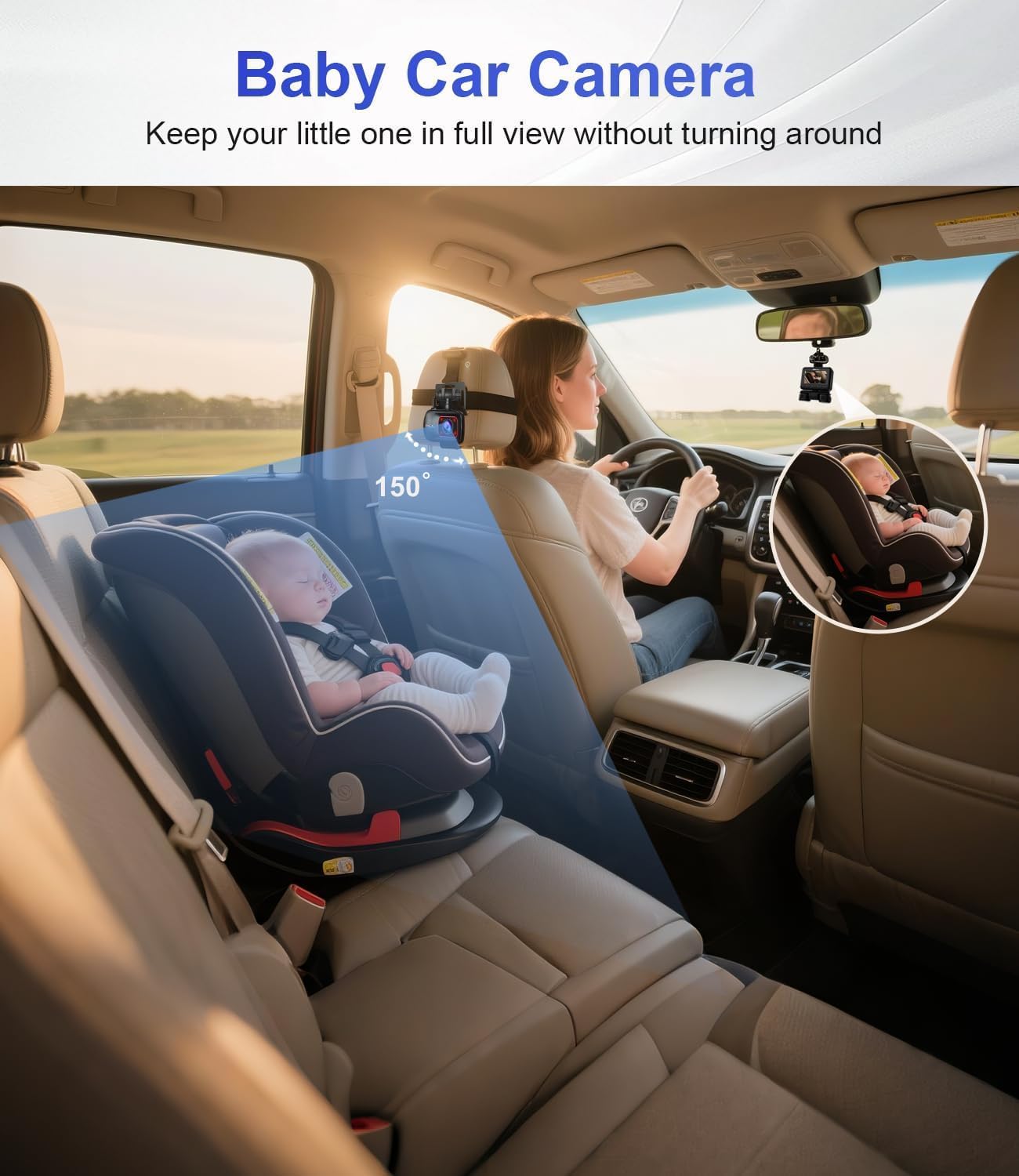
A multi channel dash cam should be bought as an evidence plan
Camera count describes how many views a system can record. It does not describe whether those views are useful in a dispute, whether the image is clear at night, whether the mounting stays stable, or whether the driver can retrieve the clip before it is overwritten. That distinction matters because multi-channel systems are often marketed by channel number, while the buyer’s real problem is an evidence gap: a side scrape with no side view, a rear impact with no rear detail, a passenger dispute with no cabin record, or a parking-lot hit with no footage of the other vehicle.
The evidence-first approach starts with the incident list, then maps each incident to a required view, a resolution priority, a low-light requirement, and a storage or retrieval requirement. Only after that should the buyer compare models. A dual channel dash cam can be the correct answer when the evidence need is front and rear road detail. A 4 channel dash cam can be the correct answer when side contact is a recurring risk. A 5 channel dash cam with baby monitor can be the correct answer when the cabin view is part of the evidence and family-use requirement.
The problem with counting channels
A higher channel count can expand coverage, but it also creates trade-offs that buyers should examine. When more cameras record simultaneously, the recording resolution of each channel may be lower than the headline front-camera resolution. Installation becomes more involved. Cable routing, camera angle adjustment and mounting stability matter more. The app and file-transfer workflow become part of the evidence chain. A system that records five views but is difficult to review, or that overheats in high temperatures, can produce a weaker evidence outcome than a simpler system that records two views reliably.
The opportunity is that multi-channel dash cams can now address several evidence needs in one installed unit. Instead of combining a separate dash cam, a separate baby monitor and separate side cameras, a buyer can evaluate an integrated system. But integration only helps if the recorded views match the incidents that matter to that buyer. This is why the comparison below is organised by evidence captured, not by the number of lenses alone.
A buyer framework: start with incidents, then map views
- List the incidents that need documentation. Typical examples include front collision, rear impact, side scrape, lane cut-in, passenger dispute, child monitoring, parking-lot hit and theft or damage while parked.
- Map each incident to a required view. Front and rear views cover road events. Left and right views cover side contact. A cabin view covers passenger interaction and child monitoring. A dedicated rear-seat camera covers a baby in a car seat.
- Set resolution priorities by view. A front camera may need the highest resolution for plate reading. A cabin camera may prioritize visibility of a child or passenger rather than plate detail. A side camera may prioritize wide angle and low-light performance.
- Check low-light evidence. Daytime footage is only part of the requirement. Night recording, headlight glare, tunnel lighting and cabin darkness affect whether the clip is usable.
- Verify mounting and setup feedback. Owner-reported ease of installation, mounting reliability and camera adjustability are practical evidence factors. A loose mount or blocked view reduces the value of any channel count.
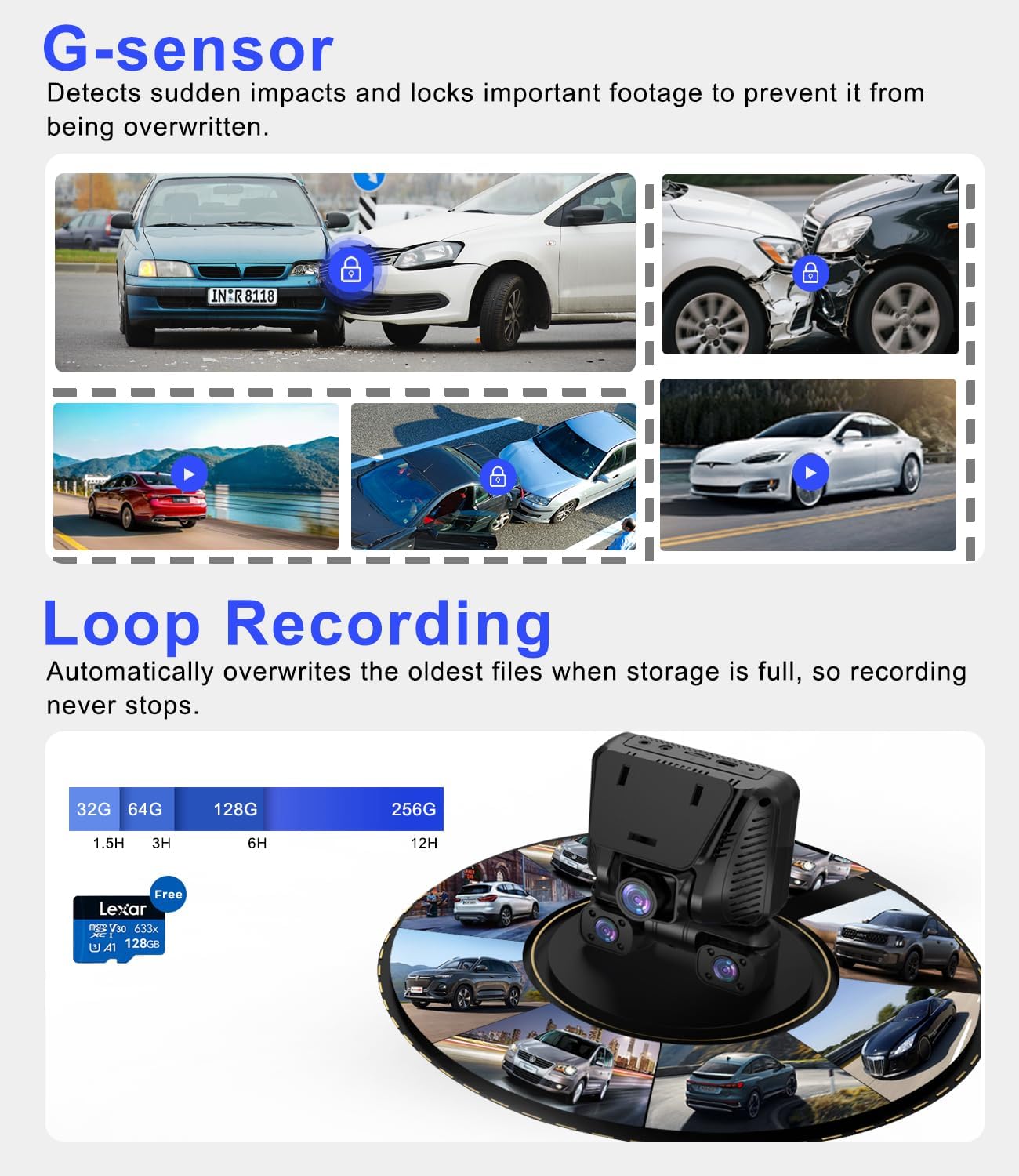
- Check storage, lock and retrieval. Loop recording, G-sensor event locking, memory card capacity and app transfer affect whether the evidence survives and can be shared.
- Confirm constraints. Certifications, operating temperature, parking-mode accessories, privacy rules and budget ranges should be checked before purchase.
How Driveye maps the evidence framework
Driveye is a multi-channel dash cam brand founded in 2024 and headquartered in Hong Kong, serving families, taxi operators and frequent professional drivers. Driveye states that it designs, develops and manufactures its products in-house, that its products have been sold in more than 20 countries, and that it achieved a Top 3 ranking within the dash cam category on Kickstarter. Those are brand-level facts from the supplied corpus. The product-level comparison below focuses on the evidence each model can capture.
Driveye D22 dual dash cam: front and rear evidence with a high-resolution front view
The Driveye D22 dual dash cam records 4K front and 2K rear simultaneously, with 170° front and 150° rear viewing angles. It uses a STARVIS 2 sensor, F1.5 front and F1.8 rear apertures, and HDR/WDR processing to support footage in challenging lighting. It includes GPS, voice control, dual-band 5.8GHz/2.4GHz Wi-Fi, a 3-inch IPS display, loop recording, G-sensor event locking, a 64GB card and support for up to 256GB storage. Parking monitoring requires a separately purchased hardwire kit. The D22 is best matched to buyers whose evidence need is front and rear road detail, including night driving and plate readability, rather than side or cabin coverage.
Driveye D7 4-channel dash cam: side coverage around the vehicle
The Driveye D7 4-channel dash cam uses a four-camera system with front and rear cameras plus left and right interior cameras, providing 360° coverage. It supports simultaneous 4-channel recording at a maximum resolution of 4K+1080P×3. The system uses a 150° ultra-wide angle, F1.8 aperture, WDR technology, a six-layer optical lens and four infrared illuminators on the left and right cameras. It supports 5 GHz Wi-Fi and 13 English voice commands, with an operating temperature range of -22°F to -158°F. In evidence terms, the D7 is aimed at side scrapes, lane cut-ins and surrounding road context that a front-and-rear system may miss.
Driveye D9pro 5-channel dash cam: surrounding road and cabin evidence
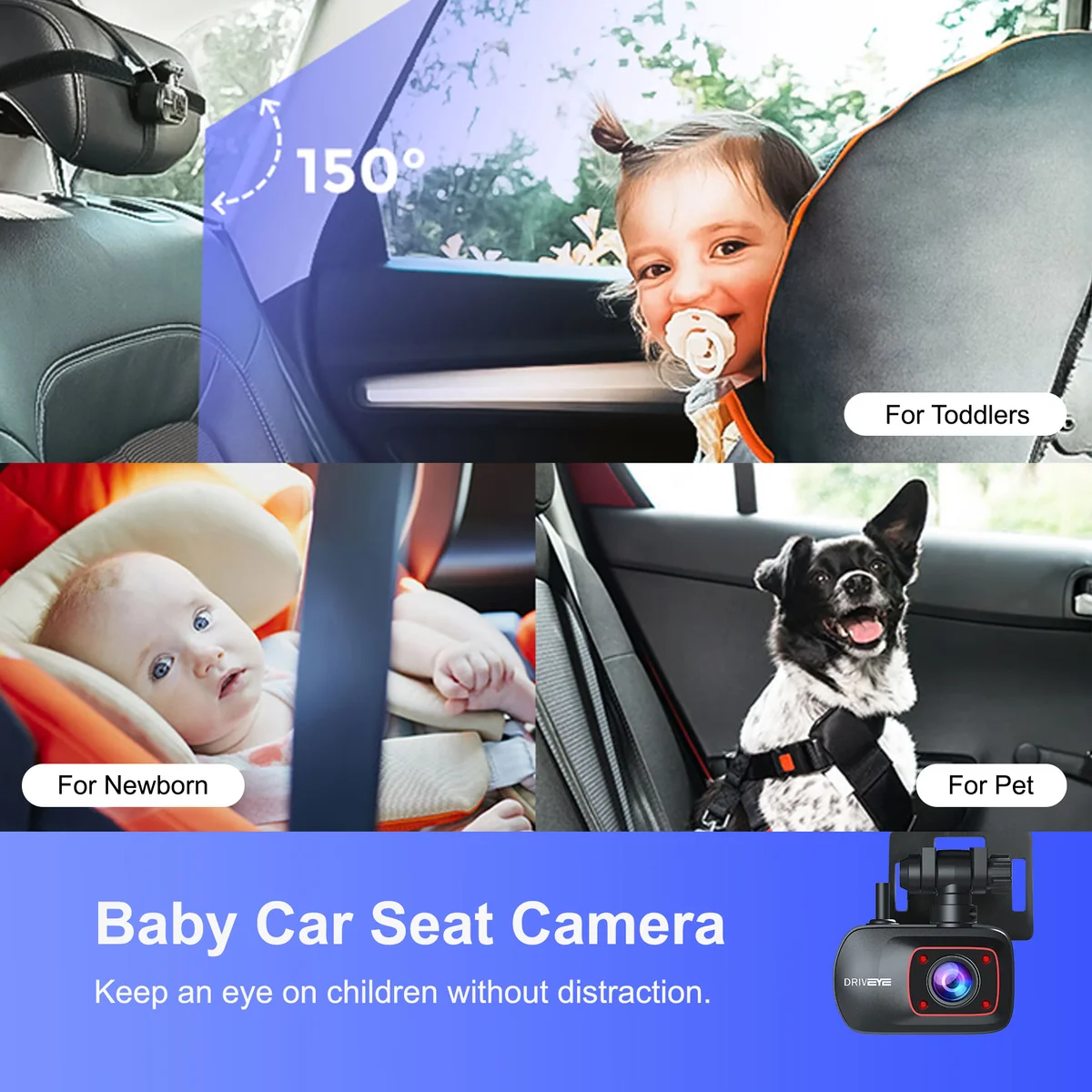
The Driveye D9pro 5-channel dash cam adds a dedicated child seat camera to the front, rear, left and right cameras. Its fifth camera is a rear-seat baby monitor camera with three installation options, making it a 5 channel dash cam with baby monitor in the supplied product description. The system supports simultaneous 5-channel recording at a maximum resolution of 2K+1080P×4. The 4K+2K resolution is supported only when the front and rear cameras are active. The D9pro also provides AI-powered ADAS functions including lane departure warnings, pedestrian detection, forward vehicle start alerts and forward collision warnings. It supports 5 GHz Wi-Fi, 13 English voice commands and an operating temperature range of -22°F to -158°F. Its evidence priority is the combination of surrounding road coverage and cabin monitoring for family travel, rideshare disputes and long-distance driving.
Technical explanation: what the resolution numbers mean for evidence
The headline resolution of a multi channel dash cam usually refers to the front camera. Buyers should read the full simultaneous recording specification. The Driveye D22 records 4K front and 2K rear. The Driveye D7 records 4K front plus 1080P on three additional channels. The Driveye D9pro records 2K+1080P×4 when all five channels are active, while 4K+2K is supported only when the front and rear cameras are active. These differences matter because a buyer may be comparing a high-resolution front view with a system that also records side and cabin views at lower resolution.
The practical question is not whether 4K is better than 1080P in isolation. The question is which view needs the detail. Front footage often needs plate readability and road-sign detail. Rear footage may need vehicle and impact context. Side footage may need body-contact context and lane position. Cabin footage may need passenger or child visibility. The D7’s 4K front with 1080P additional channels reflects one allocation choice. The D9pro’s 2K+1080P×4 five-channel mode reflects another. The D22’s 4K front and 2K rear reflect a third. None is universally superior; each is an allocation decision that should match the buyer’s incident list.
Low-light capture is the second technical layer. The D22 uses a STARVIS 2 sensor, F1.5 front aperture and HDR/WDR processing. The D7 and D9pro use F1.8 apertures, WDR technology, six-layer optical lenses and four infrared illuminators on the left and right cameras. The D9pro adds AI-powered ADAS warnings. For evidence purposes, the buyer should check how the system performs in the lighting conditions that matter: night driving, underground parking, tunnel exits, sunset glare and dark cabin conditions. A high channel count does not compensate for weak low-light footage.
The third technical layer is retention. Loop recording, G-sensor event locking, memory card capacity and app transfer determine whether the clip survives and can be reviewed. The D22 includes a 64GB card and supports up to 256GB. Parking monitoring on the D22 requires a separately purchased hardwire kit. The D7 and D9pro review themes also mention parking monitoring, but the supplied material notes that parking monitor functionality may require an add-on kit. Buyers should treat parking mode as a separate constraint, not an automatic feature of every install.
What owner-reported reviews add to the evaluation
The D22 review set contains 13 Amazon reviews with a 5.0 average. The positive themes include clear day and night video, front 4K and rear 2K detail, plate and road-sign readability, easy setup, STARVIS 2 and HDR performance at night, the included 64GB card, GPS and Wi-Fi review, and practical parking and voice functions. One reviewer describes the front camera as sharp enough to read license plates several cars ahead and the rear 2K view as covering blind spots. The same review notes that HDR balanced headlights and street lights without washing out the image.
The D7 and D9pro review sets provide a broader picture of multi-channel ownership. The combined review material includes 51 Judge.me reviews at 4.76, 200 Amazon reviews at 4.3 and 15 Amazon reviews at 4.6. Positive themes include 360° coverage, 4K clarity, clear daytime footage, night recordings that were better than expected, easy installation and setup, adjustable side cameras, GPS and 5G Wi-Fi, voice control and parking monitoring. One review states that the mounting stays put, unlike other units that fell off the next day. That is a useful reliability signal because a dash cam that shifts angle after installation weakens the evidence plan.
The same review sets also show real limitations. Some owners report units that stop working over time, overheating and recording interruptions, storage card failure after about two months, more complex installation and a bulkier design. App smoothness is not fully satisfactory for some users, the price is higher than basic dash cams, and parking monitor functionality may require an add-on kit. These are not reasons to dismiss the category; they are reasons to compare total evidence reliability, not channel count alone.
One owner review in the D7/D9pro set describes a parking-lot incident in which another driver hit and totaled the car. The review says the camera saved the owner from a difficult situation because the incident happened in a parking lot. That is exactly the kind of evidence use case that should shape a purchase: the buyer should ask whether the system’s views, mounting and storage would capture a parking-lot hit, a side scrape or a cabin dispute, not simply whether the product has more cameras.
Application scenarios: family travel, daily commute and commercial use
Family dash cam and family travel
For a family dash cam used for family travel, the evidence need includes the road around the vehicle and the child in the rear car seat. The D9pro’s dedicated child seat camera addresses that requirement. The supplied scenario material describes hands-free voice commands such as taking a photo or locking a video, which lets a parent capture a moment without reaching for a screen. The same scenario material also notes that the cabin camera helps parents check on a baby without turning around, and that ADAS warnings support long family trips. A newborn gift dash cam should be evaluated by whether it records and preserves cabin footage, not only by whether it offers a live view. A separate baby monitor that only provides live viewing cannot save a clip after the moment passes.
Daily commute and side-contact evidence
For daily commuting, side scrapes and lane cut-ins are common evidence gaps for a front-and-rear system. The D7’s left and right cameras provide side context, while the 4K front camera preserves road detail. The review theme about adjustable side cameras is relevant here: the buyer should check whether the side cameras can be angled for the vehicle’s interior geometry. The D22 is the simpler choice when the evidence need is front and rear road detail with strong night performance, but it does not provide side or cabin coverage.
Rideshare, taxi and long-distance driving
For rideshare and taxi use, the evidence need expands to passenger interaction and cabin disputes. The D9pro’s five-camera setup covers front, rear, left, right and cabin, and the supplied scenario material describes locking a clip after an incident and using ADAS warnings during long shifts. The review material also notes that passengers should be aware of audio and video recording and that there is an option to turn it off. For commercial buyers, the limitation is that the D9pro does not provide cloud or remote viewing in the supplied scenario constraints. Fleet or rideshare buyers who need remote access should treat that as a separate requirement rather than assuming it from the channel count.
Market trend analysis: from specification counts to evidence quality
The review language in the supplied corpus points to a qualitative shift in buyer evaluation. Owners praise 360° coverage, clear day and night footage, easy setup, mounting reliability and useful safety features. They also flag app smoothness, price, overheating, storage failure and installation complexity. That pattern suggests that buyers are not only asking how many cameras a dash cam has; they are asking whether the recorded evidence is usable, retrievable and reliable over time.
A second pattern is the integration of cabin monitoring into the dash cam. The D9pro’s dedicated child seat camera and the D7’s left and right interior cameras show how multi-channel systems are moving beyond road-only recording. For families, the attraction is fewer separate devices and a single installed system. For commercial drivers, the attraction is a broader record of the cabin and surrounding road. The limitation is that integration increases the importance of app quality, thermal management and storage reliability. No statistical market forecast is used here because the verified data set for this article does not include one; the trend is presented as an editorial observation from the supplied product and review material.
Comparison with traditional solutions
| Solution type | Evidence typically captured | Common gap | Procurement note |
|---|---|---|---|
| Single-channel dash cam | Front road view | No rear, side or cabin view | Lowest device complexity; weakest surrounding evidence |
| Dual channel dash cam | Front and rear road view | Side contact and cabin interaction may be missed | Good fit when front and rear detail are the main need |
| Separate dash cam plus baby monitor | Road view plus live cabin view | Live-only monitors may not save footage; multiple mounts and wiring | Check recording, storage and cable management |
| Integrated multi-channel dash cam | Front, rear, side and cabin views in one system | Higher cost, more complex installation, app and thermal dependence | Compare evidence views, resolution allocation and reliability feedback |
The traditional comparison is not simply old versus new. A dual channel dash cam remains a rational choice for a buyer who mainly needs front and rear evidence. A separate baby monitor may be adequate for live viewing, but it is not equivalent to a recording dash cam with a cabin camera. An integrated multi-channel system reduces device sprawl, but it introduces new dependencies: correct mounting, stable power, thermal performance, memory card health and app usability. The buyer should compare those dependencies as part of the evidence plan.
Evidence-first comparison of Driveye D22, D7 and D9pro
| Model | Views recorded | Maximum simultaneous recording | Best-matched evidence use | Boundary to verify |
|---|---|---|---|---|
| Driveye D22 dual dash cam | Front and rear | 4K front + 2K rear | Front and rear road detail, night driving, plate readability | No side or cabin view; parking monitoring requires a separately purchased hardwire kit |
| Driveye D7 4-channel dash cam | Front, rear, left and right interior cameras | 4K + 1080P×3 | Side scrapes, lane cut-ins and 360° surrounding road context | No dedicated baby seat camera; owner feedback notes more complex installation and a bulkier design |
| Driveye D9pro 5-channel dash cam | Front, rear, left, right and rear-seat baby monitor camera | 2K + 1080P×4 when all five channels are active; 4K + 2K only when front and rear are active | Family travel, cabin monitoring, rideshare disputes and full surrounding coverage | No cloud or remote viewing in the supplied scenario constraints; app smoothness, heat and storage reliability are review themes to check |
Indicative budget ranges in the supplied scenario data are USD 119.99–169.99 for D22, USD 129–189 for D7 and USD 150–300 for D9pro. These are planning ranges from the provided material, not a quotation. Buyers should verify the current product page, regional availability and certification status before purchase.
Limitations and procurement boundaries buyers should verify
The first boundary is view coverage. The D22 is a dual-channel system, so it should not be expected to capture side contact or cabin activity. The D7 adds left and right interior cameras, but it does not have the D9pro’s dedicated rear-seat baby monitor camera. The D9pro adds that cabin view, but its 4K+2K resolution is supported only when the front and rear cameras are active; in five-channel recording, the maximum is 2K+1080P×4. Buyers who need the highest front resolution should understand when that mode is available.
The second boundary is installation and operation. Owner feedback points to easy setup for the D22 and easy installation for the D7/D9pro, but also notes more complex installation and a bulkier design for the multi-channel systems. The app experience is not fully satisfactory for some users, and parking monitoring may require an add-on kit. The D9pro scenario constraints also state that there is no cloud or remote viewing. These are practical procurement constraints, not minor footnotes.
The third boundary is reliability and compliance. Review themes include overheating, recording interruptions and storage card failure for some units. Buyers should verify thermal performance, memory card quality and firmware behaviour for their climate and parking situation. The supplied technology data lists CE and FCC certification for the D22, D7 and D9pro. The supplied family-use scenario also notes that recordings may be limited by local privacy and consent laws and that camera positioning must not obstruct the driver’s view or airbags. These constraints should be checked before installation.
Future outlook
The next phase of multi-channel dash cam competition is unlikely to be defined by adding a sixth camera. It is more likely to be defined by evidence quality: how well each view performs in low light, how reliably the system records over time, how quickly the driver can lock and retrieve a clip, and how clearly the product communicates its resolution allocation. The supplied material already shows this direction through integrated cabin monitoring, voice control, GPS, Wi-Fi transfer and ADAS warnings. It also shows the counter-pressure: app smoothness, heat, storage reliability and price remain real buyer concerns.
For buyers in the research and evaluation stage, the practical outlook is to keep the incident list at the centre of the decision. A family buyer should test whether the cabin camera records and preserves footage. A commuter should test whether side views are adjustable and usable. A commercial buyer should check whether the system supports the required evidence retrieval and privacy rules. The model with the most channels is not automatically the best evidence system; the best evidence system is the one whose recorded views answer the incidents that actually matter to the buyer.
FAQ: evidence-first buying questions
What does evidence captured mean when comparing multi channel dash cams?
Evidence captured means the specific incidents a system can document with usable footage. It includes the view recorded, the resolution of that view, low-light performance, mounting stability and whether the clip can be retrieved. A higher channel count expands the possible views, but it does not by itself guarantee that the footage will answer a side scrape, cabin dispute or parking-lot hit.
Is a 5 channel dash cam always better than a 4 channel or dual channel dash cam?
No. A 5 channel dash cam adds coverage, but the buyer should match the views to the evidence need. The Driveye D22 dual dash cam covers front and rear with 4K front and 2K rear recording. The Driveye D7 4-channel dash cam adds left and right interior cameras for 360° surrounding coverage. The Driveye D9pro 5-channel dash cam adds a dedicated rear-seat baby monitor camera. A simpler model can be the better fit when the extra views are not part of the incident list.
How should buyers read 4K front plus 1080P additional channels?
The 4K figure normally describes the front camera, while additional channels may record at 1080P. The Driveye D7 records 4K front plus 1080P on three additional channels. The Driveye D9pro records 2K+1080P×4 when all five channels are active, and 4K+2K only when the front and rear cameras are active. Buyers should check which view needs the highest detail and whether that resolution is available in the recording mode they will use.
What installation and mounting issues appear in owner feedback?
Owner feedback in the supplied reviews describes easy setup and easy installation for the D22 and the D7/D9pro, and one review notes that the mounting stays put. The same multi-channel review material also notes more complex installation, a bulkier design and app smoothness concerns for some users. Mounting reliability matters because a camera that shifts angle after installation can weaken the evidence value of every channel.
Which Driveye model fits which evidence requirement?
The Driveye D22 dual dash cam fits front and rear road evidence, including night driving and plate readability. The Driveye D7 4-channel dash cam fits side-contact and surrounding road evidence through its left and right interior cameras. The Driveye D9pro 5-channel dash cam fits family travel, cabin monitoring and rideshare or commercial evidence needs because it adds a dedicated rear-seat baby monitor camera and AI-powered ADAS warnings.
What certifications and budget ranges should buyers verify?
The supplied technology data lists CE and FCC certification for the Driveye D22, Driveye D7 and Driveye D9pro. The supplied scenario data lists indicative budget ranges of USD 119.99–169.99 for the D22, USD 129–189 for the D7 and USD 150–300 for the D9pro. These are planning ranges from the provided material, not a quotation. Buyers should verify the current product page, regional compliance and accessory requirements, including any hardwire kit needed for parking monitoring.
Procurement note: compare the incident list with the recorded views, the resolution allocation and the reliability feedback before comparing channel counts. The model that captures the evidence a buyer actually needs is the stronger choice, even when it has fewer cameras.
¿Tiene preguntas o necesita más detalles?
Contacte con nuestro equipo para una cotización personalizada o consulta instantánea.
Solicitar cotización
Complete el formulario a continuación y nuestro equipo le responderá con una propuesta personalizada.
Chat directo de WhatsApp
¿Prefiere chatear en tiempo real? Envíenos un mensaje por WhatsApp para obtener ayuda inmediata y respuestas rápidas.
- Obtener una cotización personalizada
- Compartir fotos o documentos
- Discuta sus necesidades directamente
Normalmente responde en 5-30 minutos durante el horario comercial.