
Mould and UV Test Reports for Outdoor Webbing: What They Prove
Mould and UV Test Reports for Outdoor Webbing: What They Prove
Two documents reach a sourcing team at the same time and are usually filed together: an anti-mould test report and a weathering test report. They look alike — both are laboratory PDFs, both carry a standard number and a result — but they answer different questions. One records whether mould grows on a specimen kept warm and wet for a month. The other records how much breaking strength survives hundreds of hours of ultraviolet light and condensation. Neither document explains itself, and a grade or a percentage quoted without its test conditions is a number rather than evidence.
This reading is built around two webbing families from Xiamen Jude Webbing Co., Ltd. (JUDECAM), a manufacturer founded in 2006 with a 25,800 m² production base in Xiamen and Vietnam and a catalogue covering outdoor, eco-friendly, anti-UV and safety webbing (judewebbing.com). MicroGuard is its anti-mould and antimicrobial webbing; AgingGuard is its aging-resistant webbing. The two reports issued for those families are specific enough to demonstrate how any buyer should read a functional-webbing submission, whichever supplier it comes from.
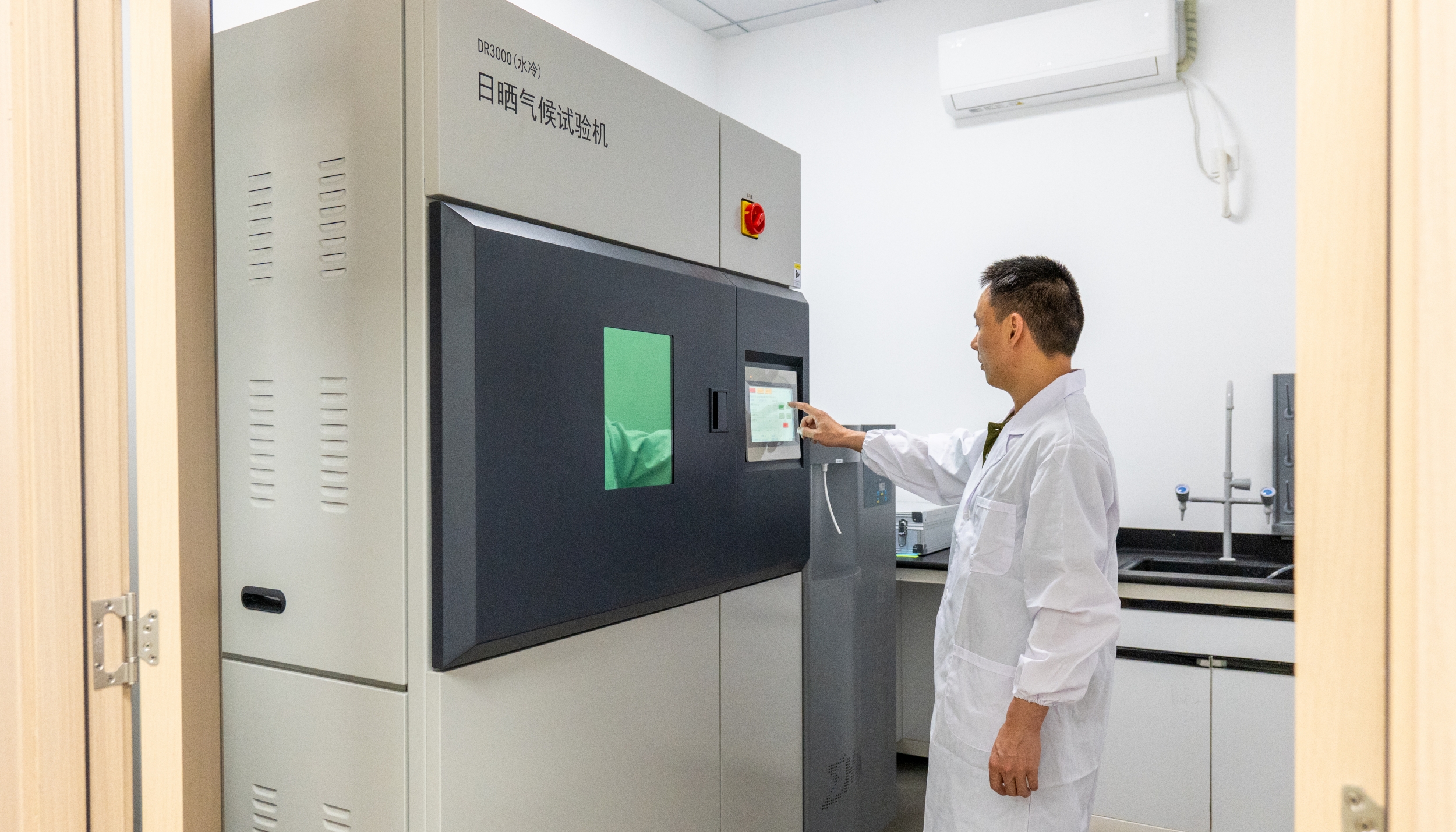
What the anti-mould report actually records
The MicroGuard anti-mould claim rests on one defined test: GB/T 24346-2009, Textiles — Evaluation for Anti-Mould Activity, performed by SGS on a Nylon 66 specimen, held for 28 days at 28°C and 90% relative humidity. The recorded result is Grade 0.
Each element of that sentence removes a different uncertainty. The standard name tells you which evaluation method produced the grade, because anti-mould claims are method-dependent and two suppliers citing different standards are not describing comparable events. The laboratory name tells you who performed and signed the assessment, and it gives you a report number and a specimen description to trace. The material tells you what was actually in the chamber: Nylon 66, the primary tested material for this family. The conditions and duration tell you how hard the specimen was pushed.
What the grade does not do is travel automatically. MicroGuard is offered in widths of 20 mm, 25 mm, 38 mm and 50 mm with typical thickness of 1.0–1.5 mm depending on construction, in customisable colours and constructions. A result obtained on one specimen of Nylon 66 is a record of that specimen. A buyer ordering a 38 mm dyed construction for a stroller harness should confirm that the functional finish is applied to that width and colour and ask whether a report exists for it, rather than assuming a single grade covers the catalogue.
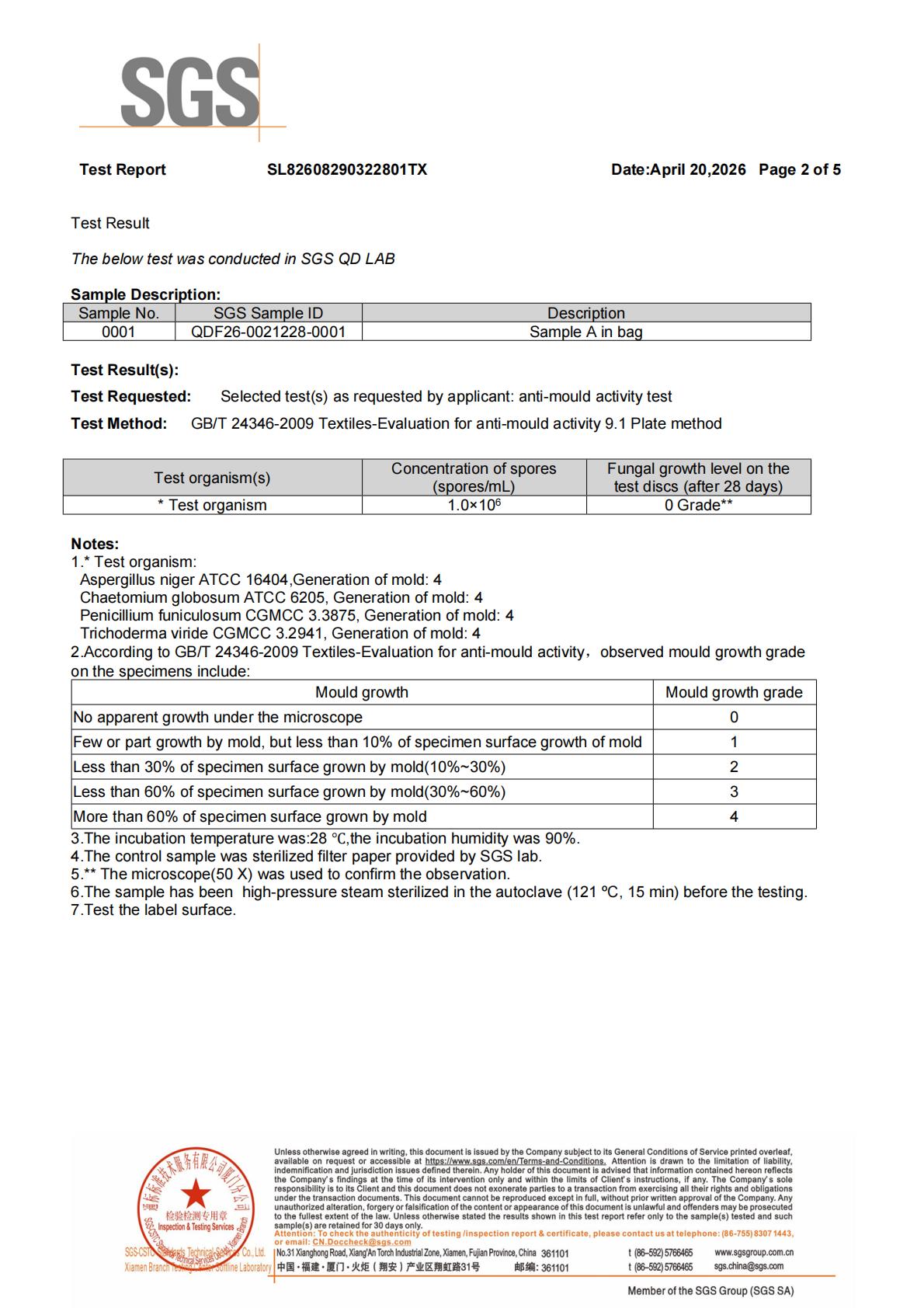
Why 28 days at 28°C and 90% relative humidity is the number to question
Twenty-eight days is not an arbitrary waiting period. It is a sustained incubation window during which a specimen sits in continuously warm, continuously humid air — the condition that lets mould establish itself if a surface or fibre will support it. The parameters are deliberately set at the upper end of comfortable indoor climate: 28°C is a warm room, 90% relative humidity is air close to saturation.
For a buyer, that combination maps onto specific failure scenarios rather than average use. It resembles a tent packed away wet and left in a vehicle, a cooler bag stored in a humid garage between seasons, a stroller kept in a tropical apartment, or a backpack shipped through a monsoon port and warehoused without dehumidification. If your product's realistic worst case is drier or cooler than the test, the result is a margin in your favour. If your worst case is wetter for longer, treat the grade as a floor rather than a ceiling.
Two questions worth asking before accepting the grade. First, whether the report states any pre-treatment of the specimen — cleaning, abrasion or washing before exposure changes what the result represents. Second, whether the observation line beside the grade has been read, because the grade condenses a visual assessment into a single value and the assessment itself describes what was seen on the specimen.
One boundary deserves stating plainly: an anti-mould finish is not sterilisation and not a permanent shield. The MicroGuard treatment is designed to reduce the risk of mould growth and odour build-up from moisture, sweat, skin oils and everyday contact, and to limit mould-related fibre deterioration such as yellowing and brittleness. It does not remove the need for the cleaning and drying routines that gear brands already specify to end users.
The aging report: 400 hours, 29,913 N and a 3.9% loss
AgingGuard Webbing, reference model 30-3000, was tested as a 30 mm wide, 3.0 mm thick construction weighing 63 g/m. The specimen was exposed to fluorescent UV weathering in 4-hour light and 4-hour condensation cycles for 400 hours, with FZ/T 65002-1995 and GB 5725-2009 cited as reference standards. Breaking strength before exposure was 29,913 N; after exposure it was 28,760 N. That is a strength loss of 3.9%, against a technical requirement of no more than 8%.
Three things in that paragraph are doing real work. The cycle structure is the first. Alternating four hours of UV with four hours of condensation is harsher than continuous light alone, because the condensation phase reintroduces moisture onto the specimen between exposures — the combination of light, heat and water is what drives surface and fibre degradation in webbing used outdoors. A report built on light exposure without a wet phase is measuring a narrower set of stresses.
The second is the duration. Four hundred hours is a screening exposure, not a service-life forecast. Accelerated weathering compresses time under controlled irradiance and moisture; it does not translate into a number of years in the field, and no responsible reading converts 400 hours into a warranty period. What the duration does provide is comparability: a competitor's webbing tested for the same time, under the same cycle, against the same reference standards, can be compared on the same terms.
The third is the requirement line. The value that decides acceptance is not the 3.9% figure on its own but the distance between it and the ceiling the specification allows. Arithmetic on the reported values gives a drop of 1,153 N, which is the strength a 30 mm strap gives up in the test — useful when a design margin was calculated on the initial figure. The 8% ceiling is a pass line; the 4.1 percentage points of headroom between the result and that line is the more practical number for a buyer setting internal limits.
| Report field | AgingGuard entry | What the buyer should do with it |
|---|---|---|
| Specimen | 30 mm width, 3.0 mm thickness, 63 g/m, high-tenacity polyester reference material | Match it to your ordered construction; a different width, thickness or base polymer is a different specimen |
| Reference standards | FZ/T 65002-1995 and GB 5725-2009 | Confirm a competing quote cites the same methods before comparing percentages |
| Exposure cycle | Fluorescent UV, 4 h light / 4 h condensation | Check that a wet phase exists; light-only data understates moisture-driven loss |
| Duration | 400 hours | Use for comparison, not for converting into years of outdoor life |
| Breaking strength | 29,913 N before, 28,760 N after | Recalculate any design margin on the post-aging figure |
| Strength loss | 3.9% | Compare with your own ceiling, not with the supplier's |
| Technical requirement | ≤8% strength loss | Treat as the pass line; headroom below it is the risk buffer |
Material scope matters here too. High-tenacity polyester was the tested reference, while Nylon 66 and other polyester or nylon constructions are available for development. A 3.9% result belongs to the polyester construction that was evaluated. A nylon version of the same webbing would need its own evidence, and a buyer who assumes otherwise is carrying an untested assumption into a specification.
Four fields that decide whether a result travels to your order
Most misreadings of functional webbing reports come from quoting a headline number while ignoring the four fields that make it meaningful. Check them in this order.
- Specimen identity. Material, width, thickness, mass per metre and colour. The aging report specifies 30 mm, 3.0 mm and 63 g/m, which is enough to place it against a purchase order. A report that describes only 'webbing' cannot be matched to anything.
- Method and reference standard. GB/T 24346-2009 for anti-mould activity, FZ/T 65002-1995 and GB 5725-2009 for the weathering work. Standards are method documents; different methods produce numbers that cannot be subtracted from one another.
- Conditions and duration. 28 days at 28°C and 90% relative humidity on one side; 400 hours of alternating UV and condensation on the other. Strip the conditions out and the result stops being comparable to any other result.
- Laboratory and report reference. SGS performed the anti-mould evaluation, and the report carries an identifier that can be traced and re-verified. A laboratory report is a record of a specimen tested on a date — it is not a product-wide certificate covering every future shipment.
That last distinction is where document classes get confused. A management-system certificate, a process certification and a performance test report each prove something different, and a submission that contains all three is stronger than one that contains any single document.
| Document class | Example in a webbing submission | What it establishes | What it does not establish |
|---|---|---|---|
| Performance test report | SGS anti-mould report to GB/T 24346-2009; 400-hour weathering report | A measured result on a described specimen under stated conditions | That every width, colour or construction performs identically |
| Quality management system | ISO 9001:2015, certificate 00224Q22797R0M, scope covering design and processing of functional webbing | That a documented quality system is in place for the certified scope | Any specific performance value |
| Chemical and process certification | bluesign System Partner 027.131.001, scope webbings and ribbons | System-partner status for the certified scope | Anti-mould or strength-retention performance |
| Recycled content certification | GRS certificate SGC-GRC03622-GRS-2026-09, covering preparatory, weaving, dyeing, finishing and packing | Chain-of-custody coverage for recycled content across listed processes | Durability or weathering behaviour |
| Product safety certification | OEKO-TEX Standard 100 Class 1, certificate SH010273603.1 | Compliance of the certified article scope with the Standard 100 limits | Mould resistance or aging performance |
Where each report carries weight in real gear
The anti-mould report and the aging report matter in different places on the same product, which is why a single-document submission is usually incomplete.
On backpacks, hiking packs and cooler bags, moisture is internal and persistent: drink spillage, damp clothing, condensation inside an insulated compartment. That is the environment MicroGuard was developed for, and it is also where odour control has a user-visible effect on returns and reviews. The same pack's shoulder straps, compression straps and haul loops live in the opposite condition — sun exposure, rain, repeated tension — which is the AgingGuard question. A brand specifying both should expect two separate documents.
On camping and tie-down products, UV load dominates. Camping webbing specifications in the same catalogue cite UV fastness of Grade 4.5 after 1000 hours under ISO 105, and water absorption below 0.5%; those are colour-fastness and absorbency measures, not strength-retention measures, and they should not be quoted as if they were aging data. On marine and life-saving equipment, salt water and light are both in play, and nylon outdoor webbing in the catalogue is specified at Grade 4 colour fastness to light (ISO 105-B02) and Grade 4-5 salt water resistance (ISO 105-E02). Each grade answers a narrow question, and stacking them into a general claim of durability is exactly the overreach buyers should resist.
On strollers and pet products — harness straps, leash webbing, adjustable belts — the dominant stress is high-contact handling plus humidity rather than extreme UV. That is the case where an anti-mould and odour-control result carries more decision weight than a 400-hour weathering figure.

Treated versus untreated: comparing documents, not adjectives
Buyers often want a simple statement that a treated webbing outperforms untreated webbing. The honest version is narrower and more useful: treated families arrive with graded results under named standards and stated conditions, while an untreated or uncharacterised alternative usually arrives with no comparable document at all. The comparison you can defend is document against document, not adjective against adjective.
A like-for-like evaluation therefore needs matched conditions on both sides: same width and thickness, same base polymer, same test method, ideally the same laboratory, and both an anti-mould grade and a strength-retention figure. Where only one side supplies performance data, the absence is the finding — not proof of failure, but proof that the claim is unverified.
Two fit boundaries belong with any treated recommendation. First, treatment adds a process step, so availability must be confirmed across the widths and colours you actually order; MicroGuard is offered in 20, 25, 38 and 50 mm with custom widths available, and webbing orders in this catalogue carry a minimum of 3,000 metres per colour per specification, with lead times of 7–25 days depending on size and customisation. Second, the aging data covers retained breaking strength after UV and condensation. It does not measure abrasion resistance, flex fatigue, chemical exposure or colour shift beyond what is separately reported, and a specification that needs those answers should ask for those tests.
Reading documents as a lifecycle item
The part of a compliance file that most often goes unmanaged is the calendar. Certifications in this catalogue carry explicit validity periods: the OEKO-TEX Standard 100 Class 1 certificate SH010273603.1 runs to 15 December 2026, the GRS certificate SGC-GRC03622-GRS-2026-09 to 6 September 2027, and the ISO 9001, ISO 14001 and ISO 45001 certificates to 20 May 2027. Bluesign System Partner status 027.131.001 is recorded from 5 January 2026.
A supplier review that checks only whether a PDF exists will eventually approve a file whose certificates have lapsed between audits. The practical fix is mundane: record issue and expiry dates in the same register as prices and lead times, and diarise renewal confirmation ahead of the expiry month rather than after it.
Test reports need a different kind of refresh. They do not expire on a fixed date, but they do age out of relevance when the construction changes — a new base polymer, a different width, a reformulated finish. The forward-looking discipline for a sourcing team is to tie each report to a specific construction in the technical file and to re-request evidence whenever that construction changes. On that basis the certificate gets a supplier shortlisted, while the specimen line and the condition line decide which supplier holds the order.
Frequently asked questions
What does Grade 0 mean on a GB/T 24346-2009 anti-mould report?
Grade 0 is the result recorded for the tested specimen after 28 days at 28°C and 90% relative humidity, evaluated by SGS against GB/T 24346-2009, Textiles — Evaluation for Anti-Mould Activity. The number summarises a visual assessment, so it should be read together with the observation recorded in the report and with the specimen description. The grade belongs to that specimen and that method; it is not a statement about every width, colour or construction in a product family.
Is a 3.9% strength loss after 400 hours of weathering a good result?
It is a documented result rather than a universal verdict. In the AgingGuard report, 3.9% sits well inside the stated technical requirement of no more than 8% strength loss, which means the tested specimen retained roughly 28,760 N of an initial 29,913 N at 30 mm width and 3.0 mm thickness. Whether that margin is acceptable depends on the design margin the buyer calculated for the finished strap, and on whether the buyer's own specification sets a tighter ceiling than 8%.
Do these anti-mould and aging reports cover every width and colour?
No. Both documents describe specific specimens: Nylon 66 for the anti-mould evaluation, and a 30 mm, 3.0 mm, 63 g/m high-tenacity polyester construction for the 400-hour weathering test. Widths from 20 mm to 50 mm, custom colours and alternative nylon or polyester constructions are available, but each is a separate specification. Buyers should confirm that the functional finish is applied to the exact construction ordered and ask for evidence covering it.
What is the difference between a test report and a certificate?
A test report records a measured result for a described specimen under stated conditions and cites the method used — for example GB/T 24346-2009 for anti-mould activity or FZ/T 65002-1995 and GB 5725-2009 for weathering. A certificate covers a system, process or compliance scope, such as ISO 9001 for quality management, GRS for recycled-content chain of custody, bluesign System Partner status or OEKO-TEX Standard 100 for product safety limits. One does not substitute for the other, and a complete submission contains both kinds.
How should two suppliers' anti-mould claims be compared?
Compare method first: the same standard, the same conditions and duration, and a specimen description detailed enough to match against the order. Compare the laboratory and the report reference so both results can be traced. Only then compare grades, and place both next to the requirement the buyer has set. Where one supplier provides no method or specimen detail, the comparison cannot be completed on grades alone, and the missing data is itself the answer.
¿Tiene preguntas o necesita más detalles?
Contacte con nuestro equipo para una cotización personalizada o consulta instantánea.
Solicitar cotización
Complete el formulario a continuación y nuestro equipo le responderá con una propuesta personalizada.
Chat directo de WhatsApp
¿Prefiere chatear en tiempo real? Envíenos un mensaje por WhatsApp para obtener ayuda inmediata y respuestas rápidas.
- Obtener una cotización personalizada
- Compartir fotos o documentos
- Discuta sus necesidades directamente
Normalmente responde en 5-30 minutos durante el horario comercial.