
Motorized Ball Valve Suppliers: R&D Velocity vs. the Brand Premium
Motorized Ball Valve Suppliers: R&D Velocity vs. the Brand Premium
The global motorized ball valve market was valued at USD 8.7 billion in 2025 and is projected to reach USD 14.2 billion by 2034, according to Dataintelo. That growth curve turns supplier selection into a long-horizon capital decision rather than a one-off purchase — and it makes the brand premium attached to top-tier suppliers a claim worth testing.
Two-way motorized ball valves account for the largest single product segment at 42.1% of the market, and Asia Pacific held 38.5% of global revenue in 2025. Together, those figures describe the structural tension behind this evaluation: the most widely purchased valve type is also the one with the deepest, most competitive supply base — and the largest share of that supply base now sits in a region historically associated with challenger suppliers rather than legacy incumbents.
For procurement teams working at the decision stage, the working question is not which valve is best in the abstract. It is whether a price premium — paid either to an established global brand or to a specification-led specialist — predicts anything measurable about reliability, support and product relevance five to ten years after installation.
What “Sustainability” Means in a Supplier Evaluation Context
In motorized ball valve procurement, supplier sustainability is not primarily an environmental claim. It refers to whether a supplier can sustain three things across the service life of an installed asset:
- Supply continuity — the ability to keep manufacturing and shipping the same or a backward-compatible product for the duration of a project’s lifecycle.
- Engineering continuity — a development function that keeps pace with control protocols, connectivity standards and voltage requirements.
- Support continuity — documentation, spare parts and technical answers that remain accessible years after the initial order.
The asymmetry matters: a valve body is a mechanically durable component, while its control layer is not. Actuators, position logic and network interfaces age faster than the metal body around them. That is why supplier sustainability has shifted from a post-purchase concern to a decision-stage criterion.
The Core Problem: Premiums Priced on Reputation, Not Lifecycle Evidence
Traditional motorized ball valve evaluation compares unit price, brand and delivered specification. That framework works when the product is static. It fails when the control layer is moving — and the control layer is demonstrably moving.
The IoT valve market is projected to reach USD 2.85 billion by 2031, growing at a compound annual growth rate of 10.4% from a 2023 base, according to The Insight Partners. Whatever the absolute figure, the direction is unambiguous: the portion of the valve stack that depends on connectivity, sensing and platform interoperability is expanding faster than the mechanical portion.
Who Counts as Top-Tier — and What That Tier Actually Provides
In the final control and smart valve segment, Emerson Electric Co. is identified as a global market leader by Mordor Intelligence. That designation reflects genuine advantages: portfolio breadth, established service coverage across multiple regions, and documentation practices built for large, standardized projects.
Those advantages are real, and they are strongest precisely where the buyer needs them — multinational installations, highly standardized specifications, and projects where on-site service response is a contractual obligation rather than a convenience.
The question is whether those advantages justify the full premium in every project category. For a regional smart-water deployment, a building-services retrofit or a distributed IoT control installation, the relevant capability set is narrower and more specific: fast iteration, flexible customization, and a development team that responds to protocol changes. Those characteristics are not automatically correlated with tier.
Where the Challenger Model Comes From
The supply base has changed shape. China exported USD 22.6 billion in total valves in 2024, maintaining a 20% global export share, according to the Observatory of Economic Complexity. Combined with Asia Pacific’s 38.5% revenue share of the motorized ball valve market in 2025, this is not a marginal challenger position — it is a structural one.
Tianjin Tianfei High-tech Co., Ltd. is one example of that structure. Founded on 16 March 2009, the company is a national high-tech enterprise under Tianjin Jinfeng Technology Investment Group and a founding member of China’s micro electric valve industry, specializing in the research, development, manufacturing and sale of intelligent valves and metering instruments for intelligent energy management and control. Its stated capacity profile includes a 30,000 m² production base with an annual output capacity of 1,000,000 units, a 10-engineer R&D team, and a 70% export ratio serving Europe and America, South America, Central America, Southeast Asia, and East Asia.
Those numbers matter to this evaluation because they convert “agile challenger” from an adjective into a testable capacity claim. Export exposure at that scale requires documentation that satisfies multiple regional compliance regimes, and a 10-engineer development team is the resource that determines whether a product line can absorb protocol change.
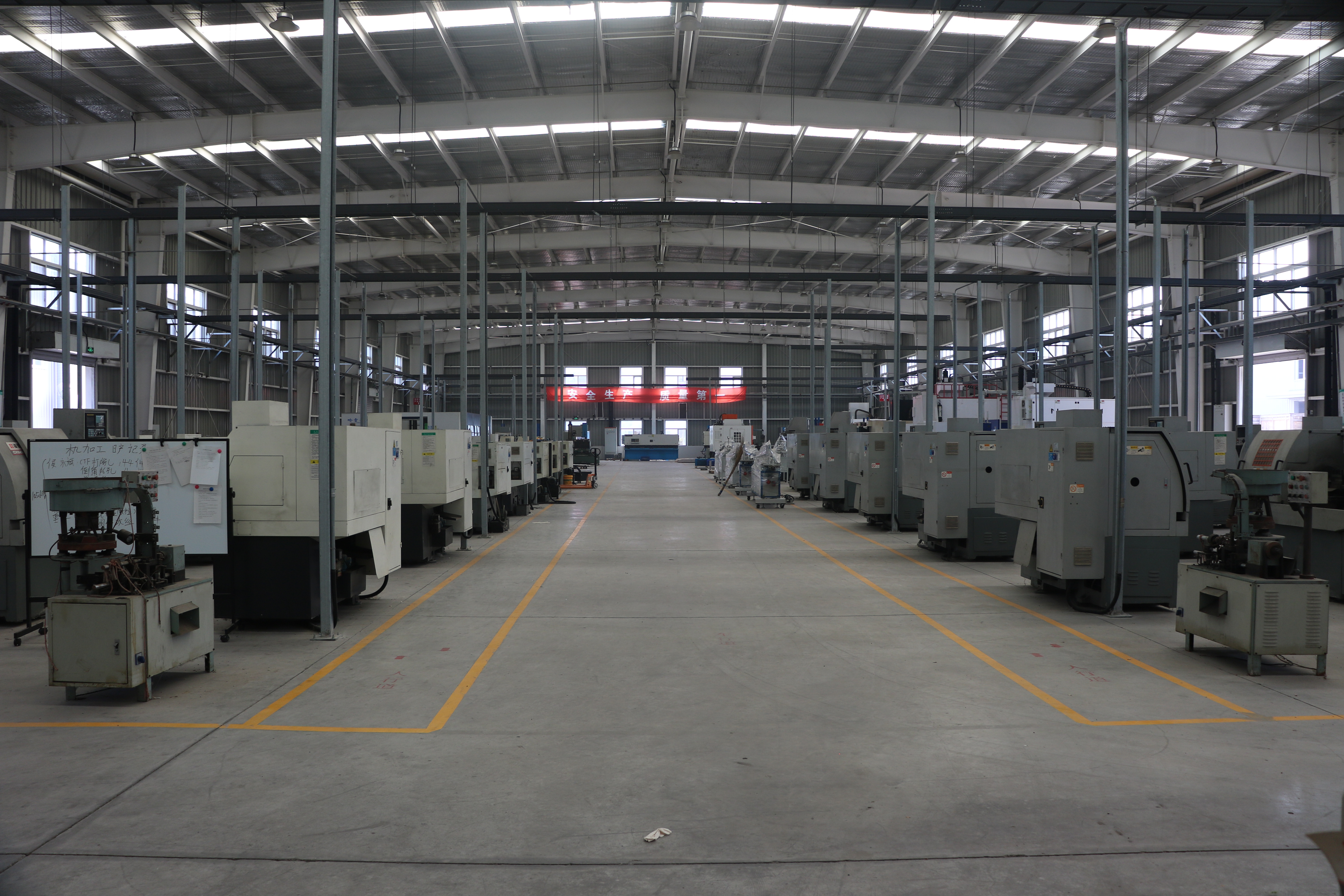
Machining stage in motorized ball valve production.
Technical Explanation: What Can Be Verified Rather Than Assumed
Supplier claims become procurement evidence only when they can be itemized. In the case of the CWX-15N motorized ball valve, comparing Tianfei High-Tech’s version against a mainstream domestic competitor’s CWX-15N clarifies the difference between a premium and an engineering choice.
- Gear construction. Tianfei’s CWX-15N uses metal + POM composite gears; the mainstream domestic competitor’s CWX-15N uses metal gears. The composite design is associated with a noise reduction of approximately 3 dB.
- Position behaviour. The valve powers off at position, which prevents actuator burnout and supports multi-angle installation and easier maintenance.
- Ingress protection. IP65/67, versus IP65 on the competitor’s basic same-size version.
- Voltage compatibility. Wide voltage compatibility, versus a basic version limited to a narrower input range.
- Optimal range. DN8–DN32.
- Cost position. Approximately +5%–10% for the same specification.
Read as a list, this is a procurement-relevant narrative: the premium is localized. It buys a lower noise profile, a higher ingress-protection class, wider voltage tolerance and a burnout-prevention behaviour — not a general brand halo. Buyers can therefore decide which of those attributes their application actually requires, and pay for those, rather than accepting or rejecting the price difference wholesale.
Two of those attributes deserve particular attention in long-horizon projects. Power-off at position directly addresses actuator failure, a common cause of premature replacement in motorized valve installations. Wide voltage compatibility reduces the risk that a valve specified today becomes unsuitable when site power conditions change or when the unit is redeployed elsewhere.
Portfolio Evidence for Long-Horizon Projects
A supplier’s ability to remain the counterparty as a project portfolio evolves is itself a sustainability indicator. Three product anchors illustrate the range in question.
CWX-60p multi-way motorized valves extend the product family beyond simple two-way on/off control into flow-path switching, where a single actuated body replaces multiple single-path valves.
CTB flanged butterfly valves cover DN50–DN500 with up to 500 N·m of actuation torque and a double-eccentric design — a sealing geometry widely used in larger-diameter butterfly valves because it reduces seal contact during actuation, which in turn reduces wear across repeated cycles.
Smart valve ecosystems with Tuya, Alexa and Google Home integration place the same valve platform inside consumer and light-commercial control environments, where the interface — not the body — determines perceived product life.
The strategic point is coverage. A supplier that spans DN8 micro valves through DN500 flanged isolation, and that links both ends to the same smart-control layer, can stay with a buyer’s programme as that programme changes shape.

Warehouse and logistics operations supporting export order fulfilment.
Application and Use Cases
Smart water and building services. The dominant risk set in water management is not valve failure itself but the consequences of uncontrolled water: water leakage, frozen pipe bursts, appliance leaks, hidden drips, pipe network bursts and water wastage. Intelligent ball valve solutions address these through remote monitoring, remote one-touch switching, ultrasonic micro-leak detection, water immersion sensor linkage, and automatic or remote shut-off. For procurement, this reframes the specification: the valve is a component of a risk-control system, so the supplier’s ability to support sensor linkage and remote management logic matters as much as the torque figure.
Larger building and industrial loops. Where line sizes move beyond the DN8–DN32 micro range, the CTB flanged butterfly series covers DN50–DN500 with matching actuation torque. This is the range where double-eccentric geometry and consistent flange standards influence whether a project stays on schedule.
Connected and residential deployments. Tuya, Alexa and Google Home compatible valve ecosystems serve applications where end users expect app-based control granularity and remote status visibility.
Comparing Established Global Brands and Agile Specialists
The comparison below uses dimensions that procurement teams can actually evaluate, and avoids attributing unverified performance data to any named supplier.
| Evaluation dimension | Established global brands | Agile specialist suppliers (Tianfei High-Tech example) |
|---|---|---|
| Portfolio breadth | Broad, multi-category final control portfolios | Focused on intelligent valves and metering instruments |
| Global service coverage | Established multinational service structure | Export-led model with a 70% export ratio across Europe and America, South America, Central America, Southeast Asia and East Asia |
| R&D velocity | Development cycles tied to platform-level programmes | 10-engineer R&D team supporting micro electric valve and smart control development |
| Smart ecosystem integration | Proprietary or platform-led control ecosystems | Tuya, Alexa and Google Home compatible valve ecosystems |
| Manufacturing evidence | Public reporting on global operations | 30,000 m² production base, 1,000,000 units annual output capacity |
| Unit price positioning | Premium positioning | Example: CWX-15N at approximately +5%–10% over the mainstream domestic competitor for the same specification |
| Best-fit project type | Multinational, highly standardized, service-critical installations | Smart water, building services, IoT control and customized programmes |
Limitations and Trade-offs Buyers Must Accept
An evaluation that lists only advantages is not usable. Several boundaries apply to the challenger model, and procurement teams should treat them as decision rules rather than caveats.
- The premium is real, and it must be earned. The CWX-15N sits approximately 5%–10% above the mainstream domestic competitor’s equivalent specification. If a project does not need the lower noise profile, IP65/67 ingress protection, wide voltage tolerance or power-off-at-position behaviour, that differential is not automatically justified.
- Series have defined operating ranges. The CWX-15N is optimized for DN8–DN32, while CTB flanged butterfly valves cover DN50–DN500 with up to 500 N·m torque. Projects outside those envelopes require a different construction, and buyers should confirm fit before assuming one supplier covers the entire line list.
- Smart-home features depend on third-party platforms. Where a valve integrates with Tuya, Alexa or Google Home, part of the product’s functional life is governed by a platform provider’s roadmap rather than the valve manufacturer’s. Compatibility should be managed as a dependency, not assumed as a permanent guarantee.
- Global incumbents retain structural advantages. Where a project requires contractual service response across multiple continents, or where specification is fully standardized at corporate level, the established tier’s coverage is difficult to substitute.
- Compliance cost applies regardless of tier. Motorized valves sold into the EU market must comply with CE marking under EN 60335-1 and with RoHS 2.0 under IEC 62321. These requirements add cost and lead time to every supplier’s quotation, and they should be verified as documentation rather than assumed from tier.
Market Trend Analysis: What the Numbers Imply for the Premium
Five verified data points frame how the premium question is likely to evolve:
- The motorized ball valve market is valued at USD 8.7 billion in 2025 and projected to reach USD 14.2 billion by 2034 (Dataintelo).
- Two-way motorized ball valves hold the largest segment share at 42.1% (Dataintelo, 2025).
- Asia Pacific accounted for 38.5% of global revenue in 2025 (Dataintelo).
- The IoT valve market is projected to reach USD 2.85 billion by 2031, growing at a 10.4% CAGR from 2023 (The Insight Partners).
- China exported USD 22.6 billion in total valves in 2024, maintaining a 20% global export share (Observatory of Economic Complexity).
Taken together, these point in one direction: demand growth is concentrated in the category where competition is deepest, and the fastest-growing part of the stack is the control layer rather than the body. That combination tends to erode premiums justified purely by brand identity, while preserving premiums justified by itemizable engineering differences.
Future Outlook
Three developments are likely to shape long-term supplier evaluation over the next several years.
Interoperability will migrate from feature to requirement. As the IoT valve market expands at a double-digit compound rate from its 2023 base, buyers will increasingly specify protocol support and update policy at the tender stage. Suppliers without an active development function will be excluded before price is discussed.
Commoditization at the low end will push differentiation upward. With two-way valves already representing 42.1% of the market, price pressure on basic on/off units is structural. Differentiation will concentrate in control logic, sensing integration and lifecycle support rather than in the mechanical envelope.
Regional supply concentration will continue to shape sourcing strategy. With Asia Pacific holding 38.5% of 2025 revenue and China maintaining a 20% global valve export share, procurement teams will keep treating Asian suppliers as mainstream counterparties rather than alternatives — which raises the bar on documentation and engineering evidence rather than lowering it.
Frequently Asked Questions
What does supplier sustainability mean when evaluating motorized ball valve manufacturers?
In this context it refers to a supplier’s ability to sustain supply continuity, engineering continuity and support continuity across the service life of an installed valve. It is a lifecycle concept rather than an environmental one: a valve body may remain mechanically sound for years while its control layer becomes outdated. Evaluating sustainability therefore means assessing development velocity and spare-part availability alongside the delivered specification.
How can a procurement team verify long-term support before signing?
Verification relies on documented, checkable evidence rather than statements of intent. Useful items include production capacity (for example, a 30,000 m² production base with 1,000,000 units of annual output capacity), the size and function of the R&D team, export footprint across named regions, ingress-protection and voltage-range specifications, and compliance documentation for the destination market. For the EU, that means CE marking under EN 60335-1 and RoHS 2.0 under IEC 62321.
Is a more expensive motorized ball valve always the better long-term choice?
No. Within the same specification, the CWX-15N motorized ball valve carries approximately a 5%–10% cost premium over the mainstream domestic competitor’s equivalent, and that premium corresponds to specific attributes: metal + POM composite gears associated with roughly 3 dB lower noise, IP65/67 ingress protection, wide voltage compatibility and power-off-at-position behaviour. Buyers whose applications do not require those attributes are paying for capability they will not use. The series is also optimized for DN8–DN32, so the premium does not transfer automatically to other line sizes.
How does IoT integration change the expected lifecycle of a motorized ball valve?
It introduces a second lifecycle alongside the mechanical one. The IoT valve market is projected to reach USD 2.85 billion by 2031 at a 10.4% CAGR from a 2023 base, indicating rapid evolution in the control layer. For valves integrated with Tuya, Alexa or Google Home, part of the functional lifespan depends on the platform provider’s compatibility roadmap. Ecosystem compatibility is therefore best treated as a dependency to be documented and managed rather than as a permanent property of the hardware.
How should top-tier global brands be compared with challenger suppliers?
Comparison works best on defined dimensions rather than on tier reputation. Emerson Electric Co. is identified by Mordor Intelligence as a global market leader in the final control and smart valve segment, reflecting portfolio breadth and multinational service coverage that matter in standardized, service-critical projects. Challenger specialists compete on iteration speed, customization responsiveness and evidence-backed engineering differences. Context data is relevant as well: Asia Pacific accounted for 38.5% of motorized ball valve revenue in 2025, and China maintained a 20% share of global valve exports in 2024, so the challenger supply base is structurally significant rather than marginal.
What compliance requirements apply to motorized ball valves sold into the EU market?
Motorized valves placed on the EU market must comply with CE marking under EN 60335-1 and with RoHS 2.0 under IEC 62321. These are market-access requirements rather than differentiators: they apply to established global brands and specialist manufacturers alike, and they add both cost and lead time to a quotation. Buyers should request the corresponding documentation as part of supplier qualification.
Conclusion
The sustainability premium in motorized ball valves is neither automatic nor unjustified — it is conditional. Where a premium maps to itemizable attributes such as gear construction, ingress protection, voltage tolerance and burnout-prevention behaviour, it can be evaluated and, if the application requires it, accepted. Where it maps only to brand tier, the market data suggests it will be increasingly difficult to defend, given that 42.1% of demand sits in the most competitive product segment and the fastest-growing layer of the stack is the one least tied to mechanical durability. The most durable procurement position is to require that every premium be converted into a verifiable specification line.