
Monalisa vs. Global Porcelain Tile Brands: Independent Buyer's Verdict on 120-270FEG12207M
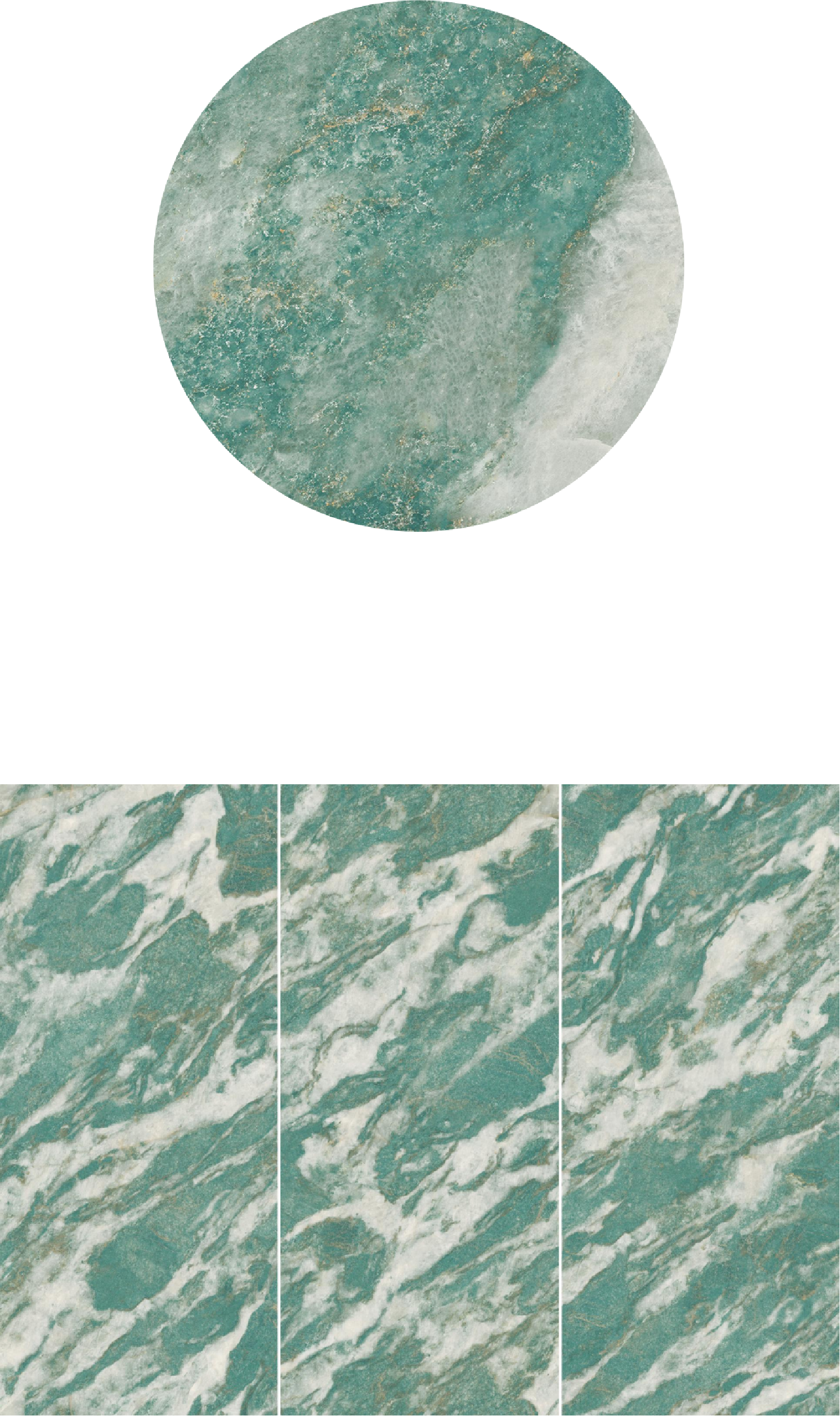
Large-format porcelain tile has shifted from a design preference to a procurement decision. Spherical Insights values the global porcelain tile market at approximately USD 9.73 billion in 2024 and projects it to reach USD 18.33 billion by 2035 — expansion driven less by new floor area than by substitution: porcelain displacing natural stone, and 1200mm-plus slabs replacing smaller modular formats in residential, commercial, and public specifications.
For a buyer, the usable version of that trend is narrower. It is not "which brand is best" but whether one model can meet the performance requirements of a specific project, and whether the manufacturer behind it can document that capability at scale. This reference examines the Monalisa 120-270FEG12207M — a 1200×2700×12mm homogeneous body porcelain tile — and sets out what is documented about it, which technical thresholds apply to any large-format porcelain specification, and where verification is still required before purchase.
It deliberately avoids two common failures in supplier comparisons: ranking brands on unverifiable preference, and attributing performance figures to competitors that no public source supports. Competitors are named only where a third-party source identifies them.
Why This Comparison Is About a Model, Not a Brand
Most "Monalisa vs. global brands" evaluations begin at the specification stage, when a buyer already has a format and a performance envelope in mind. At that point, brand-level comparison stops being actionable. A buyer does not specify a brand; they specify a size, a surface, a slip class, an absorption rate, and a delivery schedule — then test whether a supplier can satisfy that combination reliably.
Publicly available industry sources identify Mohawk Industries, Grupo Lamosa, and SCG Ceramics among the leading players in the global ceramic and porcelain tile sector. Monalisa Group Co., Ltd. operates a different structural model: a Foshan-headquartered manufacturer whose production is concentrated in four Chinese bases, and whose export ratio is 10%, meaning the large majority of its output serves the domestic Chinese market. That difference shapes lead times, stock policy, and local service coverage — factors that typically matter more to a project buyer than brand recognition.
The fair basis for comparison is therefore the documented capability envelope of a specific supplier and a specific model, measured against the same thresholds applied to any alternative. The following sections do exactly that, and they separate what is verifiable from what is not.
The Specification Behind 120-270FEG12207M
| Attribute | Recorded specification |
|---|---|
| Product name | Porcelain Tile |
| Model | 120-270FEG12207M |
| Type | Homogeneous body tile |
| Size | 1200 × 2700 × 12 mm |
| Phases | 3 |
| Surface finish | Matt / natural stone face |
| Body material | Clay / quartz sand |
| Installation mode | Static, permanently fixed to the building substrate |
Homogeneous body construction means the tile's colour and structure continue through the full thickness rather than sitting in a printed glaze layer on the surface. On a 1200×2700mm slab, that has an operational consequence: large formats are routinely cut for reveals, steps, niches, and book-matched walls, and a body-coloured edge reads more consistently than a glazed biscuit after cutting. It also means the visual outcome depends on the body's mineral composition — here, clay and quartz sand — rather than only on a digital print layer.
The matt, natural stone face defines the surface language. For procurement purposes, the relevant question is not which stone it resembles but which slip-resistance class the ordered finish actually achieves, since slip class varies by finish even within a single product family and must be confirmed per finish rather than assumed.
Performance Thresholds Buyers Should Apply First
Before comparing any two suppliers, a buyer should fix the thresholds. The table below reflects parameters that appear in project specifications for porcelain tile generally, together with the decision each one governs.
| Metric | Threshold used in project specifications | What it decides |
|---|---|---|
| Water absorption | ≤ 0.5% for porcelain under ISO 13006 / ANSI A137.1 | Separates porcelain from ceramic; governs frost behaviour and long-term staining |
| Slip resistance | R9–R11 across the range; R10 or higher for bathrooms | Whether one tile can serve wet rooms, ramps, and pool surrounds |
| Abrasion resistance | PEI 3–5; PEI 4 or higher for commercial and public areas | Surface wear under sustained foot traffic |
| Stain resistance | Grade 5 against common stains such as tea, oil, and ink | Kitchen, hospitality, and food-service suitability |
| Chemical resistance | ULA class | Laboratory and chemical-environment surroundings |
| Freeze-thaw stability | No cracking after 100 freeze-thaw cycles | Outdoor projects in cold climates |
| Dimensional tolerance | Length/width deviation ≤ ±0.2%; thickness ≤ ±5% | Joint width control in tight-joint and large-format installation |
| Environmental compliance | Class A radioactivity (China); CE, GreenGuard, or LEED where the export market requires it | Gate for regulated markets and green building programmes |
| Antibacterial / antiviral | Optional photocatalytic or silver-ion treatment | Hospitals and food-plant projects |
The application profile associated with the 120-270FEG12207M records R9–R11 slip resistance for the family and notes that bathrooms require R10 or above; PEI 3–5 abrasion resistance, with PEI 4 or higher specified for commercial and public areas; grade 5 stain resistance; ULA-class chemical resistance; freeze-thaw stability through 100 cycles; and dimensional tolerances of ±0.2% in length and width with ±5% in thickness. Because these are family-level parameters, a buyer should request the test report tied to the exact finish ordered rather than treating the catalogue entry as a substitute.
What Monalisa Documents as the Manufacturer
Monalisa Group Co., Ltd. is a Foshan, Guangdong-based architectural ceramics manufacturer founded in 1992 and listed under 002918.SZ. It operates ten holding subsidiaries and four modern production bases — Xiqiao (Foshan), Qingyuan (Guangdong), Tengxian (Guangxi), and Gao'an (Jiangxi) — running a total of 37 production lines. The company records annual output of approximately 100 million m² and monthly capacity of 12.5 million m², with a factory area of 2,779,333.33 m² and 4,106 employees.
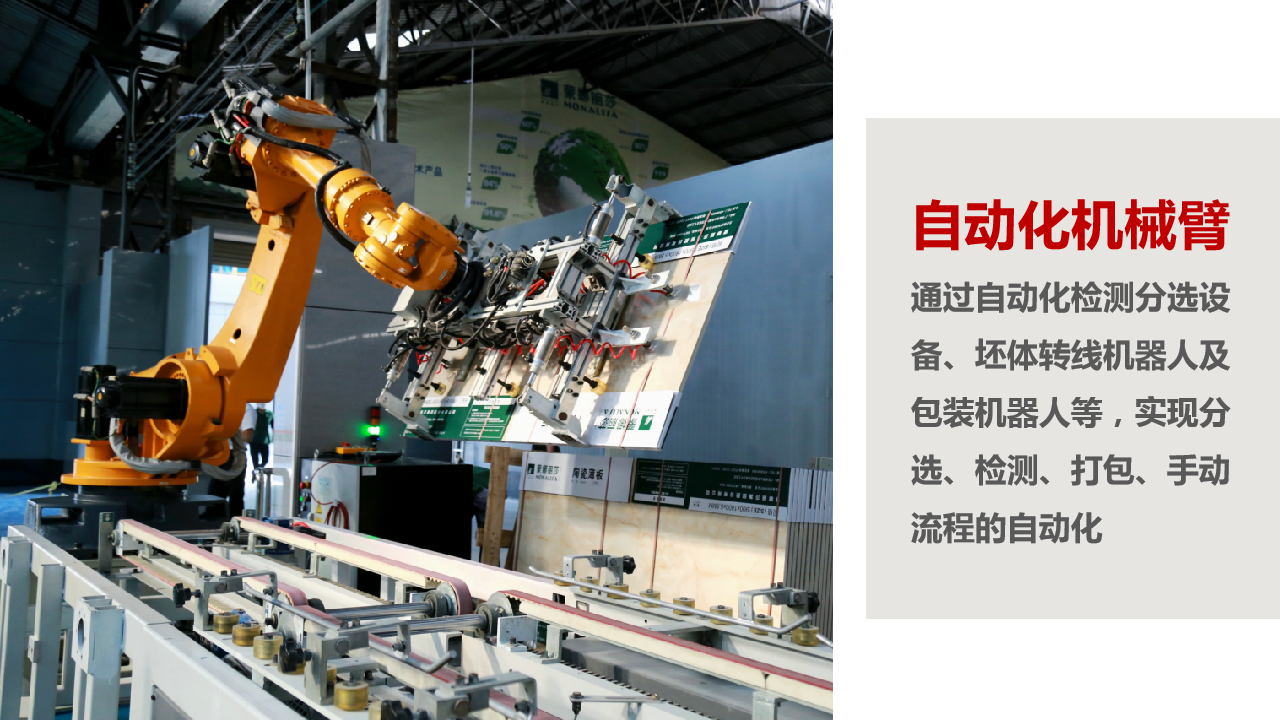
On research and standardisation, the company reports a 100-engineer R&D team, 892 authorized patents including 145 invention patents as of June 2021, and participation in drafting 49 national, industrial, local, and group standards. On quality and environmental governance, it holds 15 certifications including ISO 9001 and ISO 14001, has received the Foshan Municipal Government Quality Award and the Guangdong Provincial Government Quality Award, and was nominated for the third China Quality Award. Production runs under the company's "3M" quality management model with 100% testing. Environmental recognition includes national "Resource-saving and Environment-friendly" pilot enterprise status and inclusion among the first batch of Ministry of Industry and Information Technology "Green Factories", supported by zero wastewater discharge.
Commercial and service terms recorded in the capability profile include OEM/ODM production, customization of pattern and logo, a minimum order quantity of 2,000 m², lead time of 7–15 days, a product warranty of 5–15 years depending on series and project type, a same-batch stock reserve held for two years, complaint response within 24 hours with a solution within 7 working days, on-site technical support for large projects, and online or offline training for distributors and installation teams. Project references include venues for the Beijing Olympic Games, ten venues for the Guangzhou Asian Games, and the Hong Kong–Zhuhai–Macao Bridge; the company was also the designated ceramic tile supplier for the China Pavilion at Expo 2020 Dubai and the exclusive supplier of official architectural ceramics for the 19th Asian Games Hangzhou 2022.
For a buyer, these facts are useful in a specific way. Standard-drafting participation and patent volume indicate specification literacy rather than decorative marketing. The two-year same-batch stock reserve directly addresses the most common failure mode in tiled projects: a repair carried out years later that cannot be colour-matched to the original installation. And the 7–15 day lead time is a production statement, not a delivered-lead-time statement — it should be re-confirmed against port, shipping, and customs timelines for the destination market.
How Monalisa Compares With Global Porcelain Tile Brands
Third-party sources identify Mohawk Industries, Grupo Lamosa, and SCG Ceramics among the leading players in the global ceramic and porcelain tile sector. Monalisa is not positioned as a replacement for their regional manufacturing reach, and no public source supports a claim that its products outperform any specific competitor model. What can be compared fairly is the evidence each supplier model makes available — and what a buyer must verify in either case.
| Evaluation dimension | Monalisa — documented | What to verify with any global brand |
|---|---|---|
| Manufacturing footprint | Four production bases: Xiqiao (Foshan), Qingyuan, Tengxian, Gao'an; 37 production lines | Which plant serves your region, and what that means for freight and lead time |
| Announced production capacity | ~100 million m² annual output; 12.5 million m² monthly | Capacity actually allocated to your format, finish, and order size |
| R&D and standardisation | 100-engineer R&D team; 892 authorized patents incl. 145 invention patents (as of June 2021); 49 standards drafted | Current patent portfolio and active standards participation |
| Certification | 15 certifications including ISO 9001 and ISO 14001 | Scope and validity of each certificate, plus market-specific marks such as CE |
| Project references | Beijing Olympic venues; Guangzhou Asian Games venues; Hong Kong–Zhuhai–Macao Bridge; Expo 2020 Dubai China Pavilion; 19th Asian Games Hangzhou 2022 | References in your building category and at comparable scale |
| Commercial terms | OEM/ODM with pattern and logo customization; MOQ 2,000 m²; lead time 7–15 days | Minimum order, tooling cost, and quoted lead time for a custom run |
| Service and continuity | Warranty 5–15 years by series; 2-year same-batch stock reserve; complaint response within 24 hours and resolution within 7 working days; on-site support | Local technical presence and spare-stock policy in your market |
The structural difference worth naming is market orientation. Monalisa's export ratio is 10%, so most of its volume is domestic. For an international project that is not a defect — it is a reason to verify regional stock availability, technical support coverage, and delivery scheduling early rather than after the specification is frozen. Global brands with multiple regional plants address the same problem through geographic redundancy; a manufacturer concentrated in one region addresses it through documented stock reserve and service commitments. Both approaches are legitimate, and they impose different diligence requirements on the buyer.
Where the Evidence Stops: Limitations and Verification Points
- Export orientation. With an export ratio of 10%, regional stock, local technical support, and destination lead time should be confirmed for the specific market before scheduling.
- Dated disclosure. The 892 authorized patents (including 145 invention patents) and the 49 drafted standards are recorded as of June 2021. Ask for a current summary rather than relying on a historical figure.
- Family-level versus finish-level data. The R9–R11 slip band, PEI 3–5 abrasion, grade 5 stain resistance, ULA chemical class, and freeze-thaw performance are recorded for the application family. Request the test report for the specific finish ordered.
- Outdoor temperature window. The outdoor specification covers freeze-thaw cycling between -20°C and 40°C. Projects outside that window, or those combining standing water with repeated hard freezing, require project-specific assessment.
- Large-format handling. A 1200×2700×12mm slab demands cutting, lifting, levelling, and substrate-flatness control beyond what smaller formats require. Installation cost and site skill are genuine constraints, not footnotes.
- Customization minimum. Pattern and logo customization carries a 2,000 m² minimum order quantity. Smaller renovation or pilot projects will most likely be supplied from standard ranges.
- Reference transfer. The Jogjakarta Airport reference — 80,000 m² — was delivered with a different model, the 8FMB10032PM, an 800×800×10mm glazed-polished classic stone tile. It evidences municipal-scale execution and logistics, not the performance of the 1200×2700mm format.
- Financial context. Monalisa reported revenue of approximately CNY 3.92 billion for fiscal year 2025, a 15.28% year-over-year decline, against a wider contraction in which Chinese tile production fell 12.1% in 2024 to 5.91 billion m². For multi-phase projects, this is a legitimate input to supplier-continuity assessment.
Application Fit: From Wet Rooms to Exterior Terraces
The application profile for the 120-270FEG12207M covers indoor conditions at normal temperature in dry or humid environments such as bathrooms and kitchens, with occasional exposure to mild acid or alkaline cleaners; outdoor exposure including sun, rain, freeze-thaw cycling between -20°C and 40°C, standing water, and mild chemical corrosion; and static installation permanently fixed to the building substrate. The tile has no moving parts and no operational regime beyond surface exposure and cleaning — its performance is determined by installation quality, substrate, and cleaning practice as much as by the material itself.

| Space or project type | Requirement that decides selection | Relevant parameter |
|---|---|---|
| Bathroom floors and walls | Slip resistance of R10 or higher; low water absorption | R10+ slip class; porcelain-grade absorption of ≤0.5% |
| Kitchens and food-service areas | Resistance to tea, oil, and ink staining; ease of cleaning | Grade 5 stain resistance; ULA chemical class where relevant |
| Living rooms and bedrooms | Format continuity across large surfaces | 1200×2700mm slab; ±0.2% length/width tolerance |
| Commercial floors (malls, offices, gyms) | Wear under sustained foot traffic | PEI 4 or higher |
| Outdoor terraces, plazas, pool surrounds | Freeze-thaw and standing-water stability | No cracking after 100 freeze-thaw cycles; R10+ around water |
| Public buildings and municipal work | Radioactivity class; fire performance; cleaning regime | Class A radioactive standard; Class A fire rating |
| Industrial and logistics floors | Wear and chemical exposure | PEI 4+; ULA chemical class |
| Hospitality and tourism | Corridor and guest-room consistency, batch matching | Same-batch stock reserve of two years |
The most concrete project evidence in the manufacturer's record is the Jogjakarta Airport installation in Indonesia: 80,000 m² delivered over two years for a municipal government client, with a stated 30% reduction in life-cycle maintenance cost, a 15% saving on grouting materials and labour through tight-joint installation, and a breakage rate below 0.3%. That project used the 8FMB10032PM (800×800×10mm glazed-polished), not the 120-270FEG12207M, and the distinction should be preserved rather than blurred. What it demonstrates is that the manufacturer can execute a large, publicly procured flooring package with documented logistics and waste performance — a different question from whether a 1200×2700mm homogeneous body tile suits a particular interior.
Market Trend Analysis
Three market facts frame the decision environment in 2026. First, demand is expanding: Spherical Insights values the global porcelain tile market at approximately USD 9.73 billion in 2024 and projects USD 18.33 billion by 2035, with the glazed porcelain tile segment holding the largest share on the strength of aesthetic range and durability. Second, supply is consolidating: Chinese tile production fell 12.1% in 2024 to 5.91 billion m², equivalent to 48% of installed capacity, according to the China Building and Sanitary Ceramics Association. Third, export flows are already re-orienting: China remains the world's largest ceramic tile exporter, but export volume declined 2.5% in 2024 to 600 million m², with 74% absorbed by Asian markets.
The buyer-facing implication is not that porcelain is scarce. It is that the supplier base is thinning, and the survivors are those with documented capacity, certification, and continuity provisions. In that environment, the ability to hold the same batch in stock for two years, or to state a monthly capacity of 12.5 million m², becomes a procurement variable rather than a marketing line. It also explains why project buyers increasingly evaluate a specific model's test documentation instead of a brand's advertising footprint — the risk being managed is not visual, it is continuity of supply and replacement matching.
Future Outlook
Two directions are visible in the evidence. The first is format. Monalisa's product history runs from the 1800×900×5.5mm ceramic thin plate introduced in 2007, which won the first prize of the China Building Materials Science and Technology Progress Award, to the 9000×1800×10.5mm ultra-large ceramic plate launched in 2021. The 1200×2700×12mm homogeneous body tile sits inside that progression rather than at its edge, which suggests that format capability, not only decorative variety, will continue to define supplier shortlists for large projects.
The second is compliance. The application profile already anticipates Class A radioactive standards for China and CE, GreenGuard, or LEED certification for certain export markets, alongside optional antibacterial treatment for hospitals and food plants. As green building requirements tighten in Europe and North America, the certification set — rather than the design catalogue — is likely to become the earlier filter in supplier evaluation.
For buyers, the practical consequence is that a model-level evaluation today should also be a clause-level one: which test reports, which certificate scopes, and which stock commitments will still be valid when the second phase of a project is specified two years from now.
FAQ
It is catalogued as a homogeneous body porcelain tile measuring 1200×2700×12mm with three phases, a matt or natural stone face finish, and a body formulated from clay and quartz sand. It is installed statically and permanently fixed to the building substrate, with no moving parts or active operating regime.
The application data for this product family records R9–R11 slip resistance and notes that bathrooms require R10 or higher, so bathroom use is conditional on the finish ordered. Water absorption in the porcelain category is 0.5% or less under ISO 13006 and ANSI A137.1, which supports use in humid environments. Buyers should confirm the slip class of the exact finish, because the family band spans more than one class.
The outdoor specification covers sun exposure, rain, freeze-thaw cycling between -20°C and 40°C, standing water, and mild chemical corrosion, with a stated requirement of no cracking after 100 freeze-thaw cycles. Projects outside that temperature window, or those combining standing water with repeated hard freezing, need project-specific assessment rather than a family-level assumption.
In a homogeneous body tile, colour and structure continue through the full thickness rather than being confined to a surface glaze layer. That matters on a 1200×2700mm format because large slabs are commonly cut for reveals, steps, and book-matched walls, and cut edges remain closer in appearance to the face. The visual outcome also depends on the body's mineral composition — here clay and quartz sand — rather than only on a printed layer.
Abrasion resistance of PEI 4 or higher is the usual specification for commercial and public areas, against the PEI 3–5 band recorded for this product family. Slip resistance of R10 or above applies where floors may be wet, and grade 5 stain resistance matters in food-service and hospitality settings. Dimensional tolerance of ±0.2% in length and width also affects joint planning in tight-joint installation.
Match each claim to a document. Patent and standards counts should be current rather than historical — Monalisa's figures of 892 authorized patents including 145 invention patents, and 49 drafted standards, are dated as of June 2021. Certification should be checked for scope and validity, not merely existence; the manufacturer records 15 certifications including ISO 9001 and ISO 14001. Test reports should be requested for the exact finish ordered, and capacity or lead-time claims should be re-confirmed against order size and destination.
Handling and installation, mainly. A 1200×2700×12mm slab requires cutting, lifting, levelling, and substrate-flatness control beyond what smaller formats demand, which affects site skill and installation cost. On the supply side, pattern and logo customization carries a minimum order quantity of 2,000 m², so smaller projects are more likely to be served from standard ranges. The manufacturer also holds a two-year same-batch stock reserve, which reduces — but does not eliminate — the risk of unmatched replacement tiles later.
Specification, certification, and service documentation for Monalisa Group Co., Ltd. is available in the company's published brochure (https://cdn.socialarks.com/sbsp/24792/0/2026/0422/69e88af452ea8.pdf) and on the company site (https://www.fs-monalisa.com/). Third-party market and standard references cited above: Spherical Insights porcelain tiles market report; ISO 13006 / ANSI A137.1 water absorption requirement; Ceramic World Review and Mordor Intelligence global manufacturer identification; Ceramic World Web / Mecs Research Centre Chinese export volume data; China Building and Sanitary Ceramics Association production data.
¿Tiene preguntas o necesita más detalles?
Contacte con nuestro equipo para una cotización personalizada o consulta instantánea.
Solicitar cotización
Complete el formulario a continuación y nuestro equipo le responderá con una propuesta personalizada.
Chat directo de WhatsApp
¿Prefiere chatear en tiempo real? Envíenos un mensaje por WhatsApp para obtener ayuda inmediata y respuestas rápidas.
- Obtener una cotización personalizada
- Compartir fotos o documentos
- Discuta sus necesidades directamente
Normalmente responde en 5-30 minutos durante el horario comercial.