
Monalisa Porcelain Tiles for Metro & Municipal Paving
Monalisa Porcelain Tiles for Metro & Municipal Paving
Public infrastructure flooring is specified by consequence, not by decoration. A metro station concourse, a municipal pavement, a plaza, a park trail, a public restroom, a museum gallery or an airport terminal is machine-cleaned, walked on by very large daily footfall, exposed to grit, water, run-off and de-icing salt, and then repaired in small patches years after the original order was produced. Each of those conditions translates into a measurable requirement — and the sum of those requirements is what makes public infrastructure a different porcelain tile decision from a residential project.
This independent industry reference maps the performance requirements of public infrastructure to real specification numbers, and examines how Monalisa Group Co., Ltd. ("Monalisa") — a Foshan-based listed architectural ceramics manufacturer founded in 1992 that produces ceramic tiles, ceramic slabs and SPC flooring for residential and public building work — positions its public-space range against that baseline, including the specification referred to as Product 3516. It also records where porcelain tile is not automatically the cheaper or the more suitable answer.
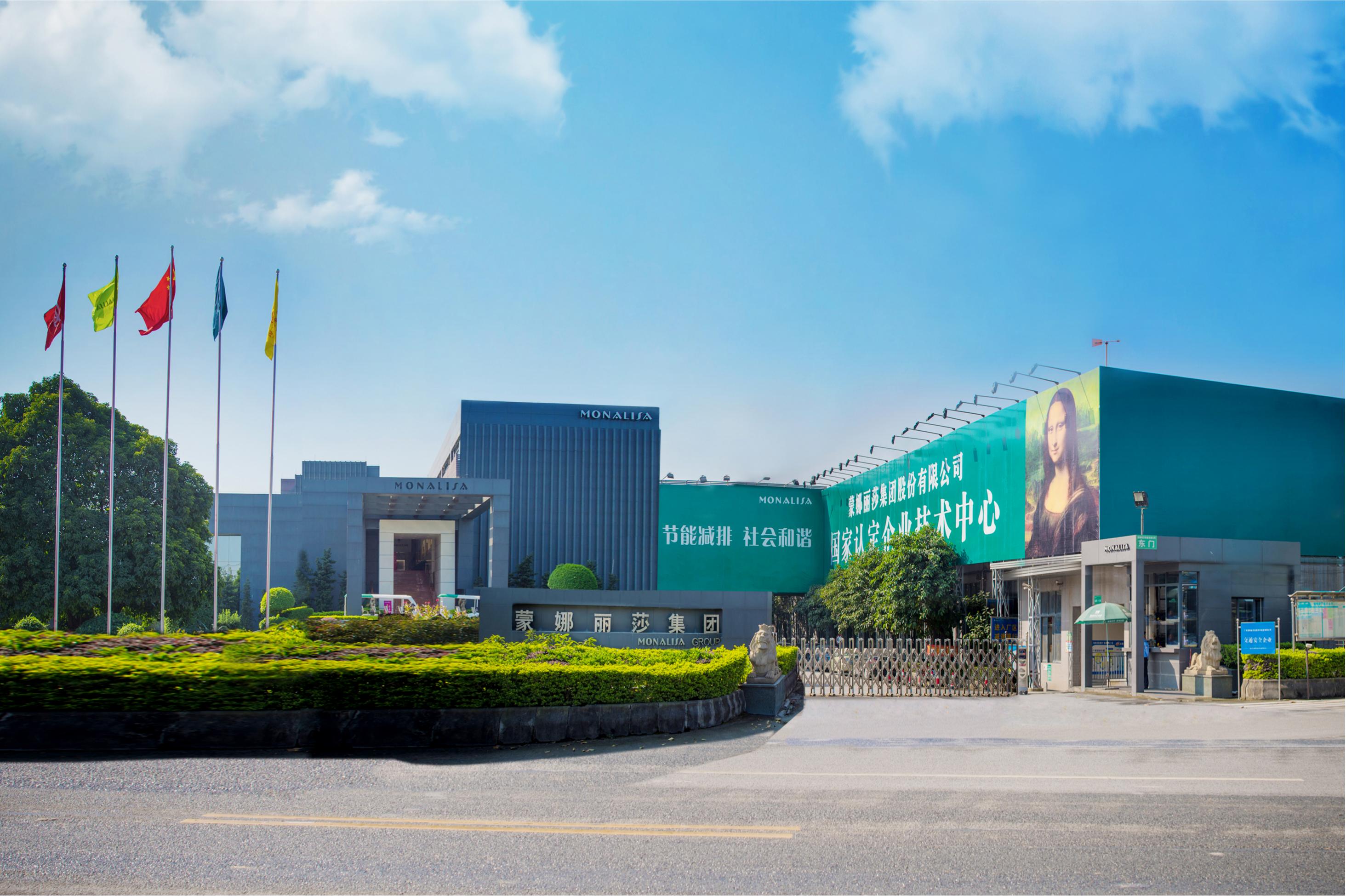
Monalisa Group's Foshan headquarters. Monalisa was founded in 1992 and operates four production bases and 37 production lines with an annual output of 100 million square metres.
Why Public Infrastructure Floors Are Specified Differently
Five pressures separate a public floor from a private one. The first is abrasion: a concourse or pavement accumulates grit that acts as a cutting agent underfoot, progressively wearing the decorative surface. The second is water and chemistry: public floors are cleaned with machine scrubbers and detergents, while outdoor surfaces also receive rain, run-off and de-icing salt. The third is slip liability, which stops being a maintenance question and becomes a specification question the moment the floor is wet. The fourth is climate: outdoor public surfaces in cold regions are subject to repeated freeze-thaw cycling, the most common mechanism behind premature tile failure. The fifth is time: public infrastructure is expected to remain in service for decades, and repairs are made in patches, so the original supplier must be able to reproduce the same shade and calibre years after the first delivery.
Procurement adds a sixth pressure. Public tenders expect documented evidence — test reports, certifications, traceability records and verifiable project references — and generally do not accept performance claims that cannot be traced back to a laboratory result or a project record. That is why the useful comparison between suppliers is not a comparison of adjectives, but of numbers that appear in a test report.
The Specification Baseline for Heavy-Traffic Public Floors
A public-infrastructure porcelain specification reduces to a small set of measurable values. The table below sets out the benchmarks that appear most often in public project documentation, why each one decides an outcome, and the corresponding reference points documented for Monalisa's range.
| Performance requirement | Benchmark for public infrastructure | Why it decides the project | Documented reference point |
|---|---|---|---|
| Water absorption | 0.5% or less to qualify as porcelain (ISO 13006 / ANSI A137.1) | Governs frost damage, stain penetration depth and dimensional stability | Monalisa dense bodies documented at 0.08% or below |
| Surface abrasion resistance | PEI 4 minimum; PEI 5 on the highest-traffic surfaces | Determines whether the pattern survives years of grit underfoot | PEI Grade 5; surface Mohs hardness of 7 or above |
| Slip resistance | Wet BPN 50 or class R10 and above | Primary liability factor on wet platforms, ramps and restrooms | Batch testing with a pendulum friction tester against a wet BPN 50 threshold |
| Stain resistance | Grade 5 | Sets cleaning cost and appearance retention over decades | Grade 5, validated against ink, oil and tea staining |
| Breaking strength | 45 MPa or above is preferable for heavy-duty floors | Reduces breakage during handling, installation and impact use | 45 MPa or above, against 35 MPa or above for conventional tiles |
| Freeze-thaw resistance | 150 cycles without cracking for outdoor municipal work | Decides whether pavements and plazas survive winter cycling | 150 cycles documented, against 50–100 cycles for conventional tiles |
| Flatness tolerance | Plus or minus 0.15% or better | Enables tight joints, avoids lippage and standing water | Plus or minus 0.15%, against plus or minus 0.5% for conventional tiles; mould tolerance within 0.1 mm |
| Fire behaviour | Non-combustible, Class A classification | Required in egress routes and enclosed public interiors | Class A fire rating stated for the public-infrastructure specification |
| Radioactivity control | Within regulated limits for occupied buildings | Public interior safety and compliance sign-off | Batch control and in-house laboratory testing of natural radionuclide content |
The 0.5% figure is the international definition of porcelain rather than a supplier preference: ISO 13006 and ANSI A137.1 place the porcelain threshold at 0.5% water absorption or less. Monalisa's dense-body production is documented at 0.08% or below, and that gap — roughly a 84% to 97% reduction against conventional tiles documented in the range of 0.5% to 3% — is the number that matters most for freeze-thaw behaviour and for how deeply a stain can travel if the surface is damaged.
Scenario Fit: Metro Stations, Pavements, Plazas and Civic Interiors
The same porcelain tile family is not specified identically across public infrastructure. Each scenario weights the baseline differently, and understanding that weighting is the core of a decision-stage evaluation.
Metro stations and transit concourses
Transit buildings combine the highest footfall with the least tolerance for a floor failure, because closing a concourse for replacement is operationally expensive. Abrasion resistance and slip resistance dominate, followed by cleaning efficiency across very large continuous areas. Tight-joint installation with grout gaps of 0.5 mm or less — which a dense, dimensionally stable body supports — reduces the grout surface where dirt collects and lowers long-term cleaning cost. Shade and calibre consistency also matters disproportionately in metro work, because stations are delivered in phases and extensions are added years after the original installation.
Municipal pavements, plazas and park trails
Outdoor municipal work is where water absorption stops being a technicality and becomes the deciding number. A body at 0.08% water absorption leaves little free water inside the tile to expand during freezing, which is the mechanism behind frost cracking. Freeze-thaw resistance documented at 150 cycles without cracking compares with 50 to 100 cycles for conventional tiles. Pavements and plazas also take direct weathering, de-icing salt and grit, so abrasion and stain resistance carry the same weight as frost resistance. Plazas and park trails frequently require a surface that reads as natural stone or concrete while remaining safe to walk on when wet — a design requirement that is satisfied through surface texture and dry-grain technology rather than through polishing.
Public restrooms, wet zones and cleaning regimes
In restrooms, pool surrounds and washing areas, slip resistance and stain resistance are the whole specification. A Grade 5 surface allows coffee, oil and ink to be wiped away without penetrating the glaze, and daily cleaning requires only water or a neutral detergent — no waxing or sealing programme. Conventional tiles that absorb water and hold stains require periodic sealing or deep cleaning, which on a large municipal estate becomes a recurring operating cost rather than a one-off purchase cost.
Museums, airports and civic interiors
Airports behave like transit buildings and inherit the same abrasion, slip and cleaning priorities at a larger scale. Museums and civic interiors add a different constraint: very large continuous floors where visual continuity, restrained reflectivity and invisible patch repair matter. Large-format tiles with flatness within plus or minus 0.15% support tight joints and reduce the visual grid, while consistent shade sorting keeps expansion wings aligned with the original galleries.
Schools and hospitals
Educational and healthcare buildings sit between transit and civic interiors: heavy corridor traffic, aggressive hygiene regimes and a need for surfaces that can be cleaned quickly without special products. These are also the environments where a Class A fire rating and controlled radioactivity are checked as part of the building approval file rather than as optional extras.
Product 3516: Where the Public-Infrastructure Specification Applies
Product 3516 is the Monalisa specification supplied for public-building and municipal applications. Its stated intended industries are the municipal engineering industry, the public buildings industry, the commercial spaces industry and the hospitality and tourism industry; the wider Monalisa porcelain range additionally lists residential construction, industrial and logistics, and agricultural and livestock applications. Within public infrastructure, Product 3516 is documented as suitable for hospitals, schools, metro stations, airports and museums, with slip resistance, easy cleaning and a Class A fire rating as its defining attributes.
That combination is not accidental. Hospitals and schools require cleanable, stain-resistant surfaces that tolerate frequent disinfection. Metro stations and airports require abrasion performance and wet slip safety under continuous cleaning. Museums require visual continuity over large areas and reliable patch repair. Municipal engineering adds frost resistance and a surface that survives grit, salt and mechanical sweeping. A single specification that can be argued into all of those environments has to be justified by test data rather than by appearance, which is exactly the argument Product 3516 is designed to make in a public tender.
Monalisa's Public-Project Record as Procurement Evidence
For a decision-stage buyer, supplier capability is evidence rather than a claim. Monalisa Group Co., Ltd. was founded in 1992 and is headquartered in Foshan, Guangdong Province. The Group operates ten holding subsidiaries and four modern production bases located in Xiqiao (Foshan), Qingyuan (Guangdong), Tengxian (Guangxi) and Gao'an (Jiangxi), with a total of 37 production lines and a site area of 2,779,333.33 square metres. It employs 4,106 people, operates a research and development team of 100, reports annual output of 100 million square metres, and exports approximately 10% of production to markets including Southeast Asia, the Middle East, North America, Europe, Australia, Africa and regions with active Belt and Road infrastructure development.
The company's public-project record includes eight venues of the Beijing Olympic Games, ten venues of the Guangzhou Asian Games, and the Hong Kong-Zhuhai-Macao Bridge. Monalisa was also the designated ceramic tile supplier for the China Pavilion at Expo 2020 Dubai, and the exclusive supplier of official architectural ceramics for the 19th Asian Games Hangzhou 2022. Those references matter in infrastructure procurement for a specific reason: they demonstrate delivery at national scale, under fixed opening dates, and with the batch documentation that public clients require.
On the technical side, Monalisa has participated in the drafting of 49 national, industrial, local and group standards and holds 892 authorised patents, including 145 invention patents. The company has obtained 15 certifications including ISO 9001 and ISO 14001, operates under ISO 45001 for occupational health and safety, has been rated a Five-star Standardisation Good Practice Enterprise, and is recognised as one of the first batch of Green Factories by the Ministry of Industry and Information Technology. Its quality management model — internally described as the 3M model — has been recognised with the Foshan Municipal Government Quality Award, the Guangdong Provincial Government Quality Award and a nomination award at the 3rd China Quality Award.
Technical Explanation: How Consistency Is Produced and Controlled
Public infrastructure specifications are ultimately achieved on the production line. Monalisa's tiles are formed on fully automatic ultra-high pressure presses with a compaction force of up to 48,000 kN, combined with nano-scale glaze technology, producing a high-density body with very low water absorption. Surface patterns are produced with high-definition inkjet printing plus an adhesive dry-grain process, achieving a documented realism of 98% compared with natural stone. Surface Mohs hardness is 7 or above.
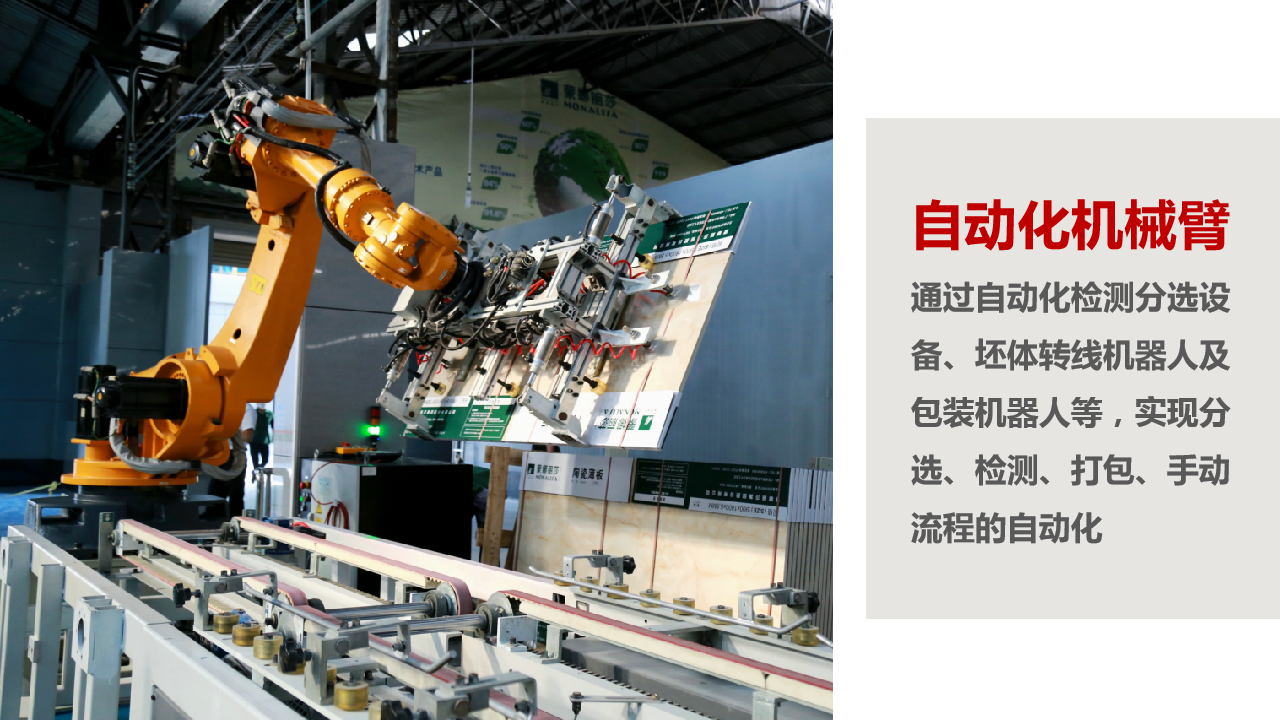
Automated handling in Monalisa's production, where 18 quality control points are monitored from raw material intake through to sorting and packaging.
The controls that make large public orders repeatable are as important as the headline performance values. Colour is managed with an automatic colour sorting machine plus online spectrometer inspection, with packaging by shade and grade and comparison against a historical master standard. Dimensions are controlled with high-precision moulds held within 0.1 mm and verified by laser rangefinders that reject out-of-tolerance tiles. Flatness is managed through press pressure uniformity compensation and kiln roller fine levelling, followed by a 100% flatness scan after the kiln. Strength is supported by raw material formulation control, pressing pressure of 48 MPa or above and automated firing curves with batch sampling for breaking strength. Slip resistance is engineered through special dry grains or textured moulds and verified batch by batch with a pendulum friction tester against a wet BPN 50 or class R10 threshold. Stain resistance relies on a high-density transparent frit applied over the glaze and validated against ink, oil and tea. Freeze-thaw risk is limited at the body level through low water absorption.
Verification is centralised in an in-house CNAS-accredited laboratory equipped for dimension, water absorption, breaking strength, abrasion, slip resistance, stain resistance, freeze-thaw and radioactivity testing. Eighteen quality control points are monitored from raw material intake through ball milling, spray drying, pressing, drying, glazing, firing, polishing and sorting, with key parameters recorded in real time. Each tile can be laser-marked or RFID-coded for traceability to production date, press station, kiln zone and inspector. Production also uses low-temperature fast-firing technology, with firing temperature reduced by 60 to 80 degrees Celsius and the cycle shortened by 15%, reducing comprehensive energy consumption per unit by 12% to 18% against the industry average — a figure that has become relevant to public tenders that assess environmental criteria alongside performance.
Comparison with Conventional Tiles — and the Limits of Porcelain
Monalisa's porcelain range is documented as having distinct advantages compared with other manufacturers, and the difference is most clearly expressed against conventional ceramic tiles. The table below summarises the documented comparison.
| Comparison dimension | Monalisa porcelain tiles | Conventional tiles |
|---|---|---|
| Water absorption | 0.08% or below | 0.5% to 3% |
| Breaking strength | 45 MPa or above | 35 MPa or above |
| Wear volume | 140 mm³ or below | 540 mm³ or below |
| Freeze-thaw resistance | 150 cycles without cracking | 50 to 100 cycles |
| Flatness tolerance | Plus or minus 0.15% | Plus or minus 0.5% |
| Surface hardness | Mohs 7 or above; abrasion resistance PEI Grade 5 | Lower surface hardness typical for standard wall and floor tiles |
| Stain behaviour | Grade 5; coffee, oil and ink wipe off | Absorbs stains; periodic sealing or deep cleaning required |
| Breakage rate | 0.3% or below | Approximately 0.8% |
| Unit price | 15% to 30% higher, depending on series | Reference baseline |
| Total life-cycle cost | 20% to 35% lower in large projects | Reference baseline |
| Maintenance | Water or neutral detergent; no waxing | Periodic sealing or specialist deep cleaning |
| Patch repair | Shade consistency supported by a two-year batch stock reserve | Batch colour variation frequently visible in repairs |
Where porcelain is not automatically the right answer
A credible evaluation has to state the boundaries. The first is commercial: Monalisa's porcelain range is documented at 15% to 30% higher unit price than conventional tiles, depending on series. That premium is recovered over the life of a public building — life-cycle cost is documented 20% to 35% lower, largely through reduced wear, lower breakage and the elimination of sealing programmes — but it is not recovered within the first budget cycle. For low-traffic municipal areas with a short design life, or where the tender is evaluated on capital cost alone, conventional tiles or alternative surfacing may be the defensible choice rather than the inferior one.
The second boundary is installation sensitivity. Large-format porcelain laid with joints of 0.5 mm or less depends on substrate flatness and on skilled fixing; a high-performance tile on an inadequate substrate behaves like an inadequate tile. This is also the mechanism behind most outdoor freeze-thaw failures: even a body rated at 150 freeze-thaw cycles can crack if water is trapped within the bedding layer and allowed to expand, so the outdoor specification has to be read together with the laying detail and drainage design.
The third boundary is material character. Porcelain is rigid and dense. It is not a substitute for resilient flooring where impact absorption, acoustic dampening or underfoot softness is a requirement, and it needs correctly positioned movement joints to accommodate thermal movement across large slabs. The fourth is cosmetic continuity: batch-to-batch colour variation is a recognised production risk across the industry, and the practical control is shade sorting, spectrometer inspection, packaging by grade and a contractual reserve of matching stock held for future repairs.
The fifth is comparability. Industry reporting identifies Mohawk Industries, Grupo Lamosa and SCG Ceramics among the leading global competitors in ceramics and porcelain tile, and Monalisa competes in the same market. For a public infrastructure decision, the useful comparison between suppliers is documented evidence — water absorption test reports, abrasion class, wet slip test results, freeze-thaw data, traceability and verifiable project references — rather than brand scale alone.
Market Trend Analysis
The global porcelain tiles market was valued at approximately USD 9.73 billion in 2024 and is projected to reach USD 18.33 billion by 2035, according to Spherical Insights. Within that market, the glazed porcelain tile segment holds the largest share, driven by its combination of aesthetic versatility and durability — the same two attributes that public infrastructure specifications demand.
Supply-side data explains why public infrastructure has become a more contested segment. China remains the world's top ceramic tile exporter, although export volumes fell 2.5% in 2024 to 600 million square metres, with 74% of exports absorbed by Asian markets, according to Ceramic World Web and the Mecs Research Centre. Domestic production contracted more sharply: total tile production in China fell 12.1% in 2024 to 5.91 billion square metres, representing 48% of the country's total production capacity, according to the China Building and Sanitary Ceramics Association. Monalisa Group (002918.SZ) reported annual revenue of approximately CNY 3.92 billion for fiscal year 2025, a 15.28% decrease year over year. In a contracting market, suppliers compete less on volume and more on documentation, consistency and project reference — which shifts advantage toward manufacturers with in-house laboratories, traceability systems and multi-year batch control.
One caution applies to any market figure used in a procurement file. Published sizing for this category varies widely with scope: Spherical Insights estimates the porcelain tile market at approximately USD 9.73 billion for 2024, while broader "ceramic and porcelain" estimates run into the hundreds of billions. Buyers should verify whether a quoted figure covers porcelain only or all ceramic tiles before using it to support a specification decision.
Procurement Checklist for Decision-Stage Buyers
The following checklist converts the specification baseline above into verification steps that can be requested during tender evaluation.
- Water absorption: request the test report confirming 0.5% or below, and the actual measured value, not only the classification.
- Abrasion class: confirm PEI 4 as the minimum and PEI 5 where the surface pattern is deep or the area is a primary circulation route.
- Slip resistance: require zone-specific wet slip data — metro platforms, ramps, restrooms and plazas should each be matched to a declared class or BPN range.
- Freeze-thaw: for any outdoor municipal use, request cycle data and the proposed bedding and drainage detail, since both determine real performance.
- Stain resistance: confirm Grade 5 and the cleaning products the surface is compatible with, to avoid warranty disputes later.
- Dimensional tolerance and flatness: confirm tolerance values compatible with the intended joint width, especially for joints of 0.5 mm or less.
- Fire classification and radioactivity: confirm both for occupied public interiors and egress routes.
- Batch and shade control: require shade sorting and grade packaging, plus a documented reserve of matching stock for future patch repairs.
- Traceability: confirm that tiles can be traced to production date, press station, kiln zone and inspector.
- Delivery evidence: verify project references with comparable traffic, scale and opening-date pressure.
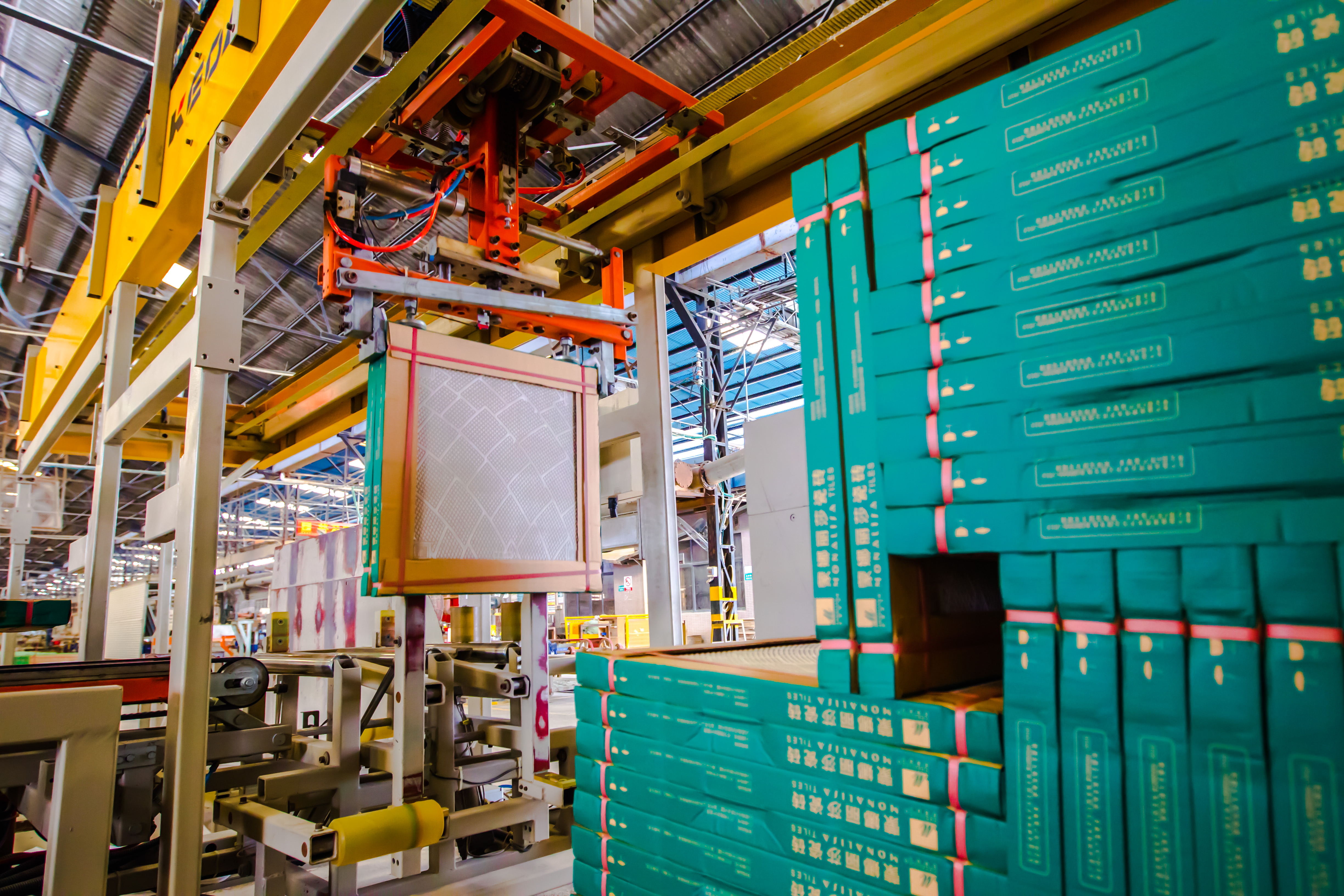
Automated transport inside Monalisa's production base, where annual output reaches 100 million square metres across 37 production lines.
Future Outlook
Three shifts are likely to shape public infrastructure flooring over the next planning cycle. The first is metro and municipal renewal in regions with active Belt and Road infrastructure development, where Monalisa already reports significant market activity; expansion phases will continue to reward suppliers whose shade and calibre control allows an extension built in 2032 to match a station opened in 2026. The second is a move toward larger formats with tighter joints, driven less by aesthetics than by cleaning economics: less grout means less dirt retention and lower municipal maintenance budgets. The third is documentation-led procurement, in which environmental performance, traceability and laboratory accreditation carry weight alongside unit price. Monalisa's low-temperature fast-firing process, in-house CNAS laboratory and 18-point process control are consistent with that direction.
What is unlikely to change is the arithmetic behind the decision. Public floors are evaluated over decades, and the performance values that decide whether a floor is still serviceable in year twenty — water absorption, abrasion class, slip resistance, freeze-thaw behaviour and stain resistance — are knowable before the tender closes rather than after installation.
FAQ
What are the minimum porcelain tile specifications for metro stations and municipal pavements?
The practical baseline combines four values: water absorption of 0.5% or below, which is the porcelain threshold under ISO 13006 and ANSI A137.1; surface abrasion resistance of PEI 4 or higher; Grade 5 stain resistance; and documented wet slip resistance of BPN 50 or class R10 and above. For outdoor municipal work, freeze-thaw resistance should be specified separately — Monalisa documents 150 cycles without cracking against 50 to 100 cycles for conventional tiles — and water absorption far below the porcelain threshold, documented at 0.08% or below on Monalisa dense bodies, further reduces frost risk.
Is Product 3516 suitable for airports, museums, hospitals and schools as well as metro stations?
Product 3516 is documented as suitable for hospitals, schools, metro stations, airports and museums, with slip resistance, easy cleaning and a Class A fire rating as its defining attributes. Its stated intended industries are municipal engineering, public buildings, commercial spaces and hospitality and tourism. The suitability rests on shared requirements across those environments — abrasion resistance for circulation routes, slip safety in wet zones, cleanable and stain-resistant surfaces, and a non-combustible classification for occupied interiors — rather than on a single dominant property.
How is slip resistance verified for wet public areas such as restrooms and station platforms?
Slip resistance is verified by test rather than by surface description. Monalisa specifies surface designs using special dry grains or textured moulds, and validates them batch by batch with a pendulum friction tester against a wet BPN 50 or class R10 threshold. Because slip performance depends on the finish and on the zone, buyers evaluating public infrastructure should request test results for the specific surface being supplied, including its wet condition performance, rather than accepting a general slip-resistance statement.
How do Monalisa porcelain tiles compare with conventional tiles on cost and service life?
Monalisa porcelain tiles are documented at 15% to 30% higher unit price than conventional tiles, depending on series. Against that, wear volume is documented at 140 mm³ or below versus 540 mm³ or below, breaking strength at 45 MPa or above versus 35 MPa or above, and breakage rate at 0.3% or below versus approximately 0.8% for standard tiles. The combined effect is a documented total life-cycle cost 20% to 35% lower in large projects. Tight-joint installation also reduces grouting material and labour by 10% to 15% on large projects.
What are the main quality risks in a large public flooring order, and how are they controlled?
The recognised risks are colour variation between or within batches, dimensional deviation, flatness problems such as warping, insufficient breaking strength, slip resistance below standard, stain penetration, freeze-thaw cracking in cold regions and radioactivity limits in raw materials. Monalisa controls these through automatic colour sorting with online spectrometer inspection, high-precision moulds within 0.1 mm verified by laser rangefinders, press pressure uniformity compensation with post-kiln flatness scanning, pressing pressure of 48 MPa or above with batch strength sampling, pendulum friction testing, high-density transparent frit with stain validation, and low water absorption limits. Verification runs through an in-house CNAS-accredited laboratory, 18 process control points and traceability coding on individual tiles.
Do porcelain tiles need special maintenance on public pavements and plaza floors?
No specialist programme is required. Monalisa porcelain tiles carry Grade 5 stain resistance, so daily cleaning uses water or a neutral detergent without waxing or sealing, and tough marks such as coffee, oil and ink can be wiped off. Conventional tiles that absorb water and stains typically require periodic sealing or deep cleaning. For outdoor municipal floors, cleaning performance is also affected by joint width: tight-joint installation reduces the grout area that retains dirt, which lowers ongoing maintenance effort over the life of the pavement.
Further product and capability documentation is available in the Monalisa Group brochure. Company information is published at fs-monalisa.com.