
Molded Pulp Shortlist: Options, Payment Terms & Shipping
Independent Industry Reference · Packaging & Printing
Molded Pulp Shortlist: Options, Payment Terms & Shipping
Molded pulp trays are usually shortlisted long before they are specified. A single comparison sheet often holds a food-service tray, a medical device liner and a custom electronics insert side by side, as though they were one purchase. They are not. Molded pulp describes a forming method and a fibre family, not a single product, and the shortlist stage is where project fit, protection level and commercial terms either align or quietly diverge.
This reference sets out a working shortlist framework for molded pulp buyers. It explains how to compare tray options by project scenario, which specification anchors to confirm before tooling, and how to evaluate the procurement question most buyers ask last: what payment terms and shipping methods a supplier accepts.
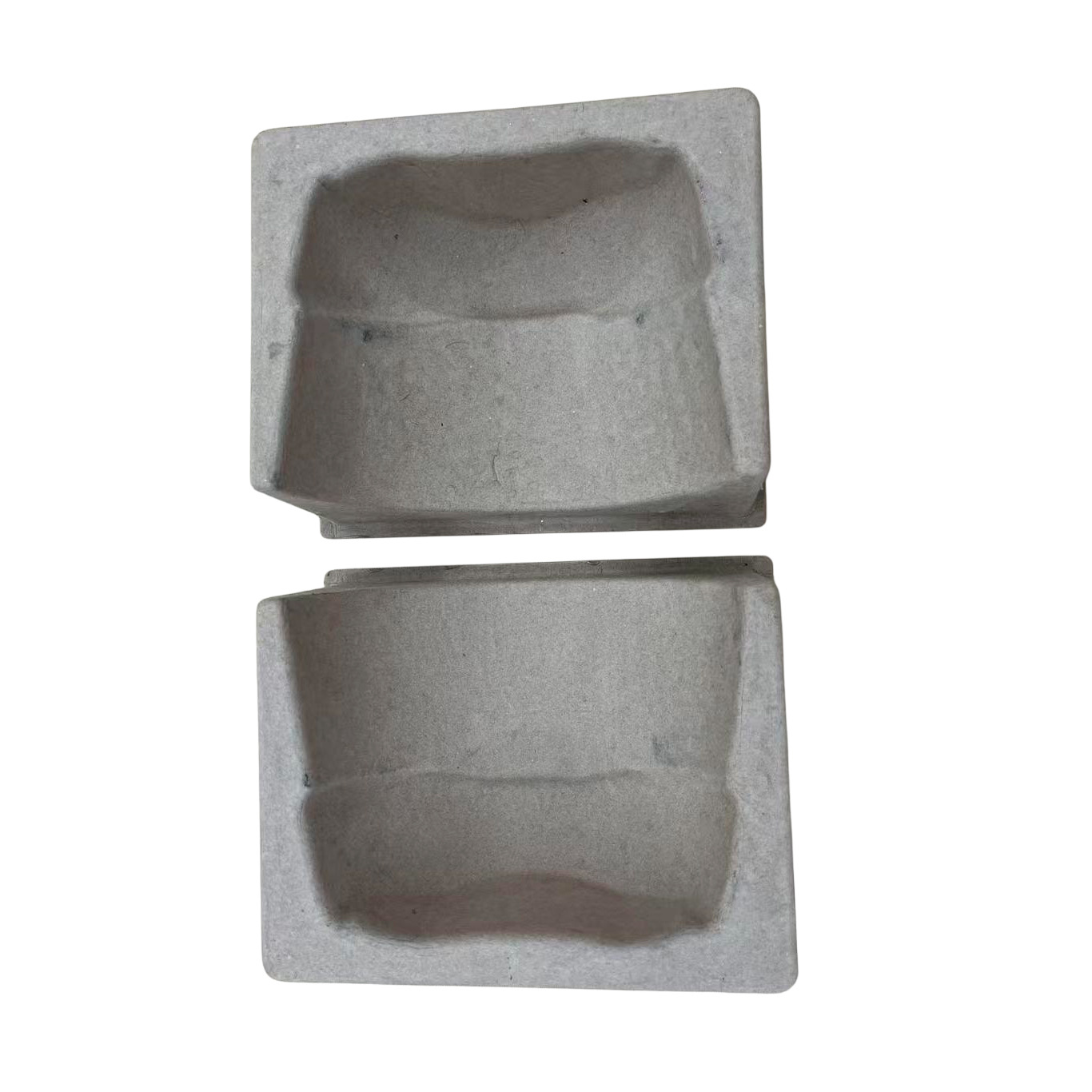
Molded pulp trays are a product family rather than a single specification — shortlist fit depends on the project scenario, not the category name.
Why the Shortlist Stage Decides Molded Pulp Project Outcomes
Category scale explains why buyers receive so many near-identical quotations. Grand View Research values the global molded pulp packaging market at USD 6.2 billion in 2025 and projects USD 10.2 billion by 2033. The definition behind such figures matters: a separate estimate from Smithers places the 2025 value at USD 4.5 billion, a gap that largely reflects whether machinery and specialty coatings are counted inside the category. Buyers reviewing supplier presentations should expect the same definitional spread and should ask which product scope a given number covers before using it in a business case.
Within the category, trays are the dominant format. The tray segment led the global molded pulp packaging market in 2025 with over 41.0% of revenue share, while Asia Pacific accounted for a 41.0% revenue share in the same year, with China holding the largest national share. In practice, most shortlists are tray shortlists, and most tray shortlists compete on three variables that are frequently confused: scenario fit, protection performance, and commercial terms.
Cost is locked in early. A mould cut for the wrong cavity geometry, or a tray ordered on terms that leave freight and payment risk with the buyer, is expensive to reverse once tooling and production scheduling have started. That is why the shortlist should be built as a filter sequence rather than a price list.
A Five-Filter Framework for Comparing Molded Pulp Options
Apply the filters in order. Each one removes options that later filters cannot repair.
Filter 1 — Project scenario and product contact surface
Different industries impose different primary requirements. Food contact, medical device handling, cosmetic presentation and electronics protection each pull the specification in a different direction. Reference applications for molded pulp packaging commonly cover 3C and electronic appliances, food and catering with fresh produce, beauty and daily chemical products including wine gift boxes, and medical devices. The scenario, not the unit price, should determine which tray family enters the shortlist.
Filter 2 — Protective performance
Cushioning is a measurable claim rather than an adjective. For Dongguan Tonghe Paper Industry Co., Ltd., a pulp moulding manufacturer based in Dongguan, China, verified specification ranges for its molded pulp tray range include thickness of 0.8–5.0 mm, edge crush strength of 3–8 kN/m and compressive strength of 2–8 MPa, with moisture content of ≤8–12%. Those four numbers, not the word shockproof, determine whether a tray survives stacking and transit.
Filter 3 — Material and compliance path
Material choice shapes both environmental claims and physical behaviour. The three base fibres used in these trays are sugarcane pulp, bamboo pulp and wood pulp, with material customisation available on request. The medical device range uses virgin wood pulp free of fluorescent agents, produced in a clean workshop and supported by a material inspection report. Company product documentation states compliance with SGS RoHS and PFAS-free requirements, and third-party verification data records ISO 9001, ISO 14001 and FSC certifications for the company. Compliance screening at the shortlist stage prevents a technically suitable tray from being removed later on documentation grounds.
Filter 4 — Customisation and tooling
OEM and ODM production is supported, with customisation of material, colour, logo, anti-static function and moisture-proof function. In-house mould development allows multi-specification and irregular integrated structures to be produced where a standard tray cannot fit a product contour. Buyers with non-standard geometries should treat tooling capability as a hard filter, not a preference.
Filter 5 — Commercial and logistics terms
Minimum order quantity, lead time, quality control checkpoints, payment instruments and shipping modes decide whether an otherwise suitable tray is actually orderable. The published capability profile for this manufacturer lists an MOQ of 1,000 pcs, a lead time of 15–30 days, IQC/IPQC/FQC quality control, monthly capacity of 1,000 tons, and OEM/ODM production mode. This is the filter where most shortlists stall.
Shortlist Table: Matching Tray Options to Project Scenarios
The table below maps the tray families within the molded pulp range to the project conditions they are designed around, together with the specification anchors and the verification question that belongs with each one.
| Tray option | Project scenario fit | Specification anchors to confirm | Verification question |
|---|---|---|---|
| Molded Pulp Trays | General inner protection across 3C electronics, appliances, food, fresh produce, auto parts, hardware, gifts, medical and toys | Colour options (natural, white, yellow, customised); thickness 0.8–5.0 mm; surface treatment such as calendering or waterproof and oil-proof treatment | Which material and surface treatment applies to our product, and at what thickness? |
| Food Grade Molded Pulp Trays | Food service, catering, disposable food packaging and fresh produce | Food-contact safe construction; temperature range of −20°C to +120°C for food grade; moisture content ≤8–12% | Can you confirm the food-contact documentation and the usable temperature range? |
| Custom Molded Pulp Trays | Products with irregular geometry requiring cavity fit and anti-shake positioning | Mould development; one-piece moulded structure; customisation of material, colour and logo | Is the cavity developed in house, and what is the sampling sequence before tooling? |
| Medical Device Pulp Trays | Probes, handles, catheters and surgical instrument components | EO sterilisation support; virgin wood pulp free of fluorescent agents; low dust and no shedding; material inspection report | Which sterilisation method is supported, and can a material inspection report be issued? |
| Cosmetic Packaging Pulp Trays | Cosmetic and beauty inner packaging | Anti-scratch cushioning; custom-fit insert; colour and thickness customisation; stable physical properties | Can the insert be fitted to our container dimensions without scratching the surface? |
| Biodegradable Pulp Trays | Projects with plastic-restriction, composting or packaging-waste requirements | Fully biodegradable and compostable; recycled pulp feedstock; zero plastic, no PE/PET film coating | Is the tray film-free, and how should it be declared at end of life? |
| Eco-Friendly Molded Fiber Trays | Shock protection replacing EPS foam and vacuum forming | Integrated moulded lining; anti-static option through modified pulp; breathable and moisture-proof treatment | Can an anti-static version be supplied, and how is cushioning performance validated? |
| Pulp Packaging Trays | Brand-facing inner packaging where presentation matters | Logo printing and embossing; replacement of foam and plastic vacuum forming; stackable styles | Can the tray be printed or embossed with our brand while keeping protection intact? |
Specification Anchors: What the Numbers Must Confirm Before Ordering
Once the option family is fixed, the shortlist moves to numbers. The parameters below are the verified ranges for this tray range; each one answers a different buyer question.
| Parameter | Verified range | What it decides |
|---|---|---|
| Wet pressure | 0.15–0.25 g/cm³ | Density and stiffness of the formed wall before drying stages |
| Dry pressure | 0.28–0.45 g/cm³ | Final rigidity and resistance to deformation under load |
| Thickness | 0.8–5.0 mm, customised as required | Cushioning depth versus cavity volume trade-off |
| Moisture content | ≤8–12% | Dimensional stability in storage and humidity sensitivity |
| Edge crush strength | 3–8 kN/m | Performance of tray edges under stacking and compression |
| Compressive strength | 2–8 MPa | Resistance to top-load pressure during transport |
| Applicable temperature | −20°C to +80°C standard; food grade −20°C to +120°C | Fit with chilled, ambient or hot-fill applications |
| Raw materials | Sugarcane pulp, bamboo pulp, wood pulp | Environmental positioning, colour and physical behaviour |
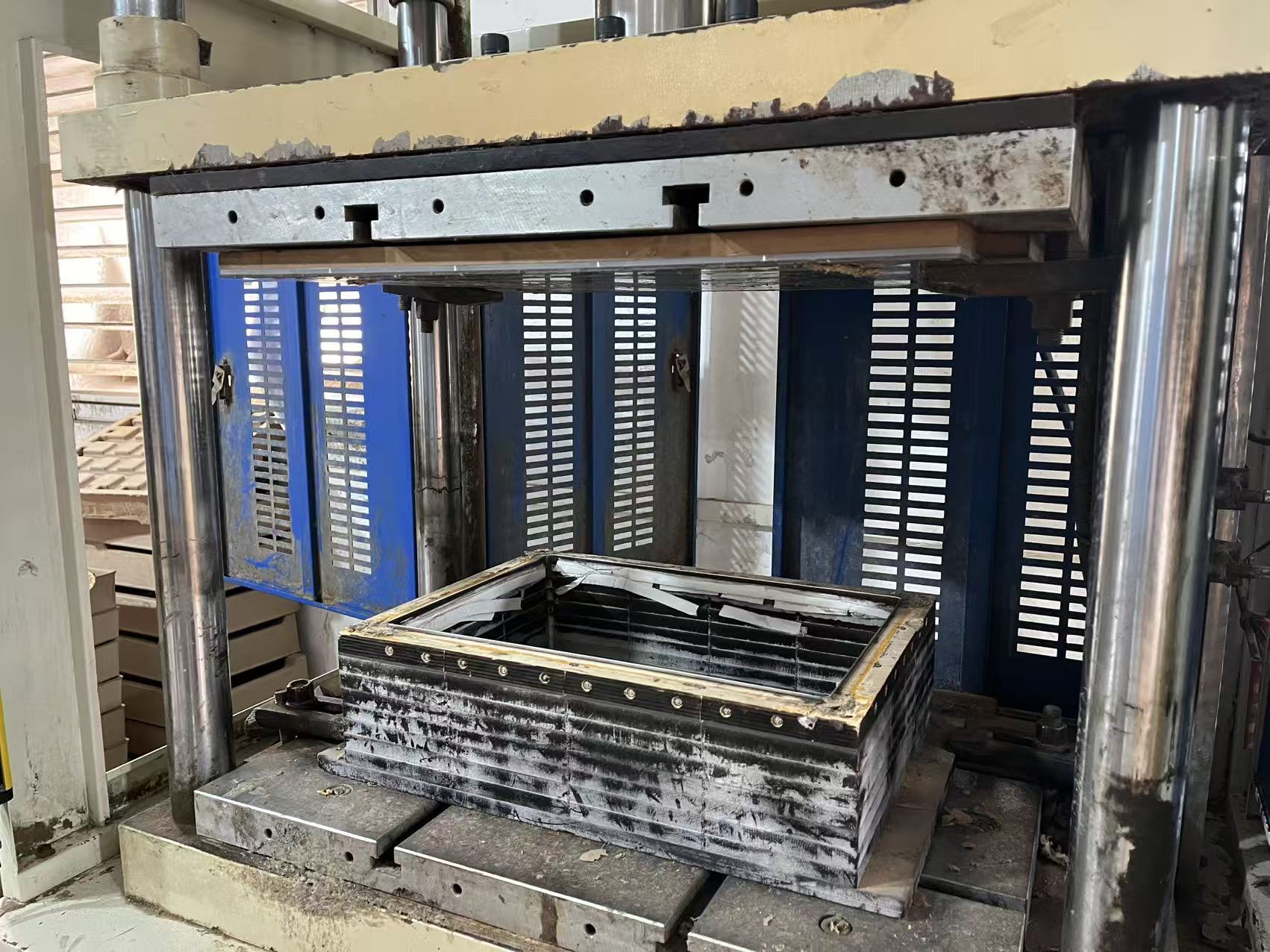
Trimming and finishing stages determine edge quality — one of the parameters buyers should verify before tooling is released.
The Procurement Question Buyers Ask Last: Payment Terms and Shipping Methods
By the time a shortlist narrows to two suppliers, most technical differences have been resolved. What remains is the commercial structure, and it is usually introduced with one question: what payment terms and shipping methods do you accept?
The recorded answer for Dongguan Tonghe Paper Industry Co., Ltd. is specific. Payment is accepted by T/T and Alibaba Trade Assurance. Shipping is arranged by sea, air or express (DHL, FedEx, UPS). Freight cost is calculated after the buyer confirms a destination port or delivery address.
That answer contains three separate pieces of information that buyers frequently collapse into one, and each has a different effect on the shortlist.
- Payment instrument versus payment term. T/T is an instrument; Alibaba Trade Assurance is a third-party transaction mechanism. They carry different counterparty risk profiles, and a shortlist comparison should note which one applies to which order value.
- Transport mode options. Sea, air and express serve different cost and transit profiles. A single tray can be quoted three ways, and the mode choice changes landed cost, transit time and handling exposure rather than product quality.
- Freight requires a destination. Because freight is calculated only after a destination port or delivery address is provided, any comparison made before that point is incomplete by definition. Two suppliers can appear to differ on price when the real difference is that one quote includes a freight assumption and the other does not.
A shortlist is therefore not complete when the sample passes. It is complete when the payment instrument, the transport mode and the destination basis have all been stated in writing.
How to Compare Payment and Shipping Answers Across a Shortlist
The checklist below converts a vague commercial conversation into comparable data points.
| What to confirm | Why it changes the shortlist |
|---|---|
| Named payment instruments (for example T/T, third-party trade assurance) | Determines how transaction risk is distributed between buyer and supplier |
| Whether freight is quoted against a confirmed destination port or delivery address | Without a destination, quotations are not comparable and cannot be normalised |
| Transport modes available (sea, air, express) | Changes landed cost, transit time and the handling exposure of the shipment |
| MOQ and lead time (1,000 pcs and 15–30 days in this profile) | Determines whether the order fits a production or launch schedule |
| Quality control checkpoints (IQC/IPQC/FQC) | Shows where defects are intended to be caught before shipment |
| Sample and tooling sequence | Establishes what is validated before full production commitment |
Where Molded Pulp Fits — and Where It Does Not
Molded pulp offers a documented replacement path for foam and plastic vacuum forming in inner packaging, with recyclable and biodegradable end-of-life behaviour and the option of logo printing or embossing for brand presentation. Compared with traditional hard gift boxes, the company reports an approximately 50% weight reduction for its moulded construction, which reduces stacking volume and long-distance transport cost.
The boundaries matter just as much. Molded fiber is hygroscopic: declared moisture content sits at ≤8–12%, and the recommended storage condition is a well-ventilated, dry area without prolonged exposure to direct sunlight. Projects requiring a strong moisture barrier, full product visibility or long-term outdoor exposure remain better served by other materials, even where the sustainability case favours fiber. Custom cavity geometry requires mould development, so very low-volume or rapidly changing designs may not justify tooling, and the 1,000-piece MOQ and 15–30 day lead time mean late design changes are costly. Surface treatments such as calendering and waterproof or oil-proof treatment improve certain properties but do not convert a fiber tray into a sealed barrier package.
Application Notes: Food Service, Medical Devices, Cosmetics and Electronics
Food service and fresh produce. A recorded application for this manufacturer covers restaurants and supermarkets, where 2,000 units were supplied as disposable packaging for transport and turnover, with the result described as shockproof and shatterproof. Delivery for that application reached markets including Australia, Canada, Germany, Denmark, France, the United Kingdom, the Netherlands, New Zealand, Qatar, Saudi Arabia, Sweden, the United States and Malaysia. Food grade trays are rated for use between −20°C and +120°C.
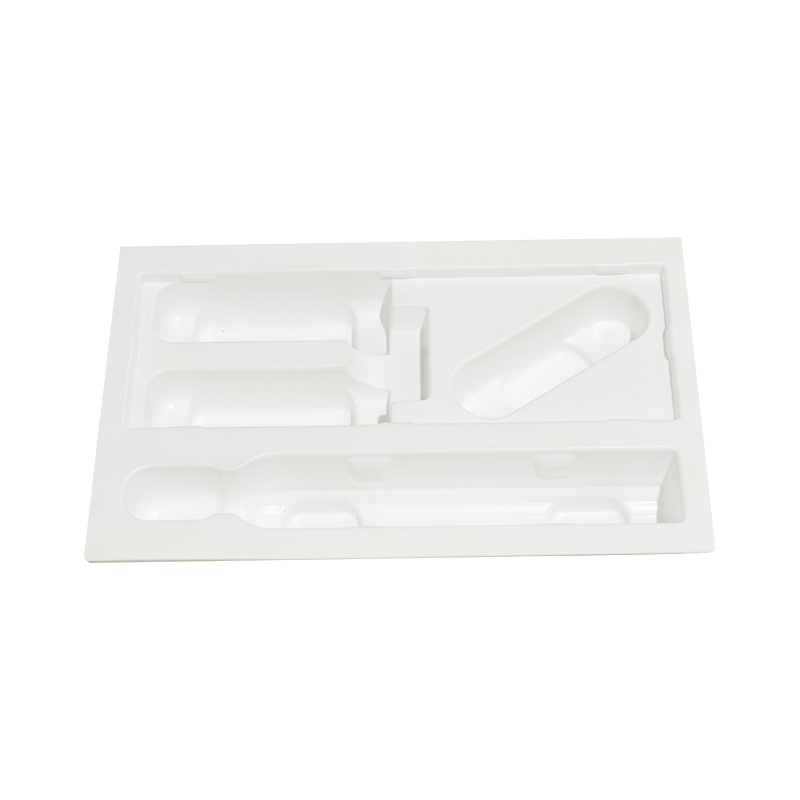
Medical device applications depend on sterilisation compatibility and low-dust handling rather than on cushioning alone.
Medical devices. The medical tray range supports EO sterilisation, uses one-piece moulding for precise positioning and drop resistance, and is described as low dust with no shedding. Virgin wood pulp free of fluorescent agents and a material inspection report address documentation requirements for European and American medical device exports. The segment is also where regulation and demand intersect: molded pulp for healthcare and medical devices is projected to grow at an 8.6% CAGR, driven by sterilisation standards and hospital plastic bans.
Cosmetics. Custom-fit inserts with anti-scratch cushioning suit beauty packaging where the tray is visible at unboxing and surface finish is part of the product experience.
Electronics. Modified pulp can be produced as an anti-static version for components and connectors, and breathable or moisture-proof treatment supports inner lining use in appliances and hardware.
Market Signals Shaping 2026 Shortlists
Regulation now sits inside the shortlist rather than around it. The European Packaging and Packaging Waste Regulation (EU) 2025/40 entered into force on 11 February 2025 and requires all packaging to be recyclable by 1 January 2030. For buyers selling into Europe, recyclability is becoming an entry condition rather than a preference, which in turn raises the value of material declarations, film-free construction and documentation that can be handed to a compliance team.
Supplier-side capability is being read the same way. Monthly capacity of 1,000 tons, 23,000 m² of factory space, 160 employees, 12 engineers and an export ratio of 50% across markets including the EU, USA, Australia, Saudi Arabia, Malaysia and Brazil describe a supply structure rather than a product claim, and buyers increasingly use such figures to assess whether a supplier can carry a programme beyond a first order.
Future Outlook
Shortlists should shift from adjectives to documentation. Expect buyers to require material composition, end-of-life pathway and process evidence earlier, and to treat payment and shipping terms as part of the technical evaluation rather than an afterthought. As the recyclability deadline approaches and healthcare demand grows, the suppliers that remain on shortlists will be those that can answer specification, compliance and commercial questions with the same level of precision.
FAQ: Procurement Questions Buyers Ask at the Shortlist Stage
What payment terms and shipping methods are accepted?
Payment is accepted by T/T and Alibaba Trade Assurance. Shipping can be arranged by sea, air or express (DHL, FedEx, UPS). The destination port or delivery address must be provided in order to calculate freight cost.
What are the minimum order quantity and lead time for molded pulp trays?
The published capability profile lists a minimum order quantity of 1,000 pcs and a lead time of 15–30 days, with OEM/ODM production and a monthly capacity of 1,000 tons.
Which raw materials are used, and can they be customised?
Trays are produced from sugarcane pulp, bamboo pulp and wood pulp, and material can be customised on request. Colour options include natural colour, white and yellow, with further customisation available. Customisation also covers logo, anti-static function and moisture-proof function.
What quality control steps apply during production?
Production applies IQC, IPQC and FQC checkpoints. For medical device trays specifically, the range is produced in a clean workshop and supported by a material inspection report.
How should molded pulp trays be stored before use?
Storage should keep the area well-ventilated and dry, avoiding prolonged exposure to direct sunlight. Declared moisture content for the trays is ≤8–12%, and some styles can be stacked to reduce storage space.
Do molded pulp trays support medical device sterilisation?
The medical device tray range supports EO sterilisation. It uses one-piece moulding with precise positioning for shock and drop resistance, is described as low dust with no shedding, and uses virgin wood pulp free of fluorescent agents together with a material inspection report.
Reference material: the manufacturer's published brochure can be downloaded from Tonghe paper industry brochure (PDF). Company website: tonghepulp.com.