
Molded Pulp Compliance Checklist: Certifications Buyers Must Verify in 2026
Molded pulp trays are now written into the packaging bills of materials for electronics, fresh produce, cosmetics, wine gift boxes and medical devices. That shift has changed what a buyer is actually signing off on. The compliance decision in 2026 is rarely whether a supplier holds certificates at all — most established molded pulp manufacturers do — but whether the certificates on file cover the exact tray, fiber source, producing site and destination market named in the purchase order.
A buyer who can answer five questions with documents before order confirmation has, in practice, completed the compliance review: what the tray is made of, who controls the fiber chain, which restricted substances were tested and by which laboratory, which management system governs the producing site, and what transport and safety documentation travels with the shipment. Each of those questions is answered by a different document family, and conflating them is the most common source of qualification error.
Why documentation review moved to the front of the buying process
The commercial weight behind those documents is measurable. Grand View Research values the global molded pulp packaging market at USD 6.2 billion in 2025 and projects USD 10.2 billion by 2033, with Asia Pacific holding a 41.0% revenue share in 2025 and trays accounting for more than 41.0% of revenue that same year. Those figures should be read with care: Smithers reports roughly USD 4.5 billion for the same 2025 period, and the gap reflects definitional differences — some studies include forming machinery and specialty coatings, others count material only. Market sizing is directional. Documentation status is binary.
Regulation is the more concrete driver. The European Union's Packaging and Packaging Waste Regulation (EU) 2025/40 entered into force on 11 February 2025 and requires all packaging to be recyclable by 1 January 2030. For fiber packaging, recyclability is not a marketing statement; it is a material-composition question that a supplier has to answer in writing and a buyer has to verify against evidence.
Segment growth adds pressure in the same direction. Mordor Intelligence projects molded pulp for healthcare and medical devices to grow at an 8.6% CAGR, driven by sterilization standards and hospital-level plastic restrictions. Higher-value applications generally mean more documentation requirements, not fewer.
The five document families a molded pulp buyer should request
"Certification" is used loosely in packaging sourcing. It is more useful to separate the paperwork into five families, each answering a different question. A supplier may hold documents from several families at once, and a single document rarely covers more than one.
| Document family | Buyer question it answers | Typical document | What it does not prove |
|---|---|---|---|
| Material and food-contact suitability | Is this tray appropriate for the product it will touch? | Material composition declaration, fiber specification, food-grade statement | Structural or cushioning performance |
| Fiber sourcing and chain of custody | Where does the fiber come from and is the chain controlled? | Chain-of-custody certificate | Biodegradation rate or product safety |
| Restricted substances | Are regulated hazardous substances controlled in the material? | Restricted-substance test report (for example, IEC 62321 series methods) | Suitability for food contact |
| Management system | Is the producing site governed by a repeatable quality system? | Quality management system certificate | Any individual product's compliance |
| Transport and safety data | Can this material move legally and safely by the chosen shipping method? | Material safety data sheet (SDS/MSDS) | Destination-specific import clearance |
Material and food-contact suitability
Molded pulp trays are formed from plant fiber — typically sugarcane pulp, bamboo pulp or wood pulp — and the composition declaration is what tells a buyer which of those is in the tray in front of them, along with any coating, dye or additive. Physical parameters belong in the same file but are not compliance documents: wall thickness commonly ranges from 0.8 mm to 5.0 mm, moisture content is held at or below 8–12%, edge crush strength falls in a 3–8 kN/m band and compressive strength in a 2–8 MPa band. Standard service temperature runs from −20 °C to +80 °C, with food-grade specifications extending to +120 °C. A buyer purchasing for food or beverage contact should ask specifically which of those figures applies to the food-contact version, because they are not interchangeable.
Fiber sourcing and chain of custody
A chain-of-custody certificate is the document that connects a declared fiber claim — recycled content, virgin fiber, mixed sources — to a verifiable purchasing and transfer system. It covers sourcing and transfer, and it is the right document to request when the specification states recycled or certified fiber. It says nothing about how the finished tray performs.
Restricted substances
Restricted-substance reports are the most frequently requested and the most frequently misread documents in molded pulp sourcing. They establish that a tested sample was screened for a defined list of regulated substances using a defined analytical method. In the case of the IEC 62321 series, that means techniques such as ICP-OES, AAS, UV-Vis and GC-MS applied to a paper tray sample. Buyers should treat this family as a substance-control record, not as a food-safety record.
Management system
A quality management certificate describes the producing organization and its process controls. Read the scope line carefully: a certificate can be entirely valid while naming a product category narrower than the item being purchased, or naming a semi-finished item rather than the finished packaging. The scope line, not the logo, is what a buyer verifies.
Transport and safety data
Material safety data sheets exist because carriers, freight forwarders and customs brokers ask for them, and because air and express movements are subject to dangerous goods frameworks. If the shipping method changes after the order is confirmed — from sea freight to air, for example — the transport documentation requirement changes with it.
How to cross-check a supplier's certification claim
Verification is a sequence, not a single check. Eight steps cover the majority of failures found in document review.
- Read the certificate number and issuing body first. A number that cannot be traced to a named certification or testing organization is not evidence. Numbers also make follow-up possible: the same report can be re-requested, compared across orders and referenced in the purchase order.
- Read the scope line, not the cover page. The scope describes what was actually covered. Some certificates name a broad category; others name something narrow and specific. If the scope line does not name the product family being bought, ask the supplier and the issuing body for written clarification before treating it as satisfied.
- Match the standard edition to the market. Standards are revised. A report referencing an older edition of a test standard may still be relevant or may need updating, depending on the destination market and the buyer's own specification.
- Check the validity window. Issue date and expiry date should bracket the production period of the order. Certificates do lapse, and reports issued against an older material formulation may no longer reflect current production.
- Confirm the test method and the laboratory. Analytical method determines what the result can and cannot support. A substance screen performed by ICP-OES, UV-Vis and GC-MS answers a different question from a migration study.
- Trace the report to the product. Test reports usually carry a product scope, such as paper tray. Confirm the scope description matches the item on the purchase order rather than a related but different product.
- Check who the certificate was issued to. Certificates issued to a producing site and certificates issued to a trading entity are different assets. When the buyer's quality system requires site-level control, the producing site should appear on the document.
- Request the complete report. Multi-page reports exist for a reason: the method description, the sample identification and the full result tables are what make the document verifiable. A cover page with a test logo is not a substitute.
A pre-order documentation checklist
The following checklist converts the eight verification steps into a review grid that can be attached to a purchase order.
| # | Item to request | What to look for | Common failure |
|---|---|---|---|
| 1 | Certificate number and issuing body | A named certification or testing organization and a unique number | Logo or badge with no traceable reference |
| 2 | Scope line | Product family named (for example, paper tray or pulp tray) | Scope covers a different product category |
| 3 | Standard and edition | Test standard and its edition, appropriate to the destination market | Superseded edition cited without explanation |
| 4 | Validity dates | Issue and expiry dates bracketing the production period | Expired certificate or open-ended validity claim |
| 5 | Product traceability | Model, material or sample reference on the report | Report not linked to the purchased SKU |
| 6 | Site identity | Certificate issued to the producing site | Only a trading entity is named |
| 7 | Complete report | All pages, including method description and result tables | Cover page submitted alone |
| 8 | Sample record | Supplier can identify which sample was tested and when | No retained sample or dated reference |
Red flags during document review
Most compliance problems are visible before the order is placed. The recurring warning signs are consistent across categories:
- A valid certificate whose scope line covers a product family different from the item being purchased.
- Documents presented as a set of badges or thumbnails, with no certificate number, issuing body or standard cited.
- A restricted-substance report presented as evidence of food-contact suitability. These are separate documentation families with separate test methods.
- A test report older than the most recent material or formulation change, with no re-testing record.
- Certificates issued to an entity that is not the producing site, with no explanation of the relationship.
- Declared fiber that does not match the composition stated in the material declaration — for example, virgin pulp claimed in the sales documentation while the technical file describes mixed recovered fiber.
- Only the first page of a multi-page report supplied, omitting method and result tables.
- Documentation requests answered verbally or with a marketing brochure rather than with the underlying certificates.
None of these signs automatically disqualifies a supplier. Each of them, however, means the claim on the table is currently unverified, and verification should happen before order confirmation rather than before shipment.
Where compliance review meets commercial terms
Payment terms and shipping methods sit in the same qualification file as the certificates, and experienced buyers treat them as process signals rather than as separate commercial topics. On the supplier side, common molded pulp trading arrangements include T/T and platform trade assurance mechanisms, with shipment by sea, air or express courier depending on order size and destination. Freight calculation normally requires the buyer to state a destination port or delivery address in advance.
The link to compliance is practical. Air and express shipments typically require transport documentation such as a material safety data sheet, so the shipping method determines which documents must exist before dispatch. Payment structure determines at which point in the order cycle certificates, sample approval records and inspection reports are exchanged. When a supplier can state payment terms, shipping options and the documentation attached to each stage coherently, the compliance file is usually coherent too. When those answers are improvised, they usually are not.
Production parameters belong in the same review for the same reason. Documented quality control across incoming material, in-process production and final inspection, a stated production lead time and a defined minimum order quantity are indicators that documentation is generated by a repeatable process rather than assembled per request.
What certification does not prove
The most common error in molded pulp qualification is treating one document as a general-purpose guarantee. The boundaries matter:
- A quality management certificate is not a product certificate. It evidences a controlled process at a defined scope; it does not certify that any particular tray meets a specification.
- A restricted-substance report is not a food-contact assessment. It screens for regulated substances in a sample using a defined analytical method.
- A chain-of-custody certificate is not a performance claim. It covers fiber sourcing and transfer, not cushioning, moisture resistance or end-of-life behaviour.
- Test reports describe samples, not batches. Unless the buyer specifies lot-level inspection or retention, a report reflects the sample submitted.
- Application-specific performance remains the buyer's validation. Sterilization compatibility, for example, depends on the buyer's own process parameters and must be validated in that process — a supplier can provide sterilization-supporting material, not a substitute for the buyer's validation protocol.
- Market and segment data are estimates. Published market values differ by definition, as the 2025 molded pulp figures show, and should not be used as evidence of a specific supplier's capability.
Which document families matter most by application
Documentation priorities shift with the end use, and buyers should weight the checklist accordingly.
| Application | Priority document families | Why |
|---|---|---|
| Food and fresh produce | Material and food-contact suitability; restricted substances; transport data | Direct contact with food, plus temperature range requirements up to +120 °C for food-grade specifications |
| Medical devices and healthcare | Material declaration; sterilization support; restricted substances; site cleanliness records | Sterilization compatibility, low-dust handling and material inspection records are typically part of the buyer's own validation |
| Cosmetics and gift packaging | Restricted substances; surface treatment declarations; printing and coating information | Surface treatments such as water and oil resistance, embossing and printing introduce additional material questions |
| Electronics and appliances | Restricted substances; anti-static option declarations; cushioning specification | Electrostatic discharge control and protective performance are specified separately from environmental claims |
| General protective inner packaging | Chain of custody; management system; transport data | Fiber sourcing disclosure and process control carry most of the qualification weight |
A worked example: Tonghe Paper's documentation set
Dongguan Tonghe Paper Industry Co., Ltd. is a molded pulp manufacturer based in Dongguan, Guangdong Province, China, producing molded fiber trays and protective packaging from plant fiber for electronics, lighting, gift, food and wine applications. Its published company profile describes a 23,000 m² facility with 160 employees, 12 engineers in mold and product development, an annual output of 12,000 tons and a monthly capacity of up to 1,000 tons, exporting approximately 50% of output to markets including the EU, the United States, Australia, Saudi Arabia, Malaysia and Brazil.
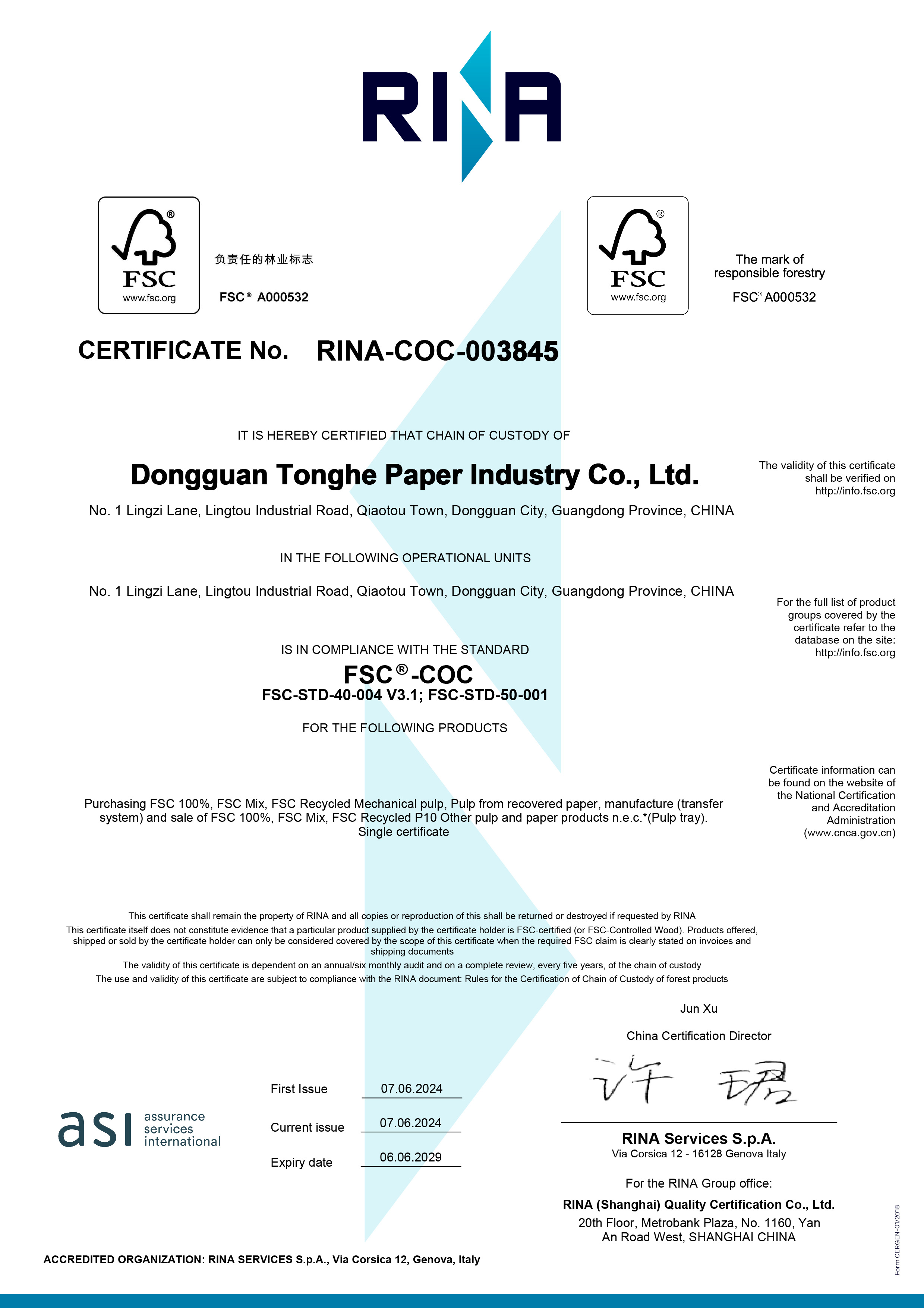
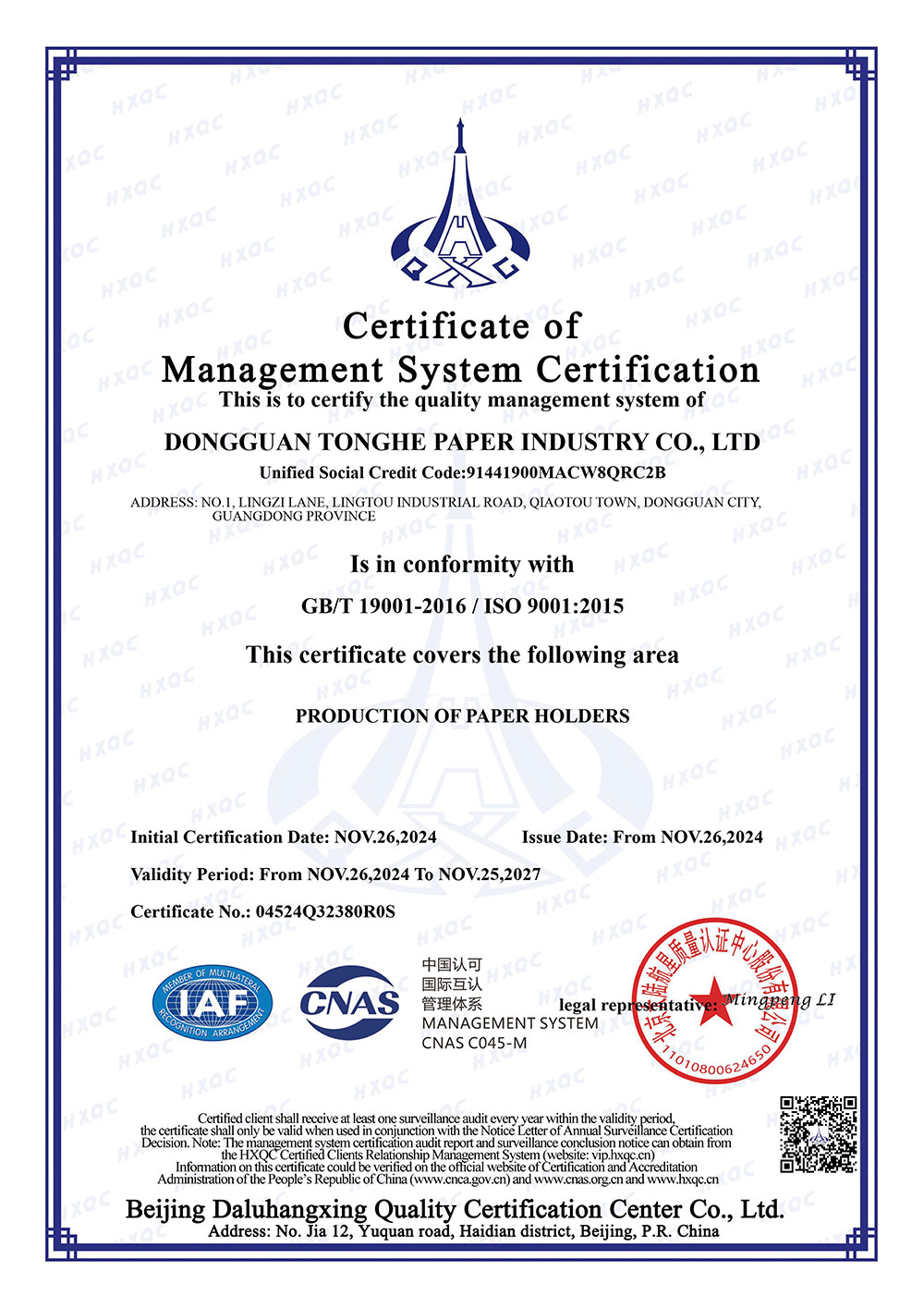
The documentation set behind that production illustrates how the five families appear in practice. For fiber sourcing, the company holds FSC chain-of-custody certification RINA-COC-003845, issued by RINA (Shanghai) Quality Certification Co., Ltd. and valid from 7 June 2024 to 6 June 2029, with a scope that includes the purchase of FSC 100%, FSC Mix and FSC Recycled pulp, pulp from recovered paper, and the manufacture and sale of pulp and paper products including pulp trays. For process control, it holds quality management system certificate 04524Q32380R0S, issued by Beijing Daluhangxing Quality Certification Center Co., Ltd. against GB/T 19001-2016 / ISO 9001:2015, valid from 26 November 2024 to 25 November 2027, with a stated scope of paper holders.
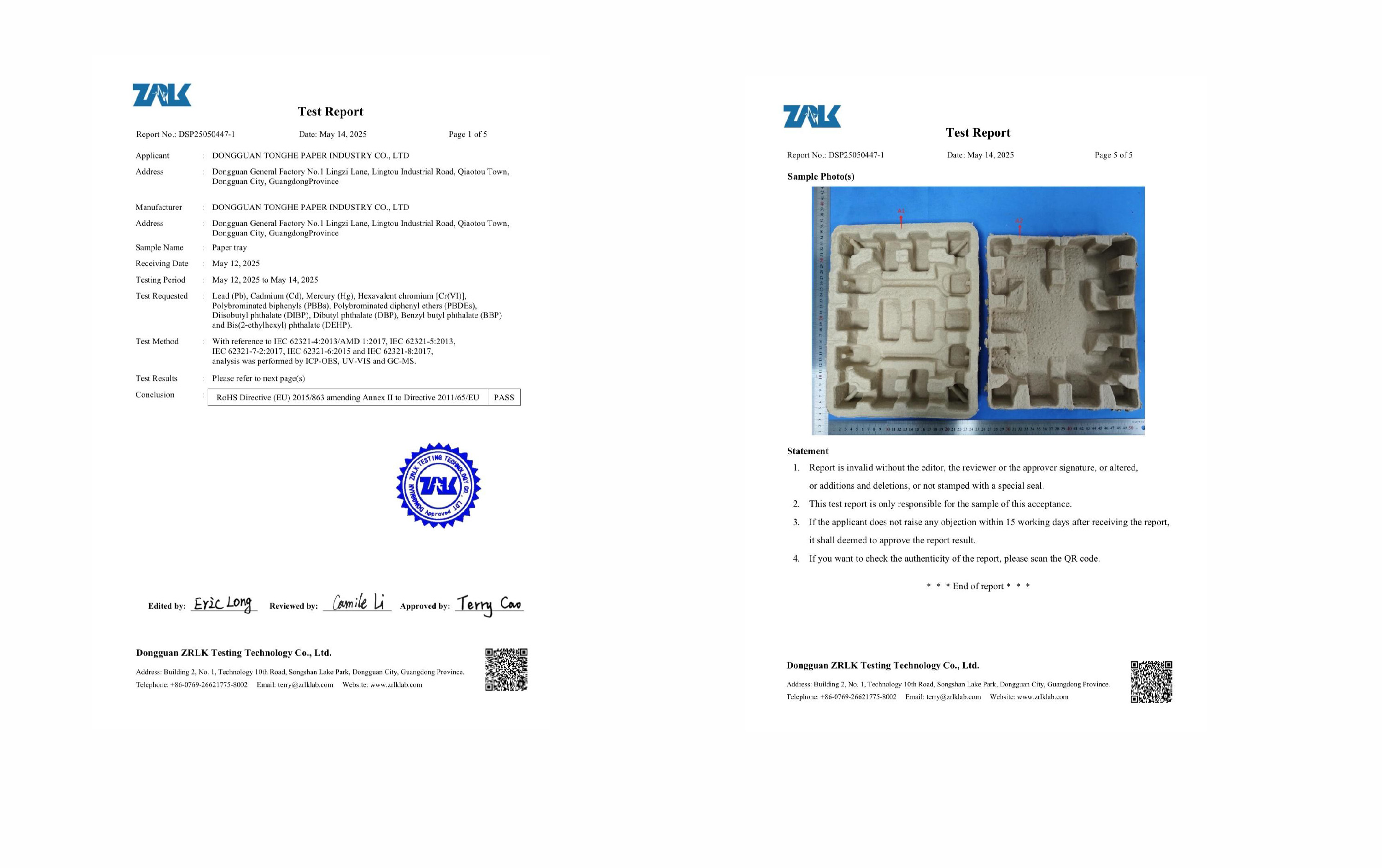
For restricted substances, two paper tray reports are on file: DSP25050447-1, issued by Dongguan ZRLK Testing Technology Co., Ltd. on 14 May 2025 with reference to the IEC 62321 series and analysis by ICP-OES, UV-VIS and GC-MS; and SZXPC26000164601, issued by SGS-CSTC Standards Technical Services Co., Ltd. on 16 January 2026 with reference to IEC 62321-4, -5, -7-2 and -12, analysed by ICP-OES/AAS, UV-Vis and GC-MS. For transport and safety data, MSDS certificate DSP25050758-1 was issued by ZRLK on 24 May 2025, referencing ISO 11014:2009, GB/T 16483-2008, the IATA Dangerous Goods Regulation (66th edition) and the IMO International Maritime Dangerous Goods Code. The company states that its products comply with SGS RoHS and PFAS-free requirements, and that its fiber selection uses sugarcane, bamboo and wood pulp with no harmful chemical additives.
Application-specific documentation follows the same pattern. For medical device pulp trays, the company's product data describes one-piece molded cavities designed for probes, handles, catheters and surgical instrument components, virgin wood pulp free of fluorescent agents, production in a clean workshop and an accompanying material inspection report. For food-grade trays, the stated service range extends from −20 °C to +120 °C, with a lower range of −20 °C to +80 °C for standard specifications and moisture content held at or below 8–12%. Delivery parameters include OEM and ODM production, customization of material, colour, logo, anti-static and moisture-proof functions, a lead time of 15–30 days, a minimum order quantity of 1,000 pieces and quality control across incoming material, in-process production and final inspection.
None of this removes the buyer's verification duty. It shows what a complete, checkable file looks like: named issuing bodies, certificate numbers, dated validity windows, standards cited by edition, and scope lines that can be compared against the purchase order.
Frequently asked questions
Which documents should a buyer request from a molded pulp tray supplier before confirming an order?
Five families cover the usual requirements: a material composition declaration naming the fiber type and any coating or additive; a chain-of-custody certificate if certified or recycled fiber is specified; restricted-substance test reports; a management system certificate for the producing site; and transport or safety documentation such as a material safety data sheet for the shipping method involved. Each should be requested in full, with the certificate number, issuing body and standard edition visible.
How can a buyer confirm that a certificate actually covers the tray being purchased?
Four checks are usually decisive: the scope line, the standard edition, the validity window and the product traceability. Scope lines vary in precision. FSC chain-of-custody certificate RINA-COC-003845, for example, includes pulp trays within its stated scope, while quality management certificate 04524Q32380R0S states its scope as paper holders. If a scope line does not name the product family being bought, the buyer should obtain written clarification from the supplier and, where relevant, from the issuing body before treating the document as satisfied.
Does a restricted-substance test report confirm that molded pulp is suitable for food contact?
No. Restricted-substance reports test a sample for a defined list of regulated substances using specified analytical methods, such as the IEC 62321 series with ICP-OES, UV-Vis and GC-MS. A food-contact assessment is a different documentation family, answering a different question about what migrates from the material under defined conditions. A tray can hold a valid restricted-substance report and still require separate food-contact documentation.
What does chain-of-custody certification cover for molded pulp trays?
It covers fiber sourcing and the transfer system: the purchase of certified, mixed or recycled pulp and pulp from recovered paper, and the manufacture and sale of products within the stated scope, which can include pulp trays. It does not certify cushioning performance, moisture resistance, biodegradation rate or food-contact suitability. Buyers should record it as a sourcing document rather than a product performance document.
What role do payment terms and shipping methods play in supplier qualification?
They determine which documents must exist and when. Air and express shipments typically require transport documentation such as a material safety data sheet, while freight quotations normally depend on the buyer stating a destination port or delivery address. On the supplier side, common arrangements include T/T and platform trade assurance, with shipment by sea, air or express courier. A supplier who can state terms, shipping options, lead time and the documents attached to each stage coherently is generally operating a repeatable documentation process; these terms are process indicators, not compliance certificates.
What documentation matters most for medical device pulp trays?
Material declaration and sterilization support carry the most weight, together with restricted-substance reports and evidence of clean production conditions. Molded pulp medical trays are typically designed with custom cavities for probes, handles, catheters and instrument components, produced from virgin wood pulp free of fluorescent agents, and supplied with a material inspection report. Sterilization compatibility must still be validated by the buyer within its own process parameters; a supplier can provide supporting material, not a substitute for that validation.
Outlook for 2026 and beyond
The direction of travel is toward documentation that is specific rather than generic. The European requirement for all packaging to be recyclable by 1 January 2030 will push buyers to ask for material composition and recyclability evidence alongside the certification sets they already collect, and the projected 8.6% CAGR in healthcare and medical device applications will raise the documentation standard in the segment with the strictest validation requirements.
The practical consequence for procurement teams is that compliance review is becoming a pre-order gate rather than a post-order formality. Two trends are worth planning for. First, more badges will be presented, which increases rather than reduces the need to read scope lines. Second, documentation will increasingly be specified in the purchase order itself — certificate numbers, standard editions, validity windows and responsible issuing bodies — so that the file can be audited after delivery.
For buyers, the checklist in this article is deliberately conservative: request the document, verify the scope, confirm the dates, trace it to the product, and keep the file with the order. That sequence is inexpensive before confirmation and expensive afterwards.
Reference material: Tonghe Paper's product and certification profile is available for download as a PDF brochure at Tonghe Paper company and product profile. General company information is published at tonghepulp.com.