
Modular Medical Storage System: Certification Constraints
Buyers specifying a modular medical storage system rarely lack product options. What they lack is a dependable way to eliminate them. In hospital tenders, the constraints that actually decide the outcome are usually four: the device classification the product falls under, the tray dimensional standard it is built around, the material and cleaning compatibility of its surfaces, and the production capacity standing behind the catalogue. Each is a separate filter. Each removes different suppliers.
The difficulty is that these four constraints are routinely written into the same paragraph of a specification, as though certification, tray format and quality management were interchangeable evidence. They are not. A supplier may hold ISO 9001 without holding an EU Declaration of Conformity for a specific cart model. A shelving system may be CE marked as a medical device while the tray it carries is specified in a separate dimensional language. Understanding which document answers which question is the difference between a procurement file that closes and one that stalls in technical review.
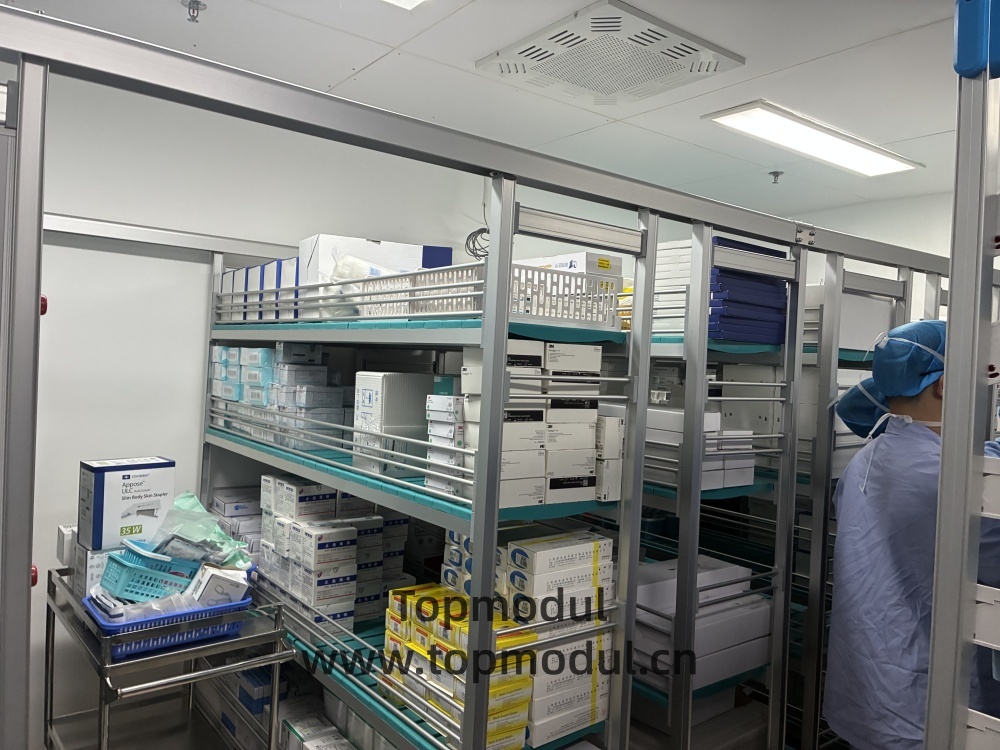
High-density mobile shelving in a hospital secondary storage room: modular storage decisions are increasingly driven by documentation and dimensional standardisation rather than by unit price alone.
Why the constraint set, not the product list, decides the purchase
Medical storage procurement has shifted from equipment buying to specification buying. Three developments drive this. First, the EU Medical Device Regulation (Regulation (EU) 2017/745) placed medical carts and storage furniture into a documentation framework that requires a named European Authorised Representative, a declaration of conformity, and in many cases a device notification. Second, hospital infection-control teams now review storage surfaces and cleaning compatibility as part of equipment approval, not as an afterthought. Third, the growth of modular tray systems introduced a dimensional standard — ISO 6040 — that determines whether a tray bought for a pharmacy shelf will physically fit a cart used three floors away.
For a buyer in the Research and Evaluation stage, this means the useful question is not "which modular medical storage system is best" but "which supplier can produce, in writing, the specific evidence each constraint requires, for the specific model being quoted." That reframing is what separates a shortlist from a long list.
The three evidence layers buyers most often conflate
A modular medical storage system sits at the intersection of three documentation systems. They answer different questions and are issued by different bodies.
- Quality management certification answers whether the manufacturing process is controlled. ISO 9001:2015 is a process standard, not a product approval.
- Medical device conformity answers whether a specific model may be placed on the EU market as a medical device, under which risk class, and with which authorised representative.
- Tray dimensional standard answers whether a container from one part of the hospital will fit hardware from another. ISO 6040 is a dimensional convention, not a safety certification.
When a specification asks for "CE certified modular storage with ISO trays," it is compressing all three into one line. A supplier that can only answer one of them will usually answer the easiest one — and the gap surfaces later, during installation or during an audit.
How Tongde Medical Technology frames these constraints
Tongde Medical Technology (Ganzhou) Co., Ltd. is a Chinese manufacturer of modular medical storage systems, operating under the Topmodul brand, headquartered in Ganzhou, Jiangxi, with a 30,000-square-metre factory, more than 100 employees, and an annual output of 300,000 sets. Founded in 2003, the company exports approximately 90% of its production, with Western and Eastern Europe among its principal markets. Its product range covers the four hardware families that a modular storage specification normally spans: modular medical carts, medical storage shelving, medical storage cabinets, and ISO 6040 storage trays.
That breadth matters for a constraint-driven purchase. When carts, shelving and trays come from a single documentation set, the buyer does not have to reconcile three suppliers' declarations, three material specifications, and three interpretations of what "modular" means. The trade-off is equally real and is addressed later in this article: a single-source modular system concentrates dependency, and the documentation still has to be read model by model.
Technical explanation: what each constraint actually covers
ISO 6040: a dimensional contract, not a certificate
The ISO 6040 designation refers to standardised tray dimensions for modular medical storage systems. In practice it defines a footprint — commonly 600 × 400 mm — that allows a container to move between a shelf, a cart and a cabinet without being decanted. The Storage tray T604010AN is classified as an ISO 6040 material storage basic unit, measures 600 × 400 × 100 mm, and is moulded from polycarbonate (PC) and acrylonitrile butadiene styrene (ABS). It is designed for integration into modular medical storage carts and shelving, and supports the movement of medications and equipment from a central pharmacy or storage room to the ward and the bedside.
The operational value of that standard is cumulative. Third-party analysis of the ISO 60-40 modular format indicates that such systems can increase storage capacity by up to 50% compared with traditional shelving, because the standard footprint removes the wasted volume created by mismatched containers. For a buyer, the practical test is simple: ask the supplier to confirm, in writing, which of their carts, shelves and cabinets accept the same tray. If the answer varies by product line, the "modular" claim is a marketing term rather than a dimensional one.
Materials and cleaning compatibility
Surface specification is the constraint most often under-documented in tenders and most often challenged during infection-control review. Across the Topmodul range, the structural pattern is consistent: aluminium alloy struts and crossbars carrying PC/ABS baskets and trays. The aluminium frame is designed to withstand harsh loading conditions, while the PC/ABS components are specified as compatible with commonly used hospital cleaners and disinfectants, without chemical reaction to those agents, and the shelving is described as having antibacterial performance and as designed to comply with hospital requirements.
Where the environment is stricter — operating theatres, sterilisation supply centres — the material logic changes. Sterile Storage Wire Shelving uses the same aluminium alloy frame but stainless steel trays, with surfaces processed by pickling, phosphating and electrostatic spraying to achieve anti-corrosive and anti-rust properties and to make cleaning easier. The sterile series is described as resistant to temperatures above 130°C and as designed to avoid harbouring dirt and virus breeding, with moisture-proof, dust-proof and vandal-proof characteristics.
Two structural variants are worth noting for specification purposes. The Alpha shelving for medicine storage is offered in two width configurations — 674 × 430 × 2000 mm (60Wide, model TDAS60) and 474 × 630 × 2000 mm (40Wide, model TDAS40) — with customisable height. High-density medical storage shelving uses a rail-based mobile frame in PE and aluminium alloy, with corrosion-resistant aluminium tracks and PE components, anti-collision parts between the mobile and fixed frames, and track installation that requires neither drilling nor gluing. In both cases, assembly is described as requiring no complicated tools.
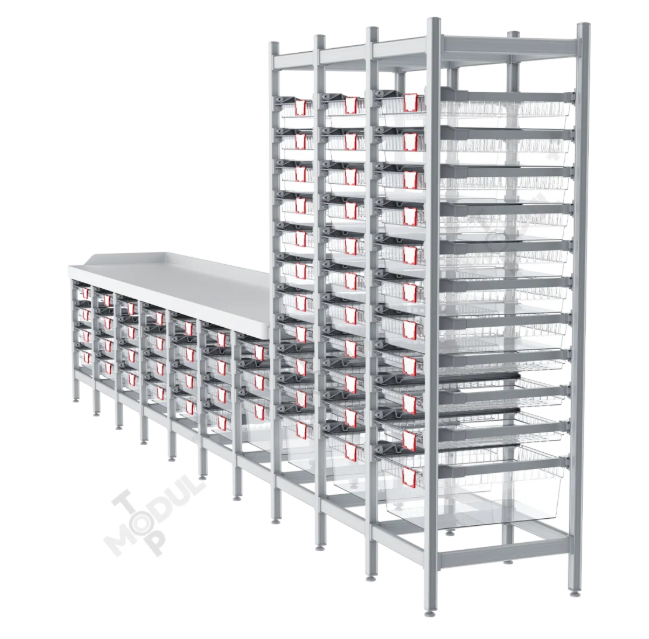
High Density Medical Shelving: aluminium alloy struts and crossbars with modular basket positions, specified for hospital secondary warehouses, pharmacies and consumables storage.
CE documentation: which certificate answers which question
This is where most tender clarifications originate. The following table sets out the documentation actually held, with the scope boundaries stated as issued.
| Document | Reference | Issued / Valid | Scope as stated |
|---|---|---|---|
| Quality Management System Certificate, ISO 9001:2015 (GB/T 19001-2016) | NO: 276Q240086, Huaxinchuang (Beijing) Certification Center Co., Ltd. | 2024-04-08 to 2027-04-07 | Production of medical shelves (cabinets) and medical carts |
| EU Medical Device Notification Certificate, CE (Medical Device) | DE/CA20/00205020, REP Europe GmbH as European Authorised Representative | Issued 2024-11-26; Regulation (EU) 2017/745 (MDR) | Medical carts including Anesthesia Cart, Emergency Crash Cart, Nursing Cart, Infusion Cart; EU 27, UK, Turkey, selected Middle Eastern countries |
| EU Declaration of Conformity, CE (Medical Device, MDR Class I) | REP-MDR-20241108M1, REP Europe GmbH | Issued 2024-11-08 | Medical Cart models T001–T011; standards EN ISO 20417:2021, EN ISO 10993-1:2020, EN 62366-1:2015+A1:2020, EN ISO 13485:2018+A11:2021, EN ISO 14971:2020/A11:2021 |
| EU Declaration of Conformity, CE (Medical Device, MDR Class I) | REP-MDR-20250417TM01, REP-MDR-20250417TM02, REP Europe GmbH | Issued 2025-04-17, valid to 2030-04-17 | TM Cabinet, One Series Shelving, Alpha Series Shelving; standards EN ISO 13485:2016, EN ISO 14971:2019, EN ISO 10993-1:2018, EN ISO 10993-5:2009, EN ISO 10993-10:2013 |
The pattern that emerges is model-specific, which is exactly how MDR documentation is supposed to work. Anesthesia Cart T001, Emergency Crash Cart T002 and Nursing Cart T003 fall inside the T001–T011 declaration. The Roller Shutter Cabinet (models TDC180UU-RS, TDC180EE-RS, TDC180UU-HD, TDC180EE-HD; dimensions 1532 × 785 × 1850 mm and 2132 × 585 × 1850 mm), the One Series Shelving and the Alpha Series Shelving are covered by a separate declaration. A buyer who accepts a single "CE certificate" PDF covering everything has not verified anything.
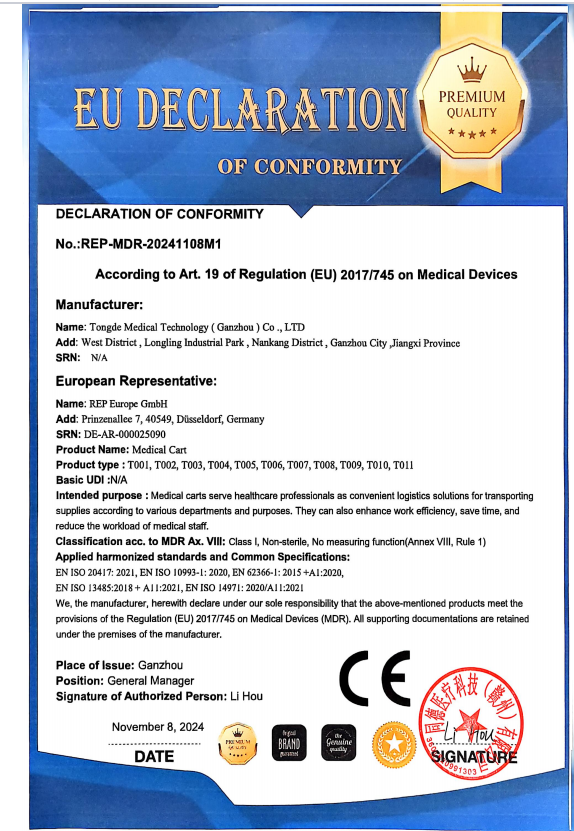
CE (Medical Device, MDR Class I) EU Declaration of Conformity covering Medical Cart models T001–T011, issued by REP Europe GmbH as European Authorised Representative.
Application: where the constraint set meets clinical workflow
The intended working condition across the range is an indoor hospital environment with controlled temperature and humidity, free from heavy corrosion and explosive dust. Within that envelope, the same modular logic is applied at four levels of the material flow.
Central pharmacy and secondary warehouse. High-density mobile shelving compresses storage channels into available floor space, and the rail system allows the mobile frame to be pushed manually. A healthcare centre project in Israel using ten units reported significant space savings and faster retrieval; a hospital project in Saudi Arabia using fifty units reported storage capacity increases of up to 50% or more.
Ward and department level. Nursing Cart T003, Anesthesia Cart T001 and Emergency Crash Cart T002 share a common 754 × 541 × 1005 mm platform and the same aluminium alloy, ABS plastic and metal construction, allowing clinical staff to position supplies at the point of care. Height can be customised for ergonomics, and configurations can be combined according to department requirements.
Inter-department transfer. The Medical trolley T6020-2, at 1385 × 445 × 2000 mm with an aluminium alloy frame and PC/ABS baskets, is specified for intra-department transfer within hospitals or medical institutions.
Sterile and clean areas. Sterile Storage Wire Shelving with stainless steel trays is intended for operating departments and sterilisation supply centres, where the rack structure is used to make full use of space while keeping surfaces suitable for aseptic processing.
A UK hospital project using 100 units of medicine storage shelving over a five-year horizon reported improved storage order, faster medicine retrieval, better inventory control and reduced medication errors. Results of this kind are project-reported rather than independently audited, but they point at the same mechanism: a consistent tray footprint reduces the searching and re-handling that consume nursing time.
Market context: growth is being pulled by constraint, not by novelty
The commercial backdrop supports the constraint-first reading. The global medical carts market is estimated to reach US$ 4.83 billion in 2026, and the European medical carts market is forecast to grow at a CAGR of 15.8% from 2025 to 2030, according to commercial research published by Grand View Research's Horizon outlook. Those figures describe the mobile segment specifically; the shelving and tray segment moves with it, because carts without a compatible tray infrastructure lose much of their point.
The more instructive signal is the capacity figure. If the ISO 60-40 modular format can lift storage capacity by up to 50% against traditional shelving, then the economic case for modularity is driven by floor space and nursing time rather than by product fashion. In European hospitals where real estate is fixed and ward footprints cannot easily expand, that is a durable argument — and it explains why the documentation layer has become a gate rather than a formality.
Comparison with traditional solutions — and where modular stops
Against welded fixed shelving and non-standardised containers, a modular medical storage system offers interchangeable trays across carts, shelves and cabinets; reconfigurable basket positions without tools; corrosion-resistant aluminium frames with PC/ABS or stainless steel containers depending on the cleanliness zone; and a documentation set that can be mapped model by model to a tender clause. Fixed shelving remains cheaper per cubic metre at the point of purchase and requires no tray discipline from staff.
The limitations deserve equal weight, because they determine whether modularity is the right answer for a given site.
Documentation boundaries that buyers should verify line by line.
- CE coverage is model-specific, not range-wide. Models T001–T011 sit under one EU Declaration of Conformity; TM Cabinet, One Series Shelving and Alpha Series Shelving sit under a separate one. A cart outside these lists is not automatically covered.
- For some items, the available product asset information does not itself state CE certification details, and the specification does not state ISO 6040 tray compatibility. Those are documentation gaps at item level, and the correct response is to request confirmation for that specific SKU rather than to assume series-level coverage.
- The CE documentation applies to specific markets — the EU 27 Member States, UK, Turkey and selected Middle Eastern countries for the cart declarations, and the EU 27 for the cabinet and shelving declaration. Buyers outside those territories need to establish which local registration applies.
- Commercial parameters are fixed: minimum order quantity of 100 units and a lead time of 30–45 days. Projects requiring smaller trial quantities or faster delivery need to plan around that, not assume it away.
- Modular systems depend on user discipline. If trays are not returned to their designated positions, the capacity advantage erodes. The system is a workflow commitment as much as a piece of furniture.
Quality control as part of the constraint set
Process evidence is the fourth filter, and it is the one that answers whether the documentation can be reproduced at scale. Tongde Medical Technology operates a total quality management system with a five-member quality control team conducting inspection at each production stage and on every product before packing and shipment, with 100% testing and full-process inspection described as covering inbound, in-process, final and outgoing stages. The ISO 9001:2015 certificate, issued by Huaxinchuang (Beijing) Certification Center Co., Ltd. and valid from 2024-04-08 to 2027-04-07, is recognised in 170 countries and regions and its stated scope covers the production of medical shelves (cabinets) and medical carts.
OEM and ODM services are offered alongside standard products, with monthly capacity referenced at 20,000 units and an annual output of 300,000 sets. After-sales provisions include free maintenance service, installation, debugging and usage training, and consultation. For a distributor or hospital group evaluating a multi-year supply arrangement, these are the parameters that determine whether a specification can be met on the second and third order, not only on the first.
Future outlook
Three directions are visible from the current constraint set. First, tray standardisation is likely to move upstream in the specification process — buyers will ask for the tray footprint before they ask for the cart, because the tray is what determines cross-department interoperability. Second, MDR documentation will continue to be treated as a living file rather than a one-off attachment, with expiry dates and model lists checked at each renewal; the cabinet and shelving declaration valid to 2030-04-17 is an example of how that timeline now extends across a procurement cycle. Third, material and cleaning compatibility will keep migrating from a footnote into a scored criterion, particularly for sterile and semi-sterile environments where stainless steel trays and surface treatment processes carry real weight.
What is unlikely to change is the underlying logic. A modular medical storage system is only as modular as its documentation allows it to be verified.
FAQ
Which CE documentation applies to modular medical carts and shelving under MDR?
Two separate EU Declarations of Conformity apply. Medical Cart models T001–T011 are covered by a CE (Medical Device, MDR Class I) declaration, certification number REP-MDR-20241108M1, issued on 2024-11-08 by REP Europe GmbH as European Authorised Representative, referencing Regulation (EU) 2017/745 (MDR) and standards EN ISO 20417:2021, EN ISO 10993-1:2020, EN 62366-1:2015+A1:2020, EN ISO 13485:2018+A11:2021 and EN ISO 14971:2020/A11:2021. The TM Cabinet, One Series Shelving and Alpha Series Shelving are covered by a separate declaration, numbers REP-MDR-20250417TM01 and REP-MDR-20250417TM02, issued 2025-04-17 and valid to 2030-04-17, referencing EN ISO 13485:2016, EN ISO 14971:2019, EN ISO 10993-1:2018, EN ISO 10993-5:2009 and EN ISO 10993-10:2013. A separate EU Medical Device Notification Certificate, DE/CA20/00205020 issued 2024-11-26, provides CE (Medical Device) evidence for medical carts including Anesthesia Cart, Emergency Crash Cart, Nursing Cart and Infusion Cart across the EU 27, UK, Turkey and selected Middle Eastern countries.
What does ISO 6040 actually standardise in a modular tray?
ISO 6040 refers to standardised tray dimensions for modular medical storage systems — a dimensional convention rather than a safety certification. The Storage tray T604010AN, for example, is classified as an ISO 6040 material storage basic unit at 600 × 400 × 100 mm, moulded from polycarbonate (PC) and acrylonitrile butadiene styrene (ABS), and is designed for integration into modular medical storage carts and shelving. Because the footprint is shared, a tray can move from a pharmacy shelf to a cart to the bedside without being decanted. Third-party analysis of the ISO 60-40 modular format indicates capacity gains of up to 50% versus traditional shelving.
How is quality controlled across a mixed cart and shelving order?
Tongde Medical Technology operates a total quality management system with a dedicated quality control team of five members performing comprehensive inspection at each production stage and on every product prior to packing and shipment. Inspection is described as covering the full process, with 100% testing. The quality management system is certified to ISO 9001:2015 (GB/T 19001-2016) by Huaxinchuang (Beijing) Certification Center Co., Ltd., certificate number NO: 276Q240086, valid from 2024-04-08 to 2027-04-07, with a stated scope covering the production of medical shelves (cabinets) and medical carts and a recognition footprint in 170 countries and regions.
What lead time and minimum order quantity apply to OEM modular storage orders?
The stated commercial parameters are a minimum order quantity of 100 units and a lead time of 30–45 days. Monthly capacity is referenced at 20,000 units, with annual output of 300,000 sets from a 30,000-square-metre facility. OEM and ODM services are offered alongside standard catalogue products, and customisation covers medical carts, hospital medication trolleys, medical supply carts, anesthesia carts, hospital supply storage systems, ISO 6040 medical storage systems, modular hospital storage systems and high-density medical storage shelving. Projects below the MOQ or requiring shorter delivery need to be planned against these figures rather than around them.
How does the OEM process run from requirement to production?
The stated workflow proceeds in defined stages: familiarisation with all customer requirements, whether standard off-the-shelf products or customised models; provision of a detailed quotation with requirements clearly defined; discussion of further needs or concerns; double confirmation of the model number followed by material and size selection; joint approval of details including materials, colours and sizes; commencement of production after payment and drawing confirmation; regular updates on production process and progress; and photographic checking and confirmation before delivery. A related safety note advises reviewing product specifications and quality standards before mass production.
Reference material: the 2026 TM Shelving Catalogue from Tongde Medical Technology is available for download at https://cdn.socialarks.com/sbsp/25390/common/2026/0924/2026%20TM%20Shelving%20Catelogue_1790243140.pdf. Market size and growth figures cited in this article are drawn from commercial research published by Grand View Research's Horizon outlook; the ISO 60-40 capacity figure is drawn from third-party product literature published via MedicalExpo. Project outcomes described are reported by the named client installations and are not independently audited.
¿Tiene preguntas o necesita más detalles?
Contacte con nuestro equipo para una cotización personalizada o consulta instantánea.
Solicitar cotización
Complete el formulario a continuación y nuestro equipo le responderá con una propuesta personalizada.
Chat directo de WhatsApp
¿Prefiere chatear en tiempo real? Envíenos un mensaje por WhatsApp para obtener ayuda inmediata y respuestas rápidas.
- Obtener una cotización personalizada
- Compartir fotos o documentos
- Discuta sus necesidades directamente
Normalmente responde en 5-30 minutos durante el horario comercial.