
Modern Wire and Cable Extrusion: Key Process Factors for Consistent Quality

The global wire and cable industry is expanding steadily. The wire and cable market worldwide was estimated at USD 267.8 billion in 2024, with a projected compound annual growth rate of 7.3% through 2034, according to Global Market Insights. In China, the wire and cable market generated approximately USD 41.1 billion in revenue in 2025 and is projected to reach USD 56.2 billion by 2033, based on Grand View Research. For manufacturers serving this growing market, extrusion is a highly consequential production stage: it controls insulation and sheath geometry, material integrity and long-term reliability.
Modern cable specifications demand more than mechanical strength. Dielectric consistency, concentricity, surface quality and resistance to environmental stress all depend on how well the extrusion line controls heat, pressure, flow and cooling. For technical buyers and production engineers evaluating equipment, a clear understanding of these factors is necessary before comparing machines or suppliers.
Why Extrusion Quality Is Hard to Control
Insulation and sheathing extruded under the same nominal settings can still vary between batches. Small disturbances, such as a temperature drift of a few degrees, a slight change in melt viscosity, or a minor variation in line speed, can produce walls that are too thick or too thin, voids in the material, or internal stress that only becomes visible during later testing.
The financial impact is direct: off-specification lengths must be reworked or scrapped, delivery schedules slip, and field failures can affect a supplier's long-term reputation. For companies evaluating new extrusion technology, the challenge is that machine data sheets rarely describe how stable the process remains under realistic variations in material lots, ambient temperature or operator skill.
This has shifted attention away from single-parameter specifications towards a systems view: material, extruder, measurement and cooling must operate as one controlled process. The factors below are the ones that most often determine whether that system performs well.
Key Technical Factors in Insulation and Sheath Extrusion
1. Temperature control and barrel profile
The temperature profile along the extruder barrel controls how a polymer transitions from solid pellets to a homogeneous melt. If the melt temperature is too low, the material may not flow evenly around the die gap, producing a rough surface or thickness variation. If it is too high, polymers with limited thermal stability, such as PVC, XLPE compounds and low-smoke halogen-free (LSZH) formulations, can begin to degrade, releasing decomposition products and creating voids or discoloration.
For technical evaluators, the key question is not only whether a machine has heating zones, but how precisely each zone can be held and how fast the system can correct a deviation. Closed-loop temperature control, well-placed sensors and adequate barrel cooling capacity are all relevant to maintaining a stable melt condition.
2. Screw geometry and material adaptability
The screw is a central component of the extrusion process. Its geometry determines compression, shear rate and residence time. A screw designed for one polymer family may perform poorly with another: XLPE compounds require controlled shear to avoid premature cross-linking, while LSZH materials need gentle, low-shear processing to avoid decomposition. Rubber compounds present different requirements again, often needing a wider working temperature range and more careful pressure control.
When evaluating equipment, checking which materials the screw geometry is optimised for, and what costs are associated with changing to a different material family, may be more revealing than a maximum output figure.
3. Extrusion speed and process stability
Line speed is an obvious productivity metric, but it interacts strongly with other process variables. A higher line speed reduces residence time in the barrel, which can lower melt temperature and alter the heat history. It also increases the demand on cooling capacity and on the response time of measurement systems.
The practical indicator is not maximum line speed but the range of speeds over which dimensions remain stable. A line that holds a thin insulation wall consistently at moderate speed may be more valuable than one with a high maximum speed but unstable dimensional output.
4. Wall-thickness and concentricity control
For insulation, wall thickness and concentricity directly influence electrical performance. Eccentric insulation increases the risk of local field concentration and can cause failure at rated voltage. Maintaining concentricity depends on the die geometry, the uniformity of melt flow around the die, and the stability of the conductor or core passing through the line.
Modern measurement systems can report eccentricity continuously, but the extrusion head design and the accuracy of the centring mechanism remain the physical basis. Evaluators should look at how precisely the die can be adjusted, how stable the crosshead pressure is, and how measurement feedback and centring adjustments are integrated.
5. Cooling system design
Cooling rate influences polymer crystallinity, internal stress and final cable roundness. An aggressive cold-water quench can freeze in stress, while slow cooling may allow sagging or deformation in thick-walled cables. Multi-zone cooling, where the cable passes through graduated water temperatures, is a common approach, and in some cases air cooling is used before water contact to avoid sudden shock.
The cooling section also needs enough length and water temperature control to match the maximum line speed. Evaluators should consider what cooling capacity is installed, how it responds to speed changes, and whether it is adequate for the thickest cable the line is expected to produce.
6. Inline measurement and feedback
Diameter gauges, wall-thickness sensors, eccentricity monitors and spark testers provide the data needed to detect problems early. Inline measurement adds value when it is connected to process control: a diameter signal can adjust line speed or screw speed automatically, reducing the time in which off-spec product is produced.
At the same time, measurement systems themselves have limits. They need calibration, and their readings relate to specific positions along the line. Understanding the measurement principle, sampling rate and placement is as important as the stated accuracy.
7. Material consistency and preparation
Extrusion quality begins before the powder or pellets enter the hopper. Moisture absorption, dust contamination, inconsistent compound properties and poor mixing all affect the melt condition. Dryers, material handling systems and batch control play a role in keeping the extrusion line stable.
When evaluating a new line or process, assessing material preparation and the repeatability of incoming compound batches is necessary. A high-performance extruder cannot fully compensate for inconsistent input.
Different Cables, Different Process Priorities
The importance of each factor changes with the cable type and application. The following overview is a practical starting point for process evaluation.
| Cable segment / application | Main extrusion challenge | Process factors to weigh more heavily |
|---|---|---|
| Thin-wall automotive and equipment wires | Tight dimensional tolerances at production speed | Concentricity control, line-speed stability, fast inline feedback |
| Medium- and high-voltage XLPE power cables | Long-term electrical reliability under high stress | Clean and uniform melt, strict temperature control, controlled cooling, cross-linking coordination |
| Low-smoke halogen-free (LSZH) sheathing | Heat- and shear-sensitive compounds | Gentle screw geometry, stable low-temperature profile, adequate barrel cooling |
| Rubber-insulated cables | Cure state coupled with extrusion heat history | Melt temperature stability, pressure control, cooling and vulcanisation coordination |
| Fibre-optic and micro cables | Very small cross-sections, demanding concentricity and surface quality | Low-speed stability, precise tension control, high-resolution measurement |
No single extrusion package is optimal for all product types. A manufacturer running mainly LSZH sheathing may prioritise gentler screw geometry and wider temperature control, while a medium-voltage XLPE producer will place more weight on cleanliness, temperature uniformity and cooling precision. Defining the product mix in advance is therefore an essential part of equipment evaluation.
Equipment, Material and Process Control: A Balanced View
Extrusion is a system. Material defines the processing window; equipment determines whether that window can be held; process control determines whether it is held consistently over time. An evaluation that focuses on only one dimension is likely to miss the critical link.
For example, even an extruder with very good temperature control will still produce voids in insulation if incoming compound contains excessive moisture. Conversely, if the material is stable and the temperature profile is correct, but measurement feedback responds too slowly, a short section of diameter drift may become scrap before it is detected.
For buyers, this means the evaluation process should include the material system, the screw and barrel design, and the measurement and control loop as one integrated package. Asking suppliers how their equipment behaves with specific materials, and what process parameters are used to maintain stability, is often more useful than comparing headline throughput figures.
Modern Process Management Compared with Traditional Practice
Traditionally, extrusion settings were established through operator experience, and quality was verified by first-article inspection and periodic sampling. This method is still common and can be effective in stable, low-mix production. However, it tends to detect process drift only after a certain amount of off-spec product has been produced, and it depends heavily on the experience of a limited number of personnel.
A process approach that combines continuous inline measurement, closed-loop adjustment and process data recording can help identify process drift earlier and make operating conditions easier to review and reproduce. Its practical value depends on the equipment configuration, measurement accuracy and how production teams use the resulting information.
A reasonable limitation should be acknowledged: inline measurement and process data do not replace meaningful debugging and testing. First-article inspection, type tests and periodic laboratory verification are still necessary, particularly for high-voltage and safety-critical cables. Measurement devices require regular calibration, and their data are only useful if the technical team understands how to interpret material and process behaviour. In other words, technology reduces but does not remove the need for engineering judgement.
Market Trends in Extrusion and Process Technology
Under this demand environment, several trends are visible in extrusion and process technology.
Material systems are becoming more challenging to process. LSZH and high-temperature compounds are increasingly specified in transportation, building and industrial applications, and these materials require equipment that can handle narrower processing windows.
Process transparency is increasingly requested by end customers. Cable users want evidence that production conditions are controlled, which makes inline measurement and data recording commercially relevant.
Production flexibility is rising in importance. Manufacturers face smaller order quantities and more product variants, pushing them to seek extruders that can change over quickly without sacrificing stability.
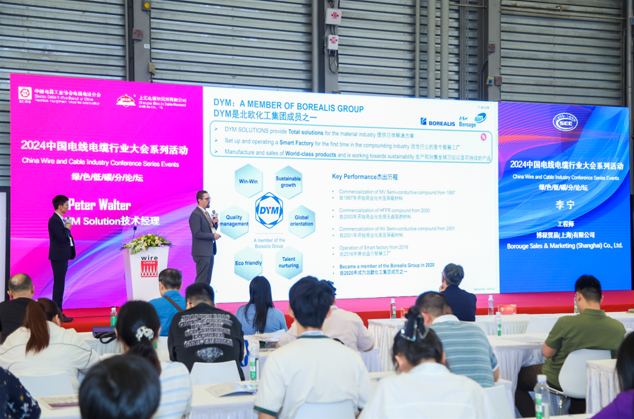
The scale of industry participation can be illustrated by wire China 2024. wire China 2024 covered an exhibition area of 80,500 square meters, bringing together 1,080 exhibitors from around the world and 41,857 professional visitors from 90 countries and regions. These figures provide a factual reference for the scale of the 2024 event.
Looking Ahead: Where Extrusion Technology and Industry Exchange Meet
Extrusion technology is likely to continue evolving towards more precise temperature management, broader material adaptability and better integration of inline measurement with process control. Equipment manufacturers are paying more attention to material-specific screw design and to flexibility across product families.
At the same time, a significant part of technical progress happens through industry exchange. Seeing how a machine reacts to a specific compound, questioning a process engineer about the reasoning behind a screw design, or comparing measurement systems with one's own product requirements is difficult to accomplish purely from online documents. Industry trade fairs provide a concentrated environment for these comparisons.
wire China 2026 is scheduled for September 21 to 24, 2026 at the Shanghai New International Expo Centre. Current published plans indicate a planned event area of 80,500 square meters, more than 1,100 exhibitors, over 40,000 expected professional visitors, and more than 60 specialised conferences and forums. The 2026 figures are current plans and expected figures rather than completed event results.
For manufacturers and technical professionals planning an equipment upgrade, participating in such a trade fair offers access to current extrusion machinery, material innovations, measurement technology and process concepts from multiple suppliers. More detailed programme information is available in the official wire China 2026 brochure. Pre-registration and planning details can be found on the official website or through the registration page.
FAQ: Common Questions on Wire and Cable Extrusion
Q1. What is the most important factor in wire and cable extrusion quality?
There is no single factor. In practice, temperature control and material consistency are often cited as the most influential, because they define the melt condition before the polymer reaches the die. The relative importance shifts with cable type: wall-thickness control may dominate for thin-wall wires, while temperature uniformity and cooling gain priority for XLPE power cables.
Q2. Why is temperature control important in insulation and sheath extrusion?
Temperature determines how uniformly a polymer melts, how well it flows through the die, and whether it stays within safe thermal limits. Excessive temperature can degrade heat-sensitive compounds such as PVC and LSZH, while low temperature can cause poor surface quality and unstable thickness.
Q3. How do manufacturers reduce insulation eccentricity?
Eccentricity is controlled through die centring accuracy, uniform melt flow around the die, stable line tension and inline measurement that feeds back to the line control. Regular verification with eccentricity monitoring is necessary, especially for thin-wall products.
Q4. What are the main difficulties when extruding LSZH materials?
LSZH compounds are typically more shear- and heat-sensitive than PVC or PE. If processed at too high a temperature or shear rate, they can decompose or degrade. Screw design, a moderate temperature profile and adequate barrel cooling are common solutions.
Q5. Why are inline measurement systems important on an extrusion line?
Inline measurement detects dimensional and material deviations in real time, allowing the line to be adjusted before large quantities of off-spec cable are produced. It complements laboratory testing, which remains necessary for final verification of electrical and mechanical properties.
Q6. Is a higher extrusion speed always beneficial?
Not necessarily. Higher speed reduces residence time and changes heat history, and it requires faster cooling and measurement responses. The practical goal is to find the speed range within which all quality parameters remain stable.
Q7. How can an industry trade fair help in evaluating extrusion solutions?
A trade fair can give buyers an opportunity to review machine designs, screw options, measurement systems and materials from different suppliers within one industry setting, and to discuss process requirements with technical personnel. wire China 2026 is scheduled for September 21 to 24, 2026, in Shanghai. The usefulness of such a visit depends on how clearly the visiting team defines its product mix, technical requirements and process challenges in advance.
¿Tiene preguntas o necesita más detalles?
Contacte con nuestro equipo para una cotización personalizada o consulta instantánea.
Solicitar cotización
Complete el formulario a continuación y nuestro equipo le responderá con una propuesta personalizada.
Chat directo de WhatsApp
¿Prefiere chatear en tiempo real? Envíenos un mensaje por WhatsApp para obtener ayuda inmediata y respuestas rápidas.
- Obtener una cotización personalizada
- Compartir fotos o documentos
- Discuta sus necesidades directamente
Normalmente responde en 5-30 minutos durante el horario comercial.