
Model-Line Audit: Judging a Gaming Chair Supplier's Longevity
Supplier Evaluation · Model-Line Audit
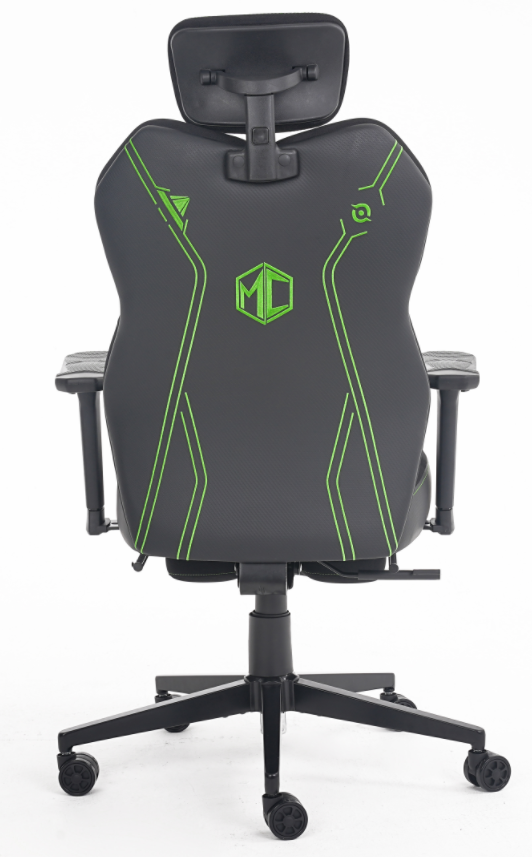
A new-design model from the audited range. Model-line continuity becomes visible when each generation reuses, revises, or replaces core structures rather than starting from zero.
The global gaming chair market was estimated at USD 1.37 billion in 2024 and is projected to reach approximately USD 2.05 billion by 2030, with North America alone accounting for 36.4% of revenue share in 2024. Growth of that shape does not reward suppliers who can produce one good sample — it rewards suppliers whose model range can be reordered, extended, and serviced over several seasons without the platform underneath it quietly changing.
For importers, distributors, and internet-cafe operators, the practical question is rarely "can this factory build a chair?" It is "will the chair I approve this quarter still exist, in the same structural form, two and three years from now?" A model-line audit is one way to answer that before committing to a program.
Why a Single Sample Cannot Answer a Long-Term Question
Most sourcing decisions rest on three artefacts: a sample, a quotation, and a specification sheet. All three describe a moment in time. None of them describe the range the sample came from, and none of them show whether the factory can keep producing a coherent family of products as demand shifts.
That gap is where long-term supply problems originate. A supplier with one strong model and no adjacent models cannot absorb a change in buyer preference, a change in regional requirement, or a change in channel mix. A supplier whose range is wide but structurally inconsistent creates a different problem: spare parts, mechanisms, and carton logic differ from SKU to SKU, and after-sales support becomes expensive.
The audit approach inverts the usual reading order. Instead of starting with the newest or cheapest model, it starts with the whole documented range and asks three questions: what stays the same, what changes deliberately, and what changes without explanation.
What a Model-Line Audit Actually Measures
A model-line audit is a structured read of a supplier's catalogue against five dimensions. Each dimension can be evidenced from published product data rather than opinion.
- Category depth — whether the range covers the buying occasions the market actually has: racing-type, heavy-duty big-size, sofa format, LED/feature-led, and gaming-office hybrid.
- Component standardization — whether gas lifts, tilt mechanisms, armrests, casters, and cushions repeat across models, or are re-specified each time.
- Material consistency — whether the material vocabulary (fabric, PU, PVC, metal, foam, plastic, plywood) is stable and documented per model.
- Generational evolution — whether successive models build on a recognizable platform instead of replacing it.
- Sustained introduction capability — whether new designs arrive while the existing line continues to be produced, which depends on process and engineering capacity rather than marketing.
Case Evidence: The MC196 Series as an Audit Trail
The clearest way to test the framework is to apply it to a documented series. The MC196 family from Anji Maochang Furniture Co., Ltd. — a Zhejiang-based chair manufacturer established in 2016 that produces gaming chairs, office chairs, and manicure chairs — is useful because multiple generations are specified in public product data, not just the newest one.
MC196 — the baseline
The base MC196 is documented as a game-type office chair intended for home, office, and live streaming use, with a backrest designed for the European market: a raised lumbar section, a slightly recessed middle area, and a neck-supporting headrest with a slight indentation. Backrest tilt locks in three positions through a 3-gear locking mechanism. Materials are listed as fabric, metal, foam, and plastic, overall dimensions W67 × D70 × H124–132 cm, carton 76 × 32 × 61 cm. This is the reference entry against which the rest of the series can be compared.
MC196-1 — a feature-led branch
MC196-1 is classified as an LED gaming chair for office, home, and live streaming scenarios. Its distinguishing structure is a segmented backrest with LED strips running down the middle as well as around the perimeter, and a frame documented as constructed entirely of wood, with fabric, metal, and plastic also listed. Overall dimensions match the baseline at W67 × D70 × H124–132 cm, but the carton changes to 75 × 61 × 32 cm. For an auditor, this is a deliberate branch: the external envelope is retained while the frame approach and packaging logic diverge.
MC196-2-1 — armrest and base escalation
MC196-2-1 is an exclusive game chair for home and office use. It carries 5D adjustable armrests, a height-adjustable headrest, and forward-backward seat-depth adjustment. The backrest supports 3 locking tilt angles and is paired with a retractable footrest. It stands on a black powder-coated metal base that is detachable to reduce packaging size, fitted with a Class-3 gas lift and 60mm casters. The seat cushion uses an inner spring package, and the product is documented with a registered design patent. Dimensions are W70 × D70 × H118–128 cm, carton 75 × 65 × 34 cm.
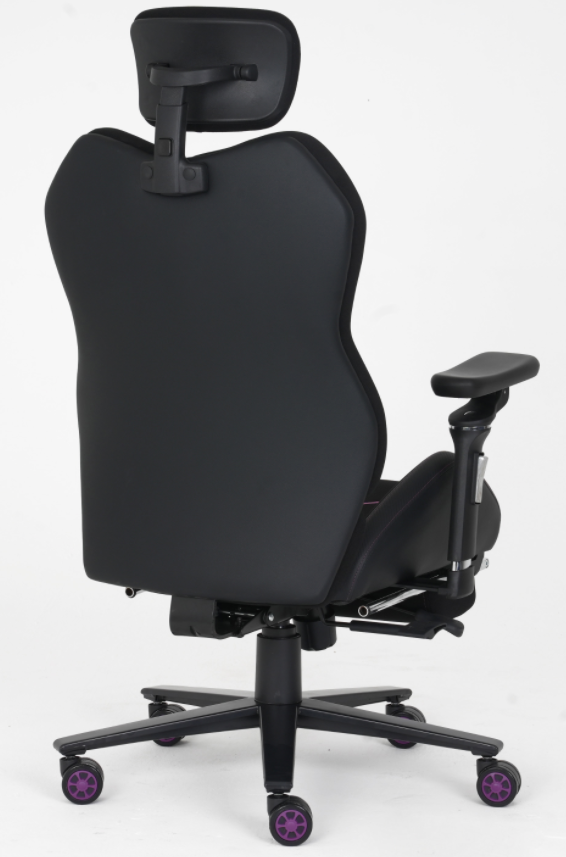
MC196-2-1 image set. A registered design patent on one generation is one of the continuity signals a model-line audit looks for: it implies the design is stable enough to defend, not a one-season experiment.
MC196-3-1 — ergonomic adjustment branch
MC196-3-1 is classified as a game-type computer chair for home, office, and internet-cafe environments. Its documented adjustments are a 3-position tilt-lock mechanism switching between gaming, working, and relaxing modes, 2D adjustable armrests moving up/down and back/forth, and an adjustable headrest and lumbar pillow. Materials are fabric, PVC, PU, metal, plastic, and foam. The height range is notably lower at H106–114 cm with a width of 66.5 cm and depth of 69 cm, carton 75 × 57 × 37 cm.
MC196-4 — seat-cushion and caster branch
MC196-4 is a game chair with a spider element, made of PU, metal, and plastic. It repeats the segmented backrest but renders it with pink embroidered lines, and adds a spring-loaded seat cushion, a retractable footrest, an up/down adjustable headrest, 2D adjustable PU-padded armrests, and a 3-position lockable tilt mechanism. Casters are 60mm. Dimensions are W68 × D69 × H122–132 cm, packed one piece per carton at 75 × 36 × 56 cm, with a loading quantity of 447 pieces.
MC196-5 — base architecture change
MC196-5 is a new-design game chair in fabric, metal, plastic, and PU, with a split-back construction and a K/D metal Starbase. The backrest tilt is adjustable across 3 positions, the headrest is adjustable, and the armrests are height-adjustable with PU padding. Embroidery and printed lines carry the decorative language forward. Overall dimensions are W70.5 × D69 × H124–132 cm with the same 75 × 36 × 56 cm carton and 447-piece loading as MC196-4.
Extending the Audit Beyond the Core Series
A series alone is not a range. Depth is tested by whether the supplier also covers formats that sit outside the main platform without the whole catalogue becoming incoherent.
MC1034 is classified as a racing-type game chair for office, gaming, and live streaming use. It is built in metal, PU, and plastic with a high-back racing ergonomic contour, molded foam for pillow and lumbar support, a 180-degree reclining mechanism, a foldable footrest, adjustable armrests, and a height-adjustable pillow. The backrest side edges and trim are spliced with wear-resistant PU leather, and the front surface carries streamlined orange embroidered lines on a black-orange scheme. Dimensions are W71.5 × D65 × H123–131 cm, carton 86.5 × 65 × 36 cm, loading 334 pieces per 40HQ.
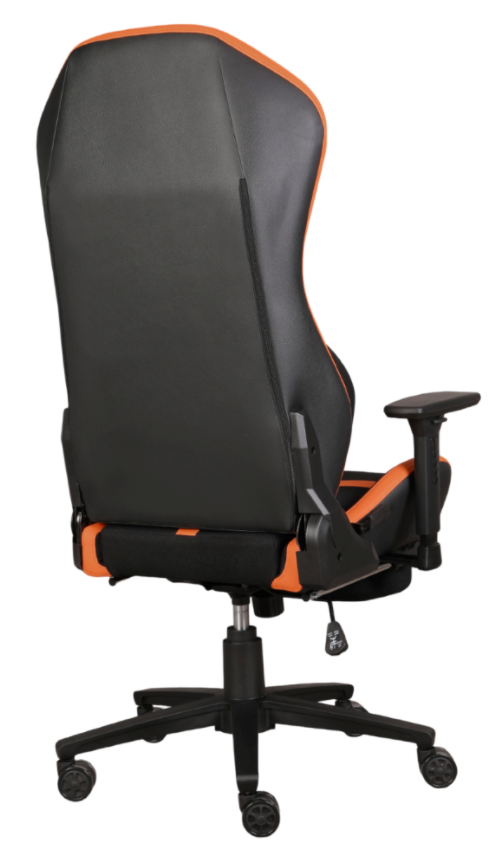
MC1034 racing-type image set. It is a separate product family, but its 180-degree recline and foldable footrest connect it to the logic used in the larger formats.
MC1039 is a new-design big-size gaming chair made of PU, PVC, mesh, fabric, plywood, and a metal frame. It is specified with a Class-3 gas lift, a 370mm big-size starbase, a frog-type multifunctional mechanism, a height-adjustable armrest, a thickened spring-pack cushion, a soft back cushion, 180-degree reclining, a foldable footrest, and a stated weight capacity of 150kg.
MC1039-1 is the heavy-duty big-size entry, suitable for heavier users, made of PU, metal, and plastic. It carries a frog-type adjustable multifunctional mechanism, 4D adjustable armrests, a foldable footrest, 180-degree reclining, and a soft back cushion. Dimensions are W74 × D80 × H126–132 cm, carton 82 × 60 × 53 cm, loading 260 pieces.
MC1040 is classified as a gaming sofa for home, office, and live streaming use, upholstered in PU and PVC on a metal frame. It offers a soft back cushion, a coiled spring inside the seat cushion, height-adjustable armrests, a foldable footrest, a 180-degree reclining angle, and silent lockable casters. Overall dimensions are W80 × D72 × H119 cm, net weight 27.4kg, stated weight capacity 150kg, carton 82 × 60 × 60 cm, loading 227 pieces.
MC1025 is a new-design computer chair in fabric, foam, PU, and metal plastic, intended for home, office, and live streaming use. It repeats the segmented backrest with orange embroidered lines, an up/down adjustable headrest, 2D adjustable PU-padded armrests, a retractable footrest, a spring-loaded seat cushion, a 3-position lockable tilt mechanism, and 60mm smooth casters. Dimensions are W70 × D69 × H121–130 cm, carton 78 × 38 × 56 cm, loading 410 pieces.
Standardization Table: Reading the Range Horizontally
The most useful output of a model-line audit is a horizontal view. The table below groups documented components by how consistently they appear across the models described above.
| Component | Documented presence in the range | Why it matters to a buyer |
|---|---|---|
| Gas lift | Class-3 gas lift on MC196-2-1 and MC1039 | A consistent lift class reduces spare-part variance across service regions and simplifies after-sales stock. |
| Tilt mechanism | 3-gear locking on MC196; 3 locking tilt angles on MC196-2-1; 3-position tilt-lock on MC196-3-1, MC196-4, MC1025; frog-type multifunctional on MC1039 and MC1039-1 | Two mechanism families coexist. Buyers reordering the same SKU should confirm which family the next production run will carry. |
| Armrests | 5D on MC196-2-1; 4D on MC1039-1; 2D PU-padded on MC196-3-1, MC196-4, MC1025; height-adjustable on MC1039, MC1040, MC196-5 | Armrest dimensionality is the clearest internal positioning ladder in the range and often the fastest way to compare quotes. |
| Recline | 180 degrees on MC1034, MC1039, MC1039-1, MC1040 | Deep recline is concentrated in larger formats and the sofa, not distributed evenly — relevant for cafe and lounge layouts. |
| Footrest | Retractable on MC196-2-1, MC196-4, MC1025; foldable on MC1034, MC1039, MC1039-1, MC1040 | Near-standard on higher tiers but not universal. Verify per SKU; it changes carton and perceived tier. |
| Casters | 60mm on MC196-2-1, MC196-4, MC1025; silent lockable on MC1040 | Caster sizing affects floor compatibility, noise in shared venues, and replacement stock. |
| Seat cushion | Inner spring package on MC196-2-1; thickened spring-pack and coiled spring on MC1039; coiled spring on MC1040; spring-loaded on MC196-4 and MC1025 | Spring-pack construction is the range's documented answer to long-session sag, which is the most common wear complaint in continuous-use venues. |
| Base | Detachable black powder-coated metal base on MC196-2-1; 370mm starbase on MC1039; K/D metal Starbase on MC196-5 | Base architecture drives carton volume and freight. K/D and detachable bases generally mean denser container loads. |
Material Consistency and the Wider Market
Material consistency is the second axis of the audit because it determines whether a range can be sourced, tested, and repaired with predictable inputs. Across the audited models the documented material vocabulary is narrow and repeatable: fabric, PU, PVC, metal, foam, plastic, plywood, and mesh. PU appears in some form on MC1034, MC1039, MC1039-1, MC1040, MC1025, MC196-2-1 territory, MC196-4, and MC196-5; fabric appears on MC196, MC196-1, MC196-2-1, MC196-3-1, MC196-5, and MC1025; metal appears across the range.
That narrow vocabulary sits inside a market pattern. PU leather remains the most common gaming chair material, holding a 57.3% market share in 2024, and premium positioning has converged on high-density mold foam — typically 50–65kg/m³ — as the reference for shape retention. For an evaluator, the useful question is not whether a supplier uses PU, but whether the same PU specification is used on the entry model and the flagship, or only on the sample.
Process as Continuity Evidence
Model-line continuity is a manufacturing outcome, not a catalogue decision. A new model can only be introduced without disturbing existing SKUs if the underlying process is stable. Anji Maochang Furniture documents a complete production line covering cutting, woodworking, foam bonding, sewing, nailing, assembly, cleaning, and packaging, operating from a 3,000 m² facility with approximately 25 staff, an annual production capacity of 75,000 units, and an R&D team of 3 engineers. Export accounts for 98% of total sales, with major markets in the EU, USA, Thailand, Brazil, and South Korea.
Those figures are modest in absolute terms, and an auditor should read them that way. What they indicate is a vertically staged, process-driven operation rather than a trading layer — which is the structural precondition for keeping nine or more documented models in production at once without the entry-level model degrading into a stripped-down variant.
Application Fit: Where Each Part of the Range Belongs
A model-line audit finishes by mapping formats to buying occasions, because that is what determines reorder behaviour.
- Internet cafe / continuous use. The documented internet-cafe scenario is an indoor, long-hour, 24/7 seating environment with gaming desks and computers, matched to the MC1040 gaming sofa. The 180-degree recline, lockable silent casters, coiled spring seat cushion, and stated 150kg capacity align with that duty cycle. High-back formats such as MC1039 and MC1039-1 address the same venue with a more upright posture.
- Home PC gaming. MC196-1 (LED), MC196-4 (spider element), and MC1025 (segmented backrest, retractable footrest) sit in this cluster, where visual character and recline comfort carry more weight than duty cycle.
- Live streaming. Live streaming appears as an intended scenario across MC196-5, MC196-4, MC1034, MC1040, MC1025, and the MC196 base — a consistent positioning signal rather than an afterthought.
- Office and gaming hybrid. MC196 is specifically documented with a backrest designed for the European market and a 3-gear locking mechanism, and MC196-3-1 is documented with a 3-position tilt-lock that switches between gaming, working, and relaxing modes.
Market Trend Check
Three published data points frame why model-line depth is becoming a sourcing criterion rather than a nice-to-have. First, PC gaming chairs dominate the category with a 52.6% product segment share in 2024, which keeps the core platform — mechanism, gas lift, armrest, base — commercially central. Second, hybrid work-and-game chairs reached a 29.8% market share in 2024, which is directly relevant to models documented for both office and gaming use. Third, geography remains concentrated: North America held a 36.4% revenue share in 2024, and the Anji furniture cluster in Zhejiang, China is the leading production base for gaming chairs, contributing to China's 30.8% share of global furniture exports.
Standards pressure runs alongside volume. ANSI/BIFMA X5.1 is the primary safety and durability standard for general-purpose office and gaming chairs in North America, EN 1335 is the European office work chair standard covering dimensions, safety, and testing, and BS 5852 is the UK fire safety standard for upholstered furniture often required for gaming chairs sold into that market. A model line that repeats mechanisms and materials across SKUs is cheaper to certify incrementally than one where every model is a new platform.
How This Differs From Traditional Supplier Evaluation — and Where It Stops
Traditional evaluation is transactional. It compares quotations, checks a sample against a specification, negotiates MOQ and lead time, and treats the model as the unit of decision. A model-line audit treats the range as the unit of decision, on the reasoning that a supplier's ability to keep a family of products coherent is a better predictor of the next three orders than the quality of any single unit.
The trade-off is real, and the approach has clear boundaries.
Limits buyers should accept up front. A model-line audit reads documented structure; it does not test units. It cannot confirm gas-lift cycle life, foam density in a specific production lot, weld quality, or load endurance. The audited product data also does not document third-party certification per model, so where a destination market requires ANSI/BIFMA X5.1, EN 1335, or BS 5852, buyers should request test evidence rather than infer compliance from catalogue positioning.
Depth carries its own cost. Platform sharing can compress differentiation: MC196-4 and MC1025 are documented with closely overlapping feature sets — segmented backrest, retractable footrest, spring-loaded seat cushion, 3-position lockable tilt, 60mm casters, up/down adjustable headrest, 2D PU-padded armrests — which may reduce shelf distinction for a retailer carrying both. Capacity is finite: with 3 R&D engineers and a 3,000 m² facility, parallel bespoke programs have a practical ceiling, and buyers planning heavy OEM customisation should expect scheduling rather than unlimited concurrency. Finally, continuity depends on component supply — a range that standardises on a single mechanism family is efficient until that family is disrupted.
Red Flags: What Breaks the Audit
The same framework that identifies consistency also identifies its absence. Four signals are worth escalating during supplier review.
- Unexplained mechanism variation. If similar-priced models in one series carry different tilt mechanisms with no positioning rationale, spare-part planning and after-sales support both become unpredictable.
- Shallow model depth. A range built around one or two models cannot absorb a change in channel demand; if a single SKU is discontinued, the buyer has no adjacent substitute.
- Undocumented generational change. When a successor model alters frame, base, or carton without any stated reason — as with the wooden frame documented on MC196-1 versus the metal listed elsewhere in the series — the buyer cannot forecast freight, assembly, or replacement parts.
- Feature drift on the entry model. If the entry SKU loses the component that originally justified it, reorders silently change the product the buyer approved.
Future Outlook
With the category projected to move from roughly USD 1.37 billion in 2024 toward approximately USD 2.05 billion by 2030, and with hybrid work-and-game formats already at 29.8% share, the competitive pressure is shifting from "who can build a gaming chair" to "who can maintain a coherent range across gaming, office, streaming, and venue use." Suppliers whose model lines already cross those boundaries — through documented multi-scenario positioning and shared component families — are structurally better placed than suppliers whose catalogue is a set of unrelated designs.
For buyers, the practical implication is that model-line review should happen before the sample request, not after. The audit does not replace testing, certification verification, or factory assessment. It tells you which questions those later steps need to answer.
Frequently Asked Questions
What is a model-line audit, and why does it matter when choosing a gaming chair supplier?
A model-line audit is a structured review of a supplier's entire documented product range rather than a single model. It examines category depth, component standardization, material consistency, generational evolution, and the ability to introduce new designs while existing models continue in production. It matters because sourcing risk is usually not a single unit's quality but the supplier's ability to keep producing the same, reorderable product over several seasons.
Which models make up the MC196 series, and how do they differ?
The documented MC196 series includes five entries. MC196 is a game-type office chair with a European-market backrest and a 3-gear locking mechanism. MC196-1 is an LED gaming chair with a segmented backrest and LED strips down the middle on a wooden frame. MC196-2-1 is an exclusive game chair with 5D armrests, seat-depth adjustment, 3 locking tilt angles, a retractable footrest, a Class-3 gas lift, 60mm casters, and a registered design patent. MC196-3-1 is a game-type computer chair with a 3-position tilt-lock and 2D adjustable armrests at a lower height range of 106–114 cm. MC196-4 is a spider-element chair with a segmented backrest, spring-loaded seat cushion, retractable footrest, and 60mm casters. MC196-5 is a new-design model with a split-back construction and a K/D metal Starbase.
How can buyers check component standardization across a gaming chair range?
Build a horizontal table from the published specifications and group components by how often they repeat. On the audited range, Class-3 gas lifts appear on MC196-2-1 and MC1039; 180-degree recline appears on MC1034, MC1039, MC1039-1, and MC1040; 60mm casters appear on MC196-2-1, MC196-4, and MC1025; spring or coiled seat-cushion construction appears on MC196-2-1, MC1039, MC1039-1, MC1040, and MC1025. Repeated components indicate shared service stock and simpler reordering; components that change model to model indicate either deliberate tiering or unmanaged variance, and the supplier should explain which.
What red flags in a model line suggest a supplier may struggle long term?
Four are commonly raised. First, inconsistent mechanisms across similarly priced models with no positioning rationale. Second, limited model depth, where the range depends on one or two SKUs. Third, undocumented generational changes, such as a shift in frame, base, or carton dimensions without a stated reason — the MC196-1 documentation, which specifies a wooden frame while other entries in the series list metal among their materials, is the kind of variation a buyer should clarify rather than assume. Fourth, feature drift on entry models, where reorders arrive with fewer or different components than the approved sample.
Can a model-line audit replace sample testing or compliance testing?
No. A model-line audit works from documented structure and shows how a range is organized, but it does not test physical units and cannot confirm gas-lift cycle life, foam density in a specific production lot, weld quality, or load endurance. The audited product data also does not document third-party certification per model, so for markets requiring ANSI/BIFMA X5.1 in North America, EN 1335 in the EU, or BS 5852 in the UK, buyers should request test evidence directly. The audit's role is to determine which tests, certifications, and factory checks are worth requesting.
The full 2026 product catalogue, including model specifications referenced in this audit, is available for download: Maochang Furniture 2026 catalogue. Manufacturer reference: Anji Maochang Furniture Co., Ltd., 198 Yangguang Road, Dipu Town, Anji County, Zhejiang Province, China — www.mcrfurniture.com.