
Mobile Concrete Mixing Plant Specifications: What Buyers Must Verify
Mobile Concrete Mixing Plant Specifications: What Buyers Must Verify
Mobile concrete mixing plants are usually presented in terms of movement, but in practice they are specified by constraints: how much installed power a site can supply, what foundation is available, how the unit travels between locations, and which weighing ranges it can hold. For a concrete mixing plant, those constraints appear as published numbers, and they decide whether a unit can be towed to a highway section, commissioned within days, and still deliver a repeatable mix design.
The international reference point for this comparison is ISO 19720-1:2017, which establishes terminology and commercial specifications for concrete mixing and batching plants. The standard exists because plant-to-plant comparison is unreliable without shared terms. For buyers in the research and evaluation stage, the practical question is narrower: which mobile configuration performs like a stationary plant, and at which point does it stop doing so?
What the Market Numbers Say About the Mobile Segment
The global concrete batch plants market was valued at USD 3.8 billion in 2024, according to Global Market Insights. Asia-Pacific is the largest region, with a 38% revenue share in 2024, based on Credence Research. Within the mobile category, demand is closely tied to infrastructure: infrastructure accounted for 39.4% of the mobile concrete batch plant market in 2024, again per Global Market Insights. On the supply side, China exported USD 276.9 million of concrete or mortar mixers under HS 847431 in 2023, according to UN Comtrade data published through the World Bank WITS database.
The pattern behind these figures is consistent: mobile capacity is concentrated where plants have to move. Linear infrastructure, dispersed work fronts and projects with short construction windows all favour a plant that can be relocated rather than rebuilt.
The Four Constraints That Define a Mobile Concrete Mixing Plant
Mobile concrete batching plants are widely used in construction, road and bridge projects, water conservancy, mining, railway, infrastructure, precast concrete production, and remote construction projects. Within that scope, four constraints determine whether the mobile format is the right choice.
1. Foundation and civil works. A mobile plant is commissioned on a flat concrete foundation without deep civil works. That is a real requirement rather than an exemption: the surface must be level and prepared, but the piling and heavy civil work associated with a fixed plant is avoided. For medium-to-large projects that relocate on completion, this removes most of the foundation cost while keeping a site-preparation step in the schedule.
2. Transport and relocation. All functional units are mounted on towable chassis, and the plant can be relocated by tractor. The HZS60Y is built on an integrated trailer chassis and can be towed to site by a standard truck. On the smallest configurations, the main unit can be transported as a single piece by truck, which reduces transport cost per move.
3. Installed power envelope. Across the mobile HZS range discussed here, installed capacity spans from 60 kW on the HZS25Y to 160 kW on the HZS120Y. This matters for sites with limited grid connection or temporary power supply, because the electrical package is one of the few items that cannot be scaled on site after delivery.
4. Capacity ceiling and storage. Mobile plants in this series cover 25 m³/h to 120 m³/h. Aggregate storage is integrated — the HZS120Y carries three 15 m³ aggregate bins with a 3.5 m³ cumulative weighing hopper — while powder silos and screw conveyors are optional items rather than integral parts on most configurations. A 100 t split-type powder silo with a φ168 screw conveyor, for example, is listed as an option on the smallest mobile unit.
Mobile Concrete Batching Plant Specifications (HZS Series)
Table 1 summarises capacity, power and mixer data for the mobile HZS line. All models listed share a discharge height of ≥3.8 m, which allows direct loading into mixer trucks, and steel as the primary structural material.
| Model | Theoretical productivity | Installed capacity | Nominal mixer capacity | Discharge height |
|---|---|---|---|---|
| HZS25Y | 25 m³/h | 60 kW | 500 L | ≥3.8 m |
| HZS35Y | 35 m³/h | 65 kW | 750 L | ≥3.8 m |
| HZS60Y | 60 m³/h | 100 kW | 1000 L | ≥3.8 m |
| HZS90Y | 90 m³/h | 120 kW | 1500 L | ≥3.8 m |
| HZS120Y | 120 m³/h | 160 kW | 2000 L | ≥3.8 m |
One comparison is worth noting for procurement purposes. Stationary plants with a comparable nominal mixer capacity — the HZS120 and HZS120G, both rated at a 2000 L twin-shaft mixer — list an installed capacity of 210 kW. The mobile HZS120Y lists 160 kW for the same nominal mixer size. Buyers should read this as a difference in the auxiliary and conveying package between the two architectures, and confirm the electrical supply available on site before freezing a model.
Weighing ranges are the second specification set that constrains real production. Table 2 lists the published ranges and accuracies for each mobile model: aggregate (sandstone) at ±2%, and cement, water and additive at ±1%.
| Model | Aggregate range (±2%) | Cement range (±1%) | Water range (±1%) | Additive range (±1%) |
|---|---|---|---|---|
| HZS25Y | 200–1000 kg | 50–300 kg | 30–100 kg | 0–10 kg |
| HZS35Y | 300–1500 kg | 80–400 kg | 50–150 kg | 0–10 kg |
| HZS60Y | 400–2000 kg | 100–600 kg | 60–200 kg | 5–20 kg |
| HZS90Y | 600–3000 kg | 150–800 kg | 100–300 kg | 10–30 kg |
| HZS120Y | 800–3500 kg | 200–1000 kg | 120–400 kg | 15–35 kg |
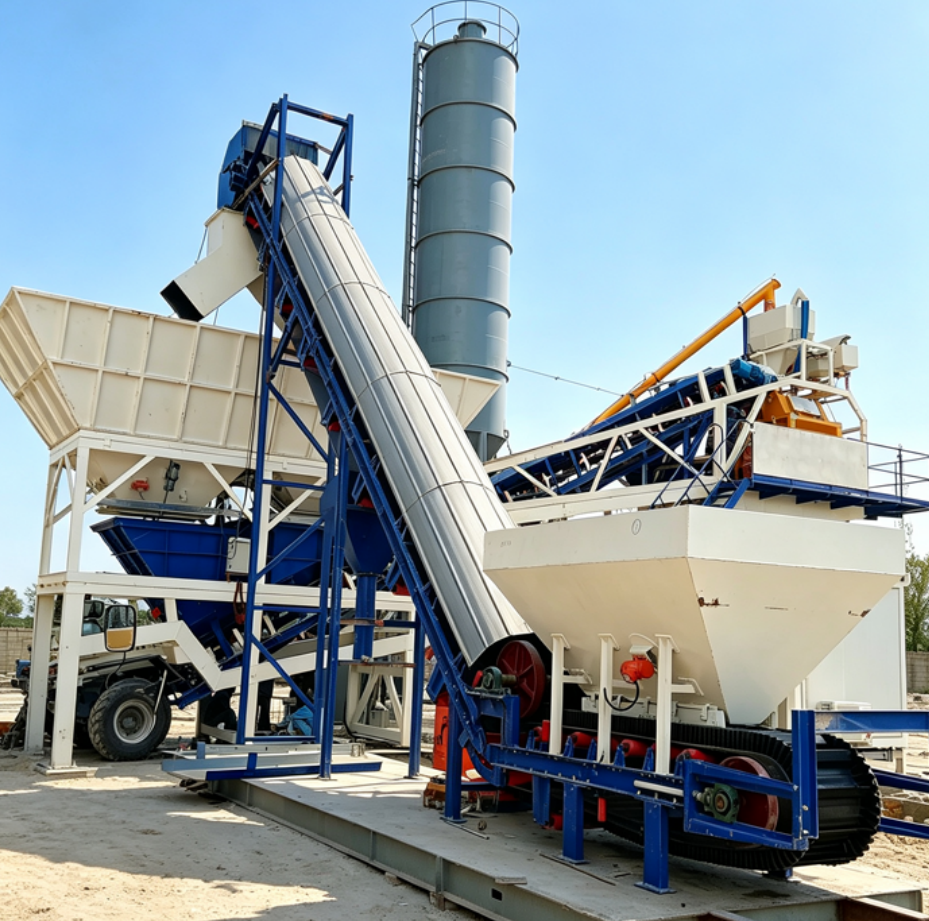
HZS60Y mobile concrete batching plant: 60 m³/h, 1000 L twin-shaft forced mixer, integrated trailer chassis, commissioned on a flat concrete surface without deep foundations.
What the Accuracy Figures Actually Constrain
The ±2% aggregate and ±1% cement, water and additive accuracy specification appears across the mobile lineup, and it is enforced through separate weighing channels rather than a single shared batch scale. The more consequential constraint, however, is the lower bound of each range.
A model with a 50–300 kg cement range cannot be dosed meaningfully at 40 kg per batch, and a plant with an 800–3500 kg aggregate range is dimensioned for larger batches than one with a 200–1000 kg range. In other words, the nominal mixer capacity in Table 1 says how large a batch can be mixed; the weighing ranges in Table 2 say which batches the plant can measure accurately. Both must match the mix designs the project actually intends to produce.
The same logic explains why high-volume commercial production generally leans towards stationary equipment. The HZS270 commercial plant, for instance, lists an aggregate weighing range of 900–5000 kg at ±2% and a cement range of 400–2600 kg at ±1%; the HZS300 handles aggregate batches up to 5000 kg in a 5000 L mixer. Mobile plants trade part of that range for the ability to move.
Installation, Relocation, and Commissioning Limits
Installation speed is one of the few claims in this category that can be checked against a defined milestone. The HZS60Y mobile plant is commissioned on site in 3 days after arrival, and requires only a flat concrete surface with no deep foundations. Relocation follows the same logic in reverse: the unit is towed away by tractor or standard truck and re-commissioned at the next work front.
Project-scenario documentation from the manufacturer describes three typical mobile settings:
Large to medium mobile projects. Integrated chassis design with axle and tyre transport for quick relocation, rapid 3-day installation and startup, and low foundation costs because only a level concrete surface is needed.
Medium-scale projects with relocation on completion. Quick installation, ready for operation within 3 days of arrival, and placement close to the job site so that concrete transport costs and environmental impact are reduced.
Small-scale and temporary projects. A forced-action twin-shaft mixer of 0.5 m³, an aggregate batching station of 2 × 8 m³, cement/water/admixture weighing systems, and an optional 100 t split-type powder silo with φ168 screw conveyor. The main unit can be transported as a single piece by truck.
The limitation to state plainly is that the powder silo, screw conveyor and some auxiliary items are optional on mobile configurations. A buyer who assumes silo capacity is included, and later adds it, changes the transport envelope and the site layout. This should be resolved during configuration, not after delivery.
Control, Automation, and the Verification Points Buyers Check
Automation is where mobile and stationary lines increasingly overlap, which makes it worth verifying item by item rather than by category. On the mobile HZS60Y and HZS120Y, the control method is fully automatic PLC control with UPS backup, and the operating mode allows single-operator management.
The HZS120Y configuration documents its hardware directly: Keli load cells, AirTAC cylinders and SICOMA butterfly valves in the dosing system; a pulse-jet dust collector and fly ash return screw in the mixing main building; and an 800 mm chevron-belt inclined aggregate conveyor with a 30 kW drive.
Stationary plants in the same product family show the wider verification list. The HZS120 uses a PLC-based control system with an industrial PC and 24-inch LCD monitoring, four 16 m³ aggregate silos with anti-blocking devices, optional 150 t powder silos with φ273 mm or φ219 mm screw conveyors, emergency stop switches, anti-fall protection and a dust-proof control cabinet. The HZS240 adds video surveillance at the belt tail and the discharge port, plus a 5 m³ corrosion-resistant PE admixture tank option. Commercial configurations also document online slump monitoring through mixer motor current curves and optional intelligent powder silo level monitoring with ±2% inventory accuracy.
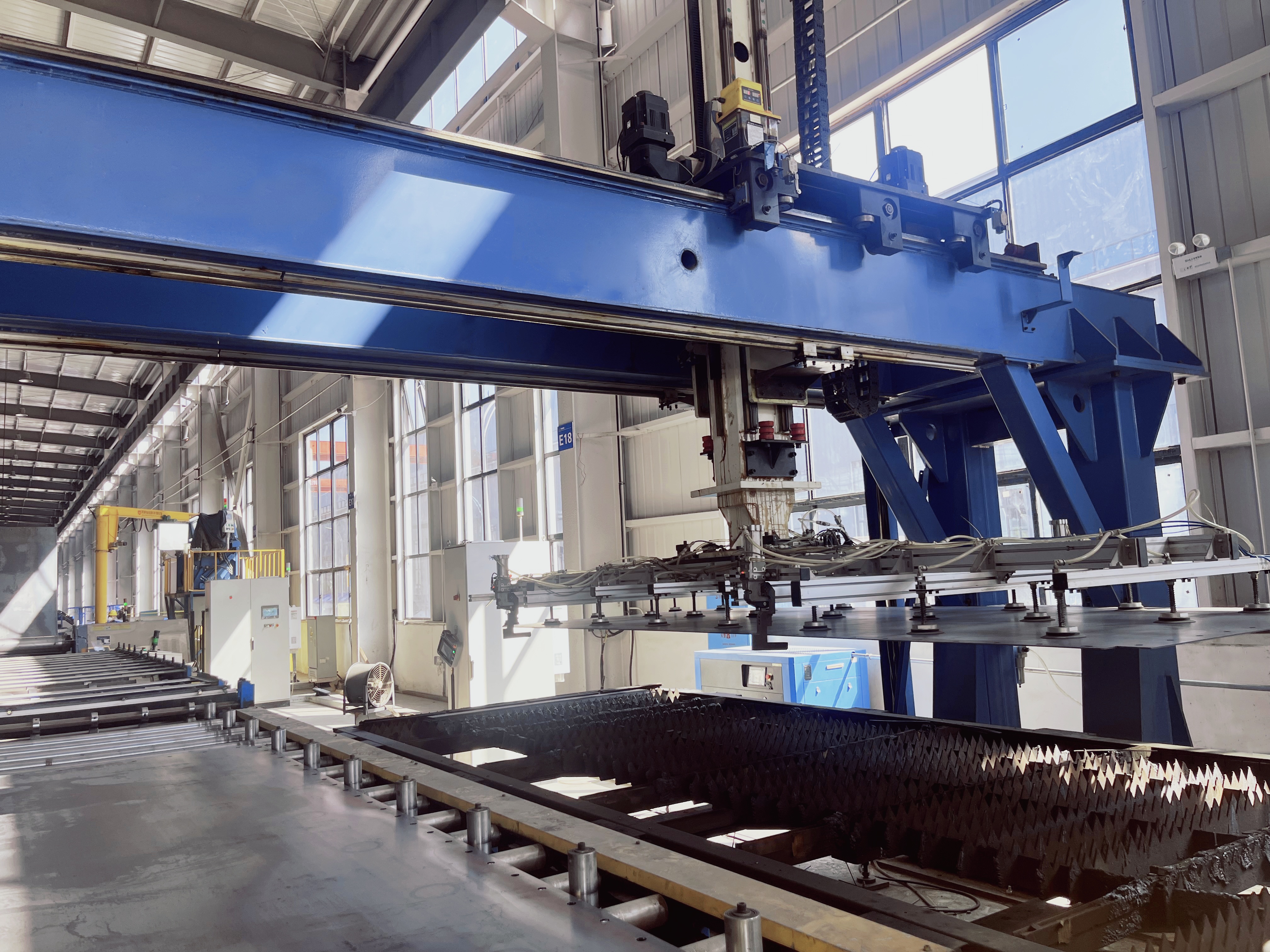
Plant modules pre-assembled in the manufacturing workshop before shipment, which shortens on-site installation work.
Supply and Customization Constraints: Voltage, MOQ, Lead Time
Hangzhou Jusheng Machinery & Equipment Co., Ltd. is a China-based manufacturer of concrete mixing and mining machinery, founded in 2015, operating a 120,000 m² facility with 430 employees, an R&D team of 80 engineers, and an annual output of 2,000 units. Around 80% of output is exported to the Middle East, Southeast Asia, Africa, Europe, Central Asia, West Asia, Australia and South America. Company profile information records the business moving from trading into robot-assisted production of mixing stations in 2017.
For buyers evaluating a supplier, the constraint set is as important as the machine set. The manufacturer offers OEM/ODM production with customization of voltage and frequency, company logo, machine colour, appearance design and branding. Minimum order quantity is 1 unit, lead time is 25–60 days, monthly capacity is 50 units, and quality control covers 100% testing. After-sales support is provided through remote support and on-site installation.
Two of these items carry procurement risk. First, voltage and frequency customization means the electrical documentation must be frozen before production starts; late changes to site power supply are expensive. Second, lead time of 25–60 days is a range, not a fixed date, and it typically moves with the number of optional items — powder silos, dust collection configuration, silo level monitoring — included in the order.
Mobile vs Stationary Concrete Mixing Plant: Where Mobile Stops Being the Right Answer
Mobile plants are often described as delivering stationary-plant performance with added mobility. In this product family, the mobile lineup reaches 120 m³/h with a 2000 L mixer, while stationary and engineering plants in the same HZS series run from 60 m³/h up to 300 m³/h with mixers up to 5000 L. The comparison is therefore not a question of quality but of where the ceiling sits.
| Decision dimension | Mobile (HZS25Y–HZS120Y) | Stationary / engineering (HZS60G–HZS300) |
|---|---|---|
| Theoretical output | 25–120 m³/h | 60–300 m³/h |
| Installed capacity | 60–160 kW | 100–350 kW |
| Foundation | Level concrete surface, no deep civil works | Fixed structure; modular assembly for relocation; steel structure foundation optional |
| Relocation method | Towed by tractor or standard truck | Disassembly and re-erection; HZS60G uses four-layer modules with sub-module pre-assembly and overall lifting |
| Aggregate storage | Integrated bins, e.g. 3 × 15 m³ on HZS120Y | Four 16 m³ bins with independent weighing hoppers on HZS120/HZS120G |
| Powder storage | Optional split-type silos | Optional 150 t powder silos with screw conveyors |
| Typical fit | Multi-site, temporary, remote or dispersed projects | Ready-mix supply, precast production, long-duration high-volume work |
The honest limitation is twofold. A mobile plant still requires a prepared level concrete surface, so it is not a zero-civil-works solution. And for high-grade concrete produced to tight tolerances — high-speed rail specifications, for example — the engineering line documents a dedicated control system with automatic correction of the drop and pulse buckle weighing, together with coarse-and-fine aggregate metering. Buyers comparing on price alone will not see this difference in the headline capacity figure; it shows up in how consistently the plant holds a mix design over a long production run.
Application Scenarios Where Mobile Plants Are Specified
Mobile plants are generally selected when the concrete has to be produced close to the placement point and the production point has to move. In road and bridge work, water conservancy and railway projects, the cost that mobile configuration removes is not the plant itself but the haul: placing the plant near the job site reduces concrete transport cost and the associated environmental impact.
Where the project is evenly spread and the daily demand is stable over years, the same numbers push the decision back towards a stationary ready-mix or precast plant, which is exactly why the two categories coexist in the same manufacturer portfolio rather than competing for the same tender.
Project Evidence from Deployed Plants
Deployment records give a sense of which configurations are actually specified in each market:
Indonesia — large construction contractor, 1 unit HZS300. Applied to large-scale infrastructure projects, with an expected service duration of 10–15 years. Reported result: high-volume production, stable operation and consistent quality; the highlight recorded is 300 m³/h capacity with precise weighing.
Oman — large construction contractor, 1 set HZS240. Large-scale infrastructure application, 10–15 year service expectation, with 240 m³/h capacity and precise weighing cited.
Philippines — ready-mix concrete suppliers, 2 units HZS90G. Commercial concrete production, 10–15 year service horizon, with stable operation and consistent concrete quality reported.
Philippines — concrete supplier, 1 unit HZS180. Bridge engineering application covering pile foundations, pile caps, piers, abutments and girder bodies, in service for 5 years, with high productivity, low failure rate and convenient maintenance recorded.
Indonesia — ready-mixed concrete company, 3 units. Supply of ready-mixed concrete to construction sites, 10–15 year service expectation.
Future Outlook
Two directions are visible in the specification data. The first is that mobile plants are absorbing features previously reserved for fixed installations: on-board dust collection, fully automatic PLC control with UPS backup, single-operator management and optional silo level monitoring. The second is that comparison is becoming more literal, supported by international terminology such as ISO 19720-1:2017 and by published parameter sheets that buyers can check line by line.
The constraints that will not move are physical. A mobile plant remains bounded by its transport envelope, its foundation requirement, its installed power and its capacity ceiling. As infrastructure demand continues to concentrate in dispersed and short-window projects — the segment that already drives a large share of the mobile market — the practical competition will be about how much verified capability fits inside those four limits.
FAQ
What is the difference between stationary and mobile concrete batching plants?
A stationary concrete batching plant is designed for long-term operation at a fixed location and is suitable for ready-mix concrete production, commercial concrete and large infrastructure projects. A mobile batching plant is designed for faster installation, relocation and flexible production at different job sites. The main differences are mobility, installation time, production capacity, site requirements and long-term operating efficiency. In this HZS family, mobile models cover 25–120 m³/h with installed capacity of 60–160 kW, while stationary and engineering models cover 60–300 m³/h with installed capacity of 100–350 kW. The choice depends on project duration, required output, relocation frequency and site conditions.
What capacity of concrete batching plant do I need?
The required plant capacity depends on concrete demand, project type, working hours, peak production requirements and transportation distance. Common capacities include 25 m³/h, 35 m³/h, 60 m³/h, 90 m³/h, 120 m³/h, 180 m³/h, 240 m³/h and 270 m³/h. As a general framework: small construction projects are typically served by 25–60 m³/h; commercial ready-mix concrete by 60–180 m³/h; and large infrastructure projects by 120–270+ m³/h. Selection should consider actual hourly production requirement and expected utilisation rate, not only theoretical capacity. For example, a highway project requiring approximately 120 m³/h is commonly matched to an HZS120 stationary plant with a twin-shaft mixer, four aggregate bins, three cement or powder silos and belt conveyor feeding.
Which mixer is best for a concrete batching plant?
Twin-shaft mixers are widely used for ready-mix concrete and large-scale concrete production because they provide fast and intensive mixing with high throughput. Planetary mixers are particularly suitable for applications requiring excellent mixing uniformity, including precast concrete, dry concrete and special concrete. Mixer options such as SICOMA, BHS or other suitable models can be configured according to concrete type, output and project requirements. For commercial ready-mix and large infrastructure projects, a twin-shaft mixer is generally a practical choice; for precast, dry or special concrete requiring very high mixing uniformity, a planetary mixer may be more suitable.
What batching accuracy and weighing ranges can a mobile concrete mixing plant hold?
In this mobile HZS lineup, aggregate (sandstone) is measured at ±2% accuracy and cement, water and additive at ±1%, using separate weighing channels. Published ranges differ by model: the HZS60Y measures 400–2000 kg of aggregate, 100–600 kg of cement, 60–200 kg of water and 5–20 kg of additive; the HZS120Y measures 800–3500 kg of aggregate, 200–1000 kg of cement, 120–400 kg of water and 15–35 kg of additive. The ranges, rather than the nominal mixer capacity alone, determine which batch sizes the plant can measure accurately.
Can the plant be customized for local voltage and branding, and what is the delivery lead time?
OEM/ODM production is available, with customization covering voltage and frequency, company logo, machine colour, appearance design and branding. Minimum order quantity is 1 unit, monthly production capacity is 50 units, and the stated lead time is 25–60 days, with 100% testing before shipment. Because voltage and frequency are customized per order, the electrical specification should be confirmed and frozen before production begins. Lead time within the stated range depends on the configuration, particularly on optional items such as powder silos, dust collection arrangement and monitoring features. After-sales support is provided as remote support and on-site installation.
Reference Documents
DKTEC publishes a concrete batching plant brochure documenting the HZS configurations discussed above, including mobile, engineering and commercial lines: concrete batching plant brochure. Company information is available at www.dongkunchina.com.