
Mirror vs Brushed vs Sandblasted vs Water Ripple: Stainless Sheet Decision Framework
Decorative stainless steel is rarely chosen for a building because of how it looks in a rendering alone. By the time a finish is written into a specification, it has to survive fabrication tolerances, installation methods, public contact, cleaning regimes and the acceptance criteria a buyer applies on delivery. Mirror, brushed, sandblasted and water ripple are the four decorative finishes most frequently specified for architectural stainless steel decoration, and they are not interchangeable. Each sits inside a different thickness band, interacts differently with light and handling, and raises a different set of questions that must be settled before a purchase order is issued.
This framework compares those four finishes as they are produced by Foshan Jinyifan Metal Products Co., Ltd. (JYF Metal), a decorative stainless steel manufacturer established in 2013 in Foshan, Guangdong, China. The company operates a 3,000 m² factory, runs an in-house R&D team of 15 engineers, and exports roughly 80% of its output to the Middle East, Asia, Europe and North America. The comparison below is built from documented product parameters — grades, thickness ranges, standard sheet sizes and available colors — rather than from aesthetic preference, because those parameters are usually what decide whether a finish can be used at all.
Why finish decisions fail on specification, not on design
Specification failures in decorative stainless steel rarely originate from a wrong design idea. They come from three recurring mismatches. The first is thickness: a finish that exists only in a narrow thickness band cannot be substituted into a sheet schedule built around a heavier gauge. The second is grade: the same visual finish behaves differently over time depending on whether the sheet is 201#, 304# or 316#. The third is acceptance: if the buyer never defines what \"acceptable\" means for color consistency, flatness or pattern alignment, the dispute arrives with the first container rather than during sampling.
The opportunity is straightforward. Treated as a set of constraints, the finish decision becomes a short and answerable sequence: which finishes are available in the required thickness, which grade suits the working environment, which standard size reduces waste and joint count, and which purchasing terms must be agreed before production begins. The four JYF decorative sheet families — JYF-01, JYF-02, JYF-03 and JYF-04 — are documented closely enough to make that sequence explicit and comparable.
The four JYF decorative sheet finishes at a glance
The table below summarises the parameters that apply to each finish family. Every value is taken from the published specification for the respective model.
| Model | Finish | Material grades | Thickness | Standard sizes | Colors |
|---|---|---|---|---|---|
| JYF-01 | Mirror finish stainless steel sheet | 201#, 304#, 316# | 0.5–3.0 mm | 1000x2000 mm, 1220x2440 mm, 1220x3050 mm | Silver, gold, rose gold, black, blue, copper, custom |
| JYF-02 | Brushed stainless steel sheet (hairline, satin, No.4, vibration) | 201#, 304#, 316# | 0.5–3.0 mm | 1000x2000 mm, 1220x2440 mm, 1220x3050 mm | Silver, gold, rose gold, black, blue, copper, bronze, custom |
| JYF-03 | Sandblasted stainless steel sheet | 201#, 304#, 316# | 0.5–3.0 mm | 1000x2000 mm, 1220x2440 mm, 1220x3050 mm | Silver, gold, rose gold, black, blue, copper, custom |
| JYF-04 | Water ripple stainless steel sheet (ripple size: small, medium, large, flow) | 201#, 304#, 316# | 0.5–2.0 mm | 1000x2000 mm, 1220x2440 mm, 1220x3050 mm | Silver, gold, rose gold, black, blue, copper, custom |
Three observations follow directly from this table. The thickness ceiling for water ripple is 2.0 mm, one millimetre lower than the other three families. All four families share the same standard sheet sizes and the same base grade options, so grade and size do not separate one finish from another — thickness band and surface behaviour do. And the brushed family carries four sub-finishes (hairline, satin, No.4 and vibration) plus an additional bronze color option, which means that a drawing stating only \"brushed stainless steel\" is not yet a complete specification.
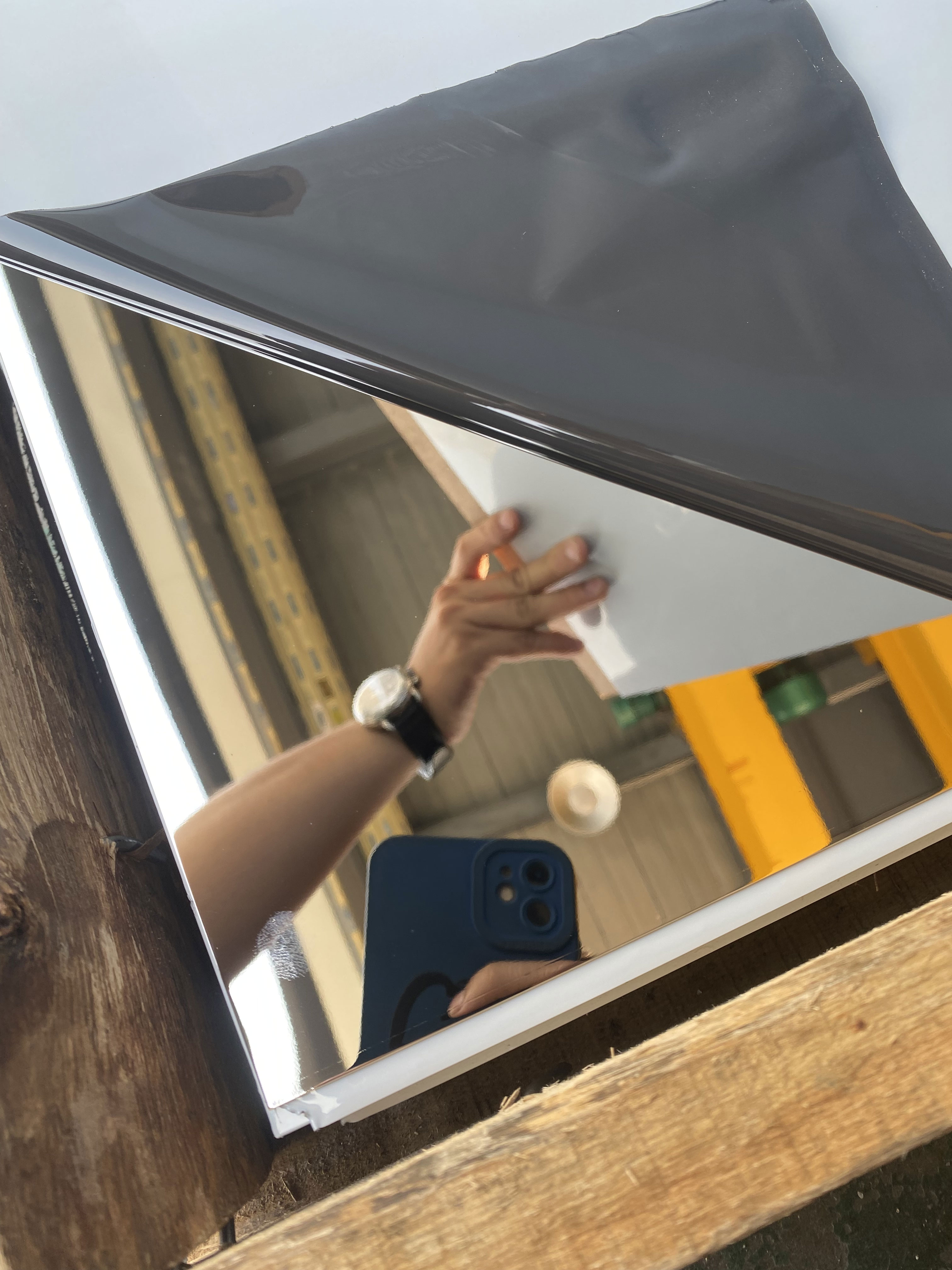
JYF-01 mirror finish stainless steel sheet, 0.5–3.0 mm, available in silver, gold, rose gold, black, blue, copper and custom colors. Image: JYF Metal.
Reading the matrix: five columns, five separate constraints
1. The model number identifies the surface
JYF-01 to JYF-04 are the finish identifiers used across this range. When a project specifies \"decorative stainless steel sheet\" without a model reference, the surface is left open and will be quoted against whatever the supplier treats as standard. Naming the model on the drawing is the cheapest way to remove that ambiguity.
2. Material grade sits outside the finish
All four finishes can be produced in 201#, 304# or 316#. Grade therefore operates as an independent decision layer: it addresses environment and corrosion exposure, not appearance. A buyer comparing mirror and sandblasted finishes is comparing surfaces; a buyer comparing 304# and 316# is comparing service life conditions. The two choices should be recorded separately in the specification.
3. The thickness band sets the design limit
JYF-01, JYF-02 and JYF-03 cover the 0.5–3.0 mm range. JYF-04 covers 0.5–2.0 mm. If a panel schedule calls for a gauge above 2.0 mm, the water ripple finish drops out of the comparison regardless of how well it matches the design intent. This single value eliminates more finish options than any other column in the table.
4. Standard sizes determine yield and joint count
The standard formats are 1000x2000 mm, 1220x2440 mm and 1220x3050 mm. The 1220x3050 mm format suits tall wall planes and long ceiling runs where fewer horizontal joints are preferred, while 1000x2000 mm is often adequate for trim work, panel inserts and smaller decorative elements. Custom sizes are available under OEM/ODM, which allows a schedule to be built around a specific joint layout rather than around a stock sheet.
5. Color is applied across the finish, not instead of it
Available colors include silver, gold, rose gold, black, blue and copper, with bronze additionally listed for the brushed family and custom colors available as a customization option. Colored decorative panels are produced on a PVD vacuum plating line for stainless steel decorative panels. Because color is applied on top of the base surface, a black mirror sheet and a black sandblasted sheet read very differently in a finished space, even though both appear in the same color column.
How each finish behaves in fabrication and in service
JYF-01 — Mirror finish
Mirror finish delivers the highest level of specular reflection in this range and is generally used where the intent is to expand a space visually or to create controlled reflections: feature walls, reception areas, column cladding and elevator interiors. The trade-off is handling discipline. A mirror surface shows fingerprints, handling marks and airborne dust more readily than a textured surface, so protective film, edge protection and clean installation handling become part of the specification rather than a site preference. Buyers who specify mirror in high-contact areas are usually accepting a defined maintenance routine in exchange for the visual effect.
JYF-02 — Brushed (hairline, satin, No.4, vibration)
Brushed stainless steel sheet is produced in four sub-finishes: hairline, satin, No.4 and vibration. The directional grain breaks up reflected light, which generally makes everyday fingerprints and light handling marks less conspicuous than on an uncoated mirror surface. That behaviour is why brushed sheet is among the most widely specified finishes for wall panels, elevator panels, door frames, trims and functional architectural metalwork where appearance must hold up under daily contact without constant attention.
JYF-03 — Sandblasted
Sandblasting produces a matte, low-sheen surface that diffuses light rather than reflecting it. It is commonly selected for large wall planes and interiors where glare from a reflective surface would be a problem, and it is available across the full 0.5–3.0 mm thickness range. Because the surface is uniformly matte, adjacent panels tend to read as one continuous plane rather than as individually reflective pieces, which makes joint alignment and panel rhythm easier to control visually.
JYF-04 — Water ripple
Water ripple sheet is a patterned finish: the surface carries a wave texture available in small, medium, large and flow ripple sizes, and the visual effect shifts with the angle of light across the panel. The finish is available in 0.5–2.0 mm. Two documented project references illustrate its typical use. A designer in Korea specified 120 pcs of water ripple stainless steel sheet for ceiling and wall decoration, describing a smooth, reflective wave-patterned surface that creates a modern, dynamic look and is easy to clean and maintain. A designer in France specified 80 pcs for ceiling decoration, with the stated results being a dynamic shimmering effect under light, PVD-coated color described as wear-resistant and fade-proof, flatness sufficient for precise joint installation, and a surface that resists dust and stains with minimal maintenance effort.
Grade and thickness: the two constraints that sit above finish choice
Grade selection is often treated as an afterthought once a finish has been chosen, but it drives service life more than surface texture does. SS201, SS304 and SS316 are all available across these four finishes. SS304 is a common general-purpose choice for interior architectural decoration, while SS316 is typically specified where higher corrosion resistance is required, including humid or coastal environments where exposure is continuous rather than occasional. Documented project requirements for architectural stainless decoration in commercial complexes, hotels, public buildings and high-end residences include corrosion resistance, scratch resistance, color stability and custom textures, applied across both indoor and outdoor conditions, including high-traffic and humid or coastal sites.
Thickness behaves differently. It is not a performance upgrade path but a hard boundary. The practical rule is to fix the thickness band first, from the structural and installation logic of the panel system, and then read the finish list backwards. Doing it in the opposite order — choosing a finish and discovering the gauge is unavailable — is the most common avoidable delay in decorative sheet procurement.
Application fit: matching finish to the plane it covers
Finish selection becomes faster once the application is treated as a constraint of its own. Wall planes, ceilings, elevator interiors, columns, screens and trims each impose different demands on reflection, pattern alignment and handling.
| Application | Finishes typically specified | Constraint to check first |
|---|---|---|
| Interior wall panels and feature walls | Brushed (JYF-02), sandblasted (JYF-03), water ripple (JYF-04), mirror (JYF-01) in low-contact zones | Thickness band; joint layout; handling exposure |
| Ceiling panels and ceiling runs | Water ripple (JYF-04), sandblasted (JYF-03), brushed (JYF-02) | 2.0 mm ceiling on water ripple; glare control |
| Elevator decorative panels | Brushed and vibration (JYF-02), mirror (JYF-01) | Contact frequency; protective film |
| Column cladding and shaped features | Mirror (JYF-01), brushed (JYF-02); shaped work through custom fabrication | Whether the geometry is flat sheet or fabricated form |
| Screens, room dividers and partitions | Mirror, brushed and vibration finishes on the JYF-05 partition range | Panel format and joint alignment |
| Trims, skirting boards and door frames | Mirror, brushed, vibration and sandblasted finishes on the JYF-06 profile range | Shape and bending requirement |
| Bar counters, sculptures, display shelving and mirror frames | Custom fabrication (JYF-07) using 201#, 304# or 316# | Drawing-based production, not stock sheet |
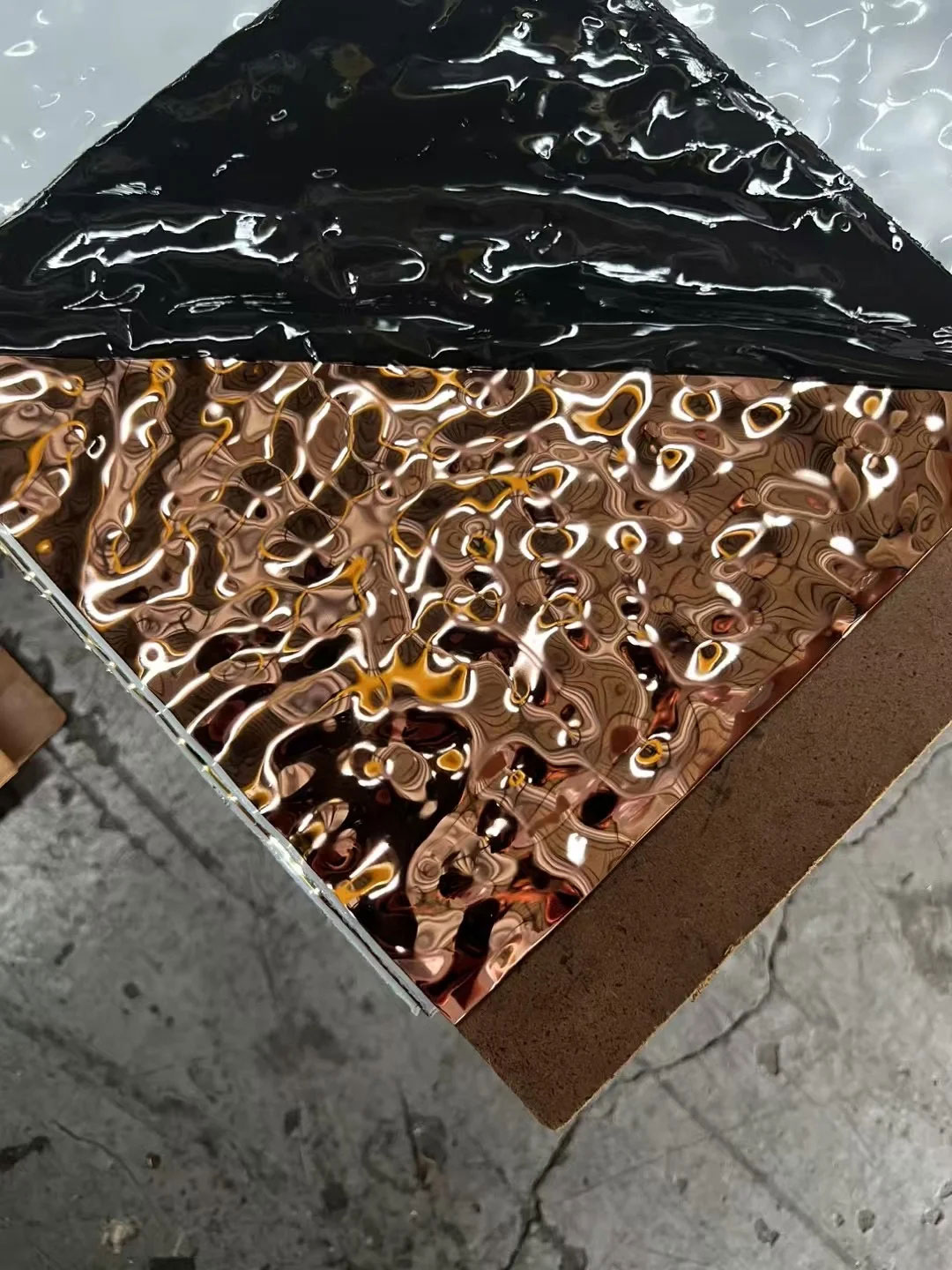
Water ripple stainless steel sheet (JYF-04) in rose gold, used for ceiling and feature wall decoration. Image: JYF Metal.
Purchasing terms and acceptance criteria to settle before the finish is locked
Finish and grade answer the technical question. Commercial terms answer whether the project can actually be delivered on schedule. For decorative stainless steel sheets, the following items should be confirmed in writing before the finish is finalised:
- Grade, thickness, sheet size and color, recorded as separate line items rather than as a single descriptive phrase.
- Finish sub-type where applicable — hairline, satin, No.4 or vibration for brushed sheet; small, medium, large or flow ripple size for water ripple sheet.
- Minimum order quantity. For this range, decorative stainless steel sheets carry an MOQ of 15 sheets per type, stainless steel trims 500 pcs per type, screen partitions 3 square meters, and custom products 1 pc.
- Lead time. Documented production times are 7–10 days for decorative stainless steel sheets, 15–20 days for stainless steel trims, 20 days for screen partitions, and 25–30 days for custom products.
- Customization scope. Custom size, custom color, custom protective film and custom logo are available under OEM/ODM production.
- Inspection method. Quality control on this range consists of 100% pre-shipment testing, with third-party inspection available.
- Certification evidence where the project requires it. JYF Metal operates an ISO 9001 quality management system; the certificate number is 120526Q00119R000, issued by Guangdong Jingwel International Certification Ltd. under GB/T 19001-2016 / ISO 9001:2015, with a scope covering the R&D and production of stainless steel colored boards, metal decorative moldings and metal decorative articles, valid from 15 May 2026 to 14 May 2029.
- Acceptance criteria for color consistency, flatness, ripple pattern alignment across adjacent panels, edge condition, and the protective film type that must remain in place on delivery.
- After-sales terms. Support options include online installation guidance, sample provision and replacement parts.
Two of these items are frequently left vague: the protection film specification and the acceptance definition for pattern alignment on textured finishes such as water ripple. Both are cheap to agree before production and expensive to argue about afterwards.
Market context: why finish specification is becoming a supply decision
The demand backdrop explains why these parameters matter commercially. The global stainless steel market was valued at USD 225.13 billion in 2025 and is projected to reach USD 353.48 billion by 2034, according to Fortune Business Insights. Within the narrower metal ceilings segment, steel held a 52% revenue share in 2026, while aluminium is projected to expand at a 7.3% CAGR through 2033, according to Grand View Research — a reminder that stainless sheet competes for ceiling and wall applications against alternative metals as well as against non-metal finishes.
Cost benchmarks matter too. In the US market, the installation cost of stainless steel wall panels is reported in the range of USD 15 to USD 35 per square foot, a figure that reflects labour and substrate preparation as much as material. Industry technical sources frequently cite ASTM A554 as a common reference standard for welded decorative stainless steel tubing, and ornamental and architectural metal work manufacturing is formally classified under NAICS 332323 in the United States. Together these signals point in one direction: buyers increasingly evaluate decorative stainless steel as a specified, documented system rather than as a commodity sheet.
Where the framework stops: limits and the comparison with conventional finishes
A useful framework should state where it stops working. Five limits apply to the comparison above.
- Water ripple is capped at 2.0 mm. Projects that require a heavier gauge must resolve the finish question within JYF-01, JYF-02 or JYF-03.
- Mirror finishes carry a maintenance commitment. In high-contact locations, a mirror surface will show fingerprints and handling marks sooner than a textured finish, and that should be accepted as a design decision rather than discovered after handover.
- This is a flat-sheet framework. Curved surfaces, hyperbolic forms, metal sculptures, cladding around complex columns and similar geometry fall under custom fabrication rather than stock sheet supply, with a longer documented lead time of 25–30 days.
- Color consistency needs a written standard. Colored panels are produced through PVD plating, and the framework cannot define an acceptable color tolerance for a project — only the buyer can, and only in writing.
- Honeycomb and curtain wall systems sit outside it. Composite panel systems introduce separate fire-performance documentation, including ratings such as ASTM E84 and EN 13501-1, which this finish-level comparison does not cover.
Compared with conventional decorative materials such as paint systems, laminate, wood veneer or stone, stainless sheet behaves differently at the installation stage. It is a fabricated metal system: panels are typically installed by dry-hanging or adhesive fixing onto frameworks, backing panels and lighting systems, and it requires coordination of substrates, protective film handling and joint tolerances. The published US installation benchmark of USD 15–35 per square foot reflects that coordination load. Stainless sheet is therefore not a lowest-first-cost substitution for a painted or laminated wall; it is a specification that trades higher upfront coordination for the color stability, scratch resistance and surface durability that project documentation in this category consistently lists as requirements.
Outlook for architectural stainless sheet specification
Publicly available supplier material across this category tends to differentiate on the same two things: the depth of the surface-finishing stack and the ability to produce from confirmed drawings, dimensions, colors and quantities. That pattern suggests the finish discussion will continue to move earlier in the project timeline, from a late aesthetic decision to an item on the specification and procurement checklist.
Two further shifts are visible. First, fire-performance and weight expectations are pushing more ceiling and facade specifications toward composite and lightweight panel constructions, where documentation such as ASTM E84 or EN 13501-1 enters the conversation alongside finish choice. Second, buyers are increasingly asking for finish consistency across repeat orders rather than one-off supply, which places the emphasis on how a supplier controls PVD color and surface texture between production runs. Neither shift changes the underlying four-way choice between mirror, brushed, sandblasted and water ripple — but both make the documented parameter table more important, not less.
FAQ
What thickness is available for each decorative stainless sheet finish?
JYF-01 mirror, JYF-02 brushed and JYF-03 sandblasted stainless steel sheets are produced in a thickness range of 0.5–3.0 mm. JYF-04 water ripple stainless steel sheet is produced in a thickness range of 0.5–2.0 mm. Specifying a gauge above 2.0 mm therefore excludes the water ripple finish from the options, while all other finishes remain available across the full range up to 3.0 mm.
Which stainless steel grades can be used with these four finishes?
All four finish families — JYF-01 mirror, JYF-02 brushed, JYF-03 sandblasted and JYF-04 water ripple — are available in 201#, 304# and 316#. Grade selection is a separate decision from finish selection: SS304 is a common general-purpose choice for interior architectural decoration, while SS316 is typically specified where higher corrosion resistance is required, such as humid or coastal environments.
What standard sheet sizes and colors are available?
The standard sheet sizes across the range are 1000x2000 mm, 1220x2440 mm and 1220x3050 mm. Colors include silver, gold, rose gold, black, blue and copper, with bronze additionally available for brushed sheet and custom colors available as a customization option. Custom size, custom color, custom protective film and custom logo are supported under OEM/ODM production.
What should be confirmed in writing before a finish is finalised?
Before locking a finish, a purchase specification should record the grade, thickness, sheet size and color as separate items; the finish sub-type where applicable, such as hairline, satin, No.4 or vibration for brushed sheet and small, medium, large or flow ripple size for water ripple sheet; the minimum order quantity, which is 15 sheets per type for decorative stainless steel sheets; the lead time, documented at 7–10 days for decorative stainless steel sheets; the protective film requirement; the inspection method; and the acceptance criteria for color consistency, flatness and pattern alignment.
How is quality verified before shipment, and what certification applies?
Quality control on this range consists of 100% pre-shipment testing, with third-party inspection available on request. JYF Metal operates an ISO 9001 quality management system certified under GB/T 19001-2016 / ISO 9001:2015. The certificate number is 120526Q00119R000, issued by Guangdong Jingwel International Certification Ltd., covering the R&D and production of stainless steel colored boards, metal decorative moldings and metal decorative articles, valid from 15 May 2026 to 14 May 2029.
Summary
The four-way choice between mirror, brushed, sandblasted and water ripple resolves more cleanly when it is treated as a constraint problem rather than a visual one. Fix the thickness band first — 0.5–3.0 mm for JYF-01, JYF-02 and JYF-03, and 0.5–2.0 mm for JYF-04. Fix the grade next, based on environment rather than appearance. Then select the finish sub-type, confirm the standard sheet size or a custom format, and write the purchasing terms and acceptance criteria into the order before production starts. Buyers who follow that order generally spend less time resolving disputes and more time on the parts of the project that are genuinely a design decision.
For readers who want the underlying product and project detail, the JYF Metal designer's handbook and project case compilation is available here: Designer's Handbook & Project Cases (PDF).
¿Tiene preguntas o necesita más detalles?
Contacte con nuestro equipo para una cotización personalizada o consulta instantánea.
Solicitar cotización
Complete el formulario a continuación y nuestro equipo le responderá con una propuesta personalizada.
Chat directo de WhatsApp
¿Prefiere chatear en tiempo real? Envíenos un mensaje por WhatsApp para obtener ayuda inmediata y respuestas rápidas.
- Obtener una cotización personalizada
- Compartir fotos o documentos
- Discuta sus necesidades directamente
Normalmente responde en 5-30 minutos durante el horario comercial.