
Mining Container Procurement FAQ: Miner, Model, Cooling
Mining Container Procurement FAQ: Miner, Model, Cooling
The most expensive compatibility error in mining-container procurement is rarely a missing technical feature. It is the assumption that a Hydro ASIC Mining Container is universally compatible because it is sold for ASIC mining. The final xinkelcs Mining Container model is confirmed per order, and miner compatibility is model-specific. Buyers should therefore treat the technical agreement, not a brochure headline, as the place where miner models, power per rack, cooling capacity in kW, site conditions, energy infrastructure and utility interfaces are fixed.
xinkelcs Mining Container is the mining-container offering of Tangshan Xinke Intelligent Technology Co., Ltd., a Tangshan-based manufacturer and system integrator of liquid-cooling infrastructure for blockchain, HPC and AI data centers. Its Hydro ASIC Mining Container is described in the 120-position / 160-position / 240-position series, with the final model confirmed per order. That line-up is a useful starting point for configuration discussion. It is not a declaration that every hydro-cooled ASIC miner can be installed without a model-by-model review.
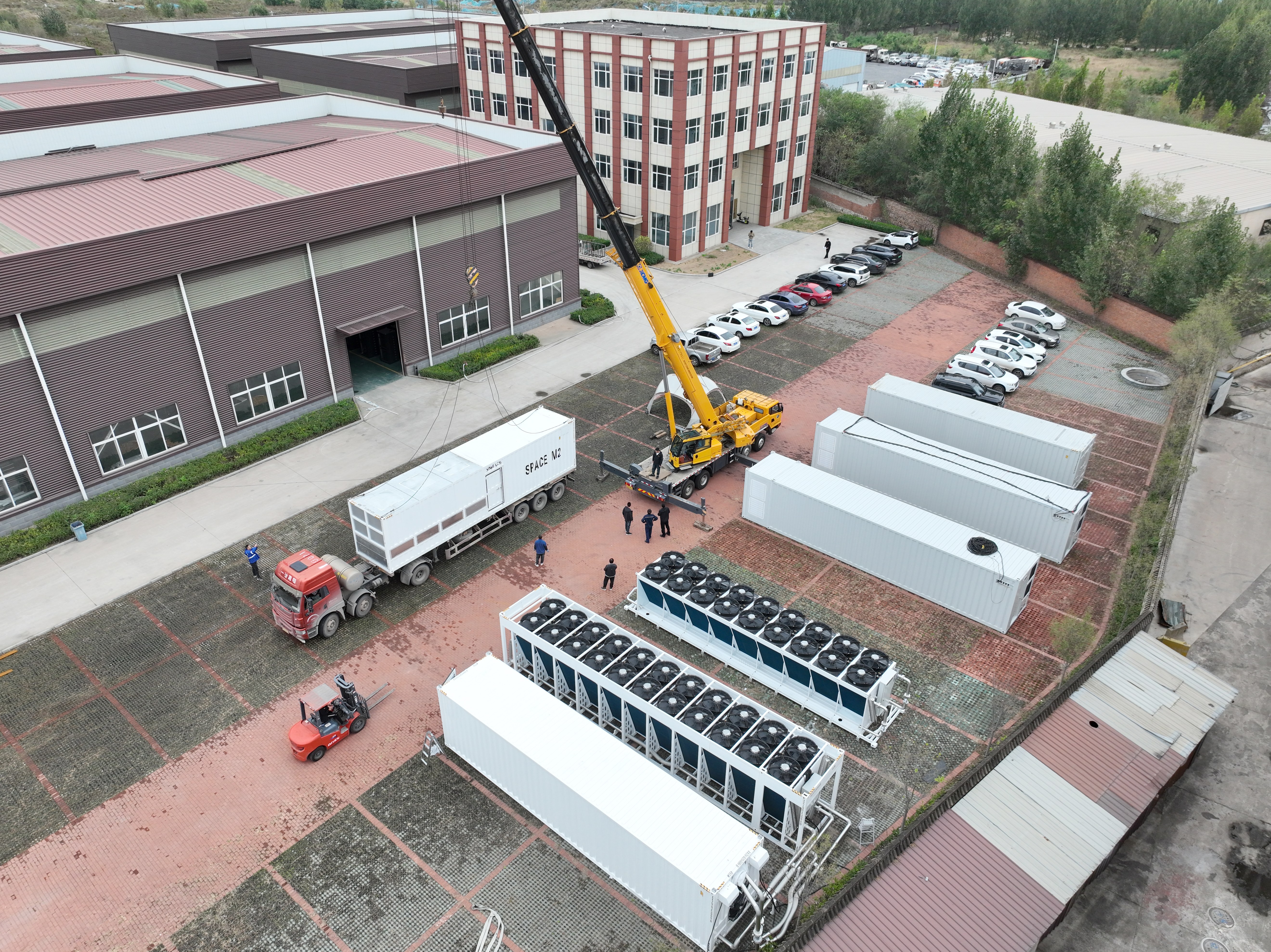
Equipment shipment area. Image source: Tangshan Xinke Intelligent Technology Co., Ltd.
Why compatibility is an order-specific decision
Compatibility has several layers. Mechanical fit is one: the selected miner must physically suit the rack or mounting arrangement. Hydraulic fit is another: the miner's coolant connections, permitted flow and pressure, coolant specification and service access must be checked against the container's cooling design. Thermal fit is a third: the project's power per rack and heat load must be matched by cooling capacity at the agreed operating conditions. Control and utility fit complete the picture: alarms, monitoring, power distribution, primary cooling and site interfaces must be assigned to a responsible party. A container can be correctly built and still be the wrong configuration for a particular miner fleet.
Because the final xinkelcs model is confirmed per order, two buyers can use the same product family and receive different configurations. One project may need a particular rack arrangement, coolant interface and monitoring scope; another may differ in power distribution, climate protection or primary-cooling boundary. This is normal for custom infrastructure. The procurement risk arises when the buyer treats the series name as a compatibility certificate and releases production before the miner list and design conditions are frozen.
What the final model confirms and what it does not
The 120-position / 160-position / 240-position series tells the buyer that multiple position counts are available. It does not tell the buyer that a given miner model will fit every position, that a stated position count equals a tested miner count, or that cooling capacity is adequate at the project's supply and return temperatures. Those points must be resolved in the configuration. The final model confirmation should refer to a defined configuration: selected miner models, rack layout, electrical distribution, cooling scope, controls, enclosure and interfaces. If any of those inputs changes, the model confirmation should be rechecked rather than assumed to remain valid.
Customization is available around IT heat load, server interfaces, rack layout, redundancy, climate and electrical supply. CDUs, cooling equipment, piping, power distribution, monitoring and container layouts can be configured. The same capability description states that customization is subject to technical review. That phrase carries procurement weight: customization is not a promise that any requested combination is pre-approved. It is a process for checking the requested combination before production.
The written confirmation list
For a buyer moving from evaluation to execution, verbal compatibility statements should become a written schedule. The schedule does not need to be elaborate, but it should be specific enough that engineering, procurement and the supplier are working from the same inputs. The following items belong in the technical agreement or an attached configuration matrix.
- Selected miner models and variants. Record exact model designations, the hydro-cooling interface, coolant connection type, rack or mounting requirement, and any model-specific flow or pressure limits supplied by the miner manufacturer. Do not write hydro ASIC miners as a generic category.
- Power per rack and total project load. Record kW per rack, total IT load, electrical supply, redundancy and available capacity. These inputs shape power distribution and cooling selection.
- Cooling capacity in kW and design conditions. State the required heat rejection at agreed supply and return temperatures, flow and pressure, ambient conditions and coolant. A headline kW rating without conditions is not enough.
- Site conditions. Ambient dry-bulb and wet-bulb temperatures, altitude, water quality, freeze and condensation risk, noise limits and local certification requirements should be identified. They affect thermal design and protection.
- Available energy infrastructure. Confirm what the site can actually deliver, including supply capacity and electrical characteristics, so the container is not configured around unavailable power.
- Utility interfaces. Define the boundary for power, primary cooling, controls and network. Record who supplies, connects and commissions each side.
- Cabinet and piping specification. If the approved configuration includes a painted carbon steel cabinet, record that construction. If it includes SS304 seamless stainless steel coolant piping, record the grade, pipe specification, connection method, test requirement and supply boundary.
- Testing and handover. Agree factory acceptance test scope, commissioning requirements, acceptance records and documentation. The quality process includes incoming, process and assembly inspections, finished-product tests and pre-shipment reinspection; integrated systems can undergo factory commissioning and testing, with FAT scope following the technical agreement.
Power per rack and cooling capacity: numbers without conditions are not enough
The phrase cooling capacity in kW sounds precise, but it is only useful when tied to conditions. A container proposal may state a rated cooling figure while leaving out the supply and return temperatures, flow, pressure, ambient design point or coolant. Those omissions make comparison unreliable. The buyer should ask for model-specific performance at the project's design conditions and compare proposals on the same basis.
Rated kW alone does not confirm performance at the intended supply and return temperatures, flow, pressure and ambient conditions. Mismatched coolant, interfaces or primary cooling can limit heat removal or disrupt operation. This is why the technical agreement should connect the miner heat load, the rack power, the cooling capacity and the primary-cooling duty in one thermal chain. If any one element is left outside the supplier's scope, the buyer should record who is responsible for it. The container is not a stand-alone guarantee of heat rejection; it is part of a system that includes the miners, the coolant loop and the site's heat-rejection equipment.
Power per rack deserves the same treatment. A project-specific figure should be recorded per rack and reconciled with the total load. The number should not be inferred from the container's position count. Position count describes configuration capacity in the product series; power per rack describes the electrical and thermal duty that the design must support. They are related but not interchangeable.
Hydro cooling is not immersion: the interface check
Hydro cooling in this procurement context is a non-immersion liquid-cooling approach. The selected miner's coolant path and connections are part of the compatibility review; the container should not be specified as though an immersion tank's assumptions apply. The buyer should confirm that the proposal describes hydro cooling, not immersion, and that the coolant loop, connections and service procedure match the chosen miner model. This is a scope and interface check, not a claim that one cooling method is universally superior.
The distinction also affects the questions asked during evaluation. For a hydro-cooled miner, the relevant evidence includes the coolant interface, flow and pressure limits, leak detection and service access. For an immersion system, the fluid volume, tank access and miner preparation would be different. A supplier should not answer a hydro compatibility question with an immersion reference, and a buyer should not accept a generic liquid-cooling statement as a substitute for a model-specific hydro interface review.
Cabinet and piping details that belong in the bill of materials
Two construction items are easy to lose between a proposal and a purchase order. The first is painted carbon steel cabinet construction. If that is the approved construction, the technical agreement should say so and tie it to the offered configuration. The buyer should check that the cabinet description in the quotation matches the model being ordered, and that coating, finish and inspection requirements are not left to a later verbal understanding. This is not a claim that painted carbon steel is appropriate for every site; it is a requirement to make the offered construction explicit and verifiable.
The second is SS304 seamless stainless steel coolant piping where specified for the applicable configuration. The qualifier matters. The buyer should not assume that every configuration uses the same piping material. Where SS304 seamless piping is specified, record the material grade, seamless condition, dimensions, connection method, pressure and leak-test requirement, and the boundary between supplier-supplied and site-supplied piping. Ask for the bill of materials and the relevant inspection record. A material name in a brochure is not the same as a controlled piping specification in the technical agreement.
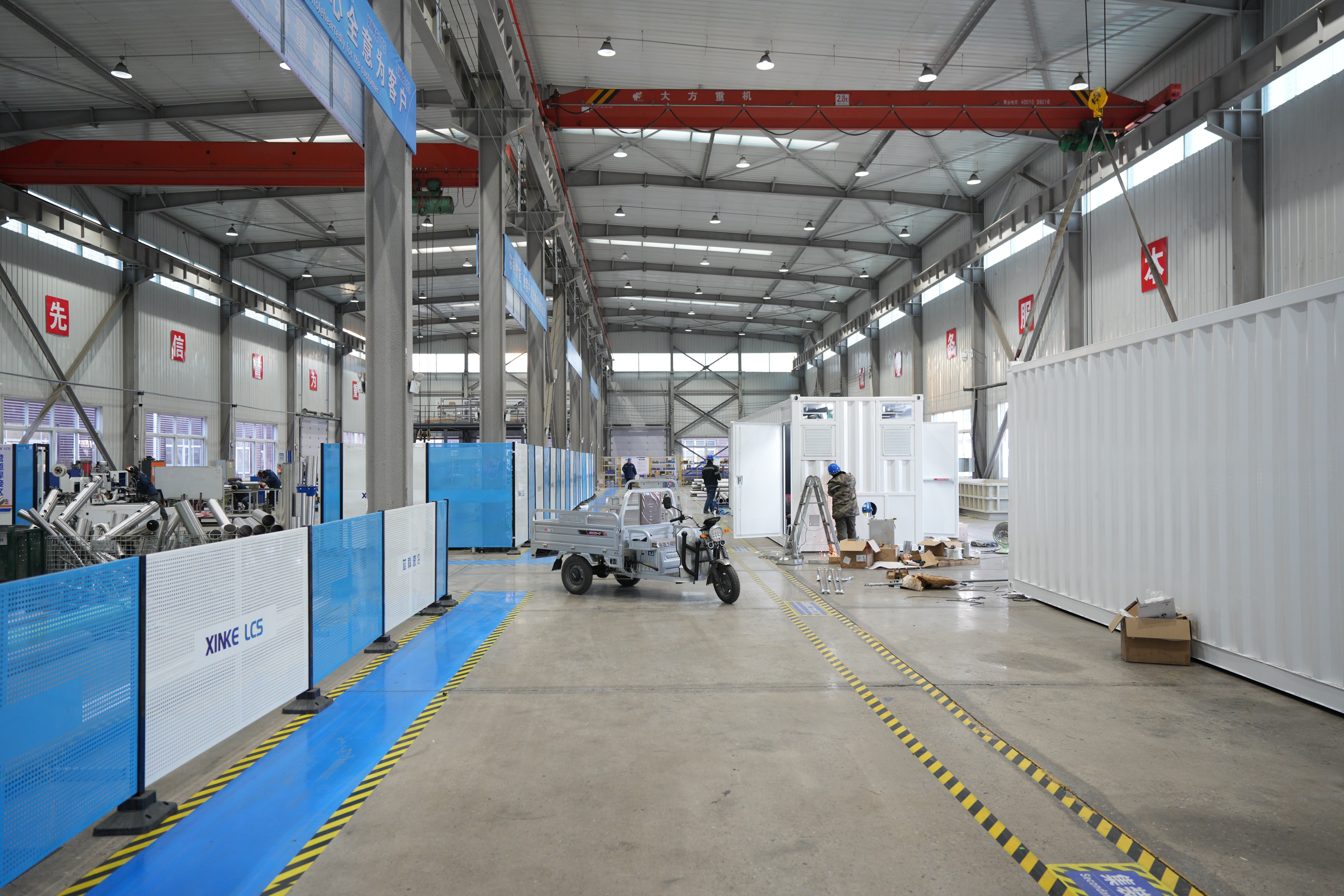
Workshop interior at the production base. Image source: Tangshan Xinke Intelligent Technology Co., Ltd.
These checks complement, rather than replace, thermal review. Correct materials do not prove that the cooling capacity is adequate; adequate capacity does not prove that the piping scope was correctly supplied. Both belong in the same configuration review.
Site conditions, energy infrastructure and utility interfaces
Site conditions change the container configuration. Liquid-cooling project guidance identifies ambient dry-bulb and wet-bulb temperatures, altitude, water quality and IT load as thermal-design inputs. It also calls for confirmation of freeze protection, condensation prevention, corrosion protection, noise, electrical supply and local certification requirements for each site. These are not details to be resolved after shipment. They are inputs to the model confirmation.
Available energy infrastructure is equally important. The buyer should state the power that the site can actually provide, not only the power the miner fleet would consume at full load. The technical agreement should connect that available capacity to the container's electrical distribution, redundancy and cooling demand. Utility interfaces should then be assigned: power, primary cooling, controls and network. For each interface, the agreement should identify what the supplier provides, what the site provides, who connects it and who commissions it. A missing interface owner can leave a technically sound container unable to start.
Lead time also belongs to execution planning. The capability description states that catalog annual capacity exceeds 500 MW but is not a fixed monthly delivery commitment. Lead time depends on model, customization, materials, production schedule and site conditions and is confirmed in the contract. Buyers should avoid converting an annual output statement into a project delivery promise without a contractual schedule.
Application scenarios that change the confirmation list
Consider a buyer preparing an outdoor modular deployment for a hydro-cooled ASIC fleet. The confirmation list should include ambient conditions, freeze and condensation protection, coolant specification, electrical supply and the boundary of the primary cooling system. The miner models should be fixed before the final container model is released, because a later change in miner type can affect rack layout, coolant connections and heat load.
Consider a buyer expanding an existing site where power is available but utility interfaces are split among several contractors. The written schedule should assign responsibility for power, cooling, controls and commissioning. The container supplier may provide an integrated system, but the site still has to deliver the agreed utilities. The technical agreement should reflect that split rather than assume the container is plug-and-play.
Consider a buyer comparing proposals that use different power definitions. One proposal may quote total data-center power; another may quote IT load or rack power. The numbers may look comparable while measuring different things. The buyer should normalize the definitions before comparing cooling capacity or container layout. The same discipline applies to miner counts: a position count is not a statement of tested compatibility with a specific miner model.
Project references are useful, but not a compatibility certificate
Deployment references can show that a supplier has worked in relevant environments, but they do not prove that a new miner model will fit a new container configuration. The manufacturer's September 10, 2026 corporate presentation lists liquid-cooled container projects in Norway for Canaan at 30 MW, in Ethiopia for BITMAIN at 21.12 MW and in Texas for MicroBT at 36 MW, plus a 1.7 MW modular container project in Ohio for BITMAIN. It also lists an ASIC modular computing center in Uzbekistan without disclosing capacity. These references support an evaluation discussion about overseas delivery and modular infrastructure. They do not replace a project-specific compatibility matrix, and the presentation does not disclose measured efficiency or operating duration for every entry.
For the buyer, the practical use of references is to ask better questions: Which miner families were integrated? What was the cooling boundary? Which items were factory-tested? What documentation was handed over? The answers should be checked against the current project, not assumed from a photograph or a capacity headline.
An evaluation-to-execution sequence
Execution should begin only after the compatibility inputs are frozen. A practical sequence is:
- Define the miner fleet. List exact models, quantities and hydro interfaces. Identify any models likely to change during the project.
- Define the site. Record ambient conditions, altitude, water quality, available power, utilities and local requirements.
- Issue a configuration matrix. Ask the supplier to state power per rack, cooling capacity in kW at design conditions, cabinet construction, piping specification and interface boundaries.
- Review the final model against the matrix. Confirm the 120-position / 160-position / 240-position series selection and every project-specific option in writing.
- Agree testing and handover. Include factory test scope, commissioning, acceptance records and documentation.
- Control changes. Require a documented review before changing miner models, rack power, cooling conditions or utility scope.
Comparison: universal assumption vs order-specific confirmation
| Universal assumption | Order-specific confirmation |
|---|---|
| The container is for hydro ASICs, so any hydro ASIC will fit. | The selected miner model and its interface are checked against the final container model. |
| A 160-position model means any 160 miners are compatible. | Position count is not a compatibility certificate; miner-specific rack and coolant requirements are confirmed. |
| Rated cooling kW is enough. | Cooling capacity at design conditions, flow, pressure and ambient are recorded. |
| A standard container is fine because the site is standard. | Site conditions and utility interfaces are project inputs. |
| Painted steel or SS304 wording is enough. | Materials and piping scope are in the bill of materials and inspection records. |
Market context: hardware growth does not remove the compatibility question
Business Research Insights projects the global Bitcoin miner market at USD 11.72 billion in 2026, with a 26.7% CAGR through 2035, in a source dated 2026-09-03. That estimate concerns the Bitcoin miner market, not the mining-container market, and it does not establish demand for any particular supplier. Its procurement relevance is narrower: a project fleet can include different miner models, so the container's compatibility record must be tied to the actual models in the project. A market forecast does not make compatibility universal.
Outlook: documentation as part of the product
The practical outlook is document-led. As customization increases, the configuration record becomes part of the product: the compatibility matrix, controlled bill of materials, factory-test records and interface schedule are not administrative extras. They are how the buyer knows that the delivered container matches the agreed miner models and design conditions. Suppliers that can provide those records clearly will be easier to evaluate, but documentation alone does not prove thermal performance. The final check remains project-specific: the delivered configuration must match the agreed miners, power per rack, cooling capacity, site conditions and utility interfaces.
FAQ: mining container procurement
Is a Hydro ASIC Mining Container compatible with every miner model?
No. The final xinkelcs Mining Container model is confirmed per order, and compatibility is model-specific. A container may be designed for hydro-cooled ASIC mining without being compatible with every miner model, rack layout or coolant interface. Buyers should provide the exact miner models and confirm mechanical, hydraulic, thermal, control and utility fit in the technical agreement. A series name or position count alone does not establish compatibility.
What miner details should be confirmed before the final container model is fixed?
Confirm the exact miner model and variant, the hydro-cooling interface, coolant connection details, rack or mounting requirement, permitted flow and pressure, and the miner heat load. These details should appear in the configuration matrix and be checked against the proposed container layout, cooling scope and controls. If the miner model changes after confirmation, the compatibility review should be repeated before production.
Which cooling figures should appear in the technical agreement?
Record cooling capacity in kW at the agreed supply and return temperatures, flow, pressure, ambient design conditions and coolant specification. Also state power per rack, total IT load, primary-cooling duty and the boundary between container-supplied and site-supplied equipment. A rated kW figure without those conditions does not confirm performance at the project site.
What site and utility information changes the container configuration?
Site inputs include ambient dry-bulb and wet-bulb temperatures, altitude, water quality, IT load, freeze and condensation risk, corrosion protection, noise limits and local certification requirements. Available energy infrastructure, electrical supply characteristics, primary cooling, controls and network interfaces should also be defined. For each utility, the agreement should record who supplies, connects and commissions the interface.
What construction and piping details should buyers verify?
If the approved configuration includes painted carbon steel cabinet construction, confirm that the offered cabinet matches the model and that coating and inspection requirements are recorded. Where SS304 seamless stainless steel coolant piping is specified for the applicable configuration, verify the grade, seamless condition, dimensions, connection method, pressure and leak-test requirement, and supply boundary. Also confirm that the proposal describes non-immersion hydro cooling rather than immersion.
Conclusion: compatibility is a documented project decision
The central procurement rule is simple: do not buy a mining container as a universal enclosure for ASIC miners. Buy it as a configured infrastructure system. xinkelcs Mining Container can be discussed across the 120-position / 160-position / 240-position series, but the final model and compatibility record must be fixed per order. The buyer's protection is a written schedule covering miner models, power per rack, cooling capacity in kW, site conditions, energy infrastructure, utility interfaces, cabinet construction and piping specification. When those items are explicit, the proposal is easier to compare, the factory test is easier to define and the delivered container is less likely to fail at the interface between miner, container and site.
Reference: English company brochure (PDF): Tangshan Xinke Intelligent Technology Co., Ltd. company brochure.
¿Tiene preguntas o necesita más detalles?
Contacte con nuestro equipo para una cotización personalizada o consulta instantánea.
Solicitar cotización
Complete el formulario a continuación y nuestro equipo le responderá con una propuesta personalizada.
Chat directo de WhatsApp
¿Prefiere chatear en tiempo real? Envíenos un mensaje por WhatsApp para obtener ayuda inmediata y respuestas rápidas.
- Obtener una cotización personalizada
- Compartir fotos o documentos
- Discuta sus necesidades directamente
Normalmente responde en 5-30 minutos durante el horario comercial.