
Minimally Invasive Care: Score the Evidence, Not Claims
Minimally Invasive Care: Score the Evidence, Not Claims

Minimally invasive cancer treatment is easier to shortlist than to compare. Specialist centres list overlapping modality sets — cryoablation, irreversible electroporation, arterial infusion, ablation combined with targeted or immune therapy — so a buyer reading five provider websites can end up with five similar inventories and no decision. The useful comparison is narrower: does the clinical problem in a provider's documented case resemble the problem in front of you, and can that provider show the record behind the claim? This framework scores providers on five dimensions and applies the method to four documented cases, so the reasoning can be tested against real constraints instead of slogans.
Why modality lists make a poor comparison tool
Technology inventories converge because the devices themselves are commercially available. What separates providers is case selection, the order in which treatments are combined, the anesthesia and access route, and the willingness to show the underlying record. None of those appear on a modality list.
The second problem is the public evidence base. Fuda Cancer Hospital's metric documentation states that its benchmark reference is peer JCI-accredited and national clinical key specialty oncology hospitals, and that no comparative clinical outcome data against other providers is provided. Read that as a description of the category rather than a mark against one hospital: head-to-head outcome tables across international providers are rarely published. A buyer who requires them before choosing may never reach a decision; a buyer who compares documented process and inspectable case records can proceed now.
Case evidence answers a narrower and more honest question than a capability claim. It does not say 'this provider treats cancer'. It says: this provider has documented a case whose constraints resemble mine — this organ, this size, this adjacent structure, this anesthesia route — and here are the images, reports and follow-up that accompany it. Comparison becomes possible once the question is phrased that way.
The five dimensions a buyer should score
Score each option from 0 to 2 on the dimensions below, using only what the provider can document for a case comparable to yours. The weighting belongs to the buyer: this article assigns no scores to any named provider, because the priority order depends on the individual clinical constraint.
- Lesion type and biology. Tumour type, size, prior treatment and current disease behaviour decide whether a documented case is comparable at all. Deep experience in one histology does not transfer automatically to another; ask for cases in the same tumour type and a similar size range.
- Anatomic constraint. The decisive variable is often proximity — a lesion touching the celiac trunk or the superior mesenteric artery, a tumour thrombus inside a major vein, or a field altered by earlier surgery. Ask the provider to name the structure at risk and show how the documented case handled it.
- Anesthesia and access. Local anesthesia, sedation and general anesthesia carry different eligibility and recovery implications, and a single-needle approach differs from a multi-needle array. A provider that cannot state the anesthesia route for its own documented case has not documented the case completely.
- MDT sequencing. When local and systemic treatments are combined, the order is a clinical decision. Ask who decided it, which disciplines participated, and whether the sequence appears in a written summary rather than in a retrospective narrative.
- Verifiable deliverables. Dated imaging in a stated modality, a pathology report, a biomarker trend and a follow-up interval are all checkable. Screenshots without dates, modality or patient context are not.
| Dimension | Question the buyer asks | Evidence that answers it | Weak answer |
|---|---|---|---|
| Lesion and biology | Does my tumour type and size sit inside the provider's documented experience? | Case profile with histology, dimensions and prior treatment | Modality lists with no case detail |
| Anatomic constraint | Has the provider documented work next to vessels, ducts or a previously operated field? | Imaging description naming the structure at risk | 'We treat difficult cases' |
| Anesthesia and access | Local, sedation or general? Single needle or multiple? | Procedure note plus anesthesia record | Unspecified 'minimally invasive' |
| MDT sequencing | Who decided the order, and is the order in the record? | Written multidisciplinary summary with sequence and rationale | A single specialist's opinion |
| Deliverables | Can I see dated imaging, pathology, marker trend and a follow-up plan? | Reports carrying dates, modality and intervals | Undated selected images |
Four documented cases, and the specific question each one tests
The four profiles below are worked examples of the framework, not predictions for another patient, and nothing here describes a typical result. Each isolates one constraint clearly enough that a buyer can put the same question to any provider.
Case 1 — A 7 cm pancreatic recurrence encasing the celiac trunk and SMA
A 7 cm recurrence after Whipple surgery, with the tumour encasing the celiac trunk and the superior mesenteric artery, was treated with single-needle bipolar S-IRE (irreversible electroporation) under local anesthesia. Two constraints are tested at once: vascular encasement, which limits how far a thermal field can safely extend, and a previously operated upper-abdomen field. The anesthesia route is part of the evidence rather than a footnote, because a local-anesthesia needle procedure implies a different eligibility and recovery profile from a general-anesthesia multi-needle approach. The documents that resolve this question are the procedure note, the anesthesia record and the pre-procedure imaging that shows the vessel contact.
Case 2 — A 17 cm to 5 cm Ewing sarcoma lung metastasis
A lung metastasis from Ewing sarcoma, documented as changing from 17 cm to 5 cm, was managed with superselective embolization-chemotherapy plus targeted therapy. Here the framework tests combination logic: a vascular intervention delivered selectively into the tumour's blood supply, linked to a systemic targeted agent. The verifiable element is the imaging series — same modality, dated, showing the mass at defined points — together with the pathology that established the diagnosis in the first place. A size change documented this way describes one case; it is not an expected response rate and should not be read as one.
Case 3 — A 14.4 cm liver tumour with tumour thrombus and elevated AFP
A 14.4 cm liver tumour with tumour thrombus and elevated alpha-fetoprotein was managed with desensitization-first HAIC (hepatic arterial infusion chemotherapy) combined with targeted therapy and immunotherapy. This profile foregrounds safety sequencing: a preparatory step precedes the infusion, and the 'desensitization-first' label is exactly the part of the record a buyer should ask to inspect. Tumour thrombus adds a vascular constraint, and the elevated AFP supplies a measurable marker to track across the treatment period. Request the AFP trend with dates, the vascular imaging, and the infusion and drug records rather than a one-sentence summary.
Case 4 — Metastatic triple-negative breast cancer
Metastatic triple-negative breast cancer was managed through an MDT sequence of ablation, Gamma Knife radiosurgery and antibody-drug conjugate (ADC) therapy. The value of this profile is not the list of three modalities, since many centres offer each of them individually, but the sequencing decision: which lesion was addressed locally, which was treated with stereotactic radiation, when the systemic agent entered the plan, and which discipline owned each step. The document that answers it is a written multidisciplinary summary showing order and rationale.
| Documented case | Constraint it foregrounds | Document to request |
|---|---|---|
| 7 cm post-Whipple pancreatic recurrence encasing the celiac trunk and SMA | Vascular encasement in a previously operated abdomen | Procedure and anesthesia record for single-needle bipolar S-IRE, with pre-procedure imaging |
| Ewing sarcoma lung metastasis documented at 17 cm, later 5 cm | Combination of selective embolization-chemotherapy with targeted therapy | Dated imaging in a consistent modality, plus diagnostic pathology |
| 14.4 cm liver tumour with tumour thrombus and elevated AFP | Safety sequencing before infusion, plus systemic combination | AFP trend with dates, vascular imaging, infusion and drug records |
| Metastatic triple-negative breast cancer | Multi-modality sequencing across disciplines | MDT summary showing order and the responsible specialty |
How Guangzhou Fuda Cancer Hospital structures the pathway behind such cases
Guangzhou Fuda Cancer Hospital is an oncology-specialized hospital in Guangzhou, China, administered under the Health Commission of Guangdong Province, with Tianhe and Haizhu campuses, more than 30,000 m² of floor area and 400 beds including 45 VIP rooms. Founded in 2003, it is accredited by Joint Commission International and was designated among the first batch of National Key Clinical Cancer Speciality Centres (Oncology) in 2010, with National Key Clinical Specialty (Oncology) status confirmed in 2018. Its documentation lists around 500 staff, an annual case volume of 3,000, and patients from more than 130 countries and regions, roughly 60% of them from Southeast Asia, the Middle East, Europe and North America.
The clinical model described is the MDT-led personalized 3C+P methodology: Cryo-Irreversible Electroporation Ablation (CIA), Cancer Vascular Intervention (CVI), and Combined Immunotherapy for Cancer (CIC), plus Personalized (P) comprehensive therapy. Its framework has four components — MDT assessment, molecular and imaging diagnostics, personalized combined treatments, and rehabilitation plus follow-up — and runs through initial assessment, MDT consultation, plan formulation, delivery of local or systemic therapy, and follow-up care. The stated goals are extending survival, reducing suffering and improving quality of life while maintaining safety.
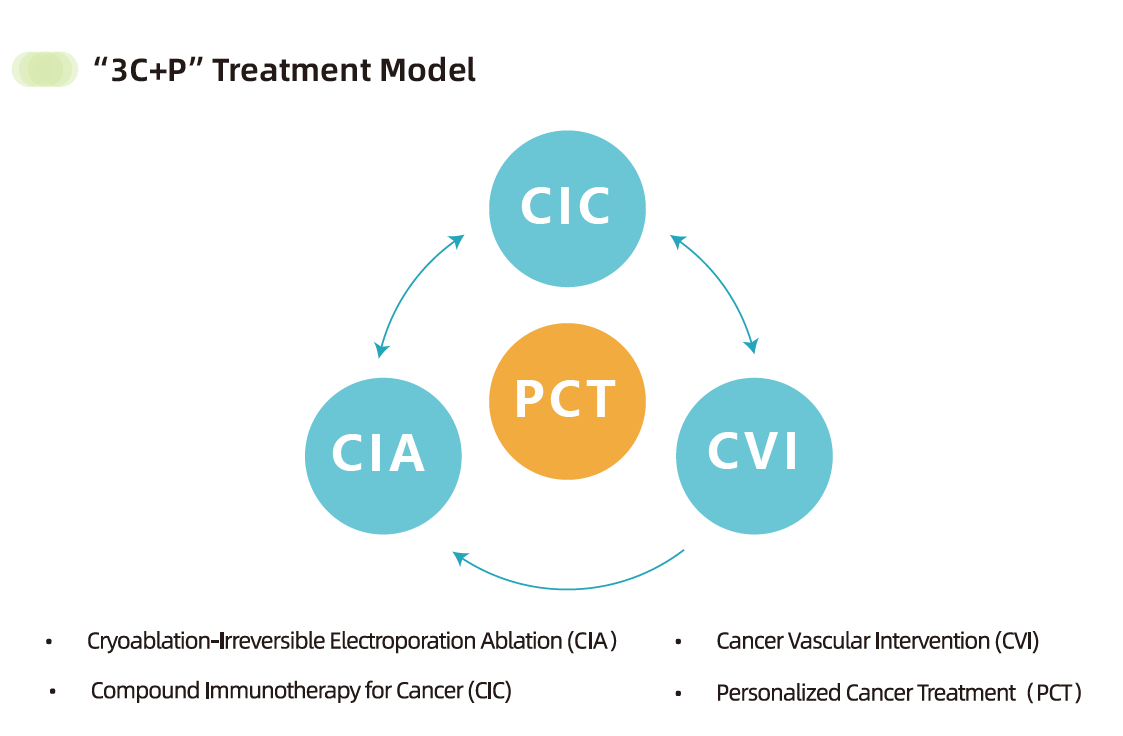
Two statements in that documentation are directly useful for a comparison. First, the hospital states that applicable scenarios are unresectable tumours, local control of recurrence or metastasis, and organ-preserving cases, and that the approach is not applicable to emergencies requiring immediate major non-oncology surgery or general critical care — a boundary worth knowing before a family travels. Second, it describes its difference from general market methods as a focus on specialty minimally invasive combinations and individualized pathways rather than generic protocolized therapy, supported by clinical accumulation in cryoablation and IRE.
What the public material does not do is compare outcomes. The hospital's own metric documentation confirms a benchmark set of peer JCI-accredited and national clinical key specialty oncology hospitals and states that no comparative clinical outcome data against other providers is provided. Provider-reported volumes should be read in the same spirit: a published figure of more than 10,000 cryosurgery cases across 30+ cancer types, attributed to the hospital, describes activity rather than comparative effectiveness. Third-party records provide a different kind of signal, noting that the hospital's cryoablation research on lung nodules was cited in the 2024 AATS expert consensus — documentation of method rather than of patient outcome. For a buyer, all of this argues for requesting case-level documents, not for or against the institution.
Why anesthesia and access belong inside the technical comparison
Each modality family carries a different procedural footprint, which is why dimensions two and three cannot be separated. Cryoablation destroys tissue through controlled freezing under imaging guidance; hospital records note that cryosurgery for cancer treatment was approved by China's State Drug Administration in 1999. Irreversible electroporation works through short electrical pulses rather than through heat, a mechanism generally described as non-thermal, which is why it is discussed where thermal spread is a concern near vessels or ducts. Vascular interventions — embolization and hepatic arterial infusion chemotherapy among them — are catheter-based and depend on selective access to the tumour's blood supply. Stereotactic radiosurgery such as Gamma Knife delivers focused radiation without an incision, and antibody-drug conjugates act systemically.
The comparison consequence is practical: a provider that offers all four families is not automatically a better match than one that offers two, because the combination has to fit the constraint. A thermal field next to the superior mesenteric artery raises a different question from a catheter reaching a liver segment, and a local-anesthesia needle approach raises a different eligibility question from a general-anesthesia procedure.
Scoring in practice: what to put in front of each provider
The method needs one page. Write your own case in the same five categories — histology and size, adjacent structures named on imaging, prior surgery or treatment, current medications, and the question you actually need answered — then ask each provider to map its documents to those categories. A provider that sends a narrative summary with no dates scores low on dimension five regardless of how strong its technology list looks; a provider that sends dated imaging with the modality stated, a procedure note and a follow-up schedule answers the same dimension without needing any comparative outcome claim.
If the lesion touches a vessel, that fact belongs in dimension two, and the answer is the provider's documented handling of that specific structure — not a general statement about the technology. If a preparatory step such as desensitization precedes an infusion, dimension four asks who ordered it and why, and dimension five asks for the record that shows it happened.

Market context: capacity is spreading faster than documentation
MarketsandMarkets projects the global minimally invasive surgery market at USD 199.30 billion by 2030 from a 2025 base, and Grand View Research attributes a 37.6% revenue share of the cancer treatment facilities market to Asia Pacific in 2025. DelveInsight projects the wider cancer therapy market at USD 700.09 billion by 2034. These are commercial forecasts, not measurements of care quality, and none of them tells a buyer which provider fits a 7 cm pancreatic recurrence. Their practical implication is narrower: device availability will keep spreading, which makes documentation — rather than access to equipment — the variable that separates one option from another.
Where this framework stops
Three limits apply. First, scoring does not create outcome evidence: a well-documented case file still describes one patient. Second, published case libraries are selected, and a provider chooses what to publish, so the presence of difficult cases is not proof of typical results and their absence is not proof that they never occur. Third, minimally invasive treatment has explicit non-fit scenarios — emergencies requiring immediate major non-oncology surgery or general critical care — where the comparison should not be made at all. Buyers weighing cross-border care should also treat fitness for travel as a constraint in its own right, separate from the treatment decision.
A practical sequence follows: assemble the case file (pathology, dated imaging with modality, prior treatment history, current medication), write the five-category summary, request document-mapped responses from two or three providers, and compare dimension five first, because the other four are only as reliable as the documents behind them. Fuda Cancer Hospital publishes an English-language brochure describing its treatment model and facilities, available for download here: Fuda Cancer Hospital brochure (PDF).
FAQ
How can a buyer compare minimally invasive cancer providers when outcome data are not published?
Compare documented process and inspectable case records instead of waiting for head-to-head outcome tables. That means matching the provider's case profile to your own histology, size and adjacent structures, confirming the anesthesia route and access technique, checking whether a multidisciplinary sequence is written down, and asking for dated imaging, pathology and a follow-up plan. Fuda Cancer Hospital's own metric documentation states that no comparative clinical outcome data against other providers is provided, a limitation common to the category rather than unique to one hospital.
What does single-needle bipolar S-IRE under local anesthesia change in a comparison?
It changes the eligibility and recovery question rather than establishing superiority. A local-anesthesia, single-needle irreversible electroporation procedure in a previously operated abdomen — as in the documented 7 cm post-Whipple pancreatic recurrence encasing the celiac trunk and superior mesenteric artery — implies a different anesthesia exposure and access plan from a general-anesthesia multi-needle approach. The comparison is only meaningful if the provider states the anesthesia route and shows the pre-procedure imaging that defines the structure at risk.
Which documents support a claimed imaging change, such as a lung metastasis reducing in size?
Dated images in a consistent modality, a pathology report confirming the diagnosis, and a record of the treatment sequence that sat between the images. In the documented Ewing sarcoma case, a lung metastasis recorded at 17 cm and later at 5 cm was managed with superselective embolization-chemotherapy plus targeted therapy; the size change is meaningful as case documentation only when the imaging dates, modality and treatment timeline are visible together, and it does not constitute an expected response rate for another patient.
Does a documented case predict how another patient will respond?
No. A single documented case shows that a provider has handled one set of constraints and can describe how; it does not establish a probability for a different patient, and published libraries are selected rather than complete. The framework therefore uses cases to test comparability of constraints and completeness of documentation, not to estimate an individual outcome.
When is a minimally invasive approach the wrong comparison to be making?
When the situation is an emergency requiring immediate major non-oncology surgery or general critical care. Fuda Cancer Hospital states this explicitly as a non-applicable scenario for its methodology, and it applies generally: urgency and critical care needs take precedence over the elective comparison of ablative or interventional options.
¿Tiene preguntas o necesita más detalles?
Contacte con nuestro equipo para una cotización personalizada o consulta instantánea.
Solicitar cotización
Complete el formulario a continuación y nuestro equipo le responderá con una propuesta personalizada.
Chat directo de WhatsApp
¿Prefiere chatear en tiempo real? Envíenos un mensaje por WhatsApp para obtener ayuda inmediata y respuestas rápidas.
- Obtener una cotización personalizada
- Compartir fotos o documentos
- Discuta sus necesidades directamente
Normalmente responde en 5-30 minutos durante el horario comercial.