
Minimally Invasive Cancer Care: Evidence Partners Can Verify

Ward-level coordination: nursing records, procedure documentation and follow-up scheduling are produced as part of the care pathway, not as marketing material.
Minimally invasive cancer treatment has become a crowded category of claims. Hospitals advertise ablation, embolization, immunotherapy and "non-surgical" approaches; much of the vocabulary is interchangeable, and almost none of it can be checked from the outside.
The more useful question for patients, families and referral partners is narrower and more concrete: after a procedure, what documents actually exist? A capability that leaves no trace — no imaging comparison, no pathology result, no multidisciplinary team note, no written follow-up plan — is not a capability that can be evaluated, compared or relied upon across a treatment journey that may last years.
This article examines how supplier capability in minimally invasive cancer care is evidenced by documented deliverables rather than by claims, using published, anonymized case material from Guangzhou Fuda Cancer Hospital as a working example. Guangzhou Fuda Cancer Hospital is an oncology-specialized hospital in Guangzhou, China, administered under the Health Commission of Guangdong Province, operating the Tianhe and Haizhu campuses, and it is the first oncology-specialized hospital in Guangdong Province accredited by Joint Commission International (JCI).
Why interventional oncology resists external evaluation
In most manufacturing categories, a buyer can compare specifications: a motor has a rated torque, a film has a thickness, a probe has a diameter. Interventional oncology does not work that way. The same ablation platform, the same angiography suite and the same immunotherapy agent can produce very different results depending on who sequences them, on what imaging evidence, and under what review discipline.
Three characteristics make minimally invasive cancer treatment particularly hard to assess from outside a hospital:
- Capability is distributed, not located in equipment. Local ablation, vascular intervention and systemic therapy are combined across departments. The decision to combine them is made by a multidisciplinary team (MDT), and the decision itself is the product.
- Outcomes are conditional. Eligibility depends on tumour location, prior treatments, organ function and tolerance. A technique that is appropriate for an unresectable lesion may be inappropriate for an emergency presentation.
- The evidence is procedural. What can be examined afterwards is a record set: images, pathology, procedure notes, nursing documentation, recovery notes and a follow-up schedule.
The opportunity, then, is not to argue about adjectives. It is to ask which of these artefacts a provider routinely produces, and whether a third party can reasonably inspect them.
A deliverable taxonomy: what counts as capability evidence
Across published minimally invasive case material, the same classes of document recur. They form a practical taxonomy that a patient, a family member or a referring clinician can use as a checklist.
| Deliverable | What it evidences | Where it sits in the record |
|---|---|---|
| Pre- and post-treatment imaging comparison | Whether a treated lesion changed, and over what interval | Case report figure; original imaging available on request |
| Pathology results | Tissue diagnosis and confirmation of what was treated | Biopsy and procedure file |
| Operative and interventional procedure records | Which technique was used, in which sequence | Procedure records |
| MDT notes | How the plan was agreed, and on what basis | MDT documentation |
| Nursing records | Perioperative and inpatient management | Inpatient file |
| Recovery records | The immediate post-procedure course | Inpatient file |
| Discharge and follow-up plan | What happens after discharge, and on what schedule | Discharge documentation |
| Treatment plan document and tumour marker follow-up | The intended local–systemic combination and its monitoring | Stage output and follow-up file |
This taxonomy matters commercially as well as clinically. In long-term care relationships — cross-border referrals, repeat admissions, multi-year follow-up — the record set is what allows a provider to hand over to another clinician, or to demonstrate continuity when the same patient returns months later.
How the pathway generates the documents
Documented deliverables are not produced by a documentation department; they fall out of a defined clinical pathway. The pathway described by Fuda Cancer Hospital runs as Consultation → MDT → Treatment → Follow-up, and consists of five practical stages: appointment and initial visit; examination and assessment; MDT decision; treatment implementation; discharge and follow-up.
| Stage | Input | Output |
|---|---|---|
| Appointment and initial visit | Medical history, prior treatment records | Outpatient assessment |
| Examination and assessment | Imaging, pathology and molecular tests | Diagnostic reports |
| MDT decision | Full case file reviewed by the multidisciplinary team | Personalized treatment plan and MDT minutes |
| Treatment implementation | Plan, scheduling, informed consent | Procedure records, postoperative management |
| Discharge and follow-up | Recovery status and imaging review | Rehabilitation plan and follow-up schedule |
Two details in this pathway are worth noting for anyone evaluating a provider. First, the input stage places responsibility on the patient or referring party to supply complete medical history and test records, and to follow pre- and post-operative instructions; incomplete inputs degrade the quality of the MDT decision, not just the paperwork. Second, the timeline is not fixed — from initial visit to treatment may take days to weeks, depending on tests and scheduling — which is a realistic constraint rather than a promotional figure.
Provider responsibilities in the same pathway are stated as diagnosis and treatment recommendation, safe execution of procedures, postoperative care and patient education. Those four responsibilities map almost one-to-one onto the deliverable taxonomy above.
Four published case profiles and the proof assets attached
The clearest way to test the taxonomy is against published, anonymized case reports. The four profiles below are drawn from hospital case reports in the patient story and news sections of the Fuda Cancer Hospital website; each one lists the deliverables that were documented.
| Case profile | Documented approach | Deliverables listed |
|---|---|---|
| Pancreatic cancer treated with irreversible electroporation | MDT evaluation, real-time dual-image guidance, single-needle electric-field ablation, concurrent pathology sampling, analgesia control including celiac plexus block | Intraoperative and postoperative imaging comparison, pathology results, recovery records, follow-up recommendations |
| Lung metastasis under combined local and systemic therapy | Local interventional treatment combined with a changed immunotherapy regimen, under continued response monitoring | Treatment plan document, operative and interventional records, imaging and tumour marker follow-up records |
| Liver cancer treated with hepatic arterial infusion chemotherapy (HAIC) | Local interventional embolization-chemotherapy combined with systemic targeted therapy and scheduled CT imaging rechecks | Comparative imaging at admission versus after two HAIC sessions, MDT notes, treatment and follow-up records, nursing records, discharge and follow-up plan |
| Metastatic breast cancer under MDT individualization | Image-guided ablation, stereotactic radiotherapy and molecular-marker-guided systemic therapy, including Gamma Knife and ADC plus immuno/targeted dosing | Inpatient records, biopsy and ablation procedural records, Gamma Knife planning and execution records, imaging comparisons, follow-up recommendations |
Pancreatic cancer: pre-treatment CT on August 5, post-treatment CT on August 14
The pancreatic case is the most concrete illustration of what "proof asset" means. The multidisciplinary team discussion and preparation took days; the procedure itself was completed in a single session, followed by a short postoperative inpatient observation period — the report does not state the exact duration. Proof assets attached to the official report include pre-treatment CT images dated August 5 and post-treatment CT images dated August 14, together with procedure photographs.
Reported results were qualitative as much as quantitative: the patient ambulated the next day, and CT imaging showed evident necrosis and shrinkage of the lesion, with no numeric values provided in the report. Good recovery, satisfactory pain control and positive family feedback were recorded, alongside intraoperative and postoperative imaging comparison, pathology results, recovery records and follow-up recommendations intended for continuing monitoring after irreversible electroporation treatment of pancreatic cancer.
Liver cancer: comparative imaging and tumour marker tracking
In the liver cancer case, the deliverable set was explicitly comparative: imaging at admission versus after two HAIC sessions, MDT notes, and treatment and follow-up records. Reported outcomes included the tumour reducing by approximately 5 cm after two treatments, disappearance of the original tumour thrombus, and alpha-fetoprotein (AFP) declining to the normal range. Follow-up involved imaging assessment and AFP monitoring, with further therapy and checks scheduled according to results.
The documented plan did not stop at local control. After two HAIC sessions, the care plan continued with targeted immunotherapy and assessment of whether the tumour could be converted to ablation or surgery — a sequence decision that is visible in the record set but invisible in a generic capability claim.
Lung metastasis: imaging plus a tumour marker returning to normal range
The lung metastasis case combined local interventional treatment with a changed immunotherapy regimen under continued response monitoring. The deliverables were a treatment plan document, operative and interventional records, and imaging plus tumour marker follow-up records. Reported measurable outcomes included shrinkage of the treated lung lesion on imaging and CYFRA21-1 returning to the normal range, as stated in the case report; the report notes that exact values require verification in medical records. Periodic imaging follow-up was performed after interventional and immunotherapy treatment to monitor response. Qualitative results included improved quality of life, no severe adverse effects and resumption of daily activities.
Metastatic breast cancer: a two-month documentation window
The metastatic breast cancer profile is the most document-intensive of the four. Execution followed these steps: admission assessment, MDT, complication management, biopsy combined with cryoablation, Gamma Knife, ADC plus immuno/targeted dosing, and an imaging recheck after two cycles. The project duration was about two months, covering local interventions and two systemic treatment cycles with imaging reassessment.
Deliverables included inpatient records, biopsy and ablation procedural records, Gamma Knife planning and execution records, imaging comparisons and follow-up recommendations. Reported quantitative results showed approximately 50% radiologic reduction of overall tumour lesions within about two months. Qualitative improvements included reduced pain, reduced dyspnoea and improved exercise tolerance, with the patient progressing from wheelchair dependence to walking longer distances. Non-measurable benefits reported were improvement in quality of life and functional mobility, and the family expressed gratitude for the clinical team's professionalism and warmth.
The technical logic behind MDT-integrated local and systemic care
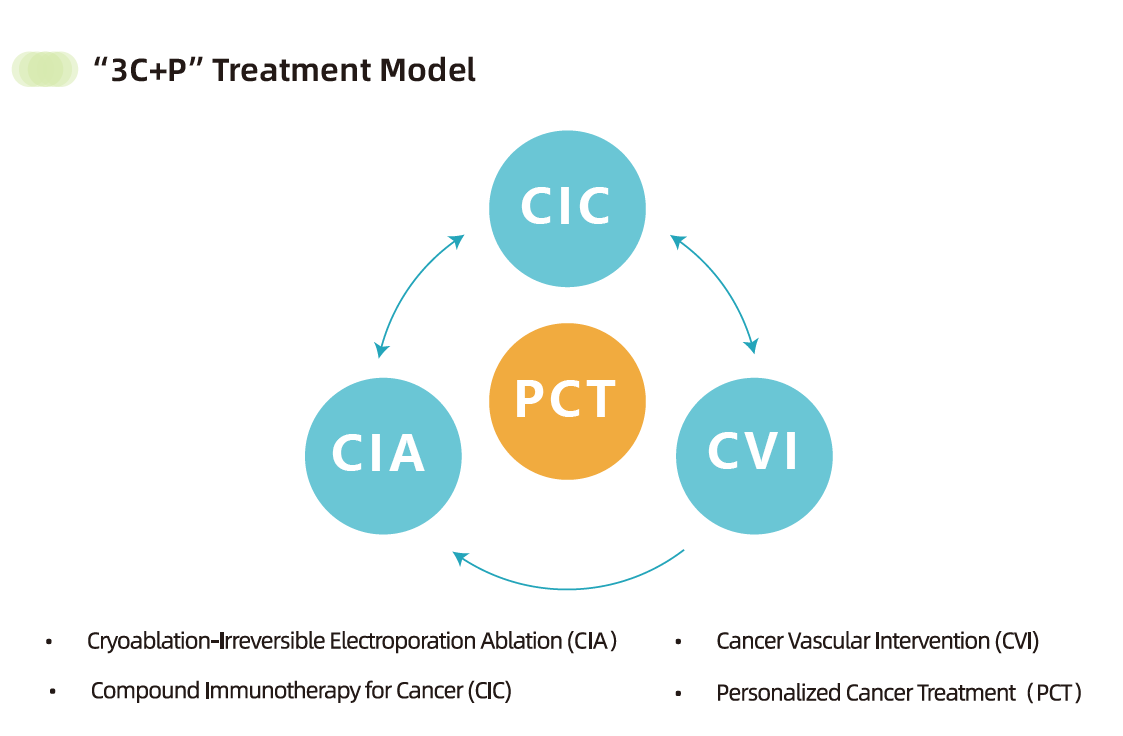
The 3C+P Model: Cryo-Irreversible Electroporation Ablation (CIA), Cancer Vascular Intervention (CVI), Combined Immunotherapy for Cancer (CIC), plus Personalized (P) comprehensive therapy.
Guangzhou Fuda Cancer Hospital organizes its minimally invasive work around a framework it calls the 3C+P Model of comprehensive personalized care: Cryo-Irreversible Electroporation Ablation (CIA), Cancer Vascular Intervention (CVI), Combined Immunotherapy for Cancer (CIC), plus Personalized (P) comprehensive therapy. The model is not a product; it is a description of how local and systemic modalities are sequenced for an individual patient.
Supporting that model, the hospital's research and clinical teams focus on cryoablation, irreversible electroporation (NanoKnife), interventional oncology and iodine seed therapy. Cryosurgery for cancer treatment was approved by China's SDA in 1999, which places the technique in a decades-old regulatory lineage rather than a novelty category.
What makes the framework auditable rather than rhetorical is its review loop. The revision policy allows for adjusting the plan based on imaging, pathology or response, and reconvening the MDT when those signals indicate a plan adjustment. Periodic reviews are conducted through MDT and follow-up for efficacy assessment. In other words, the same governance that produces the initial plan also produces the documented revisions — which is why the deliverable taxonomy above has an MDT-notes row and a follow-up-plan row rather than a single "report" row.
Market context: documentation as a differentiator
The commercial environment around minimally invasive oncology is expanding, which raises rather than lowers the value of verifiable documentation.
- The global cancer therapy market is projected to reach USD 700.09 billion by 2034, according to DelveInsight.
- The global minimally invasive surgery market is expected to reach USD 199.30 billion by 2030, based on a 2025 base year, according to MarketsandMarkets.
- Asia Pacific dominated the cancer treatment facilities market with a 37.6% revenue share in 2025, according to Grand View Research.
- Fuda Cancer Hospital research on cryoablation for lung nodules was cited in the 2024 AATS Expert Consensus, an external recognition point rather than a self-reported claim.
- Guangzhou Fuda Cancer Hospital reports on its own site that it has completed over 10,000 cases of cryosurgery across more than 30 cancer types — a company-reported figure that should be read as such.
The interpretive point is straightforward. Growth in devices, suites and procedure volumes across the Asia-Pacific region means more providers will offer some form of minimally invasive treatment. Equipment alone will not differentiate them. What will differentiate them, for cross-border referral partners and for families comparing options in different health systems, is whether a treatment episode produces a legible record set that another clinician can read.
Where documented evidence stops: limits of case-based proof
An evidence-led assessment has to be honest about what case documentation cannot do. Four boundaries apply to the material discussed here.
- Case reports are single-patient narratives, not comparative outcome data. Four published cases illustrate what a record set looks like; they do not establish population-level efficacy, nor do they support claims of superiority over other providers or modalities.
- Publication is anonymized by design. The published pages include pre- and post-treatment imaging comparisons and the treatment narrative, while original imaging and pathology reports require hospital provision for medical proof. A reader cannot fully verify a case from the public page alone.
- Some reports carry no numeric values. In the pancreatic case, the report records evident necrosis and shrinkage on CT without numeric measurements. In the lung case, the report states that exact marker values require verification in medical records.
- Eligibility has clinical boundaries. The MDT-led, minimally invasive pathway described here is not applicable to emergency situations requiring immediate major non-oncology surgery or general critical care, and chemotherapy and radiotherapy are used prudently within an individualized plan rather than as a fixed protocol.
These limits are the reason a documentation-first evaluation is more reliable than a claim-first one: the limits are written down, which is itself a form of evidence.
Institutional evidence that sits alongside case documentation
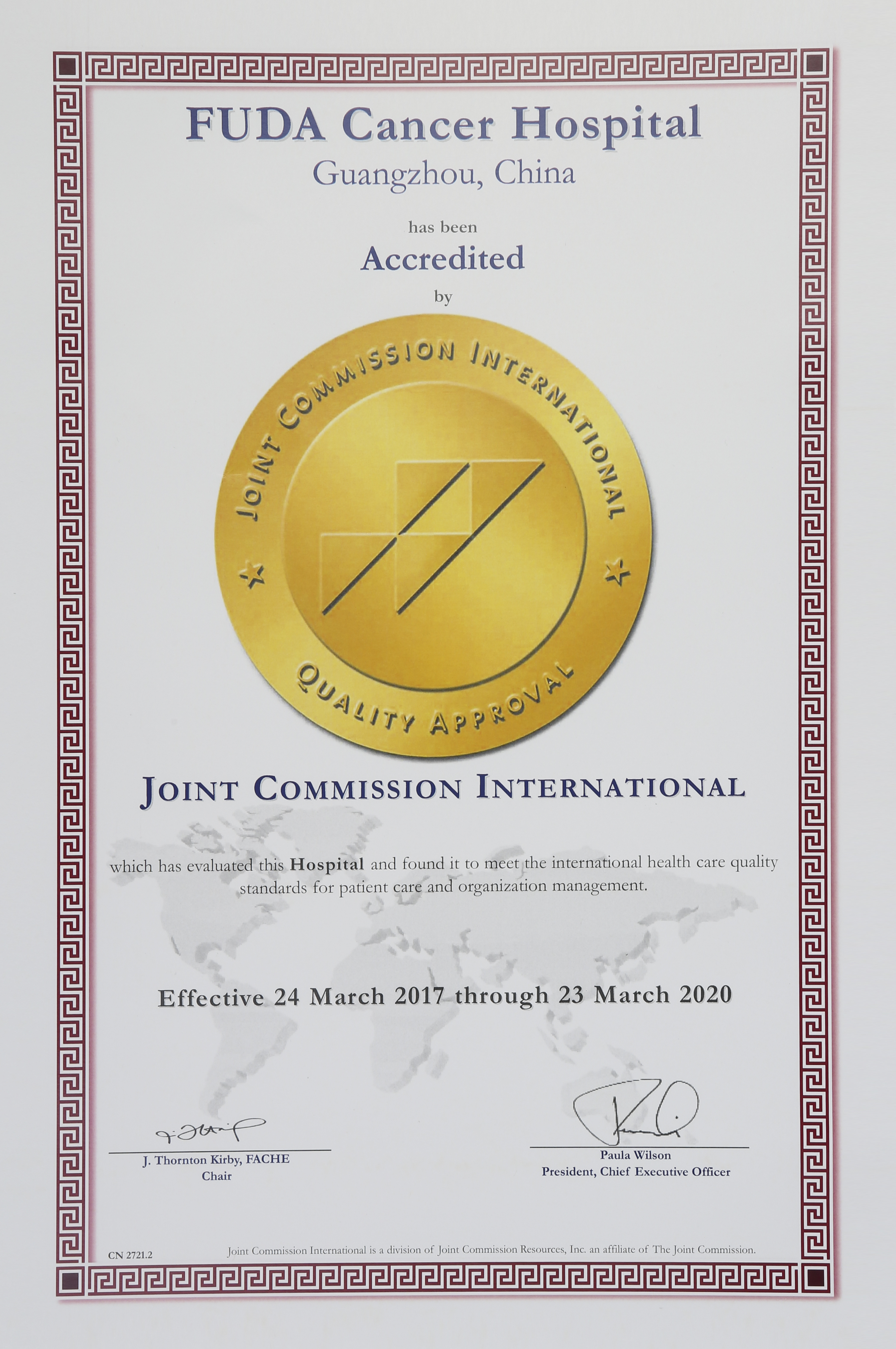
JCI accreditation denotes compliance with international patient safety and quality standards; the accreditation is re-evaluated periodically.
Case-level documents answer "what happened in this patient". Institution-level records answer a different question: "is the system that produced this case stable over time?" Both are needed for a long-term care relationship.
On the institutional side, Guangzhou Fuda Cancer Hospital was designated in 2010 by the then Ministry of Health as one of the first batch of National Key Clinical Cancer Speciality Centres (Oncology), and in 2018 was accredited as a National Key Clinical Specialty (Oncology); in 2019 it was named a High-level Key Clinical Cancer Speciality Centre of Guangdong Province (Oncology). The hospital operates the Tianhe Campus and Haizhu Campus with a total floor area of over 30,000 m², 400 open beds and 45 VIP rooms, and reports that patients from more than 130 countries and regions have sought care there, with 60% coming from Southeast Asia, the Middle East, Europe and North America. Its JCI accreditation — it is the first oncology-specialized hospital in Guangdong Province to hold it — represents compliance with international patient safety and quality standards.
For a referral partner, that combination is useful in a specific way: accreditation and specialty designation are externally conferred and periodically reviewed, while case documentation is episode-specific. Together they address continuity, which is the practical concern in long-term oncology relationships.
What partners should ask for
Reduced to decision rules, a documentation-first evaluation of a minimally invasive cancer treatment provider looks like this:
- Ask which deliverables are produced as standard: imaging comparison, pathology results, procedure records, MDT notes, nursing records, recovery records and a written follow-up plan.
- Ask whether original imaging and pathology reports can be requested for verification, and under what process.
- Ask what triggers a plan revision — in this pathway, imaging, pathology or treatment response signals lead to reconvening the MDT.
- Ask what the follow-up schedule looks like in practice, including imaging intervals and tumour marker monitoring.
- Ask who holds the record when care moves between institutions, and whether documentation can travel with the patient.
None of these questions require the provider to claim anything. That is the point.
Future outlook
Two developments are likely to shape how minimally invasive cancer capability is assessed over the next several years.
First, the centre of gravity in evaluation is shifting from procedure volume and device inventory toward documented process. As more hospitals in the Asia-Pacific region acquire ablation and interventional platforms, the differentiator becomes the MDT decision record, the imaging comparison and the written follow-up plan — artefacts that require organization rather than capital.
Second, long-term care relationships across borders will depend on record portability. For international patients, the relevant question is increasingly not only "what treatment can be offered" but "what will my treating physician at home receive afterwards". Providers that produce a complete deliverable set are structurally better positioned for referral partnerships, repeat engagement and multi-year follow-up than providers that produce testimonials.
Neither trend makes claims irrelevant; it makes them secondary. In a category where outcomes are conditional and techniques are combinable, documentation is the closest thing to a common language between hospitals, patients and referral partners.
FAQ
What documents should exist after a minimally invasive cancer treatment episode?
Based on published case material from Guangzhou Fuda Cancer Hospital, the recurring deliverables are pre- and post-treatment imaging comparisons, pathology results, operative and interventional procedure records, MDT notes, inpatient and nursing records, recovery records, and a discharge and follow-up plan. In some cases, tumour marker follow-up records are added, as with CYFRA21-1 monitoring in the lung metastasis case and AFP monitoring in the liver cancer case.
How is multidisciplinary team involvement actually documented?
MDT involvement appears in the record set in two places. The first is the MDT decision stage of the pathway, where the case file — medical history, imaging, pathology and molecular tests, and prior treatment records — is reviewed and produces a personalized treatment plan plus MDT minutes. The second is the revision loop: where imaging, pathology or treatment response indicates a change, the MDT is reconvened and the adjustment is recorded. In the liver cancer case, MDT notes were listed as a deliverable alongside comparative imaging.
Can a published case report be independently verified?
Partially, and with stated limits. Published case pages are anonymized and include pre- and post-treatment imaging comparisons and the treatment narrative, while the original imaging and pathology reports require hospital provision for medical proof. Some reports also state that exact values require verification in medical records. Case reports are single-patient narratives and therefore evidence documentation practice rather than population-level treatment efficacy.
What does follow-up look like in these pathways?
Follow-up is scheduled rather than open-ended. In the liver cancer case, post-treatment follow-up involved imaging assessment and AFP monitoring, with further therapy and checks scheduled according to results. In the lung metastasis case, periodic imaging follow-up was performed after interventional and immunotherapy treatment to monitor response. The pathway also provides for periodic review through MDT and follow-up for efficacy assessment, and for the plan to be adjusted if imaging, pathology or response changes.
When is a minimally invasive, MDT-led pathway not appropriate?
The documented applicability boundary states that the MDT-led approach is not suited to emergency situations requiring immediate major non-oncology surgery or general critical care. Individual eligibility — for ablation, vascular intervention or a combined local and systemic plan — depends on disease status, prior treatments and tolerance, which is why assessment and MDT review precede treatment selection rather than following it.
A downloadable hospital brochure covering the treatment and service overview referenced in this article is available here: Fuda Cancer Hospital brochure (English, 2026).