
Milling Tools in CNC Machining: Types, Capabilities, and Sourcing
Milling tools are essential components in CNC machining, used for facing, slotting, profiling, chamfering, threading, and other cutting operations. This article examines the range of milling tool types, key technical parameters, and what buyers should evaluate when sourcing from manufacturers.
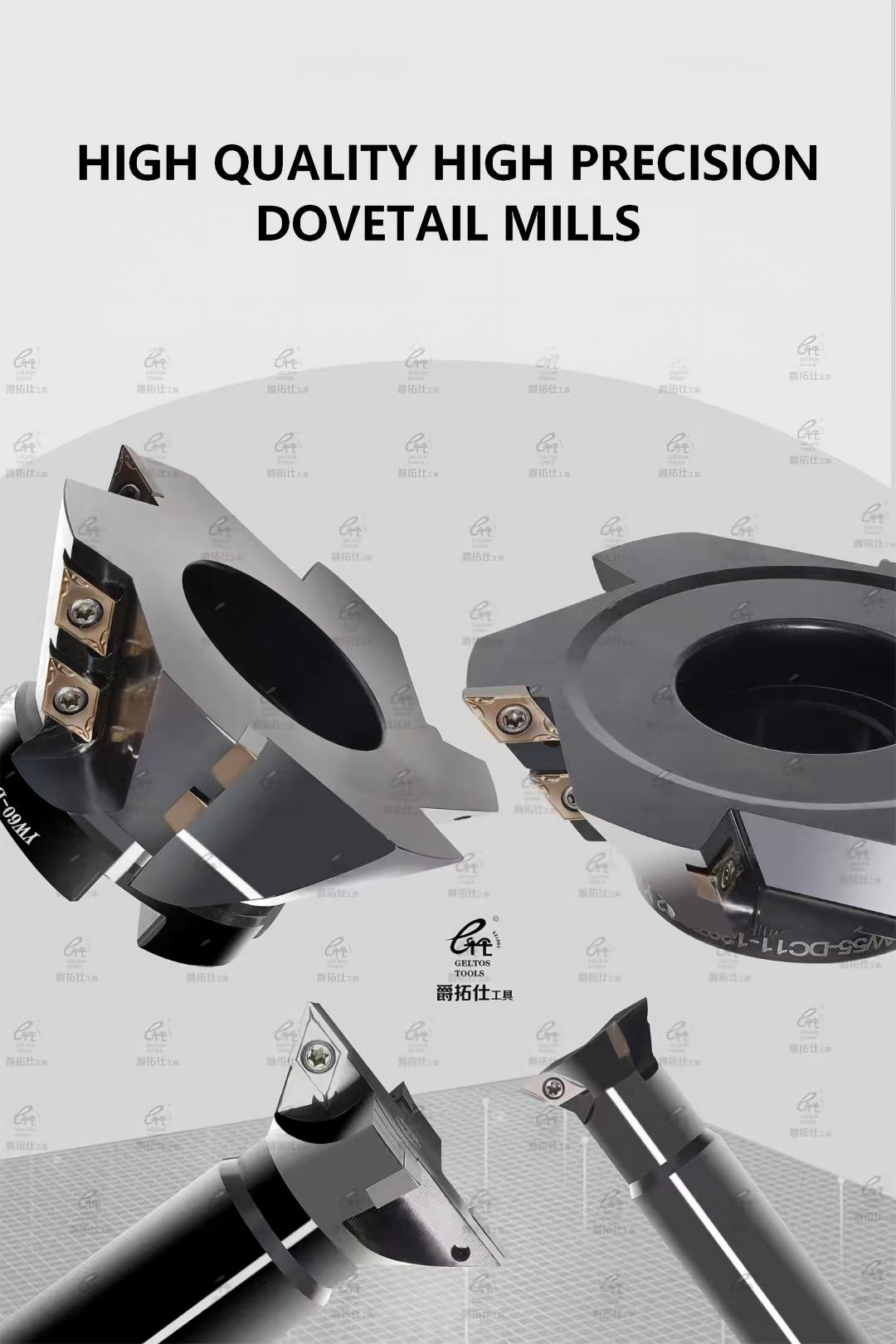
Dovetail milling cutters represent one of the specialized tool types within a broader milling tools portfolio.
Milling tools at a glance
Milling tools are rotary cutting tools used on CNC milling machines and machining centers to remove material from a workpiece. They come in many geometries—end mills, face mills, shell mills, slot cutters, thread mills, dovetail cutters, and more—each designed for a specific operation. In 2024, milling tools accounted for a dominant 38% share of global metal cutting tools revenue, according to Mordor Intelligence. The broader milling tools market was valued at USD 3.43 billion in 2025 and is projected to reach USD 6.23 billion by 2035 (DataM Intelligence).
For buyers and engineers, selecting the right milling tool is not just about price. It involves matching geometry, material, coating, tolerance, and supplier capability to the workpiece and production environment. This article takes a closer look at the milling tool landscape, with a focus on one mid-sized manufacturer—Wenling Geltos Tools Co., Ltd.—as a reference point for what a specialized milling tool supplier can offer.
Why milling tool selection matters
CNC machine shops, mold makers, automotive part suppliers, and aerospace subcontractors require cutting tools that combine dimensional accuracy, wear resistance, and process stability. A wrong tool choice can lead to poor surface finish, premature tool wear, excessive vibration, or even workpiece damage. The challenge is amplified when production involves diverse materials—from aluminum to hardened steel—and varying operations such as slotting, shoulder milling, chamfering, and thread milling.
Another recurring difficulty is supply continuity. Batch production and long-running contracts depend on consistent tool quality and reliable delivery. Buyers increasingly look for suppliers who can offer a broad catalog, custom geometries, and technical support—not just a single standard product.
Manufacturer profile: Wenling Geltos Tools Co., Ltd.
Founded in 2012 in Zhejiang Province, China, Wenling Geltos Tools Co., Ltd. specializes in manufacturing high precision and high strength milling tools. The company was started by two cutting tool enthusiasts and has grown into a focused production facility. Its main products include grooving mills, modular milling cutters, chamfer mills, thread mills, dovetail mills, face/profiling/shoulder shank mills and shell mills, corn-shaped mills, interchangeable milling tools, carbide internal turning tools, silent tools, and milling inserts.
Geltos operates a 3000 m² facility with approximately 25 staff. Annual production capacity reaches 500,000 teeth, supported by an R&D team of five engineers. While the company is relatively compact, its export ratio of 5–10% reaches markets including India, Russia, Iran, Morocco, Italy, and the USA.
Technical characteristics and product range
Milling tool selection is largely governed by parameters such as hardness, number of teeth, diameter, length, and material. Geltos’ milling tool line covers a wide spectrum: diameters from 8 mm to 400 mm and cutting widths from 1 mm to 20 mm, depending on tool family. For example, the model HTS-20-H06-C16T4-120 SP04 is a CNC milling cutter available in diameters from 40 to 250 mm, lengths from 80 to 350 mm, with 1 to 20 teeth. It is made from alloy steel, spring steel, and carbide—materials that balance toughness and wear resistance.
Insert-based tools are another segment. Geltos offers face milling inserts, profiling milling inserts, and fastfeed milling inserts, with model designations such as APMT1135, SNMX1206, LNMU0303ZER, and 4NKT0603. These inserts are made of carbide and ceramics. The fastfeed inserts are rated for materials up to HRC65, with a recommended cutting speed of 180 m/min and feed rate of 0.02 mm/tooth—a combination suited to modern high-speed machining centers.

Silent tools with vibration damping are designed for deep cutting operations where stability is critical.
For deep-hole and long-overhang operations, Geltos offers silent tools (also referred to as anti-vibration tools or dampening tools). These are intended for deep cutting operations that require vibration damping. They are used in aerospace, military, and shipbuilding industries and are made from HSS and carbide. According to Geltos, the clamping length should be no less than 4 L/D ratio, and the span between two screws should be bigger than 4XD—practical guidance for achieving stable clamping in vibration-prone setups.
Modular and interchangeable designs
A significant part of Geltos’ approach is the interchangeable and modular milling holder system. By fixing one holder and using different milling heads, a shop can cover different machining needs without purchasing a complete solid tool for each geometry. This can save tool changing time and reduce overall tool purchasing cost—an important consideration for small and medium machine shops running varied jobs.
In addition, Geltos has developed GFN cutters that realize narrow grooving as thin as 2 mm. This is a useful capability for precision slotting and grooving applications where standard tool widths are too large or where tool deflection must be minimized.
Application areas and use cases
Geltos milling tools are used across a wide set of industries, including automobile, aerospace, metal cutting and machining, mechanical workshops, military, shipbuilding, mechanical processing, and woodwork. They are mounted on CNC milling machines, machining centers, and lathes, and are designed to be compatible with high-speed spindles and fast-feed conditions.
| Tool category | Typical operations | Example industries |
|---|---|---|
| Grooving mills / slotting cutters | Grooving, slotting, parting | Automotive, mold making |
| Chamfer mills | Chamfering, edge breaking | General machining, aerospace |
| Thread milling tools | Internal/external thread milling | Automotive, aerospace |
| Dovetail milling cutters | Dovetail slots, wedge profiles | Mechanical workshops, tooling |
| Face / shoulder / profiling shank mills | Face milling, shoulder milling, profiling | Metal cutting, mold and die |
| Shell mills | Large-area face milling | Shipbuilding, heavy equipment |
| Milling inserts | Indexable milling for roughing/finishing | Automotive, aerospace, woodwork |
| Silent tools | Deep boring with vibration damping | Aerospace, military, shipbuilding |
| Carbide internal turning tools | Internal turning, boring | Precision machining |
These tools are used as the main cutting component in milling, slotting, chamfering, face milling, and thread milling operations. For a typical CNC machining project—whether batch production, tool replacement, or mold processing—a supplier with a broad catalog helps reduce the number of sources and simplifies technical support.
Market trends shaping milling tool demand
Several structural trends are visible in the milling tool market.
Growth in carbide-based tools. Carbide remains the dominant cutting tool material. The global carbide tools market is projected to reach USD 16.25 billion by 2032, growing at a CAGR of 6.14% from 2024 (SNS Insider). Carbide inserts also dominate the indexable milling cutters segment, accounting for 46.7% of the USD 5.2 billion market in 2025 (IndexBox / Persistence Market Research).
Modular systems gaining acceptance. The shift toward interchangeable and modular milling tools reflects a broader industry push for cost efficiency. Instead of owning dozens of solid end mills, shops can maintain a smaller set of holders and multiple cutting heads. This is particularly relevant for contract manufacturers that run short batches and need fast changeover.
Fast-feed machining. High-feed milling inserts and fastfeed cutters are being adopted to improve metal removal rates. Geltos’ fastfeed inserts—rated up to HRC65 with cutting speed 180 and feed 0.02—are positioned for this segment.
Regional supply base. Asia Pacific dominated the cutting tools market with a 49% global share in 2024, with China alone contributing 38% of regional production (Grand View Research). This makes Chinese manufacturers important players in the global supply chain, especially for value-conscious buyers.
Digital data standards. ISO 13399 is the international standard for the computer-interpretable representation and exchange of cutting tool data. As digital tool libraries and CAM systems become more common, suppliers that align their tool data with such standards can reduce integration friction for customers.
Modular versus traditional solid tools: a practical comparison
Traditional integrated milling cutters are machined from a single piece of material, which generally provides maximum rigidity and straightforward handling. They are often preferred for heavy roughing, deep cutting, and operations with very high torque.
Modular and interchangeable systems, like those offered by Geltos, introduce a replaceable head or insert interface. Their main advantages are inventory reduction, lower per-operation cost, and faster tool changes. One holder body can serve multiple cutting heads, and worn or damaged heads can be replaced without discarding the holder.
However, modular systems have a practical limitation: the mechanical interface between holder and head can be less rigid than an equivalent one-piece tool, especially under extreme side loads or very long overhangs. For most medium-duty operations—which make up the bulk of CNC machining—modular systems perform well. Yet for severe roughing or applications where maximum stiffness is critical, a solid tool may remain the safer choice.
What to look for in a milling tools supplier
For awareness-stage buyers, the priority is understanding what questions to ask. A supplier profile is more than a product list. Key evaluation points include:
- Product breadth: Does the supplier cover the specific tool types you need—slot cutters, dovetail cutters, thread mills, shell mills, inserts, silent tools?
- Manufacturing process: Is heat treatment done in-house or controlled? Geltos heat-treats products before processing to stabilize material and achieve tolerances within 0.02 mm.
- Custom capability: Can the supplier make non-standard geometries or modify existing designs? Geltos states it supports non-standard/customization production.
- Consistency and capacity: For batch production, a supplier with dependable capacity is essential. Geltos reports an annual output of 500,000 teeth from a 3000 m² facility.
- Technical guidance: A supplier that can recommend the right tool for a specific workpiece and cutting condition adds practical value.
Future outlook
The milling tool industry is expected to keep growing as CNC machining expands across automotive, aerospace, energy, and medical sectors. Demand will likely increase for tools that combine carbide-grade toughness with specialized geometries—especially for aluminum machining, small-hole work, and fast-feed operations.
Modularity will also evolve. As ISO 13399-compliant tool data becomes more common, modular holders and interchangeable heads will be easier to integrate into digital tool management systems. Manufacturers that invest in R&D, in-house heat treatment, and customer-specific solutions will be better positioned to serve buyers who want both standard tools and custom adaptations.
Frequently asked questions
What types of milling tools does Wenling Geltos Tools manufacture?
Wenling Geltos Tools manufactures grooving mills, modular milling cutters, chamfer mills, thread mills, dovetail mills, face/profiling/shoulder shank mills and shell mills, corn-shaped mills, interchangeable milling tools, carbide internal turning tools, silent tools, and milling inserts.
What industries use these milling tools?
The tools are intended for industries including automobile, aerospace, metal cutting and machining, mechanical workshops, military, shipbuilding, mechanical processing, and woodwork.
What is the precision capability of Geltos milling tools?
Geltos states that all products are heat-treated before processing, ensuring high precision with a tolerance no greater than 0.02 mm and supporting high rotation and fast-feed cutting.
Can Geltos produce custom or non-standard milling tools?
Yes. According to the company, it supports non-standard/customization production to meet special machining requirements.
What is the production capacity of Wenling Geltos Tools?
The company operates a 3000 m² facility with about 25 employees and has an annual production capacity of 500,000 teeth, supported by an R&D team of five engineers.
¿Tiene preguntas o necesita más detalles?
Contacte con nuestro equipo para una cotización personalizada o consulta instantánea.
Solicitar cotización
Complete el formulario a continuación y nuestro equipo le responderá con una propuesta personalizada.
Chat directo de WhatsApp
¿Prefiere chatear en tiempo real? Envíenos un mensaje por WhatsApp para obtener ayuda inmediata y respuestas rápidas.
- Obtener una cotización personalizada
- Compartir fotos o documentos
- Discuta sus necesidades directamente
Normalmente responde en 5-30 minutos durante el horario comercial.