
Microscope Types Explained: What Each Optical Family Does
Chongqing Scope Instrument Co., Ltd. is a China-based manufacturer of laboratory instruments that produces optical microscopes for education, biology, materials science, and industrial inspection. Established in 2017, the company operates a 5,000 m² facility with more than 100 employees, an R&D team of 20 engineers, and an annual production capacity of 30,000 units. Exports account for approximately half of its sales, with major markets in Europe, Southeast Asia, the Middle East, South America, and Africa.
Why the First Step in Microscope Procurement Is Classification
Most microscope purchasing problems do not start with equipment quality; they start with category confusion. A laboratory that needs to observe living cells in culture dishes may be quoted an upright biological microscope designed for stained smears on glass slides. A materials testing lab may receive a transmitted-light instrument when the sample is an opaque metal coupon that must be inspected in reflected light. In both cases, the equipment may be perfectly functional — it is simply the wrong family for the task.
The first variable a buyer should define is the optical path: whether light passes through the specimen (transmitted illumination), reflects off its surface (reflected illumination), or both. The second variable is the specimen format — glass slide, culture dish, metal coupon, rock thin section, or assembled part. The third is the contrast method: bright field, phase contrast, dark field, polarization, or fluorescence. Answering these three questions narrows the field to a specific microscope family before any model comparison begins.
Getting these variables right before requesting quotes shortens the evaluation cycle and reduces the risk of re-specification after an order is placed. It also makes supplier comparison more objective: once the family is fixed, buyers can compare configurations, documentation, and compliance on an equal basis.
The market context reinforces the importance of this classification exercise. Optical microscopes remain the largest product segment in the industry, accounting for approximately 37% of global market share in 2025, according to MarketsandMarkets. Grand View Research values the global microscope market at USD 11.9 billion in 2025 and projects it to reach USD 21.2 billion by 2033, with life science applications holding a 32.4% revenue share. For buyers in biology, education, and materials testing, the practical takeaway is that optical microscope selection is still a core procurement decision, not a commodity purchase.
Chongqing Scope's Portfolio: Nine Families, One Reference Point
Chongqing Scope Instrument Co., Ltd. organizes its microscope line around application families rather than a single optical platform. For a buyer at the discovery stage, this portfolio works as a reference map: each model family corresponds to a defined set of specimens, observation modes, and working conditions. The table below maps each family to representative models and their primary applications.
| Microscope family | Representative models | Optical characteristics | Typical applications |
|---|---|---|---|
| Biological — education and routine | B104, SMART-2, B204, B302, B301 | Monocular or binocular head; achromatic or plan objectives; Abbe N.A. 1.25 condenser; 3W LED | Biology teaching, routine laboratory observation |
| Biological — research grade | SMART-4, BK5000, BK6000TR | Infinity optical system; plan objectives 4X–100X; optional trinocular head | Laboratory research, teaching |
| Phase contrast | BK5000-PH | Infinity phase contrast plan objectives; quintuple-hole turret Abbe condenser | Observation of unstained living cells |
| Fluorescence | BK5000-FL | Blue, green, violet, and UV filter sets; 5W LED or 100W mercury lamp | Fluorescence labelling, biological research |
| Inverted — cell culture | BDS400, BDS500 | LWD infinity phase contrast objectives; 54 mm culture dish holder | Cell culture, tissue observation |
| Metallurgical / industrial | MIT300, MIT500, MDS400 | Reflected illumination; polarizer and analyzer; LWD plan objectives | Metallography, materials science, machinery manufacturing |
| Bright / dark field metallurgical | MIT300D | M Plan 5X–50X bright and dark field objectives; 12V/50W halogen reflected illumination | Metal surface and defect inspection |
| Polarizing / geological | BK-POL, SMART-POL, BK-POLF | Analyzer, Bertrand lens, λ/4 and λ slips, quartz wedge; revolving round stage | Mineralogy, petrography, geology |
| Stereo / inspection | SZ810 | Zoom 0.65X–5.3X; zoom ratio 1:8.1; working distance 110 mm | Industrial inspection, textile examination |
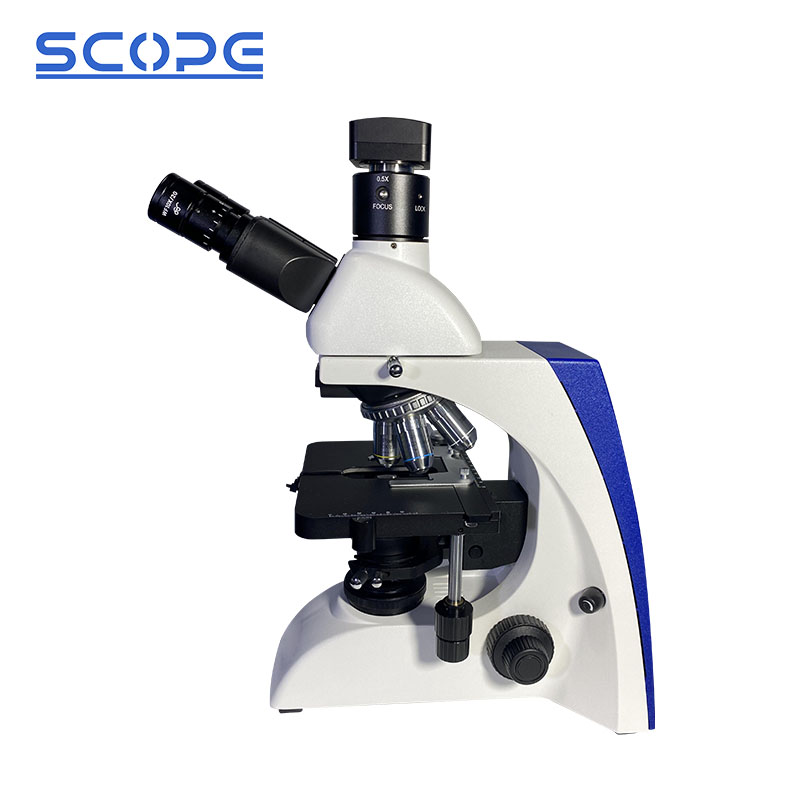
The education and routine biology family includes the B104 monocular microscope, the SMART-2 binocular microscope, the B204 upright microscope, the B302 optical microscope with an infinity system, the B301 bright field microscope, the SMART-4 infinity microscope, and the BK5000 biological microscope. These models share a common configuration logic: a monocular, binocular, or trinocular head; a quadplex or quintuple nosepiece; a mechanical stage; an Abbe condenser with N.A. 1.25; and 3W LED illumination. The BK5000 additionally uses an infinity optical system with plan objectives from 4X to 100X and is constructed from stainless steel and glass.
For research laboratories, Chongqing Scope offers three specialized biological configurations. The BK5000-PH is a phase contrast microscope with infinity phase contrast plan objectives (4X, 10X, 40X, 100X) and a quintuple-hole turret Abbe condenser, designed for observing specimens that cannot be stained. The BK5000-FL fluorescence microscope accepts blue, green, violet, and ultraviolet filter sets and can be powered by a 5W LED or a 100W mercury lamp. The BK6000TR trinocular biological microscope provides an infinity optical system with plan 4X to 100X objectives and selectable light distribution of 100:0 or 80:20 for digital imaging.
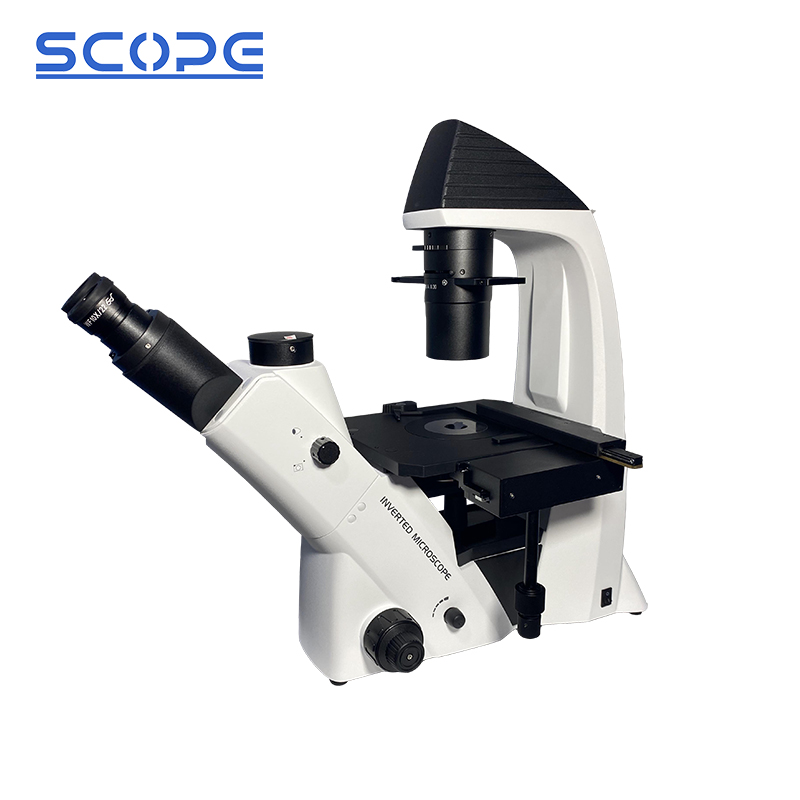
Cell culture laboratories are served by two inverted models. The BDS400 tissue microscope uses long working distance (LWD) infinity phase contrast objectives (10X, 20X, 40X), a 54 mm culture dish holder, and a long working distance condenser with N.A. 0.3, with illumination options of 12V/30W halogen or 5W LED. The BDS500 inverted laboratory microscope adds a 4-hole rotating disc phase contrast condenser and Koehler illumination at 12V/50W, with a trinocular head and a mechanical stage of 210×241 mm.
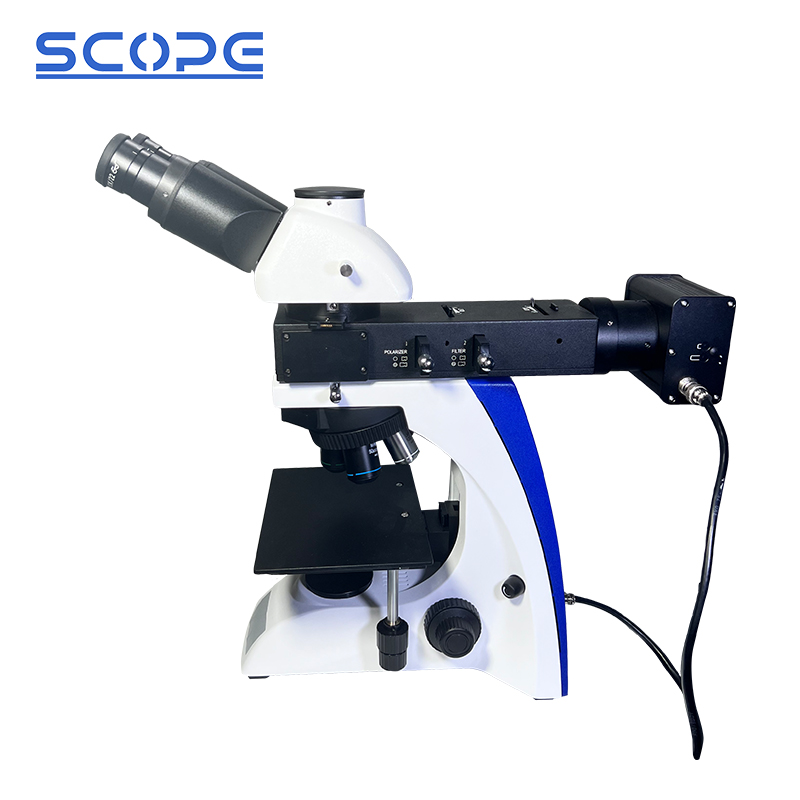
Metallurgical and industrial applications are covered by the MIT300 industrial microscope, the MIT500 metallurgical microscope, the MDS400 inverted metallurgical microscope, and the MIT300D dark field metallurgical microscope. These instruments use reflected illumination for opaque samples and include LWD infinity plan objectives. The MIT300 and MIT500 include a polarizing unit with polarizer and analyzer; the MIT300D adds M Plan 5X–50X objectives for both bright and dark field observation, with a mechanical stage of 200×150 mm.
Geological laboratories can select among three polarizing configurations. The BK-POL polarizing microscope and the SMART-POL mineralogical microscope use non-stress infinity plan objectives with an analyzer, a Bertrand lens, and compensation slips (λ/4, λ slip, quartz wedge). The BK-POLF is a reflecting petrographic microscope with non-stress LWD plan semi-apo objectives (5X–50X) and a 174 mm revolving round stage. The SMART-POL uses a 142 mm revolving round stage and includes an analyzer unit adjustable from 0° to 90°.
For assembly inspection and textile examination, the SZ810 stereo microscope provides a zoom range of 0.65X to 5.3X, a zoom ratio of 1:8.1, a working distance of 110 mm, an interpupillary distance range of 50–75 mm, and a base of 330×300 mm.
Technical Fundamentals That Distinguish the Families
Infinity-corrected optics are a defining feature of the newer biological and industrial models, including the B302, SMART-4, BK5000, BK6000TR, MIT300, MIT300D, MDS400, BDS400, BDS500, BK-POL, and SMART-POL. In an infinity system, the objective projects an image at infinity rather than at a fixed point, which allows auxiliary components — polarizers, fluorescence filter cubes, or beam splitters — to be inserted into the optical path without degrading image quality. The SMART-2, by contrast, uses a finite ("finity") plan system, a cost-optimized configuration for teaching budgets where accessory insertion is not a priority.
Objective class is another differentiator. Achromatic objectives, found on the B301 and B104, correct chromatic aberration at the center of the field. Plan objectives, found on the B204, SMART-2, SMART-4, BK5000, and BK6000TR, additionally flatten the field curvature, which is important for photomicrography. Semi-apochromatic plan objectives on the MIT300, MIT500, MDS400, and BK-POLF provide a further step in color correction and are commonly specified for materials work.
Condenser design varies with application. Routine biological models use an Abbe condenser with N.A. 1.25. The BK6000TR and BK-POL use a swing-out condenser with N.A. 0.9/0.13 to accommodate low-power observation. The BDS400 uses a long working distance condenser with N.A. 0.3 to allow observation through the bottom of culture vessels. Contrast-oriented condensers include the quintuple-hole turret Abbe condenser on the BK5000-PH and the 4-hole rotating disc phase contrast condenser on the BDS500.
Contrast technique is what separates otherwise similar instruments. Phase contrast, available on the BK5000-PH, BDS400, and BDS500, converts small refractive-index differences in unstained cells into visible brightness differences using annular rings in the condenser and matched phase objectives. Dark field observation, available on the MIT300D, uses M Plan objectives designed for both bright and dark field, with a quadplex nosepiece and a 12V/50W halogen reflected-light source. Polarizing microscopes add an analyzer, a Bertrand lens, and compensator slips; the BK-POLF and BK-POL include a revolving round stage of 174 mm for rotating specimens between crossed polarizers. Fluorescence observation on the BK5000-FL uses filter sets for blue, green, violet, and ultraviolet excitation.
Trinocular heads and light distribution ratios are directly relevant to digital documentation. On models such as the BK6000TR, MIT300D, MDS400, BDS400, and BDS500, the user can select 100:0 (all light to one channel) or 80:20 (80% to the camera port and 20% to the eyepieces), which allows simultaneous viewing and image capture without interrupting observation.
Illumination technology is the final distinction. Newer models such as the B301, B104, B204, B302, SMART-4, BK5000, MIT300, and MIT500 use 3W or 5W LEDs with DC input, which offer long service life and low heat. Halogen options (12V/20W, 12V/30W, or 12V/50W) remain available on models where higher intensity or a specific color temperature is preferred, including the BDS400, BDS500, BK5000-PH, BK5000-FL, BK6000TR, SMART-2, MIT300D, and MDS400.
Application Scenarios and Working Conditions
Chongqing Scope's microscope line is deployed across biology, industry, teaching, and research sectors in multiple countries across Asia, Europe, Africa, the Americas, and Australia. In the documented application scenario, the product functions as a microscope system providing microscopic magnification, matched with a digital camera for laboratory research and school teaching projects.
Working conditions reference. Chongqing Scope specifies indoor operation at 0°C to 40°C with a maximum relative humidity of 85%. High temperature or high humidity may cause mildew, fog, or dew on optical components. Recommended practices are to keep the instrument away from moisture, clean it regularly, and handle it with care.
- Laboratory research and school teaching. Biological microscopes such as the B104, SMART-2, B204, B301, B302, SMART-4, and BK5000 are the standard tools for slide-based observation in biology courses and routine laboratory work. Trinocular models allow a digital camera to be attached for class display and record-keeping.
- Cell culture and tissue observation. The inverted BDS400 and BDS500 are configured for culture dishes: their long working distance objectives and 54 mm culture dish holders let users observe cells without disturbing the culture vessel.
- Metallography and machinery manufacturing. The MIT300, MIT500, MDS400, and MIT300D use reflected illumination to inspect grain structure, coatings, and surface defects on opaque metal samples. The polarizing unit included on several of these models supports identification of anisotropic phases.
- Geology and mineralogy. The BK-POL, SMART-POL, and BK-POLF are specified for lithofacies analysis, mineral identification, and petrographic thin-section work, using compensator slips and revolving stages to measure optical properties.
- Industrial inspection and textiles. The SZ810 stereo microscope, with its 110 mm working distance and 1:8.1 zoom ratio, is used for assembly inspection, quality control, and textile examination where three-dimensional perception and handling space are required.
Market Trends for Optical Microscopy
Global market data points to sustained demand for optical microscopes. Grand View Research values the global microscope market at USD 11.9 billion in 2025 and projects it to reach USD 21.2 billion by 2033. Within this market, optical microscopes are the largest product segment, accounting for approximately 37% of global share in 2025, according to MarketsandMarkets.
By application, the life science segment dominates, holding a 32.4% revenue share in 2025, driven by R&D activity in genomics and drug discovery, according to Grand View Research. The same research firm attributes a 41.9% revenue share to the electron microscope segment. It is important to note that market-size estimates vary by research firm because of differences in scope, such as inclusion of accessories and software; buyers should treat these figures as directional rather than precise.
At the supplier level, the leading global microscope manufacturers are Carl Zeiss AG (Germany), Leica Microsystems (Danaher), Nikon Corporation (Japan), and Evident (formerly Olympus), according to MarketsandMarkets and Market Research Future. Chinese manufacturers such as Chongqing Scope compete in this landscape primarily on configuration breadth, OEM and ODM capability, and export documentation support.
Compliance is an increasingly visible part of procurement. Medical laboratory equipment and in vitro diagnostic (IVD) microscopes must comply with the IEC 61010-2-101 safety standard, as published by the International Electrotechnical Commission. For export orders, Chongqing Scope states that it can provide ISO 9001, ISO 14001, ISO 45001, ISO 13485, CE, and RoHS certificates, and additional customs documents such as CO, Form E, and Form F.
How Modern Configurations Compare with Traditional Ones
Modern microscope configurations differ from traditional ones in four practical ways. First, infinity-corrected optics allow accessories to be inserted without compromising image quality, whereas older finite systems require the optical path to be designed around a fixed tube length. Second, LED illumination replaces halogen in most routine models, offering longer service life, lower heat output, and more stable color temperature; halogen remains available where specific intensity or rendering is needed. Third, plan objectives and semi-apochromatic objectives have become standard in research and industrial tiers, reducing field curvature for imaging work. Fourth, trinocular heads with selectable light distribution (100:0 and 80:20) make digital documentation a built-in function rather than an aftermarket addition.
One honest limitation should be noted. For buyers who prioritize long-established brand heritage in tenders, the recognized global leaders — Carl Zeiss, Leica, Nikon, and Evident — carry institutional weight that a mid-size Chinese manufacturer does not yet match. Chongqing Scope's position is strongest for buyers who value configuration flexibility, OEM and ODM services, export packaging, and documentary compliance, and who are prepared to evaluate the product on specifications rather than brand alone. Buyers should also respect the documented operating envelope of 0°C to 40°C and 85% relative humidity, which applies to the optical instruments in this class.
Future Outlook
The direction of demand points toward closer integration of optical microscopes with digital imaging, driven by teaching environments that require screen-based observation and by laboratories that document every result. The prevalence of trinocular heads and camera-adapted configurations across Chongqing Scope's portfolio reflects this expectation.
Life science R&D remains the largest application segment for microscopy, and applied fields such as materials science and geology continue to require dedicated optical systems rather than general-purpose instruments. At the same time, certification requirements such as CE, RoHS, and ISO 13485 are becoming standard expectations in cross-border procurement, which favors manufacturers that maintain formal quality-management and export documentation systems.
For suppliers, the trend is toward specialization plus flexibility: offering a broad enough family range to cover multiple laboratory departments, while supporting OEM and ODM customization for distributors and private-label programs. Chongqing Scope's configuration of 20 R&D engineers and an annual capacity of 30,000 units positions it within this segment of the market.
FAQ
What is a biological microscope?
A biological microscope is an optical instrument that uses transmitted light to observe thin, transparent specimens mounted on glass slides. In Chongqing Scope's range, this family includes the B104, SMART-2, B204, B302, B301, SMART-4, and BK5000 models, with objectives from 4X to 100X and 3W LED illumination, intended for biology, education, and laboratory research.
What is the difference between an upright and an inverted microscope?
An upright microscope, such as the B204, positions the objectives above the stage and requires the specimen to be on a glass slide. An inverted microscope, such as the BDS400 or BDS500, positions the objectives below the stage, which allows observation of cells in culture dishes or flasks; the BDS400 includes a 54 mm culture dish holder and a long working distance condenser with N.A. 0.3 to work with vessel bottoms.
What is a metallurgical microscope used for?
A metallurgical microscope is designed for opaque samples and uses reflected illumination rather than transmitted light. It is used in metallography, materials science, metallurgical engineering, and machinery manufacturing. Chongqing Scope's metallurgical models include the MIT300, MIT500, MDS400, and MIT300D, featuring LWD infinity plan objectives and, in several models, a polarizing unit with polarizer and analyzer.
What is a polarizing microscope used for?
A polarizing microscope is used to observe birefringent materials such as minerals and rock thin sections. It uses non-stress objectives, an analyzer, a Bertrand lens, and compensator slips (λ/4, λ slip, quartz wedge) to measure optical properties. The BK-POL, SMART-POL, and BK-POLF are the polarizing models in Chongqing Scope's portfolio, with revolving round stages of 142 mm or 174 mm.
What is phase contrast microscopy used for?
Phase contrast microscopy converts small differences in refractive index into visible contrast, which makes it suitable for observing unstained living cells. The BK5000-PH uses infinity phase contrast plan objectives (4X, 10X, 40X, 100X) and a quintuple-hole turret Abbe condenser; the BDS500 and BDS400 provide phase contrast capability for inverted cell-culture work.
What is a stereo microscope used for?
A stereo microscope provides low-magnification, three-dimensional observation with a long working distance. The SZ810 has a zoom range of 0.65X to 5.3X, a zoom ratio of 1:8.1, a working distance of 110 mm, and an interpupillary distance range of 50–75 mm. It is intended for industrial inspection and textile examination.
What do the trinocular light distribution ratios 100:0 and 80:20 mean?
On trinocular microscopes such as the BK6000TR, MIT300D, MDS400, BDS400, and BDS500, the user can direct light between the eyepieces and the camera port. A 100:0 ratio sends all light to one channel, while 80:20 sends 80% to the camera and 20% to the eyepieces, enabling simultaneous observation and image capture.
What export certifications does Chongqing Scope provide?
For export orders, Chongqing Scope states that it can provide ISO 9001, ISO 14001, ISO 45001, ISO 13485, CE, and RoHS certificates, and can supply additional customs clearance documents such as CO, Form E, and Form F on request.
About Chongqing Scope Instrument Co., Ltd.
Chongqing Scope Instrument Co., Ltd. is a laboratory and medical training instrument manufacturer with more than 20 years of sales experience. Its main products include microscopes, hardness testers, metallographic equipment, medical manikins, and laboratory consumables, with OEM and ODM services available for microscopes and other products.
Contact: Claire — Email: claire@cqscope.com — Tel/WhatsApp: +86 15223521781
Address: 701, Longhushuijinguoji, No.164, Xinnan Road, Yubei District, Chongqing, China
Website: www.cqscopelab.com
Brochure: Download the company brochure (PDF)