
Microscope OEM Sourcing: What Buyers Should Verify Beyond the Quotation
Microscope procurement is often evaluated on model, magnification, and price. For buyers who intend to sell under their own brand, bundle instruments for a teaching project, or configure instruments for a specific application, the supplier's manufacturing capability matters more than the headline quotation. This article reviews what OEM microscope sourcing involves, what evidence buyers can check, and where the limits of customization usually lie.
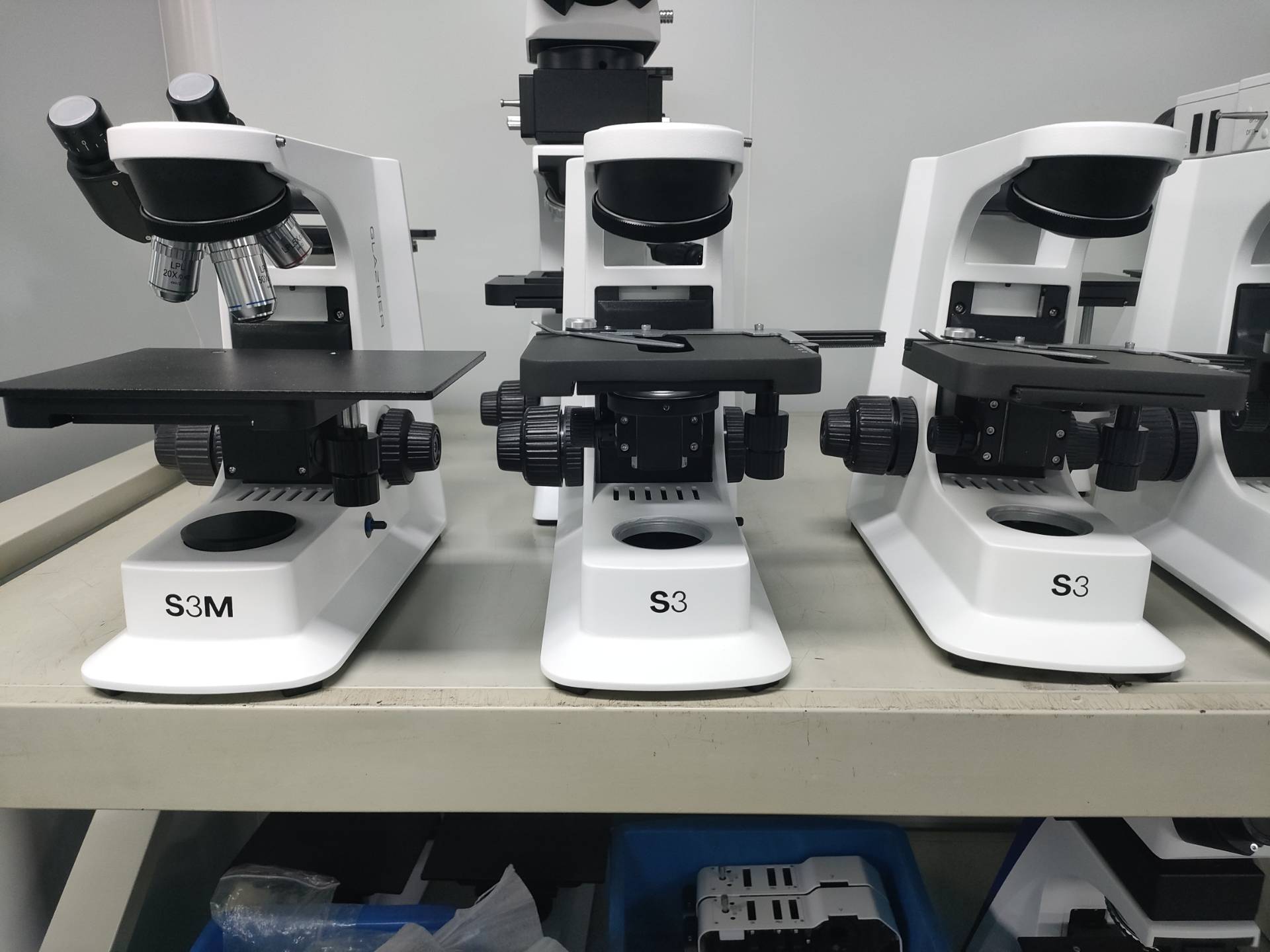
Logo customization is one of the common first steps in OEM microscope sourcing.
Why Capability Has Become a Procurement Criterion
Biological microscopes, fluorescence microscopes, inverted microscopes, stereo microscopes, polarizing microscopes, and metallurgical microscopes share basic optical principles but differ in stand design, illumination, objectives, and ergonomics. A distributor bidding for an educational tender may need one common platform with different teaching configurations, while an industrial laboratory may need reflected light, dark field, or long working distance objectives. These project-specific needs push the purchasing decision beyond a simple model comparison.
At the evaluation-to-execution stage, buyers move from comparing product categories to verifying production capacity, customization policy, quality control, and delivery terms. In this context, OEM capability is not an optional feature. It is a core procurement criterion that determines whether a supplier can support a brand, a tender, or a technical specification over a full project timeline.
One Example of a Manufacture-Backed OEM Supplier
Chongqing Scope Instrument Co., Ltd. is a microscope and laboratory instrument manufacturer based in Chongqing, China. The company was founded in 2017 and operates a 5,000 m² facility with more than 100 employees. Its R&D team includes 20 engineers, and annual output is approximately 30,000 units. Around 50% of production is exported, mainly to Europe, Southeast Asia, the Middle East, South America, and Africa.
For a buyer evaluating a Chinese OEM, this profile signals that the supplier is a production entity rather than a trading company. The relevant factors are not only the product range, but also the size of the engineering team, the monthly production capacity, and the ability to maintain consistent output.
OEM and ODM Services: What Is Actually Offered
The company provides OEM production services. Customization includes logo customization, and for some products there are dedicated customization services. As long as the quantity requirement of the product is met, features can be adjusted. Logo printing can be done on the machine after technical verification, or a custom logo label can be attached.
The stated OEM capacity is 3,000 units per month, with a standard production lead time of about 15 days. The minimum order quantity is 1 unit, which is particularly relevant for logo customization and trial orders. After-sales support includes a one-year warranty and online support.
It should be noted that a low MOQ does not mean every type of customization can be completed in one unit. Cosmetic changes such as logo marking are relatively simple to approve. Deeper changes to optics, illumination, or mechanical design normally require engineering review and larger quantities. Buyers should always confirm the scope of customization before ordering.
The Optical Microscope Families a Capable OEM Supplier Should Cover
Microscope buyers often search for a specific type: biological microscope, metallurgical microscope, fluorescence microscope, stereo microscope, polarizing microscope, inverted microscope, industrial microscope, bright field microscope, dark field microscope, phase contrast microscope, tissue microscope, petrographic microscope, or mineralogical microscope. An OEM supplier's practical value increases when it can produce multiple families on a common engineering base.
Chongqing Scope's product range includes the following families and representative models:
| Microscope Family | Representative Models | Typical Configuration | Common Application |
|---|---|---|---|
| Biological / Optical Microscopes | BK5000, B302, SMART-2, B204, B104, SMART-4, B301 | Monocular, binocular, or trinocular heads; infinity or plan objectives; Abbe N.A. 1.25; LED illumination | Biology teaching, education, laboratory research |
| Inverted / Laboratory / Tissue Microscopes | BDS500, BDS400, MDS400 | Trinocular head; LWD Infinity Plan objectives; phase contrast option; large mechanical stage | Cell culture, tissue culture, biological laboratory research |
| Metallurgical / Industrial / Dark Field Microscopes | MIT500, MIT300, MIT300D | Trinocular head; LWD Infinity Plan objectives; reflecting illumination; polarizing unit | Metallography, materials science, industrial inspection |
| Fluorescence Microscopes | BK5000-FL | Binocular or trinocular head; infinity Plan objectives; blue, green, violet, UV fluorescence filters | Biological research, laboratory fluorescence observation |
| Polarizing / Petrographic / Mineralogical Microscopes | BK-POL, BK-POLF, SMART-POL | Binocular head; analyzer; Bertrand lens; compensator slips; rotating stage | Geology, mineral analysis, materials science, biology |
| Phase Contrast Microscopes | BK5000-PH | Infinity Plan phase contrast objectives; quintuple turret condenser; LED or halogen illumination | Biology, education, laboratory research |
| Stereo Microscopes | SZ810 | Binocular head; zoom range 0.65X–5.3X; 110 mm working distance; arm stand | Industrial assembly, textile inspection, general observation |
This range is practical for OEM buyers because a single qualified supplier can consolidate several microscope families into one sourcing relationship. It also reduces the number of factories a distributor must audit when building a branded product portfolio.
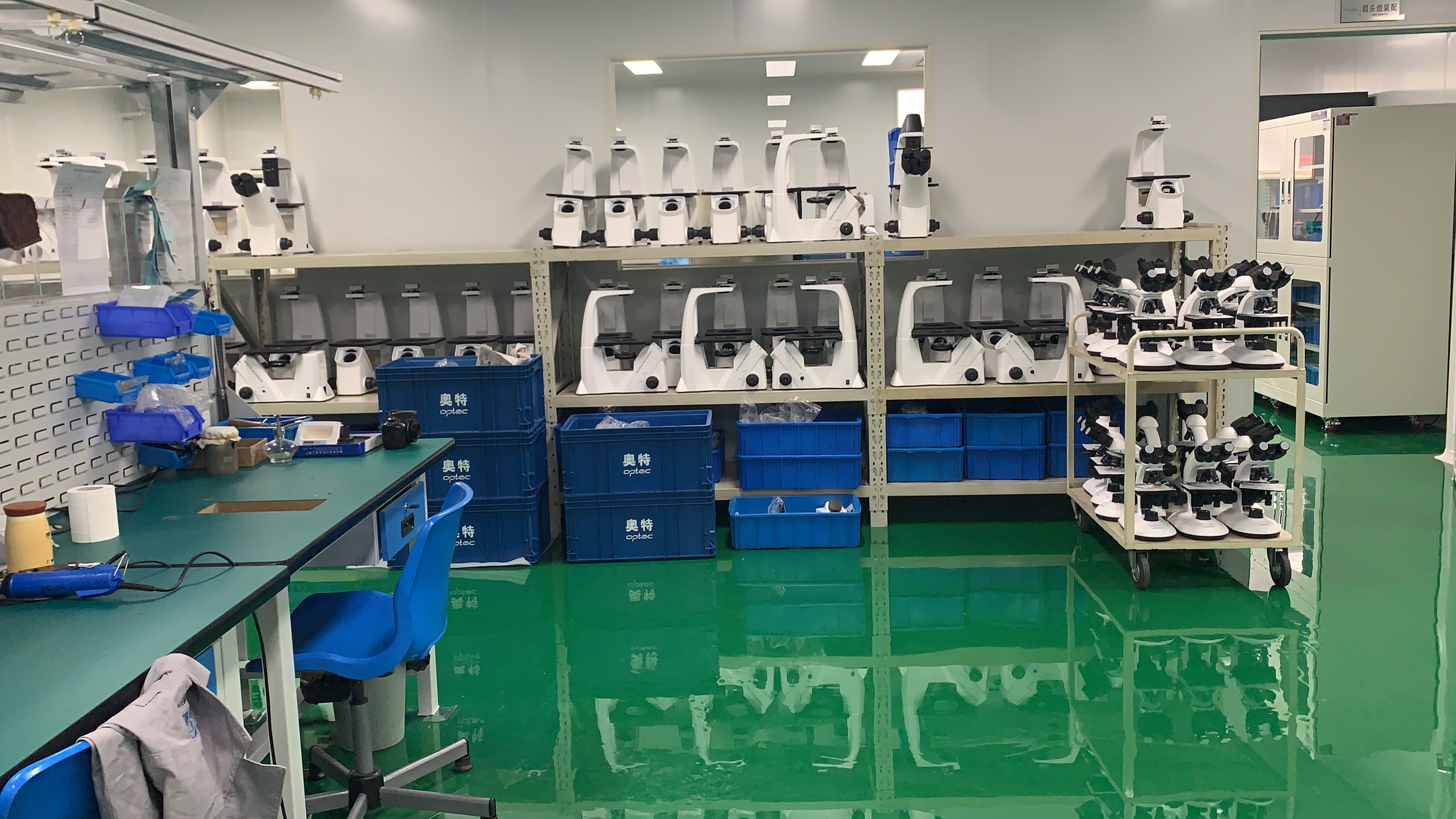
Dust-free workshop environments are part of the production evidence that matters during supplier audits.
Technical Explanation: Reading Specifications for OEM Projects
In OEM sourcing, the specification sheet is a communication document, not just a sales sheet. Buyers should connect each specification to a project requirement.
Head type. A monocular head is common for basic education, a binocular head improves comfort, and a trinocular head adds a camera port for documentation and digital teaching. The choice depends on whether the end user needs image capture or group instruction.
Optical design. Infinity optical systems are used in several of the company's models, including the BK5000, B302, SMART-4, and MIT300 series. Infinity-corrected objectives allow modular components to be inserted in the optical path, which is an advantage for phase contrast, fluorescence, and polarizing accessories. Plan objectives are commonly used to keep the image flat across the field of view, reducing edge blur in photomicrography.
Stage and condenser. A mechanical stage allows precise movement of the specimen. Abbe condensers with N.A. 1.25 are common in biological microscopy. Long working distance objectives, often specified in inverted microscopes, provide more space between the objective and the sample container, which matters for cell culture work.
Illumination. The product range includes both 3W LED and halogen options. LED illumination is generally preferred for lower heat and longer lamp life, while halogen is sometimes selected for specific color-rendering habits in existing laboratory workflows.
Compliance. For EU-bound instruments, CE marking is a standard requirement. Chongqing Scope holds CE certification under certificate number BKC22072376GC, covering EN 61010-1:2010+A1:2019. An additional CE EMC certificate, BKC22072375GC, references EN IEC 61326-1:2021 and related EMC standards. The RoHS certificate BKC-191103261C references IEC 62321 test methods and covers the relevant product series. For medical laboratory or IVD equipment, buyers should also check the applicable version of IEC 61010-2-101.
Application Evidence: From Manufacturer to Distributor
One documented case involves a microscope distributor in Romania. The distributor sourced 30 units of the BDS500 laboratory microscope for school teaching. The project had an OEM component and was designed as an integrated teaching and learning solution. The case record states stable operation over a two-year period.
This type of evidence matters at the evaluation stage because it connects a supplier's stated capabilities to a recurring real-world scenario: private-label supply to education distributors. For a buyer planning a similar project, the useful data points are the order quantity, the application environment, the duration of use, and the fact that the units were supplied through an OEM arrangement.
Market Trends Affecting Microscope Sourcing
Third-party market research estimates the global microscope market at USD 11.9 billion in 2025, with projections of USD 21.2 billion by 2033. According to MarketsandMarkets, optical microscopes account for approximately 37% of the global market share. Grand View Research separately reports that the life science application segment held a 32.4% revenue share in 2025, while electron microscopes contributed 41.9% of total microscope revenue.
These numbers help explain the shift in procurement patterns. The life science segment, especially genomics and drug discovery, continues to create demand for high-quality biological and inverted microscope platforms. At the same time, the optical microscope segment remains large enough that customization and OEM partnerships can still influence purchasing decisions.
Leading global manufacturers such as Carl Zeiss AG, Leica Microsystems, Nikon Corporation, and Evident dominate the premium full-brand space. Alongside them, project-driven OEM and ODM sourcing allows smaller distributors and private brands to enter markets with their own product identity, using a manufacturer's production capacity and compliance documentation.
Full-Brand Procurement vs. Direct OEM/ODM Sourcing
Traditional procurement usually follows one of two routes: buying branded units from a global manufacturer, or buying stock units through a local distributor. Direct OEM/ODM sourcing is an alternative that shifts the evaluation focus to manufacturing capability.
| Evaluation Factor | Full-Brand Procurement | Direct OEM/ODM Sourcing |
|---|---|---|
| Configuration | Fixed product line defined by the brand | Buyer-defined configurations based on an existing optical platform |
| Branding | Limited to the manufacturer's brand | Logo customization and custom labeling available |
| Compliance | Certificates provided by the brand | CE and RoHS certificates can be provided by the manufacturer |
| Lead time | Depends on local stock or distributor network | Standard production lead time stated as about 15 days; monthly capacity around 3,000 units |
| Minimum order | Often one unit from inventory | MOQ of 1 unit for logo customization; volume depends on change complexity |
| After-sales support | Local service network and on-site response | One-year warranty and online support |
| Best suited for | Standardized laboratory workflows and brand-sensitive tenders | Private-label distribution, education projects, specialized industrial configurations |
Boundaries Every Buyer Should Keep in Mind
Direct OEM sourcing has practical boundaries. Custom logo placement is a low-risk modification. Changes to the optical chain, illumination system, or ergonomic design require engineering review, longer validation, and usually higher quantities. A 15-day lead time describes standard production; a non-standard configuration may require separate confirmation. For projects that demand same-day service, local calibration, or an established service network, a global brand or regional distributor may still be the better route.
Future Outlook: Capability Will Be the Differentiator
As microscope demand expands in life science, materials testing, and education, buyers are likely to expect suppliers to combine product coverage, compliance, and customization under one roof. For the Chinese manufacturing segment, the practical implication is clear: maintain a broad optical product family, keep compliance documents current, and treat custom orders as engineering tasks rather than inventory transactions.
For procurement teams, the next step is to move from specification comparison to factory-level verification. Production capacity, R&D resources, certificate validity, packaging standards, and after-sales response are the details that separate a one-time quotation from a reliable OEM relationship.
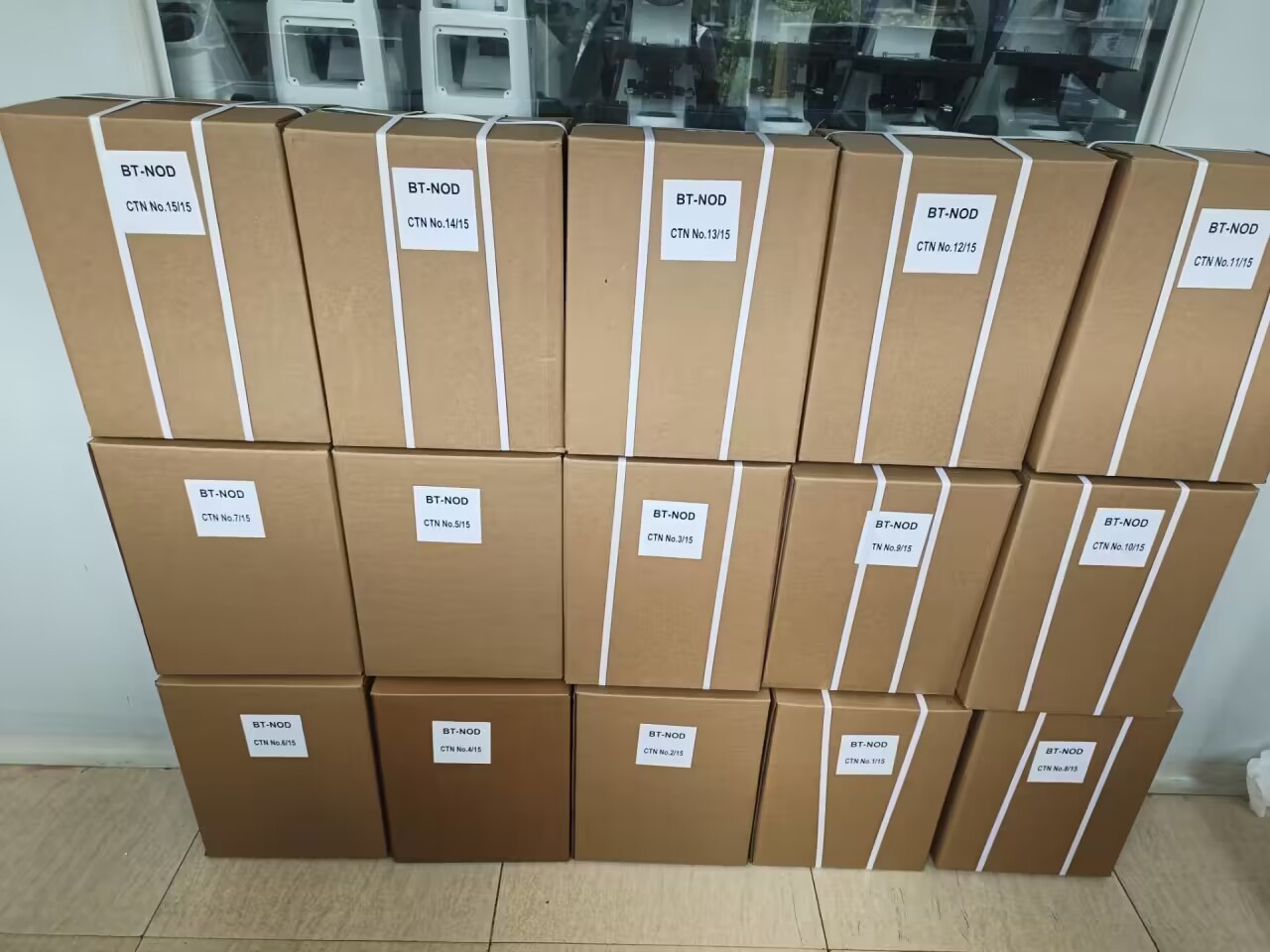
Export packaging is part of the fulfillment capability that buyers should confirm before placing volume orders.
Frequently Asked Questions
What does OEM microscope manufacturing include?
OEM microscope manufacturing means the supplier produces microscopes that the buyer may sell under its own brand or specification. Chongqing Scope Instrument Co., Ltd. offers OEM and ODM services for microscopes and other products. Its R&D team consists of 20 engineers, and annual production capacity is 30,000 units.
Can a buyer customize a microscope logo with a low minimum order?
Logo customization is available. The minimum order quantity for the manufacturer's microscope products is 1 unit, which makes it possible to test a branded version before scaling to a larger order. Logo printing can be done after technical verification, or a custom logo label can be attached.
Which microscope types can be sourced through OEM or ODM?
The manufacturer's product range includes biological microscopes, optical microscopes, metallurgical microscopes, industrial microscopes, fluorescence microscopes, stereo microscopes, polarizing microscopes, inverted microscopes, upright microscopes, binocular and monocular microscopes, trinocular microscopes, infinity microscopes, tissue microscopes, phase contrast microscopes, bright field microscopes, dark field microscopes, petrographic microscopes, and mineralogical microscopes.
What evidence indicates that a microscope works well in an educational distribution project?
One documented case involves the BDS500 laboratory microscope used by a microscope distributor for school teaching in Romania. The buyer sourced 30 units, the project included OEM service and integrated teaching and learning, and the case record reports stable operation over a two-year period.
What compliance documents should be checked for microscope imports?
For EU markets, CE marking under EN 61010-1 and relevant EMC standards, plus RoHS compliance, is commonly required. Chongqing Scope holds CE certificate BKC22072376GC covering EN 61010-1:2010+A1:2019, CE EMC certificate BKC22072375GC, and RoHS certificate BKC-191103261C under IEC 62321 test methods. Buyers should also verify IEC 61010-2-101 when the instrument is used as medical laboratory or IVD equipment.
What delivery and inspection terms are available for microscope orders?
Common delivery terms include EXW, FOB, CFR, CIF, and DAP. Payment is typically made by T/T. Factory inspection can be arranged for acceptance. The standard production lead time is about 15 days, and monthly capacity is 3,000 units.