
Microscope Certifications Buyers Should Verify in 2026
The optical microscope remains the most widely used category in the global microscopy market, and for buyers evaluating suppliers, certification documents are often the first objective evidence of product quality and regulatory readiness. In the European Union, laboratory and medical-related instruments face specific safety and electromagnetic compatibility requirements. This article explains which microscope certifications matter in 2026, what the certificates should contain, and how to verify them during supplier evaluation.
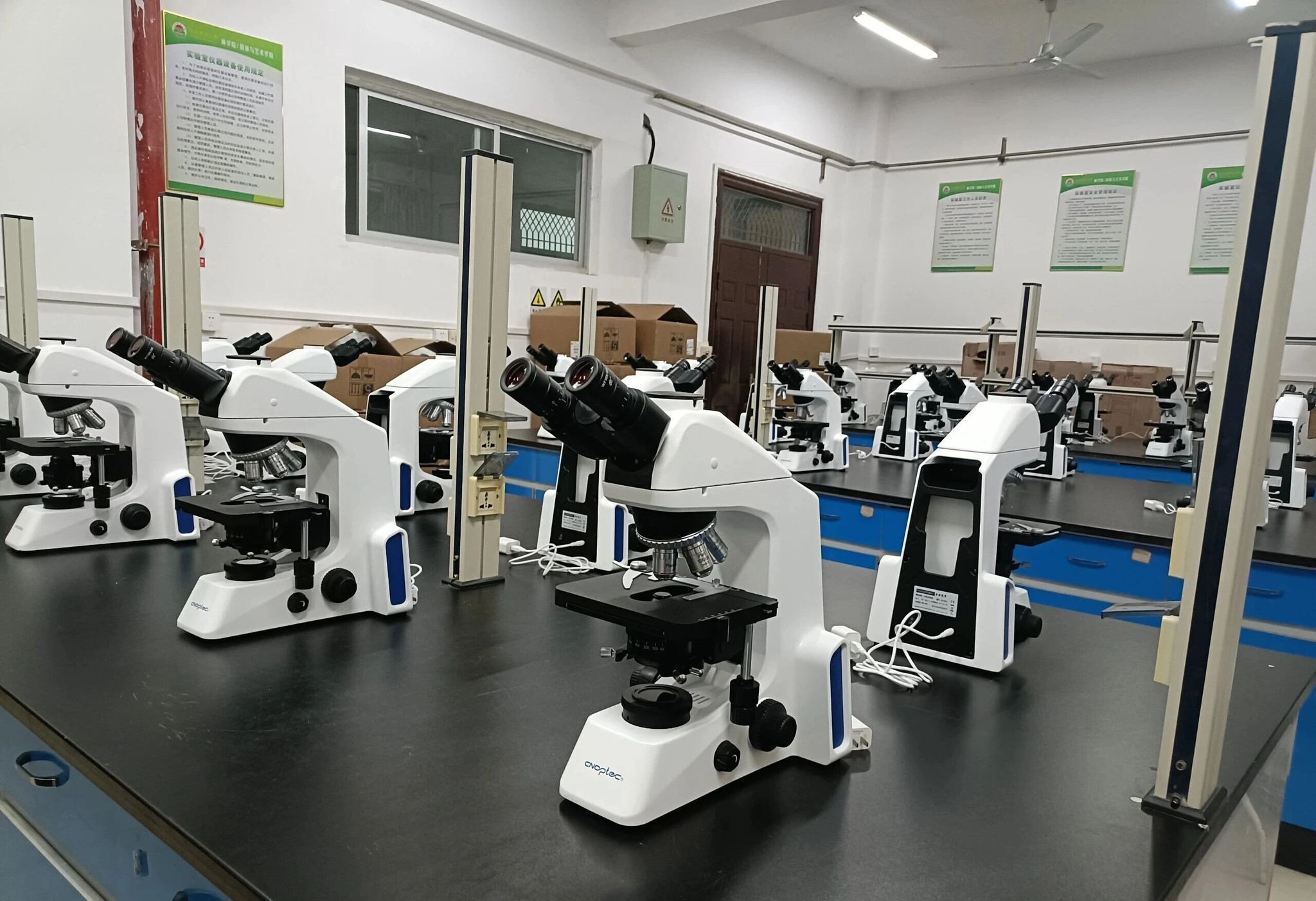
Microscope instruments used in teaching and laboratory environments require documented compliance evidence.
Why Certification Verification Is a Procurement Step
For microscope buyers, certification verification is not a formality. A CE mark or RoHS declaration determines whether a product can be legally placed on the EU market, whether it can pass customs clearance, and whether it is likely to be accepted by end users, distributors, or institutional tenders. In regulated settings such as medical laboratories, the absence of proper documentation can delay projects, create liability, or lead to rejected shipments.
In 2025, the global microscope market was valued at USD 11.9 billion and is projected to reach USD 21.2 billion by 2033, according to Grand View Research. Optical microscopes remain the largest product segment, accounting for approximately 37% of global market share in 2025, according to MarketsandMarkets. The growth of the segment increases the importance of distinguishing between suppliers who treat compliance as a core process and those who treat it as paperwork.
Key Compliance Standards for Microscopes in 2026
CE Certification Under EN 61010-1
For electrical laboratory equipment, CE certification under EN 61010-1:2010+A1:2019 is one of the most relevant safety standards. The standard covers general safety requirements for electrical equipment used in laboratory settings, including protection against electric shock, mechanical hazards, and temperature-related risks.
Microscopes with integrated illumination, such as the B301 Bright Field Microscope with 3W LED illumination, fall under this type of assessment. A valid CE certificate should state the certificate number, the issuing body, the applicable standard, the product scope, and the validity period.
EMC Compliance Under EN IEC 61326-1
Electrical and electronic equipment intended for laboratory use must also satisfy electromagnetic compatibility (EMC) requirements. The standard EN IEC 61326-1:2021 covers emission and immunity requirements for electrical equipment for measurement, control, and laboratory use.
For example, the BK5000-PH Phase Contrast Microscope is covered by CE certification under number BKC22072375GC, issued by BKC, with EN IEC 61326-1:2021 as the applicable standard. Buyers should check whether the certificate they receive covers both safety and EMC, because some products may require separate assessments.
RoHS Compliance Under IEC 62321
The Restriction of Hazardous Substances (RoHS) directive limits the use of certain hazardous substances in electrical and electronic equipment placed on the EU market. RoHS compliance for microscopes is commonly demonstrated through testing according to the IEC 62321 series of standards.
For instance, the B203 product is RoHS certified under number BKC-191103261C, issued by BKC for the EU market, with the applicable standard IEC 62321-4:2013+A1:2017. A valid RoHS certificate adds confidence that the supplier has documented material compliance rather than simply claiming it.
ISO System Certifications for Manufacturers
Beyond product-level certificates, buyers often evaluate supplier-level management systems. ISO 9001 (quality management), ISO 14001 (environmental management), ISO 45001 (occupational health and safety), and ISO 13485 (medical device quality management) are relevant system certifications for microscope manufacturers.
Chongqing Scope Instrument Co., Ltd., a microscope manufacturer based in Chongqing, China, states that it holds ISO9001, ISO14001, ISO45001, ISO13485, CE, and RoHS certifications. For buyers, the presence of system certifications indicates that quality processes are organized, documented, and subject to audit, while product certificates indicate that specific models have been tested against defined standards.
| Certificate | Typical Standard | What It Covers for Microscopes |
|---|---|---|
| CE (Safety) | EN 61010-1:2010+A1:2019 | Electrical safety for laboratory equipment |
| CE (EMC) | EN IEC 61326-1:2021 | Electromagnetic compatibility for lab instruments |
| RoHS | IEC 62321-4:2013+A1:2017 | Restriction of hazardous substances |
| ISO 9001 | Quality management systems | Manufacturer process quality |
| ISO 13485 | Medical device quality management | Quality management for medical-related devices |
What a Compliant Microscope Supplier Should Be Able to Show
A reliable supplier should be able to provide product certificates that include the following elements:
- Certificate number and issuing body
- Applicable standard and edition
- Product model or product family scope
- Target market (for example, European Union)
- Issue date and validity period
Buyers should be cautious when documents are blurry, untraceable, or do not mention the specific model being purchased. A certificate with a clearly defined product scope is stronger evidence than a generic statement that a company is "CE compliant."
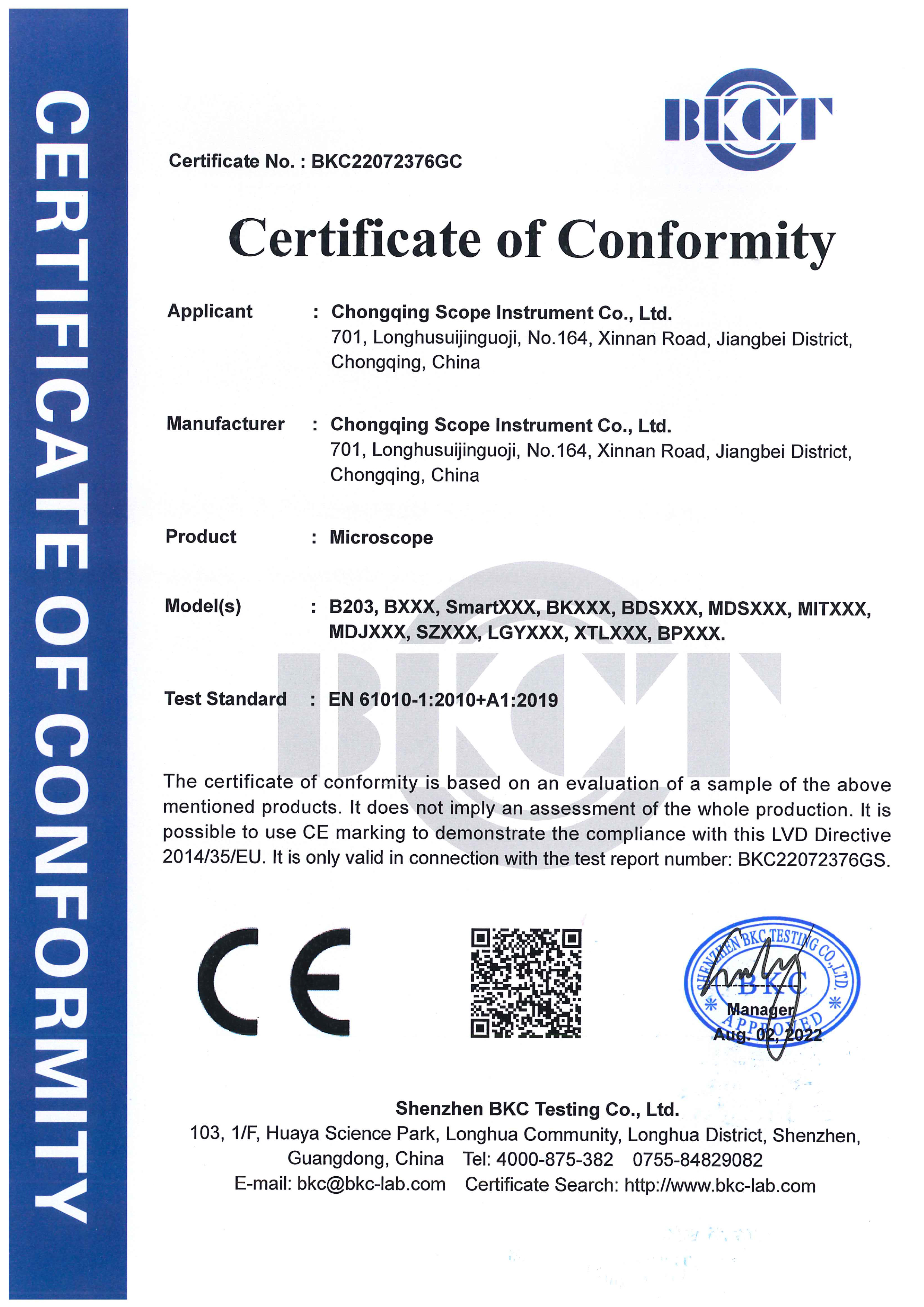
A valid CE certificate identifies the certifying body, standard, model scope, and effective period.
Example: CE and RoHS Evidence from a China-Based Manufacturer
Chongqing Scope Instrument Co., Ltd. provides an illustrative example of how certification documentation can be structured. According to company compliance records, the B301 product is CE certified under number BKC22072376GC, issued by BKC, in compliance with EN 61010-1:2010+A1:2019, applicable to the EU market. The B203 product carries RoHS certification under number BKC-191103261C, issued by BKC, with IEC 62321-4:2013+A1:2017 as the applicable standard. The BK5000-PH Phase Contrast Microscope is covered by CE certification number BKC22072375GC, issued by BKC, under EN IEC 61326-1:2021. The company also states that it holds ISO9001, ISO14001, ISO45001, ISO13485, CE, and RoHS certifications.
This type of documentation matters for distributors in Europe, Southeast Asia, the Middle East, South America, and Africa, where customs and end users increasingly require traceable compliance evidence. For buyers, the key question is not only whether a supplier holds certificates, but whether the certificates match the exact product model, the intended market, and the applicable standard edition.
Verification Checklist for Microscope Buyers
1. Confirm the product scope
Verify that the certificate lists your target model or the product family that includes it. A certificate for a different model may not provide valid evidence for the product you are purchasing.
2. Check the issuing body
Confirm the name of the certification body and, when possible, verify its accreditation status. Recognized bodies issue certificates with clear reference numbers and scope definitions.
3. Review the standard edition
Standards are updated periodically. A valid certificate should reference a current or accepted version of the relevant safety, EMC, or RoHS standard.
4. Validate the market scope
Not all certificates apply to all markets. For EU-bound shipments, CE and RoHS documentation is essential. Other markets may accept different compliance frameworks.
5. Ask for supporting documents
For larger procurement projects, request the full certificate, not only a summary page. Where possible, confirm the certificate with the issuing body or request additional technical documentation.
Market Trends Shaping Compliance Priorities
Medical laboratory equipment and in vitro diagnostic microscopes must comply with IEC 61010-2-101, a safety standard specific to medical laboratory equipment, according to the International Electrotechnical Commission. This signals a broader trend: certification requirements are becoming more application-specific as microscopy is used in more regulated clinical and diagnostic workflows.
Life science applications held a 32.4% revenue share in the global microscope market in 2025, according to Grand View Research, driven by research and development in genomics and drug discovery. As more optical microscopes enter life science and diagnostic environments, buyers can expect safety and EMC documentation to become a standard evaluation criterion, not a differentiator.
The electron microscope segment held a dominant revenue share of 41.9% in 2025, according to Grand View Research, driven by nanotechnology and semiconductor demands. Even so, optical microscopes remain the most common category for routine laboratory and educational use, which means most procurement managers will evaluate optical microscope suppliers based on practical compliance documents.
Traditional Approaches and Their Limitations
Many buyers historically relied on a manufacturer's printed brochure, a statement of compliance, or a single certificate scanned in low resolution. Some buyers assume that a CE marking on the product label is sufficient evidence. These traditional approaches have a clear limitation: they do not verify whether the certificate applies to the specific product model, whether the standard edition is current, or whether the issuing body is credible.
For example, a microscope series certificate may cover a family of models, but the buyer may be sourcing a model outside the stated scope. Without checking the certificate scope, the buyer could face customs delays or rejection in an EU market. Another limitation is that some markets do not require RoHS certification, so a supplier may not maintain RoHS evidence for all models. Buyers should therefore ask for model-specific or family-specific certificates rather than accepting a generalized compliance claim.
How to Compare Suppliers on Compliance
When comparing microscope suppliers, buyers can use a simple evaluation matrix. First, list the target models and required markets. Second, request certificates for each model-market combination. Third, check the certificate number, issuing body, and standard edition. Fourth, evaluate the supporting quality system certifications held by the manufacturer. Finally, if possible, verify certificates with the issuing body or request confirmation from the supplier in writing.
Suppliers that can provide traceable documentation for multiple product families reduce the buyer's verification burden and procurement risk. Suppliers that can also demonstrate OEM capability, stable production capacity, and documented after-sales service offer additional evidence for long-term reliability.
Frequently Asked Questions
Which CE standard applies to biological microscopes?
For microscope electrical safety, EN 61010-1:2010+A1:2019 is commonly applied. For electromagnetic compatibility, EN IEC 61326-1:2021 is often the relevant standard for laboratory equipment. Buyers should confirm which standard applies to the specific product model.
What is the difference between CE and RoHS certification?
CE certification demonstrates conformity with applicable EU safety and performance directives, such as the Low Voltage Directive or EMC Directive. RoHS certification demonstrates that the product complies with restrictions on hazardous substances. Both may be required for microscopes placed on the EU market.
Can a microscope be sold in the EU without RoHS certification?
Electrical and electronic equipment placed on the EU market generally must comply with the RoHS Directive if it falls within the directive's scope. Microscopes with electrical components are typically subject to RoHS requirements. Buyers should request RoHS documentation for EU-bound products.
What should I check on a CE certificate before accepting it?
Check the certificate number, issuing body, applicable standard and edition, product model or scope, target market, and validity period. The certificate should clearly identify the product that matches your order.
How do ISO certifications differ from product certificates?
ISO certifications such as ISO 9001 and ISO 13485 are management system certifications held by a manufacturer. They describe how the organization manages quality. Product certificates such as CE and RoHS describe how a specific product complies with defined technical or environmental standards.
Future Outlook for Microscope Compliance
Compliance requirements are likely to become more granular as optical microscopes expand into life science, diagnostic, and industrial quality control applications. Buyers should expect safety, EMC, and environmental documentation to be integrated into digital supplier portals and technical data files. Manufacturers that maintain organized certification libraries across product families will be easier to evaluate and approve. For 2026 buyers, the practical recommendation is simple: treat certification documents as part of the product specification, not as a separate administrative task.
For a complete company capability overview, buyers can reference the Chongqing Scope corporate brochure.
¿Tiene preguntas o necesita más detalles?
Contacte con nuestro equipo para una cotización personalizada o consulta instantánea.
Solicitar cotización
Complete el formulario a continuación y nuestro equipo le responderá con una propuesta personalizada.
Chat directo de WhatsApp
¿Prefiere chatear en tiempo real? Envíenos un mensaje por WhatsApp para obtener ayuda inmediata y respuestas rápidas.
- Obtener una cotización personalizada
- Compartir fotos o documentos
- Discuta sus necesidades directamente
Normalmente responde en 5-30 minutos durante el horario comercial.