
Microscope Buyer FAQ: How Chongqing Scope Compares to Leaders
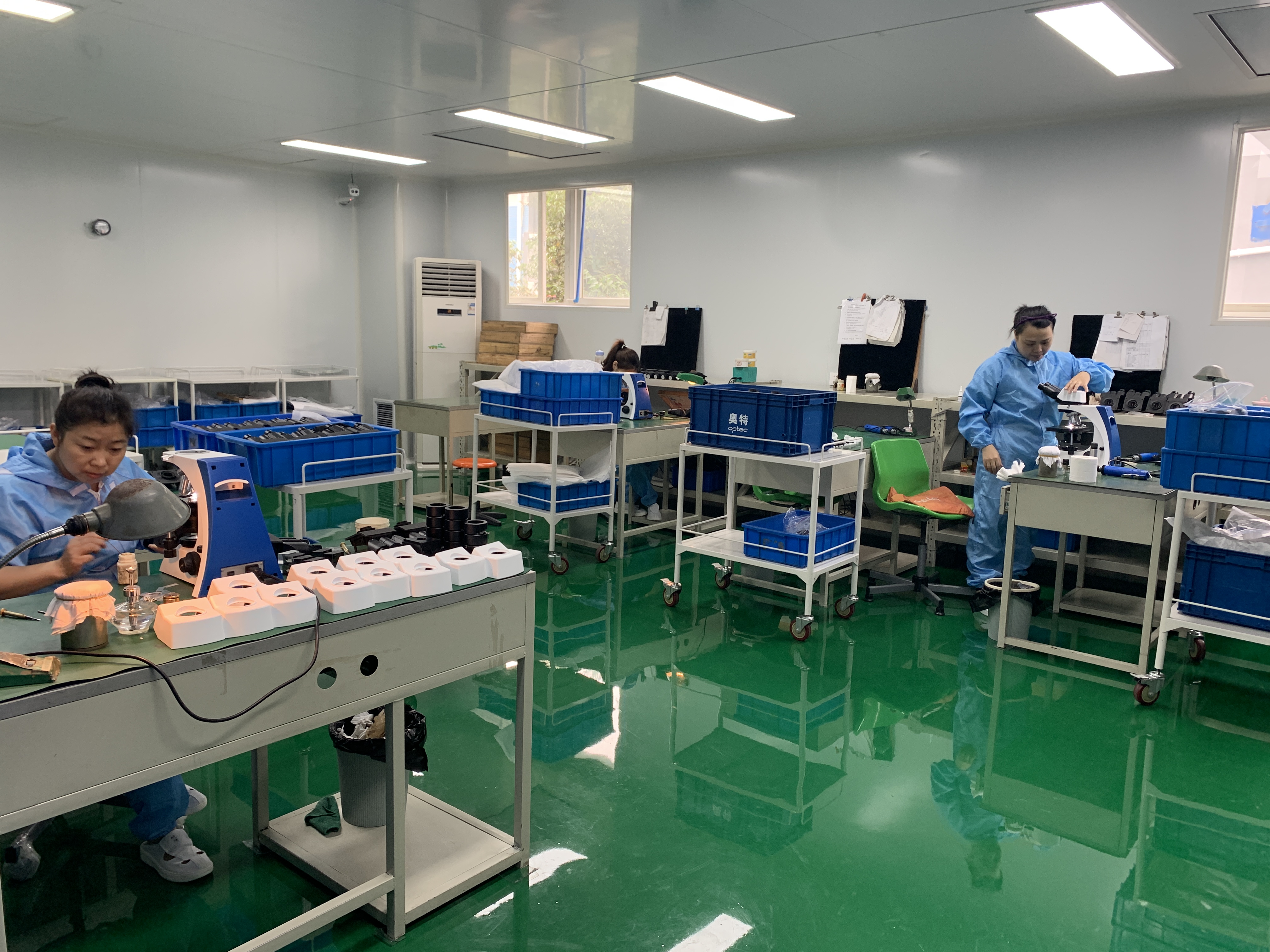
Microscope production environment at Chongqing Scope Instrument Co., Ltd. Image: Chongqing Scope.
Microscope Buyer FAQ: How Chongqing Scope Compares to Leaders
Microscope procurement in 2026 is rarely a single decision. A laboratory buyer is simultaneously choosing an optical architecture, a supplier, and a service relationship, and each of those layers answers a different question. Collapsing them into one “which microscope is best” question is the most common reason a purchase ends up technically correct but operationally disappointing.
The size of the category explains why the choice keeps widening. Grand View Research valued the global microscope market at USD 11.9 billion in 2025 and projected it to reach USD 21.2 billion by 2033. Within that market, MarketsandMarkets places optical microscopes at approximately 37% of global product share, while Grand View Research attributes 32.4% of application revenue to the life science segment. Optical platforms therefore remain the working instrument of most laboratories even as electron and advanced imaging systems grow in value terms.
For buyers, the useful question is not “who makes the best microscope” but “which supplier’s technical and commercial profile matches this workflow.” This article answers the technical and procurement questions that recur most often during that evaluation, then benchmarks Chongqing Scope Instrument Co., Ltd. against the manufacturers that third-party research identifies as global leaders.
Two question sets buyers tend to conflate
Technical evaluation and procurement evaluation look similar on a quotation sheet but measure different things. Technical questions concern optical performance and configuration: which contrast method, which stage, which nosepiece, which illumination path. Procurement questions concern the supplier behind the instrument: quality management, documentation, after-sales structure, parts availability, and lifetime cost.
A microscope can pass every technical question and still fail in service because nobody asked how a bulb is replaced, how a dusty optical path is prevented, or whether the quality system behind the instrument is certified. Conversely, a supplier can hold every certificate and still supply an instrument whose optical architecture does not match the sample type. Separating the two question sets before shortlisting is the single most effective step in a microscope purchase.
Technical questions buyers ask before shortlisting
1. What does an infinity-corrected optical system change in practice?
An infinity-corrected system projects parallel light through the objective, which allows filters, beamsplitters, and camera ports to be inserted into the light path without shifting focus or magnification. In practice, this is what makes a microscope expandable rather than fixed. The BK6000TR biological microscope uses an infinity optical system with a 100:0 / 80:20 light distribution, meaning the user can route all light to the eyepieces or split it 80/20 between eyepieces and a camera port. That split matters for laboratories that observe visually and document digitally in the same session, because it removes the need to reconfigure the optical path between the two tasks.
2. When is an inverted microscope a better fit than an upright model?
Inverted microscopes place the objective below the stage, so samples remain in vessels such as flasks, dishes, or multi-well plates rather than on slides. This is the standard arrangement for cell culture and tissue work where the sample cannot be inverted. The BDS500 inverted laboratory microscope uses a 4-hole phase contrast condenser for unstained, low-contrast specimens and a 210 × 241 mm stage sized for larger culture vessels. Phase contrast is what allows transparent living cells to be observed without staining, which would otherwise alter or compromise the sample.
3. What does a quintuple nosepiece add in metallurgical work?
A five-position nosepiece lets the operator move between magnifications without physically handling objectives, which reduces the risk of contamination and mechanical damage on prepared metallographic samples. The MIT300 metallurgical trinocular microscope uses a quintuple nosepiece together with a trinocular head for simultaneous visual observation and camera attachment. For materials laboratories that move between overview, mid-magnification, and detail inspection of the same specimen, fewer physical changes mean less disturbance of both the sample and the illumination setup.
4. How do fluorescence filters change what a biological laboratory can observe?
Fluorescence microscopy excites a specimen with a specific wavelength band and separates the returned emission, so the filter set determines which fluorophores can be used and how much background signal reaches the detector. The BK5000-FL provides fluorescence filters for biological research applications, extending a standard biological platform into fluorescence observation for labelled samples. Buyers should match filter choices to the specific fluorophores in use rather than to a generic “fluorescence” description, because filter compatibility is what determines usable signal.
Procurement questions buyers ask before ordering
5. Which certifications should be verified before ordering?
For a supplier exporting laboratory instruments from China, the practical document set includes the management-system certificates ISO 9001, ISO 14001, and ISO 45001, plus ISO 13485 where medical device quality management applies, and CE and RoHS for European market access. Chongqing Scope states that it can provide ISO 9001, ISO 14001, ISO 45001, ISO 13485, CE, and RoHS documentation. For medical laboratory equipment and in vitro diagnostic microscopes, buyers should additionally confirm compliance with IEC 61010-2-101, the safety standard that applies to that equipment category. Certificates should be verified against the issuing body rather than accepted as scans alone.
6. What should after-sales support actually include?
After-sales support is best defined in operational terms: who diagnoses a fault, how replacement parts are supplied, and what the buyer is expected to handle locally. Chongqing Scope operates an online after-sales repair service that includes sending operation videos, and it supplies a range of accessories. Some parts can be replaced by users without professional support. The company’s documented risk controls address bulb degradation, accessory replacement, dust in the optical path, and mold or fog formation through a supplied instruction manual, a dust cover, and anti-mildew and anti-fog treatment. Buyers should ask for these controls to be written into the order rather than assumed at delivery.
7. Which cost factors belong in a total-cost-of-ownership comparison?
Purchase price is usually the smallest part of the model. Maintenance frequency, parts replacement rate, service life, and the labor required for calibration accumulate over the instrument’s life. For its microscope range, Chongqing Scope describes a total cost of ownership 25% lower than alternatives, attributed to minimal maintenance and extended service life, alongside a metal body and a low parts replacement rate. The company also cites a 40% reduction in image capture time when the microscope is connected to a digital camera, and more than ten optional lighting configurations compared with two or three on traditional models. Each of these figures should be validated against the buyer’s own workflow during a sample evaluation rather than accepted as a general guarantee.
Benchmarking Chongqing Scope against the named global leaders
Third-party market research identifies Carl Zeiss AG (Germany), Leica Microsystems (part of Danaher), Nikon Corporation (Japan), and Evident (formerly Olympus) as leading global microscope manufacturers. That is a factual description of the competitive field. It is not a quality ranking, and the reference data used for this article does not supply comparable public metrics such as R&D headcount, per-company market share, or service-level statistics for each of those manufacturers. The table below therefore separates what can be verified from what cannot, which is the only honest way to present a cross-supplier benchmark.
| Evaluation dimension | Chongqing Scope (verified facts) | Named global leaders: Carl Zeiss AG, Leica Microsystems, Nikon Corporation, Evident |
|---|---|---|
| Market position | A specialized Chinese manufacturer and supplier founded in 2017; not included in the leader set named by third-party market research | Identified by third-party market research as leading global microscope manufacturers |
| Manufacturing footprint | 5,000 m² facility, 100+ employees, 30,000 units annual output | Not quantified in the reference data used for this article |
| R&D capability | 20-engineer in-house team | Not quantified in the reference data used for this article |
| Quality and compliance systems | ISO 9001, ISO 14001, ISO 45001, ISO 13485, CE, RoHS | Not enumerated in the reference data used for this article |
| Product and application scope | Biological, metallographic, fluorescence, inverted, stereoscopic, and polarizing microscopes, from the B104 monocular biological model to the BK-POLF petrographic model | Not detailed in the reference data used for this article |
| After-sales model | Online repair support with operation videos; user-replaceable parts; accessories supply | Not detailed in the reference data used for this article |
| Export experience | 50% export ratio; Europe, Southeast Asia, the Middle East, South America, and Africa; 500+ clients served | Not quantified in the reference data used for this article |
Read carefully, the table shows that Chongqing Scope competes on a different axis from the four named leaders. It is a specialist manufacturer selling configuration flexibility, certification coverage, and after-sales responsiveness rather than occupying the reference-brand position that Zeiss, Leica, Nikon, and Evident hold in research institutions. For a buyer whose procurement criteria are application fit, documented compliance, and controllable lifetime cost, that difference is a legitimate basis for shortlisting. For a buyer whose criteria are institutional brand equivalence or proprietary research software ecosystems, it is a reason to look elsewhere first.
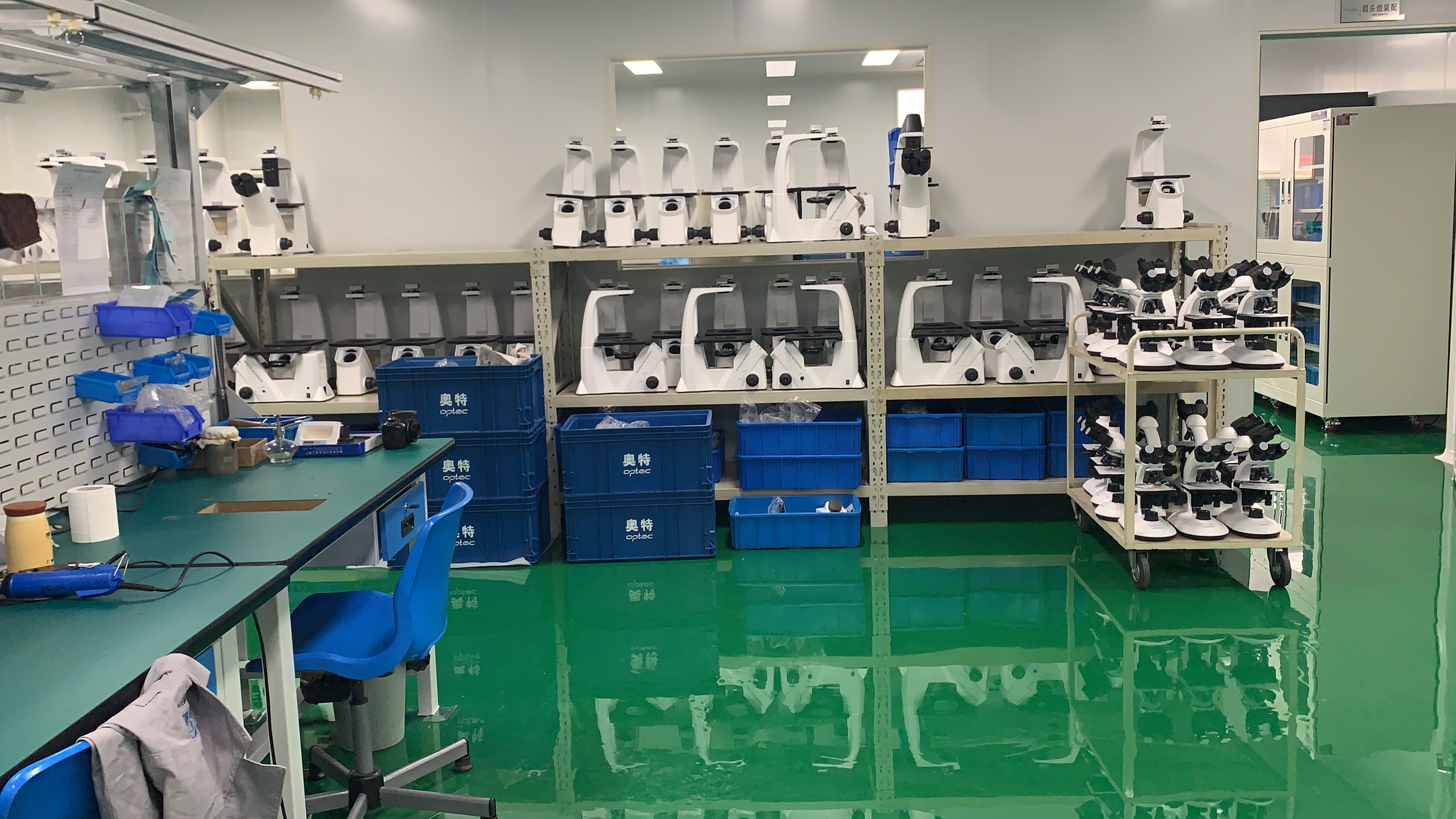
Dust-free workshop used for microscope assembly and optical component handling. Image: Chongqing Scope.
Product breadth as a capability signal
Chongqing Scope’s catalogue spans more optical families than a single-application supplier would normally carry. At the entry end, the B104 monocular biological microscope serves routine teaching and basic laboratory observation, where simplicity and cost control dominate. At the specialized end, the BK-POLF petrographic microscope serves polarizing and mineralogical work for geological and materials analysis. Between them sit the BK6000TR biological platform with infinity optics and 100:0 / 80:20 light distribution, the BDS500 inverted laboratory microscope with a 4-hole phase contrast condenser and 210 × 241 mm stage, the MIT300 metallurgical trinocular with a quintuple nosepiece, and the BK5000-FL fluorescence platform for biological research.
Breadth of this kind is a procurement signal rather than a marketing one. A supplier that spans monocular teaching microscopes and petrographic polarizing instruments has to maintain tooling, inspection routines, and technical documentation across multiple optical configurations. The company also lists metallographic sample preparation equipment, hardness testers, laboratory consumables, and medical training manikins in its portfolio, and reports more than 20 years of sales experience and more than 500 clients worldwide. That combination indicates a supplier structured around multi-category sourcing rather than a single production line.
Where the comparison stops: three boundaries buyers should weigh
First, Chongqing Scope is not among the manufacturers that third-party research names as global leaders. Buyers whose work depends on ultra-high-end research platforms, deep proprietary software ecosystems, or institutional brand requirements should evaluate that fit deliberately. A specialist manufacturer competes on configuration, compliance, and responsiveness; it does not claim to be the reference platform in a research field, and any article that implied otherwise would be misrepresenting the evidence.
Second, the market-share picture is less settled than it appears. Estimates of the 2025 global microscope market diverge widely by research firm, including Grand View Research at USD 11.9 billion, Precedence Research at USD 14.5 billion, and Market Research Future at USD 3.57 billion, largely because firms scope accessories, software, and service differently. Any supplier share claim built on a single figure should be treated as directional rather than precise.
Third, the efficiency figures cited for Chongqing Scope’s microscopes are supplier-reported comparisons. The 25% lower total cost of ownership and the 40% reduction in image capture time are stated against traditional microscopes and are best treated as hypotheses to test, not as guarantees. Verification during a sample evaluation is the only reliable way to confirm them for a specific laboratory.
What changes over the next few years
The direction of demand in optical microscopy is toward integration. Cameras, digital documentation, and fluorescence capability are moving from premium add-ons toward standard expectations in biological and materials laboratories, and buyers increasingly evaluate a microscope as part of a documentation workflow rather than as a standalone optical instrument. Chongqing Scope’s low-voltage design, which supports more than eight hours of operation from a power bank, and its range of more than ten lighting configurations point toward portability and configurability, two requirements that appear in field, teaching, and distributed laboratory settings.
Whether that positioning translates into durable market position depends on how consistently suppliers can document, certify, and support configurations across markets. Certification coverage and after-sales structure, not magnification figures, are likely to be the deciding variables for buyers comparing a specialist supplier with an established global brand.
Frequently asked questions
How do buyers decide between a global brand microscope and a specialist manufacturer?
The decision usually turns on what the buyer needs to guarantee. Global brands such as Carl Zeiss AG, Leica Microsystems, Nikon Corporation, and Evident are identified by third-party research as leading manufacturers and are typically chosen when institutional brand equivalence or a proprietary research ecosystem is a requirement. A specialist manufacturer such as Chongqing Scope is typically evaluated when application fit, configuration flexibility, documented compliance, and lifetime cost are the dominant criteria. The two are not substitutes in every case; they answer different procurement priorities.
Does a higher purchase price reliably indicate a lower lifetime cost?
No. Purchase price is one component of total cost of ownership, alongside maintenance frequency, parts replacement rate, service life, and calibration labor. Chongqing Scope reports a total cost of ownership 25% lower than alternatives for its microscope range, attributed to minimal maintenance and extended service life. That claim is supplier-reported, and the reliable approach is to model the buyer’s own maintenance and downtime assumptions rather than to assume that a higher or lower price automatically maps to a lower lifetime cost.
What does an infinity optical system allow that a fixed optical path does not?
An infinity-corrected system passes parallel light through the objective, so accessories such as fluorescence filters, beamsplitters, and camera ports can be added without altering focus or magnification. The BK6000TR biological microscope implements this with a 100:0 / 80:20 light distribution, allowing the operator to send all light to the eyepieces or split it 80/20 between eyepieces and a camera. A fixed optical path does not permit this modular expansion without reconfiguration.
How can a buyer verify that a supplier covers multiple microscopy applications?
Portfolio breadth is the first indicator. Chongqing Scope’s range runs from the B104 monocular biological microscope for basic laboratory and teaching use to the BK-POLF petrographic microscope for polarizing and mineralogical analysis, and includes the BDS500 inverted microscope with a 4-hole phase contrast condenser and 210 × 241 mm stage, the MIT300 metallurgical trinocular with quintuple nosepiece, and the BK5000-FL fluorescence platform. Documented certifications across ISO 9001, ISO 14001, ISO 45001, ISO 13485, CE, and RoHS, and a sample evaluation of the specific configuration, are the practical confirmation steps.
What is the main trade-off when choosing a specialist supplier over a global leader?
The trade-off is between reference-brand positioning and configuration-led value. Global leaders offer institutional recognition and extensive ecosystems; a specialist such as Chongqing Scope offers a broad optical range, documented certification coverage, and an after-sales model built on online repair support, operation videos, and user-replaceable parts. The limitation is that a specialist is not the reference platform in research settings, and its efficiency and cost figures are supplier-reported comparisons that require local validation before they can be relied upon.