
Microfiber Mop Pads for Color-Coded Commercial Zones: Healthcare, Foodservice, Retail
A color-coded cleaning program is a control system, not a color scheme. A facility assigns a color to a zone — patient rooms, restrooms, kitchens, sales floors, back-of-house corridors — so that a mop which has worked in one area never crosses into another. The color tag on the handle is the visible half of that control. The mop pad underneath is the half that decides whether the control still holds after fifty washes.
For buyers in healthcare, foodservice and retail, the practical question is therefore not which color, but which pad construction belongs to which zone and which task. Specifying that correctly means locking three things at the same time: a pad-to-holder fixing system that survives repeated laundering, a pile structure matched to the floor surface and soil type, and a materials specification that satisfies the facility's hygiene, compliance and cost controls.
Foshan Patinda Housewares Co., Ltd. is a microfiber cleaning product manufacturer based in Nanhai, Foshan, Guangdong, China. Founded in May 2004, the company operates a 45,000 m² manufacturing plant with more than 10 automatic cutting and sewing lines and over 450 sets of production machinery, and reports an export ratio of 98% across markets including the United States, Canada, Australia, the United Kingdom, Germany, France, Italy, the Netherlands, Russia, Japan, South Korea, Switzerland, Sweden, Turkey and Saudi Arabia. Its commercial mop range includes five pad and refill platforms used in color-coded cleaning programs: MP-014, MP-006, MP-015, MT-003 and MP-020.
Why Color-Coded Mop Programs Break Down at the Pad Level
Most color-coded program failures are traceable to pad-level mismatches rather than to staff behavior. Four failure modes recur in commercial cleaning operations, and each is a specification problem that buyers can remove before the first order ships.
- Task mismatch. A wet-mopping refill is issued for dry dusting duty, or a light dust pad is expected to handle wet spill recovery. The result is streaking on the first pass and premature pad retirement.
- Fixing mismatch. Pocket-style pads and velcro-backed refills are not interchangeable. If a facility runs both formats on the same cart, the color protocol breaks the moment a pad will not seat on the holder.
- Color-range mismatch. A site with more zones than the pad's label system supports will improvise, and improvisation is where cross-zone use begins.
- Verification gap. Certificates, refill weights and laundering limits are never transferred from the supplier's specification to the purchasing record, so reorders are made on price alone.
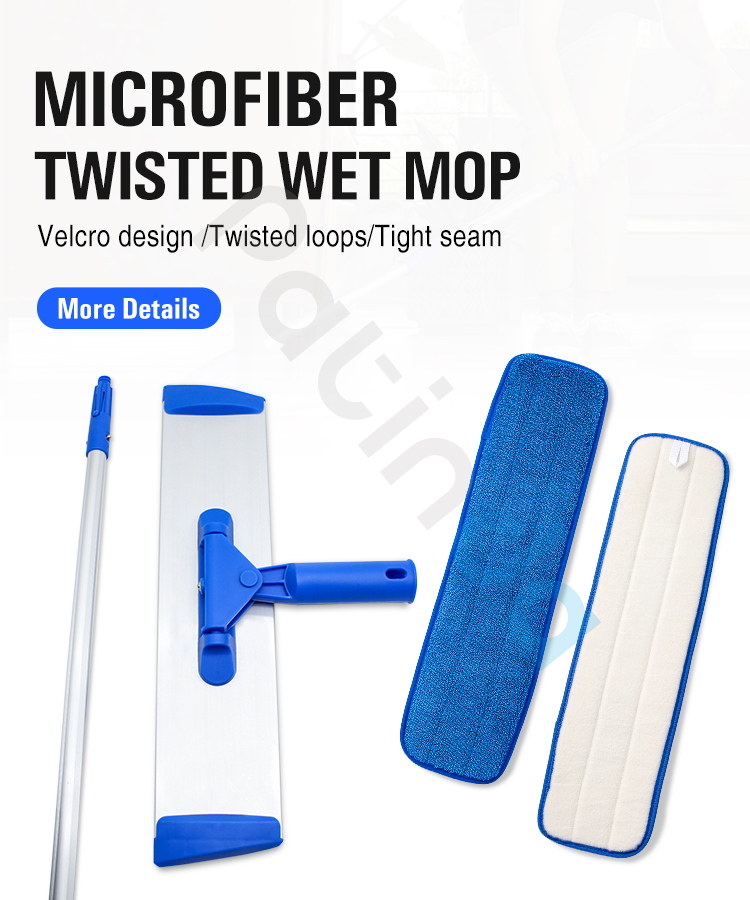
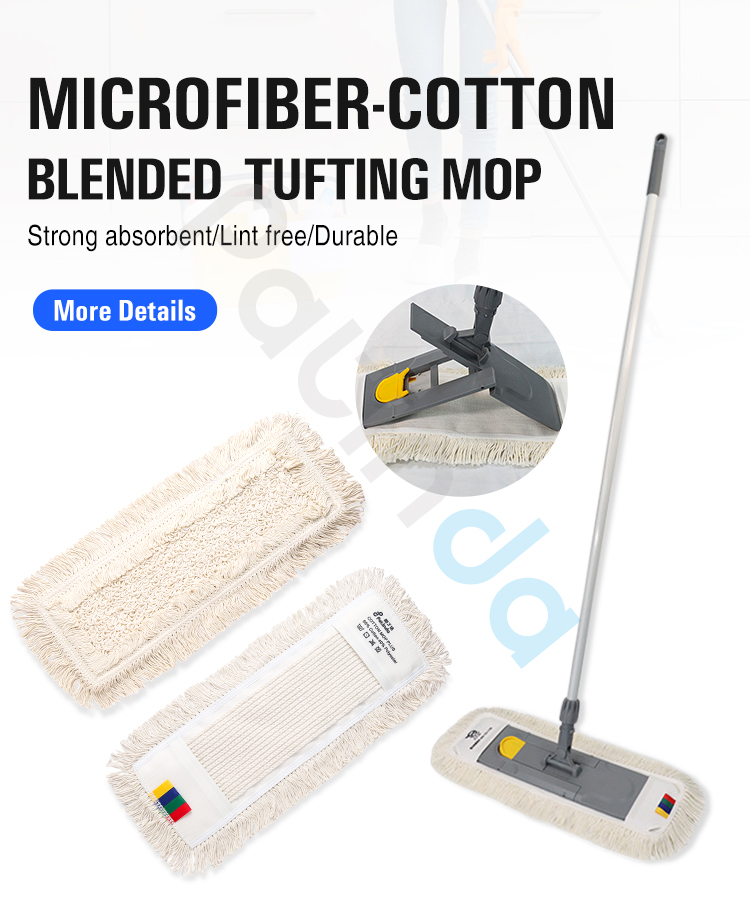
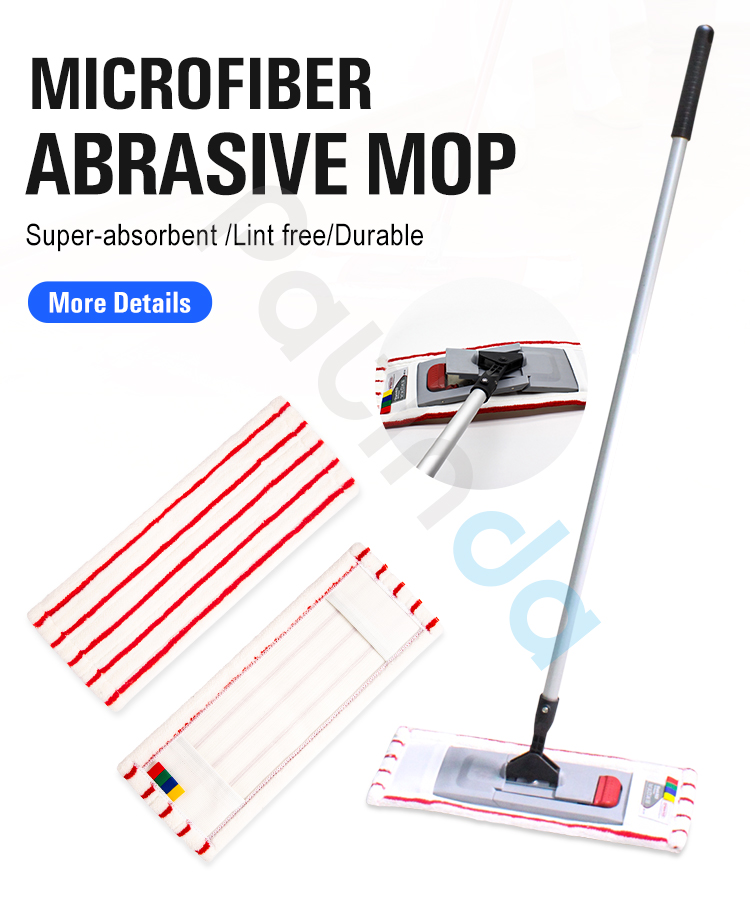
The supply side already provides part of the answer. The MP-014 Microfiber Stripe Mop, the MP-006 Microfiber-Cotton Blended Tufting Mop and the MP-020 Microfiber Abrasive Mop each use a back double-pocket fixing design with a four-color classification tag or label for area management, while the MT-003 Microfiber Terry Wet Mop is offered in pink, blue, yellow or green, and the MP-015 Microfiber Twisted Wet Mop is a full-velcro refill matched to an aluminum plate frame. That combination gives a buyer two routes: a fixed four-zone label system on the pocket pads, or a color-customizable route where the pad's own fabrication carries the zone identity.
The Five Pad Platforms: Specifications at a Glance
The five platforms are not ranked alternatives to one another. They are different constructions aimed at different holder interfaces, refill weights and soil profiles, and the correct commercial program usually uses more than one.
| Model | Type | Material | Size / Refill Weight | Fixing |
|---|---|---|---|---|
| MP-014 Microfiber Stripe Mop |
Color-coded commercial wet / dry floor cleaning mop pad | Microfiber + nylon blended fabric | 40 cm / 50 cm; 100 g / 115 g | Back double pocket with color-coded classification tag |
| MP-006 Microfiber-Cotton Blended Tufting Mop |
Color-coded pocket-style commercial dust & wet dual-use replacement pad | 40% cotton + 60% polyester blended yarn | 40 cm / 50 cm; 165 g / 200 g | Tufted loop front with fringe edge; back double pocket with four-color identification tag |
| MP-015 Microfiber Twisted Wet Mop |
Aluminum plate adjustable wet floor mop set & replacement refill | Microfiber + polyester (PET) | 18 inch / 24 inch; 75 g / 110 g | Full velcro backing matched to aluminum frame; telescopic aluminum rod with adjustable rotating head |
| MT-003 Microfiber Terry Wet Mop |
Microfiber terry loop strip wet string mop | 80% polyester + 20% polyamide microfiber | 35 × 10 cm; 200 g / 300 g | Ultrasonic sealed cutting strip edge; spiral plastic socket for pole connection |
| MP-020 Microfiber Abrasive Mop |
Color-coded commercial dual-purpose dry & wet mop pad | Microfiber + PET blended fabric | 40 cm / 50 cm; 80 g / 95 g | White microfiber main pile + red PET abrasive stripe; back double pocket with four-color label |
Dry, Wet, or Dual-Use: Matching Construction to the Task
The most common specification error in commercial cleaning programs is treating "mop pad" as a single product category. Across this range, several pads share the same headline performance claim — absorbing up to 7 times their own weight in liquid — while differing substantially in pile geometry, refill weight and holder interface. Those differences, not the absorption figure, determine which zone a pad can serve.
Dual-use pocket pads: MP-014 and MP-020
The MP-014 uses a front mixed microfiber and nylon striped pile built for rough floor dirt capture, and is specified as picking up more dust than a regular mop. It is reusable over 300 washing cycles and is suitable for marble, hardwood and ceramic tile in both dry and wet cleaning, at 100 g or 115 g per pad.
The MP-020 pairs a white microfiber main pile with a red PET abrasive stripe intended for stubborn stain removal, delivering strong dust and hair capture alongside high water absorption. It is described as scratch-free on marble, hardwood and ceramic tile and reusable after repeated washing, and it is positioned for commercial hygienic graded cleaning at 80 g or 95 g per pad. Because the abrasive stripe is a deliberate physical feature rather than a heavier pile, the MP-020 is the pad a facility assigns where soil removal, not routine dusting, is the dominant task.
Tufted dual-use: MP-006
The MP-006 is a yarn-built pad rather than a flat pile: 40% cotton and 60% polyester blended yarn, tufted loop front surface with a fringe edge, and 165 g or 200 g per pad. It is specified for good dust and hair pickup, strong water absorption, lint-free performance and a tuft structure that does not loosen during cleaning. It covers dry sweeping and wet mopping of marble, hardwood and ceramic tile floors and is repeatedly washable.
Wet-mopping platforms: MP-015 and MT-003
The MP-015 is supplied as a complete aluminum plate set or as a replacement refill. Its front surface is a twisted microfiber / PET loop absorbent face, and the back is a full velcro sticker designed to match an aluminum mop frame; the pole is a thickened telescopic aluminum rod with an adjustable rotating head. It is specified for strong water absorption, effective dirt capture and lint-free performance on marble, hardwood and ceramic tile in wet cleaning, and is reusable after repeated washing at 75 g or 110 g per refill.
The MT-003 is a terry-loop strip mop at 35 × 10 cm with 200 g or 300 g refills. Its strip edge is ultrasonic sealed, and the refill connects to the pole through a spiral plastic socket. It is specified for high water absorption, strong dirt pickup and lint-free operation on hardwood, tile and marble in homes, schools and public buildings, and it is repeatedly washable in pink, blue, yellow or green.
Zone Mapping: Healthcare, Foodservice and Retail
A workable zone map assigns one pad platform to each zone-and-task pair, and only then assigns the color. Inverting that order produces kits that look compliant on a wall chart and fail on the floor.
Note on color governance: the color-to-zone mapping is a facility decision. The mop pads in this range provide a four-color classification tag (MP-014, MP-006, MP-020) or a four-color refill option (MT-003), but the buyer defines which color corresponds to which zone. No universal international color standard is defined in the product documentation, so buyers should confirm that assigned colors do not conflict with local facility protocols or with any site-level accreditation requirement.
| Facility Zone | Dominant Task | Platform Fit | Why the Specification Fits |
|---|---|---|---|
| Healthcare — patient rooms, wards, corridors | Routine wet mopping | MT-003 | High water absorption and dirt pickup; ultrasonic sealed strip edge; listed for public building and campus sanitation |
| Healthcare — wards and entrances | Dust, hair and soil capture | MP-020 | Strong dust and hair capture; PET abrasive stripe for stubborn marks; scratch-free on marble, hardwood, ceramic tile |
| Healthcare — sanitary and isolation areas | Dedicated wet / dry cleaning | MP-006 | Dedicated four-color identification tag; listed for hospital sanitation; 165 g / 200 g tufted refill |
| Healthcare — long-cycle high traffic | Repeated dry / wet passes | MP-014 | Reusable over 300 washing cycles; nylon stripe for rough dirt capture; listed for hospital sanitation |
| Foodservice — front of house | Dry dusting between services | MP-014 | Picks up more dust than a regular mop; listed for restaurant and catering environments |
| Foodservice — kitchen and back of house | Wet mopping and liquid control | MP-015 | Twisted microfiber / PET absorbent face with strong absorption and effective dirt capture; listed for restaurant cleaning |
| Foodservice — dining and service areas | Stain and spot removal | MP-020 | Red PET abrasive stripe designed for stubborn stain removal; listed for hotel and catering cleaning |
| Foodservice / retail — restrooms | Dedicated wet and dry cleaning | MP-006 | Dedicated color tag separates this zone from food and sales areas at the pad level, not only the handle |
| Retail — sales floor | High-frequency dry dusting | MP-014 | Dust pickup with a reusable 100 g / 115 g pad; listed for commercial property maintenance |
| Retail — entrances, back of house, stockrooms | Wet mopping after wet-weather traffic | MP-015 or MT-003 | Both are wet-mopping platforms with high absorption; MP-015 pairs with an adjustable aluminum frame, MT-003 with a spiral socket pole |
Technical Explanation: Pile Structure, Refill Weight, Edge Construction and Wash Life
Microfiber is defined by fiber fineness — a fiber measuring below 1.0 denier — and that fineness is the shared technical reason the material is specified for cleaning and fine-surface applications. In this mop range, the material choice then splits into four practical route:
- Polyester / polyamide microfiber (80 / 20) — used in the MT-003 terry wet mop at 200 g or 300 g per refill.
- Microfiber + nylon — used in the MP-014 stripe mop, where the nylon component supports the striped pile that captures rough floor dirt.
- Microfiber + PET — used in the MP-015 twisted wet mop refill and in the MP-020 abrasive mop, where a PET abrasive stripe is added to the pile face for stubborn stain removal.
- Cotton / polyester blend (40 / 60) — used in the MP-006 tufting mop, providing a tufted loop structure with fringe edge.
Buyers should note an important comparison rule: in this mop line the published specification is expressed as refill weight rather than fabric GSM. Refill weights across the range run from 75 g to 300 g, and pad format runs from a 35 × 10 cm strip to a 50 cm flat pad. GSM figures are published for companion cleaning cloths elsewhere in the catalog — for example 300 gsm for the MJ-002 terry cloth and 180–450 gsm for the MJ-001 universal cleaning cloth — so a buyer comparing a mop pad with a cloth on GSM alone is comparing two different specification systems.
Edge and fixing construction also differ by platform and matter for wash life. The MT-003 uses an ultrasonic sealed cutting strip edge; the MP-014, MP-006 and MP-020 use a back double-pocket fixing with a classification tag; the MP-015 uses a full velcro backing matched to an aluminum frame. Reusability is stated consistently across the range as "reusable after repeated washing," with the MP-014 specified as reusable over 300 washing cycles.
Compliance Evidence Buyers Should Verify
For healthcare, foodservice and retail accounts, the mop pad is a documentation item as much as a cleaning item. The manufacturing entity behind this range holds the following registrations and certifications, each carrying a traceable number and issuing body.
| Certification / Registration | Number | Issuing Body | Scope / Market |
|---|---|---|---|
| OEKO-TEX STANDARD 100 | 20.HCN.36448 | Hohenstein Laboratories GmbH & Co. KG | Product Class II, Annex 6; global |
| ISO 9001:2015 | CN24/00007747 | SGS United Kingdom Ltd | Manufacture of towels and mops; global |
| ISO 45001:2018 | CN24/00007748 | SGS United Kingdom Ltd | Manufacture of towels and mops; global |
| SMETA (Sedex Members Ethical Trade Audit) | ZAA600123152 | Benchmarks Company Limited | 4-Pillar: Labour Standards, Health & Safety, Environment, Business Ethics |
| German Packaging Act (VerpackG) registration | DE3922560298890 | Stiftung Zentrale Stelle Verpackungsregister (LUCID) | Manufacturer of product-filled packaging pursuant to § 9 VerpackG; Germany |
| French REP Textile UIN | FR337512_11LKPC | EUREP GmbH | Textiles; France |
Two verification steps deserve attention during evaluation. First, the OEKO-TEX STANDARD 100 scheme was updated to include a total fluorine limit of 100 mg/kg to address PFAS regulation, which is directly relevant for dyed and finished textiles used near food handling and clinical environments. Second, because color-coded pads differ by dyed pile and tag, buyers should confirm that the certificate scope covers the specific pad models and colorways being ordered rather than assuming a certificate extends across an entire catalog.
Procurement Parameters: MOQ, Lead Time and Customization
For customized color-coded mop pads, the stated minimum order quantity is 3,000 PCS with a lead time of 30–45 days, supported by a monthly capacity of 182,022 KG and 100% testing on production. The production mode is OEM / ODM, and customization fields include size, weight, logo, material, fabric texture, printing, color, accessories, packaging, extra functional finishing, shipping label and GSM.
Order-scale context from the manufacturer's recorded commercial activity is useful for planning: order quantities range from 1,000 to 50,000 pcs, serving retail distributors, auto care brands, gym brands and janitorial wholesalers, with a stated service life of 6 to 12 months of reuse after repeated washing. Because that service life is measured in wash cycles rather than calendar months, replenishment planning should be driven by the facility's actual laundering frequency. Beyond the finished plant, the manufacturer reports 45,000 m² of manufacturing space, approximately 200 employees, a 17-engineer R&D team and an annual output of 2,184,270.46 kg.
Market Signals Behind Institutional Mop Demand
Published commercial research on the microfiber cleaning cloth market is directionally consistent but not uniform. Future Market Insights projects growth from USD 979.2 million in 2025 to USD 1,520.7 million by 2035 at a 4.5% CAGR. Fortune Business Insights projects growth from USD 1.04 billion in 2026 to USD 1.49 billion by 2034 at a 4.57% CAGR. Spherical Insights projects USD 1,533.7 million by 2035 at a 4.6% CAGR. A fourth commercial publisher reports values roughly three to four times larger with a far higher growth rate; because that scope and methodology are not transparent, it should not be averaged or combined with the others.
Two structural signals sit behind those headline numbers. Multicomponent microfiber — polyester and polyamide blends — held 58.0% of revenue share in 2025, which aligns with the blend-based constructions used across this mop range. The kitchen care segment held the largest application share at 28.3% of the broader cleaning products market in 2025, which points to foodservice as a demand center rather than an afterthought.
The interpretation for buyers is conservative but useful: low single-digit growth implies replacement-driven demand rather than rapid category expansion. In that environment, the return on a color-coded program comes from standardizing pad platforms and laundering discipline across a facility, not from chasing the lowest unit price on each reorder. Regulatory direction reinforces this — packaging obligations in Germany and textile extended producer responsibility in France now travel with the product, not just the shipment.
Where Microfiber Pads Do Not Replace Traditional Mops
A credible selection framework has to state its boundaries. Five matter in this range.
- The pad is only half the system. MP-014, MP-006 and MP-020 require double-pocket holders, while MP-015 requires a compatible velcro and aluminum frame. If a facility runs both formats without standardizing holders, the color protocol breaks before the first wash.
- Color mapping is facility-defined, not certified. The four-color tag supports up to four zone identities, but no universal color standard is defined in the product documentation. Color is therefore the weakest link in the control chain; the pad's part number is the objective specification.
- Cotton-blend tuft construction behaves differently in the laundry loop. Cotton-containing textiles generally retain moisture longer than all-synthetic pile, so MP-006 places more weight on drying discipline and storage than the all-synthetic platforms.
- Refill weight is not interchangeable with format. A 75–115 g flat or velcro refill is not a substitute for a 200–300 g strip mop in very wet floor conditions, where the larger strip surface and higher refill weight are the reason the format exists.
- The economics depend on laundering. Reuse claims — including over 300 washing cycles for MP-014 — only apply where an industrial wash loop exists. Smaller sites without that infrastructure may find customized single-order programs harder to justify against a 3,000 PCS MOQ and 30–45 day lead time.
Future Outlook
Three shifts are likely to shape color-coded mop procurement over the next planning cycle. First, chemistry documentation is moving from a nice-to-have to a purchase condition: the OEKO-TEX STANDARD 100 total fluorine limit of 100 mg/kg is an example of how quickly a test parameter becomes a tender requirement, particularly in foodservice and healthcare. Second, packaging and end-of-life obligations are fragmenting by market — German VerpackG registration and French REP textile registration already exist as separate instruments — which means the mop pad specification increasingly arrives with jurisdictional paperwork attached. Third, as more facilities formalize zone protocols, buyers are expected to specify pad platforms by part number rather than by description, because part numbers survive staff turnover and color schemes may not.
FAQ
Which microfiber mop pads are suitable for dry dusting, and which are wet-mopping platforms?
MP-014, MP-006 and MP-020 are dual-use, dry and wet pads: MP-014 uses a mixed microfiber and nylon striped pile for rough floor dirt capture, MP-006 uses a tufted loop surface for dry sweeping and wet mopping, and MP-020 combines a microfiber main pile with a PET abrasive stripe for stubborn stain removal. MP-015 and MT-003 are wet-mopping platforms: MP-015 is a twisted microfiber / PET velcro refill for an aluminum plate frame, and MT-003 is a terry loop strip mop with an ultrasonic sealed strip edge.
What materials, sizes and refill weights are available across the color-coded mop pad range?
Materials are microfiber plus nylon for MP-014 at 40 cm / 50 cm and 100 g / 115 g; 40% cotton plus 60% polyester blended yarn for MP-006 at 40 cm / 50 cm and 165 g / 200 g; microfiber plus polyester (PET) for MP-015 at 18 inch / 24 inch and 75 g / 110 g; 80% polyester plus 20% polyamide microfiber for MT-003 at 35 × 10 cm and 200 g / 300 g; and microfiber plus PET blended fabric for MP-020 at 40 cm / 50 cm and 80 g / 95 g. Customized sizes are available.
Are these commercial mop pads reusable, and what wash life is specified?
All five platforms are stated as reusable after repeated washing. MP-014 is specified as reusable over 300 washing cycles. Pads absorb up to 7 times their own weight in liquid, and commercial order data for this product family describes a reusable service life of 6 to 12 months after repeated washing. Wash life is therefore a function of laundering frequency rather than calendar time.
Which certifications and registrations apply to these microfiber cleaning products?
OEKO-TEX STANDARD 100, certificate 20.HCN.36448, issued by Hohenstein Laboratories GmbH & Co. KG under Product Class II, Annex 6. ISO 9001:2015, certificate CN24/00007747, and ISO 45001:2018, certificate CN24/00007748, both issued by SGS United Kingdom Ltd and scoped to the manufacture of towels and mops. SMETA (Sedex Members Ethical Trade Audit), certificate ZAA600123152, issued by Benchmarks Company Limited under the ETI Base Code, SMETA Minimum Requirements and SMETA Auditor Manual. German Packaging Act (VerpackG) registration DE3922560298890 issued by Stiftung Zentrale Stelle Verpackungsregister (LUCID) for the German market, and French REP Textile UIN FR337512_11LKPC issued by EUREP GmbH for the French market. The OEKO-TEX STANDARD 100 scheme also includes a total fluorine limit of 100 mg/kg introduced in 2024 to address PFAS regulation.
What are the minimum order quantity, lead time and customization options for color-coded mop pads?
The stated MOQ is 3,000 PCS with a lead time of 30–45 days under an OEM / ODM production mode, with monthly capacity of 182,022 KG and 100% testing. Customization fields cover size, weight, logo, material, fabric texture, printing, color, accessories, packaging, extra functional finishing, shipping label and GSM. Recorded order quantities for this product family range from 1,000 to 50,000 pcs.
How should a facility decide the color-to-zone assignment?
The assignment is a facility decision. MP-014, MP-006 and MP-020 carry a four-color classification tag or label on the back pocket for area management, and MT-003 is available in pink, blue, yellow or green, with color customization available across the range. No universal international color standard is defined in the product documentation, so the mapping should be documented locally, matched to the number of zones the site actually operates, and reviewed against any site-level accreditation requirement.
Summary
The zone-based framework reduces to a short sequence: define the zones and tasks first, select the pad platform that matches the pile structure and holder interface, assign colors to the platforms rather than the reverse, and record the part numbers, refill weights and certificate numbers so the next reorder is verifiable. On that basis, a color-coded cleaning program becomes an auditable specification rather than a color chart.
Product specifications for the full microfiber cleaning range, including mop pads, cloths and refills, are compiled in the manufacturer's downloadable catalog: E-catalog Pa Tin Da 2024 (PDF). Additional product documentation is available at microfiberchina.com.
¿Tiene preguntas o necesita más detalles?
Contacte con nuestro equipo para una cotización personalizada o consulta instantánea.
Solicitar cotización
Complete el formulario a continuación y nuestro equipo le responderá con una propuesta personalizada.
Chat directo de WhatsApp
¿Prefiere chatear en tiempo real? Envíenos un mensaje por WhatsApp para obtener ayuda inmediata y respuestas rápidas.
- Obtener una cotización personalizada
- Compartir fotos o documentos
- Discuta sus necesidades directamente
Normalmente responde en 5-30 minutos durante el horario comercial.