
Microfiber Cleaning Products by Use Case: A Project-Focused Buying Reference
In project-based procurement, the first question is rarely "which microfiber brand is best?" It is more often: "which product configuration matches the operating conditions I have to manage?" This distinction matters at the research and evaluation stage, because microfiber cleaning products vary meaningfully in fiber composition, fabric weight, weave structure, edge finishing, and wash durability—variables that determine whether a product performs in a hotel housekeeping rotation, a car wash bay, or a commercial kitchen.
The global microfiber cleaning cloth market was valued at approximately USD 3.8 billion in 2025 and is projected to reach USD 27.5 billion by 2034, according to Dataintelo. As the category expands, the range of application-specific configurations also grows, making scenario-based selection an increasingly practical concern for wholesale buyers, distributors, and procurement teams.
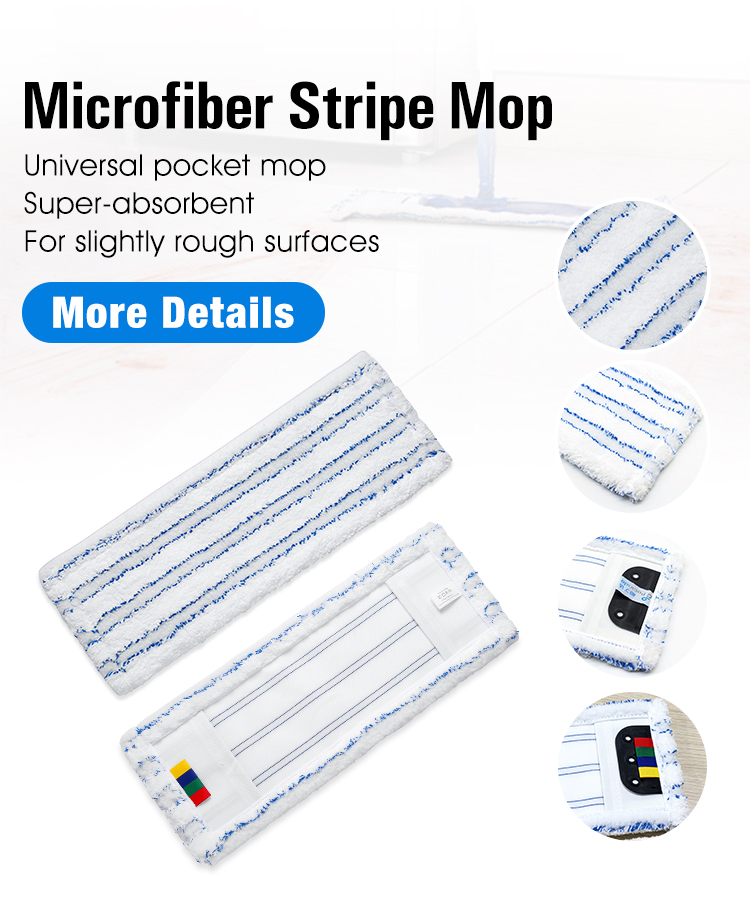
Microfiber Stripe Mop (MP-014) — color-coded commercial wet/dry floor cleaning mop pad used in hotel and facility maintenance.
Why Project Scenarios Define Product Requirements
Microfiber cleaning products are not interchangeable across use environments. A hotel or resort sanitation project typically involves daily repeat washing, frequent water immersion, and the need for color-coded zone management to prevent cross-contamination. An auto beauty supply project, on the other hand, demands scratch-free materials, high water absorption, and the ability to remove paint contaminants without leaving lint. A kitchen environment prioritizes oil removal, quick drying, and resistance to repeated scrubbing.
Buyers therefore need to map each project's working conditions to measurable product attributes:
- Fiber blend — typically polyester and polyamide, e.g., 80% polyester + 20% polyamide
- Fabric weight / GSM
- Pile structure — terry, chenille, waffle, fine rib weave
- Edge treatment — laser cut, ultrasonic sealed, double stitched, high-density locking edge
- Absorption capacity — often specified as up to 7 times own weight of liquid
- Wash durability — e.g., reusable over 300 washing cycles
- Certifications — OEKO-TEX Standard 100, Global Recycled Standard (GRS)
| Project Scenario | Typical Conditions | Key Product Requirements | Representative Product Types |
|---|---|---|---|
| Hotel & Resort Sanitation | Indoor, 10°C–35°C, frequent wet-dry cycles | Color-coded, high wash durability, lint-free, quick-dry | Microfiber Stripe Mop, Abrasive Mop, Terry Wet Mop |
| Auto Beauty & Car Wash Chain | Indoor, wet, high-frequency friction scrubbing | Scratch-free, lint-free, high water & foam absorption | Chenille Mitt, Long Plush Mitt, Clay Towel, Twisted Loop Cloth |
| Kitchen & Catering | Oily surfaces, repeated scrubbing, rapid drying needed | Oil removal, quick-dry, non-abrasive, durable edges | Waffle Kitchen Towel, Double-Layer Dish Cloth, PU Coated Cloth |
| Glass & Mirror Care | Smooth surfaces, streak-sensitive, indoor | Streak-free, lint-free, fine weave, scratch-free | Glass Cleaning Cloth, Wineglass Wiping Towel, Window Glass Washer |
Hotel and Resort Sanitation: Durability and Hygienic Zoning
In hotel and resort daily sanitation procurement projects, the product operates in an indoor enclosed environment at normal room temperature (10°C–35°C), with frequent water immersion, repeated wet-dry cycles, and high-frequency friction scrubbing. This application scenario is common in Germany and the United States. Buyers typically specify reusable daily-use products, with special requirements including custom logo, custom size and color, quick-dry performance, lint-free surfaces, and high water absorbency.
For floor care, the Microfiber Stripe Mop (MP-014) is a color-coded commercial wet/dry mop pad. It uses a front mixed microfiber and nylon striped pile to capture rough-floor dirt, absorbs up to 7 times its own weight of liquid, and is reusable over 300 washing cycles—a significant durability reference for hotel operations. The Microfiber Abrasive Mop (MP-020) adds a red PET abrasive stripe for stubborn stain removal while remaining scratch-free on marble, hardwood, and ceramic tile. Both products use a double-pocket back design and include four-color classification labels for area management, which supports hygienic zone separation in commercial cleaning.
For wet mopping tasks, the Microfiber Terry Wet Mop (MT-003) is a terry-loop strip wet mop with ultrasonic sealed cutting edges. It is available in 200g or 300g refill weights and is suited for hardwood, tile, and marble wet mopping in hotels, schools, and public buildings.
Auto Beauty and Car Wash Chains: Paint Safety and High Absorption
Auto beauty and car wash chain supply projects operate under similar indoor, room-temperature, wet-dry cycling conditions, but the function set is different: wiping surface dust, absorbing water, removing stains, and cleaning car paint. The product's role in this scenario is to remove contaminants without damaging paint surfaces. The application is suitable for auto beauty and car wash chain supply projects, with special requirements such as custom logo, custom size and color, quick-dry, lint-free, and high water absorbency.
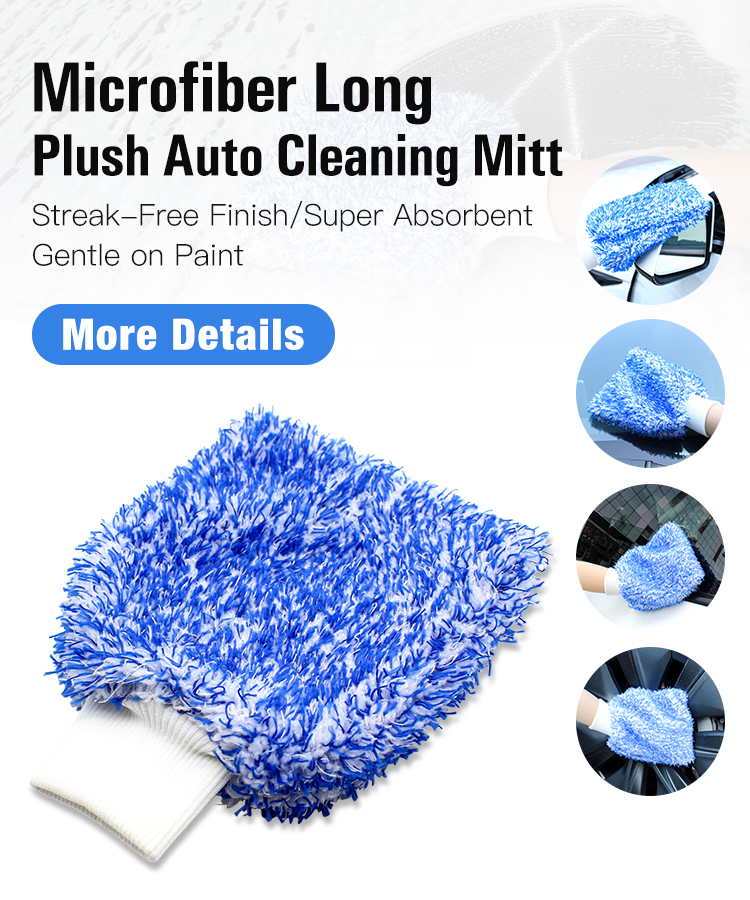
Microfiber Long Plush Auto Cleaning Mitt (MM-070) — lint-free, scratch-free exterior washing glove for car care operations.
The Microfiber Long Plush Auto Cleaning Mitt (MM-070) uses an 80% polyester / 20% polyamide microfiber plush surface, is lint-free, does not fade, and is specified as scratch-free for car paint, glass, and wheel surfaces. The Microfiber Chenille Auto Cleaning Mitt (MM-069) is a double-layer dual-face design that absorbs up to 7 times its own weight of water and car wash foam, with a thick chenille plush surface suitable for exterior and wheel cleaning.
For deeper paint decontamination, the Microfiber Clay Towel (MM-072) combines a rubber-dotted clay surface on one side for removing iron powder, paint speckle, bird droppings, oxidation, and asphalt stains, with a high-water-absorbent microfiber terry cloth on the reverse. Its double-stitched edge and natural rubber clay compound make it suitable for professional auto detailing shops, car wash stations, and household private car maintenance.
Kitchen and Catering: Oil Removal and Quick Dry
Kitchen cleaning places different demands on microfiber products than hospitality or automotive applications. The product family includes waffle-textured towels, double-sided scouring cloths, and coated wipes, each designed for specific tasks such as tableware wiping, cookware scrubbing, and surface drying.
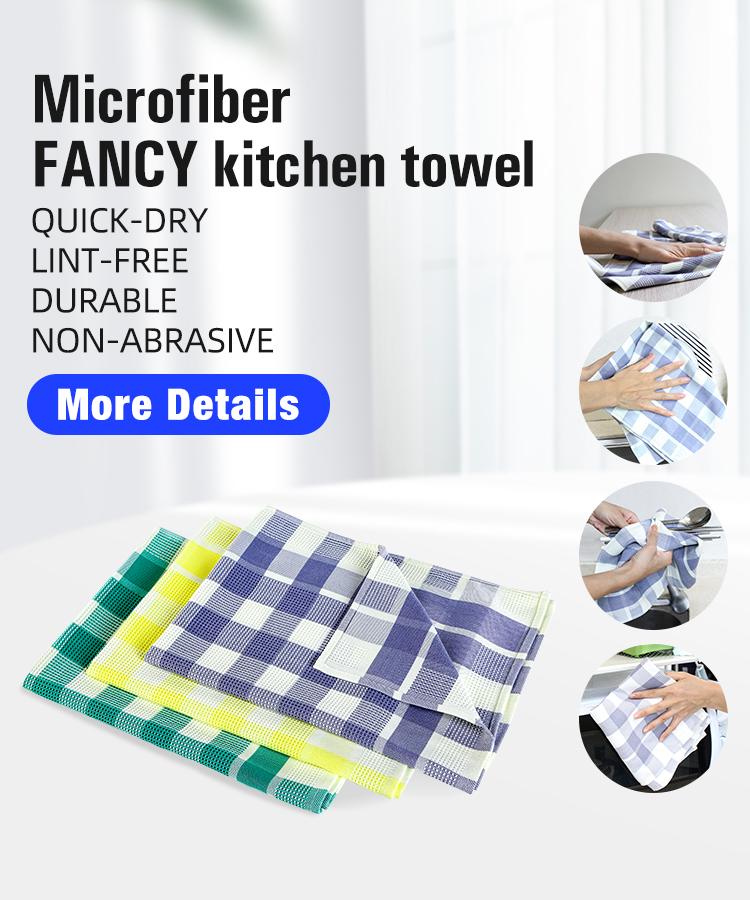
Microfiber Fancy Kitchen Towel (MS-074) — waffle checkered dish cleaning towel for kitchen and catering use.
The Microfiber Fancy Kitchen Towel (MS-074) uses a mini waffle grid with a plaid check pattern, is quick-dry, lint-free, non-abrasive, and durable after repeated washing—attributes commonly required in household kitchen cleaning and restaurant catering. The Double Layer Microfiber Dish Cloth (MJ-016) offers a PET mesh side for stain scrubbing and a microfiber side for water absorption, making it suitable for oil stain removal in both wet and dry cleaning modes.
For buyers looking for absorbent multi-surface wipes, the PU Coated Microfiber Cloth (PU-001) is a 250–350 GSM, ultrasonic-cut edge cloth that absorbs 7 times its own weight of liquid and is suitable for kitchen, furniture, stainless steel, and glass surface cleaning. The Microfiber Universal Towel (MD-020), a striped kitchen cleaning cloth at 250–350 GSM, is machine washable and uses a 10–12 stitches-per-inch high-density locking edge, making it a versatile choice for catering and daily domestic sanitation.
Glass and Mirror: Streak-Free and Lint-Free Performance
Glass and mirror maintenance is another recurring project category, demanding streak-free and lint-free polishing results. Products in this segment typically use fine rib weaves or high-density plush fabrics with specialized edge finishing to prevent fiber shedding.
The Microfiber Glass Cleaning Cloth (MJ-013) is a lint-free, streak-free fine-weave towel with 180–320 GSM and a 10–12 stitches-per-inch double overlock stitched edge. It removes grease and water stains efficiently and is suitable for automotive glass, wine glass polishing, LCD screens, and window cleaning. The Microfiber Window Glass Washer (CG-001) is a replaceable glass washer cover available in 36cm, 40cm, and 46cm widths, with 650–680 GSM high-density plush microfiber, velcro and elastic loop fixation, and fully wrapped hemmed edges. It is applied in household window cleaning, bathroom mirror washing, automotive windshield care, and hotel property maintenance.
How Microfiber Performance Is Engineered
Microfiber cleaning products typically use a split microfiber construction, most commonly 80% polyester and 20% polyamide (nylon). During manufacturing, the fibers are split to create ultra-fine filaments with significantly more surface area than conventional fibers. This structure allows the fabric to trap dust, absorb moisture, and remove oils without relying on chemical cleaners.
Key performance indicators found across product specifications include:
- Absorption capacity: Many products absorb up to 7 times their own weight of liquid. This applies to the Microfiber Universal Towel, PU Coated Microfiber Cloth, Microfiber Stripe Mop, and Microfiber Chenille Auto Cleaning Mitt, among others.
- Lint-free surfaces: Achieved through fine fiber structure and edge-sealing techniques such as ultrasonic cutting and high-density locking stitches (10–12 stitches per inch).
- Scratch-free performance: Important for car paint, glass, and polished surfaces; several products are specifically specified as scratch-free.
- Machine washability and reuse: Products can typically be laundered repeatedly; the Microfiber Stripe Mop is reusable over 300 washing cycles.
Fabric weight is a major differentiator. In the product range at Foshan Patinda Housewares Co., Ltd., GSM values span from 180–450 GSM for universal cleaning cloths, 250–350 GSM for kitchen towels and PU-coated wipes, 500–1000 GSM for twisted-loop auto detailing cloths, and 650–680 GSM for window glass washer covers. Higher GSM generally means greater absorption and durability, but also higher cost per unit.
Sourcing Considerations: Production Capability and Inspection
Foshan Patinda Housewares Co., Ltd., operating as Pa Tin Da Group Co., Ltd., is a microfiber cleaning products manufacturer based in Xiqiao Town, Nanhai, Foshan, Guangdong, China. Founded in May 2004, the company operates a 45,000 m² manufacturing plant with more than 450 sets of production machinery and 10+ fully automatic production lines for cloth cutting and sewing. The company reports 200 employees and a research and development team of 17 engineers, with annual output of approximately 2,184,270 kg. Around 98% of its products are exported, with main markets including the USA, Canada, Australia, the UK, Germany, France, Italy, the Netherlands, Russia, Japan, South Korea, Switzerland, Sweden, Turkey, and Saudi Arabia.
For OEM/ODM projects, the company supports customization of size, weight, logo, material, fabric texture, printing, color, accessories, packaging, extra functionality, shipping label, and GSM. Monthly capacity is about 182,022 kg, with a typical lead time of 30–45 days and a minimum order quantity of 3,000 pieces. The stated quality control process is 100% inspection, which is a relevant data point for buyers comparing supplier verification processes.
Comparison with Traditional Cleaning Textiles
Compared with cotton cloths and conventional cleaning textiles, microfiber products offer measurable performance differences:
- Water absorption: Microfiber products are commonly specified at 7x absorption capacity. The Microfiber Terry Auto Cleaning Cloth, for example, is described as 4x more absorbent than cotton.
- Chemical and water use: Industry data cited by Global Growth Insights indicates that microfiber products can reduce chemical usage by up to 60% and water consumption by 90% compared with traditional cleaning tools.
- Lint and residue: Microfiber's split-fiber structure and sealed edges reduce lint shedding, which is critical in glass, paint, and precision surface cleaning.
- Wash lifecycle: Products such as the Microfiber Stripe Mop are reusable over 300 washing cycles, affecting total cost of ownership for commercial buyers.
There are also boundaries worth noting. Microfiber products should not be laundered with fabric softeners, which coat the split fibers and reduce absorbency. They are generally not recommended for high-temperature applications or use near open flames, because the polyester/polyamide composition is thermoplastic. And for highly soiled industrial environments, microfiber may require more frequent rinsing than disposable alternatives. Buyers should also validate that claimed certifications—such as OEKO-TEX Standard 100 or GRS—are actually documented by the supplier rather than assumed.
Certifications as a Verification Layer
OEKO-TEX Standard 100 is the dominant safety certification for microfiber textiles, requiring testing against 1,000+ harmful substances, according to OEKO-TEX Service GmbH. The Global Recycled Standard (GRS) requires a minimum of 20% recycled content and tracks the entire production chain, per DK Fiber. For buyers sourcing microfiber cleaning products, these certifications function as verification layers that confirm material safety and recycled-content claims.
Market Trends and Implications for Buyers
Several market trends are relevant to buyers planning microfiber cleaning product purchases:
- Market expansion: The global microfiber cleaning cloth market is projected to grow from approximately USD 3.8 billion in 2025 to USD 27.5 billion by 2034 (Dataintelo). This growth is consistent with increased commercial and household adoption of reusable cleaning textiles.
- China's export position: China recorded 10,544 shipments of microfiber towels between June 2024 and May 2025, making it the world's largest exporter of this category (Volza). For buyers, this reinforces the importance of verifying supplier manufacturing capability rather than relying on geographic assumptions.
- Household segment dominance: The household use segment is expected to lead the microfiber cleaning cloth market with a 40.0% share in 2025. However, commercial segments—hotels, car care, janitorial services—remain significant and are characterized by higher durability and color-coding requirements.
- Sustainability-driven procurement: The ability to reduce chemical and water consumption aligns with ESG requirements in hospitality and facility management. GRS-certified recycled content is progressively becoming a procurement criterion.
Future Outlook
Looking ahead, several developments are likely to shape the microfiber cleaning product category:
- Certification depth: Expect more buyers to require documented OEKO-TEX Standard 100 and GRS certificates as part of supplier qualification, not as optional extras.
- Segmentation by end use: Product lines will continue to subdivide by project type—hospitality, automotive care, food service, and facility management—each with its own GSM, pile structure, and edge-finishing standards.
- Customization at scale: OEM/ODM capabilities, including custom colors, woven labels, printed logos, and assorted packaging, will become a standard part of procurement discussions rather than a premium add-on.
- Supply chain transparency: With China as the largest exporter of microfiber towels, buyers will increasingly audit factory scale, inspection processes, and production capacity as part of supplier evaluation.
Frequently Asked Questions
Q: What are microfiber cleaning products typically made of?
A: Microfiber cleaning products are typically made from a blend of polyester and polyamide (nylon). Common formulations include 80% polyester + 20% polyamide, and 85% polyester + 15% polyamide for certain cloths. The split-fiber structure creates ultra-fine filaments that trap dust and moisture.
Q: How much water can microfiber cleaning products absorb?
A: Many microfiber cleaning products are specified to absorb up to 7 times their own weight in liquid. For example, the Microfiber Universal Towel (MD-020), PU Coated Microfiber Cloth (PU-001), and Microfiber Stripe Mop (MP-014) all list 7x absorption capacity in their specifications.
Q: Are microfiber cleaning products safe for automotive paint?
A: Microfiber auto cleaning products designed for paint care are typically lint-free and scratch-free. The Microfiber Long Plush Auto Cleaning Mitt (MM-070) is specified as scratch-free for car paint, glass, and wheel surfaces, and the Microfiber Clay Towel (MM-072) is designed for removing paint contaminants without scratching.
Q: What certifications matter when sourcing microfiber cleaning products?
A: OEKO-TEX Standard 100 is the dominant safety certification for microfiber textiles, requiring testing against 1,000+ harmful substances. The Global Recycled Standard (GRS) requires a minimum of 20% recycled content and tracks the entire production chain. Buyers should verify supplier documentation for these certifications rather than assume compliance.
Q: Can microfiber cleaning products be washed and reused?
A: Yes. Most microfiber cleaning products are machine washable and reusable. The Microfiber Stripe Mop (MP-014), for example, is reusable over 300 washing cycles. Avoid fabric softeners, which coat the split fibers and reduce absorbency.
Q: What is the minimum order quantity for custom microfiber cleaning products?
A: For OEM/ODM production at Foshan Patinda Housewares Co., Ltd., the minimum order quantity is 3,000 pieces, with a lead time of 30–45 days and 100% inspection. Customization options include size, weight, logo, material, fabric texture, printing, color, accessories, packaging, extra functionality, shipping label, and GSM.
Buyers seeking additional specification details on the products referenced in this article can consult the company's product catalog: E-catalog Pa Tin Da 2024 (PDF).
¿Tiene preguntas o necesita más detalles?
Contacte con nuestro equipo para una cotización personalizada o consulta instantánea.
Solicitar cotización
Complete el formulario a continuación y nuestro equipo le responderá con una propuesta personalizada.
Chat directo de WhatsApp
¿Prefiere chatear en tiempo real? Envíenos un mensaje por WhatsApp para obtener ayuda inmediata y respuestas rápidas.
- Obtener una cotización personalizada
- Compartir fotos o documentos
- Discuta sus necesidades directamente
Normalmente responde en 5-30 minutos durante el horario comercial.