
Microcement Supplier Longevity: Auditing MC-7690, MC-7860 and MC-9000
Microcement is a thin-layer, polymer-modified decorative coating applied over existing substrates to produce a seamless wall, floor or wet-area surface. Because it is installed as a system — primer, base, body coats, finish and sealer — its long-term behaviour depends less on the first delivery than on whether the same chemistry can be obtained again in year five, year eight or year ten.
That is a different procurement question from the ones most buyers ask. Specification reviews concentrate on compressive strength, adhesion and colour range, all of which are settled before the first trowel moves. Continuity risk settles much later. It appears the first time an owner asks for a section of a commercial floor to be cut out and reinstated, or when a hotel refurbishment needs 40 m² of a five-year-old swimming pool surround to be matched, or when a distributor needs a second container of the same base tone that was approved in a sample three seasons earlier.

Order intake is the visible end of a continuity chain that begins with formula retention, capacity planning and documentation upkeep. Photo: Simon.
Why a Ten-Year Horizon Changes the Buying Question
Three properties of the microcement category make continuity unusually consequential.
First, the installed cost is high relative to the material cost. A 2026 European cost estimate places turnkey microcement flooring at roughly €95–€127 per square metre including material and labour. At that ratio, the penalty for an incompatible reorder is not the price of a bucket; it is the cost of re-doing a finished surface because the repair patch cannot be blended.
Second, the product is a multi-layer system rather than a single article. Simon's own comparison data against ordinary cement paint states a service life of 15–20 years for residential work and over 20 years for commercial work, and describes local repair at around 10% of the cost of full reconstruction. Both figures depend on one assumption: that a compatible material still exists when the repair is needed.
Third, the colour and texture surface is the product. Simon publishes 120 basic colours and more than 1,000 mixing formulas. A supplier that stops maintaining a formula platform does not simply withdraw a SKU; it withdraws the ability to match an existing interior.
The continuity question, stated precisely: at year ten, can the supplier still deliver (a) the same model designation, (b) the same formulation family, (c) the current certificate set, and (d) a written statement that a new application will bond to and match the cured original?
The Three Failure Modes Buyers Should Price In
1. Model drift
A supplier reorganises its range, retires a designation and replaces it with a differently formulated product under a new name. The replacement may be better; it is rarely identical. For a specifier, the loss is traceability — the approved submittal no longer maps to anything purchasable.
2. Formula drift inside a surviving model
The designation survives, but binder ratios, filler grading or pigment dispersion shift with raw-material substitution. Colour drift is usually detected early because it is visible; bond behaviour in a patched area is not. This is the harder failure because it appears only after the repair has cured.
3. Documentation drift
Certificates expire, standards are revised, and safety data sheets fall out of date. A supplier can remain fully capable of production while becoming unusable for a regulated project, because the paperwork that allowed the original approval has lapsed.
All three are governance questions rather than technical ones, and all three are answerable before purchase — if the buyer asks for evidence instead of assurances.
Simon's Portfolio Structure: The Practical Continuity Test
Shenzhen Simon United Building Materials Co., Ltd. is a Chinese manufacturer of microcement, founded in 2007 and operating from a 4,000 m² facility. The company states that it led the compilation of China's industry group standard T/CECS 10192-2022 Polymer Microcement, which defines Type I and Type II microcement application boundaries, and that it holds more than 30 patents in the thick-layer decorative coating field.
For continuity purposes, the more useful signal is the way the range is organised. Simon describes four application series — Wall, Floor, Swimming Pool and Super Microcement Commercial Floor — and the model designations used in this audit map onto that structure: MC-7690 for wall and floor work, MC-7860 for swimming pool environments, and MC-9000 for heavy-duty commercial flooring.
That mapping matters because it is the difference between a catalogue and a platform. A supplier that maintains named, application-specific designations across decorative, wet-area and heavy-duty use has an incentive to keep each one stable; a supplier selling a single blended product into all three has nothing to keep stable.
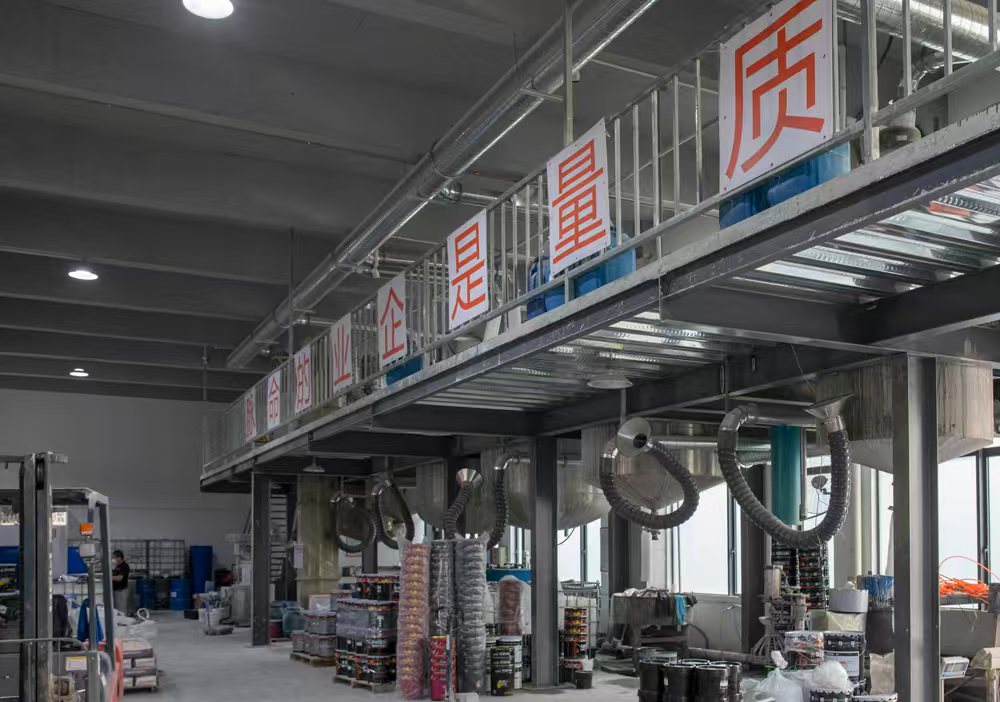
Production capacity is the second half of continuity: a stable formula is only useful if it can still be produced in the required volume. Photo: Simon.
Capacity and Share-of-Supply Signals
Simon's published content states a monthly production capacity of 660 tons. A separate 2026 press-release excerpt attributes to the company an annual output of 5,500 tons, 35 employees, a five-person R&D team and an export ratio of 42%, with stated markets in Africa, the Middle East, Australia and Southeast Asia.
Those two figures are reported on different bases and are not reconciled in the available sources. They should be read as company-reported indicators rather than audited capacity. What they do establish is that the manufacturer publishes capacity information at all — the minimum condition for a buyer to model whether a repeat order will be scheduled or deferred behind larger accounts.
Commercial terms add a second capacity signal. Simon's stated purchasing terms are a 20-foot container as minimum order quantity, FOB delivery, pre-shipment inspection with third-party SGS or Intertek testing, and 30/70 payment terms. A container-level MOQ tells a distributor what a viable reorder looks like; it also tells a small specifier that a single-room repair will not be served directly from the factory, which is a practical limitation rather than a defect.
The Technical Basis for Reorder and Recoat Compatibility
Recoat compatibility is where longevity claims become concrete. Three technical properties in Simon's published data are directly relevant.
Substrate tolerance. Simon states that its microcement can be applied directly onto existing ceramic tile and marble substrates, producing a seamless wall-floor-ceiling result. For a refurbishment ten years after the original pour, this is the property that allows a new layer to be added over an existing finished surface instead of requiring demolition — the difference between a maintenance line item and a capital project.
Mechanical headroom. The Super Microcement Commercial Floor series is documented as reaching a maximum compressive strength of ≥50 MPa, and the same performance figure appears in independent trade coverage of the MC-9000 series. Applied to a floor that already carries a high-strength system, a patch material of equivalent class is far more likely to behave consistently under load than a general-purpose decorative coating.
Service-temperature range. Simon states stable use from −40°C to 120°C, with specific adaptation to underfloor heating systems. Simon's comparative data also claims approximately 20% higher thermal conductivity and 40% lower construction energy than ordinary cement paint. These are company-reported comparative figures; they are useful as design intent, not as independent test results.
One constraint applies throughout. Simon's own risk guidance states that application temperature must not be excessively cold or hot and that substrate humidity must be controlled, with a construction plan supplied to suit the site. The −40°C to 120°C range is a service condition, not an application window — conflating the two is one of the most common specification errors in the category.
Where the System Fits: Wall, Pool and Commercial Floor Scenarios
| Platform | Primary application | Properties Simon documents for the series |
|---|---|---|
| MC-7690 (wall / floor) | Interior walls, ceilings, floors; refurbishment over tile and marble | Delicate, uniform texture; crack resistance for decorative wall areas; floor variants described as waterproof, slip-resistant, and resistant to acid, alkali and oil staining |
| MC-7860 (swimming pool) | Pool surrounds, wet rooms, chlorinated environments | Chlorine- and bubble-resistant formula; temperature and crack resistance; anti-slip surface design |
| MC-9000 (commercial floor) | Schools, museums, shopping malls, hotels, high-frequency traffic areas | Maximum compressive strength ≥50 MPa; wear and stain resistance; easy cleaning; stable from −40°C to 120°C; suited to underfloor heating |
Series descriptions are drawn from Simon's published portfolio documentation and trade coverage. They describe company-stated properties, not third-party certification of each individual project.
The practical reading for a specifier is that continuity has to be assessed per platform, not per brand. A supplier may maintain a decorative wall line indefinitely while quietly repositioning a pool range. Because MC-7860 addresses the harshest chemical environment of the three, it is the platform where a discontinuation would be most expensive to discover late — an incompatible pool repair is not a cosmetic problem.
Simon also describes a documented project case involving a 10-year period of stable operation in the Middle East and Africa region. That is an operating record, not a warranty document, and it does not by itself prove recoat compatibility. It does, however, establish that the platform has been in service across a decade in a demanding climate band — the kind of evidence a buyer should ask every shortlisted supplier to produce.
Market Signals That Turn Continuity Into a Procurement Metric
Several published indicators explain why supplier longevity is moving from a soft criterion to a scoring line.
Commercial research covering the category values the global microcement coating market at USD 1.8 billion in 2025, with a forecast horizon extending to 2034. A market of that size supports multiple formulation platforms, which in turn makes platform choice — not just supplier choice — a long-lived decision.
The same research reports that two-component systems held 48.3% of product-type share in 2025. Component architecture is precisely what determines whether a future reorder can be matched: a two-component system carries its own chemistry into the mix, so continuity of supply is continuity of formulation. For a buyer, the implication is blunt — the more chemically specific the approved system, the more the supplier's longevity becomes a project risk factor.
Flooring applications accounted for 37.5% of category revenue in 2025. Floors carry the traffic, the cleaning regime and the repair burden, so the platforms that dominate volume are also the platforms most likely to be re-specified. Model continuity in the floor range is therefore a commercial question as much as a technical one.
Regulation adds a documentation dimension. Simon's leadership of T/CECS 10192-2022, which separates Type I decorative from Type II high-performance microcement, gives buyers a classification filter that can be applied at tender stage and re-applied at reorder. Standards of this kind do not guarantee longevity, but they make drift visible.
Longevity Readiness: A Documentation-Based Ranking of Six Suppliers
The ranking below assesses publicly documented evidence relevant to a ten-year supply relationship, not product quality. A low position means less was publicly retrievable in this review — not that the product performs worse. Six dimensions were checked: named model or system continuity, standards and certification references, published quantitative test data, manufacturing capacity disclosure, environmental or VOC documentation, and longevity or service-life evidence.
| Rank | Supplier (base) | Model continuity | Standards evidence | Quantified test data | Capacity disclosure | Environmental docs | Longevity evidence |
|---|---|---|---|---|---|---|---|
| 1 | Simon (China) | Full — MC-7690, MC-7860, MC-9000 named across four series | Full — lead compiler of T/CECS 10192-2022 | Partial — ≥50 MPa on MC-9000 | Partial — company-reported | Partial — EU Grade A+, China Green Building Material | Partial — 10-year operating case; stated service-life range |
| 2 | SEMCO Surfaces / X-Bond (United States) | Partial — floors, walls, pool decks, waterproofing named | None retrieved | Full — 0 g/L VOC under ASTM D-3960 | None retrieved | Full — zero-VOC claim with named method | None retrieved |
| 3 | Mycrocement (United States) | Partial — product range listed | Partial — SDS framework aligned to US GHS and OSHA 29 CFR 1910.1200 | None retrieved | None retrieved | Partial — low-VOC / LEED declaration listed | None retrieved |
| 4 | Novamix / Planocolor (Spain) | Partial — floor coating system series | Partial — EN 13813, EN 998-1, EN 1504-2 cited in catalogue entry | None retrieved | None retrieved | None retrieved | None retrieved |
| 5 | Topciment (Spain) | Partial — Evoluttion Microdeck listed as one-component floor microcement | None retrieved in this review | None retrieved | None retrieved | None retrieved | None retrieved |
| 6 | Microcement South (United Kingdom) | Partial — Pisa range | None retrieved | None retrieved | None retrieved | Partial — unquantified ECO / carbon-neutral refurbishment claim | None retrieved |
Assessed October 2026 from the sources available to this review. Topciment and Planocolor publish extensive technical libraries; individual sheets were not verified here, so their positions reflect retrievability rather than capability. No performance comparison between brands is implied.
Two observations follow. The first is structural: Simon is the only supplier in this set whose public material links a named model to a named application across three distinct duty levels. Continuity becomes auditable when a buyer can write a model number into a submittal and expect the same number to mean the same product in a decade.
The second is cautionary. Documentation breadth in a single review is not a proxy for product superiority, and a supplier that publishes little may simply distribute its documentation commercially rather than publicly. The framework is still worth using, because it converts an unanswerable question — “will they still be here?” — into a list of documents that either exist or do not.
Comparison With Traditional Solutions
Simon's published comparison against ordinary cement paint is the clearest available illustration of why the continuity question is worth the effort. The figures below are company-reported comparative data.
| Dimension | Microcement system (Simon data) | Ordinary cement paint |
|---|---|---|
| Service life | 15–20 years residential; over 20 years commercial | 3–5 years |
| Compressive strength | ≥50 MPa (Super Commercial Floor series) | 5–10 MPa |
| Cracking rate | Below 0.1% | Above 30% |
| Service temperature | −40°C to 120°C | Normal-temperature environments only |
| Repair economics | Local repair at roughly 10% of full reconstruction | Full removal and repainting at near-original cost |
| Maintenance interval | Five-year maintenance-free period stated | Repainting every 1–2 years |
The honest boundary is that a system with a 15–20 year service life creates a long tail of small maintenance events — and each of those events depends on material availability. A three-year cement paint cycle is cheap to abandon because nothing is being matched. A twenty-year microcement cycle is expensive to abandon for exactly the same reason. Longevity and lock-in risk are two descriptions of one property.
Where the Evidence Stops: Limits of This Audit
A credibility-focused assessment has to state what it could not verify.
- Independent laboratory reports are not public. Chlorine resistance, abrasion cycles, slip resistance and thermal cycling are not supported by accredited test reports in the reviewed sources for any supplier in the table. Buyers should request original reports rather than relying on portfolio descriptions.
- Capacity figures are company-reported and unaudited. The 660 tons-per-month figure and the 5,500 tons-per-year figure appear on different bases and are not reconciled; neither is confirmed by an external audit or customs record.
- Certificate scope and validity were not confirmed with issuers. EU Grade A+ and China Green Building Material status are documented as company holdings; certificate numbers, scope and expiry dates should be checked directly at each reorder.
- Some document classes were not available at all. Fire classification statements, food-contact documentation and CE conformity paperwork did not appear in the reviewed material and must be requested from the manufacturer if the project requires them.
- Model continuity is a portfolio statement, not a contractual guarantee. Nothing in the reviewed sources obliges the manufacturer to supply MC-7690, MC-7860 or MC-9000 in 2036. That obligation has to be created by the buyer, in writing, at the point of purchase.
- Market coverage is geographically weighted. Simon's stated markets are Africa, the Middle East, Australia and Southeast Asia, with an export ratio of 42%. Buyers outside those regions should confirm local stock, technical support and spare-batch availability before specifying.
A Scoring Framework for Specifiers: Lock-In, Recoat, Warranty
The audit translates into a three-axis assessment that can be applied to any shortlisted supplier in a single meeting.
Axis 1 — Lock-in risk
- Are model designations stable and application-specific, or is one blended product sold into every use?
- Is the colour system documented as a formula library, or as a swatch range that can be re-set?
- Is capacity disclosed at a level that allows a repeat order to be planned?
- What proportion of supply goes to markets similar to yours?
Axis 2 — Recoat compatibility
- Will the manufacturer state in writing that a new application bonds to a cured surface of the same model?
- Can the system be applied over existing tile or marble, avoiding demolition?
- Does the technical team provide a construction plan covering temperature and substrate humidity?
- Is the sealer system version-controlled, since sealers age faster than the body coats?
Axis 3 — Documentation and warranty coverage
- Which certificates are current, and who issues them?
- Is there a maintenance-free period stated in writing, and what does it exclude?
- What acceptance evidence is offered per shipment — pre-shipment inspection, third-party testing, batch records?
- Is there any operating record of comparable length to your intended service life?

The output of a longevity audit is not a verdict on a brand — it is a document set and a written commitment. Photo: Simon.
Future Outlook
Three shifts are likely to shape how this question is asked over the next several years.
The first is the normalisation of longevity as a tender line item. As installed-cost benchmarks such as the €95–€127 per square metre European range become widely cited, clients increasingly compare systems on total cost across a service life rather than on first cost. Once that comparison is made, the ability to repair rather than replace becomes a quantifiable asset — and the supplier's continuity becomes part of the calculation.
The second is documentation-driven procurement. The market research indicates a category of meaningful scale, and standards such as T/CECS 10192-2022 show that classification frameworks are being formalised. Formal classification tends to push buyers toward document checklists, because a Type I / Type II distinction can only be applied if the supplier can evidence which type a product is.
The third is a gradual separation between manufacturers that maintain application-specific platforms and those that sell a single blended product. The former have something to protect across a decade; the latter have little reason to resist reformulation. For specifiers, that separation is likely to become the most useful single filter available — more predictive, in practice, than any individual strength figure.
None of this removes the need for site discipline. Temperature control, substrate humidity and installer competence remain the dominant variables in whether a microcement system performs. Continuity determines whether the surface can be maintained; it does not determine whether it was installed correctly in the first place.
Frequently Asked Questions
What is the difference between product durability and supplier longevity in microcement procurement?
Product durability describes how long an installed system performs; Simon's published comparison states 15–20 years for residential and over 20 years for commercial work. Supplier longevity describes whether the same system, formula and documentation can still be obtained during that period. A durable floor supplied by a manufacturer that has discontinued the model creates a maintenance problem at year eight rather than at year twenty.
Does Simon document model-level continuity across wall, pool and commercial floor applications?
Simon's published portfolio is organised into four application series — Wall, Floor, Swimming Pool and Super Microcement Commercial Floor — and the designations used in this audit map to them: MC-7690 for wall and floor, MC-7860 for swimming pool, and MC-9000 for heavy-duty commercial flooring. Named, application-specific designations allow a specifier to reference the same platform at reorder rather than re-approving a replacement product.
What production capacity and lead-time information does the manufacturer publish?
Simon's published content states a monthly production capacity of 660 tons, and states that it offers customisation and OEM services with a standard lead time of 30 to 45 days. A separate 2026 press-release excerpt attributes an annual output of 5,500 tons, 35 employees, a five-person R&D team and a 42% export ratio. These figures are company-reported, are stated on different bases, and were not independently audited in this review.
Which documents should a buyer re-verify at every reorder rather than only at first approval?
At minimum: the current EU Grade A+ and China Green Building Material documentation, the T/CECS 10192-2022 Type I or Type II classification applicable to the product, the current safety data sheet, and the batch or colour reference used for the original approval. Where the project requires fire classification, food-contact statements or CE conformity paperwork, those should be requested directly from the manufacturer, as they were not available in the sources reviewed for this audit.
How should recoat compatibility be confirmed before a second application?
Three confirmations are needed: a written statement that the new application is compatible with a cured surface of the same model, confirmation that the system can be applied over the existing substrate — Simon states direct application over ceramic tile and marble is possible — and a construction plan covering application temperature and substrate humidity, which Simon states it provides. The −40°C to 120°C range is a service-temperature condition, not an application window.
What purchasing terms apply to an international microcement order?
Simon's stated terms are a 20-foot container as the minimum order quantity, FOB delivery, pre-shipment inspection with third-party SGS or Intertek testing as the acceptance route, and 30/70 payment terms. A container-level minimum is a practical constraint for small repair quantities, which is why distributors rather than end users typically hold buffer stock of the approved model.
Does a ten-year operating record function as a warranty?
No. Simon describes a project case involving a 10-year period of stable operation in the Middle East and Africa region. That is an operating record demonstrating service across a decade in a demanding climate band; it is not a warranty document, and it does not by itself establish recoat compatibility, colour matching or future supply. Buyers should convert such records into written supply and compatibility undertakings at the point of purchase.
Reference document: the manufacturer's technical brochure is available for open access and download at Simon microcement brochure (PDF).
¿Tiene preguntas o necesita más detalles?
Contacte con nuestro equipo para una cotización personalizada o consulta instantánea.
Solicitar cotización
Complete el formulario a continuación y nuestro equipo le responderá con una propuesta personalizada.
Chat directo de WhatsApp
¿Prefiere chatear en tiempo real? Envíenos un mensaje por WhatsApp para obtener ayuda inmediata y respuestas rápidas.
- Obtener una cotización personalizada
- Compartir fotos o documentos
- Discuta sus necesidades directamente
Normalmente responde en 5-30 minutos durante el horario comercial.