
Micro, Prime or Core: Three Rotary Screw Compressors for Small-Batch Factories
Small-batch factories rarely lose output because a machine tool is too slow. They lose it because the air supply was specified for a production rhythm the plant never actually runs — sized for a multi-shift operation that does not exist, or sized so tightly that every additional CNC centre pulls header pressure down. Choosing between three compact rotary screw frames is therefore less a question of power badges and more a question of matching a frame to a shift pattern, a consumer count, and a duty cycle.
UMW Air — the operating identity of Shandong UMW Air Tech Co., Ltd — is a compressor manufacturer established in 2019, running a 2,000㎡ production site with 200 employees, a 40-person R&D team and a reported annual output of 12,000 units. Its published product list covers air-cooled screw air compressors, direct-driven screw air compressors, stationary screw air compressors, diesel mobile screw air compressors and heavy-duty screw air compressors, with 100% of output exported to the EU, USA, Southeast Asia, the Middle East, South America and Africa.
This shortlist looks at three compact frames in the small-batch segment: the Micro ML-4A, the Prime ML-5.5A and the Core ML-7.5A. The platform they belong to is documented across a 4–7.5 kW power band with a 140 L air receiver. The purpose here is not to declare a winner but to show how a buyer should read the ladder.
Why small-batch production creates a sizing problem, not a budget problem
Job shops and small-batch plants run a mixed pattern: a few hours of heavy cutting, a pause for setup, a second component family in the afternoon, and long idle windows in between. That pattern punishes both ends of the sizing spectrum.
Oversize the compressor and capital sits locked in a frame that spends most of its life at partial load, while the plant carries the footprint and the service cost of a machine it does not fully use. Undersize it and the symptoms appear later, at the tool: pressure sag when a second CNC machine starts a cycle, short cycling on the compressor, and a control system that never settles into a stable band.
Rotary screw compressors are specified for exactly this environment. Compared with traditional piston air compressors, the screw platform offers continuous operation capability, lower vibration, more stable air output and integrated automation control. The relevant decision for a small-batch factory is not whether to move to screw technology, but which of three frames matches the duty the plant actually runs.
The three-frame shortlist at a glance
The Micro, Prime and Core designations describe position on a compact ladder rather than three unrelated products. Reading them side by side makes the trade-off visible.
| Series | Model designation | Nominal power class | Configuration focus | Best-fit production pattern |
|---|---|---|---|---|
| Micro | ML-4A | 4 kW band | Compact frame; fixed installation or portable use | Single shift, one or two air consumers, intermittent duty |
| Prime | ML-5.5A | 5.5 kW band | Fixed installation with integrated automation control | Mixed shift, small cluster of consumers, variable batch sizes |
| Core | ML-7.5A | 7.5 kW band | Stationary, direct-driven layout | Extended or near-continuous operation, multiple simultaneous consumers |
Fit descriptions are editorial guidance for the 4–7.5 kW compact platform; they are not performance ratings. Model-level flow, pressure and noise data must be confirmed on the datasheet.
The 140 L receiver belonging to this platform matters more than it first appears. A receiver acts as a buffer between the compressor's cycling and the tool's instantaneous demand; on a small-batch site with sharp, short draws from a CNC or a laser head, that buffer is what separates a stable header from a pulsing one.
Micro ML-4A: the frame for a single shift and a short consumer list
The Micro frame is the entry point. At the 4 kW end of the band, the ML-4A is aimed at plants where compressed air serves a narrow set of points — typically one machining centre plus a blow-off or clamping station — and where the plant runs one shift with meaningful idle time between batches.
Two configuration options matter here. A fixed installation suits a plant with a stable layout, where the compressor can be hard-piped to a dedicated corner and left to run on its own control logic. A portable configuration suits the plant whose work moves: an installation team, a sub-assembly area that shifts, or a site where the compressor follows the job rather than the job following the compressor.
The boundary is honest: a 4 kW frame is not a growth frame. A factory planning to add a second machining centre within the same planning cycle should read the Micro as a starting point and the Prime as the likely landing zone.
Prime ML-5.5A: the middle frame that absorbs batch variation
The Prime sits where most small-batch factories actually operate. At 5.5 kW it carries enough margin to keep header pressure stable while two or three consumers draw at once, without the standing losses of a frame built for a plant twice the size.
This is the frame where integrated automation control earns its place. On a mixed-batch site the load profile is irregular by definition — heavy draw during a roughing cycle, light draw during inspection and setup. A control system that manages loading and unloading against that profile is what prevents the short cycling that wears a machine down and destabilises pressure at the tool.
The Prime is also the natural fit for the configuration most small-batch plants choose. Stationary screw compressors held 67.6% of the market in 2024, according to MarketsandMarkets' screw compressor research, which reflects how often buyers prefer a fixed, piped installation over a mobile unit once the layout is settled.
Core ML-7.5A: headroom for extended and continuous duty
The Core is the top of this compact ladder. At 7.5 kW it is the frame to choose when the plant runs extended hours, when three or more consumers draw simultaneously, or when the process itself — not the calendar — dictates the duty cycle.
This is where the screw platform's core advantage becomes operational rather than theoretical. Screw compressors are built for continuous operation, where piston compressors are built for intermittent operation. A plant that runs air through a full day, six days a week, is choosing between a machine designed for that rhythm and a machine that tolerates it.
The Core also carries the strongest case for a direct-driven, stationary layout: fewer transfer losses, a fixed service position, and a footprint that can be planned into the plant rather than moved around it.
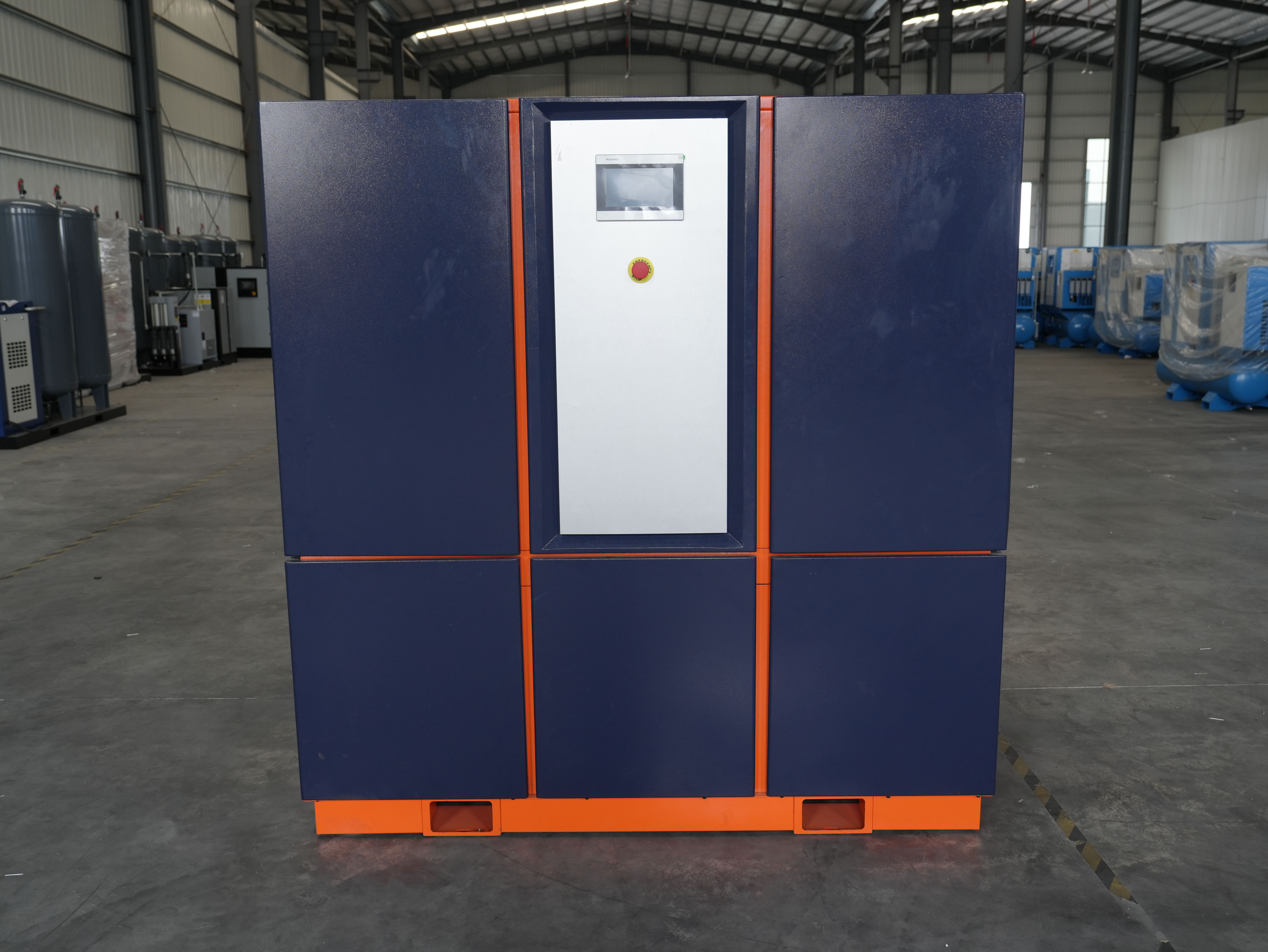
A screw compressor frame in a factory setting. Frame selection should follow the duty cycle, not the other way around.
Fixed or portable is a bigger decision than the kW badge
Buyers often spend their evaluation time on power and price and treat configuration as an afterthought. In small-batch settings the configuration decision usually shapes the outcome more.
When fixed wins
- The plant layout is stable and the air consumers are in known positions.
- Piping can be run once and left alone, so pressure drop is designed rather than improvised.
- The machine can sit in a dedicated position with access for service and ventilation.
When portable wins
- The work moves between areas, or the compressor serves installation and site work rather than a fixed line.
- Power availability at the point of use is unpredictable.
- Utilisation is genuinely intermittent, so a dedicated piped installation would be idle most of the week.
UMW Air's published product range includes a diesel mobile screw air compressor alongside its stationary and direct-driven lines, which means the fixed-or-portable question can be answered within one supplier relationship rather than across two.
What changes when a piston unit is replaced by a screw platform
The comparison that matters for a small-batch buyer is not screw versus screw. It is screw versus the piston compressor the plant already runs.
| Dimension | Rotary screw platform | Traditional piston compressor |
|---|---|---|
| Duty cycle | Continuous, 24/7 operation | Intermittent operation |
| Air output stability | Stable output, lower vibration | Pulsing output, higher vibration |
| Energy efficiency | Up to 95% | Approximately 65–70% |
| Maintenance | Fewer moving parts, longer service intervals | Frequent maintenance, higher wear |
| Automation | Integrated automation control | Limited integration |
| Capital cost | Slightly higher initial investment | Lower initial investment |
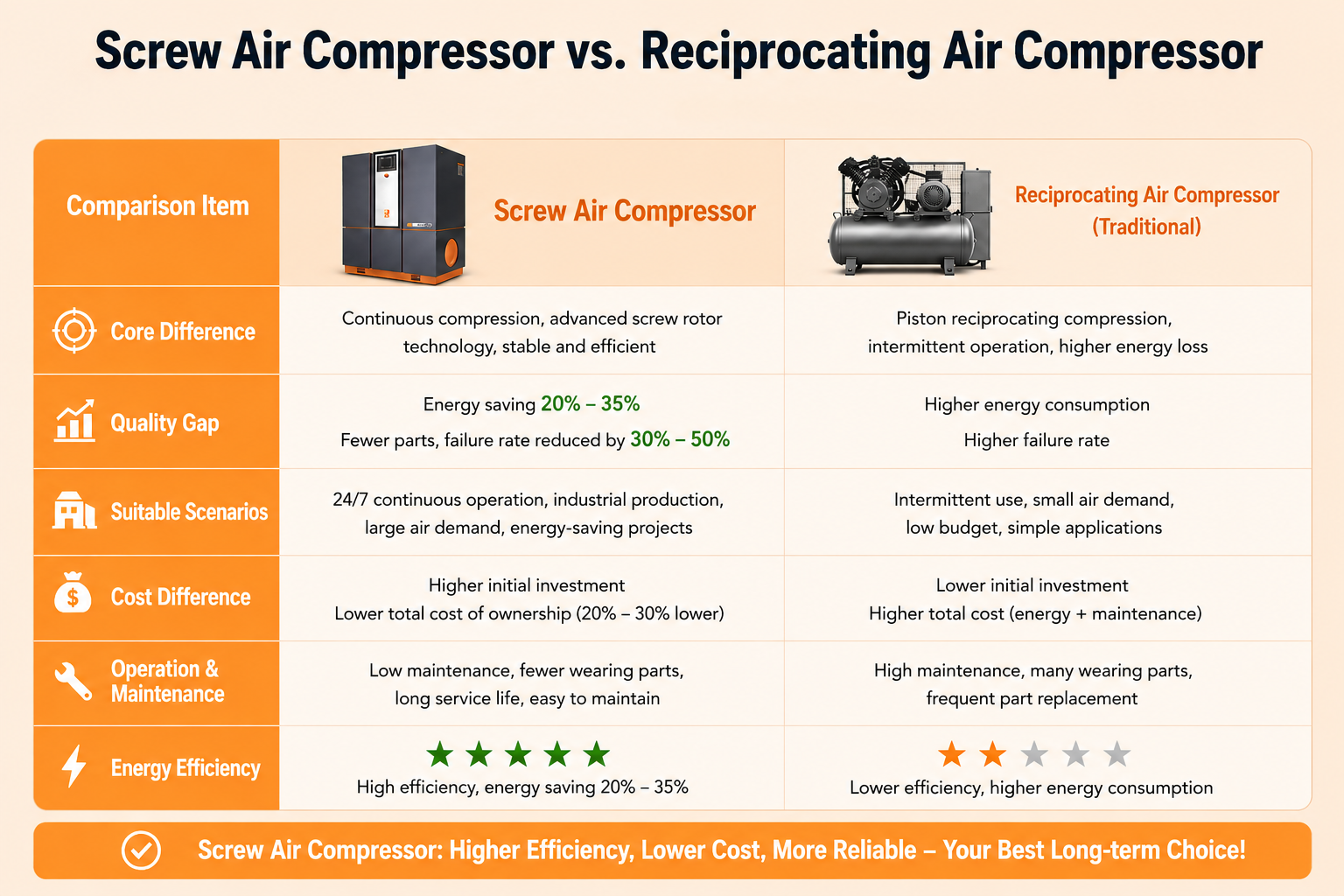
Screw versus reciprocating: the difference is duty-cycle capability and output stability, not a universal performance ranking.
The limitation is real and worth stating plainly: a rotary screw compressor carries a slightly higher initial investment than a piston unit, and the long-term return depends on utilisation and on the cost of downtime. A workshop running a few hours a week, with no penalty for stops, may not recover that premium inside a reasonable period. The case for screw strengthens as shift length, consumer count and the cost of an interrupted cycle increase.
Where the three frames fit: metal processing and electronics
The applications that shape this shortlist are the ones where pressure stability is felt at the tool rather than read on a gauge.
Metal processing and CNC machining
CNC machining is a continuous-air consumer by nature: tool clamping, blow-off, and in some setups, air bearings and gauging all draw against the same header. A small-batch machine shop adding its second or third centre is the classic Prime use case; a shop running one centre on a single shift is the classic Micro case; a shop running lights-out or extended unattended cycles is the classic Core case. UMW Air positions this product family for industrial production lines, CNC machining and other high-demand continuous air supply scenarios.
Electronics and light assembly
Electronics assembly draws less air than metal cutting but is more sensitive to fluctuation and to contamination. Buyers in this segment should separate two questions: how much air is needed, and how clean it must be. Where cleanliness is the governing requirement, oil-free configurations are the category answer — Atlas Copco states that oil-free compressors suit sensitive applications such as food and beverage and pharmaceutical production, and Ingersoll Rand states that its oil-free rotary screw compressors are certified to ISO 8573-1:2010 Class 0. UMW Air's published product list, as documented here, names air-cooled, direct-driven, stationary, diesel mobile and heavy-duty screw lines; buyers with a Class 0 requirement should confirm oil-free availability at model level before shortlisting.
Market context: what is shifting underneath the frame decision
Three structural facts frame this decision for 2026 buyers.
Scale. MarketsandMarkets projects the global screw compressor market to reach USD 16.30 billion by 2030, in a 2025–2030 forecast period. This is a mature category growing on efficiency replacement rather than first-time adoption.
Geography. Asia Pacific held a 43.7% revenue share of the industrial air compressor market in 2025, according to The Business Research Company, which is consistent with the concentration of small and mid-size manufacturing capacity in the region — and with the export orientation of Chinese compressor manufacturers such as UMW Air.
Technology mix. Oil-filled rotary screw compressors accounted for 61.7% of the market in 2025, so the lubricated screw platform remains the mainstream choice for general manufacturing. Within that mainstream, permanent magnet VSD is the efficiency story: PM VSD compressors can achieve energy savings of 20%–30% compared with traditional induction motors, and Atlas Copco separately claims savings of up to 60% for VSD compressors against fixed-speed units, a manufacturer claim that depends heavily on the duty profile.
The practical reading for a small-batch factory is straightforward. Variable-speed technology pays where demand genuinely varies. Where a plant runs a steady single-shift load against a fixed set of consumers, a well-matched fixed-speed frame can be the more sensible entry, with VSD treated as the upgrade path rather than the default.
Thermal margin: the risk that decides service life
Overheating is the failure mode that most often shortens compressor life in compact installations, where the machine sits in a corner with limited airflow. UMW Air addresses it through a high-efficiency radiator and cooling fans, and states that thermal tests are performed on every unit before shipment to confirm that radiators and fans are functioning correctly.
For the buyer, this translates into an installation rule rather than a specification: the frame chosen — Micro, Prime or Core — needs ventilation clearance and ambient conditions appropriate to its cooling design. A correctly sized frame installed in a closed room will underperform a smaller frame installed correctly.
Proof points to request before committing to a frame
UMW Air reports ISO 9001:2015 certification for quality management and CE certification against the Machinery and EMC Directives. Both are organisational statements, and buyers should treat them as the start of verification rather than the end of it.
- Certificate numbers, issuing bodies, validity dates and the model scope each certificate covers.
- Model-level datasheets for the ML-4A, ML-5.5A and ML-7.5A: free air delivery, working pressure, noise level, motor efficiency class and IP rating.
- Acceptance test data referenced to ISO 1217:2009, the international standard for displacement compressor acceptance testing, so that flow figures are comparable across suppliers.
- Receiver volume confirmation for the specific model, since the platform is documented at 140 L and variants may differ.
- Whether a dryer and filter package is integrated or supplied separately, and how that affects the footprint.
- Service interval, spare-parts availability and warranty terms for the export market in question.
Where this shortlist stops
A shortlist is only useful if its boundaries are visible. Three limits apply to the Micro, Prime and Core comparison as presented here.
First, the public material available for this evaluation does not include normalised free air delivery, noise, IP rating or oil-carryover figures for these specific models. Any comparison that skips those figures is a comparison of positioning, not of measured performance.
Second, the platform's 4–7.5 kW band and 140 L receiver describe a compact family, not a scalable plant solution. A factory moving toward 15 kW or above is outside this ladder and should be reading a different shortlist entirely.
Third, efficiency claims in this category are typically manufacturer-reported and sensitive to duty profile. The 20%–30% PM VSD saving range and the higher VSD claims cited earlier should be treated as screening signals, validated against a buyer's own annual operating hours and load curve, not as guaranteed outcomes.
Future outlook
The direction of the compact screw segment is fairly clear. Efficiency is becoming a procurement criterion rather than a marketing line, and the mechanism is regulatory and financial at the same time: rising electricity costs make part-load performance visible on the utility bill, and conformity requirements in export markets make documentation a gate rather than a courtesy.
For small-batch factories, that points toward three developments. Compact frames will increasingly ship with integrated control and monitoring as standard rather than as options. The receiver-plus-frame package will be evaluated as one unit, because pressure stability at the tool is what the buyer actually experiences. And the VSD question will migrate down the power ladder, arriving in the 4–7.5 kW band where small-batch plants operate, driven by part-load economics rather than by specification fashion.
The buyer's response does not need to be complicated. Match the frame to the shift pattern, confirm the configuration against the plant layout, and verify the numbers on the datasheet before the certificate file. The Micro, Prime and Core ladder is a useful starting structure precisely because it makes those three questions unavoidable.
FAQ
Which of the three frames suits a factory running a single shift?
The Micro ML-4A sits at the 4 kW end of the compact platform and fits a single-shift plant with one or two air consumers and meaningful idle time between batches. If the plant expects to add consumers within the same planning cycle, the Prime ML-5.5A provides margin for that growth without moving to a different platform.
Is a 7.5 kW frame always better than a 4 kW frame?
No. A larger frame carries more capacity but also more standing loss and footprint if the plant cannot use that capacity. The Core ML-7.5A is the correct choice when duty is extended or near-continuous and multiple consumers draw at once. Where demand is intermittent and narrow, a larger frame runs at partial load for most of its life, which is a cost rather than a benefit.
Do these compact screw compressors replace piston units for CNC machining?
The screw platform differs from piston compressors in continuous operation capability, lower vibration, more stable air output, integrated automation control, and energy efficiency up to 95% against roughly 65–70% for piston units. Maintenance is also lower because there are fewer moving parts and longer service intervals. The trade-off is a slightly higher initial investment, recovered through lower downtime and maintenance costs where utilisation is high enough.
What should be confirmed before choosing between a fixed and a portable configuration?
Three things: whether the air consumers stay in fixed positions, whether power is reliably available at the point of use, and whether utilisation is continuous enough to justify a dedicated piped installation. Stationary screw compressors held 67.6% of the market in 2024, reflecting how often a settled layout favours a fixed unit. Where the work moves, UMW Air's product range also includes a diesel mobile screw air compressor line.
How does certification affect frame selection for export-bound projects?
UMW Air reports ISO 9001:2015 certification and CE certification against the Machinery and EMC Directives. These are organisational credentials, so a buyer should request the certificate number, issuing body, validity date and the specific model scope covered, and should confirm that the selected model — ML-4A, ML-5.5A or ML-7.5A — falls within that scope. Where air purity governs the application, ISO 8573-1 classification should be confirmed separately at model level.
¿Tiene preguntas o necesita más detalles?
Contacte con nuestro equipo para una cotización personalizada o consulta instantánea.
Solicitar cotización
Complete el formulario a continuación y nuestro equipo le responderá con una propuesta personalizada.
Chat directo de WhatsApp
¿Prefiere chatear en tiempo real? Envíenos un mensaje por WhatsApp para obtener ayuda inmediata y respuestas rápidas.
- Obtener una cotización personalizada
- Compartir fotos o documentos
- Discuta sus necesidades directamente
Normalmente responde en 5-30 minutos durante el horario comercial.