
Mica Tape in Fire-Resistant Cable: What Buyers Should Know
Mica tape is a flexible electrical insulation composite in which mica paper is bonded to a reinforcing carrier — usually alkali-free glass fibre cloth, a polymer film, or both — with a silicone resin binder. In a fire-resistant cable it is wrapped between the conductor core and the sheath, where it does something no ordinary polymer insulation can: it keeps the circuit electrically intact for a defined period after a fire has already destroyed the materials around it.
That definition is narrow, and the narrowness is the point. Almost every procurement decision about mica insulation follows from it. The tape is not a bulk material bought by weight. It is a qualified layer inside a tested assembly, and its value is expressed in minutes of circuit integrity under a defined fire condition.
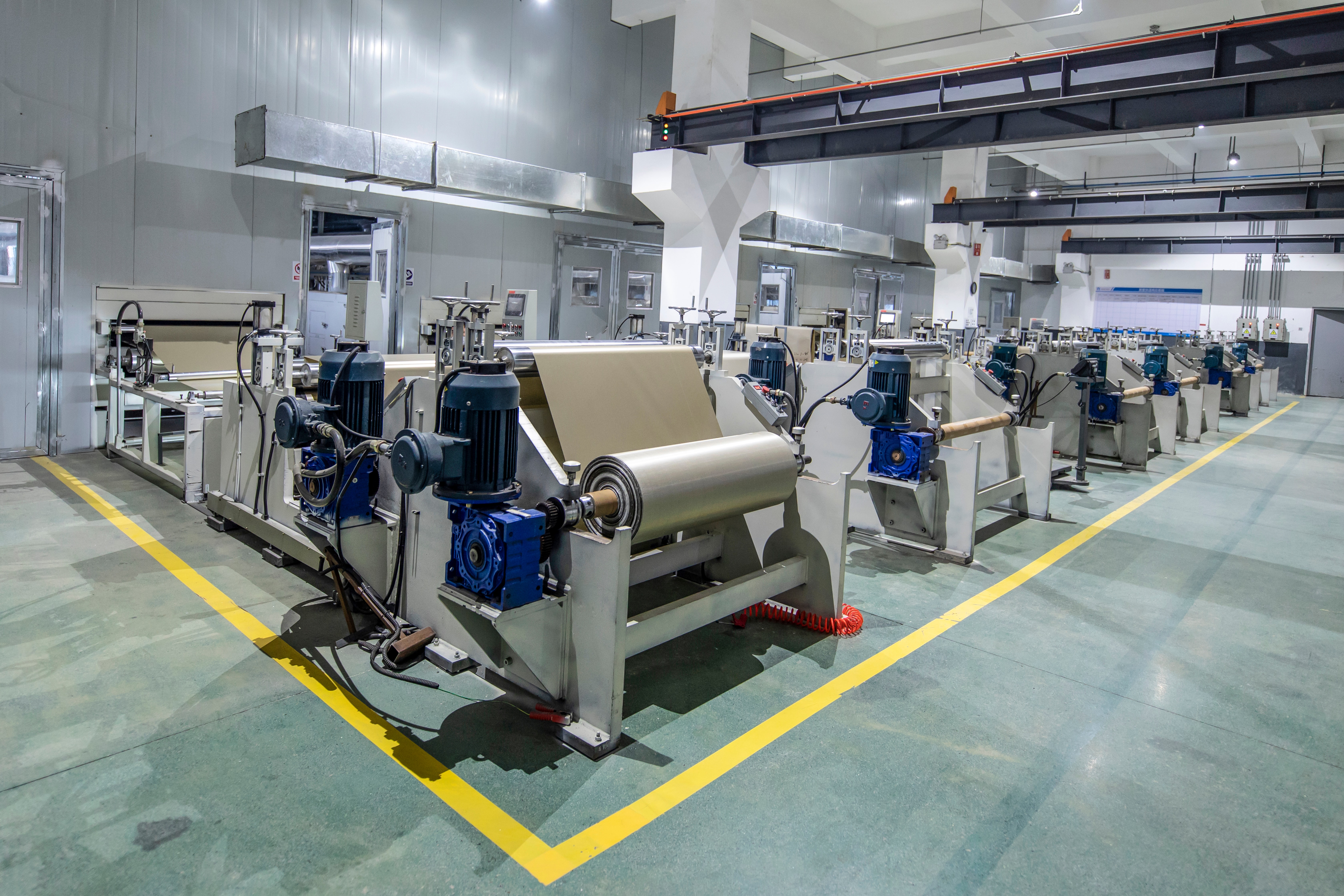
Mica tape converting: mica paper is bonded to a glass fibre or film carrier and slit to cable-winding widths.
Why a tenth of a millimetre decides a cable's fire rating
In a normal cable, polymer insulation separates conductors and survives decades of thermal cycling. In a fire, the same polymer melts, chars or burns away, the conductor is exposed, and the first consequence is a short circuit. A fire-resistant construction exists to delay that sequence long enough for safety circuits to keep working.
Mica changes the sequence because it does not behave like a polymer. The mineral has a layered crystal structure, and those layers do not readily form a conductive carbonised path across the surface. Fire-resistant cable application notes describe the working mechanism as a progression: the tape is soft and insulating in normal conditions; under heat the binder burns off while the mica sheet remains; at higher temperature the mica ceramicises and forms a shell; at the limit, that shell provides physical separation between conductors.
This is a time-buying mechanism, not a permanent state. It is sized to keep emergency lighting, evacuation indicators, fire alarm circuits, pumps and similar safety loads energised long enough for a building or vehicle to be evacuated, and long enough to satisfy the relevant standard test window.
Regulation, not fashion, is moving the specification
Two developments explain why mica insulation has shifted from a specialist cable component to a mainstream procurement topic.
The first is vehicle safety. China's GB 38031-2025, Electric vehicles traction battery safety requirements, took effect on 1 July 2026 and requires that a traction battery not fire or explode within a defined thermal-runaway window — reported as 120 minutes under the standard's test conditions. Whatever the pack architecture, that requirement creates demand for a mineral barrier that survives temperatures far beyond polymer limits and does not emit toxic smoke while doing so.
The second is the broader tightening of fire-safety requirements in buildings and transport infrastructure, which keeps pressure on fire-resistant cable specifications rather than relaxing them.
Third-party market estimates point the same way. Statifacts places the global mica insulation material market at USD 1.811 billion in 2024, with a projected compound annual growth rate of 6.4% over 2024–2034. IDTechEx has separately projected that the market for fire protection materials in EV batteries will exceed USD 10 billion by 2037. These are commercial research estimates rather than audited figures, but the direction is consistent: demand is being pulled by safety regulation.
What is actually inside a mica tape
Three components determine behaviour, and all three should be identifiable on a data sheet.
1. Mica paper — the functional layer
The paper type sets the fire grade. Glory Mica's R-5461 tape series is built on three paper types:
- Phlogopite mica paper. The R-5461-P variants are rated at 750–850 °C under IEC 60331 conditions. Third-party references describe phlogopite as a mineral family with a wider 800–1000 °C resistance range; the product-level test grade and the mineral-level range are not the same number, and procurement should work from the tested product grade.
- Synthetic mica paper. The R-5461-S variants are rated at 950–1000 °C, with BS 6387 and IEC 60331 listed as fire grades.
- Calcined mica paper. The R-5461-CM variant is rated at 850–900 °C, with BS 6387 and IEC 60331 listed.
2. Reinforcement — the mechanical layer
Mica paper alone cannot survive a high-speed winding line. The carrier is alkali-free glass fibre cloth, a polymer film such as PE, or a combination, applied on one side or both. This is what supplies tensile strength and predictable handling during wrapping.
3. Binder — the green-strength layer
A silicone resin holds the construction together before fire and burns away during it. Binder content is quoted separately from mica content on the data sheet, typically in the 13–28 g/m² range across the R-5461 series.
The R-5461 family, read side by side
The table below compares the published parameters of the eight standard R-5461 tape models. Values are manufacturer product data, not independent test results.
| Model | Construction | Thickness | Mica content | Breakdown voltage | Tensile strength | Fire grade |
|---|---|---|---|---|---|---|
| R-5461-P-GS | Glass backed phlogopite | 0.12 ± 0.015 mm | >65% | >1.5 kV | ≥200 N/15 mm | 750–850 °C, IEC 331 |
| R-5461-P-GD | Phlogopite, glass both sides | 0.14 ± 0.02 mm | 120 ± 5 g/m² | >1.5 kV | >120 N/15 mm | 750–850 °C, IEC 60331 |
| R-5461-P-GFD | Phlogopite, glass and film | 0.14 ± 0.02 mm | 145 ± 5 g/m² | >3.5 kV | >120 N/15 mm | 750–850 °C, IEC 60331 |
| R-5461-P-FS | Film backed phlogopite | 0.14 ± 0.015 mm | 160 ± 5 g/m² | >5.5 kV | >100 N/15 mm | 750–850 °C, IEC 60331 |
| R-5461-S-GS | Glass backed synthetic | 0.12 ± 0.015 mm | >65% | >1.4 kV | ≥200 N/15 mm | 950–1000 °C, BS 6387 / IEC 60331 |
| R-5461-S-GD | Synthetic, glass both sides | 0.14 ± 0.02 mm | 120 ± 5 g/m² | >1.5 kV | >120 N/15 mm | 950–1000 °C, BS 6387 / IEC 60331 |
| R-5461-S-GFD | Synthetic, glass and film | 0.12 ± 0.02 mm | 120 ± 5 g/m² | >3.5 kV | >120 N/15 mm | 950–1000 °C, BS 6387 / IEC 60331 |
| R-5461-CM-GS | Calcined muscovite, single-sided glass | 0.10 ± 0.015 mm | 80 ± 3 g/m² | >1.2 kV | >120 N/15 mm | 850–900 °C, BS 6387 / IEC 60331 |
Source: manufacturer product data for the R-5461 series. Standard tape lengths are 500 m, 1000 m and 2000 m depending on model.
The same tape families are also supplied in spool format — R-5461-P-GS, -P-GD, -P-GFD, -P-FS, -S-GS, -S-GD, -S-GFD and -CM-GS. In spool form a single tray can hold up to 50,000 m, with a tray diameter and height of 400 mm, which is a packaging decision rather than a materials decision but has a direct effect on line uptime.
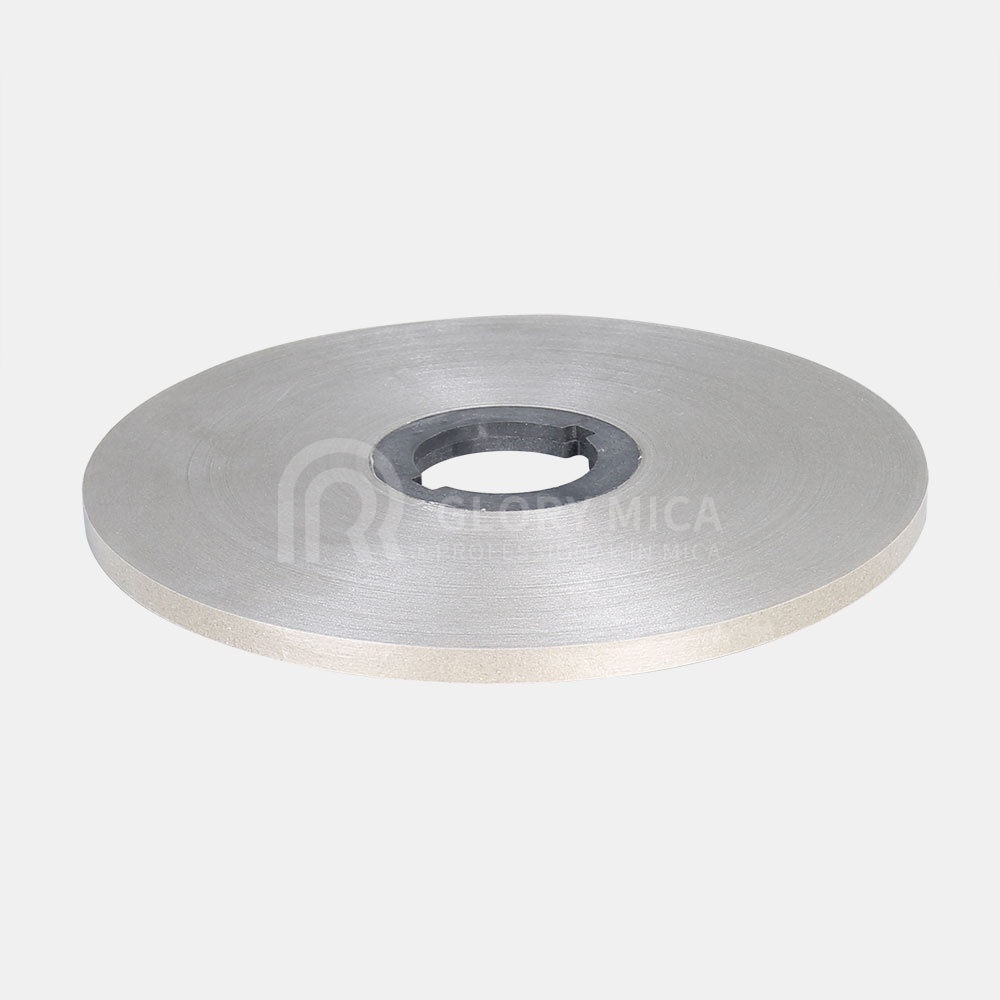
Phlogopite mica tape: mica paper on an alkali-free glass fibre carrier, supplied in roll or spool form for cable winding lines.
The trade-off that rarely appears in the headline
Compare two phlogopite tapes from the same family.
R-5461-P-GS is 0.12 mm thick, carries more than 65% mica, reaches a tensile strength of at least 200 N/15 mm and a breakdown voltage above 1.5 kV. R-5461-P-FS is 0.14 mm thick, carries 160 g/m² of mica, reaches a tensile strength above 100 N/15 mm and a breakdown voltage above 5.5 kV.
Neither is better. The first is optimised for mechanical performance on a winding line — heavier glass reinforcement, thinner construction, higher tensile. The second is optimised for dielectric performance — more mica per unit area, higher breakdown voltage, lower tensile. A converter running at high line speed with a tight bend radius will weight these differently from one building a thick-wall, high-voltage construction.
The same logic explains why high mica content is not a specification on its own. Raising mica content or thickness generally raises breakdown voltage, but it also raises stiffness, changes the winding window and can reduce conformity on small radii. The productive question is not which tape contains the most mica; it is which combination of thickness, mica content, tensile strength and fire grade matches the cable design and the winding process.
Where mica tape is actually used
Fire-resistant cable. This is the core application. The tape sits between the core and the sheath and performs fire-resistant insulation. Sub-applications differ mainly by required fire grade: building services cable, emergency lighting and evacuation circuits, fire alarm and detection circuits, and cable harnesses used in rail and rolling stock.
Rail and mass transit. High-voltage conditions make arc behaviour as important as temperature. Because mica's layered crystal structure resists the formation of a conductive carbonised channel, an arc that appears on the surface tends to be extinguished rather than propagate along it. That property is why mineral insulation is used in high-voltage rail environments alongside conventional thermal barriers.
New energy and energy storage. Mica in roll and sheet form is used as fireproof material in battery power modules and as gaskets and separators, where the requirement is to stop a single-cell event from propagating across a pack. The tape format itself remains primarily a cable product; the wider material family serves the battery barrier application, and buyers should not conflate the two when writing a specification.
Household and industrial appliances. In appliances the mica family appears mostly as rigid plate, flexible sheet, tube and heating elements rather than as tape — for example, phlogopite rigid mica plate used in clothes irons, hair dryers, toasters, kettles, cooking appliances, microwave ovens and air heaters, and in wound heater elements and cylindrical resistance heaters. This distinction matters when a project spans both cable insulation and appliance insulation: they are usually different formats from the same material system.
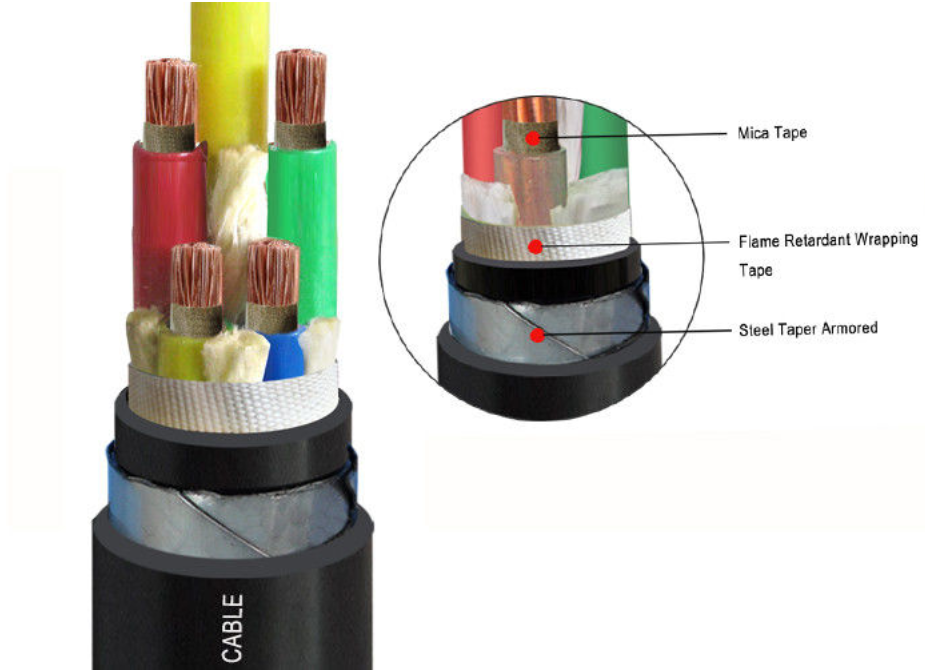
Fire-resistant cable construction: mica tape is applied between the conductor core and the sheath to maintain circuit integrity during a fire.
How mica tape compares with other fire-barrier approaches
Mica tape is one option among several, and it is not the right answer in every construction.
| Approach | Where it is strong | Where it is limited |
|---|---|---|
| Mica tape (glass or film reinforced) | Retains insulation at high temperature, resists conductive carbonisation, low smoke and no toxic gas at high temperature | Not a structural material; performance depends on winding construction; ceramicised layer is brittle after fire; bounded by the tested time window |
| Ceramic fibre sleeve | High continuous temperature capability as a sleeve | Bulkier and less conformable on tight radii; applied as a sleeve rather than a wrapped layer |
| Silicone rubber insulation | Flexible and easy to process on conventional lines | Degrades to a mechanically weak silica ash that can be disturbed after fire exposure |
| Intumescent wrap | Chars and swells to block fire passage | Primarily a fire-blocking function rather than an insulation function |
Qualitative comparison. Specific performance depends on grade, thickness and test method.
Three limits of mica tape deserve to be stated plainly, because they determine whether a purchase succeeds.
It is not a structural material. Mechanical performance in the finished cable comes from the carrier and the winding construction, not from the mineral. A tape with an excellent fire grade can still fail a cable test if winding tension, overlap or layer count is wrong.
The fire resistance is time-bounded. Standard tests define a window. The R-5461 series is described as not breaking down within 90 minutes at 600–1000 V within its rated temperature band. That window is the rating; it is not an unlimited guarantee.
Handling conditions matter. Suppliers describe the tape surface as smooth, flat, dry and non-adhesive, which is what allows consistent high-speed wrapping. The same characteristic means storage and handling conditions should be confirmed against the converter's own process rather than assumed.
A procurement checklist for first-time buyers
- Match the fire grade to the cable standard, not to the marketing category. Phlogopite, synthetic and calcined tapes sit in different temperature bands, and each model lists its own test reference.
- Read breakdown voltage and thickness together. A higher breakdown voltage achieved through greater thickness is not equivalent to one achieved through higher mica content.
- Check tensile strength against line speed and bend radius. Tensile values across the family range from 100 N/15 mm to 200 N/15 mm or more.
- Confirm roll length and packaging. 500 m, 1000 m and 2000 m rolls, or spool format where long runs reduce changeover frequency.
- Confirm mica type against the temperature profile, including the actual short-term excursion the cable is expected to survive.
- Ask for certificate numbers, not certificate names. Glory Mica's company profile lists ISO 9001, ISO 14001, ISO 14005 and IATF 16949 system certifications, UL and FDA product certifications, and states compliance with EU RoHS and REACH. Certificate numbers, issuing bodies, validity dates and product scope should be requested and checked before these are treated as qualification evidence.
- Confirm which test standards actually apply. ASTM D1039-16(2022), Standard Test Methods for Glass-Bonded Mica Used as Electrical Insulation, exists as a reference for glass-bonded mica, but its applicability to a specific tape construction needs product-level confirmation.
What changes next
Three shifts are visible in how mica tape is bought.
From material specification to system validation. As battery and cable regulations move toward full-assembly testing, a supplier's relevance depends less on catalogue ranges and more on whether its data can support the customer's own qualification test.
Deeper documentation. The gap between a stated certification and a verifiable certificate is now a procurement risk rather than an administrative detail. Buyers increasingly request test reports tied to a specific model number and production batch.
Supply continuity as a specification item. Fire-resistant cable and battery barriers are safety components, so a second source or a supplier with multi-site capacity reduces programme risk. Zhejiang Rongtai Electric Material Co., Ltd., which trades as Glory Mica, was established in 1998 and operates three plants in Zhejiang and Hunan with a combined factory area of approximately 404,000 m², around 617 staff, more than 90 R&D staff, and total annual production capacity of roughly 88,000 tonnes across the three sites. The company reports an export share of about 50%, with the EU and USA as main markets, and holds recognition as a National High-tech Enterprise alongside a Zhejiang Provincial Enterprise Research Institute designation.
Frequently asked questions
What is mica tape and where is it used?
Mica tape is a flexible insulation composite of mica paper bonded to a reinforcing carrier — typically alkali-free glass fibre cloth, polymer film or both — with a silicone resin binder. Its main use is fire-resistant cable, where it is wrapped between the conductor core and the sheath to maintain circuit integrity for a defined period during a fire. The same material family is supplied in plate, sheet, roll, tube and machined-part form for appliance, industrial heating, rail and battery applications, but the tape format itself is primarily a cable product.
How do phlogopite, synthetic and calcined mica tapes differ?
They differ mainly in the mica paper used, which sets the fire grade and the temperature band. In Glory Mica's R-5461 series, phlogopite tape (R-5461-P) is rated 750–850 °C, synthetic mica tape (R-5461-S) is rated 950–1000 °C, and calcined muscovite tape (R-5461-CM) is rated 850–900 °C. Thickness, mica content, breakdown voltage and tensile strength vary by model within each group, so paper type is the starting point rather than the complete specification.
How should a buyer specify mica tape for a fire-resistant cable?
Start from the cable standard and the required fire grade, then match the tape's rated temperature band and test reference to it. Next, set mechanical requirements from the winding process — tensile strength, thickness and surface behaviour — and the dielectric requirement from the cable design. Finally, define packaging: 500 m, 1000 m or 2000 m rolls, or spool format where longer runs reduce changeover frequency. Each choice constrains the others, so the specification is normally a combination rather than a single number.
Does higher mica content always mean better performance?
No. Within one tape family, higher mica content or greater thickness usually raises breakdown voltage, but it also changes stiffness, winding behaviour and layer conformity. Glory Mica's R-5461-P-FS is quoted at 160 g/m² mica with breakdown voltage above 5.5 kV and tensile strength above 100 N/15 mm, while the thinner R-5461-P-GS carries more than 65% mica with breakdown voltage above 1.5 kV and tensile strength of at least 200 N/15 mm. The right balance depends on cable design and line conditions.
What documentation should be requested before qualifying a mica tape supplier?
Request product-level test data for the specific model — fire grade and test standard, breakdown voltage, tensile strength, thickness tolerance and mica content — rather than catalogue ranges. For management-system and product compliance, request certificate numbers, issuing bodies, validity dates and the covered product scope; Glory Mica's company profile lists ISO 9001, ISO 14001, ISO 14005, IATF 16949, UL and FDA certifications and states compliance with EU RoHS and REACH, and buyers should verify scope against the specific product. Where a test method is named, such as ASTM D1039-16(2022) for glass-bonded mica, confirm that it applies to the product type being purchased.
¿Tiene preguntas o necesita más detalles?
Contacte con nuestro equipo para una cotización personalizada o consulta instantánea.
Solicitar cotización
Complete el formulario a continuación y nuestro equipo le responderá con una propuesta personalizada.
Chat directo de WhatsApp
¿Prefiere chatear en tiempo real? Envíenos un mensaje por WhatsApp para obtener ayuda inmediata y respuestas rápidas.
- Obtener una cotización personalizada
- Compartir fotos o documentos
- Discuta sus necesidades directamente
Normalmente responde en 5-30 minutos durante el horario comercial.