
Metal vs Mini Brackets: An Independent Workflow Comparison
HTNXT Industry Reference · Orthodontic Materials · Decision Stage
A digital orthodontic workflow relocates precision from the chair to the plan. Intraoral scan data defines the set-up, and the archwire or the bracket placement is generated to deliver it, the approach commonly associated with systems such as SureSmile. Once that shift occurs, the bracket stops behaving as a passive attachment and starts behaving as the fixed geometric reference the entire plan depends on.
That is why bracket selection has become a decision-stage question rather than a catalogue question. Two metal families sit at the centre of it: conventional metal brackets, represented in the Yortho catalogue by Metal Orthodontic Brackets (Y-M1 Mini Bracket), and self-ligating mini brackets, represented by Mini Orthodontic Brackets (Y-M2 Mini Self-ligating Bracket).
Yortho is the orthodontic brand of Zhejiang YO Medical Technology Co., Ltd, a manufacturer based in Deqing, Huzhou, Zhejiang Province, China. The company produces brackets, buccal tubes, molar bands, pliers, hand instruments, arch wires and auxiliaries, reports an export share of 80%, and lists the EU, USA, Middle East, Australia and Africa as main markets; the brand states that its products reach more than 70 countries.
This comparison is independent and deliberately does not declare a winner. Both families come from the same supplier, so the choice is a clinical and operational decision rather than a sourcing-coverage decision. One caveat belongs at the top rather than the bottom: the published product data for the two metal families is nearly identical, and no dimensional values are published for either. The differentiation below should be read as a framework for inquiry, not as a ranking.
What a digital workflow actually asks of a bracket
In an analog set-up, a clinician compensates chair-side: a little more bend here, a re-tie there. In a scan-driven set-up the wire is generated to a planned geometry, so that compensation has to come from somewhere else. Three bracket properties therefore carry disproportionate weight: slot size, prescription family, and the consistency with which both are held across a batch.
Yortho publishes slot sizes of 0.018 and 0.022 inch and Roth, MBT and Edge-wise prescriptions for both metal families, with hooks available with or without. Those three attributes form the interface between the bracket and any prescription-driven plan. What the company does not publish, in the material reviewed for this comparison, is a torque and angulation table by tooth position, a dimensional drawing, or a digital bracket library. Each of those matters if the workflow depends on a specific planning library, so each should be requested in writing before a clinic standardises.
A usable decision rule: if the treatment plan is generated in software that references a specific prescription library, verify library-level agreement before evaluating anything else. Slot size and prescription name are necessary conditions, not sufficient ones.
The two families side by side
| Model | Type | Slot | Hook | Prescription | Material |
|---|---|---|---|---|---|
| Y-M1 Mini Bracket | Metal dental brackets (conventional ligation) | 18 / 22 | with, without | Roth, MBT, Edge-wise | 17-4 and 304 stainless steel |
| Y-M2 Self-ligating Bracket | Self-ligating metal dental brackets | 18 / 22 | with, without | Roth, MBT, Edge-wise | 17-4 and 304 stainless steel |
| Y-M2 Mini Self-ligating Bracket | Self-ligating metal dental brackets | 18 / 22 | with, without | Roth, MBT, Edge-wise | 17-4 and 304 stainless steel |
| Y-C2 Mini Self-ligating Ceramic Bracket | Ceramic self-ligating brackets | 18 / 22 | with, without | Roth, MBT, Edge-wise | Al₂O₃ |
The ceramic row is included because aesthetic constraints are frequently the reason a metal comparison is abandoned mid-evaluation, and buyers should know it exists in the same catalogue.
Read the metal rows carefully. They are identical on slot size, hook options, prescription systems and material. The differences that are actually documented are the ligation mechanism — conventional ligation for the Y-M1 Mini Bracket, self-ligating for the Y-M2 family — and the mini designation carried in the model naming.
Where the real differences sit
Ligation mechanics and chair-side steps. The Y-M1 Mini Bracket is a conventionally ligated metal bracket; the catalogue pairs it with Orthodontic Elastic Ligatures (Y-S80201 ligature rings, supplied in 40-piece and 10-piece bags) as the routine tying option. The Y-M2 family is self-ligating, which removes the elastomeric tie from the routine step and changes how the archwire is retained in the slot. In a planned digital set-up this matters less for speed than for predictability: a self-ligating closure returns to the same position at every visit, while an elastomeric tie is a wear component that changes force delivery across the appointment interval. The published material does not quantify that difference for Yortho brackets.
Friction and surface quality. Yortho's comparison notes for its metal brackets describe a polished surface and slot design intended to reduce wire-to-bracket friction, plus an integrated moulding process with tidy structural detail; the same notes characterise ordinary metal brackets as having rougher surfaces and rougher edges that can irritate soft tissue. These are supplier-stated comparative descriptions, not independently measured friction coefficients. For the self-ligating family, the company describes neat inner cavities without casting burrs and smoothly rounded edges, and attributes lower friction and higher clinical efficiency to those features.
Auxiliary flexibility. One documented design point is specific and testable: the metal bracket's ligation wings are described as spacious enough that a practitioner can add a ligature ring on demand and shift a passive self-ligating bracket into active mechanics, and no pre-mounted auxiliary hooks are required during clinical operation, which removes a procedural step. In a planned digital set-up, that flexibility is what lets one bracket stock serve several mechanics without a separate SKU.
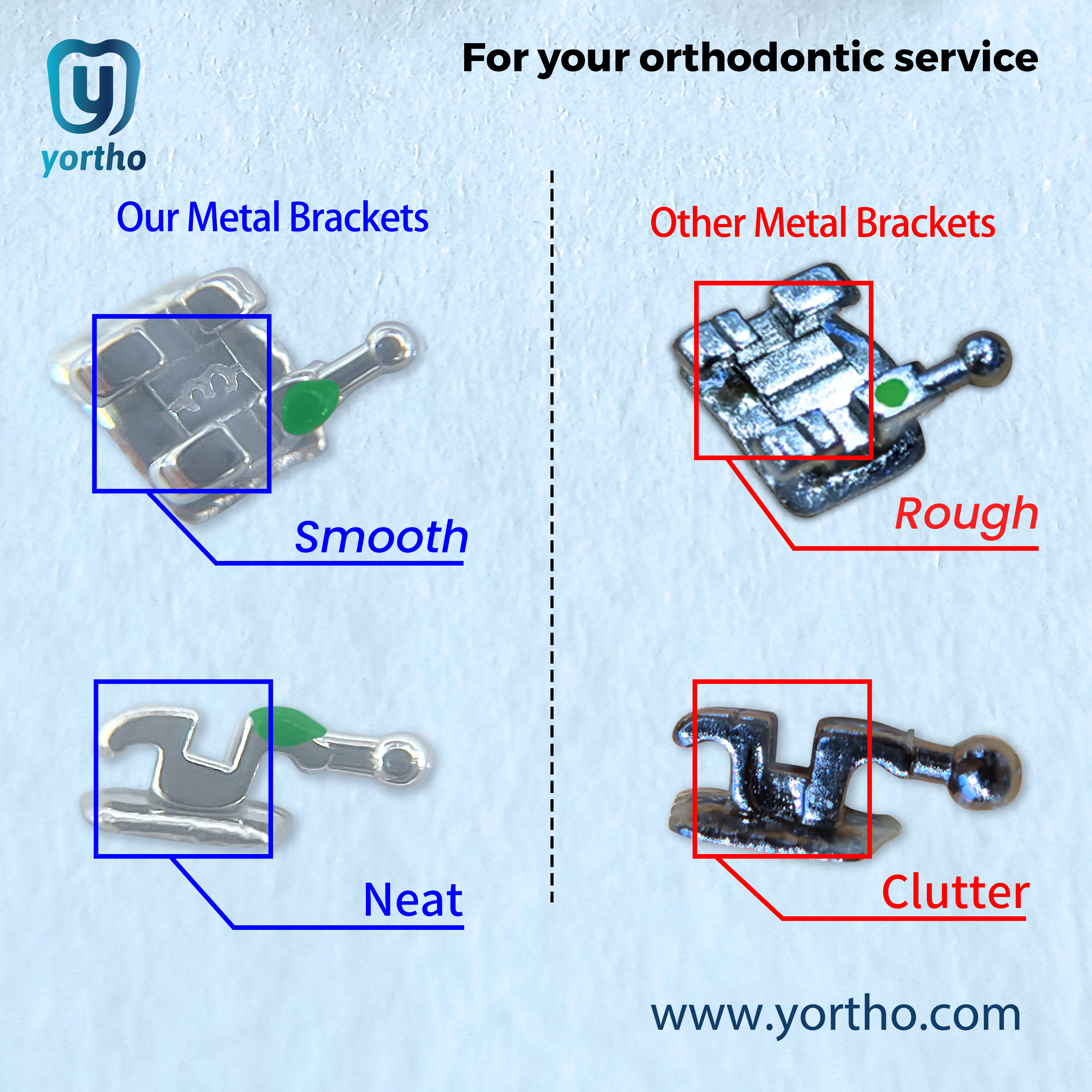
Surface finish and slot detail in the metal bracket family matter more once the archwire is machine-generated to a planned geometry.
Posterior segments do not disappear in a digital plan. Yortho's buccal tubes — Y-T1 Buccal Tube and Y-T2 Self-ligating Buccal Tube, stainless steel, Roth and MBT, low and high torque, slot 0.018 and 0.022 inch — carry several published design claims: a chamfered triangular mesial inlet to ease archwire insertion, a 20%–25% increase in effective tube length for torque control, a 15% slimmer body, and a 30% reduction in insertion resistance. Those are the company's own comparison figures and should be read as such. The practical point for a digital workflow is narrower: the terminal segment must accept the generated archwire at the angle the plan expects, and that is a fit question answered by drawings, not by a feature list.
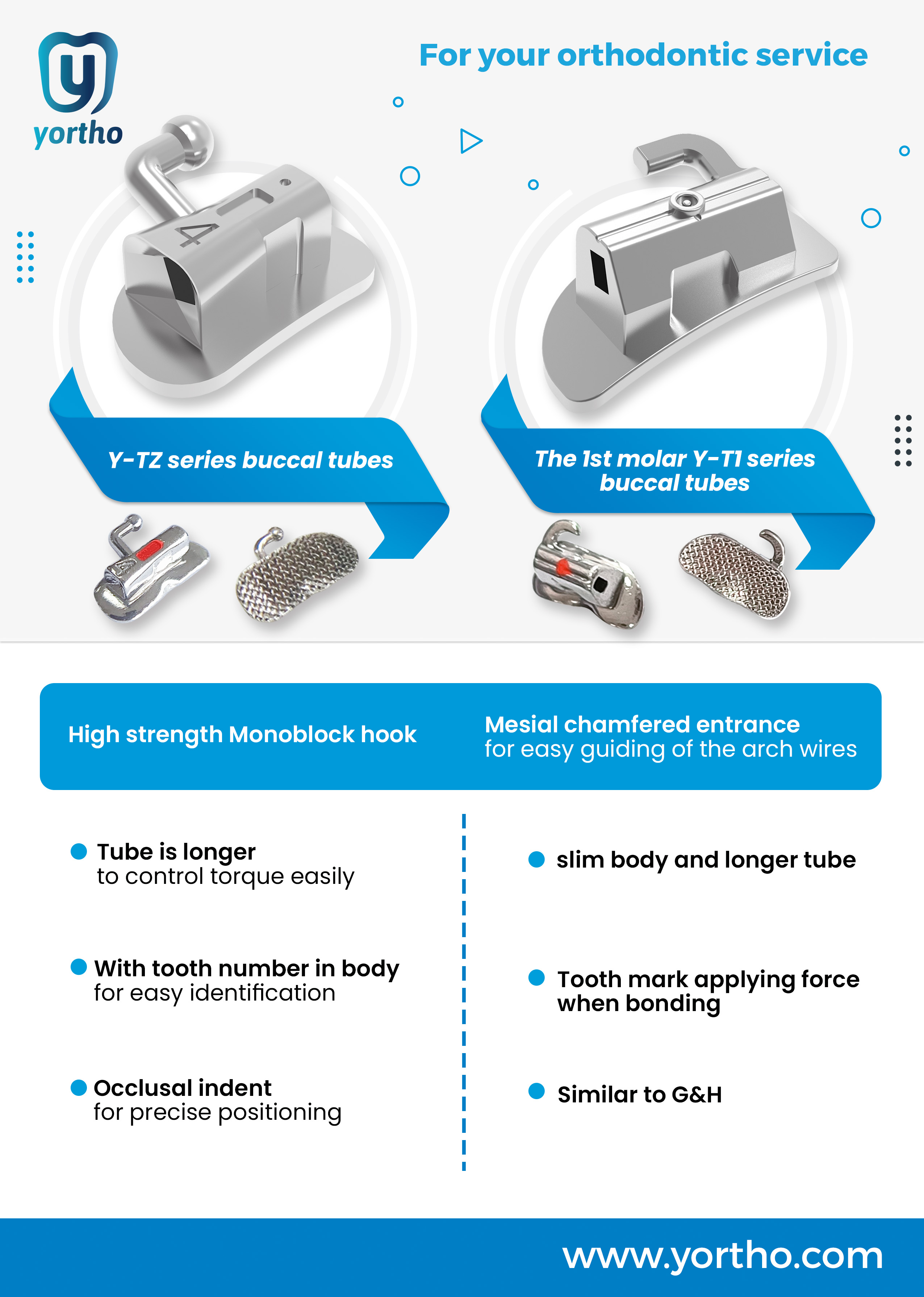
Buccal tubes sit at the end of the arch, where a planned archwire has the least tolerance for insertion resistance.
What is not documented. No mesiodistal width, occlusogingival height, slot depth, base contour, bond area or torque/angulation table appears in the material assessed here for either metal family. In this dataset, therefore, the word “mini” signals a product line rather than a verified dimension. A buyer who needs to know how much smaller a mini bracket is — and whether the reduced footprint still offers the bond area their bonding protocol assumes — has to request the dimensional drawing.
Clinical adaptation: match mechanics to the plan, not to the label
Adaptation is less about which bracket performs better and more about which bracket asks less of the workflow around it.
The conventional metal family keeps ligation choice open. That suits high-volume practices running several mechanics from one stock, and it suits cases where a steel tie is preferred at specific teeth. Yortho's comparison notes state that use of the metal bracket product may reduce diagnosis and treatment time and the number of consultations by 30% relative to alternatives, and that the family is offered at a cost described as 75% lower than ordinary metal brackets. Both figures are supplier-reported, and both should be validated against a clinic's own case mix before they enter a capacity or margin model.
The self-ligating mini family trades that flexibility for repeatability. Yortho attributes lower friction and higher efficiency to the cavity and edge finish, and cites customer feedback of a treatment period 15% to 20% shorter than competitor products, with a cost described as 50% lower than alternatives. Those are directional claims from the manufacturer, not outcomes from a controlled comparison, and they are presented here as claims rather than findings.
Where the two overlap is the part that actually decides procurement: both deliver the same slot sizes and the same three prescription families, and both accept the same archwire range — Yortho lists stainless steel (Y-SS), super-elastic NiTi (Y-SN), heat-activated NiTi (Y-HN) and TMA wires across Square, Natural, Damon, Oval, Europa-I and Broad arch forms, in round and rectangular cross-sections from 0.012 to 0.020 inch, upper and lower. In other words, the wire the digital plan generates can be specified independently of the bracket family. That is a useful separation: it means the bracket decision can be made on mechanics and documentation, and the wire decision on force delivery.
Aesthetic and comfort trade-offs
Both metal families are visible. The aesthetic decision is usually settled at case acceptance rather than at procurement, and when aesthetics is the binding constraint the metal comparison is simply the wrong comparison. Yortho's ceramic option — Clear Orthodontic Brackets and Ceramic Self-ligating Brackets, model Y-C2 Mini Self-ligating Ceramic Bracket, Al₂O₃ body, slot 0.018 and 0.022 inch, Roth, MBT and Edge-wise, hooks with or without — belongs in that discussion. Ceramic self-ligating brackets have been gaining ground for aesthetic and friction-reduction reasons, a trend noted in 2024 market coverage by Fortune Business Insights.
Comfort arguments for a mini profile are intuitive but need discipline. A lower-profile bracket generally sits further from the soft tissue, which patients notice; equally, a smaller footprint generally reduces the bonded area and narrows the space available for ligation and auxiliaries. Neither effect can be quantified from the published material for these two families. The honest position is that mini is a design direction with a real trade-off, and the trade-off is settled by dimensions, not by the name.
Material sensitivity belongs in the same paragraph. Stainless steel remains the most widely used material for orthodontic arch wires and brackets globally, according to Grand View Research (2024), and nickel and chromium are the primary allergens of concern in metal brackets, per medical literature cited in Fortune Business Insights' 2024 market coverage. Both Yortho grades — 17-4 and 304 stainless steel — are stainless steels. Clinics serving nickel-sensitive patients should confirm composition documentation and any coating options with the supplier rather than assume.
What to verify before standardising
| Verification item | Why it matters in a digital workflow | Status in published data |
|---|---|---|
| Slot size and prescription | The interface between the bracket and any prescription-driven plan | Published: 0.018 and 0.022 inch; Roth, MBT, Edge-wise |
| Torque and angulation values by tooth | Determines whether the plan's built-in values can be reproduced | Not published; request in writing |
| Dimensional drawing | Defines what “mini” means and what bond footprint remains | Not published; request in writing |
| Digital library and indirect bonding | Whether the bracket exists in the planning set or suits a generated tray | Not stated in the assessed material |
| Batch consistency and lot traceability | A plan is only reproducible if geometry holds between batches | Not quantified; company describes integrated moulding and inspection |
| Certification documents | Market access; the EU pathway for brackets is CE marking under MDR 2017/745, the US pathway is Class II with 510(k) | ISO, CE (MDR) and FDA registration stated; verify scope per product |
| Comparative performance figures | Capacity and margin assumptions often rest on these numbers | Supplier-stated; validate on own cases |
| Commercial terms | Determines trial cost and replenishment rhythm | First order without MOQ; formal order USD 1,000 total; OEM 500 units, ODM 1,000 units; standard stock dispatched within 3 business days after payment confirmation; samples free except pliers and self-ligating brackets, freight at buyer cost |
Market context: why bracket tiers still set the volume base
The most useful thing an independent reference can say about orthodontic market sizing in 2026 is that the published numbers do not agree, and the reason is definitional rather than analytical.
Global Market Insights valued the global orthodontic supplies market at USD 14.8 billion in 2024. Grand View Research valued orthodontic consumables — a narrower scope — at USD 3.1 billion in 2024, projecting USD 4.3 billion by 2030. Polaris Market Research framed the orthodontics market at USD 7.65 billion in 2024 rising to USD 38.21 billion by 2034. The growth rates diverge just as widely: 20.1% for 2025–2034 from Global Market Insights, 5.5% for 2025–2030 from Grand View Research, and 17.88% for 2026–2034 from Fortune Business Insights. A procurement plan built on a single CAGR is built on a definition, not a forecast, and the difference between 5.5% and 20.1% is the difference between steady replacement demand and capacity scramble.
What the sources do agree on is structure. The brackets segment dominated orthodontic consumables revenue in 2024 (Grand View Research). The buccal braces segment is expected to hold 89.55% of market share by 2026 (Fortune Business Insights), which is a reminder that despite aligner growth the fixed appliance remains the volume carrier. Stainless steel remains the most widely used material for arch wires and brackets globally (Grand View Research). Orthodontic clinics and standalone practices represent over 50% of the end-user distribution channel (Grand View Research), which explains why supplier responsiveness to small and mid-size accounts matters commercially.
Geography adds a second layer. Asia-Pacific is identified as the fastest-growing market for orthodontic supplies (MarketsandMarkets), China's orthodontic supplies market was estimated at USD 713.25 million in 2024 (Market Research Future), and Chinese dental instrument exports are concentrated in Guangdong, Jiangsu and Zhejiang — the last being where Yortho's factory is located. For buyers, the implication is not that one region is preferable, but that documentation quality and lead-time reliability are becoming the differentiators between manufacturing clusters that otherwise quote similar prices.
The comparison, reduced to fit
| Criterion | Metal brackets (Y-M1 Mini Bracket) | Mini self-ligating (Y-M2 Mini Self-ligating Bracket) |
|---|---|---|
| Routine chair-side steps | Elastomeric or steel tie at each appointment | No routine elastomeric tie |
| Friction management | Depends on ligation tension and surface polish | Fixed closure; cavity and edge finish described as burr-free |
| Auxiliary flexibility | Spacious wings allow ligature rings on demand; no pre-mounted hooks | Depends on slot and undercut design; verify |
| Profile and comfort | Conventional metal profile | Mini designation; dimensions not published |
| Aesthetics | Visible; ceramic Y-C2 is the alternative in-catalogue | Visible |
| Digital workflow fit | Slot and prescription published; library status unconfirmed | Slot and prescription published; library status unconfirmed |
| Cost signal (supplier-stated) | Described as 75% lower than ordinary metal brackets | Described as 50% lower than alternatives |
| Typical fit | High-volume practices running several mechanics from one stock | Protocols that value repeatable closure and fewer routine steps |
Where this comparison stops
Independent does not mean exhaustive, and the limits are concrete.
No dimensional data is published for either metal family, so no statement about how much smaller the mini design is can be made from this material. All comparative percentages — 30% fewer consultations, 15%–20% shorter treatment, 50% and 75% cost differentials, 20%–25% longer effective tube length — originate with the manufacturer and are not third-party audited. No controlled clinical trial data for Yortho brackets appears in the assessed material. Compatibility with any named digital system, including SureSmile-type workflows, is treated here as an assumption for evaluation and not as an established claim; system-level validation is a buyer responsibility and belongs in writing. Ceramic brackets and clear aligners sit outside this comparison while remaining inside the buyer's decision. And regulatory status is market-specific: CE marking under MDR 2017/745 in the EU, Class II with 510(k) in the US, with ISO 13485:2016 as the quality-system basis that the FDA now recognises within its Quality Management System Regulation.
Future outlook
Three trends will shape how this comparison is written two years from now.
The first is documentation. Digital workflows, intraoral scanning and CAD/CAM are identified as critical technological trends for 2025 by Straits Research, and 3D printing is becoming standard for orthodontic models and aligner moulds. As planning moves into software, the bracket supplier that publishes dimensional drawings, torque tables and lot-level traceability will be easier to qualify than one that publishes only feature claims. That is a low-cost shift for manufacturers and a high-value one for buyers.
The second is regulatory convergence. ISO 13485:2016 is now explicitly recognised by the US FDA as the primary basis for its new Quality Management System Regulation, and the Medical Device Single Audit Program allows one audit to satisfy quality-system requirements across five major jurisdictions. Both raise the floor for export-oriented manufacturers and reduce the documentation burden on buyers who purchase across regions.
The third is segment mix. Ceramic self-ligating brackets continue to gain share on aesthetic and friction grounds, while metal keeps the volume base in paediatric and cost-sensitive segments and in markets where per-case economics dominate. The likeliest outcome is not substitution but stratification: aesthetics moving up-market, metal holding the base, and the buyer's real differentiator becoming the quality of the paperwork attached to either.
FAQ
What is the actual difference between Yortho metal brackets and Yortho mini brackets?
The documented difference is the ligation mechanism. Metal Orthodontic Brackets (Y-M1 Mini Bracket) are conventionally ligated metal brackets; Mini Orthodontic Brackets (Y-M2 Mini Self-ligating Bracket) are self-ligating. Both are published with slot sizes of 0.018 and 0.022 inch, Roth, MBT and Edge-wise prescriptions, hooks with or without, and 17-4 and 304 stainless steel bodies. Dimensional values that would quantify the mini profile are not published and must be requested from the supplier.
Can either family be used inside a digital orthodontic workflow?
Both publish the attributes a prescription-driven plan depends on: slot size and prescription family. Neither is presented in the assessed material as validated for a specific third-party digital system, including SureSmile-type workflows. A clinic should confirm library-level or indirect-bonding compatibility in writing with the supplier before standardising.
Which prescriptions and slot sizes are available?
Both metal families are listed with 0.018 and 0.022 inch slot sizes, Roth, MBT and Edge-wise prescriptions, and hooks available with or without. The same slot options and prescriptions apply to the ceramic Y-C2 Mini Self-ligating Ceramic Bracket and to the Y-T1 and Y-T2 buccal tubes, which are additionally offered in low and high torque.
Are the brackets certified for export markets?
The company states ISO certification, CE certification under the EU MDR, and FDA registration, and reports exports to more than 70 countries. Certificates should be verified per product and per destination market, because bracket regulation differs by jurisdiction: CE marking under MDR 2017/745 in the EU, and Class II with 510(k) clearance in the United States.
What are the order terms and lead times?
According to the company's published answers, the first order carries no MOQ, the MOQ for a formal order is USD 1,000 in total value, and OEM customisation starts at 500 units while ODM starts at 1,000 units. Standard products held in stock can be packed and dispatched within 3 business days after payment confirmation. Samples are offered free of charge except for pliers and self-ligating brackets, with courier costs covered by the buyer.
What after-sales support is provided?
The company states that it provides after-sales service on all orders and guarantees product quality, and frames this as part of long-term cooperation. Buyers should confirm the specific remedy process — replacement, credit or return — in the purchase agreement rather than rely on a general statement.
How should a clinic decide between the two families?
Start with the workflow, not the bracket. If the plan references a specific prescription library, confirm library compatibility first. Then decide whether ligation flexibility or repeatable self-ligating closure matters more to the practice's mechanics, whether a reduced profile is clinically required, and whether the dimensional and torque data needed to answer those questions is actually available. Cost signals such as the stated 50% and 75% differentials should be applied only after those questions are answered.
Closing note
This comparison reduces to a verification list rather than a verdict. The two metal families differ in ligation mechanics and in the profile implied by the mini designation; they do not differ in the published slot, prescription or material data. The variable that actually separates them in a digital workflow is documentation — the dimensional drawing, the torque table, and the compatibility statement that a buyer can put in a file. Yortho's full product and capability overview is available in the company brochure, and specification requests can be directed to the supplier directly.
Brochure: Yortho product catalogue (PDF)
Contact: info@yortho.com · www.yortho.com
¿Tiene preguntas o necesita más detalles?
Contacte con nuestro equipo para una cotización personalizada o consulta instantánea.
Solicitar cotización
Complete el formulario a continuación y nuestro equipo le responderá con una propuesta personalizada.
Chat directo de WhatsApp
¿Prefiere chatear en tiempo real? Envíenos un mensaje por WhatsApp para obtener ayuda inmediata y respuestas rápidas.
- Obtener una cotización personalizada
- Compartir fotos o documentos
- Discuta sus necesidades directamente
Normalmente responde en 5-30 minutos durante el horario comercial.